
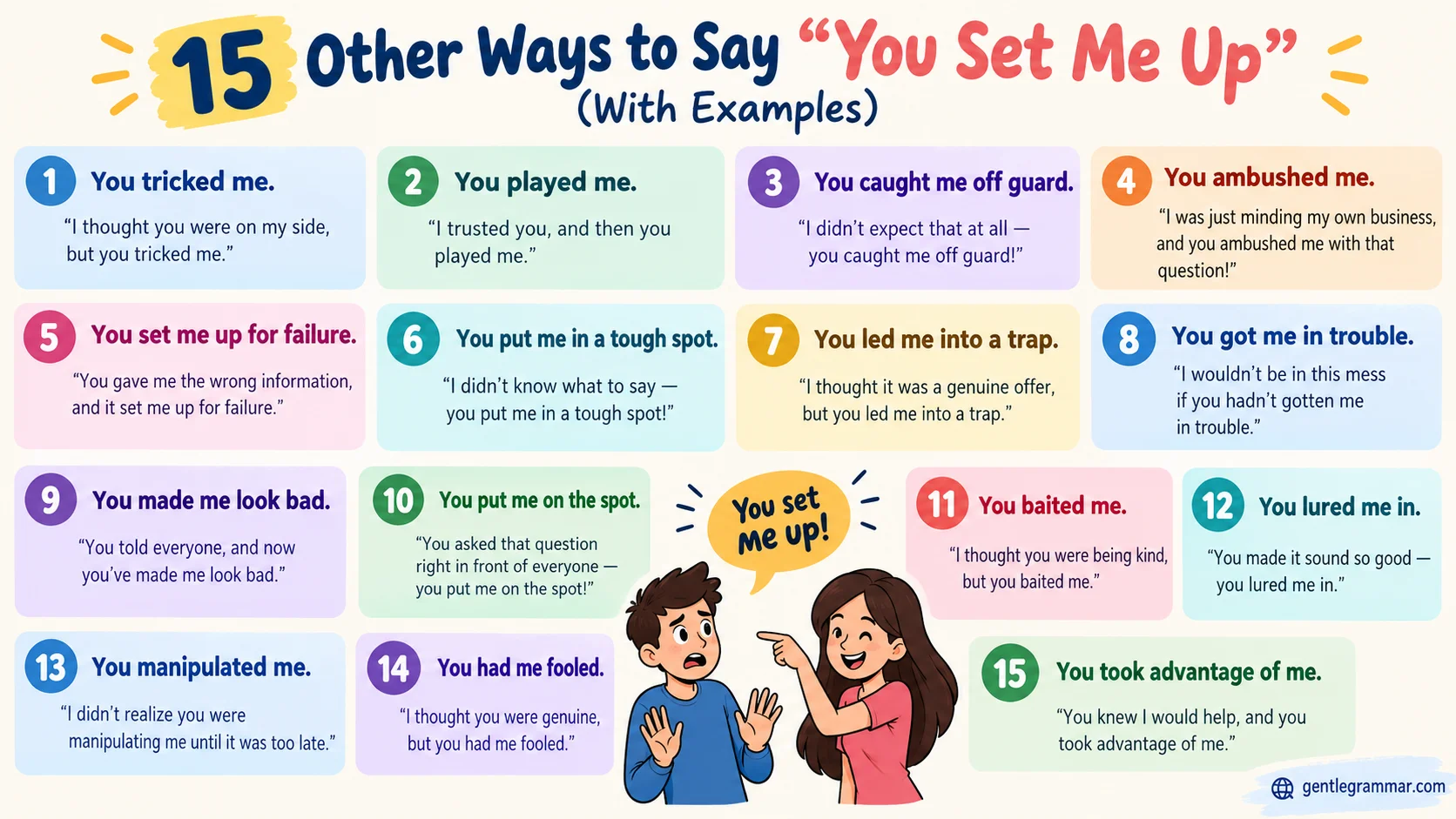
This guide to 15 Other Ways to Say “You Set Me Up” (With Examples) helps readers choose clearer words for everyday conversations, workplace emails, and sensitive situations.
Imagine a coworker who asks you to attend a meeting. When you arrive, you discover that the discussion concerns a mistake you were never told about. You might say, “You set me up!” In everyday English, this phrase can express the feeling that someone deliberately arranged a situation to deceive, trap, embarrass, blame, or put you at a disadvantage. However, its meaning depends heavily on context. Sometimes, “set me up” describes a practical trick, while in other situations, it may imply betrayal, manipulation, or deliberate deception.
Because the expression can sound emotionally charged, choosing an alternative can make your message clearer and more appropriate. For professionals, students, ESL learners, and content writers, understanding these distinctions is useful. For example, a workplace email may need a calmer expression, such as “You put me in a difficult position,” while a casual conversation might naturally use “You tricked me.” The right alternative communicates your intended meaning without creating unnecessary confusion or conflict.
What Does “You Set Me Up” Mean?
“You set me up” usually means that someone arranged a situation that caused you to be tricked, embarrassed, blamed, or placed at a disadvantage. The phrase often suggests that the other person acted deliberately, although the exact meaning depends on the context. For example, if a friend gives you incorrect information so that you embarrass yourself in front of others, you might say, “You set me up!” In a more serious situation, the phrase can mean that someone arranged circumstances to make you appear guilty of something you did not do. However, “set me up” has other meanings, too. It can describe someone arranging a date, introducing two people, or helping someone get started with a job or opportunity. In the context of this article, the focus is on the negative meaning: deception, unfair treatment, manipulation, or a planned disadvantage.
Common Situations Where “You Set Me Up” Is Used
People commonly use this expression in everyday conversations, text messages, friendships, relationships, and disagreements. A person might say it jokingly when friends play a prank on them or more seriously when they believe someone has intentionally misled them. At work, the phrase may come up when an employee feels that a colleague withheld important information or arranged circumstances that made them look incompetent. It can also appear in social media discussions or personal messages when someone wants to confront another person about a perceived betrayal. In school or other group settings, it may describe feeling deliberately embarrassed or unfairly blamed. Because the phrase can sound accusatory, people sometimes choose a more specific expression to explain exactly what happened without escalating the disagreement.
Is It Professional or Polite to Say “You Set Me Up”?
“You set me up” is direct, conversational, and potentially confrontational. Among close friends, it can be playful when everyone understands that the situation is a joke. In a serious disagreement, however, it implies that the other person may have acted intentionally, so it can sound like an accusation. In professional communication, the phrase is not necessarily inappropriate, but it may be too informal or emotionally charged for a workplace email, meeting, or formal complaint. A more measured expression, such as “I feel I was put in an unfair position,” allows you to describe the problem without immediately assuming the other person’s motives. When the evidence is clear that someone deliberately misled you, stronger wording may be justified. The key is to match your language to the evidence, relationship, and seriousness of the situation.
Advantages and Disadvantages of Saying “You Set Me Up”
Advantages
The phrase is short, clear, and emotionally expressive. It quickly communicates that you believe someone played a role in creating an unfavorable situation for you. In casual conversation, it can also be humorous, especially when friends knowingly arrange a harmless prank. Because the wording is familiar, most listeners can understand the basic message without needing a long explanation.
Disadvantages
The expression can sound accusatory because it suggests that the other person intentionally caused the problem. If the situation resulted from a misunderstanding or mistake, this wording may create unnecessary conflict. It also does not explain whether you were deceived, framed, embarrassed, or placed in a difficult position. In formal communication, a more precise expression can help you describe what happened and communicate your concerns more calmly.
Synonyms for “You Set Me Up”
- You tricked me
- You played me
- You deceived me
- You misled me
- You framed me
- You threw me under the bus
- You put me in a tough spot
- You backed me into a corner
- You led me into a trap
- You made me look bad
- You caught me off guard
- You manipulated the situation
- You set me up to fail
- You hung me out to dry
- That was a setup
1. You tricked me
Meaning
“You tricked me” means someone made you believe something that was not true or fooled you into doing something. It is a straightforward alternative when you feel someone deliberately misled you.
Definition
To trick someone means to deceive them through a false impression, statement, or action.
Detailed Explanation
This expression is useful when someone uses a prank, lie, or clever plan to fool you. It is usually less serious than accusing someone of framing you for a crime, but it still expresses disappointment or annoyance. Unlike “You set me up,” it focuses directly on the act of fooling you rather than arranging an entire situation against you. Depending on your relationship, it can sound playful or genuinely upset.
Scenario Examples
– Scenario: Your friend tells you that a surprise party is canceled, even though it is still happening.
Example: “You tricked me! I really thought nobody was coming.”
– Scenario: A colleague gives you incorrect instructions as a prank.
Example: “You tricked me into preparing the wrong presentation.”
– Scenario: Your sibling hides your phone and pretends not to know where it is.
Example: “I can’t believe you tricked me like that.”
Best Use
Use this phrase in casual conversations, friendly disagreements, and situations involving clear deception. It also works when you want to explain what happened without using more serious language.
Tone
Tone: Direct, casual, and sometimes playful.
The tone depends on the situation. A smile can make it sound humorous, while a serious delivery can communicate genuine frustration.
2. You played me
Meaning
“You played me” means someone fooled you, manipulated your trust, or took advantage of your feelings or expectations.
Definition
To play someone means to mislead or manipulate them for personal advantage, often in an emotional or social situation.
Detailed Explanation
This expression is especially common in informal conversations about friendships, dating, and trust. It often suggests that the other person understood your feelings or expectations and used them against you. Compared with “You tricked me,” it can carry a stronger sense of emotional betrayal. However, it does not necessarily mean the person arranged a deliberate trap, so it is best when the focus is on manipulation or dishonesty rather than a carefully planned scheme.
Scenario Examples
– Scenario: Someone you are dating promises commitment but secretly pursues another relationship.
Example: “I trusted you, but you played me the whole time.”
– Scenario: A friend pretends to support your idea to gain something from you.
Example: “You played me just to get what you wanted.”
– Scenario: Someone makes you believe a deal is fair while hiding important details.
Example: “I feel like you played me with that agreement.”
Best Use
Use it in informal conversations, relationship discussions, and situations involving broken trust. Avoid it in formal reports or workplace emails unless the conversational tone is appropriate.
Tone
Tone: Emotional, informal, and accusatory.
This phrase often conveys hurt or betrayal more strongly than a neutral description of being misled.
3. You deceived me
Meaning
“You deceived me” means someone intentionally made you believe something false. It emphasizes dishonesty rather than simply creating an awkward situation.
Definition
To deceive someone means to deliberately cause them to believe something untrue.
Detailed Explanation
This expression is suitable when you want to emphasize the seriousness of someone’s dishonesty. It sounds more formal and deliberate than “You tricked me,” making it useful for explaining a breach of trust. Unlike “You set me up,” it does not necessarily suggest that the person arranged events to make you fail or look guilty. It focuses on the false information or dishonest behavior itself. Use it when you have a reasonable basis for believing that the person knowingly misrepresented the truth.
Scenario Examples
– Scenario: A business partner hides important information about an agreement.
Example: “You deceived me by leaving out those conditions.”
– Scenario: A friend lies about why they missed an important event.
Example: “I feel hurt because you deceived me about what happened.”
– Scenario: Someone gives you false information to influence your decision.
Example: “You deceived me into making a choice I would not otherwise have made.”
Best Use
This phrase works well in serious personal conversations, formal complaints, and discussions about honesty or trust. In professional writing, describe the specific misleading statement or action when possible.
Tone
Tone: Serious, firm, and somewhat formal.
Its wording places strong emphasis on dishonesty, so it may sound severe during an ordinary disagreement.
4. You misled me
Meaning
“You misled me” means someone gave you an incorrect impression or information that caused you to misunderstand a situation.
Definition
To mislead someone means to guide them toward a mistaken understanding, intentionally or otherwise.
Detailed Explanation
This is a useful alternative when you believe another person gave you the wrong impression. It can describe deliberate dishonesty, but it can also fit situations where someone communicated poorly or left out essential details. That makes it less emotionally charged than “You played me” or “You framed me.” The phrase focuses on the effect of the information rather than automatically claiming that the other person planned everything against you. In a workplace discussion, it can help you raise a concern without making your accusation more serious than the available evidence supports.
Scenario Examples
– Scenario: A manager describes a project as almost finished when substantial work remains.
Example: “I feel you misled me about how much work was left.”
– Scenario: A friend recommends an event but fails to mention an important restriction.
Example: “You misled me about the entry requirements.”
– Scenario: A seller describes a product inaccurately.
Example: “Your description misled me about what I was buying.”
Best Use
Choose this phrase for workplace discussions, customer communication, serious conversations, and situations involving incorrect information.
Tone
Tone: Calm, direct, and professional when delivered respectfully.
It identifies a problem clearly without necessarily implying a malicious plan.
5. You framed me
Meaning
“You framed me” means someone deliberately made it appear that you were responsible for something wrong that you did not do.
Definition
To frame someone means to falsely make them appear guilty or responsible for wrongdoing.
Detailed Explanation
This is one of the strongest alternatives because it suggests a serious form of deception. It is appropriate when someone planted evidence, fabricated a story, or deliberately shifted blame onto you for an offense. It is not an accurate substitute for every situation in which you feel tricked or embarrassed. For example, a friend playing a harmless prank has not necessarily framed you. Use this expression when the central issue is false blame or fabricated guilt, rather than ordinary manipulation or a difficult social situation.
Scenario Examples
– Scenario: A coworker falsely claims you approved a decision you never authorized.
Example: “You framed me as the person responsible for that decision.”
– Scenario: Someone makes it appear that you took missing money.
Example: “I believe someone framed me for the missing cash.”
– Scenario: A character in a crime story is blamed for an offense committed by another person.
Example: “The detective realized that someone had framed him.”
Best Use
Use it in serious accusations, discussions of false blame, legal-related narratives, and fictional storytelling. Be careful when using it in real disputes because it makes a substantial accusation.
Tone
Tone: Strong, serious, and accusatory.
The expression implies deliberate wrongdoing and is much stronger than saying someone misled you.
6. You threw me under the bus
Meaning
“You threw me under the bus” means someone sacrificed your reputation, interests, or position to protect themselves or gain an advantage.
Definition
To throw someone under the bus means to blame, expose, or abandon them for personal benefit.
Detailed Explanation
This idiom is especially useful when someone who should have supported you instead shifts responsibility onto you. It often occurs in workplace conflicts, group projects, and friendships where loyalty matters. Unlike “You set me up,” it does not always mean the person planned the problem from the beginning. The emphasis is on how they treated you when trouble arose. It is particularly effective when someone protects themselves by making you appear responsible for a shared mistake.
Scenario Examples
– Scenario: A team member blames you for a project delay caused by the whole group.
Example: “You threw me under the bus during the meeting instead of explaining what happened.”
– Scenario: A friend reveals your private mistake to avoid criticism.
Example: “I thought you had my back, but you threw me under the bus.”
– Scenario: A manager denies involvement in a decision they previously supported.
Example: “He threw me under the bus when senior management started asking questions.”
Best Use
This expression fits workplace disagreements, group responsibilities, friendships, and situations involving betrayal or blame-shifting. It is informal, so a more neutral phrase may work better in official correspondence.
Tone
Tone: Frustrated, disappointed, and informal.
It communicates a sense of betrayal, especially when you expected the other person to stand by you.
7. You put me in a tough spot
Meaning
“You put me in a tough spot” means someone placed you in a difficult situation where your choices were limited or uncomfortable.
Definition
To put someone in a tough spot means to create a challenging or awkward situation for them.
Detailed Explanation
This phrase is a good choice when you want to explain the consequences of someone’s actions without claiming that they deliberately deceived you. It may describe a last-minute request, an unexpected responsibility, or a situation where you must choose between two uncomfortable options. Compared with “You set me up,” it is softer and more focused on the difficulty you experienced. It does not automatically imply dishonesty, so it is useful when the other person’s intentions are unclear or the problem arose unintentionally.
Scenario Examples
– Scenario: A friend asks you to keep a secret that conflicts with another promise you made.
Example: “You put me in a tough spot by asking me to hide that from her.”
– Scenario: A colleague gives you an urgent task just before a deadline.
Example: “You put me in a tough spot by waiting until the last minute to tell me.”
– Scenario: Your family expects you to attend two important events at the same time.
Example: “You’ve put me in a tough spot because I don’t want to disappoint either side.”
Best Use
Use it in everyday conversation, workplace communication, family discussions, and polite expressions of frustration. It is especially helpful when you want to address the impact of someone’s actions without making assumptions about their motives.
Tone
Tone: Diplomatic, conversational, and mildly frustrated.
It communicates discomfort while leaving room for a reasonable discussion about what happened.
8. You backed me into a corner
Meaning
“You backed me into a corner” means someone pressured you into a situation where you felt you had very few acceptable choices.
Definition
To back someone into a corner means to leave them with limited options through pressure or difficult circumstances.
Detailed Explanation
This expression highlights the pressure you experienced rather than simply the fact that someone fooled you. It often suggests that the other person pushed you toward a decision or response you did not want to make. Compared with “You set me up,” it focuses more on feeling trapped than on being deceived. The phrase can describe a deliberate attempt to force your hand, but it can also describe circumstances that developed through a disagreement. It is particularly useful when explaining why you felt unable to respond freely.
Scenario Examples
– Scenario: Your manager demands an immediate answer before you have enough information.
Example: “You backed me into a corner by asking me to approve the proposal without giving me time to review it.”
– Scenario: A friend insists that you choose sides in an argument.
Example: “You backed me into a corner when you asked me to choose between you and my other friends.”
– Scenario: Someone keeps pressuring you to accept an unwanted offer.
Example: “I felt you backed me into a corner instead of letting me decide for myself.”
Best Use
Use this phrase in personal disagreements, negotiations, workplace discussions, and situations involving pressure or limited choices.
Tone
Tone: Firm, frustrated, and direct.
It communicates that another person restricted your freedom to choose, whether intentionally or through persistent pressure.
9. You led me into a trap
Meaning
“You led me into a trap” means someone guided you toward a situation that was designed to cause trouble for you.
Definition
To lead someone into a trap means to direct them into a situation where they are likely to be deceived, caught, or disadvantaged.
Detailed Explanation
This phrase suggests more planning than simply giving someone incorrect information. It implies that the person guided you toward an outcome that benefited them or harmed you. Unlike “You put me in a tough spot,” it carries a stronger suggestion of deliberate deception. It can be used in real-life disagreements when you believe someone concealed a risk, but it also works naturally in mystery stories, action scenes, and fictional dialogue. Use it when the idea of a planned trap is central to what happened.
Scenario Examples
– Scenario: Someone invites you to a meeting without telling you that several people intend to confront you.
Example: “You led me into a trap by telling me the meeting was just a friendly discussion.”
– Scenario: A rival encourages you to reveal confidential information.
Example: “I realized too late that you had led me into a trap.”
– Scenario: A character follows a false clue into a dangerous location.
Example: “The warning was fake, and someone had led me into a trap.”
Best Use
This expression works best in serious confrontations, discussions about deception, suspenseful storytelling, and situations involving a suspected plan.
Tone
Tone: Suspicious, dramatic, and accusatory.
It suggests that the other person deliberately guided you toward trouble, so it is stronger than a simple complaint about being misinformed.
10. You made me look bad
Meaning
“You made me look bad” means someone’s words or actions caused others to form a negative impression of you.
Definition
To make someone look bad means to damage their image, reputation, or standing in the eyes of others.
Detailed Explanation
This expression is appropriate when the main problem is embarrassment or harm to your reputation. Someone might reveal private information, make an unfair comment, or present a situation in a way that reflects poorly on you. Unlike “You framed me,” it does not necessarily suggest that anyone falsely accused you of wrongdoing. It simply describes the negative impression created. If you want to explain how another person’s behavior affected your credibility without making a broader accusation, this wording can be a useful choice.
Scenario Examples
– Scenario: A coworker criticizes your work in front of a client without explaining the full situation.
Example: “You made me look bad in front of the client when you blamed me for the delay.”
– Scenario: A friend shares an embarrassing story about you at a gathering.
Example: “You made me look bad by bringing that up in front of everyone.”
– Scenario: A group member presents your shared work as if you contributed nothing.
Example: “You made me look bad by leaving my contribution out of the presentation.”
Best Use
Use it in friendships, workplace discussions, group projects, and situations involving public embarrassment or reputation.
Tone
Tone: Direct, personal, and disappointed.
It highlights the effect on your image without necessarily claiming that the other person intended to harm you.
11. You caught me off guard
Meaning
“You caught me off guard” means someone surprised you when you were not prepared for what happened.
Definition
To catch someone off guard means to surprise them when they are unprepared or not expecting something.
Detailed Explanation
This expression is useful when an unexpected question, action, or event leaves you without a ready response. It is much softer than “You set me up” because it does not imply deception or bad intentions. Someone might catch you off guard accidentally or deliberately, and the phrase alone does not establish which occurred. It is particularly suitable when you want to acknowledge that you were surprised without accusing anyone of planning against you. If you suspect a deliberate trick, you may need to explain that separately.
Scenario Examples
– Scenario: Your supervisor unexpectedly asks you to explain a decision during a meeting.
Example: “Your question caught me off guard because I hadn’t reviewed those figures yet.”
– Scenario: A friend suddenly asks you about a sensitive personal issue.
Example: “You caught me off guard with that question. Can we talk about it later?”
– Scenario: Someone surprises you with an unexpected announcement.
Example: “That announcement caught me off guard, but I understand now.”
Best Use
Choose this phrase for everyday conversation, meetings, personal messages, and situations involving unexpected questions or events.
Tone
Tone: Neutral, conversational, and sometimes mildly defensive.
It explains your lack of preparation without automatically assigning blame.
12. You manipulated the situation
Meaning
“You manipulated the situation” means someone influenced events or information in a way that unfairly benefited them or disadvantaged you.
Definition
To manipulate a situation means to control or influence circumstances strategically, often for an unfair purpose.
Detailed Explanation
This expression emphasizes how someone arranged or influenced events rather than simply stating that you were fooled. It may describe selective information, hidden motives, or calculated actions intended to influence the outcome. Compared with “You tricked me,” it suggests a broader pattern of control rather than one isolated deception. However, manipulation implies questionable or unfair influence, so the wording should reflect the evidence you have. In a serious disagreement, explaining the specific action can make your concern clearer and more credible.
Scenario Examples
– Scenario: A colleague shares only part of a conversation to make you appear responsible for a mistake.
Example: “You manipulated the situation by leaving out what happened before that decision.”
– Scenario: A friend pressures several people to support their version of an argument.
Example: “I think you manipulated the situation so everyone would take your side.”
– Scenario: Someone changes the conditions of an agreement after you have committed to it.
Example: “You manipulated the situation instead of discussing the changes honestly.”
Best Use
Use it in serious personal discussions, workplace disagreements, and situations involving suspected unfair influence. For formal complaints, describe the actions and their consequences rather than relying only on the label.
Tone
Tone: Serious, analytical, and accusatory.
It suggests intentional influence and can sound forceful when used during a conflict.
13. You set me up to fail
Meaning
“You set me up to fail” means someone placed you in circumstances where success was difficult or impossible, possibly by withholding support, information, or resources.
Definition
To set someone up to fail means to create conditions that make their failure likely or prevent them from succeeding.
Detailed Explanation
This is one of the closest alternatives when the original phrase concerns a planned disadvantage. It is particularly useful in workplaces, schools, and group projects where someone may assign an unrealistic task or withhold essential information. Unlike “You caught me off guard,” it suggests that the circumstances made failure more likely, not merely that you were surprised. It can imply deliberate sabotage, although poor planning or inadequate support may also create similar conditions. The surrounding details help clarify whether you are accusing someone of intentional interference.
Scenario Examples
– Scenario: Your manager gives you a major assignment without the necessary resources or deadline flexibility.
Example: “You set me up to fail by giving me an impossible deadline without the required support.”
– Scenario: A group member withholds important instructions until the last minute.
Example: “You set me up to fail when you kept the updated requirements from me.”
– Scenario: A student is expected to complete a project without receiving the information needed to finish it.
Example: “I feel like I was set up to fail because nobody explained the grading criteria.”
Best Use
Use this expression in workplace conflicts, academic situations, project discussions, and conversations about unfair expectations.
Tone
Tone: Firm, serious, and frustrated.
It focuses on the conditions that prevented success and often implies that someone should be held responsible for creating them.
14. You hung me out to dry
Meaning
“You hung me out to dry” means someone abandoned you or left you to face criticism, blame, or trouble without the support you expected.
Definition
To hang someone out to dry means to leave them exposed to difficulties or criticism without providing help or protection.
Detailed Explanation
This informal idiom is especially useful when someone promised support but failed to stand by you when a problem arose. It can describe a colleague refusing to defend you, a friend abandoning you during a disagreement, or a manager leaving you to handle a difficult situation alone. Unlike “You set me up,” it does not necessarily suggest that the other person arranged the problem in advance. The central idea is abandonment when support was needed. It may imply betrayal, particularly when you reasonably expected the person to help.
Scenario Examples
– Scenario: Your colleague refuses to explain their part in a mistake during a meeting.
Example: “You hung me out to dry by letting everyone believe the mistake was entirely mine.”
– Scenario: A friend disappears when others begin criticizing you over a misunderstanding.
Example: “I thought you would stand up for me, but you hung me out to dry.”
– Scenario: A manager leaves you to handle an angry customer without the promised assistance.
Example: “You hung me out to dry when you left me to deal with the complaint alone.”
Best Use
Use it in informal workplace conversations, friendships, and situations where someone fails to provide expected support. For a formal email, explain that you were left to handle the problem without assistance.
Tone
Tone: Hurt, frustrated, and informal.
It conveys disappointment in someone who failed to support you when it mattered.
15. That was a setup
Meaning
“That was a setup” means a situation appears to have been deliberately arranged to deceive, embarrass, trap, or disadvantage someone.
Definition
A setup is an arranged situation intended to produce a particular outcome, often an unfair or embarrassing one.
Detailed Explanation
Unlike the other alternatives, this expression describes the situation rather than directly accusing a particular person. It is useful when you suspect that an event was planned but want to comment on the circumstances themselves. For example, a meeting might feel like a setup if several people arrive with accusations you were never given a chance to address. The phrase can also describe a harmless prank or surprise, depending on context. If you want to identify who was responsible, you may need to explain that separately.
Scenario Examples
– Scenario: Your friends invite you somewhere and arrange a harmless prank.
Example: “That was a setup! You all knew what was going to happen.”
– Scenario: You arrive at a meeting and discover that it has been arranged to confront you about an issue.
Example: “Honestly, that felt like a setup because nobody told me what the meeting was about.”
– Scenario: Someone creates circumstances that make you appear responsible for a mistake.
Example: “The more I look at the evidence, the more I think that was a setup.”
Best Use
This phrase works in casual conversations, serious disagreements, storytelling, and situations where you suspect a planned event or trap.
Tone
Tone: Suspicious, direct, and context-dependent.
It can sound playful when describing a prank or serious when suggesting that someone deliberately arranged an unfair situation.
FAQs:
What is another way to say “You set me up”?
Good alternatives include “You tricked me,” “You misled me,” “You put me in a tough spot,” and “You set me up to fail.” Choose the phrase that best describes what happened. Use “You tricked me” for deception, “You put me in a tough spot” for a difficult situation, and “You set me up to fail” when someone created conditions that made success unlikely.
What does “You set me up” mean?
It usually means that someone deliberately arranged a situation that caused you to be deceived, embarrassed, blamed, or placed at a disadvantage. The expression can also have positive meanings in other contexts, such as arranging a date or helping someone get started with an opportunity. The surrounding conversation determines the intended meaning.
Is “You set me up” professional?
It is understandable in professional English, but it can sound accusatory and informal, especially during a disagreement. In a workplace email, a more measured phrase such as “I feel I was put in an unfair position” may communicate the concern more constructively. If deliberate deception is involved, explain the specific actions that led to your concern.
What is a more polite way to say “You set me up”?
A more diplomatic option is “I feel I was put in a difficult position.” You could also say, “I wasn’t given the information I needed to handle the situation properly.” These expressions explain the problem without immediately accusing the other person of deliberately trying to harm you.
Which alternative works best in formal communication?
“You misled me” may work when the issue involves inaccurate information, while “I was placed in an unfair position” can be more measured when discussing difficult circumstances. For false accusations, describe the evidence and explain why you believe responsibility was wrongly assigned. The best wording depends on what happened and how confidently you can establish the facts.
Conclusion:
Choosing the right alternative to “You set me up” helps you communicate what happened more accurately. If someone fooled you, “You tricked me” is straightforward. If they falsely blamed you, “You framed me” expresses a much more serious accusation. When the problem involves pressure, embarrassment, or a lack of support, phrases such as “You put me in a tough spot” or “You hung me out to dry” may better capture your experience.
Remember that similar expressions do not always carry the same meaning. Some suggest deliberate deception, while others describe an unexpected problem or a failure to provide support. Before choosing your wording, consider the evidence, your relationship with the other person, and the tone you want to convey. Clear, specific language helps you express frustration without making an unfair accusation.
