
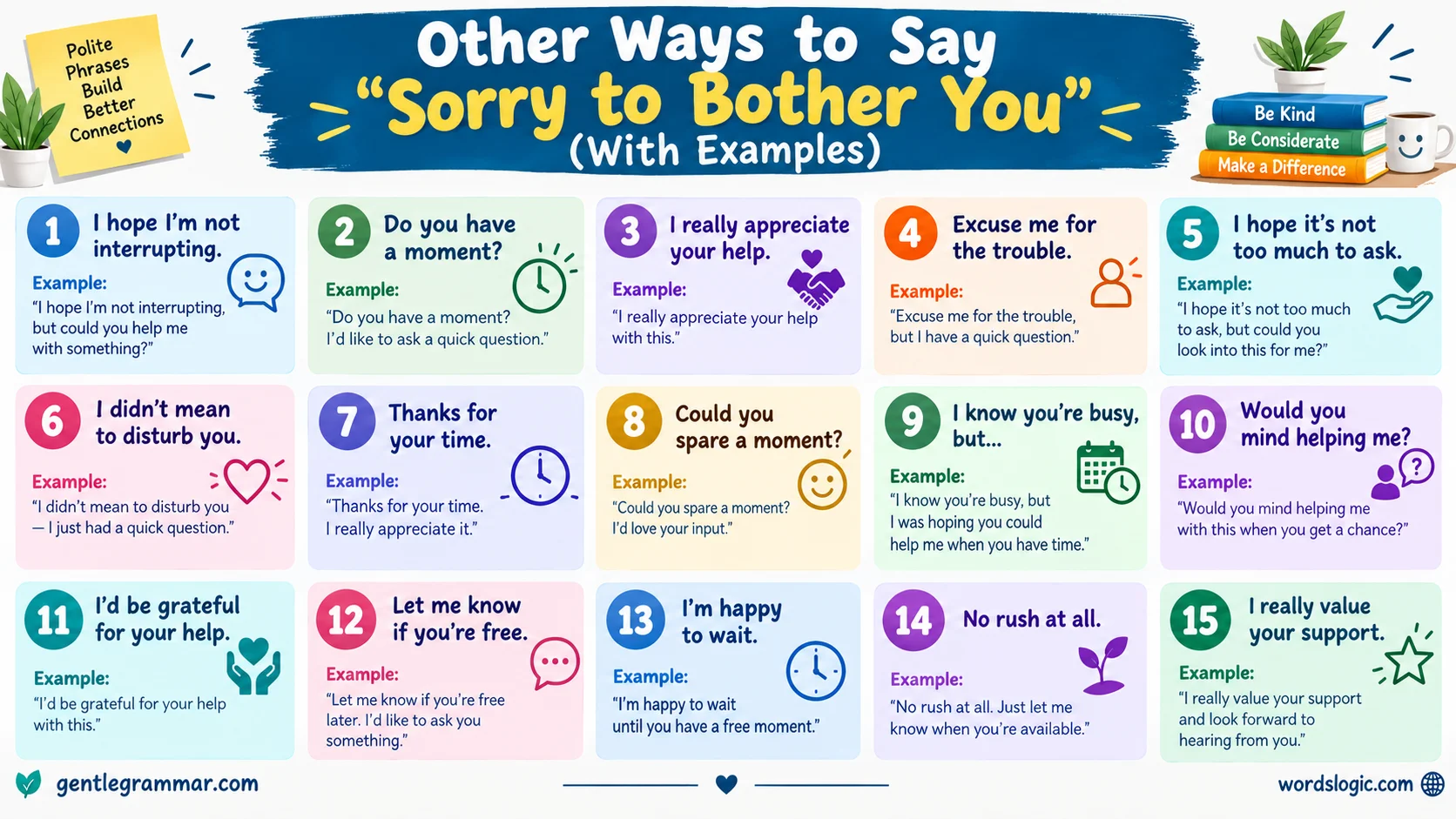
15 Other Ways to Say “Sorry to Bother You” (With Examples) can help you choose better words for everyday conversations.
The commonly used phrase “sorry to bother you” is often perfectly polite, but repeating it in every email, text, or conversation can make you sound overly apologetic. The right alternative depends on the context, situation, purpose, and intention behind your request. In professional communication and everyday conversations, the right wording can make a small request feel more comfortable, natural, and respectful.
Whether you are interrupting a colleague, contacting a supervisor, asking a teacher for help, messaging a friend, or following up with a client, consider your recipient, audience, and relationship before choosing your words. English offers plenty of natural options, from friendly expressions for casual conversations to professional expressions for work emails, professional messages, and business correspondence. A suitable polite phrase helps you express politeness, courtesy, respect, and consideration without creating unnecessary hesitation, sounding uncertain, or making the other person feel pressured.
What Does “Sorry to Bother You” Mean?
“Sorry to Bother You” is a polite expression used when you want to get someone’s attention, ask for help, interrupt them, or make a request that might take up their time. It shows that you recognize the other person may be busy and want to approach them respectfully. For example, you might say, “Sorry to bother you, but could you help me with this report?” The phrase does not necessarily mean you have done anything wrong. Instead, it often communicates consideration, courtesy, and awareness of someone else’s time.
Depending on the situation, the expression can sound friendly, professional, hesitant, or overly apologetic. When contacting a close friend, it may be unnecessary to apologize at all. In a workplace email, however, it can soften a request, especially when you are interrupting someone or asking for an unexpected favor. Alternatives such as “Do you have a moment?” or “I appreciate your time” can communicate the same consideration with a more confident or specific tone.
Common Situations Where “Sorry to Bother You” Is Used
People use this expression in many everyday and professional situations when they want to approach someone politely.
- Workplace communication: You might use it when asking a colleague a question, requesting assistance from a manager, or interrupting someone during a busy day.
- Emails and text messages: It can introduce a request, a follow-up, or a reminder without sounding too demanding.
- School and education: Students may use it when contacting teachers, classmates, or academic advisers for help.
- Personal relationships: Friends and family members might say it when asking for a favor or reaching out at an inconvenient time.
- Customer communication: A customer service representative may use similar wording when interrupting a customer or requesting additional information.
- Unexpected requests: The expression can acknowledge that a message or question was not planned or may require the recipient’s attention.
People often look for alternatives because they want to sound polite without being overly apologetic. The best replacement depends on whether you are interrupting someone, asking for assistance, following up, or simply starting a conversation.
Is It Professional or Polite to Say “Sorry to Bother You”?
Yes, “Sorry to Bother You” is generally polite and can be professional when used in the right context. It acknowledges the other person’s time and can make an unexpected request feel less abrupt. For example, “Sorry to bother you, but could you clarify the deadline?” is appropriate when contacting a busy colleague.
However, the phrase can sometimes sound unnecessarily apologetic, especially when you are making a routine request that is part of your job. In those situations, “Could I ask you a quick question?” or “When you have a moment, could you review this?” may sound more confident and equally respectful. In formal emails, expressions such as “I would appreciate your assistance” may fit better, while casual messages often work well with “Do you have a minute?” The goal is to show consideration without making a reasonable request seem like an inconvenience.
Advantages and Disadvantages of Saying “Sorry to Bother You”
Advantages
The main advantage of this expression is its polite and considerate tone. It can soften an interruption, acknowledge another person’s workload, and make a request feel less demanding. It is also widely understood, so readers rarely need additional explanation. In unfamiliar or formal situations, it can be a useful way to begin a conversation respectfully.
Disadvantages
The phrase can sometimes make the speaker sound overly apologetic or uncertain, particularly when the request is routine or entirely reasonable. Repeatedly using it in workplace emails may also make messages feel less direct. Additionally, it does not explain exactly what you need, so the recipient may still have to read the rest of your message to understand the request. More specific alternatives can communicate your intention clearly while preserving a polite tone.
Synonyms for “Sorry to Bother You”
- Excuse Me
- Do You Have a Moment?
- Could I Ask You a Quick Question?
- When You Have a Moment
- I Hope I’m Not Interrupting
- Pardon the Interruption
- May I Trouble You for a Moment?
- I Hate to Interrupt
- I Don’t Mean to Disturb You
- Could You Spare a Few Minutes?
- I Appreciate Your Time
- Thank You for Your Attention
- I Hope I’m Not Catching You at a Bad Time
- Sorry for the Interruption
- If It’s Not Too Much Trouble
1. Excuse Me
Meaning
“Excuse Me” is a polite way to get someone’s attention, interrupt briefly, or ask for permission to speak. It can replace “Sorry to Bother You” when you need to approach someone directly.
Definition
A courteous expression used to gain attention or interrupt someone respectfully.
Detailed Explanation
“Excuse me” is usually shorter and more direct than the original phrase. It does not necessarily express an apology; instead, it signals that you would like the other person’s attention. The expression works in both formal and casual settings, depending on your tone of voice. It is especially useful when you need to speak to someone without suggesting that your request is a serious inconvenience.
Scenario Examples
Scenario 1: Asking a colleague for help.
Example: “Excuse me, could you show me where the latest report is saved?”
Scenario 2: Getting someone’s attention in a public place.
Example: “Excuse me, is this seat available?”
Scenario 3: Asking a teacher a question.
Example: “Excuse me, could you explain that last point again?”
Best Use
Use this expression when approaching someone, asking a brief question, or politely interrupting a conversation. It works well in person and in short written messages.
Tone
Tone: Polite, direct, neutral.
It acknowledges the other person without requiring a lengthy apology.
2. Do You Have a Moment?
Meaning
“Do You Have a Moment?” asks whether someone has a little time available to talk or help. It is a considerate alternative when you want to check the person’s availability before making a request.
Definition
A polite question asking whether someone is available for a brief conversation.
Detailed Explanation
Unlike the original expression, this phrase focuses on the recipient’s availability rather than apologizing for contacting them. It gives the other person an opportunity to say they are busy. The wording is natural in offices, classrooms, and personal conversations. Although it suggests a short interaction, you should avoid using it if you know the discussion will take considerable time.
Scenario Examples
Scenario 1: Speaking to your manager.
Example: “Do you have a moment to discuss the revised schedule?”
Scenario 2: Messaging a friend.
Example: “Hey, do you have a moment? I’d love to get your opinion on something.”
Scenario 3: Contacting a teacher.
Example: “Do you have a moment after class to go over my assignment?”
Best Use
Use it before asking a question, requesting advice, or starting a conversation when the other person might be occupied.
Tone
Tone: Respectful, friendly, considerate.
It communicates that the other person’s time matters without making you sound unnecessarily apologetic.
3. Could I Ask You a Quick Question?
Meaning
“Could I Ask You a Quick Question?” introduces a specific request for information. It works well when you want to make it clear that you need a small amount of the person’s attention.
Definition
A courteous request for permission to ask a brief question.
Detailed Explanation
This expression is more specific than “Sorry to Bother You” because it tells the recipient what kind of interaction to expect. It sounds natural in professional communication and everyday conversation. The word “could” makes the request polite, while “quick” suggests that you will be concise. However, make sure your question really is brief; otherwise, the wording may create the wrong expectation.
Scenario Examples
Scenario 1: Asking a coworker for clarification.
Example: “Could I ask you a quick question about the presentation slides?”
Scenario 2: Contacting a classmate.
Example: “Could I ask you a quick question about tomorrow’s exam?”
Scenario 3: Messaging a client.
Example: “Could I ask you a quick question about the delivery address?”
Best Use
Use this phrase when you need a short answer, clarification, or a small amount of assistance. It is especially useful in workplace chats and text messages.
Tone
Tone: Polite, approachable, purposeful.
Its main strength is that it identifies the reason for contacting someone rather than leading with an apology.
4. When You Have a Moment
Meaning
“When You Have a Moment” indicates that the recipient can respond when they have time. It is a softer alternative when your request is not urgent.
Definition
A courteous expression meaning at a convenient time for the other person.
Detailed Explanation
This phrase removes the pressure of an immediate response. It is particularly useful when sending emails or messages to colleagues who have busy schedules. Unlike “Sorry to Bother You,” it emphasizes flexibility instead of interruption. However, if something is urgent, you should state the deadline clearly rather than relying on this open-ended wording.
Scenario Examples
Scenario 1: Requesting a document review.
Example: “When you have a moment, could you review the attached proposal?”
Scenario 2: Sending a message to a colleague.
Example: “When you have a moment, please let me know whether the figures look correct.”
Scenario 3: Asking a teacher for feedback.
Example: “When you have a moment, I’d appreciate any feedback on my draft.”
Best Use
Use it in professional emails, workplace messaging, and nonurgent requests where the recipient can choose a convenient time.
Tone
Tone: Considerate, calm, professional.
It respects the other person’s schedule without suggesting that asking for help is wrong.
5. I Hope I’m Not Interrupting
Meaning
“I Hope I’m Not Interrupting” expresses concern that you may be contacting someone while they are occupied. It is suitable when you are unsure whether the person is available.
Definition
A polite statement acknowledging that your arrival or message might interrupt someone’s activity.
Detailed Explanation
This expression is more explicitly concerned with interruption than the original phrase. It is helpful when entering an ongoing conversation, calling unexpectedly, or approaching someone who appears busy. The wording sounds thoughtful because it recognizes what the other person may be doing. Still, if the person is clearly busy, asking whether another time would be better can be more considerate than simply stating your hope.
Scenario Examples
Scenario 1: Calling a colleague.
Example: “Hi, I hope I’m not interrupting. Is now a good time to discuss the client feedback?”
Scenario 2: Approaching a friend who is working.
Example: “I hope I’m not interrupting, but could I borrow your charger?”
Scenario 3: Starting a conversation during a busy afternoon.
Example: “I hope I’m not interrupting your work. I just wanted to confirm the meeting room.”
Best Use
Use this expression when you are unsure whether someone is busy, particularly during unexpected calls or face-to-face conversations.
Tone
Tone: Thoughtful, gentle, slightly cautious.
It is warmer than a direct request because it acknowledges the possibility that your timing may be inconvenient.
6. Pardon the Interruption
Meaning
“Pardon the Interruption” is a polite way to acknowledge that you are interrupting someone. It is often used when entering an ongoing discussion or briefly shifting someone’s attention.
Definition
A courteous expression asking someone to excuse a temporary interruption.
Detailed Explanation
This phrase sounds more formal than “Sorry to Bother You” and is particularly suitable for meetings or professional conversations. “Pardon” communicates courtesy, while “the interruption” identifies the specific inconvenience. It can sound slightly stiff in a casual text to a close friend. Use it when an actual interruption is taking place rather than as a general opening for every message.
Scenario Examples
Scenario 1: Joining a workplace discussion.
Example: “Pardon the interruption, but the client has arrived for the meeting.”
Scenario 2: Speaking during a group conversation.
Example: “Pardon the interruption. I just wanted to clarify one detail before we move on.”
Scenario 3: Addressing a meeting room.
Example: “Pardon the interruption, everyone. We need to move to the conference room next door.”
Best Use
Use it during meetings, formal discussions, and professional interactions where you need to interrupt briefly.
Tone
Tone: Formal, courteous, composed.
It recognizes the interruption directly and suits situations where professional manners matter.
7. May I Trouble You for a Moment?
Meaning
“May I Trouble You for a Moment?” politely asks someone to give you a little time or assistance. It acknowledges that your request may require some effort from the recipient.
Definition
A formal and considerate way to ask for someone’s brief attention or help.
Detailed Explanation
This expression is more formal and old-fashioned than many everyday alternatives. The word “may” makes the request deferential, while “trouble you” recognizes the effort involved. It can be appropriate when speaking to someone you do not know well or when maintaining a respectful tone is important. In relaxed workplace chats, however, it may sound unnecessarily elaborate.
Scenario Examples
Scenario 1: Requesting assistance from a senior colleague.
Example: “May I trouble you for a moment to review this calculation?”
Scenario 2: Asking a professional adviser for guidance.
Example: “May I trouble you for a moment to clarify one point in the contract?”
Scenario 3: Asking for help at an event.
Example: “May I trouble you for a moment? I’m trying to find the registration desk.”
Best Use
Use it in formal conversations, respectful requests, and situations where a deferential tone feels appropriate.
Tone
Tone: Respectful, formal, deferential.
It is more ceremonious than the original phrase and may feel overly formal among close friends.
8. I Hate to Interrupt
Meaning
“I Hate to Interrupt” communicates that you feel reluctant to interrupt someone but have a reason to do so. It is often used when the timing is inconvenient or the conversation is important.
Definition
An expression showing reluctance about interrupting another person.
Detailed Explanation
This phrase carries more emotional emphasis than “Sorry to Bother You.” The word “hate” is usually figurative; it does not mean you literally dislike the person or the conversation. It can soften an interruption, particularly when you recognize that someone is in the middle of something. However, it may sound overly dramatic when the interruption is minor or routine.
Scenario Examples
Scenario 1: Interrupting a colleague during a discussion.
Example: “I hate to interrupt, but the meeting is starting in two minutes.”
Scenario 2: Speaking to a friend who is telling a story.
Example: “I hate to interrupt, but I need to leave before the traffic gets worse.”
Scenario 3: Contacting a manager during a busy period.
Example: “I hate to interrupt your afternoon, but we need your approval before submitting the file.”
Best Use
Use it when you genuinely need to interrupt an ongoing activity and want to acknowledge the timing.
Tone
Tone: Apologetic, considerate, slightly emphatic.
It works best when the interruption has a clear reason, not as a routine opening for every request.
9. I Don’t Mean to Disturb You
Meaning
“I Don’t Mean to Disturb You” expresses that you do not want to interrupt or inconvenience someone. It is useful when approaching someone who may be resting, working, or concentrating.
Definition
A considerate statement indicating that you do not intend to interfere with someone’s time or activity.
Detailed Explanation
This phrase focuses on your intention rather than directly apologizing for contacting the person. It can sound gentle and respectful, especially when the recipient may be occupied. Compared with “Sorry to Bother You,” it may feel slightly more formal or personal. However, it can be unnecessarily cautious when you are simply sending a routine message or asking a normal work-related question.
Scenario Examples
Scenario 1: Contacting someone after work hours.
Example: “I don’t mean to disturb you this evening, but could you confirm tomorrow’s appointment?”
Scenario 2: Approaching someone who is concentrating.
Example: “I don’t mean to disturb you while you’re studying. I just need to ask where the notes are.”
Scenario 3: Checking in with a friend.
Example: “I don’t mean to disturb you. Let me know when you’re free to talk.”
Best Use
Use this expression when timing and personal space matter, particularly in unexpected messages or conversations.
Tone
Tone: Gentle, considerate, respectful.
It shows awareness of the other person’s circumstances, although a shorter expression may sound more natural for everyday requests.
10. Could You Spare a Few Minutes?
Meaning
“Could You Spare a Few Minutes?” asks someone to set aside a short period of time for you. It is especially helpful when you need a conversation rather than a single answer.
Definition
A polite request for a small amount of someone’s time.
Detailed Explanation
This expression focuses on the time commitment involved. It is more specific than a general apology because it tells the recipient that you would like a brief conversation. The word “spare” suggests that the person would be setting aside time from other activities. It is useful at work, but if your discussion may take longer, it is better to give an accurate estimate.
Scenario Examples
Scenario 1: Requesting a meeting with a supervisor.
Example: “Could you spare a few minutes to discuss my project progress?”
Scenario 2: Talking to a colleague.
Example: “Could you spare a few minutes this afternoon to walk me through the new system?”
Scenario 3: Asking a mentor for advice.
Example: “Could you spare a few minutes this week? I’d value your advice on my career plans.”
Best Use
Use it when asking for a brief meeting, advice, feedback, or a short discussion.
Tone
Tone: Polite, professional, considerate.
It respects the value of someone’s time while clearly communicating that you would like a conversation.
11. I Appreciate Your Time
Meaning
“I Appreciate Your Time” expresses gratitude for someone giving you attention or making time to help. It works best as a thank-you rather than as a direct replacement at the beginning of every request.
Definition
A statement expressing gratitude for someone’s time and attention.
Detailed Explanation
Unlike “Sorry to Bother You,” this expression focuses on appreciation rather than inconvenience. It can make professional messages sound confident and respectful, especially when you are requesting a meeting or receiving assistance. It is often most natural at the end of a message or after the other person has helped you. Using it before a request can work, but the wording should not imply that the person has already agreed to give you time.
Scenario Examples
Scenario 1: Ending a professional email.
Example: “I appreciate your time and consideration. I look forward to hearing your thoughts.”
Scenario 2: Thanking a colleague after a meeting.
Example: “I appreciate your time today. Your feedback helped me clarify the next steps.”
Scenario 3: Following a consultation.
Example: “Thank you for explaining the process. I appreciate your time and guidance.”
Best Use
Use it in professional emails, meeting follow-ups, consultations, and thank-you messages.
Tone
Tone: Grateful, professional, sincere.
It replaces an apology with appreciation, making it especially useful after someone has given you their attention.
12. Thank You for Your Attention
Meaning
“Thank You for Your Attention” expresses appreciation for someone listening, reading, or focusing on the information you have shared. It is more suitable when addressing an audience or concluding a formal message than when asking a private favor.
Definition
A courteous expression thanking someone for listening to or considering information.
Detailed Explanation
This phrase emphasizes the attention someone has given to your message rather than the inconvenience of receiving it. It is commonly appropriate in presentations, formal announcements, and professional correspondence. It does not naturally replace “Sorry to Bother You” when you first approach a person because it generally expresses thanks after attention has been given. Choose it when your purpose is to acknowledge the recipient’s focus, not to ask permission to interrupt.
Scenario Examples
Scenario 1: Concluding a presentation.
Example: “Thank you for your attention. I’m happy to answer any questions.”
Scenario 2: Ending a formal announcement.
Example: “Thank you for your attention to this important update.”
Scenario 3: Closing a professional message.
Example: “Thank you for your attention to this matter. Please contact me if further details are needed.”
Best Use
Use it for presentations, announcements, formal notices, and messages that require careful consideration.
Tone
Tone: Formal, respectful, composed.
It works best as an expression of gratitude after communicating information rather than as an opening apology.
13. I Hope I’m Not Catching You at a Bad Time
Meaning
“I Hope I’m Not Catching You at a Bad Time” asks whether your contact is arriving at an inconvenient moment. It is especially useful for unexpected phone calls or conversations.
Definition
A considerate expression used to check whether someone is available to speak at that moment.
Detailed Explanation
This phrase is more focused on timing than the original expression. It recognizes that the other person may be busy and makes room for them to say they cannot talk. It sounds warmer and more conversational than many formal alternatives. Because it is relatively long, it is usually better suited to spoken conversations or personal messages than to short workplace chats.
Scenario Examples
Scenario 1: Calling a friend unexpectedly.
Example: “Hi, I hope I’m not catching you at a bad time. I wanted to ask about your weekend plans.”
Scenario 2: Calling a client.
Example: “Good morning. I hope I’m not catching you at a bad time. Do you have a moment to discuss the proposal?”
Scenario 3: Contacting a relative.
Example: “I hope I’m not catching you at a bad time. I wanted to check how everything is going.”
Best Use
Use it for unexpected calls, personal check-ins, and conversations where the recipient’s immediate availability is uncertain.
Tone
Tone: Warm, considerate, conversational.
It feels less like a formal apology and more like a genuine check on whether the timing is convenient.
14. Sorry for the Interruption
Meaning
“Sorry for the Interruption” is a direct apology for interrupting someone who is already engaged in another activity or conversation. It is useful when an interruption has actually occurred.
Definition
A brief apology acknowledging that you have interrupted someone’s attention or activity.
Detailed Explanation
This expression is more specific than “Sorry to Bother You” because it identifies the action for which you are apologizing. It works well when entering a meeting, speaking over someone unintentionally, or interrupting a conversation. The wording is natural in professional and casual settings. However, it is less suitable when you are simply sending an ordinary email, since no interruption may have taken place.
Scenario Examples
Scenario 1: Entering a meeting.
Example: “Sorry for the interruption. The delivery team needs a quick decision on the shipment.”
Scenario 2: Interrupting a conversation.
Example: “Sorry for the interruption. Could I confirm one detail before we continue?”
Scenario 3: Contacting someone during a discussion.
Example: “Sorry for the interruption, but your manager is waiting for you outside.”
Best Use
Use it when you have interrupted an ongoing conversation, meeting, or task and want to acknowledge it directly.
Tone
Tone: Apologetic, straightforward, courteous.
It is clear and appropriate when an actual interruption has happened, without making the apology unnecessarily elaborate.
15. If It’s Not Too Much Trouble
Meaning
“If It’s Not Too Much Trouble” softens a request by acknowledging that the other person may need to make an effort. It is especially useful when asking for a favor rather than simply requesting someone’s attention.
Definition
A polite expression meaning provided the request does not cause too much inconvenience.
Detailed Explanation
This phrase is more focused on the effort required than on the act of contacting someone. It can make a favor sound considerate, especially when the request is optional. Compared with “Sorry to Bother You,” it avoids a direct apology and instead gives the recipient room to decline. However, it can sound overly hesitant if attached to every routine workplace request, so use it when the extra effort is meaningful.
Scenario Examples
Scenario 1: Asking a neighbor for help.
Example: “If it’s not too much trouble, could you collect my package while I’m away?”
Scenario 2: Requesting a small favor from a colleague.
Example: “If it’s not too much trouble, could you send me the updated figures?”
Scenario 3: Asking a friend for assistance.
Example: “If it’s not too much trouble, could you drop me near the station?”
Best Use
Use it when requesting a favor, an optional task, or assistance that may require extra effort.
Tone
Tone: Considerate, gentle, deferential.
It shows respect for the other person’s willingness and effort, making it particularly suitable for favors that go beyond an ordinary request.
FAQs:
1. What is another way to say “Sorry to Bother You”?
Some natural alternatives are “Do You Have a Moment?”, “Could I Ask You a Quick Question?”, and “When You Have a Moment.” Choose the first when checking availability, the second for a short question, and the third for a nonurgent request.
2. What does “Sorry to Bother You” mean?
It is a polite expression used when asking for someone’s attention, requesting help, or interrupting them. It communicates consideration for the other person’s time and does not necessarily mean you have done anything wrong.
3. Is “Sorry to Bother You” professional?
Yes, it can be professional, especially when making an unexpected request or interrupting someone who is busy. However, for routine workplace messages, a direct phrase such as “Could you clarify one point?” may sound more confident.
4. What is a more polite way to say “Sorry to Bother You”?
“I Hope I’m Not Interrupting” is a thoughtful option when you are unsure whether someone is busy. For a favor that requires extra effort, “If It’s Not Too Much Trouble” can sound considerate without making the interaction revolve around an apology.
5. Which alternative works best in formal communication?
“May I Trouble You for a Moment?” is suitable for a formal request for brief attention. In modern business emails, however, “When You Have a Moment” or “I Would Appreciate Your Assistance” may sound more natural, depending on the request.
Conclusion:
Choosing an alternative to “Sorry to Bother You” can help you express yourself with greater clarity and confidence. Some phrases, such as “Do You Have a Moment?”, check whether someone is available, while others, such as “Pardon the Interruption,” acknowledge that you are interrupting. Expressions like “I Appreciate Your Time” are better for showing gratitude, and “If It’s Not Too Much Trouble” works well when asking for a favor.
The best choice depends on your relationship with the recipient, the effort involved, and the urgency of your request. You do not need to apologize every time you ask a reasonable question. Instead, choose wording that respects the other person’s time while allowing you to communicate naturally. A thoughtful expression can make your message 15 Other Ways to Say “Sorry to Bother You” (With Examples)
15 Other Ways to Say “Sorry to Bother You” (With Examples) can help you choose better words for everyday conversations.
The commonly used phrase “sorry to bother you” is often perfectly polite, but repeating it in every email, text, or conversation can make you sound overly apologetic. The right alternative depends on the context, situation, purpose, and intention behind your request. In professional communication and everyday conversations, the right wording can make a small request feel more comfortable, natural, and respectful.
Whether you are interrupting a colleague, contacting a supervisor, asking a teacher for help, messaging a friend, or following up with a client, consider your recipient, audience, and relationship before choosing your words. English offers plenty of natural options, from friendly expressions for casual conversations to professional expressions for work emails, professional messages, and business correspondence. A suitable polite phrase helps you express politeness, courtesy, respect, and consideration without creating unnecessary hesitation, sounding uncertain, or making the other person feel pressured.
What Does “Sorry to Bother You” Mean?
“Sorry to Bother You” is a polite expression used when you want to get someone’s attention, ask for help, interrupt them, or make a request that might take up their time. It shows that you recognize the other person may be busy and want to approach them respectfully. For example, you might say, “Sorry to bother you, but could you help me with this report?” The phrase does not necessarily mean you have done anything wrong. Instead, it often communicates consideration, courtesy, and awareness of someone else’s time.
Depending on the situation, the expression can sound friendly, professional, hesitant, or overly apologetic. When contacting a close friend, it may be unnecessary to apologize at all. In a workplace email, however, it can soften a request, especially when you are interrupting someone or asking for an unexpected favor. Alternatives such as “Do you have a moment?” or “I appreciate your time” can communicate the same consideration with a more confident or specific tone.
Common Situations Where “Sorry to Bother You” Is Used
People use this expression in many everyday and professional situations when they want to approach someone politely.
- Workplace communication: You might use it when asking a colleague a question, requesting assistance from a manager, or interrupting someone during a busy day.
- Emails and text messages: It can introduce a request, a follow-up, or a reminder without sounding too demanding.
- School and education: Students may use it when contacting teachers, classmates, or academic advisers for help.
- Personal relationships: Friends and family members might say it when asking for a favor or reaching out at an inconvenient time.
- Customer communication: A customer service representative may use similar wording when interrupting a customer or requesting additional information.
- Unexpected requests: The expression can acknowledge that a message or question was not planned or may require the recipient’s attention.
People often look for alternatives because they want to sound polite without being overly apologetic. The best replacement depends on whether you are interrupting someone, asking for assistance, following up, or simply starting a conversation.
Is It Professional or Polite to Say “Sorry to Bother You”?
Yes, “Sorry to Bother You” is generally polite and can be professional when used in the right context. It acknowledges the other person’s time and can make an unexpected request feel less abrupt. For example, “Sorry to bother you, but could you clarify the deadline?” is appropriate when contacting a busy colleague.
However, the phrase can sometimes sound unnecessarily apologetic, especially when you are making a routine request that is part of your job. In those situations, “Could I ask you a quick question?” or “When you have a moment, could you review this?” may sound more confident and equally respectful. In formal emails, expressions such as “I would appreciate your assistance” may fit better, while casual messages often work well with “Do you have a minute?” The goal is to show consideration without making a reasonable request seem like an inconvenience.
Advantages and Disadvantages of Saying “Sorry to Bother You”
Advantages
The main advantage of this expression is its polite and considerate tone. It can soften an interruption, acknowledge another person’s workload, and make a request feel less demanding. It is also widely understood, so readers rarely need additional explanation. In unfamiliar or formal situations, it can be a useful way to begin a conversation respectfully.
Disadvantages
The phrase can sometimes make the speaker sound overly apologetic or uncertain, particularly when the request is routine or entirely reasonable. Repeatedly using it in workplace emails may also make messages feel less direct. Additionally, it does not explain exactly what you need, so the recipient may still have to read the rest of your message to understand the request. More specific alternatives can communicate your intention clearly while preserving a polite tone.
Synonyms for “Sorry to Bother You”
- Excuse Me
- Do You Have a Moment?
- Could I Ask You a Quick Question?
- When You Have a Moment
- I Hope I’m Not Interrupting
- Pardon the Interruption
- May I Trouble You for a Moment?
- I Hate to Interrupt
- I Don’t Mean to Disturb You
- Could You Spare a Few Minutes?
- I Appreciate Your Time
- Thank You for Your Attention
- I Hope I’m Not Catching You at a Bad Time
- Sorry for the Interruption
- If It’s Not Too Much Trouble
1. Excuse Me
Meaning
“Excuse Me” is a polite way to get someone’s attention, interrupt briefly, or ask for permission to speak. It can replace “Sorry to Bother You” when you need to approach someone directly.
Definition
A courteous expression used to gain attention or interrupt someone respectfully.
Detailed Explanation
“Excuse me” is usually shorter and more direct than the original phrase. It does not necessarily express an apology; instead, it signals that you would like the other person’s attention. The expression works in both formal and casual settings, depending on your tone of voice. It is especially useful when you need to speak to someone without suggesting that your request is a serious inconvenience.
Scenario Examples
Scenario 1: Asking a colleague for help.
Example: “Excuse me, could you show me where the latest report is saved?”
Scenario 2: Getting someone’s attention in a public place.
Example: “Excuse me, is this seat available?”
Scenario 3: Asking a teacher a question.
Example: “Excuse me, could you explain that last point again?”
Best Use
Use this expression when approaching someone, asking a brief question, or politely interrupting a conversation. It works well in person and in short written messages.
Tone
Tone: Polite, direct, neutral.
It acknowledges the other person without requiring a lengthy apology.
2. Do You Have a Moment?
Meaning
“Do You Have a Moment?” asks whether someone has a little time available to talk or help. It is a considerate alternative when you want to check the person’s availability before making a request.
Definition
A polite question asking whether someone is available for a brief conversation.
Detailed Explanation
Unlike the original expression, this phrase focuses on the recipient’s availability rather than apologizing for contacting them. It gives the other person an opportunity to say they are busy. The wording is natural in offices, classrooms, and personal conversations. Although it suggests a short interaction, you should avoid using it if you know the discussion will take considerable time.
Scenario Examples
Scenario 1: Speaking to your manager.
Example: “Do you have a moment to discuss the revised schedule?”
Scenario 2: Messaging a friend.
Example: “Hey, do you have a moment? I’d love to get your opinion on something.”
Scenario 3: Contacting a teacher.
Example: “Do you have a moment after class to go over my assignment?”
Best Use
Use it before asking a question, requesting advice, or starting a conversation when the other person might be occupied.
Tone
Tone: Respectful, friendly, considerate.
It communicates that the other person’s time matters without making you sound unnecessarily apologetic.
3. Could I Ask You a Quick Question?
Meaning
“Could I Ask You a Quick Question?” introduces a specific request for information. It works well when you want to make it clear that you need a small amount of the person’s attention.
Definition
A courteous request for permission to ask a brief question.
Detailed Explanation
This expression is more specific than “Sorry to Bother You” because it tells the recipient what kind of interaction to expect. It sounds natural in professional communication and everyday conversation. The word “could” makes the request polite, while “quick” suggests that you will be concise. However, make sure your question really is brief; otherwise, the wording may create the wrong expectation.
Scenario Examples
Scenario 1: Asking a coworker for clarification.
Example: “Could I ask you a quick question about the presentation slides?”
Scenario 2: Contacting a classmate.
Example: “Could I ask you a quick question about tomorrow’s exam?”
Scenario 3: Messaging a client.
Example: “Could I ask you a quick question about the delivery address?”
Best Use
Use this phrase when you need a short answer, clarification, or a small amount of assistance. It is especially useful in workplace chats and text messages.
Tone
Tone: Polite, approachable, purposeful.
Its main strength is that it identifies the reason for contacting someone rather than leading with an apology.
4. When You Have a Moment
Meaning
“When You Have a Moment” indicates that the recipient can respond when they have time. It is a softer alternative when your request is not urgent.
Definition
A courteous expression meaning at a convenient time for the other person.
Detailed Explanation
This phrase removes the pressure of an immediate response. It is particularly useful when sending emails or messages to colleagues who have busy schedules. Unlike “Sorry to Bother You,” it emphasizes flexibility instead of interruption. However, if something is urgent, you should state the deadline clearly rather than relying on this open-ended wording.
Scenario Examples
Scenario 1: Requesting a document review.
Example: “When you have a moment, could you review the attached proposal?”
Scenario 2: Sending a message to a colleague.
Example: “When you have a moment, please let me know whether the figures look correct.”
Scenario 3: Asking a teacher for feedback.
Example: “When you have a moment, I’d appreciate any feedback on my draft.”
Best Use
Use it in professional emails, workplace messaging, and nonurgent requests where the recipient can choose a convenient time.
Tone
Tone: Considerate, calm, professional.
It respects the other person’s schedule without suggesting that asking for help is wrong.
5. I Hope I’m Not Interrupting
Meaning
“I Hope I’m Not Interrupting” expresses concern that you may be contacting someone while they are occupied. It is suitable when you are unsure whether the person is available.
Definition
A polite statement acknowledging that your arrival or message might interrupt someone’s activity.
Detailed Explanation
This expression is more explicitly concerned with interruption than the original phrase. It is helpful when entering an ongoing conversation, calling unexpectedly, or approaching someone who appears busy. The wording sounds thoughtful because it recognizes what the other person may be doing. Still, if the person is clearly busy, asking whether another time would be better can be more considerate than simply stating your hope.
Scenario Examples
Scenario 1: Calling a colleague.
Example: “Hi, I hope I’m not interrupting. Is now a good time to discuss the client feedback?”
Scenario 2: Approaching a friend who is working.
Example: “I hope I’m not interrupting, but could I borrow your charger?”
Scenario 3: Starting a conversation during a busy afternoon.
Example: “I hope I’m not interrupting your work. I just wanted to confirm the meeting room.”
Best Use
Use this expression when you are unsure whether someone is busy, particularly during unexpected calls or face-to-face conversations.
Tone
Tone: Thoughtful, gentle, slightly cautious.
It is warmer than a direct request because it acknowledges the possibility that your timing may be inconvenient.
6. Pardon the Interruption
Meaning
“Pardon the Interruption” is a polite way to acknowledge that you are interrupting someone. It is often used when entering an ongoing discussion or briefly shifting someone’s attention.
Definition
A courteous expression asking someone to excuse a temporary interruption.
Detailed Explanation
This phrase sounds more formal than “Sorry to Bother You” and is particularly suitable for meetings or professional conversations. “Pardon” communicates courtesy, while “the interruption” identifies the specific inconvenience. It can sound slightly stiff in a casual text to a close friend. Use it when an actual interruption is taking place rather than as a general opening for every message.
Scenario Examples
Scenario 1: Joining a workplace discussion.
Example: “Pardon the interruption, but the client has arrived for the meeting.”
Scenario 2: Speaking during a group conversation.
Example: “Pardon the interruption. I just wanted to clarify one detail before we move on.”
Scenario 3: Addressing a meeting room.
Example: “Pardon the interruption, everyone. We need to move to the conference room next door.”
Best Use
Use it during meetings, formal discussions, and professional interactions where you need to interrupt briefly.
Tone
Tone: Formal, courteous, composed.
It recognizes the interruption directly and suits situations where professional manners matter.
7. May I Trouble You for a Moment?
Meaning
“May I Trouble You for a Moment?” politely asks someone to give you a little time or assistance. It acknowledges that your request may require some effort from the recipient.
Definition
A formal and considerate way to ask for someone’s brief attention or help.
Detailed Explanation
This expression is more formal and old-fashioned than many everyday alternatives. The word “may” makes the request deferential, while “trouble you” recognizes the effort involved. It can be appropriate when speaking to someone you do not know well or when maintaining a respectful tone is important. In relaxed workplace chats, however, it may sound unnecessarily elaborate.
Scenario Examples
Scenario 1: Requesting assistance from a senior colleague.
Example: “May I trouble you for a moment to review this calculation?”
Scenario 2: Asking a professional adviser for guidance.
Example: “May I trouble you for a moment to clarify one point in the contract?”
Scenario 3: Asking for help at an event.
Example: “May I trouble you for a moment? I’m trying to find the registration desk.”
Best Use
Use it in formal conversations, respectful requests, and situations where a deferential tone feels appropriate.
Tone
Tone: Respectful, formal, deferential.
It is more ceremonious than the original phrase and may feel overly formal among close friends.
8. I Hate to Interrupt
Meaning
“I Hate to Interrupt” communicates that you feel reluctant to interrupt someone but have a reason to do so. It is often used when the timing is inconvenient or the conversation is important.
Definition
An expression showing reluctance about interrupting another person.
Detailed Explanation
This phrase carries more emotional emphasis than “Sorry to Bother You.” The word “hate” is usually figurative; it does not mean you literally dislike the person or the conversation. It can soften an interruption, particularly when you recognize that someone is in the middle of something. However, it may sound overly dramatic when the interruption is minor or routine.
Scenario Examples
Scenario 1: Interrupting a colleague during a discussion.
Example: “I hate to interrupt, but the meeting is starting in two minutes.”
Scenario 2: Speaking to a friend who is telling a story.
Example: “I hate to interrupt, but I need to leave before the traffic gets worse.”
Scenario 3: Contacting a manager during a busy period.
Example: “I hate to interrupt your afternoon, but we need your approval before submitting the file.”
Best Use
Use it when you genuinely need to interrupt an ongoing activity and want to acknowledge the timing.
Tone
Tone: Apologetic, considerate, slightly emphatic.
It works best when the interruption has a clear reason, not as a routine opening for every request.
9. I Don’t Mean to Disturb You
Meaning
“I Don’t Mean to Disturb You” expresses that you do not want to interrupt or inconvenience someone. It is useful when approaching someone who may be resting, working, or concentrating.
Definition
A considerate statement indicating that you do not intend to interfere with someone’s time or activity.
Detailed Explanation
This phrase focuses on your intention rather than directly apologizing for contacting the person. It can sound gentle and respectful, especially when the recipient may be occupied. Compared with “Sorry to Bother You,” it may feel slightly more formal or personal. However, it can be unnecessarily cautious when you are simply sending a routine message or asking a normal work-related question.
Scenario Examples
Scenario 1: Contacting someone after work hours.
Example: “I don’t mean to disturb you this evening, but could you confirm tomorrow’s appointment?”
Scenario 2: Approaching someone who is concentrating.
Example: “I don’t mean to disturb you while you’re studying. I just need to ask where the notes are.”
Scenario 3: Checking in with a friend.
Example: “I don’t mean to disturb you. Let me know when you’re free to talk.”
Best Use
Use this expression when timing and personal space matter, particularly in unexpected messages or conversations.
Tone
Tone: Gentle, considerate, respectful.
It shows awareness of the other person’s circumstances, although a shorter expression may sound more natural for everyday requests.
10. Could You Spare a Few Minutes?
Meaning
“Could You Spare a Few Minutes?” asks someone to set aside a short period of time for you. It is especially helpful when you need a conversation rather than a single answer.
Definition
A polite request for a small amount of someone’s time.
Detailed Explanation
This expression focuses on the time commitment involved. It is more specific than a general apology because it tells the recipient that you would like a brief conversation. The word “spare” suggests that the person would be setting aside time from other activities. It is useful at work, but if your discussion may take longer, it is better to give an accurate estimate.
Scenario Examples
Scenario 1: Requesting a meeting with a supervisor.
Example: “Could you spare a few minutes to discuss my project progress?”
Scenario 2: Talking to a colleague.
Example: “Could you spare a few minutes this afternoon to walk me through the new system?”
Scenario 3: Asking a mentor for advice.
Example: “Could you spare a few minutes this week? I’d value your advice on my career plans.”
Best Use
Use it when asking for a brief meeting, advice, feedback, or a short discussion.
Tone
Tone: Polite, professional, considerate.
It respects the value of someone’s time while clearly communicating that you would like a conversation.
11. I Appreciate Your Time
Meaning
“I Appreciate Your Time” expresses gratitude for someone giving you attention or making time to help. It works best as a thank-you rather than as a direct replacement at the beginning of every request.
Definition
A statement expressing gratitude for someone’s time and attention.
Detailed Explanation
Unlike “Sorry to Bother You,” this expression focuses on appreciation rather than inconvenience. It can make professional messages sound confident and respectful, especially when you are requesting a meeting or receiving assistance. It is often most natural at the end of a message or after the other person has helped you. Using it before a request can work, but the wording should not imply that the person has already agreed to give you time.
Scenario Examples
Scenario 1: Ending a professional email.
Example: “I appreciate your time and consideration. I look forward to hearing your thoughts.”
Scenario 2: Thanking a colleague after a meeting.
Example: “I appreciate your time today. Your feedback helped me clarify the next steps.”
Scenario 3: Following a consultation.
Example: “Thank you for explaining the process. I appreciate your time and guidance.”
Best Use
Use it in professional emails, meeting follow-ups, consultations, and thank-you messages.
Tone
Tone: Grateful, professional, sincere.
It replaces an apology with appreciation, making it especially useful after someone has given you their attention.
12. Thank You for Your Attention
Meaning
“Thank You for Your Attention” expresses appreciation for someone listening, reading, or focusing on the information you have shared. It is more suitable when addressing an audience or concluding a formal message than when asking a private favor.
Definition
A courteous expression thanking someone for listening to or considering information.
Detailed Explanation
This phrase emphasizes the attention someone has given to your message rather than the inconvenience of receiving it. It is commonly appropriate in presentations, formal announcements, and professional correspondence. It does not naturally replace “Sorry to Bother You” when you first approach a person because it generally expresses thanks after attention has been given. Choose it when your purpose is to acknowledge the recipient’s focus, not to ask permission to interrupt.
Scenario Examples
Scenario 1: Concluding a presentation.
Example: “Thank you for your attention. I’m happy to answer any questions.”
Scenario 2: Ending a formal announcement.
Example: “Thank you for your attention to this important update.”
Scenario 3: Closing a professional message.
Example: “Thank you for your attention to this matter. Please contact me if further details are needed.”
Best Use
Use it for presentations, announcements, formal notices, and messages that require careful consideration.
Tone
Tone: Formal, respectful, composed.
It works best as an expression of gratitude after communicating information rather than as an opening apology.
13. I Hope I’m Not Catching You at a Bad Time
Meaning
“I Hope I’m Not Catching You at a Bad Time” asks whether your contact is arriving at an inconvenient moment. It is especially useful for unexpected phone calls or conversations.
Definition
A considerate expression used to check whether someone is available to speak at that moment.
Detailed Explanation
This phrase is more focused on timing than the original expression. It recognizes that the other person may be busy and makes room for them to say they cannot talk. It sounds warmer and more conversational than many formal alternatives. Because it is relatively long, it is usually better suited to spoken conversations or personal messages than to short workplace chats.
Scenario Examples
Scenario 1: Calling a friend unexpectedly.
Example: “Hi, I hope I’m not catching you at a bad time. I wanted to ask about your weekend plans.”
Scenario 2: Calling a client.
Example: “Good morning. I hope I’m not catching you at a bad time. Do you have a moment to discuss the proposal?”
Scenario 3: Contacting a relative.
Example: “I hope I’m not catching you at a bad time. I wanted to check how everything is going.”
Best Use
Use it for unexpected calls, personal check-ins, and conversations where the recipient’s immediate availability is uncertain.
Tone
Tone: Warm, considerate, conversational.
It feels less like a formal apology and more like a genuine check on whether the timing is convenient.
14. Sorry for the Interruption
Meaning
“Sorry for the Interruption” is a direct apology for interrupting someone who is already engaged in another activity or conversation. It is useful when an interruption has actually occurred.
Definition
A brief apology acknowledging that you have interrupted someone’s attention or activity.
Detailed Explanation
This expression is more specific than “Sorry to Bother You” because it identifies the action for which you are apologizing. It works well when entering a meeting, speaking over someone unintentionally, or interrupting a conversation. The wording is natural in professional and casual settings. However, it is less suitable when you are simply sending an ordinary email, since no interruption may have taken place.
Scenario Examples
Scenario 1: Entering a meeting.
Example: “Sorry for the interruption. The delivery team needs a quick decision on the shipment.”
Scenario 2: Interrupting a conversation.
Example: “Sorry for the interruption. Could I confirm one detail before we continue?”
Scenario 3: Contacting someone during a discussion.
Example: “Sorry for the interruption, but your manager is waiting for you outside.”
Best Use
Use it when you have interrupted an ongoing conversation, meeting, or task and want to acknowledge it directly.
Tone
Tone: Apologetic, straightforward, courteous.
It is clear and appropriate when an actual interruption has happened, without making the apology unnecessarily elaborate.
15. If It’s Not Too Much Trouble
Meaning
“If It’s Not Too Much Trouble” softens a request by acknowledging that the other person may need to make an effort. It is especially useful when asking for a favor rather than simply requesting someone’s attention.
Definition
A polite expression meaning provided the request does not cause too much inconvenience.
Detailed Explanation
This phrase is more focused on the effort required than on the act of contacting someone. It can make a favor sound considerate, especially when the request is optional. Compared with “Sorry to Bother You,” it avoids a direct apology and instead gives the recipient room to decline. However, it can sound overly hesitant if attached to every routine workplace request, so use it when the extra effort is meaningful.
Scenario Examples
Scenario 1: Asking a neighbor for help.
Example: “If it’s not too much trouble, could you collect my package while I’m away?”
Scenario 2: Requesting a small favor from a colleague.
Example: “If it’s not too much trouble, could you send me the updated figures?”
Scenario 3: Asking a friend for assistance.
Example: “If it’s not too much trouble, could you drop me near the station?”
Best Use
Use it when requesting a favor, an optional task, or assistance that may require extra effort.
Tone
Tone: Considerate, gentle, deferential.
It shows respect for the other person’s willingness and effort, making it particularly suitable for favors that go beyond an ordinary request.
FAQs:
1. What is another way to say “Sorry to Bother You”?
Some natural alternatives are “Do You Have a Moment?”, “Could I Ask You a Quick Question?”, and “When You Have a Moment.” Choose the first when checking availability, the second for a short question, and the third for a nonurgent request.
2. What does “Sorry to Bother You” mean?
It is a polite expression used when asking for someone’s attention, requesting help, or interrupting them. It communicates consideration for the other person’s time and does not necessarily mean you have done anything wrong.
3. Is “Sorry to Bother You” professional?
Yes, it can be professional, especially when making an unexpected request or interrupting someone who is busy. However, for routine workplace messages, a direct phrase such as “Could you clarify one point?” may sound more confident.
4. What is a more polite way to say “Sorry to Bother You”?
“I Hope I’m Not Interrupting” is a thoughtful option when you are unsure whether someone is busy. For a favor that requires extra effort, “If It’s Not Too Much Trouble” can sound considerate without making the interaction revolve around an apology.
5. Which alternative works best in formal communication?
“May I Trouble You for a Moment?” is suitable for a formal request for brief attention. In modern business emails, however, “When You Have a Moment” or “I Would Appreciate Your Assistance” may sound more natural, depending on the request.
Conclusion:
Choosing an alternative to “Sorry to Bother You” can help you express yourself with greater clarity and confidence. Some phrases, such as “Do You Have a Moment?”, check whether someone is available, while others, such as “Pardon the Interruption,” acknowledge that you are interrupting. Expressions like “I Appreciate Your Time” are better for showing gratitude, and “If It’s Not Too Much Trouble” works well when asking for a favor.
The best choice depends on your relationship with the recipient, the effort involved, and the urgency of your request. You do not need to apologize every time you ask a reasonable question. Instead, choose wording that respects the other person’s time while allowing you to communicate naturally. A thoughtful expression can make your message polite without making it sound hesitant or unnecessarily formal.without making it sound hesitant or unnecessarily formal.
