
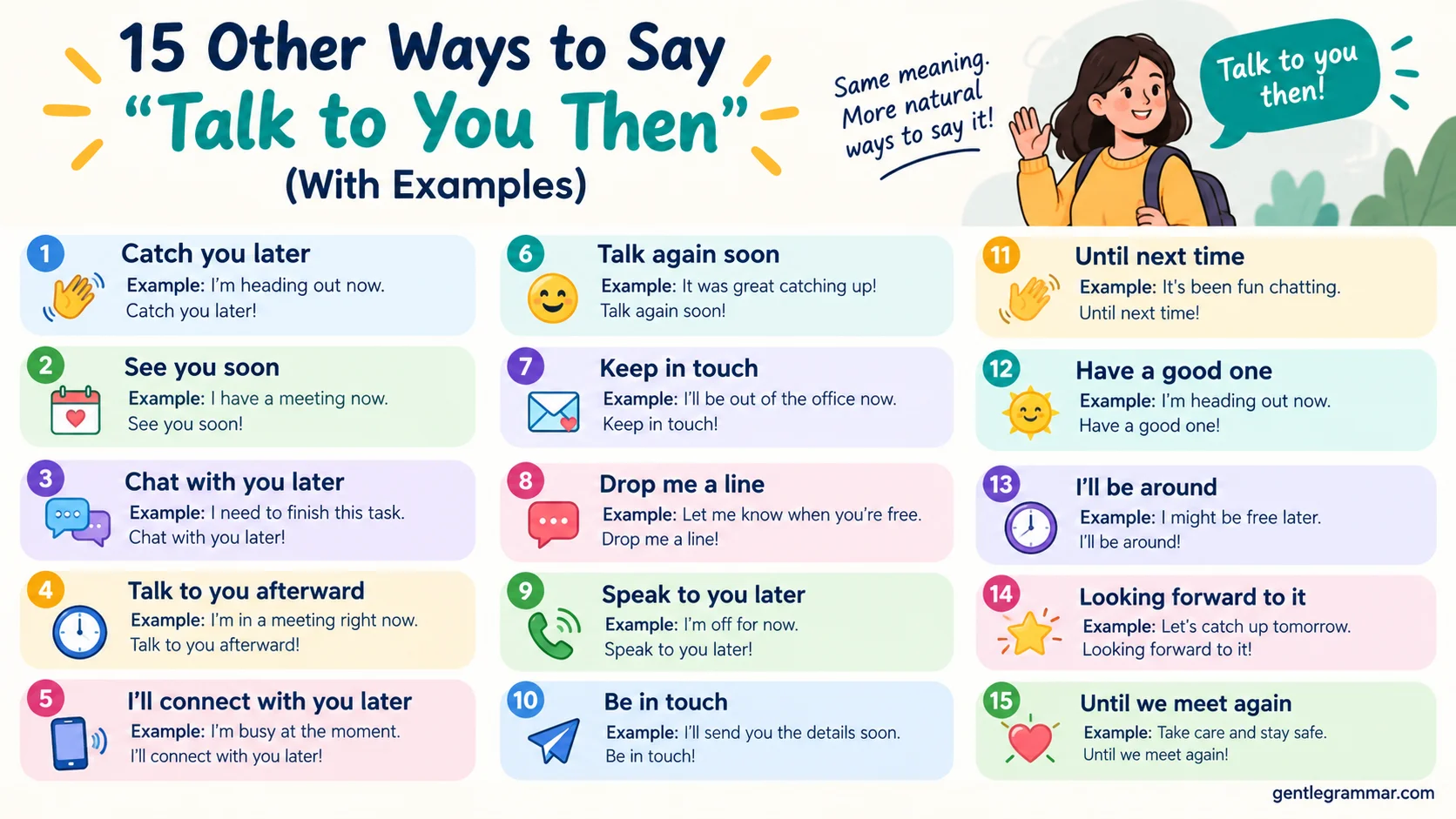
Other Ways to Say “Talk to You Then” can make everyday communication clearer with natural phrases for friendly and professional farewells.
When learning English language, grammar rules are useful, but understanding the nuances of everyday conversation can also improve English fluency. The phrase Talk to you then is a common way to end a conversation, but repeating it too often may make your speech sound repetitive. From my experience as an English editor, students and professional speakers can make their communication more natural, clear, and engagingly varied by using alternative expressions and building their vocabulary.
A useful guide should include practical phrases and examples that help people communicate effectively and develop stronger conversational skills. Other Ways to Say Talk to You Then also support diversifying farewells, helping you tailor your language to different contexts, varying degrees of formality, personality, and interactions, while showing a better command of English.
What Does “Talk to You Then” Mean?
“Talk to you then” is a casual expression used when you and another person have agreed, directly or indirectly, to speak again at a particular future time. The word “then” refers to a time that has already been mentioned or is understood from the conversation. For example, if someone says, “I’ll call you tomorrow afternoon,” replying, “Talk to you then,” means you expect to speak with that person tomorrow afternoon.
The phrase usually communicates friendly agreement and a planned future conversation. It can be used after arranging a phone call, meeting, online conversation, or another opportunity to speak. It is generally relaxed rather than formal, so the exact tone depends on the relationship and setting. In everyday English, it often works as a simple way to end a conversation while acknowledging that communication will continue later.
Common Situations Where “Talk to You Then” Is Used
People commonly use “Talk to you then” in everyday conversations when a future time for speaking has been established. A friend might use it after making plans for a phone call, while a family member might say it before ending a conversation. It also works naturally in text messages and personal communication, especially when both people already understand when they will reconnect.
The phrase can sometimes appear in workplace conversations, particularly among colleagues who have a friendly or informal relationship. For example, coworkers might use it after arranging a discussion for the afternoon. However, in a highly formal email or communication with a customer, a more specific expression may sound more polished. Choosing an alternative can also help you express a slightly different feeling, such as warmth, professionalism, enthusiasm, or simple acknowledgment.
Is It Professional or Polite to Say “Talk to You Then”?
“Talk to you then” is polite and friendly, but it is primarily a casual expression. It is perfectly appropriate when speaking with friends, relatives, classmates, familiar coworkers, or other people with whom you have a relaxed relationship. It does not normally sound rude or dismissive.
In professional communication, the phrase can be appropriate when the relationship and communication style are informal. However, a more precise expression may work better in a formal email, customer message, business letter, or communication with someone you do not know well. Expressions that clearly confirm a future contact or meeting can sound more professional without becoming unnecessarily stiff.
Advantages and Disadvantages of Saying “Talk to You Then”
Advantages
The main advantage of “Talk to you then” is its simplicity. It is short, natural, and immediately communicates that the conversation will continue at an understood future time. The phrase also has a friendly and cooperative tone, making it useful when ending a casual conversation. Because it does not sound overly formal, it can make communication feel relaxed and personal.
Disadvantages
The main limitation is that the phrase can sound too casual for certain formal settings. It may also be slightly vague if the future time has not already been established, because “then” depends on previous context. In addition, it focuses specifically on talking, so it may not be ideal when the next contact involves a broader activity, such as connecting professionally or following up on an issue.
Synonym for “Talk to You Then”
- Speak with you then
- Talk with you later
- We’ll talk then
- I’ll talk to you later
- Talk soon
- Speak soon
- Catch up with you then
- I’ll catch up with you later
- I’ll be in touch then
- I’ll reach out then
- Let’s connect then
- I’ll chat with you later
- Looking forward to talking then
- Until then
- See you then
1. Speak with you then
Meaning
“Speak with you then” communicates that you expect to have a conversation with someone at a previously established future time. It has essentially the same core meaning as “Talk to you then,” but “speak with” can sound slightly more polished.
Definition
Speak with you then means “I expect to have a conversation with you at that future time.”
Detailed Explanation
This expression is useful when you want to confirm a future conversation without sounding overly casual. Compared with “Talk to you then,” it can feel a little more professional or polished, especially in workplace communication. It still sounds natural and friendly rather than stiff. The phrase works particularly well when the time has already been discussed.
Scenario Examples
Scenario: You arrange a video call with a coworker for Friday.
Example: “Friday at 2 p.m. works for me. Speak with you then.”
Scenario: A teacher and student agree to discuss an assignment after class the next day.
Example: “I’ll bring the revised draft tomorrow. Speak with you then.”
Best Use
Use this expression for workplace conversations, scheduled calls, professional messages, and polite everyday communication.
Tone
Tone: Polite, professional, friendly
It sounds slightly more polished than “Talk to you then” while remaining approachable.
2. Talk with you later
Meaning
“Talk with you later” means that you expect to have another conversation with the person at some point in the future. Unlike “Talk to you then,” it does not necessarily point to one exact time.
Definition
Talk with you later means “I’ll speak with you again at a later time.”
Detailed Explanation
This phrase is useful when you know you will communicate again but do not need to specify precisely when. It is especially common in casual conversation and messaging. The wording is warm and familiar, although “later” can be less specific than “then.” Choose it when flexibility matters more than confirming a precise time.
Scenario Examples
Scenario: You need to leave a conversation with a friend because you have an appointment.
Example: “I have to run now, but I’ll talk with you later.”
Scenario: You are ending a quick chat with a sibling.
Example: “I’m heading downstairs. Talk with you later!”
Best Use
It works best in texting, casual conversations, family communication, and friendly messages.
Tone
Tone: Casual, warm, familiar
The word “later” gives the expression a relaxed and flexible feeling.
3. We’ll talk then
Meaning
“We’ll talk then” emphasizes that both people will have a conversation at the future time already discussed.
Definition
We’ll talk then means “We will have our conversation at that future time.”
Detailed Explanation
This expression is slightly different because it uses “we,” making the future conversation sound like a shared plan. It can be especially natural after discussing a specific appointment, issue, or decision. Depending on the situation, it may sound reassuring and confident. It can also be more direct than the softer “Talk to you then.”
Scenario Examples
Scenario: Two friends decide to discuss a problem after both have had time to think.
Example: “Let’s both think about it tonight, and we’ll talk then tomorrow.”
Scenario: Two coworkers agree to discuss a project during their next meeting.
Example: “I’ll review the numbers before the meeting, and we’ll talk then.”
Best Use
Use it for planned conversations, everyday speech, workplace discussions, and situations where a shared plan is clear.
Tone
Tone: Direct, confident, conversational
The use of “we” highlights the mutual nature of the future conversation.
4. I’ll talk to you later
Meaning
“I’ll talk to you later” tells someone that you intend to speak with them again in the future, without identifying a particular time.
Definition
I’ll talk to you later means “I intend to speak with you again later.”
Detailed Explanation
This is one of the most familiar casual expressions for ending a conversation. It is broader than “Talk to you then” because “later” does not require a specific previously mentioned time. It can be used even when no exact plan has been made. In relaxed communication, it sounds natural and friendly.
Scenario Examples
Scenario: You are leaving a group chat temporarily.
Example: “I need to get back to work. I’ll talk to you later.”
Scenario: You are saying goodbye to a friend before leaving a café.
Example: “Thanks for meeting me. I’ll talk to you later.”
Best Use
It is best for friends, family, texting, casual workplace conversations, and everyday interactions.
Tone
Tone: Friendly, casual, relaxed
It has an easygoing quality and does not create a formal commitment about timing.
5. Talk soon
Meaning
“Talk soon” expresses the expectation that you and another person will communicate again in the near future.
Definition
Talk soon means “I expect we will speak again soon.”
Detailed Explanation
This short expression is particularly natural in texts, emails, and informal conversations. It is less specific than “Talk to you then” because it does not refer to a particular future time. The word “soon” adds a sense of friendliness and suggests that another conversation is expected relatively soon. It can feel warmer and more upbeat than a simple goodbye.
Scenario Examples
Scenario: A friend is moving to another city but plans to stay in contact.
Example: “It was great seeing you. Talk soon!”
Scenario: You finish a casual phone conversation.
Example: “I’ve got to go now. Talk soon.”
Best Use
Use it in friendly messages, casual emails, social communication, and conversations with people you know well.
Tone
Tone: Warm, casual, upbeat
Its brevity makes it feel natural and affectionate without being overly emotional.
6. Speak soon
Meaning
“Speak soon” communicates that you expect to speak with someone again in the near future.
Definition
Speak soon means “I expect to speak with you again soon.”
Detailed Explanation
This expression is similar to “Talk soon,” but “speak” can sometimes feel slightly more polished. It is common in informal and semi-professional communication, particularly in messages and emails. Unlike “Talk to you then,” it does not identify a specific time. It is therefore useful when future communication is expected but the exact schedule is flexible.
Scenario Examples
Scenario: You finish an email exchange with a colleague you know well.
Example: “Thanks for your help with this. Speak soon.”
Scenario: A friend is traveling and promises to call after arriving.
Example: “Have a safe flight. Speak soon!”
Best Use
It works well in friendly emails, personal communication, professional relationships, and casual conversations.
Tone
Tone: Friendly, polished, warm
It has a conversational feel but can sound slightly neater than some very casual alternatives.
7. Catch up with you then
Meaning
“Catch up with you then” means you expect to talk with someone at a future time, often to discuss what has happened since you last spoke.
Definition
Catch up with you then means “I’ll talk with you at that future time and exchange updates.”
Detailed Explanation
The important nuance here is “catch up.” It often suggests more than simply having a conversation; it implies sharing news, discussing recent events, or reconnecting after some time apart. Because of this, it is not a perfect replacement in every situation. It is especially appropriate when you already have a friendly relationship with the person.
Scenario Examples
Scenario: Two old friends arrange a weekend phone call.
Example: “Saturday evening sounds perfect. Catch up with you then!”
Scenario: You and a former coworker plan to meet after several months apart.
Example: “Let’s meet at noon next Saturday and catch up with you then.”
Best Use
Use it for friends, relatives, former coworkers, reunions, and informal personal conversations.
Tone
Tone: Friendly, familiar, warm
“Catch up” suggests personal connection and an interest in hearing what has been happening.
8. I’ll catch up with you later
Meaning
“I’ll catch up with you later” indicates that you plan to reconnect and talk with someone later, often to exchange updates or continue a conversation.
Definition
I’ll catch up with you later means “I’ll reconnect with you later and talk about what’s happening.”
Detailed Explanation
This expression is more personal than a simple statement that you will speak again. “Catch up” often carries the idea of reconnecting, particularly when there has been a gap in communication. The word “later” keeps the timing flexible. It works naturally among friends and familiar colleagues.
Scenario Examples
Scenario: You see a friend at a busy event but cannot talk for long.
Example: “I need to help with something right now. I’ll catch up with you later.”
Scenario: You are working with a colleague and need to step away.
Example: “I have another call starting, but I’ll catch up with you later.”
Best Use
It is suitable for casual conversations, friendly workplaces, social events, and personal messages.
Tone
Tone: Casual, friendly, familiar
It suggests an intention to reconnect rather than simply ending communication.
9. I’ll be in touch then
Meaning
“I’ll be in touch then” means that you intend to contact the person at the previously discussed future time.
Definition
I’ll be in touch then means “I will contact you at that future time.”
Detailed Explanation
This phrase shifts the focus from specifically talking to making contact. That makes it useful when the future communication might involve a phone call, email, message, or another form of contact. It can sound more professional than “Talk to you then.” Because “be in touch” is broader, it should not be treated as an exact synonym when a spoken conversation is specifically intended.
Scenario Examples
Scenario: A business representative promises to contact a customer after checking an issue.
Example: “I’ll confirm the details with our team and be in touch then.”
Scenario: You are coordinating plans with someone and have agreed to reconnect tomorrow.
Example: “I should have the information by tomorrow. I’ll be in touch then.”
Best Use
Use it for professional communication, customer messages, business emails, and situations where the method of contact is not important.
Tone
Tone: Professional, polite, reassuring
It sounds organized and respectful without being excessively formal.
10. I’ll reach out then
Meaning
“I’ll reach out then” means that you plan to initiate contact at the future time that has been established.
Definition
I’ll reach out then means “I will contact you at that future time.”
Detailed Explanation
This phrase places emphasis on taking the initiative to contact someone. It is especially common in workplace and professional communication. Compared with “Talk to you then,” it sounds more business-oriented and does not necessarily mean that the contact will be a spoken conversation. Use it when you want to make clear that you will be the person initiating the next contact.
Scenario Examples
Scenario: A hiring manager plans to contact an applicant after reviewing information.
Example: “We’ll complete the review this week, and I’ll reach out then.”
Scenario: A colleague asks you to contact them once you have an update.
Example: “I should know by Thursday, so I’ll reach out then.”
Best Use
It works particularly well in professional emails, business communication, networking, and workplace messages.
Tone
Tone: Professional, proactive, direct
The expression communicates that you intend to take responsibility for the next contact.
11. Let’s connect then
Meaning
“Let’s connect then” suggests that two people plan to communicate or meet at a future time.
Definition
Let’s connect then means “Let’s communicate or meet at that future time.”
Detailed Explanation
This expression is broader than “Talk to you then” because “connect” can refer to a conversation, meeting, call, or professional interaction. It is particularly common in workplace and networking situations. It creates a sense of mutual agreement because it begins with “let’s.” The phrase is less specific about exactly how the communication will happen.
Scenario Examples
Scenario: Two professionals agree to discuss a possible collaboration next week.
Example: “Next Wednesday works for me. Let’s connect then.”
Scenario: Two coworkers need to review a project together.
Example: “I’ll finish the draft this afternoon. Let’s connect then and go through it.”
Best Use
Use it for professional communication, networking, workplace conversations, and semi-formal messages.
Tone
Tone: Professional, cooperative, modern
It emphasizes collaboration rather than simply ending a conversation.
12. I’ll chat with you later
Meaning
“I’ll chat with you later” means that you intend to have a relaxed conversation with someone later.
Definition
I’ll chat with you later means “I’ll have a casual conversation with you later.”
Detailed Explanation
The word “chat” makes this expression distinctly informal. It suggests a relaxed conversation rather than a serious meeting, formal discussion, or business negotiation. It can be especially natural in texting and online communication. Like “I’ll talk to you later,” it does not require a specific future time.
Scenario Examples
Scenario: You are messaging a friend but need to leave your phone.
Example: “Dinner’s ready, so I have to go. I’ll chat with you later.”
Scenario: Two classmates are discussing plans online.
Example: “I have class now. I’ll chat with you later.”
Best Use
It works best for friends, classmates, family members, online conversations, and informal messages.
Tone
Tone: Casual, relaxed, friendly
“Chat” creates a light, comfortable feeling and is generally unsuitable for very formal communication.
13. Looking forward to talking then
Meaning
“Looking forward to talking then” expresses that you are pleased or enthusiastic about the upcoming conversation.
Definition
Looking forward to talking then means “I am anticipating our future conversation positively.”
Detailed Explanation
This expression adds positive anticipation that is not necessarily present in “Talk to you then.” It is useful when you want to show that you are genuinely pleased about speaking with someone. It can sound warm in personal communication and polished in professional messages. Because it expresses anticipation, it is not simply a neutral confirmation of timing.
Scenario Examples
Scenario: You arrange a consultation with someone whose advice you value.
Example: “Thursday at 10 works perfectly. Looking forward to talking then.”
Scenario: You arrange a video call with a friend you have not seen for a while.
Example: “I’m glad we finally found a time that works. Looking forward to talking then!”
Best Use
Use it for professional emails, scheduled conversations, personal messages, and situations where you want to express enthusiasm.
Tone
Tone: Warm, positive, courteous
The phrase adds a feeling of anticipation and makes the closing more personable.
14. Until then
Meaning
“Until then” means that you are saying goodbye for the period between now and a previously mentioned future time.
Definition
Until then means “I will not see or communicate with you again before that specified time.”
Detailed Explanation
This expression is related to “Talk to you then,” but it is broader and less explicit about speaking. It can refer to the period before a future meeting, event, or point in time. Because it does not specifically promise a conversation, it should not always be treated as an exact substitute. It is useful when the future occasion is already clear from the context.
Scenario Examples
Scenario: You and a friend have plans to meet next weekend.
Example: “Enjoy the rest of your week. Until then!”
Scenario: A teacher finishes a class and reminds students about the next scheduled session.
Example: “Please finish the reading before Monday. Until then, take care.”
Best Use
Use it for goodbyes, scheduled meetings, personal communication, and situations involving a clearly established future occasion.
Tone
Tone: Warm, concise, slightly formal
It has a graceful quality and can sound more polished than a casual farewell.
15. See you then
Meaning
“See you then” means that you expect to see someone at a specific future time or occasion.
Definition
See you then means “I expect to see you at that agreed future time.”
Detailed Explanation
This is an important context-dependent alternative because it refers specifically to seeing someone, not merely talking to them. It works naturally when the future plan involves an in-person meeting or another situation where seeing the person is expected. If the planned communication is only a phone call, “see you then” may be inaccurate. It is therefore best viewed as a related farewell rather than a perfect replacement in every situation.
Scenario Examples
Scenario: You arrange to meet a friend at a restaurant tomorrow.
Example: “Seven o’clock works. See you then!”
Scenario: A coworker confirms an in-person meeting for Monday.
Example: “I’ll bring the documents to the meeting. See you then.”
Best Use
Use it for in-person plans, meetings, appointments, social events, and casual farewells.
Tone
Tone: Friendly, casual, positive
It sounds natural when both people expect to meet face-to-face.
FAQs:
What is another way to say “Talk to You Then”?
Natural alternatives include “Speak with you then,” “We’ll talk then,” “Talk soon,” “Speak soon,” and “I’ll be in touch then.” The best choice depends on the context. For example, “Talk soon” is casual and friendly, while “I’ll be in touch then” is more suitable when the next contact may be professional or may happen through different communication channels.
What does “Talk to You Then” mean?
“Talk to you then” means that you expect to speak with someone at a future time that has already been mentioned or understood. The phrase is commonly used as a friendly way to end a conversation after making or confirming plans to communicate again.
Is “Talk to You Then” professional?
“Talk to you then” is polite but generally casual. It can work in an informal workplace relationship, particularly between familiar colleagues. In formal business or customer communication, expressions such as “I’ll be in touch then,” “I’ll reach out then,” or “Speak with you then” may better match the setting.
What is a more polite way to say “Talk to You Then”?
A slightly more polished option is “Speak with you then.” For professional situations, “I’ll be in touch then” can also work well because it confirms future contact without sounding overly informal. If you want to express warmth, “Looking forward to talking then” adds positive anticipation.
Which alternative works best in formal communication?
For formal communication, “I’ll be in touch then,” “I’ll reach out then,” or “Speak with you then” can fit well, depending on what you mean. If you specifically expect a conversation, “Speak with you then” is clear. If the next contact could be a call, email, or message, “I’ll be in touch then” is broader and more appropriate.
Conclusion:
Choosing an alternative to “Talk to you then” is mainly about matching your wording to the situation. A casual phrase such as “Talk soon” or “I’ll talk to you later” can make a personal conversation feel relaxed, while “Speak with you then” can add a little more polish. In professional communication, “I’ll be in touch then,” “I’ll reach out then,” and “Let’s connect then” can make the intended contact clearer. Some expressions, such as “Until then” and “See you then,” have related but slightly different meanings, so context matters. The most natural wording is the one that accurately reflects when you will reconnect, how you will communicate, and the relationship between the people involved.
