
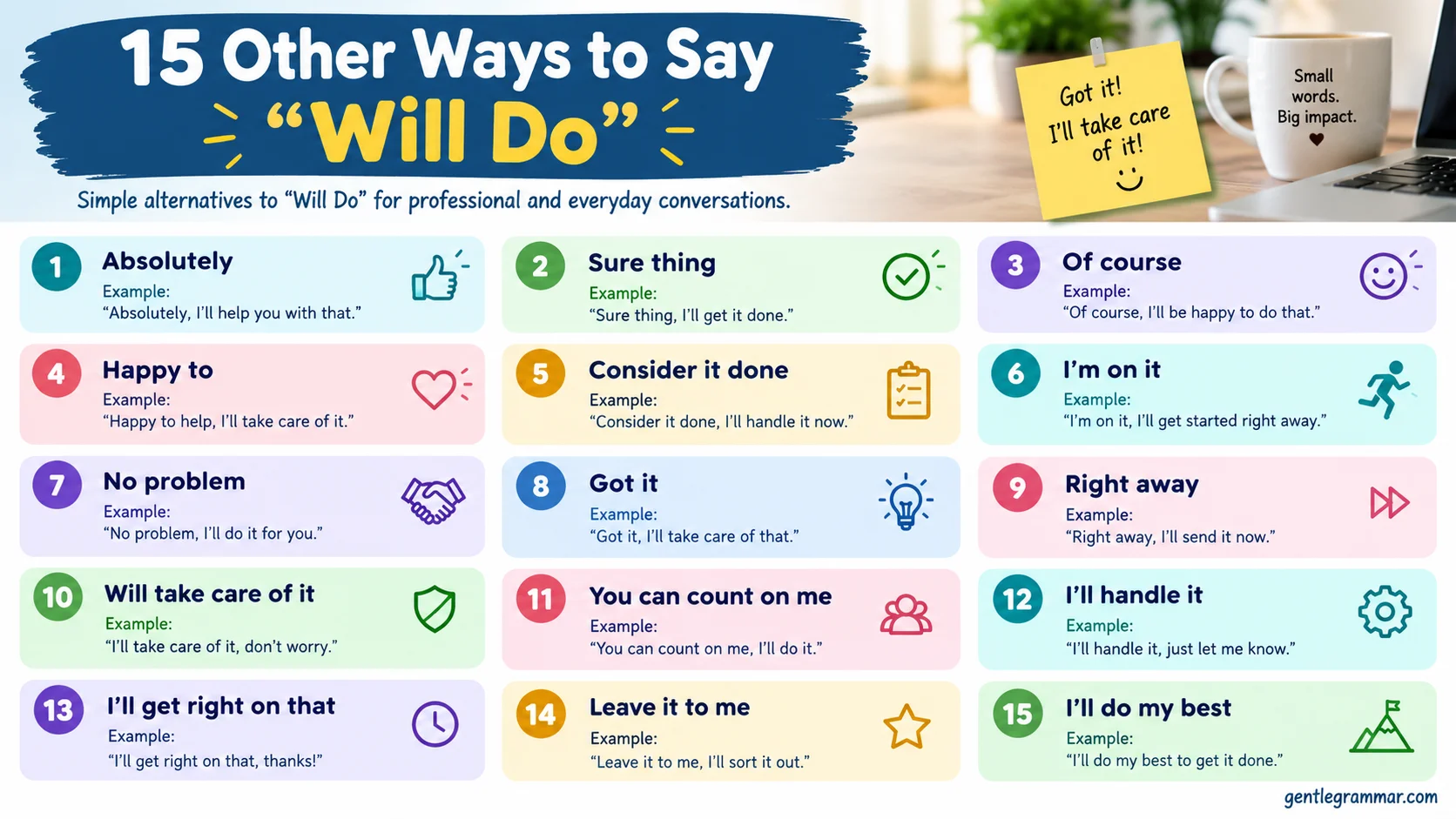
In this guide to Other Ways to Say “Will Do”, you can choose wording that sounds clear, warm, professional, and natural in everyday communication.
When wrapping up a meeting, a manager may ask you to send a revised file by a certain time, and your reply needs to be quick, clear, and efficient. The phrase Will do is simple, but small phrases can carry big meaning and shape how others perceive your reliability, tone, and professionalism. In modern workplaces, including emails, chats, voice notes, and other workplace communication, choosing the right wording matters. A thoughtful alternative can add clarity, warmth, authority, or understanding, depending on when and how you use it.
I remember typing an important email and wondering whether my words sounded strong enough or too ordinary. That doubt made me search for alternatives that could express commitment, dedication, and accountability in a more professional and formal way. In interviews, client messages, business communication, customer service, team collaboration, leadership settings, and corporate writing, the right expression can strengthen trust, clarity, confidence, and emotional intelligence.
What Does “Will Do” Mean?
“Will do” is a short expression commonly used to mean “I will do that” or “I will take care of it.” It usually shows that the speaker understands a request and agrees to complete it. For example, if someone says, “Please send me the document this afternoon,” replying “Will do” communicates that you intend to send it. The phrase is generally casual, direct, and cooperative.
“Will do” can also have a different meaning when used as a response to whether something is sufficient. In a sentence such as “This amount will do,” it means “This will be enough” or “This is suitable for the purpose.” The intended meaning therefore depends on the context and grammatical use.
Common Situations Where “Will Do” Is Used
“Will do” is especially common in everyday conversation, text messages, workplace chats, and informal emails. Someone might use it after receiving an instruction, accepting a request, or confirming that they will handle a task. For example, a colleague might say, “Please update the spreadsheet before lunch,” and receive the simple response, “Will do.”
The expression is also useful in personal communication because it is quick and friendly. However, people sometimes choose an alternative when they want to sound more specific, reassuring, appreciative, or formal. In professional communication, a slightly fuller response can sometimes make the commitment clearer.
Is It Professional or Polite to Say “Will Do”?
Yes, “will do” can be polite and professional, particularly in workplace conversations where communication is relatively informal. It sounds cooperative and confident without being overly formal. It works naturally between colleagues, managers, clients, or team members when the surrounding relationship allows for conversational language.
That said, “will do” is generally informal rather than formal. In a formal email, official letter, or sensitive customer communication, a phrase such as “I’ll take care of that” or “I’ll make sure that is completed” may provide more clarity and professionalism. The best choice depends on the relationship, setting, and importance of the request.
Advantages and Disadvantages of Saying “Will Do”
Advantages
The biggest advantage of “will do” is its simplicity. It quickly confirms that you have understood a request and intend to act on it. It can also sound confident, cooperative, and friendly without requiring a long response. For routine tasks, this concise wording is often all that is needed.
Disadvantages
Because it is so brief, “will do” can sometimes provide little detail. The listener may not know when the task will be completed or whether you fully understood a complicated request. It can also sound too casual in highly formal situations. When greater reassurance or specificity is needed, a fuller alternative may communicate your intention more effectively.
Synonym for “Will Do”
- I’ll Take Care of It
- I’ll Handle It
- Consider It Done
- I’ll Get It Done
- Absolutely
- Sure, I Will
- I’ll Make Sure It’s Done
- I’m On It
- I’ll See to It
- Leave It With Me
- I’ll Get Right on It
- I’ll Take Care of That
- Understood
- I’ll Do That
- You Can Count on Me
1. I’ll Take Care of It
Meaning
“I’ll take care of it” means I will handle the matter or complete the requested task. It communicates responsibility and reassurance.
Definition
I’ll take care of it is an expression used to confirm that you will personally deal with something that needs attention.
Detailed Explanation
Compared with “will do,” this expression sounds more reassuring and responsible. It tells the other person not only that you agree but also that you will handle the matter. It works particularly well when someone is worried about whether a task will be dealt with. The wording can sound friendly in casual conversation while remaining suitable for many workplace situations.
Scenario Examples
Scenario: A colleague asks you to contact a supplier.
Example: “I’ll take care of it and let you know what they say.”
Scenario: A friend asks you to pick something up.
Example: “Don’t worry, I’ll take care of it on my way home.”
Best Use
Best for workplace communication, personal messages, requests, and reassuring conversations.
Tone
Tone: Reassuring, responsible, friendly. It emphasizes that you are taking ownership of the task.
2. I’ll Handle It
Meaning
“I’ll handle it” means I will deal with the situation myself.
Definition
I’ll handle it is a direct expression used when someone agrees to manage a task, problem, or situation.
Detailed Explanation
This alternative is slightly more direct and confident than “will do.” It suggests that you are prepared to manage whatever needs to be done. It is especially useful when the task involves solving a problem rather than simply completing an instruction. Depending on your tone of voice, it can sound either reassuring or firm.
Scenario Examples
Scenario: A coworker notices an issue with a customer order.
Example: “I’ll handle it and speak with the customer.”
Scenario: Your friend asks who will organize the reservation.
Example: “I’ll handle it. Just send me the details.”
Best Use
Best for workplace conversations, practical tasks, problem-solving, and everyday communication.
Tone
Tone: Confident, direct, capable. It conveys personal responsibility.
3. Consider It Done
Meaning
“Consider it done” means you can be confident that I will complete it.
Definition
Consider it done is a confident expression used to assure someone that a requested task will be completed.
Detailed Explanation
This phrase is stronger and more expressive than “will do.” It gives the listener a sense of certainty and commitment. It can sound upbeat and confident, making it popular in informal workplace conversations and personal interactions. However, because of its slightly dramatic or enthusiastic quality, it may not suit every formal situation.
Scenario Examples
Scenario: A friend asks you to bring their favorite snack.
Example: “Could you pick some up for me?”
“Consider it done.”
Scenario: A colleague asks you to print meeting materials.
Example: “I need these ready before the meeting.”
“Consider it done.”
Best Use
Best for friendly conversations, informal workplace communication, and confident promises.
Tone
Tone: Confident, upbeat, reassuring. It adds a little enthusiasm to the commitment.
4. I’ll Get It Done
Meaning
“I’ll get it done” means I will complete the task successfully.
Definition
I’ll get it done is a direct statement promising that a task will be completed.
Detailed Explanation
Unlike the brief “will do,” this phrase emphasizes the completion of the task. It can communicate determination, especially when the task may require effort or persistence. It is useful when someone wants reassurance that an important responsibility will not be ignored. The expression is usually conversational rather than highly formal.
Scenario Examples
Scenario: Your manager gives you a task with a deadline.
Example: “I’ll get it done before the end of the day.”
Scenario: A friend asks whether you can finish organizing something.
Example: “Give me an hour. I’ll get it done.”
Best Use
Best for work tasks, deadlines, projects, and situations requiring determination.
Tone
Tone: Determined, confident, practical. It focuses on completion and results.
5. Absolutely
Meaning
“Absolutely” can mean yes, certainly, or without a doubt. When responding to a request, it can serve as a positive confirmation.
Definition
Absolutely is an emphatic word used to express strong agreement or certainty.
Detailed Explanation
“Absolutely” does not literally mean “I will do it,” so it is a context-dependent alternative rather than an exact synonym. When someone asks, “Can you send this today?” an answer of “Absolutely” clearly communicates agreement. It sounds warmer and more enthusiastic than “will do,” but the exact commitment should be clear from the preceding conversation.
Scenario Examples
Scenario: A colleague asks whether you can review a document.
Example: “Could you look over this before the meeting?”
“Absolutely.”
Scenario: Someone asks for your help with an event.
Example: “Can you help me set everything up?”
“Absolutely. I’d be happy to.”
Best Use
Best for friendly requests, customer interactions, workplace conversations, and enthusiastic agreement.
Tone
Tone: Warm, positive, enthusiastic. It emphasizes strong agreement rather than the mechanics of completing a task.
6. Sure, I Will
Meaning
“Sure, I will” means yes, I agree to do that.
Definition
Sure, I will is a friendly response used to accept a request or promise to perform an action.
Detailed Explanation
This expression is closer in meaning to “will do” because it clearly contains the promise to act. It sounds natural and conversational, particularly in spoken English and text messages. “Sure” makes the response feel cooperative rather than merely factual. It may sound slightly more personal than the shorter “will do.”
Scenario Examples
Scenario: A parent asks someone to call a relative.
Example: “Can you call your aunt tonight?”
“Sure, I will.”
Scenario: A friend asks you to save them a seat.
Example: “Can you save me a spot?”
“Sure, I will.”
Best Use
Best for casual conversation, texting, family communication, and friendly requests.
Tone
Tone: Casual, agreeable, friendly. It communicates willingness without sounding overly formal.
7. I’ll Make Sure It’s Done
Meaning
“I’ll make sure it’s done” means I will take responsibility for ensuring the task is completed.
Definition
I’ll make sure it’s done is an assurance that a particular task will be completed properly or by the required time.
Detailed Explanation
This wording provides more reassurance than “will do.” The important idea is follow-through: you are not merely agreeing to try, but saying you will ensure completion. It is particularly useful when the task matters or when another person needs confidence that it will not be forgotten. It can sound professional without becoming stiff.
Scenario Examples
Scenario: A supervisor asks you to ensure a report is ready.
Example: “Please have the report ready for tomorrow.”
“I’ll make sure it’s done.”
Scenario: A friend asks you to remember an important errand.
Example: “Please don’t forget to pick up the tickets.”
“I’ll make sure it’s done.”
Best Use
Best for professional communication, important tasks, deadlines, and reassuring messages.
Tone
Tone: Responsible, reassuring, professional. It stresses reliability and follow-through.
8. I’m On It
Meaning
“I’m on it” means I have started dealing with it or will deal with it immediately.
Definition
I’m on it is an informal expression indicating that someone is actively taking responsibility for a task or problem.
Detailed Explanation
This phrase can be more energetic than “will do.” Rather than simply promising future action, it often suggests that you are already taking action. It is especially common in spoken English, workplace chats, and text messages. Because it is informal, it may not be appropriate for highly formal correspondence.
Scenario Examples
Scenario: A teammate reports a technical problem.
Example: “The file isn’t opening.”
“I’m on it.”
Scenario: Your friend asks you to find an address.
Example: “Can you check where the restaurant is?”
“I’m on it.”
Best Use
Best for workplace chats, texting, teamwork, quick responses, and urgent tasks.
Tone
Tone: Informal, energetic, responsive. It suggests immediate action.
9. I’ll See to It
Meaning
“I’ll see to it” means I will take responsibility for making sure something is handled.
Definition
I’ll see to it is an expression meaning that you will personally attend to or arrange something.
Detailed Explanation
This phrase is somewhat more formal and deliberate than “will do.” It emphasizes that you will make the necessary arrangements or ensure that an issue receives attention. It can be useful when a simple “will do” feels too casual. In everyday conversation, however, it may sound slightly more formal than most people need.
Scenario Examples
Scenario: A customer asks whether an issue will be addressed.
Example: “Please make sure someone contacts me today.”
“I’ll see to it.”
Scenario: A manager asks you to arrange a meeting.
Example: “Please arrange a meeting with the design team.”
“I’ll see to it.”
Best Use
Best for professional communication, formal conversations, customer service, and situations involving responsibility.
Tone
Tone: Professional, respectful, deliberate. It conveys attention and responsibility.
10. Leave It With Me
Meaning
“Leave it with me” means I will take responsibility for handling it.
Definition
Leave it with me is an informal or semi-professional expression used to tell someone that you will deal with a matter for them.
Detailed Explanation
This phrase offers a particularly strong sense of reassurance and personal responsibility. It tells the other person that they do not need to worry about the matter because you will handle it. It is common in British English and is also understood in many other varieties of English. The phrase works especially well when someone is asking for help with a practical issue.
Scenario Examples
Scenario: A colleague asks you to contact a supplier.
Example: “Could you follow up with them?”
“Leave it with me.”
Scenario: A friend is worried about arranging transportation.
Example: “I don’t know how we’ll get there.”
“Leave it with me. I’ll figure something out.”
Best Use
Best for workplace communication, friendly conversations, customer service, and reassuring someone.
Tone
Tone: Reassuring, confident, helpful. It communicates “you can rely on me.”
11. I’ll Get Right on It
Meaning
“I’ll get right on it” means I will start working on it immediately.
Definition
I’ll get right on it is a phrase used to promise prompt action on a task or request.
Detailed Explanation
This alternative adds a sense of urgency and immediacy that “will do” does not necessarily express. It is useful when the other person wants to know that you will not delay. The phrase is conversational and can be particularly natural in workplace settings where someone has just assigned a task. It should not be used if you cannot realistically act soon.
Scenario Examples
Scenario: A manager asks for a document to be corrected quickly.
Example: “There are a few errors in this report.”
“I’ll get right on it.”
Scenario: A customer asks an employee to check an order.
Example: “Could you check whether my order has shipped?”
“I’ll get right on it.”
Best Use
Best for workplace communication, customer service, urgent requests, and quick tasks.
Tone
Tone: Responsive, energetic, professional-casual. It highlights prompt action.
12. I’ll Take Care of That
Meaning
“I’ll take care of that” means I will deal with that particular matter.
Definition
I’ll take care of that is a reassuring expression used to confirm responsibility for a specific task.
Detailed Explanation
This is closely related to “I’ll take care of it,” but “that” points more directly to something already mentioned. It can make a response feel clear and attentive because it acknowledges the specific matter being discussed. It works naturally in both personal and professional conversations. Compared with “will do,” it sounds slightly fuller and more reassuring.
Scenario Examples
Scenario: A coworker asks you to update a contact’s information.
Example: “Could you change the phone number in the system?”
“I’ll take care of that.”
Scenario: Someone asks you to bring an item home.
Example: “Please remember to bring the package inside.”
“I’ll take care of that.”
Best Use
Best for work emails, workplace conversations, customer communication, and personal requests.
Tone
Tone: Helpful, responsible, reassuring. It communicates clear ownership of a specific task.
13. Understood
Meaning
“Understood” means I understand what you have said or requested.
Definition
Understood is a concise expression confirming that a message, instruction, or request has been understood.
Detailed Explanation
“Understood” is not always a direct substitute for “will do” because it confirms understanding rather than action. In situations where understanding an instruction naturally implies that you will follow it, however, it can work well. It sounds more serious and formal than “will do.” For that reason, it is useful when clarity and brevity matter.
Scenario Examples
Scenario: A supervisor gives you a clear instruction.
Example: “Please submit the form before 3 p.m.”
“Understood.”
Scenario: Someone explains an important rule.
Example: “Make sure confidential files aren’t left on the desk.”
“Understood.”
Best Use
Best for professional communication, instructions, formal conversations, and situations where clarity matters.
Tone
Tone: Professional, serious, concise. It emphasizes comprehension and acknowledgment.
14. I’ll Do That
Meaning
“I’ll do that” means I agree to perform the action that has been requested or discussed.
Definition
I’ll do that is a straightforward statement of willingness or intention to complete a particular action.
Detailed Explanation
This is one of the closest and simplest alternatives to “will do.” It is slightly more explicit because it directly states what you intend to do without relying on the shorter idiomatic response. It works in casual and professional settings, depending on the surrounding conversation. It is especially useful for English learners because its meaning is immediately clear.
Scenario Examples
Scenario: A friend asks you to send a photo later.
Example: “Can you send me that picture tonight?”
“I’ll do that.”
Scenario: A colleague asks you to check some figures.
Example: “Could you verify these numbers?”
“I’ll do that before the meeting.”
Best Use
Best for everyday conversation, emails, workplace communication, and clear confirmations.
Tone
Tone: Neutral, cooperative, direct. It gives a clear commitment without sounding overly expressive.
15. You Can Count on Me
Meaning
“You can count on me” means you can rely on me to do what I have promised.
Definition
You can count on me is an expression used to assure someone that you are dependable and will follow through.
Detailed Explanation
This phrase goes beyond the simple meaning of “will do” by emphasizing trust and reliability. It is especially appropriate when the other person needs reassurance that you will keep your commitment. Because it carries an emotional element, it can sound warmer and more personal than a straightforward confirmation. It is less suitable for routine tasks where such strong reassurance is unnecessary.
Scenario Examples
Scenario: A friend asks you to help with an important event.
Example: “I really need someone to help me tomorrow.”
“You can count on me.”
Scenario: A teammate needs someone to meet an important deadline.
Example: “Can you make sure your part is ready by Friday?”
“You can count on me.”
Best Use
Best for personal communication, teamwork, important commitments, and situations where trust matters.
Tone
Tone: Warm, dependable, reassuring. It focuses on trust and reliability.
FAQs:
What is another way to say “will do”?
Natural alternatives include “I’ll take care of it,” “I’ll handle it,” “I’ll do that,” “I’m on it,” and “I’ll make sure it’s done.” The best choice depends on whether you want to sound casual, professional, reassuring, energetic, or highly dependable.
What does “will do” mean?
“Will do” usually means “I will do that” or “I’ll take care of it.” It is commonly used to acknowledge a request and confirm that you intend to act. In another context, “will do” can also mean that something will be sufficient, as in “That will do.”
Is “will do” professional?
“Will do” can be professional in informal workplace communication, especially between people who regularly communicate casually. However, it is relatively informal. For formal emails or important business communication, a fuller expression such as “I’ll take care of that” or “I’ll make sure it’s completed” may provide more clarity.
What is a more polite way to say “will do”?
A more reassuring or polished option is “I’ll take care of that.” If you want to emphasize reliability, “I’ll make sure it’s done” is also useful. For a warm personal response, “You can count on me” can work when the situation calls for stronger reassurance.
Which alternative works best in formal communication?
For formal or professional situations, “I’ll see to it,” “I’ll make sure it’s done,” and “I’ll take care of that” can be appropriate depending on the context. “Understood” is useful when you primarily need to acknowledge an instruction rather than explicitly promise completion.
Conclusion:
Choosing an alternative to “will do” is less about finding one perfect synonym and more about matching your wording to the situation. “I’ll handle it” can communicate confidence, while “I’ll make sure it’s done” emphasizes reliability. “I’m on it” suggests immediate action, whereas “You can count on me” adds warmth and trust. In formal settings, a slightly fuller expression may make your commitment clearer than the brief “will do.”
The important thing is to consider tone, relationship, urgency, and context before choosing your words. A small change in phrasing can make a response feel more natural, reassuring, or professional. When you understand these differences, you can use “will do” confidently while also having the vocabulary to express the same general idea in a way that fits the moment.
