
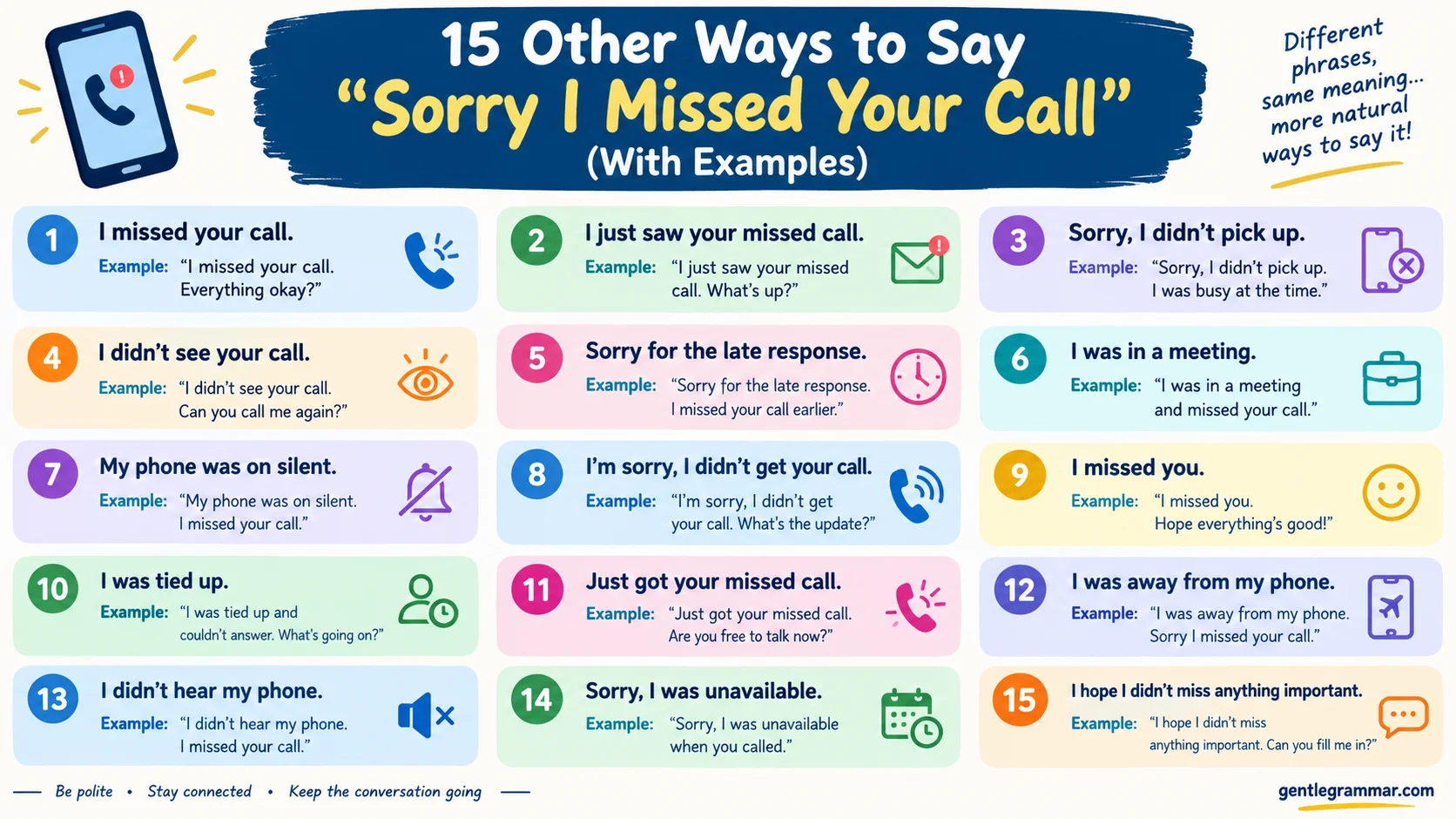
A missed call can feel awkward when you are busy, especially if it comes from a client or manager. 15 Other Ways to Say “Sorry I Missed Your Call” (With Examples) can help you respond politely, naturally, and professionally in different situations.
Whether you were in a meeting, driving, or away from your phone, a thoughtful apology can turn an unanswered call into an opportunity for clear communication. Instead of sending a routine phrase that sounds flat or overly casual, choose wording that shows sincerity and respect. A short text message or voicemail can acknowledge the missed call, briefly explain your unavailability, and let the other person know when you can talk.
When choosing the right response, consider who called, why you missed the call, and how quickly you can call back. For example, you could say, “Hi [name], sorry I missed your call. I was in a meeting, but I’m free now if you want to talk. Let me know what works best.” If you are unavailable, suggest a good time or offer to reschedule. If you are out of the office until a specific date, explain when you will return the call.
What Does “Sorry I Missed Your Call” Mean?
“Sorry I missed your call” is a polite expression used when someone calls you and you do not answer. It acknowledges the missed call and expresses regret that you were unavailable to speak at that moment. The word “sorry” communicates consideration or a mild apology, while “missed your call” explains what happened. The phrase does not necessarily mean you deliberately ignored the caller. You might have been busy, away from your phone, in a meeting, or unable to answer for another reason. Depending on your relationship with the caller, you can follow the message with an explanation, an offer to call back, or a question about what they needed.
Common Situations Where “Sorry I Missed Your Call” Is Used
This phrase is common in text messages, phone conversations, emails, and workplace communication. You might send it to a friend after noticing their call, message a family member when you become available, or respond to a colleague whose call came in during a meeting. Businesses can also use similar wording when returning calls from clients or customers. In personal relationships, a warmer message may feel more caring, while a professional setting may call for a concise response and a clear next step. Choosing an alternative helps you match your message to the situation without sounding distant, overly apologetic, or unnecessarily formal.
Is It Professional or Polite to Say “Sorry I Missed Your Call”?
Yes, “Sorry I missed your call” is both polite and acceptable in professional communication. It sounds natural, respectful, and direct without being overly formal. It works well in a message to a coworker, manager, client, or business contact, particularly when the conversation is relatively informal. For a more formal email, you might prefer “I apologize for missing your call” or “I was unable to answer your call.” In a friendly conversation, “Sorry I couldn’t pick up” may sound more relaxed. The best choice depends on your relationship with the caller, the importance of the call, and whether you want to explain your unavailability or simply arrange a callback.
Advantages and Disadvantages of Saying “Sorry I Missed Your Call”
Advantages
The phrase is short, clear, and courteous. It acknowledges the missed call without requiring a lengthy explanation, making it useful for quick texts and professional messages. It also leaves room to continue the conversation by asking what the caller needed or offering to call back. Because it is familiar everyday English, most people understand it immediately.
Disadvantages
The wording can feel generic if you use it repeatedly, especially when responding to someone whose call was important or urgent. On its own, it does not tell the caller when you will be available or whether you intend to return the call. It may also sound less formal than a full apology in a sensitive business situation. Adding a brief explanation, a warmer expression, or a specific offer to reconnect can make the message more helpful.
Synonyms for “Sorry I Missed Your Call”
- I apologize for missing your call.
- Sorry I couldn’t answer your call.
- I wasn’t able to pick up.
- I missed your call earlier.
- Sorry I couldn’t take your call.
- I was unavailable when you called.
- Sorry I couldn’t get to the phone.
- I just saw your missed call.
- I’m sorry I wasn’t available.
- I couldn’t answer when you rang.
- Sorry we couldn’t connect.
- I was tied up when you called.
- Please accept my apologies for missing your call.
- Thanks for calling; sorry I missed you.
- I couldn’t take your call at the time.
1. I apologize for missing your call.
Meaning
“I apologize for missing your call” expresses regret in a slightly more formal and professional way. It acknowledges that you did not answer and shows that you respect the caller’s time.
Definition
A polite expression of regret for being unable to answer a phone call.
Detailed Explanation
This expression is more formal than the original phrase because it uses “I apologize” instead of “sorry.” It is particularly useful when communicating with clients, managers, or people you do not know well. The wording accepts responsibility for the missed connection without suggesting that you intentionally ignored the call. You can make it more helpful by adding when you will be available to speak.
Scenario Examples
Scenario 1: Responding to a client
Example: I apologize for missing your call earlier. Would this afternoon be a convenient time to connect?
Scenario 2: Messaging your manager
Example: I apologize for missing your call. I was away from my desk and am available now.
Scenario 3: Following up on a business matter
Example: I apologize for missing your call regarding the proposal. Please let me know when you are available to discuss it.
Best Use
Use this expression in professional emails, business messages, client communication, and formal conversations where courtesy matters.
Tone
Tone: Professional, respectful, formal.
The phrase communicates consideration without sounding overly emotional.
2. Sorry I couldn’t answer your call.
Meaning
This expression explains that you were unable to answer when the phone rang. It is a natural way to acknowledge a missed call while keeping the message friendly.
Definition
A casual apology for being unable to respond to a phone call when it came in.
Detailed Explanation
Unlike the original expression, this version emphasizes your inability to answer rather than the fact that you missed the call. It sounds conversational and works well when you want to acknowledge the situation without giving a detailed explanation. It does not imply that you were deliberately avoiding the caller. If necessary, you can add a short reason or offer to speak later.
Scenario Examples
Scenario 1: Texting a friend
Example: Sorry I couldn’t answer your call. I was out getting groceries!
Scenario 2: Replying to a family member
Example: Sorry I couldn’t answer your call earlier. Is everything okay?
Scenario 3: Responding to a colleague
Example: Sorry I couldn’t answer your call during the meeting. I can talk now if you’re free.
Best Use
This phrase is ideal for everyday texts, friendly conversations, family messages, and informal workplace communication.
Tone
Tone: Friendly, polite, conversational.
It balances a brief apology with a relaxed, natural style.
3. I wasn’t able to pick up.
Meaning
“I wasn’t able to pick up” means you could not answer an incoming phone call. It is a relaxed expression commonly used in spoken English and text messages.
Definition
A statement explaining that you were unable to answer the phone when someone called.
Detailed Explanation
The expression “pick up” is an informal phrasal verb meaning to answer a phone call. Compared with the original phrase, this alternative focuses more on your inability to respond than on apologizing. It can sound natural when the person already knows you are getting back to them. However, because it does not contain an apology, you may want to add “sorry” if the call was important or the caller had been waiting for a response.
Scenario Examples
Scenario 1: Messaging a friend
Example: I wasn’t able to pick up earlier. What’s going on?
Scenario 2: Replying after a busy afternoon
Example: I wasn’t able to pick up while I was driving. Can I call you now?
Scenario 3: Contacting a coworker
Example: I wasn’t able to pick up during the presentation, but I’m free now.
Best Use
Use this phrase in casual messages, everyday conversations, and familiar workplace exchanges. In formal emails, a more complete expression may be preferable.
Tone
Tone: Casual, direct, neutral.
Its simplicity makes it useful when you want to explain what happened without over-apologizing.
4. I missed your call earlier.
Meaning
This phrase acknowledges that someone called you at an earlier time and you did not answer. It is a straightforward way to reopen communication.
Definition
A brief statement confirming that you did not answer a previous phone call.
Detailed Explanation
The emphasis here is on when the call happened rather than on expressing regret. It can be especially useful when you are returning a call after some time has passed. The phrase is not inherently an apology, so it may sound more neutral than the original wording. You can make it warmer by asking how the person is or offering to call back. In professional situations, a sentence about your current availability makes the message more actionable.
Scenario Examples
Scenario 1: Returning a friend’s call
Example: I missed your call earlier. Are you free to chat now?
Scenario 2: Following up with a colleague
Example: I missed your call earlier this morning. Let me know if you still need to discuss the report.
Scenario 3: Responding to a family member
Example: I missed your call earlier while I was at the store. Everything all right?
Best Use
This alternative works well in texts, callback messages, everyday conversations, and routine professional follow-ups.
Tone
Tone: Neutral, clear, conversational.
It is useful when you want to acknowledge the missed call without making the situation sound more serious than it is.
5. Sorry I couldn’t take your call.
Meaning
This expression apologizes for being unavailable to speak on the phone. It is slightly more polished than some casual alternatives while remaining natural.
Definition
A courteous way to say that you could not answer or participate in a phone conversation when someone called.
Detailed Explanation
The phrase “take your call” is common in professional and personal communication. It can suggest that you were occupied with something that prevented you from speaking, rather than simply failing to notice the phone. It is useful when a caller may have expected a conversation at that moment. The wording is still fairly informal, but it fits many workplace situations. If the matter is important, follow it with a clear offer to reconnect.
Scenario Examples
Scenario 1: Replying to a business contact
Example: Sorry I couldn’t take your call earlier. I can discuss the contract after 2 p.m.
Scenario 2: Messaging a friend
Example: Sorry I couldn’t take your call. I was helping my sister with something.
Scenario 3: Responding to a customer
Example: Sorry I couldn’t take your call this morning. Please let me know a suitable time to speak.
Best Use
Choose this phrase for workplace messages, customer communication, personal texts, and situations where a conversation was expected.
Tone
Tone: Polite, practical, approachable.
It acknowledges the missed conversation while keeping the focus on reconnecting.
6. I was unavailable when you called.
Meaning
“I was unavailable when you called” explains that you could not speak at the time of the incoming call. It emphasizes your availability rather than the missed call itself.
Definition
A statement indicating that you were not free to answer or speak by phone when someone tried to reach you.
Detailed Explanation
This wording is more neutral and slightly more formal than the original phrase. It does not directly express an apology, so it can be useful when a brief factual explanation is enough. It is particularly suitable for workplace or customer communication, where concise wording may be preferred. However, in a personal conversation, it can sound a little distant if used without a friendly follow-up. Add a return-call offer when you want to show that you are ready to continue the conversation.
Scenario Examples
Scenario 1: Emailing a client
Example: I was unavailable when you called this morning. I’m available between 3 and 5 p.m. today.
Scenario 2: Replying to a coworker
Example: I was unavailable when you called because I was meeting with the team. Do you still need anything?
Scenario 3: Responding to an appointment inquiry
Example: I was unavailable when you called. Please send me a convenient time to return your call.
Best Use
This expression is appropriate for professional emails, customer service, scheduling, and business correspondence.
Tone
Tone: Neutral, professional, composed.
Its factual wording works well when you want to explain your unavailability without offering unnecessary personal details.
7. Sorry I couldn’t get to the phone.
Meaning
This phrase means you were unable to reach or answer your phone when the call came in. It gives the situation a natural, everyday feel.
Definition
An informal apology for being unable to answer the phone at a particular moment.
Detailed Explanation
The wording “get to the phone” suggests that something prevented you from answering, such as being occupied, away from the device, or unable to stop what you were doing. It sounds more conversational than a formal apology. It does not necessarily tell the other person why you were unavailable, which can be helpful when the reason is private or unimportant. Although it works well in casual communication, it may be less suitable for formal business correspondence.
Scenario Examples
Scenario 1: Texting a friend
Example: Sorry I couldn’t get to the phone. I was making dinner.
Scenario 2: Replying to a relative
Example: Sorry I couldn’t get to the phone earlier. I was helping Dad with something.
Scenario 3: Returning a personal call
Example: Sorry I couldn’t get to the phone this afternoon. Are you around for a quick chat?
Best Use
Use it in casual texts, family conversations, friendly calls, and informal voicemail messages.
Tone
Tone: Warm, informal, apologetic.
It sounds natural when speaking with someone you know and does not require a detailed explanation.
8. I just saw your missed call.
Meaning
This expression tells someone that you have only recently noticed their attempt to contact you. It is especially useful when you did not realize they had called.
Definition
A statement explaining that you recently noticed a previous incoming call.
Detailed Explanation
Unlike the original phrase, this wording emphasizes when you became aware of the call. It is particularly appropriate if you were away from your phone or did not notice the notification. The expression does not automatically include an apology, but it can help explain why you are responding later. Adding a question or a callback offer keeps the conversation moving. Avoid using “just” if you noticed the call a long time ago, since it may give the wrong impression about the timing.
Scenario Examples
Scenario 1: Replying to a friend
Example: I just saw your missed call. Did you need something?
Scenario 2: Responding to a family member
Example: I just saw your missed call while checking my phone. I’ll call you in a few minutes.
Scenario 3: Following up with a colleague
Example: I just saw your missed call from this morning. Is the issue with the presentation resolved?
Best Use
This expression works well in text messages, messaging apps, personal communication, and routine workplace follow-ups.
Tone
Tone: Casual, informative, approachable.
It explains the delayed response without suggesting that you deliberately avoided the call.
9. I’m sorry I wasn’t available.
Meaning
This phrase expresses regret that you were not free to speak or respond when someone tried to reach you. It can also apply to other situations where someone needed your attention.
Definition
A polite expression of regret for being unavailable when another person wanted to communicate.
Detailed Explanation
This alternative is broader than the original phrase because it does not specifically mention a phone call. That makes it useful when the missed call is part of a larger scheduling or communication issue. It sounds considerate and can be adapted to professional or personal situations. The phrase does not explain why you were unavailable, allowing you to maintain privacy. If the person needs a response, follow it with a specific time when you can talk.
Scenario Examples
Scenario 1: Responding to a client
Example: I’m sorry I wasn’t available when you called. I can speak with you later this afternoon.
Scenario 2: Messaging a friend
Example: I’m sorry I wasn’t available earlier. I know you wanted to talk about something important.
Scenario 3: Following up with a colleague
Example: I’m sorry I wasn’t available during your call. Could we discuss the issue after lunch?
Best Use
Use this expression in professional communication, thoughtful personal messages, scheduling discussions, and situations requiring a little extra courtesy.
Tone
Tone: Considerate, polite, empathetic.
Its broader wording makes it suitable when you want to acknowledge the other person’s needs, not just the missed call.
10. I couldn’t answer when you rang.
Meaning
This expression means you were unable to answer when someone called your phone. The word “rang” is commonly used in British English to describe making a phone call.
Definition
A statement explaining that you could not answer a phone call at the moment it came in.
Detailed Explanation
This phrase is a natural alternative in British English and other varieties that commonly use “ring” for telephone calls. It focuses on your inability to answer rather than directly apologizing. In American English, “when you called” may sound more familiar to some speakers, though the meaning is clear. The phrase is suitable for ordinary conversations and can also work in a friendly work message. Add an apology if you want the response to sound more considerate.
Scenario Examples
Scenario 1: Texting a friend
Example: I couldn’t answer when you rang. Can I call you back in ten minutes?
Scenario 2: Replying to a relative
Example: I couldn’t answer when you rang earlier. I was in the garden.
Scenario 3: Messaging a coworker
Example: I couldn’t answer when you rang because I was on another call. I’m free now.
Best Use
This phrase fits casual conversation, personal messages, and informal workplace communication, especially for people accustomed to British English.
Tone
Tone: Conversational, straightforward, neutral.
It sounds natural and uncomplicated, particularly when paired with an offer to call back.
11. Sorry we couldn’t connect.
Meaning
“Sorry we couldn’t connect” expresses regret that two people were unable to speak or reach each other. It is useful when communication did not happen as planned.
Definition
A polite expression of regret that two people were unable to communicate at the intended time.
Detailed Explanation
This phrase focuses on the failed connection rather than placing all the emphasis on one person’s missed call. It can be appropriate when both people tried to reach each other or when a scheduled phone conversation did not happen. In a business setting, it sounds collaborative and tactful. However, it is not always an exact substitute: if only one person called and the other did not answer, it can imply that both parties were involved in the missed connection. Use it when that broader meaning fits.
Scenario Examples
Scenario 1: Following up with a colleague
Example: Sorry we couldn’t connect this morning. Could we try again after the team meeting?
Scenario 2: Messaging a client
Example: Sorry we couldn’t connect earlier. I’m available for a quick call tomorrow morning.
Scenario 3: Responding to a friend
Example: Sorry we couldn’t connect last night. Let’s catch up this weekend.
Best Use
Choose this expression for business follow-ups, rescheduling calls, missed appointments, and situations involving unsuccessful attempts to communicate.
Tone
Tone: Tactful, cooperative, professional.
It emphasizes reconnecting rather than focusing on who missed the call.
12. I was tied up when you called.
Meaning
This phrase means you were busy with something and could not answer the phone. “Tied up” is an informal expression for being occupied.
Definition
A casual explanation that you were busy or engaged in another activity when someone called.
Detailed Explanation
Unlike a simple acknowledgment, this alternative gives a reason for your unavailability without requiring a long explanation. It often suggests that you were occupied with work, a task, or another commitment. The phrase is common in everyday spoken English and informal business conversations. It can sound slightly abrupt if the caller was dealing with an urgent matter, so a brief apology or acknowledgment may be appropriate. For sensitive situations, a more considerate expression may be better.
Scenario Examples
Scenario 1: Replying to a coworker
Example: I was tied up when you called. Can we go over the figures now?
Scenario 2: Texting a friend
Example: Sorry, I was tied up with family stuff earlier. What’s up?
Scenario 3: Following up with a customer
Example: I was tied up in another appointment when you called. I’m available now if you’d like to talk.
Best Use
Use it in informal workplace conversations, texts to friends, and everyday messages where a brief explanation is enough.
Tone
Tone: Casual, practical, slightly informal.
It works best when the relationship is familiar enough for straightforward language.
13. Please accept my apologies for missing your call.
Meaning
This expression offers a more formal apology for not answering a phone call. It communicates respect and is useful when the missed call concerns an important matter.
Definition
A formal statement asking the other person to accept your expression of regret for a missed phone call.
Detailed Explanation
This is one of the most formal alternatives on the list. The words “please accept my apologies” sound more deliberate than “sorry,” which can be useful when communicating with a senior colleague, an important client, or someone you do not know well. It may feel unnecessarily stiff for a quick text to a close friend. The phrase acknowledges the missed call but does not explain the reason or promise a callback. For a complete professional message, add a clear next step.
Scenario Examples
Scenario 1: Writing to a senior business contact
Example: Please accept my apologies for missing your call earlier. I would be happy to arrange another time to speak.
Scenario 2: Responding to a client about a time-sensitive matter
Example: Please accept my apologies for missing your call this morning. I am available to discuss the matter at your convenience.
Scenario 3: Following up on a scheduled conversation
Example: Please accept my apologies for missing your call at the agreed time. Could we reschedule for tomorrow?
Best Use
Use this expression in formal emails, important business correspondence, and situations where a more respectful apology is appropriate.
Tone
Tone: Formal, courteous, respectful.
Its careful wording communicates seriousness without needing an emotional explanation.
14. Thanks for calling; sorry I missed you.
Meaning
This expression combines appreciation for the person’s effort to call with an apology that you were unable to speak. It feels friendly and welcoming.
Definition
A warm message that thanks someone for reaching out and acknowledges that you missed their call.
Detailed Explanation
The phrase starts with appreciation, which helps the response feel more positive than an apology alone. It is especially suitable when someone has made an effort to contact you and you want them to know that you value it. “Missed you” is conversational and means that you were unable to speak with the person; it does not mean you failed to notice them in person. For formal correspondence, “Thank you for calling” may be more appropriate than the casual “Thanks.” You can add a callback offer to make your response more useful.
Scenario Examples
Scenario 1: Replying to a friend
Example: Thanks for calling; sorry I missed you. Give me a ring when you’re free.
Scenario 2: Responding to a family member
Example: Thanks for calling, and sorry I missed you earlier. I’d love to catch up tonight.
Scenario 3: Following up with a business contact
Example: Thanks for calling; sorry I missed you. Please let me know a convenient time to reconnect.
Best Use
This phrase is best for friendly messages, personal calls, relationship-building, and approachable professional communication.
Tone
Tone: Warm, appreciative, friendly.
It makes the caller feel acknowledged rather than leaving the interaction focused only on the missed connection.
15. I couldn’t take your call at the time.
Meaning
This expression explains that you were unable to answer a particular call when it came in. It focuses on your availability at that specific moment.
Definition
A clear statement that you were not able to answer a phone call at the time it was made.
Detailed Explanation
The phrase is slightly more formal and measured than “I couldn’t pick up.” It can be useful when the caller needs a straightforward explanation but does not need personal details. The words “at the time” emphasize that your unavailability was limited to that moment, without guaranteeing that you are free now. It works well in professional messages and routine personal communication. If you are available to speak now, add that information so the recipient knows what to do next.
Scenario Examples
Scenario 1: Responding to a customer
Example: I couldn’t take your call at the time. I’m available now if you’d like to discuss your order.
Scenario 2: Messaging a colleague
Example: I couldn’t take your call at the time because I was presenting. Please send me a suitable time for a callback.
Scenario 3: Replying to a friend
Example: I couldn’t take your call at the time. Are you free to talk this evening?
Best Use
Use this wording in professional messages, customer communication, scheduling, and situations where a concise explanation is preferred.
Tone
Tone: Neutral, polite, measured.
It conveys the practical circumstances without sounding overly apologetic or too casual.
FAQs:
What is another way to say “Sorry I Missed Your Call”?
A natural alternative is “Sorry I couldn’t answer your call.” It sounds friendly and polite in everyday conversations. For professional communication, “I apologize for missing your call” is a more formal option.
What does “Sorry I Missed Your Call” mean?
It means you are expressing regret because someone called you and you did not answer. The phrase acknowledges the missed connection and may also suggest that you would like to speak with the person when you are available.
Is “Sorry I Missed Your Call” professional?
Yes. It is appropriate for many workplace conversations, including messages to colleagues, managers, and clients. For a more formal email, consider “I apologize for missing your call” or “Please accept my apologies for missing your call.”
What is a more polite way to say “Sorry I Missed Your Call”?
“I apologize for missing your call” is a polite, professional alternative. You can make the message more considerate by adding, “Please let me know a convenient time to speak.” This acknowledges the missed call and offers a practical way to reconnect.
Which alternative works best in formal communication?
“Please accept my apologies for missing your call” is a suitable choice for formal business correspondence. If you prefer a shorter, professional message, “I apologize for missing your call” works well. Choose the version that matches the importance of the conversation and your relationship with the recipient.
Conclusion:
Choosing the right words after a missed call can help you maintain good relationships and communicate with confidence. Although “Sorry I Missed Your Call” is already polite and natural, other expressions can make your response more professional, friendly, appreciative, or considerate. For example, “I apologize for missing your call” suits formal communication, while “I just saw your missed call” works well when you have only recently noticed the notification.
The most effective wording depends on your relationship with the caller, the urgency of the conversation, and the tone you want to convey. You do not need to give a lengthy explanation every time you miss a call. A brief acknowledgment and a clear offer to reconnect are often enough. Ultimately, choose the expression that sounds natural to you while showing the other person that you value their time and are willing to continue the conversation.
