
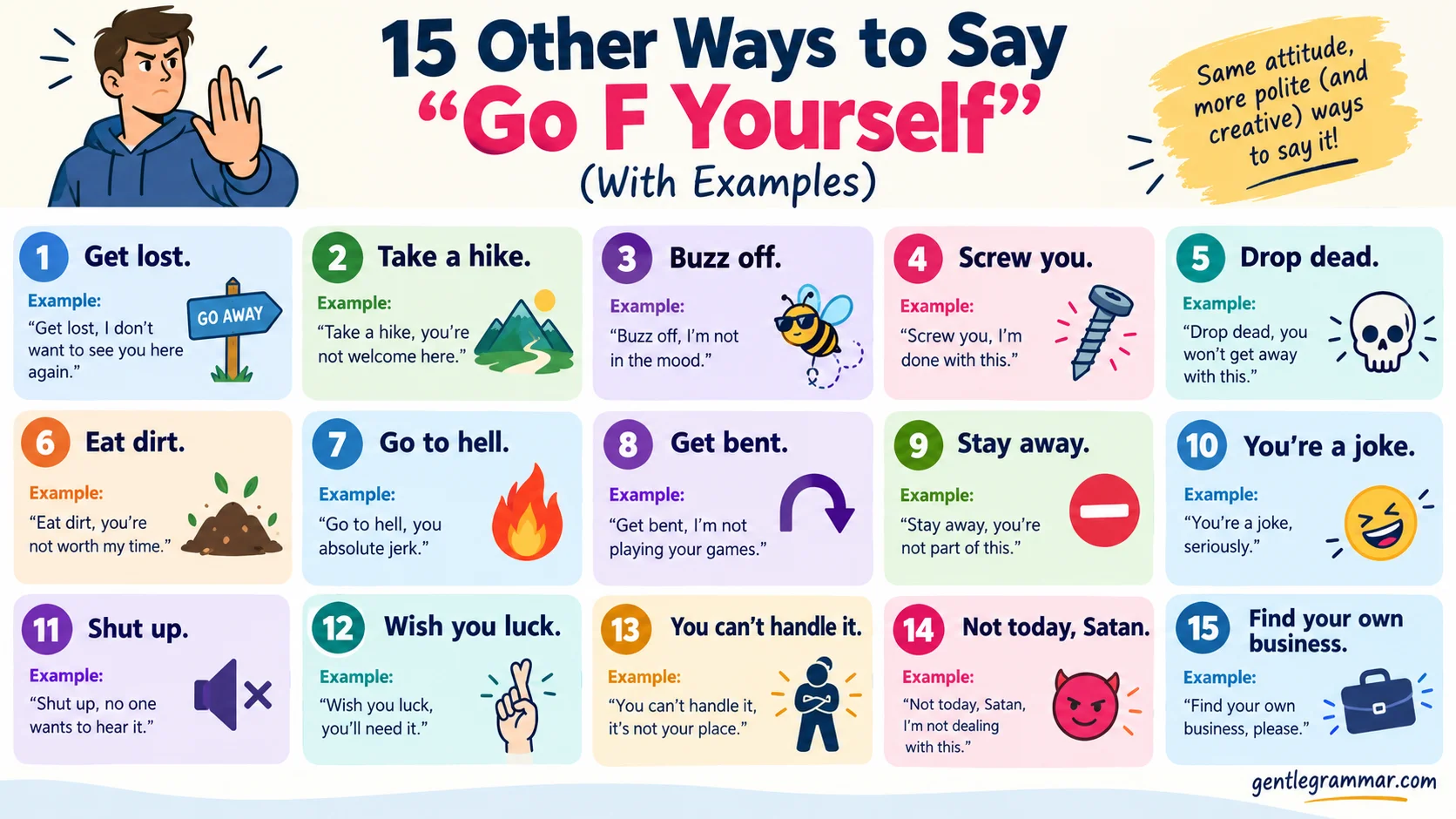
15 Other Ways to Say “Go F Yourself” (With Examples) explores how language can express anger without causing unnecessary offense or damaging relationships.
The slang expression “go fuck yourself” is an extremely direct, rude expression used to show strong frustration, anger, irritation, or emotional rejection. The dictionary meaning describes it as a crude insult, but its exact meaning depends on tone, context, relationship, culture, and delivery. Native speakers may use this phrase jokingly with close friends in casual conversations, while outsiders may find it deeply offensive or hurtful.
As an English learner, I have learned through personal experience that words, phrasing, and diction make a real difference in how people understand an English expression. When emotions run high, people may lash out with harsh language or overtly aggressive language and literally say something they regret later. Although some people value the honesty behind the phrase, it may sound like a pure insult and cause strong offense in different social situations.
What Does “Go F Yourself” Mean?
“Go F Yourself” is a vulgar, insulting expression used to show strong anger, contempt, or rejection toward another person. It is a censored form of an explicit sexual insult, commonly understood as telling someone to go away in an extremely hostile manner. Depending on the context, it can communicate that the speaker is offended, refuses to cooperate, feels disrespected, or wants to end an interaction.
The phrase is sometimes used jokingly between close friends who understand each other’s humor, but it can easily cause offense. Its meaning depends on the relationship, delivery, and situation. In most unfamiliar or professional settings, it is likely to sound aggressive and disrespectful, rather than playful or constructive. Alternatives can preserve the message of rejection while changing its emotional intensity.
Common Situations Where “Go F Yourself” Is Used
People may use this expression during heated arguments, online disputes, unwanted conversations, or moments when they feel insulted or deliberately provoked. It can also appear in private text messages, social media comments, fictional dialogue, or joking exchanges between friends with an established sense of humor.
However, the phrase is rarely suitable for workplace emails, customer service, school communication, or serious personal discussions. Someone who wants to establish a boundary may communicate more effectively by saying they are unwilling to continue the conversation, asking the other person to stop, or directly explaining what they will not tolerate. Choosing a suitable alternative helps distinguish genuine anger from playful teasing and firm boundaries from personal attacks.
Is It Professional or Polite to Say “Go F Yourself”?
“Go F Yourself” is highly informal, vulgar, and confrontational. It is neither conventionally polite nor appropriate for professional communication. In a private conversation, a person might use it to express anger or even humor, but that depends heavily on mutual understanding and the relationship between the speakers.
In professional settings, the expression can undermine trust, intensify disagreements, and make it harder to resolve a problem. If someone is behaving disrespectfully, a statement such as “Please stop speaking to me that way” communicates a clear boundary without an insult. If the goal is to end an interaction, “I don’t wish to continue this conversation” is more controlled. The best alternative depends on whether you want to reject a request, confront disrespect, express frustration, or end contact.
Advantages and Disadvantages of Saying “Go F Yourself”
Advantages
The main advantage of this expression is its immediate emotional impact. It leaves little doubt that the speaker is angry, offended, or unwilling to cooperate. In fictional dialogue or a mutually understood exchange between close friends, it can convey a character’s frustration or exaggerated comic hostility. It may also communicate a forceful rejection when the speaker does not want to soften their feelings.
Disadvantages
Its greatest disadvantage is that it can sound personally degrading and unnecessarily aggressive. The insult may shift attention away from the original problem and toward the speaker’s behavior. It is particularly risky in workplace conversations, public comments, customer interactions, and relationships where trust matters. Because it is so emotionally charged, it may also fail to communicate the precise intention behind it. A more specific expression can be stronger in practice because it explains what the speaker rejects or what behavior needs to stop.
Synonyms for “Go F Yourself”
- Get Lost
- Leave Me Alone
- Back Off
- Screw You
- Take a Hike
- Go to Hell
- Get Out of My Face
- I’m Done With You
- Don’t Bother Me Again
- I Want Nothing to Do With You
- Keep Your Opinions to Yourself
- Stop Wasting My Time
- Drop It
- Get Out of Here
- Kindly Leave Me Alone
1. Get Lost
Meaning
“Get lost” is a blunt way to tell someone to go away because you do not want their company or attention. Like the original insult, it can express anger and rejection, but it does not contain explicit sexual profanity.
Definition
A dismissive expression telling someone to leave or stop bothering you.
Detailed Explanation
This expression is useful when someone’s presence or behavior is irritating you. It is less vulgar than the original phrase, although it can still sound hostile. Unlike a neutral request to leave, it suggests that you are annoyed and do not welcome further interaction. It is most effective in informal conversation rather than polite or professional communication.
Scenario Examples
– Scenario: Someone keeps interrupting you while you are trying to concentrate.
Example: “I’ve asked you twice to stop interrupting me. Get lost.”
– Scenario: A fictional character confronts an unwanted visitor.
Example: “You have no business being here. Get lost!”
Best Use
Use it in casual arguments, informal dialogue, or fictional scenes when you want a sharp dismissal. Avoid it in professional emails or sensitive conversations.
Tone
Tone: Dismissive, irritated, confrontational.
The wording communicates that the speaker has little patience left and wants the interaction to end.
2. Leave Me Alone
Meaning
“Leave me alone” tells someone to stop contacting you, speaking to you, or interfering with your personal space. It expresses rejection without necessarily insulting the other person.
Definition
A direct request for someone to stop bothering you or give you space.
Detailed Explanation
This phrase focuses on what you want the other person to do rather than attacking their character. It can sound angry when shouted, but it can also be a reasonable boundary stated calmly. Compared with a vulgar insult, it is clearer about the speaker’s immediate need: privacy, distance, or peace. It is often a better choice when you want to end an unwanted interaction without adding another personal attack.
Scenario Examples
– Scenario: A friend keeps asking questions after you have said you need time alone.
Example: “I’m not ready to talk about this. Please leave me alone for now.”
– Scenario: Someone repeatedly sends unwanted messages.
Example: “I’ve already explained that I don’t want to continue this conversation. Leave me alone.”
Best Use
Use it for personal boundaries, unwanted messages, arguments, and situations where you need space. It also works in everyday spoken English.
Tone
Tone: Direct, firm, potentially emotional.
Adding “please” can soften the request, although your delivery and the surrounding context still matter.
3. Back Off
Meaning
“Back off” tells someone to stop pressuring, provoking, threatening, or interfering with you. It can communicate anger while emphasizing your personal boundaries.
Definition
A forceful instruction to stop interfering or give someone space.
Detailed Explanation
This expression is particularly suitable when someone refuses to respect your limits. It is more confrontational than “leave me alone” because it suggests that the other person is pushing too far. It does not automatically mean you want to end the relationship; you may simply want the unwanted behavior to stop. Its strength makes it useful in tense situations, but it can escalate an argument if delivered aggressively.
Scenario Examples
– Scenario: A colleague continues pressuring you to accept extra work.
Example: “I’ve explained my workload already. Back off and let me manage my priorities.”
– Scenario: Someone is provoking you during an argument.
Example: “Back off. I’m not interested in fighting with you.”
Best Use
Use it when someone is pressuring you, crossing boundaries, or deliberately provoking you. It is not a polite substitute for routine workplace requests.
Tone
Tone: Assertive, forceful, defensive.
The expression signals that a boundary has been crossed and that the behavior needs to stop.
4. Screw You
Meaning
“Screw you” is a rude expression of anger, contempt, or defiance. It is one of the closer alternatives in emotional force to the original phrase, although it uses different wording.
Definition
An insulting expression used to reject someone angrily or show strong disrespect.
Detailed Explanation
This phrase communicates hostility toward the person rather than simply asking them to leave. It can also express defiance when someone makes an unreasonable demand or treats you unfairly. While it avoids the original phrase’s explicit wording, it remains offensive and is not appropriate for most professional settings. The expression can sometimes be used jokingly among close friends, but that interpretation depends on shared humor and trust.
Scenario Examples
– Scenario: Someone takes credit for your work and then mocks you.
Example: “You know exactly what you did. Screw you for pretending otherwise.”
– Scenario: A character rejects a manipulative demand in a drama.
Example: “You don’t get to control my life. Screw you!”
Best Use
Use it sparingly in heated informal arguments or fictional dialogue. Avoid it in workplace discussions, customer messages, and situations where you want to preserve a relationship.
Tone
Tone: Hostile, defiant, insulting.
It expresses strong resentment and can make reconciliation more difficult.
5. Take a Hike
Meaning
“Take a hike” is an informal way to tell someone to go away. It can communicate annoyance or rejection, often with a slightly old-fashioned or playful flavor.
Definition
A dismissive expression meaning that someone should leave or stop bothering you.
Detailed Explanation
This phrase is generally less aggressive than a direct vulgar insult. It can sound humorous in a lighthearted exchange or dismissive in a serious disagreement. Its meaning centers on sending someone away rather than expressing the full depth of your anger. Because it is idiomatic and informal, it sounds more natural in conversation than in formal writing.
Scenario Examples
– Scenario: Someone keeps trying to sell you something after you have refused.
Example: “I’m not interested, and I’ve said so already. Take a hike.”
– Scenario: A character responds to an annoying rival.
Example: “Go bother someone else and take a hike.”
Best Use
Use it in casual conversation, comedy, informal storytelling, or mild confrontations. It is less suitable for serious professional disagreements.
Tone
Tone: Dismissive, informal, sometimes playful.
The phrase can deliver rejection with less intensity than a profanity-heavy insult.
6. Go to Hell
Meaning
“Go to hell” is a strong insult expressing anger, contempt, or resentment toward another person. It is emotionally forceful but does not literally instruct someone to leave a physical location.
Definition
An angry expression of rejection or hostility toward someone.
Detailed Explanation
This expression can be as confrontational as the original phrase, particularly during a personal dispute. It conveys a wish to reject or condemn the other person rather than merely end a conversation. In some fictional or dramatic settings, it creates a strong emotional moment. However, it is not a polite alternative and can be especially hurtful when directed at someone with whom you have a close relationship.
Scenario Examples
– Scenario: Someone betrays a character’s trust in a story.
Example: “After everything I did for you, you lied to me? Go to hell!”
– Scenario: A person angrily rejects an unreasonable demand.
Example: “You expect me to take the blame for your mistake? Go to hell.”
Best Use
Use it in fiction, dramatic dialogue, or highly emotional informal disputes when strong hostility is intended. It is unsuitable for polite or professional communication.
Tone
Tone: Angry, contemptuous, emotionally intense.
It conveys condemnation rather than a simple request for distance.
7. Get Out of My Face
Meaning
“Get out of my face” tells someone to move away or stop confronting you. It often suggests that the speaker feels provoked, overwhelmed, or unwilling to tolerate further interaction.
Definition
A forceful request for someone to stop confronting you and give you physical or emotional space.
Detailed Explanation
This expression is more specific than a general insult because it emphasizes the other person’s immediate presence or confrontation. It may be used when someone is arguing aggressively, invading personal space, or refusing to let a disagreement end. Although it does not contain explicit profanity, it can sound threatening or intimidating depending on the delivery. A calmer alternative is “I need some space right now.”
Scenario Examples
– Scenario: Two people are arguing, and one keeps moving closer.
Example: “You’re getting too close. Get out of my face.”
– Scenario: A person continues confronting you after you have asked for a break.
Example: “I’m too upset to discuss this. Get out of my face and give me a minute.”
Best Use
Use it in tense face-to-face confrontations or dramatic dialogue. For a calmer boundary, request space directly.
Tone
Tone: Aggressive, defensive, urgent.
Its intensity comes from the demand for immediate distance.
8. I’m Done With You
Meaning
“I’m done with you” communicates that you no longer want to engage with someone, often because of repeated disappointment, betrayal, or frustration.
Definition
A statement that you have reached your limit and want to end an interaction or relationship.
Detailed Explanation
Unlike a simple dismissal, this expression can suggest a more lasting decision. It may mean that you are ending an argument, withdrawing from a friendship, or refusing to tolerate repeated behavior. The phrase does not necessarily involve profanity, but it can carry significant emotional weight. If you only need a short break, saying so explicitly prevents the other person from interpreting your words as a permanent rejection.
Scenario Examples
– Scenario: A friend repeatedly breaks promises.
Example: “I’ve given you several chances, and nothing has changed. I’m done with you.”
– Scenario: A person ends an argument with someone who refuses to listen.
Example: “We’re going in circles, and you won’t hear me out. I’m done with you for tonight.”
Best Use
Use it in serious personal disagreements, relationship conversations, or moments when you have reached your limit. Clarify your intention if you mean to end only the current conversation.
Tone
Tone: Final, disappointed, emotionally firm.
It communicates exhaustion with a person or an ongoing pattern of behavior.
9. Don’t Bother Me Again
Meaning
“Don’t bother me again” tells someone not to contact or disturb you in the future. It expresses a stronger and potentially longer-lasting boundary than asking for a moment of privacy.
Definition
A firm instruction for someone to stop contacting or disturbing you.
Detailed Explanation
This expression is useful when someone repeatedly ignores your requests for space. It focuses on future contact rather than simply expressing anger about the present situation. The phrase can be appropriate when you need to end unwanted communication, but it may sound severe if used in response to a minor disagreement. If you want the request to be unmistakable, specify the type of contact you want to stop.
Scenario Examples
– Scenario: Someone continues sending messages after being asked to stop.
Example: “I’ve made my decision. Don’t bother me again.”
– Scenario: A person ends contact after repeated unwanted visits.
Example: “Please don’t come to my home or contact me again.”
Best Use
Use it for repeated unwanted contact, serious personal boundaries, and ending communication. In sensitive situations, state the boundary clearly and avoid unnecessary insults.
Tone
Tone: Firm, final, uncompromising.
The wording signals that the speaker does not want the unwanted interaction to continue.
10. I Want Nothing to Do With You
Meaning
“I want nothing to do with you” expresses a strong refusal to associate with, cooperate with, or maintain a relationship with someone.
Definition
A declaration that you do not want involvement or contact with a particular person.
Detailed Explanation
This phrase goes beyond telling someone to leave you alone for a moment. It communicates a broader rejection of the person’s involvement in your life or activities. It can be appropriate after a serious breach of trust, although it may sound extreme during a temporary disagreement. Unlike a profanity-based insult, it makes the speaker’s intention more explicit: they do not want a relationship or association to continue.
Scenario Examples
– Scenario: Someone discovers that an acquaintance has repeatedly deceived them.
Example: “Now that I know the truth, I want nothing to do with you.”
– Scenario: A person refuses to join a dishonest scheme.
Example: “If your plan involves cheating people, I want nothing to do with you.”
Best Use
Use it when rejecting an association, distancing yourself from misconduct, or ending a relationship. It is less suitable when you only need a short break from a conversation.
Tone
Tone: Resolute, rejecting, serious.
The phrase communicates a clear decision rather than a momentary burst of irritation.
11. Keep Your Opinions to Yourself
Meaning
“Keep your opinions to yourself” tells someone that you do not want to hear their views, especially when their comments are unwanted, intrusive, or insulting.
Definition
A blunt instruction asking someone to stop sharing their opinions with you.
Detailed Explanation
This expression is more specific than a general insult because it targets unwanted commentary. It may be appropriate when someone repeatedly criticizes your personal choices or offers advice you have not requested. However, it does not necessarily mean you want the person to leave or end the relationship. It can also sound dismissive of reasonable feedback, so a more constructive response may be preferable when discussing work or shared responsibilities.
Scenario Examples
– Scenario: Someone repeatedly criticizes your appearance.
Example: “I’ve made my own choices about how I look. Keep your opinions to yourself.”
– Scenario: A friend continues giving unsolicited relationship advice.
Example: “I appreciate that you care, but please keep your opinions to yourself unless I ask.”
Best Use
Use it when rejecting unsolicited advice, intrusive comments, or unwanted personal criticism. In professional discussions, specify which comments are inappropriate instead of rejecting all feedback.
Tone
Tone: Blunt, defensive, dismissive.
The expression makes it clear that the speaker does not welcome the other person’s commentary.
12. Stop Wasting My Time
Meaning
“Stop wasting my time” expresses frustration with someone whose actions, delays, or behavior you consider unproductive or dishonest.
Definition
A direct demand for someone to stop engaging in behavior that you believe is wasting your time.
Detailed Explanation
This phrase focuses on the person’s behavior and its effect on you rather than using a personal insult alone. It can be effective when someone repeatedly breaks commitments, avoids answering questions, or delays an important decision. However, it sounds accusatory and may make a disagreement more heated. If you want to preserve a working relationship, explaining what needs to happen next can be more useful than simply expressing frustration.
Scenario Examples
– Scenario: A seller repeatedly changes the agreed price.
Example: “We agreed on the amount yesterday. Stop wasting my time and give me a clear answer.”
– Scenario: Someone keeps making promises without taking action.
Example: “We’ve discussed this three times already. I need a real solution, not another excuse. Stop wasting my time.”
Best Use
Use it in frustrating negotiations, informal disputes, or conversations involving repeated delays. For professional communication, describe the deadline or action required.
Tone
Tone: Impatient, demanding, confrontational.
The phrase communicates that you expect more direct and productive behavior.
13. Drop It
Meaning
“Drop it” tells someone to stop discussing a subject or bringing up an issue. It expresses a desire to end the conversation about a particular topic.
Definition
A direct instruction to stop talking about or pursuing a specific matter.
Detailed Explanation
This expression differs from a personal insult because it focuses on ending a discussion rather than rejecting the person. It is useful when an argument is becoming repetitive or when a subject is private and you do not want to discuss it. Depending on the delivery, it can sound calm, impatient, or hostile. It also does not automatically resolve the underlying disagreement; it simply asks the other person to stop pursuing the topic.
Scenario Examples
– Scenario: A sibling keeps teasing you about a personal mistake.
Example: “I’ve heard enough jokes about that. Drop it.”
– Scenario: Two colleagues keep revisiting a decision that has already been settled.
Example: “We’ve agreed on the next steps, so let’s drop it and move forward.”
Best Use
Use it when ending repetitive arguments, stopping unwanted teasing, or moving away from an unproductive subject. In formal settings, “Let’s move on to the next issue” is often more tactful.
Tone
Tone: Direct, impatient, occasionally authoritative.
The phrase is about stopping a discussion, not necessarily ending a relationship.
14. Get Out of Here
Meaning
“Get out of here” can tell someone to leave a place or, in a more figurative use, express disbelief or surprise. When used angrily, it can function as a blunt dismissal.
Definition
A phrase that can mean leaving a location or reacting with disbelief, depending on the context.
Detailed Explanation
Context is especially important with this expression. In an argument, it may be a forceful command for someone to leave, making it a possible alternative to an angry dismissal. In friendly conversation, however, it can mean “Really?” or “You must be joking!” and may convey amusement rather than hostility. Because these meanings differ significantly, the speaker’s tone and the surrounding words determine how the phrase is understood.
Scenario Examples
– Scenario: An unwanted visitor refuses to respect a household’s rules.
Example: “You’ve been asked to stop shouting. Get out of here if you can’t respect everyone.”
– Scenario: A friend shares an unbelievable piece of news.
Example: “Get out of here! You actually won the competition?”
Best Use
Use the phrase for informal dismissals or expressions of surprise, making sure the context clarifies your meaning. For a more precise request, say “Please leave.”
Tone
Tone: Dismissive or surprised, depending on delivery.
It can be confrontational in an argument but playful among friends.
15. Kindly Leave Me Alone
Meaning
“Kindly leave me alone” asks someone to stop bothering you while maintaining a more controlled and courteous style than an insult.
Definition
A polite-sounding but firm request for personal space and an end to unwanted interaction.
Detailed Explanation
The word “kindly” gives this expression a restrained, sometimes formal quality, although it can sound sarcastic when spoken sharply. The message itself remains direct: you do not want further interaction at that moment. It is useful when you want to maintain composure while communicating a clear boundary. Compared with a vulgar dismissal, it reduces the likelihood that your wording will become the main issue in a disagreement.
Scenario Examples
– Scenario: Someone continues questioning you about a private matter at a social gathering.
Example: “I don’t wish to discuss my personal life. Kindly leave me alone.”
– Scenario: A person keeps interrupting you while you are working.
Example: “I’m trying to finish an important task. Kindly leave me alone until I’m done.”
Best Use
Use it in controlled disagreements, formal-sounding personal requests, and situations where you want distance without profanity. For a warmer tone, “Please give me some space” may sound more natural.
Tone
Tone: Restrained, firm, potentially formal.
Its value lies in expressing a boundary without resorting to vulgar language, though the delivery can still affect how polite it sounds.
FAQs:
What is another way to say “Go F Yourself”?
Some alternatives include “Get lost,” “Back off,” “Screw you,” “Leave me alone,” and “I’m done with you.” Each communicates a different level of anger or rejection. Choose one based on whether you want to express frustration, establish a boundary, or end a relationship.
What does “Go F Yourself” mean?
It is a vulgar insult used to express anger, contempt, or strong rejection. It usually tells someone that the speaker wants nothing to do with them or refuses to cooperate. Depending on the relationship, it may occasionally be used jokingly, but it is generally offensive.
Is “Go F Yourself” professional?
No. It is generally considered unprofessional and disrespectful, especially in workplace emails, customer service, and formal discussions. A phrase such as “I disagree with your approach” or “I don’t wish to continue this conversation” communicates disagreement without using an insult.
What is a more polite way to say “Go F Yourself”?
“Kindly leave me alone” is a controlled alternative, while “Please stop speaking to me that way” is useful when someone is being disrespectful. If you simply need space, “I need some time alone” expresses your preference without sounding hostile.
Which alternative works best in formal communication?
For formal communication, “I don’t wish to continue this conversation” is a useful choice when you need to end an interaction. If someone has crossed a boundary, “Please respect my boundaries” may be more appropriate. These expressions are not exact synonyms, but they communicate rejection or disengagement in a more professional manner.
Conclusion:
Choosing the right words can make a significant difference when expressing anger, frustration, or rejection. Although “Go F Yourself” conveys strong emotions, its vulgarity can distract from your message and turn a disagreement into a more serious conflict. Alternatives such as “Back off,” “Leave me alone,” and “I’m done with you” allow you to communicate different intentions, from requesting personal space to ending a relationship.
Remember that similar expressions do not always have the same meaning. Some sound playful, others are confrontational, and a few offer a more controlled way to establish boundaries. Before choosing an expression, consider your relationship with the other person, the seriousness of the situation, and the result you want.
