
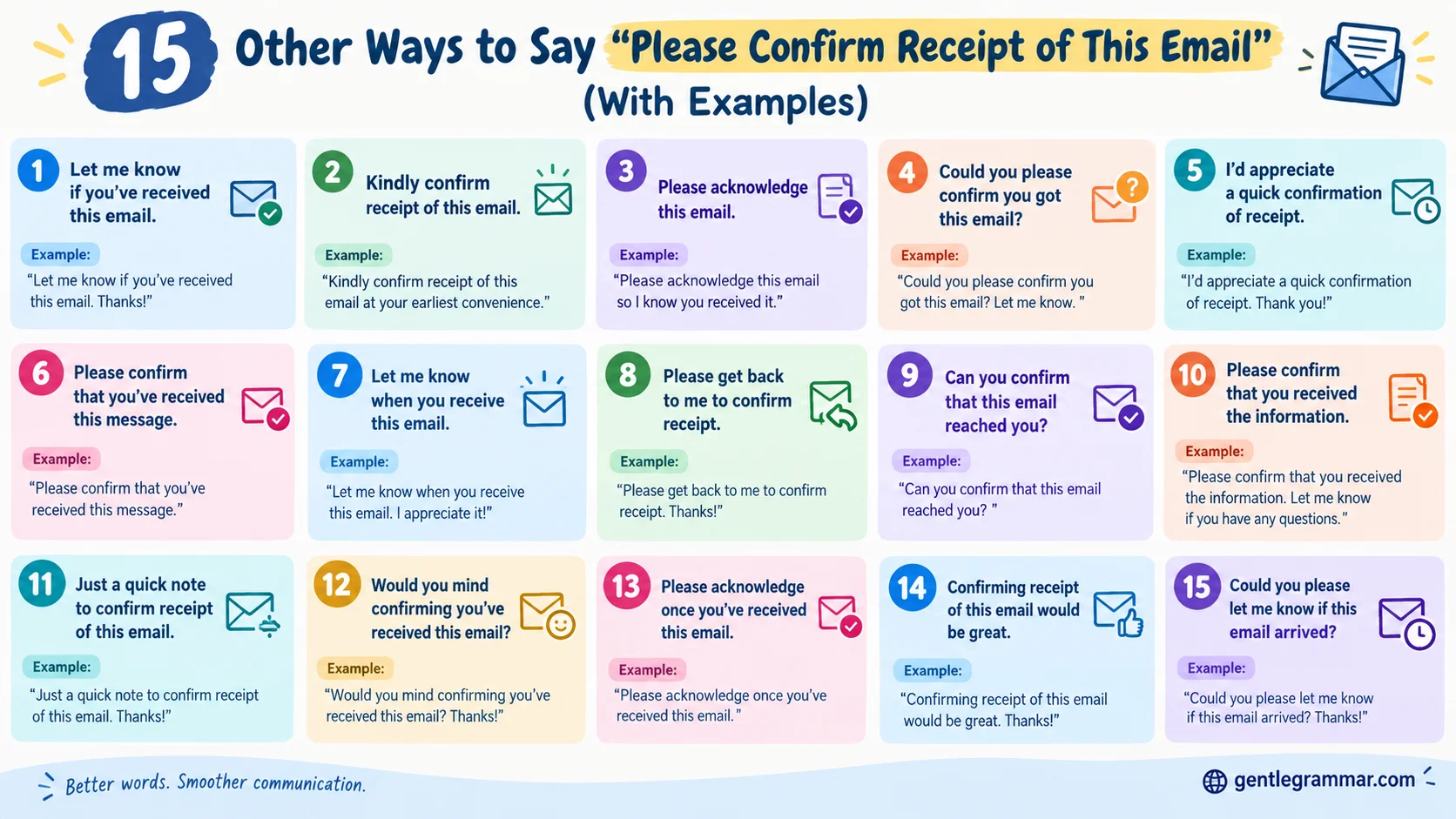
15 Other Ways to Say “Please Confirm Receipt of This Email” (With Examples) helps you choose the right words for professional communication and everyday emails.
In my experience emailing clients, colleagues, HR, managers, and external partners, a simple request can completely change the tone of a conversation. The widely used phrase “please confirm receipt of this email” is common in formal communication, contract discussions, document submission, and time-sensitive correspondence. However, alternative phrases such as “Could you kindly confirm once received.
Kindly confirm receipt,” “Please acknowledge receipt,” and “Confirm once received” can make a message sound more human, polite, respectful, and thoughtful. These professional options and refined alternatives help the sender request an email acknowledgment or receipt confirmation without sounding pushy. Choosing appropriate wording, concise wording, and a courteous expression supports clear communication, effective communication, and professional etiquette.
What Does “Please Confirm Receipt of This Email” Mean?
“Please confirm receipt of this email” means asking someone to acknowledge that they have received your email. The sender wants confirmation that the message has reached the recipient and, ideally, that the recipient is aware of it. This request does not automatically mean that the recipient has read the entire email, understood its contents, or agreed with the information.
The phrase is commonly used when sending important documents, work instructions, official notices, or time-sensitive information. The word “please” adds politeness, while “confirm receipt” communicates a specific request. Depending on the situation, you might prefer a simpler expression such as “Please let me know you received this” or a more formal option such as “Kindly acknowledge receipt.”
Common Situations Where “Please Confirm Receipt of This Email” Is Used
This expression is useful when the sender needs clear acknowledgment rather than a detailed response. For example, a manager might use it when sending updated procedures, a business might request confirmation after delivering a contract, or a student might ask a professor to acknowledge an important submission.
It can also appear in customer communication, administrative correspondence, and formal email exchanges. However, repeating the same wording in every message can make communication feel mechanical. A shorter phrase may work better with colleagues, while a more formal expression may suit official documents. Choosing an alternative helps you match your language to the recipient and the importance of the message.
Is It Professional or Polite to Say “Please Confirm Receipt of This Email”?
Yes, “Please confirm receipt of this email” is generally professional and polite. It clearly states what the sender expects and is appropriate for workplace correspondence, business transactions, and formal requests. It is particularly useful when a record of acknowledgment matters.
However, its tone can feel somewhat formal, especially in everyday conversations with familiar colleagues or friends. In those situations, “Please let me know when you receive this” may sound more natural. If you are writing to a senior colleague, client, or official organization, “Kindly acknowledge receipt” can be suitable, although it may sound more formal. The best wording depends on the relationship, the message’s importance, and whether you need acknowledgment, a response, or confirmation that the recipient has read the email.
Advantages and Disadvantages of Saying “Please Confirm Receipt of This Email”
Advantages
- Clear purpose: The recipient knows that you need acknowledgment.
- Professional tone: It suits formal and business correspondence.
- Useful documentation: It encourages a written record that the message was received.
- Reduced uncertainty: It helps the sender follow up if confirmation does not arrive.
Disadvantages
- Can sound formal: The phrase may feel stiff in casual correspondence.
- May seem demanding: Without context, it can sound like an instruction rather than a friendly request.
- Does not confirm understanding: Receiving an email is different from reading or agreeing with its contents.
- Can feel repetitive: Using the same expression in every email may make your writing less personal.
15 Alternatives to “Please Confirm Receipt of This Email”
- Please acknowledge receipt of this email.
- Kindly confirm that you have received this email.
- Please let me know once you receive this email.
- Could you confirm that this email reached you?
- Please reply to confirm receipt.
- Kindly acknowledge receipt of the attached document.
- Please confirm that you received the information.
- Let me know when this comes through.
- Please send a quick acknowledgment.
- I would appreciate confirmation of receipt.
- Please let me know that you have received my message.
- Could you kindly acknowledge this email?
- Please confirm that the email came through successfully.
- A brief confirmation of receipt would be appreciated.
- Please let me know once you have received and reviewed this email.
1. Please Acknowledge Receipt of This Email
Meaning
This expression asks the recipient to formally acknowledge that an email has been received. It is a close alternative to the original phrase and is especially suitable for official communication.
Definition
A polite, formal request for written acknowledgment that an email has arrived.
Detailed Explanation
“Please acknowledge receipt of this email” emphasizes formal acknowledgment rather than simply checking whether a message arrived. It is appropriate when a record of receipt matters, such as during administrative procedures or business transactions. The wording is more formal than “Let me know when you get this.” It does not necessarily ask the recipient to review or respond to the email’s contents.
Scenario Examples
Scenario 1: Sending an official notice
Example: “Please acknowledge receipt of this email regarding the updated company policy.”
Scenario 2: Sharing a signed agreement
Example: “I’ve attached the signed agreement. Please acknowledge receipt for our records.”
Scenario 3: University administration
Example: “Please acknowledge receipt of the completed application form.”
Best Use
Use this phrase in formal emails, official notices, administrative correspondence, and business transactions where a clear record of acknowledgment is useful.
Tone
Tone: Formal, professional, direct.
It communicates a clear expectation while maintaining a respectful business tone.
2. Kindly Confirm That You Have Received This Email
Meaning
This phrase politely asks the recipient to confirm that the email has arrived. It emphasizes courtesy and clear acknowledgment.
Definition
A respectful request for confirmation that someone has received an email.
Detailed Explanation
Adding “kindly” gives the request a courteous, formal feel. This wording works well when communicating with clients, senior colleagues, or people you do not know well. It is slightly more conversational than “Please acknowledge receipt,” because it uses the familiar verb “received.” However, “kindly” can sound stiff in some workplaces, so a simpler alternative may feel more natural in a friendly exchange.
Scenario Examples
Scenario 1: Contacting a client
Example: “Kindly confirm that you have received this email containing the revised quotation.”
Scenario 2: Sending a project update
Example: “Kindly confirm that you have received this email before tomorrow’s meeting.”
Scenario 3: Following up with an administrator
Example: “Kindly confirm that you have received my registration details.”
Best Use
Choose this expression for formal business emails, customer correspondence, and respectful requests to people you do not communicate with casually.
Tone
Tone: Courteous, professional, respectful.
The wording makes the request polite without hiding what you need from the recipient.
3. Please Let Me Know Once You Receive This Email
Meaning
This expression asks the recipient to tell you when the email arrives. It sounds more conversational and approachable than the original phrase.
Definition
A request for the recipient to notify the sender after receiving an email.
Detailed Explanation
Unlike “confirm receipt,” this wording sounds more like an ordinary conversation. It is particularly helpful when the recipient is a colleague or someone with whom you have an established working relationship. “Once you receive” also suggests that acknowledgment can happen when the message arrives, rather than immediately. It is a natural choice when you want to avoid overly formal language while still making your request clear.
Scenario Examples
Scenario 1: Sharing a work schedule
Example: “I’ve emailed you the updated schedule. Please let me know once you receive this email.”
Scenario 2: Sending a school assignment
Example: “I’ve sent the assignment instructions to your school email. Please let me know once you receive them.”
Scenario 3: Coordinating with a colleague
Example: “I just forwarded the meeting details. Please let me know once you receive the email.”
Best Use
Use this phrase in everyday professional communication, school correspondence, and friendly work emails.
Tone
Tone: Friendly, polite, conversational.
It encourages a simple acknowledgment without making the message sound like an official instruction.
4. Could You Confirm That This Email Reached You?
Meaning
This question asks whether the email successfully reached the recipient. It focuses on delivery and receipt rather than the content itself.
Definition
A polite question asking someone to verify that an email arrived.
Detailed Explanation
Using “could you” softens the request and makes it sound less like a command. This expression is useful when you are uncertain whether an email was delivered or when previous messages may have been missed. It is slightly more cautious than “Please confirm receipt.” The phrase does not necessarily ask the recipient to read or respond to the email’s contents.
Scenario Examples
Scenario 1: Following up after a technical issue
Example: “My email service was having problems earlier. Could you confirm that this email reached you?”
Scenario 2: Sending a travel itinerary
Example: “I’ve sent the final itinerary for our trip. Could you confirm that this email reached you?”
Scenario 3: Checking a business message
Example: “I forwarded the pricing details this morning. Could you confirm that this email reached you?”
Best Use
Choose this wording when delivery is uncertain, especially after technical problems or when sending important information.
Tone
Tone: Polite, considerate, gently direct.
The question format makes the request feel collaborative rather than demanding.
5. Please Reply to Confirm Receipt
Meaning
This phrase asks the recipient to send a reply specifically to acknowledge that an email has been received.
Definition
A direct request for a written response confirming email receipt.
Detailed Explanation
This alternative is particularly clear because it tells the recipient exactly what action to take: reply to the message. It works well when you need a written acknowledgment rather than an informal indication that the email arrived. Compared with “Let me know when you receive this,” it sounds more direct and procedural. It does not imply that the recipient needs to provide a detailed answer.
Scenario Examples
Scenario 1: Sending an event invitation
Example: “Please reply to confirm receipt of the invitation and event details.”
Scenario 2: Sharing important instructions
Example: “Please reply to confirm receipt so I know the updated instructions reached everyone.”
Scenario 3: Sending an appointment confirmation
Example: “Your appointment details are attached. Please reply to confirm receipt.”
Best Use
Use this phrase for official instructions, event arrangements, administrative messages, and situations requiring a written acknowledgment.
Tone
Tone: Direct, professional, practical.
It establishes a clear next step and reduces uncertainty about how the recipient should respond.
6. Kindly Acknowledge Receipt of the Attached Document
Meaning
This expression asks someone to confirm receiving a particular attachment rather than the entire email.
Definition
A formal request for acknowledgment that an attached file or document has been received.
Detailed Explanation
This wording is more specific than the original phrase because it identifies the attached document as the item that needs acknowledgment. It is helpful when the email contains a contract, report, invoice, application, or other important file. The word “kindly” adds a formal and courteous touch. Because it refers to an attachment, it should not be used when you only need confirmation that the email itself arrived.
Scenario Examples
Scenario 1: Sending an invoice
Example: “Kindly acknowledge receipt of the attached invoice for your records.”
Scenario 2: Submitting a contract
Example: “I’ve attached the revised contract. Kindly acknowledge receipt of the attached document.”
Scenario 3: Sharing a project report
Example: “Kindly acknowledge receipt of the attached document before the review meeting.”
Best Use
This phrase is ideal for legal correspondence, invoices, reports, contracts, and formal document submissions.
Tone
Tone: Formal, courteous, administrative.
Its precise wording makes it suitable when the attachment itself is the main concern.
7. Please Confirm That You Received the Information
Meaning
This phrase asks the recipient to verify that specific information has been received. The focus is on the information being communicated, not just the email.
Definition
A request to confirm that particular details, instructions, or information have reached the recipient.
Detailed Explanation
This alternative works well when the email contains details that the recipient needs to know, such as a deadline, schedule, policy change, or set of instructions. It is broader than “confirm receipt of this email” because the sender is interested in whether the information reached the recipient. However, receipt does not guarantee that the recipient has understood or acted on it. If understanding matters, ask the recipient to confirm that they have reviewed the information.
Scenario Examples
Scenario 1: Communicating a deadline
Example: “The submission deadline has changed to Friday. Please confirm that you received the information.”
Scenario 2: Updating a team
Example: “I’ve shared the revised shift schedule. Please confirm that you received the information.”
Scenario 3: Informing a customer
Example: “We’ve sent the updated delivery details. Please confirm that you received the information.”
Best Use
Use this wording for important updates, workplace instructions, schedule changes, and customer notifications.
Tone
Tone: Professional, clear, matter-of-fact.
It directs attention to the information that the recipient needs to receive.
8. Let Me Know When This Comes Through
Meaning
This casual expression asks someone to tell you when a message or file arrives successfully.
Definition
An informal request to notify the sender when an email or other electronic item is received.
Detailed Explanation
“Comes through” is a conversational expression often used for messages, emails, and digital files. It sounds less formal than “confirm receipt” and is especially natural among colleagues who communicate regularly. It can also be useful when there is a possibility of a delivery issue. However, it may be too casual for official correspondence or situations where a documented acknowledgment is required.
Scenario Examples
Scenario 1: Sending a large file
Example: “I’ve sent the presentation separately. Let me know when this comes through.”
Scenario 2: Messaging a teammate
Example: “I just emailed the updated slides. Let me know when this comes through.”
Scenario 3: Sharing a personal document
Example: “I sent the photos to your email. Let me know when they come through.”
Best Use
Choose this phrase for casual workplace chats, familiar colleagues, and everyday digital communication.
Tone
Tone: Casual, friendly, relaxed.
Its natural conversational style makes it feel less like a formal instruction.
9. Please Send a Quick Acknowledgment
Meaning
This expression asks the recipient to send a short message acknowledging receipt or recognizing that the message has been received.
Definition
A request for a brief written acknowledgment, usually without a detailed response.
Detailed Explanation
The word “quick” communicates that a short reply is sufficient. This can save time when the recipient does not need to answer a question or discuss the email’s contents. Unlike the original phrase, this wording emphasizes the brevity of the response. The exact meaning of “acknowledgment” depends on context, so if you need confirmation of receipt specifically, make that purpose explicit.
Scenario Examples
Scenario 1: Sending an internal memo
Example: “I’ve circulated the new office guidelines. Please send a quick acknowledgment when you receive them.”
Scenario 2: Coordinating a team project
Example: “Please send a quick acknowledgment so I can finalize the distribution list.”
Scenario 3: Sharing an updated schedule
Example: “The revised timetable is attached. Please send a quick acknowledgment of receipt.”
Best Use
Use this expression for team updates, administrative emails, internal notices, and situations where a short reply is enough.
Tone
Tone: Efficient, professional, direct.
It sets a modest expectation without asking the recipient for an unnecessarily long response.
10. I Would Appreciate Confirmation of Receipt
Meaning
This phrase politely expresses that receiving confirmation would be helpful or important to the sender.
Definition
A courteous request for acknowledgment that a message or document has been received.
Detailed Explanation
“I would appreciate” softens the request by presenting confirmation as something the sender values. It can be a good alternative when writing to a client, business partner, or senior colleague. The wording is more formal than “Please let me know,” but it generally sounds less commanding than a blunt instruction. It is especially appropriate when you want to remain respectful while making your expectation clear.
Scenario Examples
Scenario 1: Sending a proposal
Example: “I’ve attached our project proposal. I would appreciate confirmation of receipt.”
Scenario 2: Corresponding with a supplier
Example: “The revised purchase order is included. I would appreciate confirmation of receipt at your convenience.”
Scenario 3: Submitting an official form
Example: “I have submitted the completed form by email and would appreciate confirmation of receipt.”
Best Use
This phrase suits formal business correspondence, client communication, proposals, and official submissions.
Tone
Tone: Courteous, polished, professional.
It conveys a clear request while giving the recipient a sense of consideration and respect.
11. Please Let Me Know That You Have Received My Message
Meaning
This expression asks the recipient to tell the sender that a message has arrived. It can refer to an email or another form of communication.
Definition
A polite request for confirmation that a message has been received.
Detailed Explanation
This wording is broader than the original because it refers to a “message” rather than specifically to an email. That makes it useful when the conversation includes emails, messaging platforms, or forwarded communications. It sounds personal and straightforward, particularly when you already know the recipient. If the message is highly formal or concerns an official record, a more precise expression may be preferable.
Scenario Examples
Scenario 1: Contacting a colleague
Example: “I’ve sent you the updated figures. Please let me know that you have received my message.”
Scenario 2: Coordinating a family event
Example: “I emailed everyone the new dinner time. Please let me know that you have received my message.”
Scenario 3: Sending a school notice
Example: “The schedule for the parent meeting is attached. Please let me know that you have received my message.”
Best Use
Choose this expression for personal emails, everyday workplace communication, school correspondence, and general follow-ups.
Tone
Tone: Friendly, clear, polite.
It sounds personal without being overly casual or excessively formal.
12. Could You Kindly Acknowledge This Email?
Meaning
This phrase politely asks the recipient to acknowledge the email. It is particularly useful when the sender wants an acknowledgment but does not need a detailed response.
Definition
A courteous request for the recipient to recognize or confirm receipt of an email.
Detailed Explanation
The question form “Could you” softens the request, while “kindly acknowledge” keeps the wording formal. Compared with “Please reply to confirm receipt,” it does not explicitly require a reply, so the recipient may interpret acknowledgment more broadly. For clarity, this expression is best used when a simple acknowledgment is sufficient. If you need a written confirmation for recordkeeping, specify that a reply is required.
Scenario Examples
Scenario 1: Sending an internal announcement
Example: “Could you kindly acknowledge this email about the upcoming office closure?”
Scenario 2: Following up with a business contact
Example: “Could you kindly acknowledge this email so I know the revised terms have reached you?”
Scenario 3: Sharing a meeting notice
Example: “Could you kindly acknowledge this email regarding tomorrow’s meeting?”
Best Use
Use this wording in formal workplace emails, administrative correspondence, and polite follow-ups.
Tone
Tone: Respectful, formal, considerate.
The question structure softens the request while maintaining a professional style.
13. Please Confirm That the Email Came Through Successfully
Meaning
This phrase asks the recipient to confirm that an email arrived without an apparent delivery problem.
Definition
A request to verify the successful delivery of an email.
Detailed Explanation
The phrase “came through successfully” places special emphasis on successful delivery. It is useful when sending files, important messages, or information after experiencing email problems. Unlike a general acknowledgment request, it draws attention to whether the message arrived as intended. However, it does not prove that an attachment opens correctly or that the email has been read, so ask a separate question if those details matter.
Scenario Examples
Scenario 1: Sending a presentation
Example: “I’ve emailed the final presentation. Please confirm that the email came through successfully.”
Scenario 2: Resending a document
Example: “I had trouble sending the file earlier. Please confirm that the email came through successfully this time.”
Scenario 3: Sharing a confirmation notice
Example: “Your updated booking details have been sent. Please confirm that the email came through successfully.”
Best Use
Choose this phrase when email delivery is uncertain, attachments are important, or a message has been resent.
Tone
Tone: Practical, polite, direct.
It communicates a specific concern about delivery rather than simply asking for a general acknowledgment.
14. A Brief Confirmation of Receipt Would Be Appreciated
Meaning
This expression politely indicates that the sender would value a short acknowledgment that an email or document has arrived.
Definition
A formal statement requesting a brief confirmation of receipt.
Detailed Explanation
This wording uses an indirect construction, making it less like a direct command. It is particularly suitable for official or business correspondence where a measured tone is preferred. The phrase “brief confirmation” also suggests that a short acknowledgment is enough. Although it is polite, it can sound impersonal or somewhat bureaucratic in a casual conversation, so a simpler request may work better with familiar recipients.
Scenario Examples
Scenario 1: Sending a formal proposal
Example: “Please find the proposal attached. A brief confirmation of receipt would be appreciated.”
Scenario 2: Submitting business paperwork
Example: “The completed documents are attached. A brief confirmation of receipt would be appreciated for our records.”
Scenario 3: Contacting an organization
Example: “I’ve emailed the requested information. A brief confirmation of receipt would be appreciated.”
Best Use
This expression works well in formal letters, business emails, administrative submissions, and official correspondence.
Tone
Tone: Formal, diplomatic, reserved.
The indirect wording keeps the request courteous, although it may feel less personal than a direct question.
15. Please Let Me Know Once You Have Received and Reviewed This Email
Meaning
This expression asks the recipient to confirm not only receipt but also that they have reviewed the email.
Definition
A request for acknowledgment that an email has been received and read or reviewed.
Detailed Explanation
This alternative goes beyond the original phrase because it asks the recipient to receive and review the message. It is useful when the email contains instructions, decisions, or details that the recipient needs to consider. Unlike a simple acknowledgment request, it implies that the recipient should do more than confirm delivery. However, reviewing a message does not automatically mean agreeing with its contents, so request a separate response if you need a decision or approval.
Scenario Examples
Scenario 1: Sending project instructions
Example: “Please let me know once you have received and reviewed this email about the revised project timeline.”
Scenario 2: Sharing a workplace policy
Example: “I’ve attached the updated guidelines. Please let me know once you have received and reviewed this email.”
Scenario 3: Requesting feedback on a proposal
Example: “Please let me know once you have received and reviewed this email, and we can discuss any questions during our meeting.”
Best Use
Use this expression when sending important instructions, policy updates, proposals, or documents that require the recipient’s attention.
Tone
Tone: Professional, clear, purposeful.
It establishes a stronger expectation than a simple receipt confirmation because it asks the recipient to review the information as well.
FAQs:
What is another way to say “Please Confirm Receipt of This Email”?
You can say “Please acknowledge receipt of this email,” “Please let me know once you receive this email,” or “Could you confirm that this email reached you?” Choose a formal option for official communication and a conversational one for familiar colleagues.
What does “Please Confirm Receipt of This Email” mean?
It means the sender wants the recipient to confirm that an email has arrived. It does not automatically mean the recipient has read, understood, or agreed with the email’s contents.
Is “Please Confirm Receipt of This Email” professional?
Yes. It is a professional and direct expression suitable for business correspondence, official notices, and important documents. In a casual conversation, simpler wording may sound more natural.
What is a more polite way to ask someone to confirm receipt?
“I would appreciate confirmation of receipt” is a courteous option. You could also say, “Could you kindly acknowledge this email?” Both expressions make the request respectfully without sounding overly demanding.
Which alternative works best in formal communication?
“Please acknowledge receipt of this email” is a strong choice for formal communication because it is clear, concise, and professional. When you need confirmation of a specific attachment, “Kindly acknowledge receipt of the attached document” is more precise.
Conclusion:
Choosing the right wording for an email acknowledgment can make professional and personal communication clearer and more comfortable. While “Please confirm receipt of this email” is direct and appropriate in many formal situations, other expressions can sound warmer, more conversational, or more specific to your needs.
For official documents, “Please acknowledge receipt of this email” communicates a clear expectation. For everyday workplace messages, “Please let me know once you receive this email” feels more natural. If you need someone to read the information as well as receive it, make that distinction explicit.
