
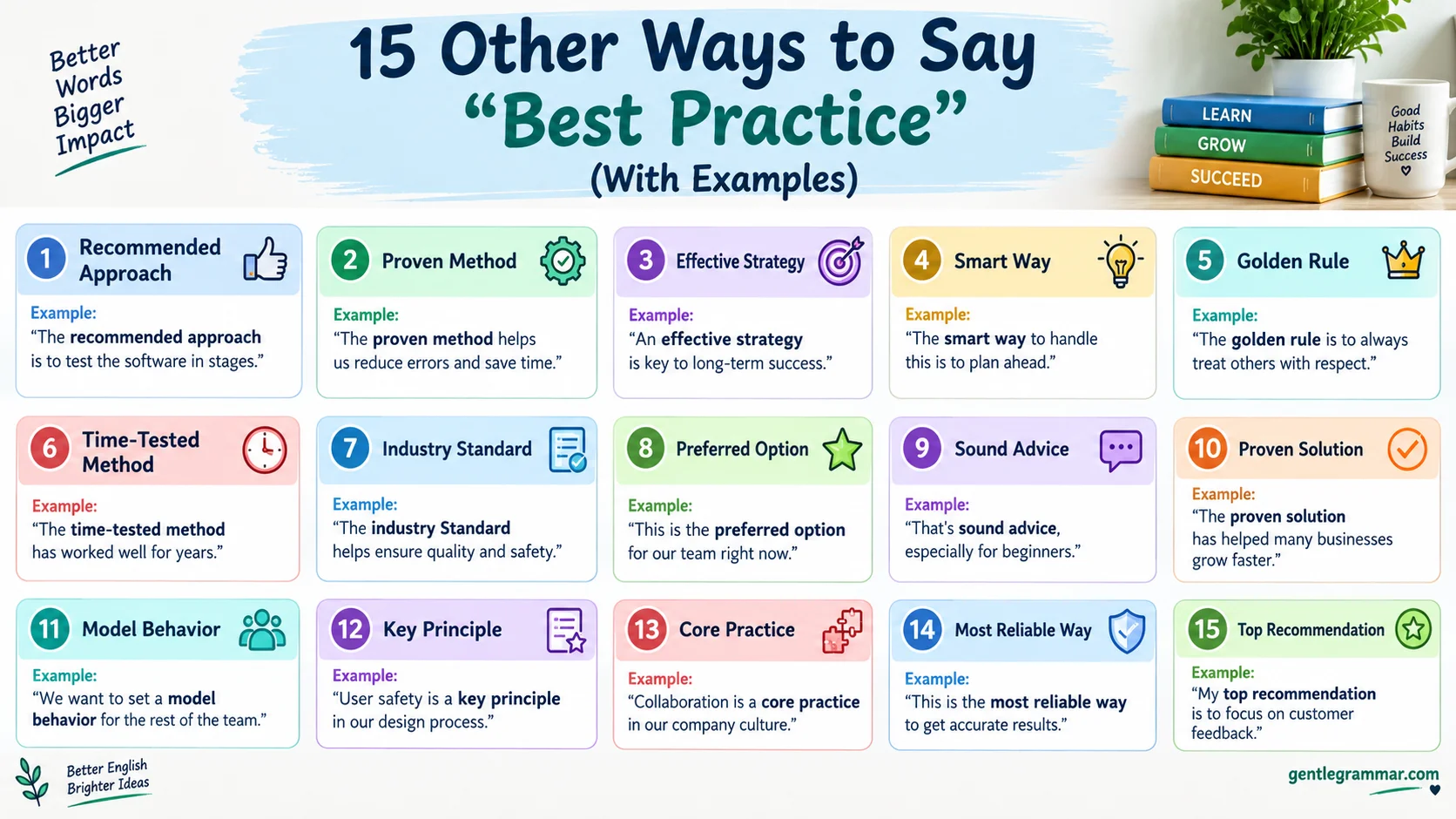
A good phrase should feel meaningful, natural, and suitable for its context. For example, recommended methods, industry standards, proven strategies, effective techniques, established procedures.
Successful approaches can replace repetitive wording when explaining workplace expectations. These professional terms support business writing, academic writing, corporate documents, and team communication by making ideas more specific and credible. Using powerful synonyms, practical synonyms, and professional synonyms also improves readability, content clarity, and communication skills.
In a professional setting or business environment, I recommend choosing words that match the task rather than relying on one familiar expression. Recommended practices, industry practices, proven methods, effective methods, established methods, successful methods, and practical methods can describe different ways of working. These standards, strategies, techniques, procedures, and approaches strengthen professional writing, workplace writing, document writing, and concise writing.
What Does “Best Practice” Mean?
Best practice means a method, process, or approach considered particularly effective for achieving a desired result. It is commonly used in business, education, technology, healthcare, and other professional settings to describe ways of working that reflect experience, established standards, or demonstrated results. For example, keeping regular backups of important files is considered a best practice because it helps protect against data loss. The phrase generally communicates that an approach is recommended and useful, but it does not always mean that the method is the only correct option or that it works equally well in every situation.
Common Situations Where “Best Practice” Is Used
People use this expression when sharing recommendations, developing procedures, improving performance, or explaining how a task should be handled. In professional communication, it often appears in reports, training materials, project plans, and workplace discussions. In education, it can describe effective teaching methods, while in technology, it may refer to secure coding, data protection, or system maintenance. It is also useful in customer service and team management when explaining consistent ways to deliver good results.
Sometimes, however, a more specific phrase communicates the intended meaning better. For example, recommended approach sounds like practical advice, while industry standard suggests a widely accepted expectation within a particular field. Selecting the right expression helps readers understand whether a method is optional guidance, an established procedure, or an expected professional requirement.
Is It Professional or Polite to Say “Best Practice”?
Yes, best practice is a professional, neutral expression that works well in meetings, reports, emails, policies, and technical documentation. It can help present a recommendation without sounding overly personal or emotional. For example, saying “Following this best practice can reduce errors” is appropriate when discussing ways to improve a process.
The phrase can sound somewhat formal or technical in casual conversations, particularly when a simpler expression such as “a good way to do it” would be more natural. It can also sound overly authoritative if someone presents a recommendation as universally correct without considering different circumstances. In sensitive discussions, explain why a method is useful and allow room for context rather than assuming one approach suits everyone.
Advantages and Disadvantages of Saying “Best Practice”
Advantages
The phrase best practice is concise, familiar, and widely understood in professional environments. It allows people to discuss effective methods without explaining the entire concept every time. It is particularly useful in training documents, workplace guidelines, and technical discussions where consistency and quality matter. It also communicates that a recommendation is based on more than personal preference, although the evidence supporting it should be clear when that distinction matters.
Disadvantages
The expression can be vague when the speaker does not explain what makes a method effective. Different organizations may use different approaches, and a method that works well in one situation may not work as well in another. Repeating the phrase can also make writing sound generic. In addition, calling something a best practice may imply stronger support or wider acceptance than the available evidence justifies. More precise wording can help readers understand the recommendation and its limitations.
Synonyms for “Best Practice”
- Recommended Approach
- Proven Method
- Effective Strategy
- Preferred Method
- Standard Procedure
- Established Practice
- Industry Standard
- Accepted Practice
- Recommended Procedure
- Sound Approach
- Effective Technique
- Good Practice
- Practical Approach
- Guiding Principle
- Tried-and-Tested Method
1. Recommended Approach
Meaning
A recommended approach is a method suggested because it is suitable for a particular situation. It is one of the closest alternatives when you want to communicate useful advice without claiming that the method is always the best possible choice.
Definition
A recommended approach is a suggested way of handling a task or solving a problem.
Detailed Explanation
This expression emphasizes a suggestion rather than an absolute rule. It is especially useful when several solutions are possible but one seems most appropriate under the circumstances. Unlike “best practice,” it does not necessarily suggest an established industry-wide method. It also leaves room for people to adjust the recommendation according to their needs.
Scenario Examples
Scenario 1: Workplace guidance
Example: “The recommended approach is to review the figures before submitting the report.”
Scenario 2: Helping a colleague
Example: “Our recommended approach is to discuss the issue privately before involving the wider team.”
Scenario 3: Project planning
Example: “Please follow the recommended approach outlined in the project plan.”
Best Use
Use this phrase in professional emails, project documents, training materials, and advisory discussions. It works particularly well when explaining a suggested course of action without making it sound compulsory.
Tone
Tone: Professional, helpful, neutral.
The wording communicates guidance while respecting the possibility that another solution may be appropriate.
2. Proven Method
Meaning
A proven method is an approach that has demonstrated its effectiveness through experience, testing, or results. It is useful when you want to emphasize evidence of success rather than simply recommend an idea.
Definition
A proven method is a way of doing something that has been shown to work in relevant circumstances.
Detailed Explanation
This expression puts the emphasis on demonstrated results. It can sound more evidence-focused than “best practice,” particularly when the method has been tested repeatedly or used successfully in comparable situations. However, the word “proven” should be used carefully because success in one context does not guarantee the same result everywhere. It is most convincing when you can explain the experience or evidence behind the claim.
Scenario Examples
Scenario 1: Employee training
Example: “We use a proven method to help new employees learn the reporting system.”
Scenario 2: Study advice
Example: “Breaking the material into smaller sections has been a proven method in my own revision routine.”
Scenario 3: Technical work
Example: “The team selected a proven method for testing the software before release.”
Best Use
Choose this phrase when discussing tested processes, training methods, troubleshooting, and approaches supported by relevant results. Avoid using it when you have no reasonable basis for saying the method has been demonstrated to work.
Tone
Tone: Confident, practical, evidence-oriented.
It suggests reliability, but the strength of that suggestion should match the evidence available.
3. Effective Strategy
Meaning
An effective strategy is a plan designed to achieve a particular goal successfully. Unlike a general best practice, a strategy usually involves a broader direction or a coordinated set of actions.
Definition
An effective strategy is a plan that helps achieve an intended outcome.
Detailed Explanation
This phrase is particularly useful when discussing long-term goals, decision-making, and problem-solving. A best practice may describe one recommended action, while a strategy often connects several actions to an overall objective. The expression highlights how well the plan serves its purpose rather than whether it is a formal standard. To keep the wording accurate, use “effective” when there is a reasonable basis for expecting the strategy to deliver results.
Scenario Examples
Scenario 1: Business planning
Example: “Our effective strategy combines customer feedback with regular product improvements.”
Scenario 2: Team management
Example: “Setting weekly priorities is an effective strategy for keeping the project on schedule.”
Scenario 3: Exam preparation
Example: “Creating a revision timetable is an effective strategy for managing a heavy workload.”
Best Use
Use it in business plans, project discussions, presentations, educational advice, and performance improvement. It is most appropriate when the focus is on reaching a goal rather than following a single procedure.
Tone
Tone: Purposeful, professional, results-focused.
It emphasizes direction and outcomes instead of routine or compliance.
4. Preferred Method
Meaning
A preferred method is the way someone or an organization favors among available options. It can replace “best practice” when describing a chosen method without claiming that it is objectively superior in every situation.
Definition
A preferred method is the option favored for a particular task or purpose.
Detailed Explanation
The key distinction is that preference does not necessarily prove superiority. A company may prefer one process because it is easier to maintain, fits its existing systems, or suits its employees. Another organization may reasonably choose a different method. This phrase is therefore useful when communicating a decision or organizational preference rather than a universal recommendation.
Scenario Examples
Scenario 1: Internal communication
Example: “Email is our preferred method for sharing nonurgent project updates.”
Scenario 2: Classroom instructions
Example: “The preferred method for submitting assignments is through the online portal.”
Scenario 3: Team workflow
Example: “Using the shared spreadsheet is our preferred method for tracking progress.”
Best Use
Use this expression in internal policies, workplace instructions, team guidelines, and discussions involving several available options. It is particularly helpful when explaining how a specific organization normally operates.
Tone
Tone: Neutral, organized, professional.
It communicates a choice without implying that other reasonable methods are wrong.
5. Standard Procedure
Meaning
A standard procedure is an established set of steps for completing a task. It is more specific and rule-oriented than “best practice,” which can describe a recommendation rather than a required process.
Definition
A standard procedure is a defined sequence of actions used to carry out a task consistently.
Detailed Explanation
This phrase emphasizes consistency, repeatability, and clear instructions. It is suitable when people need to follow the same steps, especially in operational or regulated environments. Unlike a general recommendation, a standard procedure may be formally documented and required by an organization. However, do not assume every standard procedure is automatically the most effective method; it describes an established process, not necessarily proof of optimal results.
Scenario Examples
Scenario 1: Office administration
Example: “Checking the recipient’s address is part of our standard procedure before sending a contract.”
Scenario 2: Customer support
Example: “The standard procedure is to verify the customer’s account before making changes.”
Scenario 3: Equipment maintenance
Example: “Please follow the standard procedure when shutting down the equipment.”
Best Use
Choose this expression for operational manuals, workplace policies, customer service instructions, and repeatable tasks. Use it when the steps themselves matter, rather than simply offering a helpful suggestion.
Tone
Tone: Formal, procedural, precise.
It sounds more authoritative than “recommended approach” because it suggests an established process.
6. Established Practice
Meaning
An established practice is a way of working that has become familiar or customary within a group, organization, or profession. It emphasizes continuity and existing usage rather than necessarily proving that the method is the best available.
Definition
An established practice is a method or activity that has been adopted and used over time.
Detailed Explanation
The expression is helpful when describing how an organization or professional community usually operates. It may refer to a method supported by experience, but being established does not automatically make it effective or appropriate for every situation. Compared with “best practice,” it places more emphasis on history and adoption than on quality. This distinction is useful when discussing whether a traditional process should be maintained or improved.
Scenario Examples
Scenario 1: Workplace operations
Example: “Providing a written handover is an established practice on our team.”
Scenario 2: Academic work
Example: “Citing the original source is an established practice in academic writing.”
Scenario 3: Company communication
Example: “Monthly progress reviews are an established practice across the department.”
Best Use
Use it in reports, organizational histories, academic discussions, and explanations of existing workflows. It works well when you want to describe what is customary without automatically endorsing it as the best choice.
Tone
Tone: Professional, descriptive, measured.
It communicates familiarity and continuity rather than a strong judgment about quality.
7. Industry Standard
Meaning
An industry standard is a level, requirement, specification, or method recognized within a particular industry. It is appropriate when discussing widely recognized expectations rather than an individual recommendation.
Definition
An industry standard is an accepted benchmark or requirement used within a specific field.
Detailed Explanation
This phrase carries a stronger sense of shared professional expectations than “best practice.” Depending on the context, an industry standard may be established through formal specifications, regulations, or widespread professional conventions. However, not every common practice is an official standard, and not every industry standard is legally mandatory. Use the expression precisely and identify the relevant standard when compliance or technical accuracy matters.
Scenario Examples
Scenario 1: Software development
Example: “The team checked the system against the relevant industry standard before deployment.”
Scenario 2: Manufacturing
Example: “Our quality checks are designed to meet the applicable industry standard.”
Scenario 3: Professional services
Example: “Clients expect clear documentation as part of the industry’s professional standards.”
Best Use
Choose this expression for technical documentation, quality assurance, compliance discussions, procurement, and professional reporting. It is especially useful when the recommendation is tied to an identifiable external benchmark.
Tone
Tone: Authoritative, technical, professional.
It suggests broader recognition, so avoid using it for a personal preference or an unsupported recommendation.
8. Accepted Practice
Meaning
An accepted practice is a method generally regarded as appropriate within a particular group or setting. It focuses on recognition and acceptance rather than necessarily proving that the method produces the best results.
Definition
An accepted practice is a way of working commonly recognized as suitable within a particular context.
Detailed Explanation
This phrase is useful when describing what a professional community, institution, or organization considers appropriate. It can sound less prescriptive than “standard procedure” because an accepted practice does not always involve a fixed sequence of steps. It also differs from “proven method,” since acceptance does not automatically establish effectiveness. When writing formally, explain who accepts the practice or what professional context supports it.
Scenario Examples
Scenario 1: Academic writing
Example: “Acknowledging the contributions of other researchers is an accepted practice in academic publishing.”
Scenario 2: Team collaboration
Example: “Sharing meeting notes afterward is an accepted practice within our department.”
Scenario 3: Professional communication
Example: “Giving colleagues advance notice of major changes is an accepted practice in our organization.”
Best Use
Use it in academic writing, professional discussions, organizational guidelines, and descriptions of customary conduct. It works best when the emphasis is on what is recognized as appropriate.
Tone
Tone: Formal, measured, matter-of-fact.
It indicates acceptance within a context without claiming universal agreement.
9. Recommended Procedure
Meaning
A recommended procedure is a suggested sequence of steps for completing a task. It is particularly useful when guidance needs to be clear enough for someone to follow.
Definition
A recommended procedure is an advised set of steps for carrying out an activity.
Detailed Explanation
This expression focuses on how to perform a task, making it more procedural than “effective strategy.” It is useful in training documents and operational guidance where readers need practical instructions. Unlike a mandatory procedure, a recommended procedure may leave room for judgment or alternative methods. The distinction matters when explaining whether a process is simply advisable or officially required.
Scenario Examples
Scenario 1: Customer service
Example: “The recommended procedure is to confirm the order number before processing a refund.”
Scenario 2: Workplace training
Example: “Please review the recommended procedure for recording expenses before using the system.”
Scenario 3: Project administration
Example: “The recommended procedure includes checking the document, obtaining approval, and then sharing the final version.”
Best Use
Choose this phrase for instruction manuals, staff training, customer service, administrative tasks, and process documentation. It is most helpful when the reader needs to know which steps to follow.
Tone
Tone: Instructional, polite, professional.
It gives clear direction while distinguishing advice from a compulsory requirement.
10. Sound Approach
Meaning
A sound approach is a sensible and well-considered way to handle a situation. It is useful when recommending a course of action based on judgment, logic, or practical considerations.
Definition
A sound approach is a reasonable method supported by careful thinking.
Detailed Explanation
This phrase emphasizes good judgment rather than formal rules or established evidence. It is especially suitable for situations that require flexibility, such as resolving disagreements or making decisions with incomplete information. Compared with “proven method,” it makes a more modest claim because a sound approach may be sensible even when its results have not been tested extensively. It is a natural choice when you want to sound thoughtful without being overly technical.
Scenario Examples
Scenario 1: Conflict resolution
Example: “Listening to both sides before making a decision is a sound approach to resolving the disagreement.”
Scenario 2: Business decisions
Example: “Reviewing the risks before committing to the investment is a sound approach.”
Scenario 3: Team planning
Example: “Starting with the most urgent tasks is a sound approach when deadlines are tight.”
Best Use
Use it in meetings, decision-making discussions, business reports, advice, and problem-solving conversations. It is particularly useful when the situation calls for balanced judgment rather than a fixed procedure.
Tone
Tone: Thoughtful, reassuring, professional.
It communicates that a decision is sensible without insisting that it is the only acceptable option.
11. Effective Technique
Meaning
An effective technique is a particular skill, action, or method that helps achieve a desired result. It works well when discussing a specific way to perform a task rather than a complete organizational process.
Definition
An effective technique is a method or skill that helps accomplish a task successfully.
Detailed Explanation
This expression is more focused than “best practice” because it often refers to a specific action or skill. For example, asking open-ended questions is a technique that can help encourage conversation. The word “effective” highlights usefulness, but its suitability depends on the goal and context. Use this phrase when you want to describe what someone does, rather than a broader policy or system.
Scenario Examples
Scenario 1: Communication skills
Example: “Asking follow-up questions is an effective technique for understanding a customer’s concerns.”
Scenario 2: Learning
Example: “Testing yourself without looking at your notes is an effective technique for reviewing material.”
Scenario 3: Presentations
Example: “Pausing briefly between key points is an effective technique for keeping the audience engaged.”
Best Use
Choose it for teaching, presentations, communication training, learning strategies, and practical skill development. It is most appropriate when referring to a specific action that supports a clear goal.
Tone
Tone: Practical, instructional, encouraging.
It focuses on a useful skill rather than a formal rule or industry-wide expectation.
12. Good Practice
Meaning
Good practice describes a sensible, responsible, or appropriate way of doing something. It is a flexible alternative to “best practice” when you want to recommend a method without suggesting that it is the single best option.
Definition
Good practice is a suitable way of working that supports quality, responsibility, or consistency.
Detailed Explanation
The phrase is often less absolute than “best practice” because it suggests a worthwhile approach without necessarily ranking it above every alternative. It is useful when discussing responsible behavior, professional habits, and everyday processes. For example, documenting important decisions is generally good practice because it helps people understand what was agreed. However, what counts as good practice may depend on the task, workplace, or professional requirements.
Scenario Examples
Scenario 1: Data handling
Example: “Keeping confidential files secure is good practice for anyone handling customer information.”
Scenario 2: Teamwork
Example: “Sharing updates before a deadline is good practice when several people depend on your work.”
Scenario 3: Writing
Example: “Reading your message once before sending it is good practice when communicating with clients.”
Best Use
Use it in workplace guidance, educational materials, general advice, responsible business practices, and informal professional conversations. It is especially helpful when a flexible recommendation is more appropriate than an absolute claim.
Tone
Tone: Practical, balanced, approachable.
It promotes responsible habits without implying that one method is always superior.
13. Practical Approach
Meaning
A practical approach is a realistic way of handling a task or problem. It emphasizes what can actually be done with the available time, resources, and circumstances.
Definition
A practical approach is a workable method suited to real-world needs and limitations.
Detailed Explanation
This expression is useful when a theoretically ideal solution may not be realistic. It encourages people to consider feasibility, resources, and everyday constraints. Unlike “proven method,” it does not necessarily imply that the approach has been tested, and unlike “standard procedure,” it does not require a fixed set of steps. It is a good choice when you want to focus on solutions that people can realistically implement.
Scenario Examples
Scenario 1: Project management
Example: “Creating a short weekly checklist is a practical approach for tracking the team’s progress.”
Scenario 2: Budget planning
Example: “Setting a realistic monthly budget is a practical approach to managing expenses.”
Scenario 3: Workplace improvement
Example: “Let’s introduce the changes gradually; that would be a practical approach for the team.”
Best Use
Choose this phrase for planning, resource management, problem-solving, team discussions, and everyday recommendations. It works particularly well when the solution must fit real constraints.
Tone
Tone: Realistic, constructive, down-to-earth.
It suggests an emphasis on workable results rather than ideal conditions.
14. Guiding Principle
Meaning
A guiding principle is a central belief or rule that helps someone make decisions. It is different from a specific best practice because it describes the idea behind an action rather than the precise steps to take.
Definition
A guiding principle is a core value or rule used to direct decisions and behavior.
Detailed Explanation
This phrase is appropriate when discussing the values that shape an organization’s policies or a person’s decisions. For example, putting customer safety first can serve as a guiding principle for product development. It is broader and more enduring than an individual procedure, although it may influence which procedures are selected. Choose it when the focus is on why decisions are made, not simply how a task should be completed.
Scenario Examples
Scenario 1: Customer service
Example: “Treating every customer respectfully is a guiding principle for our support team.”
Scenario 2: Leadership
Example: “Transparency is a guiding principle in how we communicate major changes.”
Scenario 3: Product development
Example: “Accessibility should remain a guiding principle throughout the design process.”
Best Use
Use it in mission statements, leadership discussions, company values, strategic planning, and policy documents. It is most effective when describing a value that influences many decisions rather than one particular action.
Tone
Tone: Reflective, principled, professional.
It communicates a lasting commitment or decision-making value rather than a step-by-step recommendation.
15. Tried-and-Tested Method
Meaning
A tried-and-tested method is an approach that has been used and evaluated in practice. It is a natural alternative when you want to emphasize practical experience and familiarity.
Definition
A tried-and-tested method is a way of doing something that has been used and found useful through experience.
Detailed Explanation
This expression highlights hands-on experience rather than formal approval or industry recognition. It is often warmer and more conversational than “proven method,” making it suitable for sharing advice with colleagues or explaining a familiar routine. However, a method that worked previously may need adjustment when circumstances change. The phrase is most accurate when there is genuine experience behind the recommendation, rather than simply a belief that the approach should work.
Scenario Examples
Scenario 1: Team training
Example: “Pairing new employees with experienced colleagues is a tried-and-tested method in our department.”
Scenario 2: Everyday problem-solving
Example: “I use a tried-and-tested method for organizing my weekly tasks: I write down the three most important priorities.”
Scenario 3: Small business
Example: “Before introducing a new process, the owner relied on a tried-and-tested method for checking customer orders.”
Best Use
Choose this phrase for practical advice, training, familiar workflows, informal professional communication, and methods supported by experience. It is especially natural when explaining an approach that has worked repeatedly in a similar setting.
Tone
Tone: Reassuring, experienced, conversational.
It conveys confidence based on practical use while sounding less technical than some formal alternatives.
FAQs:
What is another way to say “Best Practice”?
Recommended approach is one of the most versatile alternatives. It communicates that a particular method is advisable without claiming that it is the only correct option. Other choices include proven method, good practice, and effective strategy, depending on whether you want to emphasize experience, responsible behavior, or results.
What does “Best Practice” mean?
Best practice refers to a method, process, or approach considered particularly effective or appropriate for achieving a goal. It is often based on experience, established standards, or demonstrated results. However, a best practice may need to be adapted to suit different circumstances.
Is “Best Practice” professional?
Yes, best practice is a widely used professional expression. It fits business emails, reports, workplace policies, training materials, and technical discussions. For casual conversations, a simpler expression such as “a good way to do it” may sound more natural.
What is a more polite way to say “Best Practice”?
Recommended approach is a polite alternative because it presents guidance without sounding overly forceful. For example, “We recommend reviewing the document before submission” sounds helpful and direct. The best wording depends on whether you are offering a suggestion, explaining a requirement, or sharing an established procedure.
Which alternative works best in formal communication?
Standard procedure works well when describing an established set of steps, while industry standard is appropriate when referring to a recognized benchmark within a profession. If you are simply offering advice, recommended approach is often more suitable. Choose the expression that accurately reflects the authority and purpose of your message.
Conclusion:
Choosing the right alternative to best practice helps make your communication more precise, natural, and useful. Although these expressions share some similarities, they do not all mean the same thing. A recommended approach offers guidance, a proven method emphasizes demonstrated results, and a standard procedure describes an established process. Meanwhile, a guiding principle communicates the values behind a decision.
Before selecting a phrase, consider your audience, purpose, and the strength of your recommendation. Formal reports may require specific terminology, while everyday conversations often benefit from simpler wording. Most importantly, avoid calling a method the best option unless you have a reasonable basis for that claim.
