
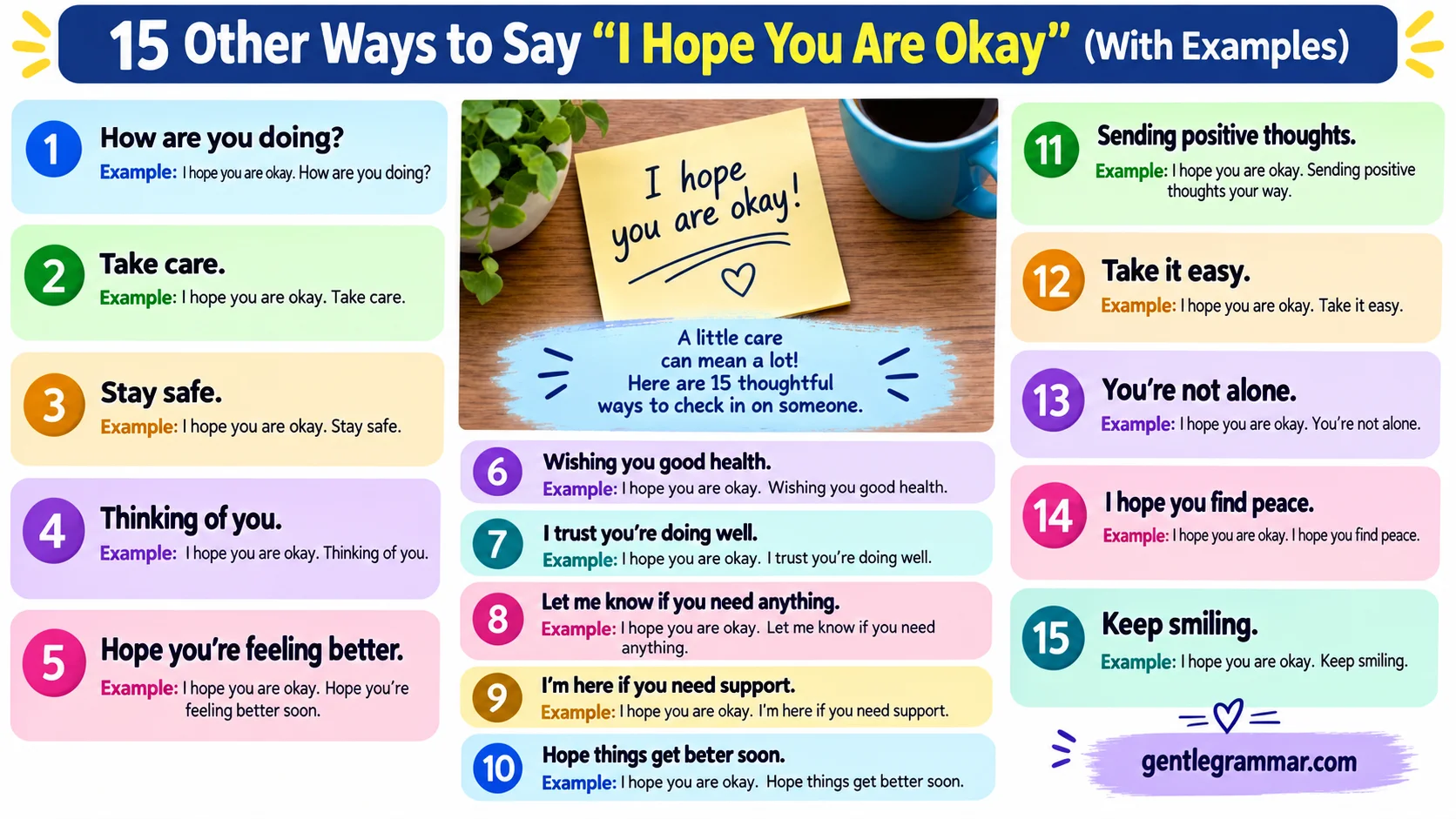
Explore Other Ways to Say “I Hope You Are Okay” to choose caring, professional, and natural words for different situations and relationships.
When looking for an email opener to use instead of the familiar phrase, the right alternative can express genuine care and concern for someone’s well-being, including physical, mental, or circumstantial health. A simple phrase can initiate a meaningful conversation after a period of no contact, especially when you are concerned about someone going through tough times or experiencing a difficult moment.
From my experience, choosing the right words makes communication feel more natural, while a simple message can show support and emotional support without becoming overwhelming. Whether you are writing to colleagues, clients, or another person, different ways to express empathy can work depending on the situation, what has happened, and your relationship with the recipient.
What Does “I Hope You Are Okay” Mean?
“I Hope You Are Okay” is a caring expression used to show concern for someone’s well-being. It usually means that you are thinking about the person and hope they are safe, healthy, emotionally well, or coping with a difficult situation. The phrase is often used when you know or suspect that something may be wrong, such as after hearing disappointing news, noticing that someone seems upset, or learning that they have experienced a stressful event.
The phrase is intentionally broad. “Okay” can refer to physical safety, emotional well-being, or simply how someone is managing a challenging circumstance. Because it does not assume exactly what the person is feeling, it can be a respectful way to check in without demanding personal details.
Common Situations Where “I Hope You Are Okay” Is Used
People commonly use “I Hope You Are Okay” in personal messages, text conversations, emails, and everyday speech. You might send it to a friend who has been unusually quiet, a family member dealing with a problem, or someone who has recently experienced an upsetting event.
It can also appear in workplace communication when a colleague has faced a difficult situation. For example, a manager might send a short supportive message after learning that an employee is dealing with a family emergency. In these situations, the phrase communicates concern without requiring the recipient to explain everything.
The wording is also common in relationships and social media messages. However, an alternative may be useful when you want to sound more compassionate, more formal, less direct, or more specific about the kind of support you are offering.
Is It Professional or Polite to Say “I Hope You Are Okay”?
Yes, “I Hope You Are Okay” is generally polite and can be appropriate in professional communication, particularly when a colleague or client has experienced something difficult. Its simple wording makes it relatively safe because it expresses concern without making assumptions about the person’s circumstances.
That said, the phrase has a warm and conversational quality rather than a highly formal one. In a professional email, something such as “I hope you’re doing well” may fit an ordinary check-in, while “I hope you are okay” is more naturally associated with concern about a specific situation. For sensitive circumstances, a slightly more thoughtful expression may communicate empathy more effectively.
Advantages and Disadvantages of Saying “I Hope You Are Okay”
Advantages
The biggest advantage is its simplicity. The phrase is easy to understand and does not force someone to discuss something they may prefer to keep private. It can also work across many situations because “okay” can refer to emotional, physical, or general well-being. Its gentle wording makes it suitable for friends, relatives, colleagues, and acquaintances.
Disadvantages
The phrase can sometimes feel general or somewhat vague. If someone is dealing with a serious loss or crisis, simply asking whether they are okay may not fully communicate the depth of your concern. It can also become repetitive if you use it frequently. In some circumstances, a more specific expression can offer greater emotional warmth or make your support clearer.
Synonyms for “I Hope You Are Okay”
- I Hope You’re Doing Alright
- I Hope Everything Is Okay
- I Hope You’re Doing Well
- I’m Thinking of You
- I Hope You’re Taking Care of Yourself
- I’m Here If You Need Anything
- I Hope Things Get Better Soon
- I Just Wanted to Check In
- I Hope You’re Holding Up Okay
- I’m Hoping You’re Doing All Right
- I’m Sending You My Best
- I Hope You’re Getting Through This
- Please Take Care of Yourself
- I’m Keeping You in My Thoughts
- Let Me Know How You’re Doing
1. I Hope You’re Doing Alright
Meaning
“I Hope You’re Doing Alright” expresses concern while gently asking about someone’s current well-being. It is very close in meaning to “I Hope You Are Okay”, but its wording can sound slightly more conversational.
Definition
A friendly expression of concern that communicates a wish for someone to be coping reasonably well.
Detailed Explanation
This expression works especially well when you know someone has been dealing with something difficult but do not want to sound overly serious. “Doing alright” focuses on how the person is managing rather than suggesting that everything must be completely fine. It can therefore feel natural when circumstances are challenging but there is no indication of an immediate crisis.
Scenario Examples
Scenario: A friend has had a stressful week.
Example: “You’ve had a lot going on lately. I hope you’re doing alright.”
Scenario: You are checking on a coworker after a difficult day.
Example: “I heard yesterday was pretty stressful. I hope you’re doing alright.”
Best Use
Best for friendly messages, casual conversation, texting, and supportive personal communication.
Tone
Tone: Warm, casual, considerate.
The wording feels caring without being overly emotional.
2. I Hope Everything Is Okay
Meaning
“I Hope Everything Is Okay” expresses concern about someone’s circumstances as a whole. Rather than focusing only on the person, it can refer to whatever situation may be causing concern.
Definition
A phrase used to express the hope that nothing serious or troubling is happening.
Detailed Explanation
This alternative is useful when you know something seems unusual but do not know exactly what happened. It is slightly broader than “I hope you are okay” because “everything” can include the person’s surroundings, family, work, plans, or circumstances. It works particularly well when you want to invite the person to share more without directly asking for private details.
Scenario Examples
Scenario: A friend suddenly stops responding.
Example: “I haven’t heard from you today, so I hope everything is okay.”
Scenario: A colleague leaves work unexpectedly.
Example: “I noticed you had to leave early. I hope everything is okay.”
Best Use
Best for texts, personal messages, everyday conversation, and gentle check-ins.
Tone
Tone: Concerned, gentle, neutral.
It communicates that you noticed something unusual without making a definite assumption.
3. I Hope You’re Doing Well
Meaning
“I Hope You’re Doing Well” is a broad expression of goodwill that wishes someone continued well-being. It is less specifically concerned than “I Hope You Are Okay.”
Definition
A polite expression used to wish someone good health, happiness, or general well-being.
Detailed Explanation
This is one of the most versatile phrases in everyday and professional communication. Unlike “I hope you are okay,” it does not necessarily imply that something bad has happened. That makes it suitable for ordinary correspondence as well as friendly check-ins. In a difficult situation, however, it may sound less emotionally specific.
Scenario Examples
Scenario: You are reconnecting with an old classmate.
Example: “It’s been such a long time. I hope you’re doing well.”
Scenario: You are beginning a professional email to someone you have worked with before.
Example: “I hope you’re doing well. I wanted to follow up about our previous conversation.”
Best Use
Best for professional emails, acquaintances, everyday conversation, and general correspondence.
Tone
Tone: Polite, friendly, professional.
Its broad meaning makes it appropriate in many settings without sounding overly personal.
4. I’m Thinking of You
Meaning
“I’m Thinking of You” tells someone that they are in your thoughts, particularly during a difficult or emotional period.
Definition
A supportive expression showing that you are remembering someone and care about what they are experiencing.
Detailed Explanation
This phrase can feel warmer than a direct question about whether someone is okay. It does not ask the person to explain their feelings or provide an update. Because of that, it can be especially appropriate when someone is grieving, recovering, or facing a serious personal challenge.
Scenario Examples
Scenario: A friend’s family member is going through a difficult period.
Example: “I know things are difficult right now. I’m thinking of you.”
Scenario: You want to send a supportive message without expecting a reply.
Example: “Just wanted you to know I’m thinking of you today.”
Best Use
Best for personal messages, emotional support, difficult circumstances, and situations where a reply is not necessary.
Tone
Tone: Warm, compassionate, heartfelt.
It conveys emotional presence without putting pressure on the recipient.
5. I Hope You’re Taking Care of Yourself
Meaning
“I Hope You’re Taking Care of Yourself” expresses concern while encouraging someone to pay attention to their own physical and emotional needs.
Definition
A supportive statement encouraging someone to look after their well-being during a difficult or stressful period.
Detailed Explanation
This wording goes a little further than simply asking whether someone is okay. It gently reminds the person that their own needs matter, particularly when they are under stress. It can sound caring and personal, although it may feel more intimate than a general check-in.
Scenario Examples
Scenario: A friend has been working extremely long hours.
Example: “Things sound hectic at work. I hope you’re taking care of yourself.”
Scenario: Someone is dealing with a demanding personal situation.
Example: “You have a lot on your plate right now. I hope you’re taking care of yourself.”
Best Use
Best for close friends, family, partners, and supportive personal communication.
Tone
Tone: Caring, protective, gentle.
The expression focuses on the person’s well-being rather than asking for details.
6. I’m Here If You Need Anything
Meaning
“I’m Here If You Need Anything” offers practical or emotional support rather than simply asking whether someone is okay.
Definition
A reassuring expression that tells someone you are available to help or listen if they need support.
Detailed Explanation
This phrase is valuable when you want your message to include an actual offer of support. It does not require the person to respond immediately, and it leaves the choice with them. Depending on the relationship, “anything” can mean listening, helping with a task, or simply being available.
Scenario Examples
Scenario: A friend is dealing with a stressful family situation.
Example: “I know things are complicated right now. I’m here if you need anything.”
Scenario: A coworker has experienced a personal difficulty.
Example: “Take the time you need. I’m here if you need anything from me at work.”
Best Use
Best for personal support, close relationships, workplace empathy, and difficult circumstances.
Tone
Tone: Supportive, reassuring, generous.
It emphasizes availability and help, making it more action-oriented than the original phrase.
7. I Hope Things Get Better Soon
Meaning
“I Hope Things Get Better Soon” expresses optimism that a difficult situation will improve.
Definition
A hopeful expression wishing for improvement after a challenging period.
Detailed Explanation
This alternative is appropriate when you know someone is experiencing a problem and want to offer encouragement. Unlike “I hope you are okay,” it focuses on the future rather than the person’s current state. It is supportive, but it should be used thoughtfully because improvement may not happen quickly in serious circumstances.
Scenario Examples
Scenario: A friend is dealing with problems at work.
Example: “I’m sorry work has been so difficult lately. I hope things get better soon.”
Scenario: Someone is dealing with a temporary setback.
Example: “That sounds frustrating. I hope things get better soon.”
Best Use
Best for friendly messages, encouragement, personal conversations, and temporary difficulties.
Tone
Tone: Hopeful, encouraging, compassionate.
The expression offers optimism without requiring the person to respond.
8. I Just Wanted to Check In
Meaning
“I Just Wanted to Check In” means that you are contacting someone because you want to see how they are doing.
Definition
A gentle expression used to initiate a conversation about someone’s well-being.
Detailed Explanation
This phrase is less direct than asking, “Are you okay?” It gives the recipient space to decide what they want to share. It can also sound natural when you have not spoken to someone recently or have noticed that they seem different. In professional settings, it can be particularly useful because it is considerate without being overly personal.
Scenario Examples
Scenario: A friend has been unusually quiet.
Example: “I just wanted to check in and see how you’re doing.”
Scenario: A manager is contacting an employee after a difficult event.
Example: “I just wanted to check in and make sure you have everything you need.”
Best Use
Best for texts, emails, workplace communication, friendships, and gentle follow-ups.
Tone
Tone: Polite, thoughtful, unobtrusive.
It opens the door to conversation without putting immediate pressure on the other person.
9. I Hope You’re Holding Up Okay
Meaning
“I Hope You’re Holding Up Okay” is used when someone is dealing with a particularly difficult, stressful, or emotional situation.
Definition
A compassionate expression asking whether someone is managing or coping during a difficult time.
Detailed Explanation
This phrase carries more emotional weight than a general “I hope you’re doing well.” The expression “holding up” suggests that the person is facing pressure but is trying to manage it. It is therefore especially suitable for serious circumstances, although it may sound too heavy for a minor inconvenience.
Scenario Examples
Scenario: A friend has recently experienced a major loss.
Example: “I’ve been thinking about you. I hope you’re holding up okay.”
Scenario: A colleague is dealing with a demanding personal situation.
Example: “I know this has been a difficult week. I hope you’re holding up okay.”
Best Use
Best for serious personal difficulties, emotional support, close relationships, and compassionate messages.
Tone
Tone: Compassionate, serious, empathetic.
The wording recognizes that the person may be going through something genuinely difficult.
10. I’m Hoping You’re Doing All Right
Meaning
“I’m Hoping You’re Doing All Right” communicates concern while sounding slightly more reflective and personal than a simple question.
Definition
A considerate expression showing that you wish someone is coping well with their circumstances.
Detailed Explanation
The use of “I’m hoping” can make the statement feel gentle and sincere. It works well when you have been thinking about someone and want to express concern without sounding demanding. It is very close to the original phrase, but the wording can give the message a softer conversational rhythm.
Scenario Examples
Scenario: You are checking on a friend after an upsetting event.
Example: “I heard what happened, and I’m hoping you’re doing all right.”
Scenario: You are reaching out after someone has been absent from work.
Example: “We missed you at the meeting today. I’m hoping you’re doing all right.”
Best Use
Best for personal messages, supportive emails, friends, acquaintances, and sensitive check-ins.
Tone
Tone: Gentle, sincere, caring.
It expresses concern without sounding overly dramatic.
11. I’m Sending You My Best
Meaning
“I’m Sending You My Best” is a goodwill expression that communicates warm wishes, encouragement, or support.
Definition
A polite expression conveying positive thoughts and sincere good wishes to someone.
Detailed Explanation
This phrase is less direct than “I hope you are okay” because it does not explicitly ask about the person’s condition. Instead, it sends a message of goodwill. It can work particularly well when you want to close a message warmly without putting the recipient in a position where they feel they need to explain themselves.
Scenario Examples
Scenario: A former colleague is facing a difficult transition.
Example: “I know this is a big change for you. I’m sending you my best.”
Scenario: You want to support someone before an important event.
Example: “Wishing you strength for tomorrow. I’m sending you my best.”
Best Use
Best for emails, cards, thoughtful messages, acquaintances, and semi-formal communication.
Tone
Tone: Warm, respectful, gracious.
It provides support while maintaining a little more emotional distance than some personal alternatives.
12. I Hope You’re Getting Through This
Meaning
“I Hope You’re Getting Through This” acknowledges that someone is facing a difficult experience and expresses hope that they are managing it.
Definition
A compassionate expression recognizing someone’s struggle and wishing them strength as they cope with it.
Detailed Explanation
This wording is more specific and emotionally serious than a general well-being check. The phrase “getting through this” recognizes that the person may be experiencing hardship rather than simply having a bad day. Because of its emotional weight, it is best reserved for circumstances where a genuine difficulty is known.
Scenario Examples
Scenario: A friend is going through a painful breakup.
Example: “I know this has been really hard. I hope you’re getting through this.”
Scenario: Someone is dealing with a serious personal setback.
Example: “I’ve been thinking about you and hope you’re getting through this one day at a time.”
Best Use
Best for serious personal challenges, close friendships, emotional messages, and supportive conversations.
Tone
Tone: Compassionate, serious, reassuring.
It recognizes the difficulty directly rather than pretending everything is normal.
13. Please Take Care of Yourself
Meaning
“Please Take Care of Yourself” expresses concern and encourages someone to prioritize their own well-being.
Definition
A caring request asking someone to look after themselves physically and emotionally.
Detailed Explanation
This expression can stand on its own or work as the closing line of a supportive message. It does not ask the recipient to provide an update, so it can be useful when you want to show concern without expecting a response. The word “please” adds warmth, although in some contexts the phrase can sound slightly more directive than “I hope you are okay.”
Scenario Examples
Scenario: A friend is exhausted after a demanding period.
Example: “You’ve been doing so much lately. Please take care of yourself.”
Scenario: You are ending a supportive message.
Example: “Take all the time you need, and please take care of yourself.”
Best Use
Best for personal messages, close relationships, supportive notes, and emotional conversations.
Tone
Tone: Caring, gentle, protective.
It communicates concern through a direct reminder rather than a question.
14. I’m Keeping You in My Thoughts
Meaning
“I’m Keeping You in My Thoughts” tells someone that you are thinking about them during a difficult or meaningful period.
Definition
A warm expression showing continued care and remembrance for someone experiencing a challenging situation.
Detailed Explanation
This phrase is particularly useful when you want to acknowledge someone’s circumstances without asking them to talk about them. It can feel more heartfelt than a routine check-in. The expression is often suitable for serious situations, though its appropriateness depends on your relationship and the nature of the event.
Scenario Examples
Scenario: Someone you know is facing a difficult family situation.
Example: “I know your family has a lot going on right now. I’m keeping you in my thoughts.”
Scenario: You are writing a short supportive card.
Example: “Thinking of you during this difficult time and keeping you in my thoughts.”
Best Use
Best for cards, personal messages, sympathy messages, and serious circumstances.
Tone
Tone: Heartfelt, respectful, compassionate.
It offers emotional support without asking for information.
15. Let Me Know How You’re Doing
Meaning
“Let Me Know How You’re Doing” invites someone to give you an update about their well-being when they are ready.
Definition
A supportive invitation for someone to share how they are feeling or coping.
Detailed Explanation
This alternative is more interactive than “I hope you are okay.” Rather than simply expressing your hope, you explicitly leave an opening for further conversation. It can be especially helpful when you genuinely want to hear from the person, but it is important to avoid making the invitation feel like an obligation.
Scenario Examples
Scenario: A friend is dealing with a stressful situation.
Example: “Take some time for yourself, and let me know how you’re doing when you feel up to it.”
Scenario: You are checking on a colleague after an unexpected problem.
Example: “Please don’t worry about responding right away. Let me know how you’re doing when you have a chance.”
Best Use
Best for personal messages, supportive conversations, close colleagues, and follow-up communication.
Tone
Tone: Caring, open, supportive.
It encourages communication while giving the recipient control over when and how they respond.
FAQs:
What is another way to say “I Hope You Are Okay”?
Natural alternatives include “I hope you’re doing alright,” “I hope everything is okay,” “I’m thinking of you,” and “I just wanted to check in.” The best choice depends on the situation. For example, “I’m thinking of you” feels more emotionally supportive, while “I just wanted to check in” is more conversational and unobtrusive.
What does “I Hope You Are Okay” mean?
“I Hope You Are Okay” means that you are concerned about someone’s well-being and hope they are safe, healthy, or coping with whatever situation they are experiencing. It is a broad expression that does not necessarily require the person to explain what is happening.
Is “I Hope You Are Okay” professional?
Yes. “I Hope You Are Okay” can be professional when a colleague, client, or other professional contact is experiencing a difficult situation. However, it is relatively warm and conversational, so the surrounding message and relationship should determine whether it fits the setting.
What is a more polite way to say “I Hope You Are Okay”?
A gentle alternative is “I just wanted to check in”, especially when you want to give the person space. “I hope you’re doing alright” is another polite choice that retains the caring meaning while sounding natural and conversational.
Which alternative works best in formal communication?
For a formal or semi-formal setting, “I hope you’re doing well” is usually suitable when you are making a general check-in. When someone is dealing with a specific difficulty, “I’m sending you my best” can offer warm support while maintaining a respectful level of distance.
Conclusion:
Choosing the right words can make a supportive message feel much more genuine. “I Hope You Are Okay” is simple, caring, and versatile, but different circumstances may call for a softer, warmer, more formal, or more direct expression. For a casual check-in, “I hope you’re doing alright” may feel natural, while “I’m thinking of you” can offer emotional support without asking for an explanation. In a professional setting, “I hope you’re doing well” may provide a more neutral tone.
The most important thing is to consider your relationship with the person, the seriousness of the situation, and the kind of support you want to communicate. Similar phrases can carry noticeably different emotional meanings, so thoughtful wording can help your message sound sincere rather than routine.
