
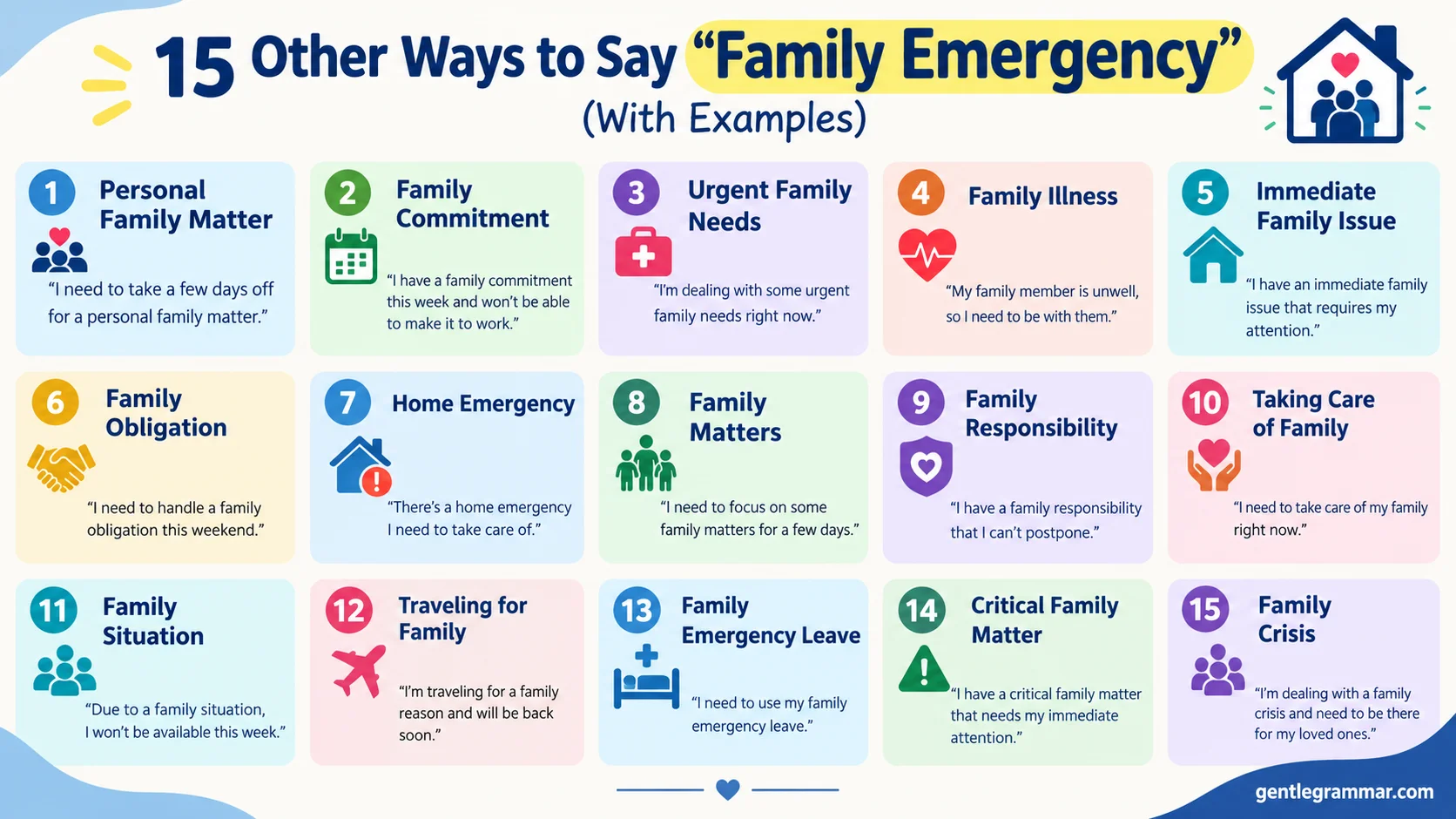
Other Ways to Say “Family Emergency” can help when you need clear, respectful wording that sounds natural in an email or message without giving too much detail.
When I write or edit an email about a family emergency, I know how easy it is to stare at the words and wonder if they sound too vague, dramatic, or overused. The right one often depends on who is reading your message. A professional tone works well for formal emails, workplace requests, leave-request emails, and student absence notes, while casual texts to friends may suit warmer expressions. An honest wording does not need every detail.
If a person needs permission to leave a place at a particular time, saying you have a family matter to attend to can communicate the urgency without sounding stiff. In cases involving a real family emergency, a better way to explain the serious situation may be more suitable. This guide covers 15 natural alternatives, including professional wording for workplace messages and personal choices for personal conversations. Each phrase has its own meaning, tone, and usage, so picking the best option means considering your boss, professor, or best friend.
What Does “Family Emergency” Mean?
A family emergency is an unexpected and serious situation involving a family member or close family circumstances that requires immediate or urgent attention. The phrase usually suggests that something important has happened and that the person affected may need to leave work, school, an appointment, or another commitment to provide help or deal with the situation. It can refer to many circumstances, including a sudden illness, injury, accident, urgent caregiving need, or another serious family matter.
The expression is intentionally general and private. Saying that you have a family emergency communicates that the situation is serious without requiring you to disclose personal details. Because of this, it is common in both spoken and written English when someone needs to explain an absence or change of plans while maintaining their family’s privacy.
Common Situations Where “Family Emergency” Is Used
People commonly use family emergency when an unexpected family-related problem requires their attention. For example, an employee may tell a manager that they need to leave work because of a family emergency, while a student might use the phrase when explaining an unexpected absence from class.
The expression also appears in text messages, emails, phone conversations, and personal communication. Someone might use it when canceling plans, asking for time away, or explaining why they cannot respond immediately. In professional settings, its broad wording is useful because it gives enough information to explain the change without forcing someone to reveal sensitive family details.
An alternative may be helpful when you want to adjust the tone or level of detail. A workplace email might benefit from more neutral wording, while a message to a close friend can sound warmer and more personal. The best choice depends on your relationship with the reader and how much information you want to provide.
Is It Professional or Polite to Say “Family Emergency”?
Yes, family emergency can be both professional and polite when it is used appropriately. In workplace or school communication, it is generally a clear way to explain an unexpected absence or urgent need for time away. It is also relatively private because you do not have to explain exactly what happened.
The phrase is direct, serious, and neutral rather than highly formal. It works well in a short email to a manager, a message to a teacher, or a conversation with someone who needs to understand why you are unavailable. If you want to sound less dramatic or avoid suggesting a life-threatening event, a softer expression such as urgent family matter may be more suitable. On the other hand, if the situation truly involves an immediate crisis, stronger wording may communicate the urgency more accurately.
Advantages and Disadvantages of Saying “Family Emergency”
Advantages
The main advantage of family emergency is its clarity. Most English speakers immediately understand that an unexpected family-related situation requires your attention. It is also concise and appropriately private, making it useful when you need to explain an absence without sharing personal information. In professional communication, the phrase can establish urgency without requiring a long explanation.
Another benefit is its flexibility. It can be used in a text, email, phone call, or face-to-face conversation. The same basic expression can work when speaking to a manager, teacher, colleague, friend, or another person who needs a simple explanation.
Disadvantages
The phrase can sometimes sound more serious than intended because the word “emergency” suggests immediate urgency. If the situation is important but does not require immediate action, another expression may be more accurate. It also provides very little emotional or situational detail, so someone may not understand whether the issue involves health, caregiving, travel, or another family concern.
There is also a potential issue with repetition. If you frequently use the same phrase in messages, alternatives can help your wording feel more natural while allowing you to choose a level of formality, warmth, and urgency that fits each situation.
Synonyms for “Family Emergency”
- Family Crisis
- Urgent Family Matter
- Serious Family Matter
- Urgent Family Situation
- Family Situation Requiring Immediate Attention
- Family-Related Emergency
- Unexpected Family Matter
- Pressing Family Matter
- Unforeseen Family Circumstances
- Urgent Situation Involving My Family
- Personal Family Matter
- Family Matter Requiring Immediate Attention
- Emergency at Home
- Family Crisis Requiring Immediate Attention
- Unexpected Family Situation
1. Family Crisis
Meaning
Family crisis describes a serious and difficult situation affecting a family that may require immediate attention or significant support. It is related to “family emergency,” but it can suggest a broader or more sustained problem rather than a single urgent event.
Definition
Family crisis means a serious family-related situation that disrupts normal life and requires substantial attention or support.
Detailed Explanation
This expression often carries more emotional weight than “family emergency.” A crisis may continue for hours, days, or longer, whereas an emergency often emphasizes immediate action. It can be appropriate when you need to explain that your family is dealing with a significant problem without revealing the details. Because “crisis” sounds serious, it should be reserved for circumstances where that level of seriousness is accurate.
Scenario Examples
Scenario: You need to tell your manager that you cannot attend work because of a serious situation at home.
Example: “I’m dealing with a family crisis and need to take some time away from work today.”
Scenario: A friend asks why you have canceled an important plan.
Example: “I’m sorry for the short notice. There’s a family crisis I need to focus on right now.”
Best Use
Best for serious personal communication, workplace explanations, and situations where the family problem may involve more than one immediate event.
Tone
Tone: Serious, direct, and emotional. It communicates a stronger sense of difficulty than a neutral family-related explanation.
2. Urgent Family Matter
Meaning
Urgent family matter refers to an important family-related issue that needs attention soon. It is one of the most useful alternatives when you want to communicate urgency while keeping the details private.
Definition
An urgent family matter is a family-related issue that requires prompt attention.
Detailed Explanation
This expression is often softer and more discreet than “family emergency.” It does not necessarily imply that someone is in immediate danger, so it can work for a wider range of situations. It is particularly useful in professional communication because it sounds respectful without becoming overly dramatic. If you want your message to remain private, this wording gives you considerable flexibility.
Scenario Examples
Scenario: You need to leave the office unexpectedly.
Example: “I need to leave early today because of an urgent family matter.”
Scenario: You are unable to attend a meeting.
Example: “Unfortunately, I won’t be able to attend the meeting due to an urgent family matter.”
Best Use
Best for work emails, messages to managers, school communication, and polite explanations where privacy matters.
Tone
Tone: Professional, polite, and discreet. It communicates importance without emphasizing the word “emergency.”
3. Serious Family Matter
Meaning
Serious family matter communicates that something important is happening within your family and requires your attention. It emphasizes seriousness rather than immediate urgency.
Definition
A serious family matter is an important or difficult family-related issue that needs attention.
Detailed Explanation
This wording is useful when you want to signal that the situation is significant without claiming that it is an emergency. It can sound more measured than “family crisis.” The phrase also leaves the details private, making it suitable when you do not want to discuss personal circumstances. However, it does not necessarily tell the listener that immediate action is required.
Scenario Examples
Scenario: You need to explain an absence from an appointment.
Example: “I’m sorry, but I need to reschedule because of a serious family matter.”
Scenario: You are speaking with a colleague about an unexpected absence.
Example: “I had to step away yesterday to deal with a serious family matter.”
Best Use
Best for professional communication, personal conversations, and explanations where seriousness matters more than urgency.
Tone
Tone: Respectful, serious, and restrained. It sounds thoughtful without being overly dramatic.
4. Urgent Family Situation
Meaning
Urgent family situation describes a family-related circumstance that needs attention quickly. It focuses on the current circumstances rather than labeling the event an emergency.
Definition
An urgent family situation is a family circumstance that requires prompt action or attention.
Detailed Explanation
This phrase has a natural, conversational quality while still being appropriate in many professional settings. It can feel slightly less formal than “urgent family matter,” particularly in spoken English. It is also useful when the exact nature of the situation is complicated or difficult to summarize. The word “urgent” preserves the important idea that your attention is needed quickly.
Scenario Examples
Scenario: You need to tell your supervisor why you cannot stay late.
Example: “I’m sorry, but I have an urgent family situation I need to handle this evening.”
Scenario: You are texting a friend after canceling plans.
Example: “Something urgent came up with my family, so I won’t be able to make it tonight.”
Best Use
Best for texts, everyday conversation, workplace messages, and short explanations.
Tone
Tone: Direct, natural, and concerned. It sounds less formal than some workplace-focused alternatives.
5. Family Situation Requiring Immediate Attention
Meaning
Family situation requiring immediate attention clearly states that a family-related circumstance needs to be dealt with right away. It places emphasis on immediate responsibility and action.
Definition
A family situation requiring immediate attention is a family circumstance that needs to be addressed without delay.
Detailed Explanation
This is a more descriptive and formal alternative to “family emergency.” Rather than using the emotionally strong word “emergency,” it explains the practical reason for your absence or unavailability. Its longer structure makes it less natural for casual texting, but it can work well in carefully written communication. It is particularly useful when clarity is more important than brevity.
Scenario Examples
Scenario: You are writing a formal message about an unexpected absence.
Example: “I will be unable to attend the appointment because of a family situation requiring immediate attention.”
Scenario: You need to explain why you are stepping away from work.
Example: “I need to take some time away to address a family situation requiring immediate attention.”
Best Use
Best for formal writing, professional emails, official explanations, and situations requiring precise wording.
Tone
Tone: Formal, respectful, and direct. The longer wording makes it sound more deliberate than casual.
6. Family-Related Emergency
Meaning
Family-related emergency has almost the same basic meaning as “family emergency.” It emphasizes that the emergency is connected to a family member or family circumstances.
Definition
A family-related emergency is an unexpected and urgent situation involving or affecting one’s family.
Detailed Explanation
This expression is very close to the original phrase, but its structure can sound slightly more explicit and formal. It may be useful when you want to distinguish a family-related emergency from another kind of personal or workplace emergency. Because it still contains the word “emergency,” it communicates a high level of urgency. It is therefore best used when the situation genuinely requires immediate attention.
Scenario Examples
Scenario: You need to notify a supervisor at short notice.
Example: “I’m unable to come in this morning because of a family-related emergency.”
Scenario: You are explaining why you need to change a travel arrangement.
Example: “We had to change our plans because of a family-related emergency.”
Best Use
Best for workplace messages, travel situations, formal explanations, and direct communication.
Tone
Tone: Serious, clear, and professional. It preserves most of the urgency of the original phrase.
7. Unexpected Family Matter
Meaning
Unexpected family matter describes a family issue that arose suddenly and was not planned. It emphasizes the unplanned nature of the situation rather than its severity.
Definition
An unexpected family matter is an unforeseen issue involving the family that requires attention.
Detailed Explanation
This expression is gentler than “family emergency” because “unexpected” does not automatically imply danger or extreme urgency. It can therefore be useful when something has disrupted your plans but you do not want to overstate the situation. The phrase also works well when you want to preserve privacy. However, if immediate action is essential, it may not communicate enough urgency by itself.
Scenario Examples
Scenario: You need to cancel a dinner appointment.
Example: “I’m sorry, but an unexpected family matter has come up, and I need to cancel tonight.”
Scenario: You need to postpone a personal commitment.
Example: “Could we move our meeting to tomorrow? An unexpected family matter came up.”
Best Use
Best for polite cancellations, personal messages, casual professional communication, and situations where the event was sudden but the severity is unclear.
Tone
Tone: Gentle, private, and understated. It avoids making the situation sound more severe than necessary.
8. Pressing Family Matter
Meaning
Pressing family matter describes an important family issue that needs attention soon. The word pressing suggests that the matter cannot reasonably be ignored or postponed.
Definition
A pressing family matter is an important family issue that requires prompt attention.
Detailed Explanation
This wording is somewhat more formal than everyday expressions such as “urgent family situation.” It communicates urgency without using the stronger word “emergency.” Because of that balance, it can be useful when writing to someone professionally. It also sounds appropriate when you want to explain that your family responsibilities must temporarily take priority.
Scenario Examples
Scenario: You need to request time away from work.
Example: “I’d like to request the afternoon off to attend to a pressing family matter.”
Scenario: You need to postpone a professional conversation.
Example: “I have a pressing family matter to deal with and would appreciate the opportunity to speak tomorrow instead.”
Best Use
Best for professional emails, workplace requests, formal messages, and respectful explanations.
Tone
Tone: Formal, composed, and urgent. It sounds serious without being alarmist.
9. Unforeseen Family Circumstances
Meaning
Unforeseen family circumstances refers to family-related circumstances that could not have been predicted or planned for. It emphasizes unexpected circumstances rather than a specific emergency.
Definition
Unforeseen family circumstances are unexpected family-related conditions or events that require someone to adjust their plans.
Detailed Explanation
This is one of the more formal choices on the list. It can be useful when you need to explain a change in attendance, availability, or plans without discussing private details. Unlike “family emergency,” it does not necessarily indicate an immediate crisis. Its broad wording makes it suitable for situations where several factors may be involved.
Scenario Examples
Scenario: You need to explain why you cannot attend a formal event.
Example: “Unfortunately, I’m unable to attend due to unforeseen family circumstances.”
Scenario: You need to explain an unexpected change in your schedule.
Example: “My availability has changed because of unforeseen family circumstances.”
Best Use
Best for formal correspondence, workplace communication, academic communication, and carefully worded explanations.
Tone
Tone: Formal, discreet, and measured. It provides very little personal detail while sounding polished.
10. Urgent Situation Involving My Family
Meaning
Urgent situation involving my family directly explains that something requiring prompt attention is happening and that the family is involved. It is a clear, descriptive alternative.
Definition
An urgent situation involving my family is a family-connected circumstance that requires immediate or prompt attention.
Detailed Explanation
This wording sounds natural when you want to be clear without using the word “emergency.” It can also feel slightly more personal because the speaker explicitly says that their family is involved. The phrase is flexible enough for both spoken and written communication. It is particularly useful when the listener needs to understand the reason for your absence but does not need private details.
Scenario Examples
Scenario: You are explaining an unexpected absence to a colleague.
Example: “I’m sorry I missed your call; I was dealing with an urgent situation involving my family.”
Scenario: You need to notify your manager.
Example: “I need to take the rest of the day off because of an urgent situation involving my family.”
Best Use
Best for workplace communication, personal messages, conversations, and situations where directness is helpful.
Tone
Tone: Direct, personal, and respectful. It communicates urgency without sounding overly dramatic.
11. Personal Family Matter
Meaning
Personal family matter describes a private issue connected to the speaker’s family. It emphasizes privacy and personal responsibility more than emergency-level urgency.
Definition
A personal family matter is a private issue involving one’s family that requires attention.
Detailed Explanation
This is a useful choice when you do not want to reveal what is happening. It is softer than “family emergency” because it does not automatically imply that something serious or urgent has occurred. In a workplace, it can be an effective way to protect personal boundaries while still giving a reasonable explanation for an absence. If the situation is genuinely urgent, adding a word that communicates urgency may be more accurate.
Scenario Examples
Scenario: A colleague asks why you need to leave early.
Example: “I need to take off a little early today to handle a personal family matter.”
Scenario: You need to decline an invitation.
Example: “Thank you for inviting me, but I have a personal family matter to attend to.”
Best Use
Best for workplace conversations, professional emails, personal messages, and privacy-conscious communication.
Tone
Tone: Private, polite, and understated. It creates a clear boundary around personal information.
12. Family Matter Requiring Immediate Attention
Meaning
Family matter requiring immediate attention describes a family issue that cannot reasonably wait. It combines privacy with a clear sense of urgency.
Definition
A family matter requiring immediate attention is a family-related issue that needs to be addressed without delay.
Detailed Explanation
This expression is especially useful when you want to sound formal and precise. It communicates that your attention is needed now without requiring you to describe the nature of the issue. Compared with “family emergency,” it sounds more measured and less emotionally charged. Its longer wording makes it more suitable for emails or formal explanations than casual conversation.
Scenario Examples
Scenario: You need to request an unexpected absence.
Example: “I’m requesting leave for today due to a family matter requiring immediate attention.”
Scenario: You need to explain why you cannot complete something on time.
Example: “I may need additional time to complete this because of a family matter requiring immediate attention.”
Best Use
Best for formal workplace communication, leave requests, academic messages, and professional explanations.
Tone
Tone: Formal, respectful, and precise. It conveys urgency while maintaining privacy.
13. Emergency at Home
Meaning
Emergency at home refers to an urgent situation occurring in or around the speaker’s home. It can sometimes serve as an alternative to “family emergency,” but the meaning is broader and not necessarily family-related.
Definition
An emergency at home is an unexpected urgent situation occurring at one’s residence or requiring immediate attention there.
Detailed Explanation
This expression should not be treated as an exact synonym for “family emergency.” An emergency at home could involve a family member, but it could also involve property damage, a household problem, or another domestic issue. Therefore, it is useful only when the location or home circumstances are actually relevant. Choose it when you want to explain why you must deal with an urgent problem at home rather than specifically identifying a family issue.
Scenario Examples
Scenario: You need to leave work because something urgent has happened at your residence.
Example: “I’m afraid I need to head home because there’s an emergency at home.”
Scenario: You need to explain why you cannot attend a scheduled appointment.
Example: “I’m sorry, but I have an emergency at home and need to reschedule.”
Best Use
Best for everyday conversation, workplace messages, and situations involving an urgent problem at home.
Tone
Tone: Direct, urgent, and practical. It focuses on the location rather than the family relationship.
14. Family Crisis Requiring Immediate Attention
Meaning
Family crisis requiring immediate attention describes a serious family crisis that needs to be addressed without delay. It combines high seriousness with explicit urgency.
Definition
A family crisis requiring immediate attention is a serious family-related problem that demands prompt action or support.
Detailed Explanation
This is stronger than several alternatives on the list because both “crisis” and “immediate attention” communicate seriousness. It should therefore be reserved for situations where that level of urgency is accurate. The phrase can be useful when you need to make it clear that you cannot reasonably continue with normal responsibilities. Because it is formal and somewhat heavy, it is less natural for a casual text unless the circumstances are genuinely severe.
Scenario Examples
Scenario: You need to explain a sudden absence from work.
Example: “I’m unable to work today because I’m dealing with a family crisis requiring immediate attention.”
Scenario: You are explaining why you must postpone an important commitment.
Example: “I’m sorry to change plans at the last minute, but a family crisis requires my immediate attention.”
Best Use
Best for serious professional communication, formal explanations, and situations involving a genuinely urgent family crisis.
Tone
Tone: Very serious, formal, and urgent. The wording makes the importance of the situation unmistakable.
15. Unexpected Family Situation
Meaning
Unexpected family situation describes a family-related circumstance that arose suddenly. It is a gentler and less specific option than “family emergency.”
Definition
An unexpected family situation is an unplanned circumstance involving the family that requires some degree of attention.
Detailed Explanation
This expression is useful when you want to explain a sudden change without suggesting that the situation is necessarily dangerous or severe. It works especially well when you are canceling plans, changing your schedule, or responding to questions from friends and colleagues. Because it does not explicitly communicate urgency, it may be too vague if someone needs to understand that immediate action is required. Its softer wording makes it suitable for situations where discretion is important.
Scenario Examples
Scenario: You need to cancel plans with a friend.
Example: “I’m sorry, but an unexpected family situation came up, so I need to stay home tonight.”
Scenario: You need to explain a sudden schedule change.
Example: “I had an unexpected family situation to deal with, so I wasn’t able to respond earlier.”
Best Use
Best for casual conversation, texting, personal messages, and polite explanations involving unexpected changes.
Tone
Tone: Gentle, private, and conversational. It avoids unnecessarily strong language.
FAQs:
What is another way to say “Family Emergency”?
There are several natural alternatives, depending on the situation. “Urgent family matter” works particularly well when you want to sound professional and discreet, while “family crisis” communicates greater seriousness. For a softer explanation, “unexpected family situation” may be more appropriate.
What does “Family Emergency” mean?
Family emergency means an unexpected and serious situation involving a family member or family circumstances that requires urgent attention. The phrase is deliberately broad, so it allows someone to explain an absence or change of plans without revealing private details.
Is “Family Emergency” professional?
Yes. Family emergency is commonly suitable for professional communication when someone needs to explain an unexpected absence or request time away. It is direct and understandable, although a phrase such as “urgent family matter” may sound more measured in a formal email.
What is a more polite way to say “Family Emergency”?
A more discreet option is “urgent family matter.” It communicates that something important needs your attention without emphasizing the word “emergency.” “Personal family matter” is another option when privacy is more important than communicating urgency.
Which alternative works best in formal communication?
The most appropriate wording depends on what you need to communicate. “Unforeseen family circumstances” can work well when you want a formal, discreet explanation, while “family matter requiring immediate attention” is useful when you need to emphasize urgency. Choose wording that accurately reflects the situation rather than making it sound more or less serious than it is.
Conclusion:
Choosing the right wording for a family emergency is not simply about finding a different phrase. The best expression depends on what you want the listener to understand about urgency, privacy, seriousness, and tone. “Urgent family matter” can sound professional and discreet, while “family crisis” communicates a more serious situation. Softer choices such as “unexpected family situation” may work better when you want to explain a change without creating unnecessary alarm.
The important thing is to match your language to the circumstances. In professional communication, clear and respectful wording can protect your privacy while explaining why you are unavailable. In personal conversations, a warmer or more direct expression may feel more natural. Good communication gives people enough information to understand the situation without requiring details that you would rather keep private.
