
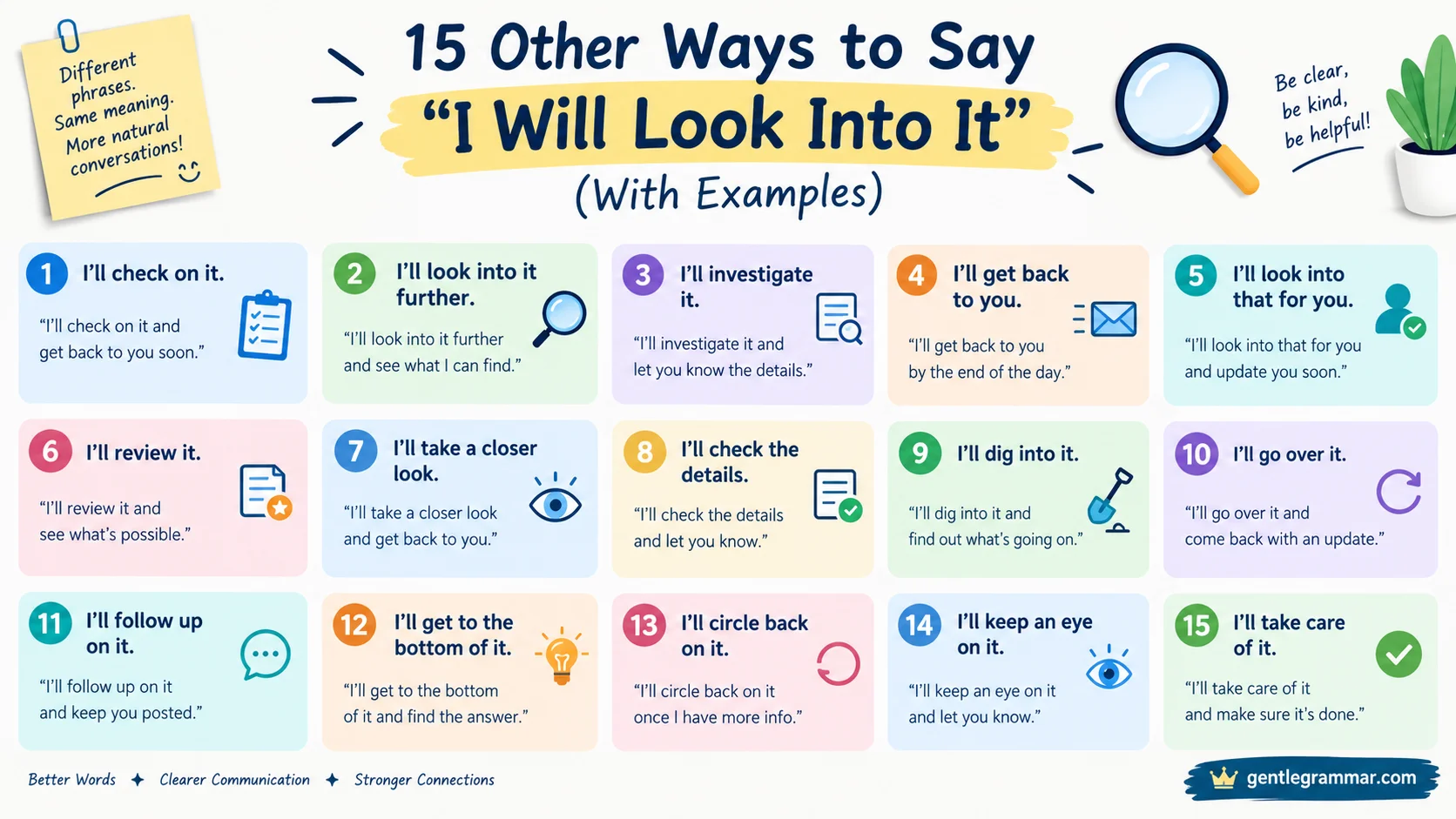
Other Ways to Say “I Will Look Into It” can help you sound clear and professional when responding to someone’s email at work with genuine care.
When responding to someone’s email at work, I often pause before saying “I will look into it.” This helpful phrase may sound empty without real effort and a clear intention. I’ve found that thoughtful phrases and varied phrases can show genuine care and professionalism. The right way of expressing a response depends on who you are talking to, such as a colleague, client, or friend, and the kind of task you are dealing with.
When replying to someone’s email, take some time before looking into something so you can understand the request properly. It is good to use a term like “I’ll look into it,” but better alternatives can make your sentences sound more natural. Another way to say it is to explain that you will review the matter and get back later. In daily communication, it is important to show that you are taking action instead of brushing off a request.
What Does “I Will Look Into It” Mean?
“I Will Look Into It” means I will investigate, examine, or find out more about something. When someone uses this phrase, they are usually telling another person that they intend to spend some time checking a problem, question, request, or situation rather than responding immediately. For example, if a coworker asks why a report contains an error, you might say, “I will look into it,” meaning that you will check the details and try to understand what happened.
The phrase is broad enough to work in many situations. It does not necessarily promise a particular result; it mainly communicates an intention to investigate or review something. Depending on context, it can sound professional and neutral, although its exact tone can change based on the surrounding conversation.
Common Situations Where “I Will Look Into It” Is Used
“I Will Look Into It” is commonly used when someone needs time to check information, investigate a concern, review details, or understand a situation. At work, an employee might use it when responding to a question from a manager or colleague. A customer-service representative may say it when they need to investigate an account or order issue. In everyday conversation, someone might use it when they need to find an answer before responding.
The phrase also works well in emails, text messages, and personal communication. However, people sometimes want an alternative because the original wording can become repetitive or vague. A more specific expression can tell the listener whether you plan to investigate, review, research, or simply take a closer look.
Is It Professional or Polite to Say “I Will Look Into It”?
Yes, “I Will Look Into It” is generally professional, polite, and neutral. It is particularly common in workplace conversations because it acknowledges an issue without making a premature judgment. It can also sound helpful because it shows that you are willing to take action.
That said, the phrase can occasionally feel too general when the listener wants to know exactly what you will do. In a formal email, “I will investigate the matter” may sound more precise. In a friendly conversation, “I’ll take a closer look” may feel warmer and less formal. The best wording depends on your relationship with the other person and the seriousness of the issue.
Advantages and Disadvantages of Saying “I Will Look Into It”
Advantages
The main advantage of “I Will Look Into It” is its flexibility. It can be used for questions, problems, requests, complaints, technical issues, and situations where you do not yet have enough information. It also avoids making assumptions and gives you time to gather facts before responding. In professional communication, its neutral wording can help keep a conversation calm and constructive.
Disadvantages
The phrase can sometimes sound vague because it does not explain what kind of investigation will take place. If used repeatedly, it may also feel formulaic. In a serious situation, someone may prefer a stronger expression such as “I will investigate” because it communicates a clearer commitment to examining the matter. In casual situations, some alternatives may sound more natural or personal.
synonym for “I Will Look Into It”
- I’ll investigate
- I’ll look into this
- I’ll check into it
- I’ll look into the matter
- I’ll examine it
- I’ll review it
- I’ll take a closer look
- I’ll look further into it
- I’ll research it
- I’ll find out more
- I’ll check it out
- I’ll dig into it
- I’ll see what I can find
- I’ll explore the issue
- I’ll get to the bottom of it
1. I’ll investigate
Meaning
“I’ll investigate” means I will carefully examine something to discover facts, causes, or answers. It is one of the clearest alternatives to “I Will Look Into It.”
Definition
I’ll investigate means that you will conduct a deliberate inquiry to understand or resolve something.
Detailed Explanation
This expression sounds more serious and purposeful than “I Will Look Into It.” It suggests that you intend to examine evidence, information, or circumstances rather than simply glance at something. It works especially well when there is a problem, complaint, error, or unexplained event. Because of its stronger wording, it may sound less casual than the original phrase.
Scenario Examples
Scenario: A manager reports an unexplained problem with a project.
Example: “I’ll investigate the issue and let you know what I find.”
Scenario: A customer reports an unexpected charge.
Example: “Thank you for bringing this to our attention. I’ll investigate the charge.”
Best Use
Best for professional communication, complaints, problems, incidents, and situations requiring careful examination.
Tone
Tone: Professional, serious, direct.
The word “investigate” signals a deliberate effort to discover facts.
2. I’ll look into this
Meaning
“I’ll look into this” means I will investigate or examine the specific matter you have just mentioned.
Definition
I’ll look into this means that you will check a particular issue or situation more carefully.
Detailed Explanation
This is very close in meaning to “I Will Look Into It,” but “this” can make the response feel more immediate and connected to what the other person has just said. It is especially natural in spoken English and everyday workplace communication. The expression remains neutral without sounding overly formal. It can be useful when the issue is already clear from the conversation.
Scenario Examples
Scenario: A coworker points out a missing figure in a spreadsheet.
Example: “Thanks for catching that. I’ll look into this.”
Scenario: A friend tells you that something unusual happened with a booking.
Example: “That doesn’t sound right. I’ll look into this.”
Best Use
Best for workplace conversations, emails, everyday communication, and quick replies.
Tone
Tone: Neutral, helpful, conversational.
“This” makes the response feel directly connected to the current issue.
3. I’ll check into it
Meaning
“I’ll check into it” means I will investigate or check the details of something.
Definition
I’ll check into it means that you will make an effort to find out more information about a matter.
Detailed Explanation
This phrase is a natural alternative when you want to sound straightforward without being overly formal. It often appears in workplace and customer-service conversations. Compared with “I’ll investigate,” it usually sounds less serious and less official. It is useful when you need to verify information or determine what happened.
Scenario Examples
Scenario: A colleague asks why a delivery has not arrived.
Example: “I’ll check into it and see where the shipment is.”
Scenario: Someone asks about an unexpected appointment change.
Example: “I’m not sure why it was moved, but I’ll check into it.”
Best Use
Best for work conversations, customer communication, phone calls, and everyday speech.
Tone
Tone: Polite, practical, moderately casual.
It communicates that you will verify the details without making the situation sound overly serious.
4. I’ll look into the matter
Meaning
“I’ll look into the matter” means I will investigate a particular issue or concern carefully.
Definition
I’ll look into the matter means that you will examine a specific situation and try to determine the relevant facts.
Detailed Explanation
This wording is more formal and deliberate than “I’ll look into it.” The word “matter” gives the sentence a professional quality and is especially suitable when discussing a concern, complaint, or official issue. It may sound slightly more formal in everyday conversation. In business correspondence, however, it can provide a calm and respectful response.
Scenario Examples
Scenario: An employee raises a formal concern.
Example: “Thank you for explaining the situation. I’ll look into the matter.”
Scenario: A customer reports a problem with a service.
Example: “We appreciate your patience while we look into the matter.”
Best Use
Best for formal emails, workplace communication, complaints, customer service, and official correspondence.
Tone
Tone: Formal, respectful, professional.
The phrase creates a sense of careful attention and seriousness.
5. I’ll examine it
Meaning
“I’ll examine it” means I will inspect or study something carefully.
Definition
I’ll examine it means that you will look at something closely to understand its details or condition.
Detailed Explanation
This phrase focuses more strongly on careful inspection than general investigation. It is useful when the object, document, information, or evidence itself needs close attention. Compared with “I Will Look Into It,” it can sound more precise and analytical. It is particularly natural when discussing reports, documents, data, proposals, or physical items.
Scenario Examples
Scenario: A colleague sends you a contract to review.
Example: “Please give me a little time. I’ll examine it carefully.”
Scenario: A technician receives a faulty device.
Example: “I’ll examine it and see whether I can identify the problem.”
Best Use
Best for documents, reports, objects, evidence, data, and technical matters.
Tone
Tone: Analytical, professional, focused.
“Examine” emphasizes careful inspection rather than general curiosity.
6. I’ll review it
Meaning
“I’ll review it” means I will read, inspect, or evaluate something carefully.
Definition
I’ll review it means that you will examine material or information to understand, assess, or check it.
Detailed Explanation
“Review” is particularly useful when the thing being examined is a document, proposal, report, application, plan, or set of information. It often sounds more professional than “I’ll look into it,” especially in office or academic settings. Unlike “investigate,” it does not necessarily suggest that something is wrong. It can simply mean that you will assess something before giving an answer.
Scenario Examples
Scenario: A manager sends an employee a proposal.
Example: “I’ll review it this afternoon and send you my feedback.”
Scenario: A student asks a teacher to check an assignment.
Example: “I’ll review it and let you know if anything needs to be corrected.”
Best Use
Best for emails, reports, proposals, assignments, applications, and professional communication.
Tone
Tone: Professional, calm, neutral.
“Review” suggests careful consideration without implying that a problem exists.
7. I’ll take a closer look
Meaning
“I’ll take a closer look” means I will examine something more carefully than I have so far.
Definition
I’ll take a closer look means that you will spend additional time examining or considering something.
Detailed Explanation
This expression sounds warmer and more conversational than “I’ll investigate.” It is ideal when you want to reassure someone that you will pay additional attention to a question or problem. It does not necessarily imply a formal investigation. Because of its friendly quality, it can work in both personal and workplace conversations.
Scenario Examples
Scenario: A coworker asks you to check a small error.
Example: “I noticed the same thing. I’ll take a closer look.”
Scenario: A friend asks whether you can identify an unfamiliar product.
Example: “Send me a picture, and I’ll take a closer look.”
Best Use
Best for casual conversation, friendly messages, workplace chats, and situations involving closer inspection.
Tone
Tone: Friendly, reassuring, conversational.
The phrase emphasizes extra attention without sounding overly formal.
8. I’ll look further into it
Meaning
“I’ll look further into it” means I will continue investigating or gather more information about something.
Definition
I’ll look further into it means that you will conduct additional investigation beyond what has already been checked.
Detailed Explanation
This phrase is especially useful when some investigation has already happened or when the issue appears to require additional checking. It suggests persistence without sounding overly dramatic. Compared with “I Will Look Into It,” the word “further” implies that you intend to go beyond an initial review. It can therefore be reassuring when someone wants to know that the issue will not simply be dismissed.
Scenario Examples
Scenario: A customer has already provided some information about a problem.
Example: “I have the details now, and I’ll look further into it.”
Scenario: You notice that an explanation does not fully answer a question.
Example: “That explanation raises another question, so I’ll look further into it.”
Best Use
Best for ongoing investigations, workplace issues, customer concerns, research, and follow-up communication.
Tone
Tone: Reassuring, attentive, professional.
“Further” communicates continued effort.
9. I’ll research it
Meaning
“I’ll research it” means I will gather information and study the subject to learn more about it.
Definition
I’ll research it means that you will actively seek and examine information about a topic.
Detailed Explanation
“Research” is more specific than “look into” when the goal is to gather knowledge or investigate a subject in depth. It is particularly suitable for academic, professional, technical, and informational questions. It may sound excessive if someone only needs a quick check. When you genuinely need information from several sources or a deeper understanding, however, it communicates your intention clearly.
Scenario Examples
Scenario: A coworker asks about a new software feature.
Example: “I’m not familiar with it yet, but I’ll research it.”
Scenario: A student needs information about a historical topic.
Example: “I’ll research it before we decide which topic to present.”
Best Use
Best for academic work, professional research, technical questions, and information gathering.
Tone
Tone: Focused, thoughtful, professional.
“Research” suggests active information gathering, not merely checking something quickly.
10. I’ll find out more
Meaning
“I’ll find out more” means I will gather additional information so that I understand the situation better.
Definition
I’ll find out more means that you will try to obtain additional facts or details.
Detailed Explanation
This is a useful alternative when you do not want to make your response sound too formal. It focuses on the result of gaining information rather than the investigative process itself. The expression works particularly well when you need to ask someone else, check a source, or gather details. It can sound more approachable than “I’ll investigate.”
Scenario Examples
Scenario: A friend asks whether an event has changed locations.
Example: “I’m not sure yet, but I’ll find out more.”
Scenario: A coworker asks for additional details about a new policy.
Example: “I’ll find out more and share the details with everyone.”
Best Use
Best for everyday conversation, workplace chats, personal messages, and informal information gathering.
Tone
Tone: Friendly, straightforward, helpful.
It focuses on learning more rather than formally investigating.
11. I’ll check it out
Meaning
“I’ll check it out” means I will take a look at, inspect, or investigate something casually.
Definition
I’ll check it out means that you will examine something or find out more about it.
Detailed Explanation
This is one of the more casual alternatives on the list. It can refer to a problem, website, place, product, suggestion, or piece of information. In many contexts, it sounds relaxed and friendly rather than professional or formal. Because of its casual character, it is usually better suited to conversations with friends, peers, or informal colleagues than formal correspondence.
Scenario Examples
Scenario: A friend recommends a new restaurant.
Example: “That place sounds interesting. I’ll check it out.”
Scenario: A coworker sends you a website to review.
Example: “Thanks for sending it. I’ll check it out when I have a moment.”
Best Use
Best for casual conversation, texting, social media, and informal workplace communication.
Tone
Tone: Casual, friendly, relaxed.
“Check it out” sounds less formal and more conversational than the original phrase.
12. I’ll dig into it
Meaning
“I’ll dig into it” means I will examine something deeply and try to understand all the important details.
Definition
I’ll dig into it means that you will investigate something thoroughly rather than giving it only a quick review.
Detailed Explanation
This expression is more energetic and informal than “I Will Look Into It.” It suggests that you are willing to spend time exploring the details of a complicated issue. It can be especially natural in workplace conversations where colleagues are discussing problems, data, or projects. It is less suitable for highly formal writing because “dig into” is conversational.
Scenario Examples
Scenario: A team discovers an unexpected drop in sales.
Example: “I’ll dig into it and see what might be causing the decline.”
Scenario: A friend tells you about a confusing situation.
Example: “Give me the details, and I’ll dig into it.”
Best Use
Best for workplace conversations, project discussions, research, data analysis, and informal communication.
Tone
Tone: Energetic, determined, conversational.
“Dig into” suggests thorough effort and curiosity.
13. I’ll see what I can find
Meaning
“I’ll see what I can find” means I will search for information or an answer and report what I discover.
Definition
I’ll see what I can find means that you will make a reasonable effort to discover useful information.
Detailed Explanation
This expression is helpful when you do not know whether an answer exists yet. It sounds less definite than “I’ll investigate,” which makes it useful when you want to avoid promising a particular outcome. It also has a natural, friendly quality that works well in everyday communication. The phrase emphasizes the search for information rather than the seriousness of the issue.
Scenario Examples
Scenario: A friend asks whether you can locate an old photo.
Example: “I’m not sure where I saved it, but I’ll see what I can find.”
Scenario: A colleague asks whether there is a previous version of a document.
Example: “I’ll see what I can find in the project folder.”
Best Use
Best for personal messages, informal workplace conversations, searches, and situations where the answer is uncertain.
Tone
Tone: Helpful, modest, informal.
The wording shows willingness to help without overpromising.
14. I’ll explore the issue
Meaning
“I’ll explore the issue” means I will examine a problem or subject from different angles to understand it better.
Definition
I’ll explore the issue means that you will consider and investigate the different aspects of a particular matter.
Detailed Explanation
This expression suggests a broader examination rather than a quick check. It is useful when an issue is complex and may require consideration of several factors. Compared with “I Will Look Into It,” it can sound more thoughtful and analytical. It is particularly suitable when you want to communicate that you will consider possible explanations or approaches.
Scenario Examples
Scenario: A team is trying to understand why a project is behind schedule.
Example: “I’ll explore the issue and identify where the delays are coming from.”
Scenario: A school administrator receives concerns about a new procedure.
Example: “We’ll explore the issue before deciding whether changes are necessary.”
Best Use
Best for professional communication, academic discussions, policy matters, complex problems, and analytical writing.
Tone
Tone: Thoughtful, analytical, professional.
“Explore” suggests careful consideration of different possibilities.
15. I’ll get to the bottom of it
Meaning
“I’ll get to the bottom of it” means I will investigate until I understand the real cause or truth behind something.
Definition
I’ll get to the bottom of it means that you will work to discover the underlying reason for a problem or situation.
Detailed Explanation
This expression is stronger and more determined than “I Will Look Into It.” It suggests that you are not merely going to inspect the situation but intend to discover what is really happening. It can be reassuring when someone is dealing with a confusing or frustrating problem. However, because it is an idiomatic expression, it is more natural in conversation than in highly formal writing.
Scenario Examples
Scenario: A team cannot determine why a system keeps failing.
Example: “Something is causing these errors, and I’ll get to the bottom of it.”
Scenario: A friend suspects there has been a misunderstanding.
Example: “Don’t worry. I’ll get to the bottom of it and find out what happened.”
Best Use
Best for problems, misunderstandings, workplace conversations, personal communication, and situations requiring determination.
Tone
Tone: Determined, confident, reassuring.
The expression communicates a strong intention to discover the underlying cause.
FAQs:
What is another way to say “I Will Look Into It”?
Natural alternatives include “I’ll investigate,” “I’ll review it,” “I’ll take a closer look,” and “I’ll find out more.” The best choice depends on the situation. “I’ll investigate” sounds more serious, while “I’ll take a closer look” feels warmer and more conversational.
What does “I Will Look Into It” mean?
“I Will Look Into It” means I will investigate, examine, or gather more information about something. It usually communicates that you need time to understand a question, problem, request, or situation before responding.
Is “I Will Look Into It” professional?
Yes. “I Will Look Into It” is generally professional and polite, particularly in workplace and customer-service communication. It has a neutral tone and allows you to acknowledge an issue without making assumptions.
What is a more polite way to say “I Will Look Into It”?
For a warm and polite response, you could say “I’ll take a closer look” or “I’ll find out more.” In professional communication, “I’ll look into the matter” can also sound respectful and attentive.
Which alternative works best in formal communication?
The most suitable choice depends on what you are investigating. “I’ll investigate” works well for serious concerns, while “I’ll review it” is appropriate for documents, reports, and proposals. “I’ll look into the matter” is another polished option for formal correspondence.
Conclusion:
Choosing an alternative to “I Will Look Into It” is not simply about replacing one phrase with another. The right wording can show whether you are being formal, friendly, careful, direct, or determined. “I’ll investigate” communicates a serious inquiry, while “I’ll take a closer look” sounds more reassuring and conversational. Other expressions, such as “I’ll review it,” “I’ll research it,” and “I’ll find out more,” are useful when the type of action you plan to take is more specific.
The key is to consider your audience, relationship, purpose, and context before choosing your words. Similar expressions can carry noticeably different shades of meaning. When you choose the phrase that matches the situation, your communication becomes clearer and more natural.
