
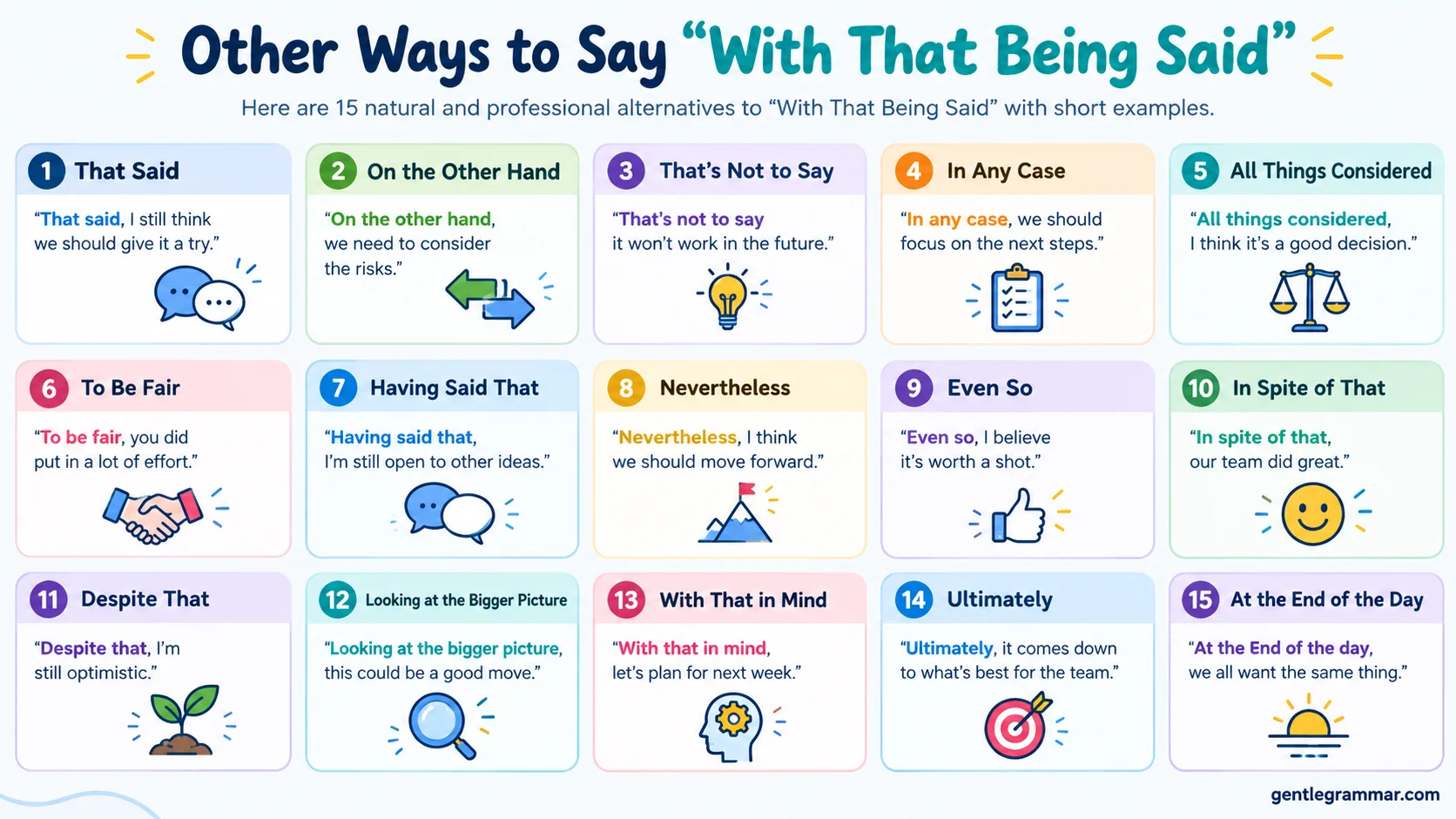
Using Other Ways to Say “With That Being Said” helps you express ideas with clarity, care, and natural flow in academic and professional writing.
When choosing the right words, this phrase can gently shift from one statement to another idea without sounding rude or dismissive. In writing and speaking, I have noticed how easy it is to fall into the habit of saying the same line three times, especially while editing an email, revising a presentation, or drafting professional conversations. If a phrase feels casual, flat, or repetitive, learning other ways to say it can make your language feel fresh and thoughtful.
In academic writing, introductory clauses are useful when you introduce counterpoints, connect two ideas, or shift topics before a conclusion. The best formal synonyms include that being said, with that, and from that; these shortened forms are concise and suitable for formal papers and formal writing. From my experience with essays, academic paper editing, and business email drafting, using these synonyms can improve flow, sound less robotic, and break a repetitive rhythm.
What Does “With That Being Said” Mean?
“With that being said” is a transitional phrase used to acknowledge something that has just been mentioned before adding a new point, qualification, or contrasting idea. It often signals that the speaker agrees with or recognizes the previous statement to some extent, but wants to introduce another perspective. For example, someone might say, “The apartment is small. With that being said, it is in a great location.” The phrase tells the listener that the small size is acknowledged, while the speaker is now shifting attention to the apartment’s positive location. In everyday English, it is commonly understood as “having considered that point, here is something else worth mentioning.”
Common Situations Where “With That Being Said” Is Used
People use “with that being said” in conversations, emails, presentations, essays, reviews, and other forms of communication when they want to move from one idea to another. It is especially useful when the second point qualifies, balances, or contrasts with the first.
In everyday conversation, it can make a change of thought sound smoother. In professional communication, it may introduce a limitation or another consideration without completely dismissing what was just said. Writers may also use it when discussing two sides of an issue. However, because the expression can become repetitive, alternatives such as “that said,” “however,” or “at the same time” may create more varied and natural wording.
Is It Professional or Polite to Say “With That Being Said”?
Yes, “with that being said” can be both professional and polite, depending on how it is used. It is common in workplace conversations, presentations, emails, essays, and discussions where a speaker wants to recognize one point before moving to another. It usually sounds neutral and moderately formal, rather than highly casual.
That said, the phrase can sometimes feel wordy in concise professional writing. A shorter option such as “that said” or “however” may be more direct. In personal conversations, the expression is also perfectly understandable, although simpler wording may sound more relaxed and spontaneous.
Advantages and Disadvantages of Saying “With That Being Said”
Advantages
The main advantage of “with that being said” is that it creates a clear bridge between two ideas. It allows you to acknowledge a previous statement before presenting another point, which can make a disagreement or qualification sound less abrupt. It is also versatile enough for conversations, workplace communication, presentations, and formal or semi-formal writing.
Disadvantages
The expression can become wordy or repetitive when used too often. In some sentences, “however,” “that said,” or “still” can communicate the same transition more efficiently. It may also sound slightly prepared or formal in a casual conversation where a simpler transition would feel more natural.
Synonym for “With That Being Said”
- That said
- Having said that
- That being said
- However
- Nevertheless
- Nonetheless
- Even so
- Still
- All the same
- On the other hand
- At the same time
- Despite that
- Yet
- Even then
- In spite of that
1. That said
Meaning
“That said” means that the previous point is acknowledged, but another point should also be considered. It is one of the closest and most natural alternatives to “with that being said.”
Definition
That said is a transitional expression used to introduce a contrasting, qualifying, or additional point after acknowledging what was just stated.
Detailed Explanation
“That said” is generally shorter and cleaner than “with that being said.” It works particularly well in professional writing because it creates a smooth transition without adding unnecessary words. The expression can introduce a mild contrast rather than a complete disagreement. It is also common in thoughtful conversations where someone wants to balance two observations.
Scenario Examples
Scenario: You are reviewing a useful but expensive service.
Example: “The service is excellent. That said, the monthly fee is higher than I expected.”
Scenario: You are giving a colleague feedback.
Example: “Your presentation was very clear. That said, the conclusion could be stronger.”
Best Use
Use “that said” in professional emails, essays, reviews, presentations, and thoughtful conversations when you want a concise transition.
Tone
Tone: Professional, balanced, concise. It sounds polished without being overly formal.
2. Having said that
Meaning
“Having said that” acknowledges a previous statement before introducing a different or qualifying thought.
Definition
Having said that is a transitional phrase meaning that despite or after acknowledging what was just stated, another point needs to be considered.
Detailed Explanation
This expression is very close in meaning to “with that being said.” It can sound slightly more conversational and reflective because it directly refers to what the speaker has just said. It is useful when you want to soften a change in direction rather than make a sharp contrast. In spoken English, it often sounds natural when someone is reconsidering or balancing their own previous comment.
Scenario Examples
Scenario: You are discussing a difficult course.
Example: “The assignments were challenging. Having said that, I learned more than I expected.”
Scenario: You are talking about a restaurant.
Example: “The wait was longer than we wanted. Having said that, the food was worth it.”
Best Use
Use it in conversation, personal messages, reviews, discussions, and semi-formal writing.
Tone
Tone: Reflective, conversational, balanced. It feels slightly more personal than a purely formal transition.
3. That being said
Meaning
“That being said” introduces another thought after recognizing a previous point. It is essentially a closely related form of “with that being said.”
Definition
That being said means that although the previous statement is acknowledged, the speaker now wants to add a different or qualifying point.
Detailed Explanation
“That being said” is often used in exactly the same kinds of situations as “with that being said.” It can signal contrast, qualification, or balance. Because it is so closely related to the original phrase, it is useful when you want to vary your wording without changing the overall meaning. However, it is not the strongest choice if your goal is to make your writing substantially more concise.
Scenario Examples
Scenario: You are recommending a difficult book.
Example: “The book takes some patience to get through. That being said, its final chapters are fascinating.”
Scenario: You are discussing remote work.
Example: “Working from home can sometimes feel isolating. That being said, it offers much more flexibility.”
Best Use
It works well in conversation, essays, workplace discussions, reviews, and personal communication.
Tone
Tone: Neutral, thoughtful, moderately formal. It sounds natural in both speech and writing.
4. However
Meaning
“However” introduces information that contrasts with or qualifies the previous statement.
Definition
However is a transition used to show contrast or an exception between ideas.
Detailed Explanation
“However” is more direct than “with that being said.” It does not necessarily imply that you are acknowledging the previous point in a conversational way; instead, it clearly tells the reader that the next idea differs from what came before. It is especially useful when clarity and concision matter. In formal writing, “however” is often preferable because it is straightforward and grammatically flexible.
Scenario Examples
Scenario: You are describing a product.
Example: “The camera is compact and affordable. However, its battery life is limited.”
Scenario: You are writing a workplace report.
Example: “The project met most of its targets. However, two deadlines were missed.”
Best Use
Use it in formal writing, business communication, academic work, reports, and professional emails.
Tone
Tone: Professional, direct, neutral. It communicates contrast efficiently.
5. Nevertheless
Meaning
“Nevertheless” introduces a statement that remains true despite something previously mentioned.
Definition
Nevertheless means “despite that” or “even so” and introduces an idea that contrasts with a preceding point.
Detailed Explanation
“Nevertheless” can express a stronger sense of persistence despite an obstacle. Compared with “with that being said,” it often creates a more definite contrast. It is particularly suitable when the second statement remains valid even though the first point creates a reason to doubt it. The word tends to sound more formal and polished.
Scenario Examples
Scenario: You are discussing a difficult exam.
Example: “The exam was extremely demanding. Nevertheless, most students completed it on time.”
Scenario: You are describing a disappointing trip.
Example: “The weather was unpleasant. Nevertheless, we enjoyed exploring the town.”
Best Use
Use it in formal writing, academic discussions, reports, essays, and polished professional communication.
Tone
Tone: Formal, determined, composed. It emphasizes continuing despite a difficulty.
6. Nonetheless
Meaning
“Nonetheless” means that something remains true despite the previous point.
Definition
Nonetheless is a formal transition meaning “nevertheless” or “despite what was just mentioned.”
Detailed Explanation
“Nonetheless” is very similar to “nevertheless,” and the two can often be substituted for one another. It is useful when you want to recognize a limitation or opposing fact while maintaining the importance of your next statement. Compared with “with that being said,” it generally creates a stronger sense of contrast. It is best suited to contexts where polished language is appropriate.
Scenario Examples
Scenario: You are reviewing a complicated process.
Example: “The application process is lengthy. Nonetheless, it is clearly explained.”
Scenario: You are discussing an old building.
Example: “The building needs significant repairs. Nonetheless, its original design is impressive.”
Best Use
Use it in formal essays, reports, professional writing, and carefully worded discussions.
Tone
Tone: Formal, measured, confident. It gives the contrast a polished feel.
7. Even so
Meaning
“Even so” means that despite the previous fact or situation, the following statement is still true.
Definition
Even so is an expression used to introduce a contrasting conclusion that remains valid despite what has just been said.
Detailed Explanation
“Even so” is generally more conversational than “nevertheless” or “nonetheless.” It works well when you want to recognize a problem but avoid letting that problem become the final word. The expression can sound sympathetic and natural in everyday discussions. It is particularly useful when the contrast is noticeable but not overly formal.
Scenario Examples
Scenario: A friend is worried about moving.
Example: “Moving to a new city will be difficult. Even so, I think it will be a good experience.”
Scenario: You are discussing a movie with a friend.
Example: “The middle part was slow. Even so, I liked the ending.”
Best Use
Use it in casual conversation, personal messages, reviews, and friendly discussions.
Tone
Tone: Casual, reassuring, balanced. It sounds natural without being overly formal.
8. Still
Meaning
“Still” can introduce a contrasting thought while emphasizing that something remains true.
Definition
Still is a concise transition meaning “despite that” or “even though that is true.”
Detailed Explanation
“Still” is one of the most natural choices in everyday spoken English. It is shorter and more relaxed than “with that being said.” Because it has several grammatical uses, context matters, but when used as a transition it can gently acknowledge a drawback before returning to another point. It often feels more spontaneous than formal transitional expressions.
Scenario Examples
Scenario: You are talking about an expensive purchase.
Example: “It costs more than I wanted to spend. Still, I think I’ll get a lot of use out of it.”
Scenario: A friend is nervous about an event.
Example: “You might feel awkward at first. Still, everyone there is friendly.”
Best Use
Use it in conversation, texting, personal communication, and informal workplace discussions.
Tone
Tone: Casual, warm, conversational. It feels natural and understated.
9. All the same
Meaning
“All the same” introduces a thought that remains valid despite something previously mentioned.
Definition
All the same means “despite that” or “nevertheless.”
Detailed Explanation
This expression emphasizes that a previous fact does not change the speaker’s next conclusion or feeling. It can sound more conversational than “nevertheless,” while still being more deliberate than simply saying “but.” It is especially useful when the speaker wants to acknowledge a drawback without allowing it to dominate the discussion. The phrase is not always interchangeable with “with that being said,” so the surrounding meaning should guide the choice.
Scenario Examples
Scenario: You are discussing a long journey.
Example: “The drive took nearly six hours. All the same, I’d make the trip again.”
Scenario: You are talking about an old laptop.
Example: “It’s not very fast anymore. All the same, it still handles my basic work.”
Best Use
Use it in conversation, personal writing, reviews, and reflective communication.
Tone
Tone: Conversational, thoughtful, slightly old-fashioned. It adds a calm sense of contrast.
10. On the other hand
Meaning
“On the other hand” introduces a different side, perspective, or consideration.
Definition
On the other hand is a transition used to present an alternative viewpoint or contrasting aspect of an issue.
Detailed Explanation
This phrase is useful when you are deliberately comparing two sides rather than simply adding a qualification. It often works best when the first statement and the second statement represent different perspectives or advantages and disadvantages. Unlike “with that being said,” it strongly signals a shift to another side of an argument. It can therefore be a better choice when balanced comparison is the main purpose.
Scenario Examples
Scenario: You are comparing two neighborhoods.
Example: “The downtown apartment is closer to work. On the other hand, the suburban house has more space.”
Scenario: You are considering two job options.
Example: “The first position pays more. On the other hand, the second offers a shorter commute.”
Best Use
Use it in comparisons, discussions, essays, presentations, decision-making, and workplace communication.
Tone
Tone: Balanced, analytical, neutral. It clearly signals another perspective.
11. At the same time
Meaning
“At the same time” can acknowledge one fact while introducing another fact that is also true.
Definition
At the same time is a transition used to show that two ideas, conditions, or perspectives can exist together.
Detailed Explanation
This expression is useful when the second idea is not necessarily a direct contradiction of the first. Instead, it suggests that both points deserve attention simultaneously. That makes it subtly different from “however.” It is a good choice when you want to communicate balance and nuance rather than a sharp opposition.
Scenario Examples
Scenario: You are giving feedback to a coworker.
Example: “The proposal needs more detail. At the same time, the overall direction is promising.”
Scenario: You are discussing social media.
Example: “Social media can be distracting. At the same time, it can help people stay connected.”
Best Use
Use it in professional communication, discussions, essays, presentations, and balanced explanations.
Tone
Tone: Balanced, thoughtful, moderate. It avoids making the contrast sound unnecessarily strong.
12. Despite that
Meaning
“Despite that” introduces an action, fact, or conclusion that occurs even though the previous point might suggest otherwise.
Definition
Despite that means “even though that is true” or “in spite of that.”
Detailed Explanation
“Despite that” focuses clearly on overcoming or existing alongside a previous circumstance. It is more explicit about the relationship between the two ideas than “with that being said.” The expression can work well when the first statement describes an obstacle or unfavorable condition. It should be used carefully when the intended relationship is simply a change of topic rather than contrast.
Scenario Examples
Scenario: You are discussing a difficult project.
Example: “We had very little time to prepare. Despite that, the team delivered the presentation successfully.”
Scenario: You are describing a busy weekend.
Example: “I had a packed schedule. Despite that, I managed to visit my family.”
Best Use
Use it in professional writing, personal communication, explanations, and situations involving obstacles or limitations.
Tone
Tone: Direct, composed, slightly formal. It clearly emphasizes the contrast.
13. Yet
Meaning
“Yet” can connect two contrasting ideas, showing that the second statement is surprising or different from what might be expected.
Definition
Yet is a conjunction or transition used to introduce a contrast or unexpected result.
Detailed Explanation
“Yet” is much shorter than “with that being said” and often produces a stronger, cleaner contrast. It is especially effective when two short ideas are closely connected. In some sentences, “yet” sounds more natural inside the sentence than as a separate transitional phrase. Because it can have several grammatical functions, punctuation and sentence structure matter.
Scenario Examples
Scenario: You are describing a difficult task.
Example: “The task was challenging, yet the team completed it quickly.”
Scenario: You are talking about someone’s personality.
Example: “He is quiet in large groups, yet he becomes very talkative around close friends.”
Best Use
Use it in formal writing, creative writing, essays, conversation, and concise statements of contrast.
Tone
Tone: Concise, polished, slightly emphatic. It makes the contrast easy to notice.
14. Even then
Meaning
“Even then” refers to a situation where something remains true despite a particular condition or circumstance.
Definition
Even then means that even under the circumstances just described, the following point still applies.
Detailed Explanation
“Even then” is more specific than “with that being said” because it usually refers to a particular condition, possibility, or previous situation. It is useful when the speaker wants to emphasize that a conclusion would remain unchanged despite an obstacle. It should not be treated as a universal replacement for “with that being said.” Its strongest use is when the preceding idea creates a condition that the next statement responds to.
Scenario Examples
Scenario: You are discussing a possible delay.
Example: “The package may arrive a day late. Even then, we should receive it before the event.”
Scenario: You are planning a difficult hike.
Example: “The weather might get colder by afternoon. Even then, we can finish the shorter trail.”
Best Use
Use it in conditional discussions, planning, everyday conversation, and explanations involving circumstances.
Tone
Tone: Practical, conversational, conditional. It emphasizes that the conclusion holds under difficult circumstances.
15. In spite of that
Meaning
“In spite of that” introduces an idea that remains true even though the previous point might have created an obstacle or reason for a different outcome.
Definition
In spite of that means “despite what was just mentioned.”
Detailed Explanation
This expression is closely related to “despite that” and emphasizes contrast in the face of a circumstance. It can sound slightly more deliberate than the shorter “despite that.” It works particularly well when the previous statement describes a problem, limitation, or negative condition. Although it can replace “with that being said” in some contexts, it is less suitable when you are simply adding a new perspective without a clear “despite” relationship.
Scenario Examples
Scenario: You are discussing a difficult renovation.
Example: “The repairs have taken longer than expected. In spite of that, the house is finally starting to look finished.”
Scenario: You are talking about a disappointing result.
Example: “We didn’t get the result we wanted. In spite of that, the experience taught us something valuable.”
Best Use
Use it in formal or semi-formal writing, explanations, reflective communication, and discussions involving setbacks.
Tone
Tone: Formal, thoughtful, resilient. It highlights the fact that something remains true despite a difficulty.
FAQs:
What is another way to say “With That Being Said”?
Some natural alternatives include “that said,” “having said that,” “however,” “even so,” “still,” and “at the same time.” The best choice depends on whether you want to sound conversational, professional, formal, contrasting, or balanced.
What does “With That Being Said” mean?
“With that being said” means that you acknowledge a previous point before introducing another idea, qualification, or contrasting perspective. It often communicates something similar to “having considered that” or “despite that point, there is something else to consider.”
Is “With That Being Said” professional?
Yes. “With that being said” can be appropriate in professional emails, presentations, reports, and discussions. However, it can sometimes sound wordier than necessary, so “that said” or “however” may be more concise in formal business writing.
What is a more polite way to say “With That Being Said”?
There is not one universally more polite replacement. “Having said that” can sound considerate and conversational, while “at the same time” can present another perspective without making the contrast sound too sharp. The right choice depends on the relationship and context.
Which alternative works best in formal communication?
For formal communication, “however,” “nevertheless,” “nonetheless,” and “that said” are useful choices. “However” is especially direct, while “nevertheless” and “nonetheless” can create a more formal sense of contrast. Choose based on the exact relationship between your ideas rather than formality alone.
Conclusion:
Choosing the right transition can make a message easier to understand and more natural to read. “With that being said” is a useful expression when you want to acknowledge one idea before introducing another, but it is not the only option. “That said” offers a concise alternative, while “having said that” feels more conversational. Words such as “however,“nevertheless,” and “nonetheless” create clearer contrast.
While “at the same time” is better when two ideas can both be true. The key is to consider the meaning, tone, relationship, and context before choosing your wording. When you understand these differences, you can move beyond “with that being said” and communicate your ideas with greater precision and variety.
