
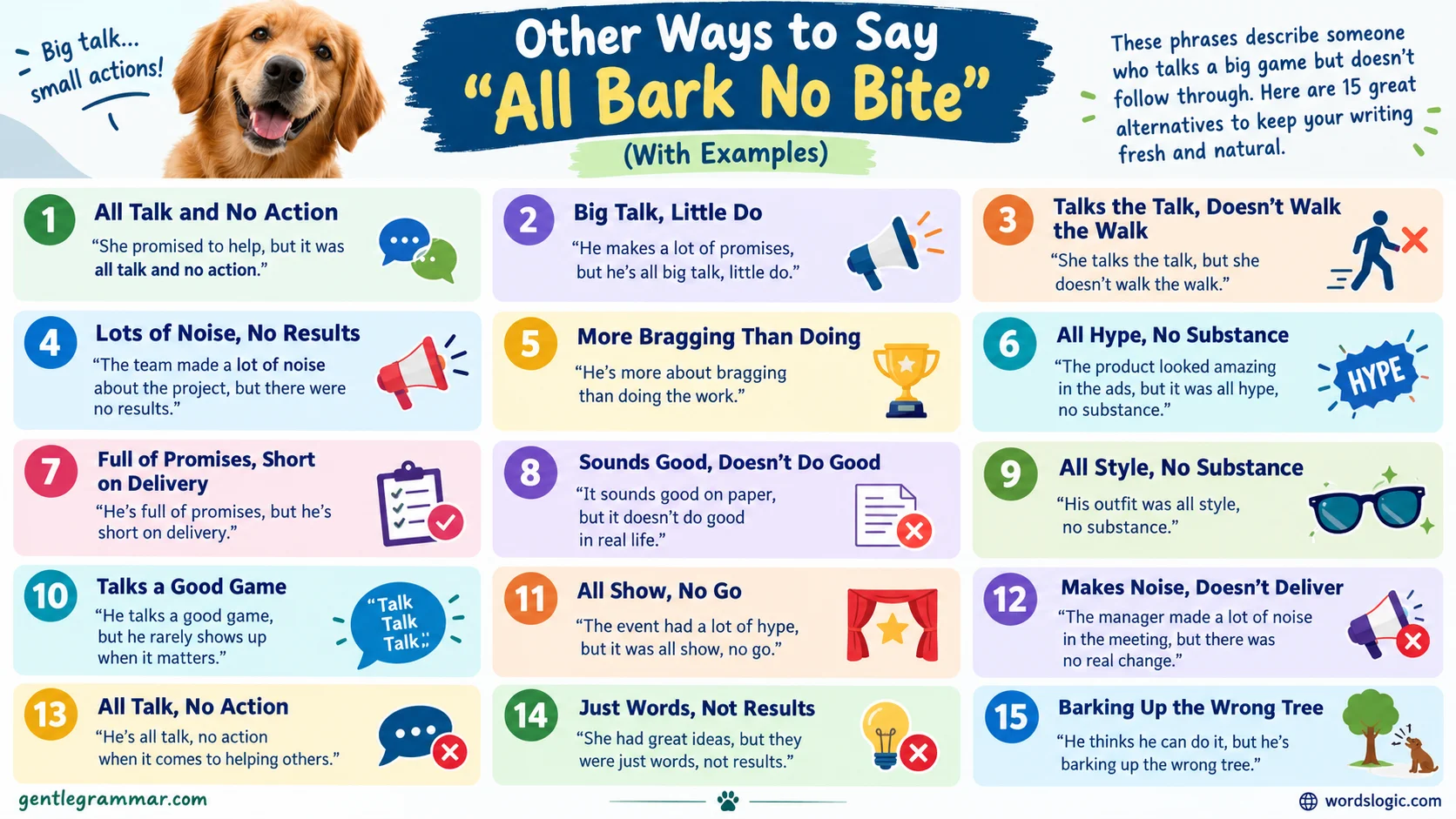
15 Other Ways to Say “All Bark, No Bite” (With Examples) for everyday use. Imagine a dog that barks menacingly but doesn’t actually bite.
This literal image explains the idiom, a catchy phrase in English used for a person who talks tough, makes bold threats, or acts aggressively but is unlikely to take real action. The meaning becomes clear when we consider people and situations where someone sounds intimidating but rarely follows through on their threats. This expression is one of many colorful idioms that use humor to create a clear picture of someone’s behavior.
In my experience, Actions speak louder than words is a useful reminder that big statements, promises, and claims of real change mean little without meaningful action. Someone may threaten consequences or make making statements a habit while lacking the ability, willingness, or courage to back up words with real effort and substance.
What Does “All Bark, No Bite” Mean?
“All bark, no bite” describes someone who sounds threatening, aggressive, or intimidating but does not follow through with their words. The expression compares a person’s loud warnings or fierce attitude to a dog that barks loudly but does not actually bite. In everyday English, it suggests that someone’s threats are more dramatic than their actions. For example, a manager might constantly threaten to fire employees over small mistakes but never take any real action. The phrase is usually informal and can sound humorous, dismissive, or critical, depending on the context.
The expression does not necessarily mean that a person is harmless in every situation. It simply suggests that their tough talk is not matched by their behavior. Someone might use it jokingly about a friend who makes exaggerated threats during a game or more seriously about a person who frequently makes promises or warnings without acting on them. The key idea is the gap between what someone says and what they actually do.
Common Situations Where “All Bark, No Bite” Is Used
People commonly use this expression when discussing someone who makes threats, boasts about their strength, or tries to intimidate others without following through. In casual conversation, a friend might describe a competitive teammate who talks aggressively before every match but becomes quiet when the game begins. On social media, the phrase can be used to comment on public arguments, exaggerated claims, or empty online threats.
It can also appear in discussions about relationships, school, and workplace behavior. For instance, a student might use it to describe a classmate who constantly threatens to report others but never does so. At work, however, the phrase may sound disrespectful if used directly about a colleague or manager. In professional communication, alternatives such as “their actions don’t match their words” may communicate the same concern more constructively. Choosing a different expression helps you describe the behavior without creating unnecessary tension.
Is It Professional or Polite to Say “All Bark, No Bite”?
“All bark, no bite” is a casual, idiomatic expression, not formal business language. It can be friendly and humorous when used among people who understand each other’s intentions, but it can also sound mocking or dismissive. Calling someone all bark, no bite implies that their threats or aggressive behavior are not worth taking seriously, which may offend them if said directly.
In a professional setting, it is usually better to describe the person’s behavior rather than label their character. For example, saying “their warnings have not been followed by action” sounds more objective than saying that someone is all bark, no bite. In a personal conversation, the original phrase may be perfectly natural when you want to express mild criticism or make a joke. The best choice depends on your relationship with the person, the seriousness of the situation, and whether your goal is to entertain, criticize, or resolve a problem.
Advantages and Disadvantages of Saying “All Bark, No Bite”
Advantages
The expression is short, memorable, and easy to understand. Its comparison between barking and biting creates a vivid image, making it effective when describing someone whose intimidating words are not backed by action. It can also add humor to an ordinary conversation and communicate skepticism without requiring a long explanation. When used among friends, it can be a playful way to point out exaggerated threats or an overly tough attitude.
Disadvantages
The phrase can sound dismissive or insulting, especially when directed at someone in authority or someone who takes their reputation seriously. It may also underestimate a person’s actual ability to cause harm, so it should not be used as proof that a threat is harmless. In formal writing, the idiom may feel too casual or judgmental. A more precise expression can help you distinguish between empty threats, exaggerated confidence, broken promises, and behavior that simply does not match someone’s words.
Synonyms for “All Bark, No Bite”
- All Talk, No Action
- Empty Threats
- More Bark Than Bite
- Big Talk, Little Action
- Tough Talk
- Doesn’t Follow Through
- Words Without Action
- A Paper Tiger
- Full of Hot Air
- Talks a Big Game
- Makes Threats They Won’t Carry Out
- Intimidating in Words Only
- Their Actions Don’t Match Their Words
- Bluster Without Substance
- More Noise Than Danger
1. All Talk, No Action
Meaning
All talk, no action describes someone who says a lot but does little to turn their words into reality. Like “all bark, no bite,” it highlights the difference between what a person says and what they actually do.
Definition
A phrase describing someone whose words are not supported by meaningful action.
Detailed Explanation
This expression is useful when a person repeatedly announces plans, makes promises, or claims they will do something but never follows through. Unlike “all bark, no bite,” it does not specifically require threats or aggression. It can describe an ambitious friend, an unreliable colleague, or a leader who repeatedly announces changes without implementing them. The wording is direct and can sound critical, so it is best used when the pattern is clear.
Scenario Examples
Scenario: A friend keeps promising to start exercising.
Example: “He’s all talk, no action. He’s been saying he’ll join the gym for months.”
Scenario: A team leader repeatedly announces improvements.
Example: “We keep hearing about new plans, but so far, it’s all talk, no action.”
Best Use
Use this phrase when discussing unfulfilled promises, abandoned plans, or repeated inaction. It works in everyday conversation and informal workplace discussions.
Tone
Tone: Direct, informal, critical. It focuses on the lack of action rather than the person’s intimidating attitude.
2. Empty Threats
Meaning
Empty threats are warnings or threats that someone makes without intending or being able to carry them out. The phrase closely matches “all bark, no bite” when the emphasis is on threatening behavior.
Definition
Threats that are unlikely to be carried out or lack a credible intention behind them.
Detailed Explanation
This expression is more specific than the original because it focuses on threats rather than general boasting. It can suggest that someone is trying to frighten, control, or pressure another person through words alone. However, a threat should not automatically be dismissed as empty simply because it has not yet been carried out. Context matters, particularly when safety is involved.
Scenario Examples
Scenario: Someone repeatedly threatens to leave a group chat after arguments.
Example: “He’s made those empty threats before, but he always comes back.”
Scenario: A person threatens to complain over every minor disagreement.
Example: “Don’t assume the warning is an empty threat; find out what they actually intend to do.”
Best Use
Use it when the central issue is a threat that may not be genuine or actionable. It fits casual discussions and serious conversations, although formal reports may require more precise wording.
Tone
Tone: Skeptical, serious, sometimes dismissive. It questions whether a threat has real substance behind it.
3. More Bark Than Bite
Meaning
More bark than bite describes a person whose aggressive words or intimidating manner are stronger than their actual willingness to act.
Definition
Having a fierce outward attitude without an equally strong tendency to act aggressively.
Detailed Explanation
This is a close variation of “all bark, no bite,” so the two are often interchangeable in casual conversation. The word “more” makes the comparison slightly less absolute: the person may still take action occasionally, but their talk tends to exceed their behavior. It can be a lighthearted way to describe a grumpy friend who is kinder than they appear. Even so, it should not be used to assume that a genuinely threatening person poses no risk.
Scenario Examples
Scenario: A neighbor often complains loudly but rarely takes things further.
Example: “He has a fierce temper, but I think he’s more bark than bite.”
Scenario: A friend acts intimidating during a board game.
Example: “Don’t let Maya’s competitive talk scare you. She’s more bark than bite.”
Best Use
Choose this phrase for informal conversations about a tough exterior or exaggerated aggression.
Tone
Tone: Casual, humorous, mildly critical. It can soften the criticism by suggesting that the person’s behavior is less severe than it first appears.
4. Big Talk, Little Action
Meaning
Big talk, little action describes someone who makes impressive claims or ambitious promises but does very little to make them happen.
Definition
A pattern of grand words accompanied by limited effort or results.
Detailed Explanation
This phrase emphasizes the contrast between ambitious language and actual performance. It can apply to someone who boasts about their abilities, promises major improvements, or claims to have big plans. Unlike “all bark, no bite,” it does not necessarily involve threats or intimidation. It is especially useful when the main concern is a person’s failure to deliver results.
Scenario Examples
Scenario: A classmate claims they will easily win a competition but never practises.
Example: “There’s a lot of big talk, little action coming from him.”
Scenario: A project group keeps promising to finish its work early.
Example: “We need results this time, not more big talk and little action.”
Best Use
Use it when someone overstates their intentions or abilities but produces little progress. It suits informal conversations and constructive discussions about performance.
Tone
Tone: Blunt, skeptical, practical. It draws attention to results rather than rhetoric.
5. Tough Talk
Meaning
Tough talk refers to strong, forceful, or intimidating language. Depending on context, it can suggest that someone is trying to sound powerful without necessarily demonstrating that power.
Definition
Language intended to sound strong, aggressive, or intimidating.
Detailed Explanation
Unlike “all bark, no bite,” tough talk describes the words themselves rather than proving that the speaker will not act. Someone may use tough talk to impress others, discourage opposition, or express frustration. The expression can be neutral when describing a communication style, but it becomes critical when suggesting that the words are mostly for show. Use it carefully when actual threats or credible risks are involved.
Scenario Examples
Scenario: Two competitors exchange aggressive comments before a match.
Example: “There’s plenty of tough talk before the game, but we’ll see how they perform.”
Scenario: A public figure promises a harsh response to criticism.
Example: “The announcement was full of tough talk, but the next steps remain unclear.”
Best Use
Use this phrase when describing aggressive language, bold warnings, or forceful public statements without making assumptions about what will happen next.
Tone
Tone: Direct, descriptive, sometimes skeptical. Its meaning depends on whether the speaker is simply describing or criticizing the language.
6. Doesn’t Follow Through
Meaning
Doesn’t follow through describes someone who fails to complete an action, fulfil a promise, or carry out a stated intention.
Definition
Failing to do what one has said or agreed to do.
Detailed Explanation
This expression is more neutral and practical than “all bark, no bite.” It focuses on a person’s failure to complete something rather than whether they sound intimidating. It is useful when you want to discuss reliability without using an insult. In professional settings, it can describe a specific behavior, although it is fairer to explain what was promised and what remains unfinished.
Scenario Examples
Scenario: A colleague repeatedly promises to send a document.
Example: “He often says he’ll send the report, but he doesn’t follow through.”
Scenario: A friend offers to help with a move but never confirms.
Example: “I appreciate the offer, but I need someone who will follow through.”
Best Use
Choose this wording for workplace feedback, practical discussions, and situations involving reliability or responsibility.
Tone
Tone: Neutral, professional, firm. It describes an observable pattern without mocking the person.
7. Words Without Action
Meaning
Words without action describes statements, promises, or declarations that are not supported by corresponding behavior.
Definition
Words that are not accompanied by meaningful steps or results.
Detailed Explanation
This phrase focuses on the gap between what someone says and what they do. It is broader than “all bark, no bite” because the words do not need to be aggressive or threatening. Someone may express concern, promise support, or announce a new plan without taking any practical steps. The expression is useful when you want to emphasize the importance of real effort rather than confident speech.
Scenario Examples
Scenario: A group promises to reduce waste but makes no changes.
Example: “Environmental promises mean little when they remain words without action.”
Scenario: A friend says they want to repair a strained relationship.
Example: “I hope we can move forward, but I need actions, not just words without action.”
Best Use
Use it in discussions about accountability, leadership, commitments, and meaningful change. A more specific description may be preferable in formal reports.
Tone
Tone: Serious, reflective, firm. It highlights the need for practical follow-through.
8. A Paper Tiger
Meaning
A paper tiger is someone or something that appears powerful or frightening but is actually weak or ineffective.
Definition
A person, group, or threat that looks formidable but lacks real strength or power.
Detailed Explanation
This expression is close to “all bark, no bite” when the focus is on an intimidating appearance that hides a lack of real power. However, a paper tiger can also refer to an organization, rule, or institution that seems powerful but cannot achieve much. It is not simply a synonym for someone who breaks promises; the central idea is apparent strength versus actual weakness. The phrase can sound dismissive, especially in political or professional discussions.
Scenario Examples
Scenario: A rival team talks confidently but struggles against strong opponents.
Example: “They looked unbeatable on paper, but their reputation turned out to be a paper tiger.”
Scenario: An organization announces strict rules that it never enforces.
Example: “Without consistent enforcement, the policy risks becoming a paper tiger.”
Best Use
Use this expression when someone’s apparent power or a threat’s intimidating reputation proves ineffective.
Tone
Tone: Critical, analytical, dismissive. It questions whether apparent strength is backed by real capability.
9. Full of Hot Air
Meaning
Full of hot air describes someone who talks boastfully or makes claims that seem exaggerated, empty, or unreliable.
Definition
Talking in a way that sounds impressive but has little truth, substance, or practical value.
Detailed Explanation
This idiom is especially useful when someone exaggerates their achievements, abilities, or plans. Like “all bark, no bite,” it can suggest that a person’s words are not worth much, but it does not specifically refer to threats. It often sounds humorous or insulting, depending on how it is delivered. If you need to maintain a respectful relationship, describing the specific claim as unsupported may be more constructive.
Scenario Examples
Scenario: Someone repeatedly boasts about knowing famous people.
Example: “He claims to have connections everywhere, but I suspect he’s full of hot air.”
Scenario: A salesperson makes grand promises without evidence.
Example: “Ask for details before accepting those claims; the presentation sounded full of hot air.”
Best Use
Use it for exaggerated boasting, unrealistic claims, or talk that lacks substance, mainly in informal conversation.
Tone
Tone: Humorous, skeptical, dismissive. It questions the credibility of what someone says.
10. Talks a Big Game
Meaning
Talks a big game describes someone who speaks confidently about their skills, ambitions, or expected achievements, sometimes without delivering the results they promise.
Definition
Speaking confidently or boastfully about what one can do or plans to achieve.
Detailed Explanation
This expression often applies to sports, competitions, work, and personal goals. It resembles “all bark, no bite” when someone boasts but fails to perform, although the phrase itself does not prove that the person is incapable. A person can talk a big game and still succeed. The wording is therefore most accurate when you are describing confident claims rather than asserting that every claim is empty.
Scenario Examples
Scenario: A new player boasts about winning a tournament.
Example: “He talks a big game, but the tournament will show how well he actually plays.”
Scenario: A business partner describes ambitious plans.
Example: “She talks a big game about expanding the company, but we need to see a workable plan.”
Best Use
Choose it for boasting, confidence, and ambitious claims when actual performance is still in question.
Tone
Tone: Casual, skeptical, sometimes playful. It challenges confidence without automatically calling the person dishonest.
11. Makes Threats They Won’t Carry Out
Meaning
This expression describes someone who threatens to do something but is not expected to follow through. It conveys the central idea of “all bark, no bite” in a more explicit way.
Definition
Making threats that someone is unlikely or unwilling to carry out.
Detailed Explanation
This wording is more literal than the original idiom and makes the behavior easy to understand. It is useful when the person repeatedly uses threats to get attention, pressure others, or appear powerful. However, saying a threat will not be carried out is a judgment about someone’s intentions, so it should be based on reasonable evidence rather than assumption. When the consequences could be serious, take threats seriously and assess the situation carefully.
Scenario Examples
Scenario: A friend threatens to quit a club whenever a decision goes against them.
Example: “He keeps making threats he won’t carry out whenever he doesn’t get his way.”
Scenario: A manager repeatedly threatens consequences but never explains or applies them consistently.
Example: “The team has stopped trusting warnings that never lead to action.”
Best Use
Use this expression when discussing repeated, seemingly unfulfilled threats and you want to make the meaning explicit.
Tone
Tone: Direct, serious, critical. It clearly describes the behavior without relying on an idiom.
12. Intimidating in Words Only
Meaning
Intimidating in words only describes someone who uses frightening or aggressive language but does not demonstrate the same level of aggression through their actions.
Definition
Appearing threatening through speech rather than observable behavior.
Detailed Explanation
This expression closely reflects the verbal side of “all bark, no bite.” It is more descriptive and less playful than the original phrase, which can make it suitable for careful explanations of someone’s communication style. It does not necessarily mean the person is incapable of taking action; it simply distinguishes their language from their demonstrated behavior. This distinction is important when describing a conflict objectively.
Scenario Examples
Scenario: Someone uses a harsh tone during a disagreement but later speaks calmly.
Example: “He can sound intimidating in words only, so I prefer to judge the situation by his actual behavior.”
Scenario: A fictional character makes dramatic threats but avoids confrontation.
Example: “The character seems intimidating in words only, which makes his later actions surprising.”
Best Use
Use it when you want to describe a threatening communication style without making a broad judgment about someone’s character.
Tone
Tone: Descriptive, measured, cautious. It emphasizes the difference between speech and action.
13. Their Actions Don’t Match Their Words
Meaning
This expression means that a person’s behavior does not support what they say. It can describe empty threats, broken promises, exaggerated claims, or inconsistent behavior.
Definition
A situation in which someone’s actions contradict or fail to support their statements.
Detailed Explanation
This is one of the most flexible alternatives because it does not assume that the person is deliberately trying to intimidate others. It can describe a friend who promises support but remains unavailable, a leader whose decisions conflict with public statements, or a colleague who repeatedly misses commitments. Compared with “all bark, no bite,” it sounds more measured and less mocking. It also allows you to discuss a specific inconsistency without claiming to know the person’s intentions.
Scenario Examples
Scenario: A friend says honesty matters but repeatedly hides important information.
Example: “I value what you say, but sometimes your actions don’t match your words.”
Scenario: A company promotes teamwork but discourages employees from sharing ideas.
Example: “The company’s actions don’t match its words about collaboration.”
Best Use
Use it in workplace feedback, relationship conversations, constructive criticism, and formal discussions where fairness and clarity matter.
Tone
Tone: Respectful, direct, thoughtful. It focuses on observable inconsistency rather than insulting someone’s personality.
14. Bluster Without Substance
Meaning
Bluster without substance describes loud, forceful, or boastful language that lacks meaningful evidence, ability, or action behind it.
Definition
Aggressive or confident talk that lacks genuine support or practical value.
Detailed Explanation
This expression is more formal and analytical than “all bark, no bite.” The word “bluster” refers to loud or boastful speech, while “substance” suggests something meaningful or credible behind it. Together, they describe a show of confidence that lacks depth or evidence. The phrase can work well when evaluating public statements, arguments, or proposals, but it may sound unnecessarily severe in a friendly conversation.
Scenario Examples
Scenario: A public speaker makes dramatic claims without providing supporting details.
Example: “The speech sounded forceful, but much of it was bluster without substance.”
Scenario: A proposal promises major changes but offers no practical steps.
Example: “We need a realistic implementation plan, not bluster without substance.”
Best Use
Use it in analytical writing, professional discussions, reviews of proposals, and commentary on unsupported claims.
Tone
Tone: Formal, skeptical, critical. It questions the substance behind confident or aggressive language.
15. More Noise Than Danger
Meaning
More noise than danger describes someone or something that creates a lot of commotion, alarm, or intimidation without necessarily posing an equally serious threat.
Definition
Creating more apparent alarm or disturbance than actual danger.
Detailed Explanation
This expression is a descriptive alternative rather than a fixed synonym for “all bark, no bite.” It is useful when the main contrast is between how alarming something appears and the actual level of risk. It may describe an exaggerated argument, a dramatic reaction, or a situation that sounds more frightening than it proves to be. Still, appearances alone cannot establish that a real threat is harmless, so this wording should be used only when there is a sound basis for that assessment.
Scenario Examples
Scenario: A minor disagreement becomes a loud argument among friends.
Example: “They argue loudly, but this time it seems like more noise than danger.”
Scenario: A fictional villain makes dramatic announcements but avoids meaningful confrontation.
Example: “The villain creates more noise than danger until the final act.”
Best Use
Use it in informal conversation, storytelling, or descriptions of exaggerated commotion when the distinction between alarm and actual risk is important.
Tone
Tone: Casual, observant, mildly dismissive. It suggests that the appearance of danger may exceed the reality, without making that judgment appropriate in every situation.
FAQs:
What is another way to say “all bark, no bite”?
“All talk, no action” is a strong general alternative. It describes someone who makes bold statements but does not follow through. If the focus is specifically on threats, “empty threats” may be more precise.
What does “all bark, no bite” mean?
It means someone sounds aggressive, intimidating, or threatening but does not act as boldly as their words suggest. The expression is informal and often implies that a person’s tough talk is exaggerated.
Is “all bark, no bite” professional?
Not usually. It is a casual idiom that can sound dismissive when used about a colleague, employee, or manager. In professional communication, “their actions don’t match their words” is generally a more measured choice.
What is a more polite way to say “all bark, no bite”?
A more tactful option is “doesn’t always follow through.” This describes a person’s behavior without mocking them or assuming their intentions. You can also say, “Their statements haven’t always been followed by action.”
Which alternative works best in formal communication?
“Their actions don’t match their words” is a useful choice for formal or professional communication because it focuses on observable behavior. When discussing a specific incident, explaining what was said, what happened, and what remains unresolved is even more precise.
Conclusion:
Choosing an alternative to “all bark, no bite” helps you describe someone’s behavior with the right balance of honesty, clarity, and tact. Expressions such as “all talk, no action” and “empty threats” work well when discussing unfulfilled promises or warnings, while “a paper tiger” describes something that appears powerful but lacks real strength. For professional situations, “their actions don’t match their words” offers a more measured way to express concern without sounding unnecessarily insulting.
Remember that these expressions are similar, but they are not interchangeable in every context. Some focus on threats, others on boasting, and some simply describe a lack of follow-through. Before choosing your wording, consider your audience, your relationship with the person, and the point you want to communicate. The best expression is the one that describes the behavior accurately while fitting the situation naturally.
