
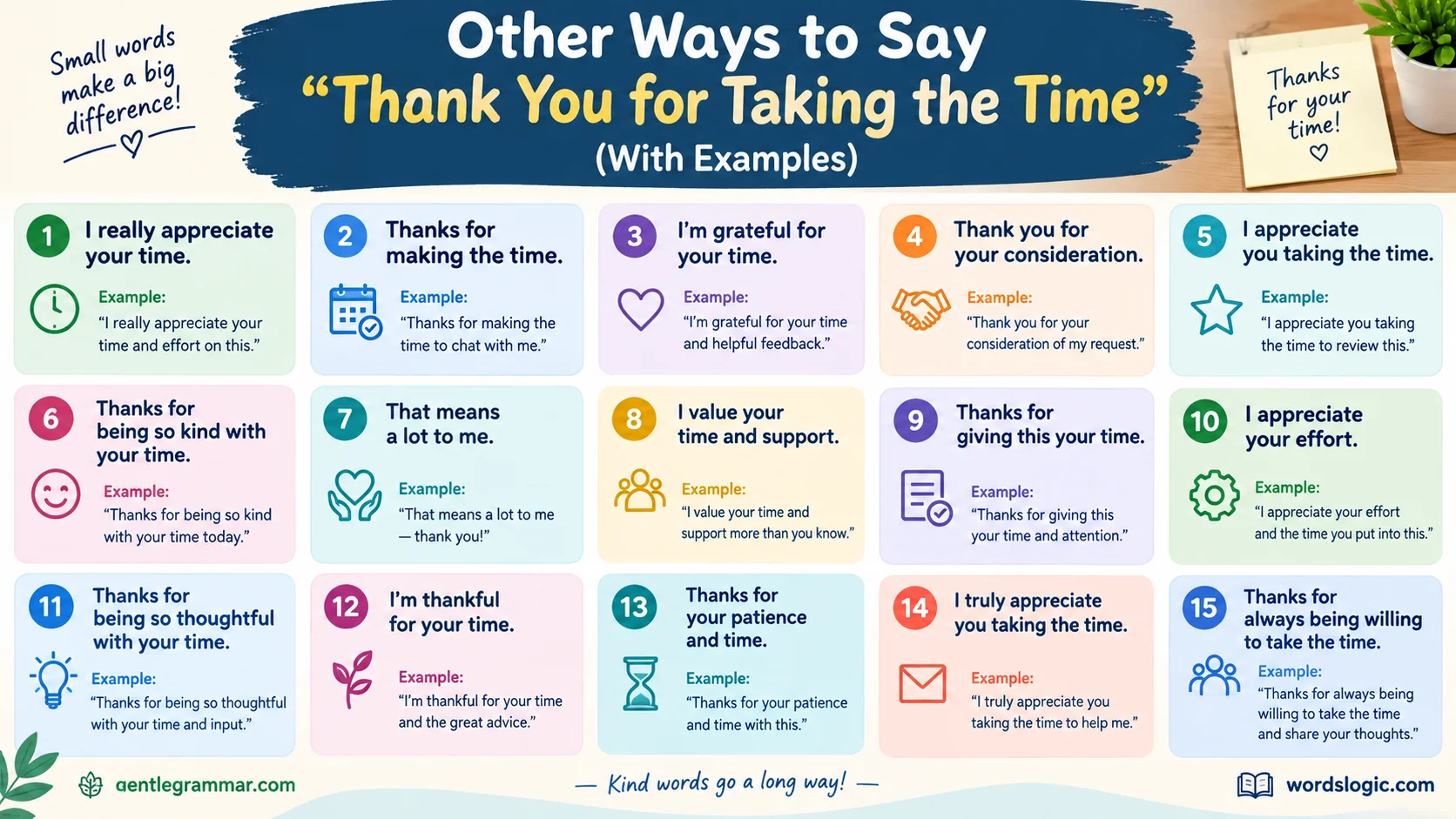
Finding the right words to express gratitude can improve communication and strengthen relationships.
This guide to 15 Other Ways to Say “Thank You for Taking the Time” (With Examples) helps you choose a sincere phrase for different situations. Saying “Thank You For Your Quick Response” is polite, but thoughtful alternatives can make your message feel more personal and meaningful. When someone takes the time to answer a question, listen carefully, or provide guidance, a genuine response shows that you value their effort.
There are 15 ways to say thank you across a wide range of situations, including interview contexts, personal moments, and professional instances. You can recognize someone’s contributions by sending a note, card, or email to colleagues, companies, and job contacts. Whether you are communicating about part-time, full-time, or remote work, a respectful and thoughtful message builds trust, strengthens communication, and creates a positive environment.
What Does “Thank You for Taking the Time” Mean?
“Thank you for taking the time” is an expression of gratitude for someone’s time, attention, or effort. It acknowledges that a person has made room in their schedule to help you, meet with you, answer your questions, review your work, or discuss something important. The phrase communicates appreciation not only for what the person did but also for the time they chose to give you.
In everyday English, the expression is generally polite, respectful, and considerate. It works well in professional and personal communication because it recognizes that another person’s time is valuable. For example, you might write it after a job interview, a helpful meeting, a detailed explanation, or a conversation with someone who offered useful advice.
Common Situations Where “Thank You for Taking the Time” Is Used
People use this expression whenever they want to recognize the time and attention someone has given them. In professional emails, it is common after interviews, meetings, consultations, presentations, and requests for feedback. Students may use it to thank teachers for explaining a difficult topic, while colleagues can use it to acknowledge someone’s help with a project.
The phrase also fits personal messages when a friend listens to a problem, a family member offers guidance, or someone makes time for a meaningful conversation. In customer communication, it can express appreciation when a customer shares feedback or when a representative takes time to resolve an issue. Choosing an alternative can make the message more specific by highlighting the person’s patience, assistance, advice, or generosity rather than simply mentioning their time.
Is It Professional or Polite to Say “Thank You for Taking the Time”?
Yes. “Thank you for taking the time” is a polite and professional expression that recognizes someone’s effort and respects their schedule. It is appropriate in business emails, job applications, follow-up messages, academic communication, and conversations with clients or supervisors. The wording is warm without being overly emotional, making it suitable for both formal and semi-formal situations.
The phrase can also sound friendly in everyday conversation, especially when the context is clear. For a more personal message, “I really appreciate you making time for me” may sound warmer, while “Thank you for your time and consideration” can be more appropriate for a formal request. The best wording depends on the relationship, the reason for the thanks, and the tone you want to convey.
Advantages and Disadvantages of Saying “Thank You for Taking the Time”
Advantages
- Polite and respectful: It recognizes that someone’s time is valuable.
- Versatile: It works in professional emails, academic settings, and personal conversations.
- Sincere without being overly emotional: It expresses gratitude in a balanced way.
- Easy to personalize: You can add the specific reason for your thanks, such as reviewing a proposal or explaining a difficult subject.
Disadvantages
- Can sound generic: Without context, the phrase may feel like a standard closing rather than a personal expression of gratitude.
- May overlook the specific contribution: It emphasizes time more than the person’s advice, patience, expertise, or practical help.
- Can become repetitive: Using it in every email may make your communication feel less distinctive.
- May need a warmer alternative: When someone has provided emotional support or gone out of their way to help, a more personal expression may better convey your appreciation.
Synonyms for “Thank You for Taking the Time”
- I Appreciate You Making Time for Me
- Thank You for Your Time and Consideration
- I Appreciate Your Help and Support
- Thank You for Meeting With Me
- I’m Grateful for Your Time
- Thank You for Your Attention
- I Appreciate Your Willingness to Help
- Thank You for Sharing Your Insights
- I Appreciate You Taking the Time to Explain
- Thank You for Your Patience
- I’m Thankful You Could Make Time
- Thank You for Your Thoughtful Feedback
- I Appreciate Your Effort
- Thank You for Being So Generous With Your Time
- I’m Grateful for the Opportunity to Connect
1. I Appreciate You Making Time for Me
Meaning
“I appreciate you making time for me” expresses personal gratitude when someone adjusts their schedule to meet, talk, or help you. It emphasizes the choice they made to give you their attention.
Definition
A polite expression of thanks for someone who has deliberately set aside time for you.
Detailed Explanation
This phrase feels slightly more personal than the original because it directly acknowledges the effort involved in arranging time together. It is particularly useful when someone has a busy schedule but still makes room for your needs. The words “I appreciate” communicate genuine gratitude rather than simple acknowledgment. You can use it with a colleague, mentor, friend, or family member without sounding overly formal.
Scenario Examples
Scenario 1: A meeting with a mentor
Example: I appreciate you making time for me today. Your career advice gave me a clearer direction.
Scenario 2: A personal conversation
Example: I know you’ve had a busy week, so I really appreciate you making time for me.
Scenario 3: A work consultation
Example: I appreciate you making time for me to discuss the project before the deadline.
Best Use
Use this expression in personal messages, professional emails, meetings, and one-to-one conversations when someone has specifically made room in their schedule for you.
Tone
Tone: Warm, respectful, and personal.
It highlights the person’s consideration and makes your gratitude feel directed toward them.
2. Thank You for Your Time and Consideration
Meaning
This expression thanks someone for giving your request, application, proposal, or situation their attention. It acknowledges both their time and thoughtful judgment.
Definition
A formal expression of gratitude for someone’s attention and careful consideration of a matter.
Detailed Explanation
Unlike the original phrase, this wording places some emphasis on the person’s willingness to consider what you have presented. It is particularly suitable when you are asking for a decision, review, opportunity, or response. It sounds professional without being excessively stiff. However, it does not necessarily mean that the person has agreed with your request or taken action on it.
Scenario Examples
Scenario 1: Following up on a job application
Example: Thank you for your time and consideration. I appreciate the opportunity to be considered for the position.
Scenario 2: Sending a business proposal
Example: Thank you for your time and consideration of our proposal. I look forward to hearing your thoughts.
Scenario 3: Requesting academic approval
Example: Thank you for your time and consideration of my request to extend the submission deadline.
Best Use
Choose this expression for formal emails, job applications, proposals, academic requests, and business correspondence where a respectful tone matters.
Tone
Tone: Formal, courteous, and professional.
The wording acknowledges the recipient’s attention while respecting their role in making a decision.
3. I Appreciate Your Help and Support
Meaning
“I appreciate your help and support” expresses gratitude for someone’s practical assistance, encouragement, or continued involvement. It focuses on what the person contributed, rather than the time they spent.
Definition
A sincere statement recognizing the assistance and encouragement someone has provided.
Detailed Explanation
This phrase is useful when someone has done more than simply listen or attend a meeting. They may have solved a problem, offered guidance, encouraged you during a difficult period, or helped you complete a task. Compared with the original expression, it places greater emphasis on the value of their contribution. It is broad enough for professional and personal relationships, but you should use it when actual help or support has been offered.
Scenario Examples
Scenario 1: A colleague helps with a deadline
Example: I appreciate your help and support in getting the report ready before Friday.
Scenario 2: A friend offers encouragement
Example: I appreciate your help and support while I’ve been working through this decision.
Scenario 3: A teacher provides extra guidance
Example: Thank you for explaining the assignment and answering my questions. I appreciate your help and support.
Best Use
Use it in thank-you messages, workplace communication, academic correspondence, and personal conversations when you want to acknowledge assistance or encouragement.
Tone
Tone: Sincere, appreciative, and supportive.
It sounds more contribution-focused than the original phrase.
4. Thank You for Meeting With Me
Meaning
This expression thanks someone for attending a meeting or setting aside time for a discussion. It is especially relevant when the interaction involved a scheduled conversation or appointment.
Definition
A polite acknowledgment of someone’s participation in a meeting or discussion.
Detailed Explanation
The phrase is more specific than “Thank you for taking the time” because it identifies the activity you are grateful for. It works particularly well after interviews, business meetings, consultations, and academic discussions. It can be followed by a sentence highlighting a useful takeaway from the meeting. Unlike broader expressions of gratitude, it is less suitable when someone helped you through messages without meeting you.
Scenario Examples
Scenario 1: Following a job interview
Example: Thank you for meeting with me today. I enjoyed learning more about the role and the team.
Scenario 2: A business discussion
Example: Thank you for meeting with me this afternoon to discuss the proposed changes.
Scenario 3: A meeting with a professor
Example: Thank you for meeting with me to review my research outline. Your suggestions were helpful.
Best Use
Choose this phrase for meeting follow-ups, interviews, consultations, appointments, and professional networking.
Tone
Tone: Professional, courteous, and straightforward.
Its strength is clarity: the recipient immediately understands what you are thanking them for.
5. I’m Grateful for Your Time
Meaning
“I’m grateful for your time” expresses heartfelt appreciation for the attention someone has given you. It conveys that their time was valuable and meaningful to you.
Definition
A sincere statement of thankfulness for someone’s time and attention.
Detailed Explanation
This expression is close in meaning to the original, but “grateful” can give it a slightly more heartfelt quality. It is appropriate when someone has listened carefully, offered guidance, or spent time helping you understand something important. It can work in both personal and professional settings. For a highly formal email, “Thank you for your time and consideration” may sound more conventional.
Scenario Examples
Scenario 1: Receiving career advice
Example: I’m grateful for your time and for the honest advice you shared with me.
Scenario 2: A helpful conversation with a friend
Example: I’m grateful for your time tonight. Talking things through helped me feel more confident.
Scenario 3: A professional consultation
Example: I’m grateful for your time and the thoughtful suggestions you offered during our call.
Best Use
Use it in personal thank-you notes, mentoring conversations, professional follow-ups, and messages after meaningful discussions.
Tone
Tone: Warm, sincere, and thoughtful.
It conveys a stronger sense of personal appreciation than a routine acknowledgment.
6. Thank You for Your Attention
Meaning
This phrase thanks someone for listening, concentrating, or directing their attention to a subject. It focuses on attentiveness rather than the time spent.
Definition
A polite expression of appreciation for someone’s focused attention.
Detailed Explanation
“Thank you for your attention” is especially useful after a presentation, explanation, announcement, or formal discussion. It recognizes that the audience listened to or considered the information presented. Unlike the original phrase, it does not necessarily imply that the person made extra time in their schedule. In a personal message, it may sound somewhat formal, so a more conversational expression might fit better.
Scenario Examples
Scenario 1: Ending a presentation
Example: Thank you for your attention. I’m happy to answer any questions about the proposal.
Scenario 2: A classroom discussion
Example: Thank you for your attention during today’s lesson. Please let me know if anything needs clarification.
Scenario 3: A customer reviewing important information
Example: Thank you for your attention to these details. Please contact us if you have any questions.
Best Use
Choose this expression for presentations, meetings, announcements, instructional settings, and formal communications where focused listening is relevant.
Tone
Tone: Formal, respectful, and composed.
It works best when the recipient’s attention is the main thing you want to acknowledge.
7. I Appreciate Your Willingness to Help
Meaning
This expression thanks someone for being ready or willing to assist you. It recognizes their cooperation and helpful attitude, even when the assistance is still being arranged.
Definition
A statement of gratitude for someone’s readiness to offer assistance.
Detailed Explanation
This phrase is useful when someone volunteers to help, agrees to take on a task, or offers to support you with a problem. Unlike the original wording, it emphasizes the person’s willingness rather than the time they have already spent. It can be used before the assistance is completed, provided the person has genuinely offered to help. It is more precise than a general thank-you when cooperation is what matters most.
Scenario Examples
Scenario 1: A colleague offers assistance
Example: I appreciate your willingness to help with the presentation. I’ll send you the latest draft this afternoon.
Scenario 2: A neighbor offers practical help
Example: I appreciate your willingness to help while we’re moving. I’ll let you know when we need an extra pair of hands.
Scenario 3: A team member volunteers for a task
Example: Thank you for stepping forward. I appreciate your willingness to help us get this project organized.
Best Use
Use it in team communication, volunteer coordination, personal requests, and professional messages when you want to recognize someone’s readiness to cooperate.
Tone
Tone: Appreciative, respectful, and encouraging.
It acknowledges a positive attitude, whether or not the actual work has begun.
8. Thank You for Sharing Your Insights
Meaning
This phrase expresses gratitude when someone shares useful knowledge, observations, advice, or a fresh perspective. It highlights the value of their ideas rather than simply their availability.
Definition
A polite expression of appreciation for someone’s knowledge or thoughtful perspective.
Detailed Explanation
The word “insights” suggests that the person has offered something useful to think about. This makes the expression especially suitable after a discussion in which someone shares professional expertise, explains a complex issue, or offers a different perspective. It is more specific than the original because it recognizes intellectual or practical value. It would be less appropriate if the person merely attended a meeting without contributing ideas.
Scenario Examples
Scenario 1: A colleague offers strategic advice
Example: Thank you for sharing your insights on the new marketing plan. Your perspective helped us identify a few gaps.
Scenario 2: A guest speaks to students
Example: Thank you for sharing your insights into the industry and what employers look for in graduates.
Scenario 3: A friend discusses a difficult decision
Example: Thank you for sharing your insights. I hadn’t considered the situation from that angle.
Best Use
Choose this phrase for professional discussions, networking, workshops, consultations, academic conversations, and thoughtful personal exchanges.
Tone
Tone: Respectful, thoughtful, and professional.
It conveys appreciation for the substance of someone’s contribution.
9. I Appreciate You Taking the Time to Explain
Meaning
This expression thanks someone for patiently explaining an idea, process, problem, or instruction. It specifically recognizes the effort involved in making something easier to understand.
Definition
A statement of gratitude for someone’s effort in providing an explanation.
Detailed Explanation
This wording is particularly useful when someone has clarified something confusing or answered several questions. It shows that you value not just their availability but also the effort they made to explain the subject clearly. It can sound more personal than a general thank-you because it identifies the precise action you appreciate. For a polished message, you can follow it with a brief note about what you now understand.
Scenario Examples
Scenario 1: A manager explains a new process
Example: I appreciate you taking the time to explain the updated procedure. I understand the next steps now.
Scenario 2: A teacher helps a student
Example: I appreciate you taking the time to explain the formula again. The example made it much clearer.
Scenario 3: A friend clears up a misunderstanding
Example: I appreciate you taking the time to explain what happened. I’m glad we talked about it.
Best Use
Use it in academic communication, workplace messages, technical support conversations, and personal discussions when someone has clarified a subject for you.
Tone
Tone: Grateful, respectful, and reassuring.
It shows that you value the person’s effort to make something clear.
10. Thank You for Your Patience
Meaning
“Thank you for your patience” acknowledges someone’s calmness and understanding while waiting, dealing with delays, or working through a difficult situation. It focuses on their tolerance and understanding, not simply their time.
Definition
A polite expression of gratitude for someone’s willingness to wait or remain understanding.
Detailed Explanation
This phrase is especially appropriate when a response has taken longer than expected, a process has been delayed, or a problem requires extra time to resolve. It differs from the original because it recognizes how the person has handled the situation rather than merely acknowledging their availability. It can be useful in customer service, workplace updates, and everyday conversations. However, if no waiting or inconvenience occurred, another expression may be more accurate.
Scenario Examples
Scenario 1: A delayed customer response
Example: Thank you for your patience while we investigate the issue. We’ll update you as soon as we have more information.
Scenario 2: A late project update
Example: Thank you for your patience as I work through the final revisions.
Scenario 3: A personal delay
Example: Thank you for your patience while I sorted everything out. I really appreciate your understanding.
Best Use
Choose this phrase for customer communication, apologies for delays, project updates, and situations where someone has had to wait.
Tone
Tone: Polite, considerate, and reassuring.
It recognizes the recipient’s understanding during a delay or inconvenience.
11. I’m Thankful You Could Make Time
Meaning
This expression shows appreciation that someone was able to fit a conversation, meeting, or visit into their schedule. It conveys gratitude for their availability and consideration.
Definition
A warm statement of thanks for someone who managed to find time for an interaction.
Detailed Explanation
“I’m thankful you could make time” is a natural choice when you want to acknowledge that a person’s schedule may have been full. It has a slightly more conversational feel than some formal email expressions. The phrase is especially suitable when someone rearranges their plans or manages to attend despite competing responsibilities. Unlike “Thank you for meeting with me,” it places more emphasis on their ability to fit the meeting into their schedule.
Scenario Examples
Scenario 1: Catching up with a busy friend
Example: I’m thankful you could make time to catch up this weekend. It’s been too long.
Scenario 2: A short meeting with a supervisor
Example: I’m thankful you could make time for a quick conversation before your next appointment.
Scenario 3: A family visit
Example: I’m thankful you could make time to visit us, especially with everything you have going on.
Best Use
Use it in friendly emails, personal messages, informal workplace conversations, and invitations or visits when availability is worth acknowledging.
Tone
Tone: Warm, conversational, and appreciative.
It sounds personal without being overly emotional.
12. Thank You for Your Thoughtful Feedback
Meaning
This expression thanks someone for providing careful, useful, or considerate comments. It highlights the quality and thoughtfulness of their feedback.
Definition
A statement of gratitude for constructive comments or carefully considered suggestions.
Detailed Explanation
This phrase is ideal when someone has reviewed your work, offered suggestions, or provided comments intended to help you improve. The word “thoughtful” suggests that the feedback was considered rather than rushed or careless. Compared with the original expression, it places the emphasis on the usefulness of the person’s response. It is best reserved for situations where the feedback genuinely shows care or consideration.
Scenario Examples
Scenario 1: Receiving feedback on a report
Example: Thank you for your thoughtful feedback on the report. I’ll revise the introduction and clarify the main findings.
Scenario 2: A writing assignment
Example: Thank you for your thoughtful feedback on my essay. Your comments helped me see where the argument needed more support.
Scenario 3: A creative project
Example: I appreciate your thoughtful feedback on the design. I’ll use your suggestions when preparing the next version.
Best Use
Choose this phrase for work reviews, academic assignments, creative collaboration, performance discussions, and professional correspondence.
Tone
Tone: Professional, appreciative, and constructive.
It acknowledges both the time spent reviewing something and the care behind the response.
13. I Appreciate Your Effort
Meaning
“I appreciate your effort” recognizes the work, energy, or commitment someone has put into a task. It focuses on the work they have done, regardless of how much time it took.
Definition
A statement of gratitude for someone’s hard work or attempt to accomplish something.
Detailed Explanation
This expression is useful when someone has worked hard to complete a task, solve a problem, or help achieve a shared goal. It can be particularly meaningful when the outcome is imperfect but the person’s effort is clear. Unlike the original, it emphasizes the contribution rather than the amount of time given. In some contexts, it can sound slightly evaluative, so adding a specific detail about what the person did can make the appreciation feel more genuine.
Scenario Examples
Scenario 1: A team completes a challenging assignment
Example: I appreciate your effort in organizing the event. The attention you gave to the details made a real difference.
Scenario 2: A student works to improve
Example: I appreciate your effort in revising the assignment and addressing the comments.
Scenario 3: A friend helps with a project
Example: I appreciate your effort to help me get everything ready before the move.
Best Use
Use it in team settings, academic feedback, collaborative projects, and personal messages when the person’s work or commitment deserves recognition.
Tone
Tone: Encouraging, respectful, and sincere.
It recognizes dedication and can be especially helpful when acknowledging progress or hard work.
14. Thank You for Being So Generous With Your Time
Meaning
This expression conveys heartfelt gratitude when someone gives you a considerable amount of time or attention. It suggests that their willingness to do so was generous and especially appreciated.
Definition
A warm expression of thanks for someone who freely gives their time to help, listen, or offer guidance.
Detailed Explanation
This phrase is more expressive than the original because it characterizes the person’s time as a generous gift. It works well when someone has spent a long time mentoring you, listening to your concerns, or helping you through a complicated task. It can make your appreciation feel more personal and substantial. Because it carries a stronger emotional emphasis, it may be unnecessary for a brief, routine interaction.
Scenario Examples
Scenario 1: A mentor offers extended guidance
Example: Thank you for being so generous with your time and helping me think through my next career step.
Scenario 2: Someone listens during a difficult period
Example: Thank you for being so generous with your time yesterday. It meant a lot to have someone listen without rushing me.
Scenario 3: A colleague helps with a complicated task
Example: Thank you for being so generous with your time while I learned the new system.
Best Use
Choose it for mentoring relationships, meaningful conversations, extended consultations, and personal thank-you notes when someone has given substantial attention or assistance.
Tone
Tone: Heartfelt, appreciative, and warm.
It communicates that the person’s contribution meant more than an ordinary courtesy.
15. I’m Grateful for the Opportunity to Connect
Meaning
This expression thanks someone for the chance to meet, communicate, exchange ideas, or begin a professional or personal relationship. It emphasizes the value of the connection itself.
Definition
A statement of gratitude for an opportunity to establish or strengthen a relationship through conversation.
Detailed Explanation
This wording is especially useful when you have met someone new, spoken with a potential collaborator, or had a conversation that could lead to future opportunities. It sounds more relationship-focused than the original, which emphasizes the person’s time. The phrase can be professional without feeling overly formal, particularly when followed by a reference to the conversation. It is less suitable when your main purpose is to thank someone for completing a specific task or resolving an immediate problem.
Scenario Examples
Scenario 1: Following a networking event
Example: I’m grateful for the opportunity to connect and learn more about your work in environmental design.
Scenario 2: After an introductory business call
Example: I’m grateful for the opportunity to connect today. I enjoyed hearing about your team’s plans for the coming year.
Scenario 3: Meeting someone with shared interests
Example: I’m grateful for the opportunity to connect with someone who shares my interest in community education.
Best Use
Use it in networking emails, introductory messages, professional follow-ups, and conversations with potential collaborators.
Tone
Tone: Professional, optimistic, and personable.
It expresses appreciation for the relationship or opportunity, rather than focusing only on time or effort.
FAQ s:
What is another way to say “Thank You for Taking the Time”?
A natural alternative is “I appreciate you making time for me.” It sounds warm and sincere when someone has adjusted their schedule to help you. For formal communication, “Thank you for your time and consideration” is an excellent choice, especially when discussing a request, application, or proposal.
What does “Thank You for Taking the Time” mean?
It means you are grateful that someone has given you their time, attention, or effort. People commonly use it after meetings, helpful conversations, interviews, explanations, or situations in which someone has made an effort to assist them.
Is “Thank You for Taking the Time” professional?
Yes. It is polite, professional, and appropriate for most workplace situations. You can use it in emails to colleagues, managers, clients, interviewers, and mentors. Adding a specific reason for your gratitude makes the message more meaningful.
What is a more polite way to say “Thank You for Taking the Time”?
“Thank you for your time and consideration” is a particularly polite option for formal requests and professional emails. If someone has provided personal assistance, “I appreciate your willingness to help” may communicate your gratitude more specifically.
Which alternative works best in formal communication?
“Thank you for your time and consideration” is a reliable choice for job applications, business proposals, and formal requests. If you are following up after a meeting, “Thank you for meeting with me” is more direct and specific. Choose the wording that accurately reflects the interaction.
Conclusion:
Expressing gratitude is about more than saying the right words; it is about recognizing the time, attention, and effort another person has given you. Although “Thank You for Taking the Time” works well in many situations, choosing a more specific expression can make your message feel more genuine and thoughtful.
For professional emails, consider “Thank you for your time and consideration.” When someone offers guidance, “Thank you for sharing your insights” may be more appropriate. For a personal conversation, “I appreciate you making time for me” can convey warmth and sincerity.
