
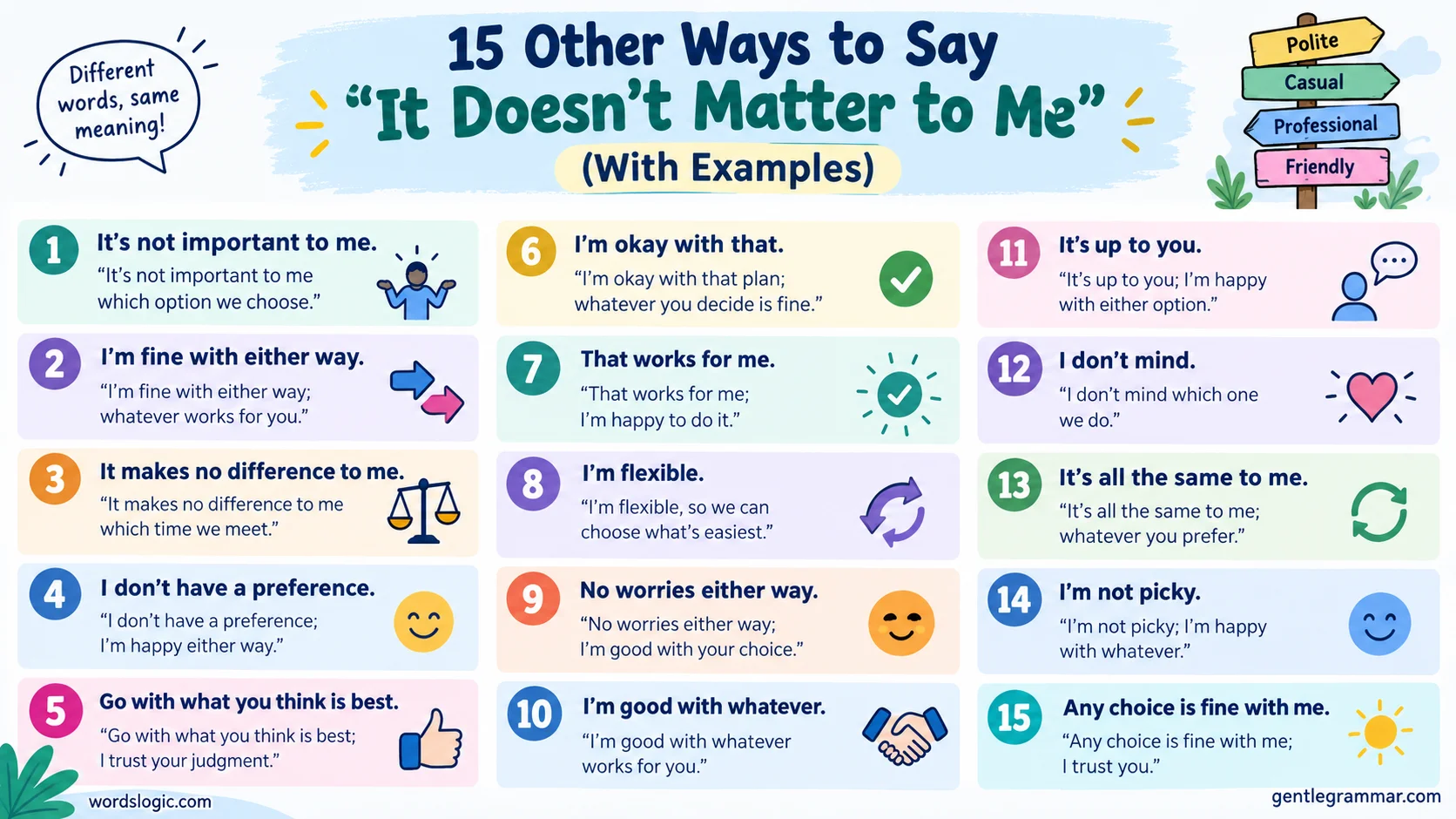
15 Other Ways to Say “It Doesn’t Matter to Me” (With Examples) helps you choose natural alternatives for everyday conversations.
Sometimes in life, little or no significance is attached to a decision, even when multiple choices or options are offered. For example, a coworker may ask whether you prefer a meeting at 10 or 11, and you can reply, “It does not matter to me.” This short sentence is easy to understand and communicates that either option is acceptable and you are willing to let another person decide.
The literal phrase “It Don’t Matter to Me” is also the title of a 1970 song by Bread, a band with a top 10 hit. This reference helps explain how the phrase appears in different contexts. In everyday situations, whether choosing blue or white paint for your house or deciding which movies to see, even if an option sounds terrible, you can make honest decisions without unnecessary argument, stress, or concern about things that seem important to others but are irrelevant to you.
What Does “It Doesn’t Matter to Me” Mean?
“It Doesn’t Matter to Me” means that something does not significantly affect your preferences, feelings, or decisions. In everyday English, people often use it to show that they have no strong preference between available choices. For example, if someone asks whether you would prefer tea or coffee, you might say, “It doesn’t matter to me,” meaning that either option is fine.
The phrase can also express indifference, depending on the context and tone of voice. When discussing a serious decision or someone else’s feelings, it might suggest that you do not care about the outcome. In contrast, when making casual plans, it can communicate flexibility and a willingness to accommodate another person. The intended meaning usually becomes clear from the situation and the speaker’s tone.
Common Situations Where “It Doesn’t Matter to Me” Is Used
This expression is common in everyday conversations, text messages, and discussions about personal preferences. Friends might use it when choosing a restaurant, family members might say it when deciding what to watch, and partners might use it to let the other person choose a weekend activity. In these situations, the phrase often communicates flexibility rather than a lack of interest.
At work or school, someone might use the expression when discussing meeting times, project options, or group assignments. However, professional communication sometimes benefits from more specific wording, such as explaining that you are flexible about the schedule. In personal relationships, a warmer alternative can prevent the other person from thinking that you are uninterested in their opinion. On social media or in customer communication, the best wording depends on whether you want to sound relaxed, helpful, or neutral.
Is It Professional or Polite to Say “It Doesn’t Matter to Me”?
“It Doesn’t Matter to Me” can be polite and professional when it communicates flexibility about a minor decision. For example, telling a colleague that the meeting time does not matter to you can help the team coordinate more easily. The expression is relatively direct and conversational, so it works well in informal discussions and many ordinary workplace exchanges.
However, the phrase can sound dismissive when the subject is important to another person. In a professional email, “I’m flexible with the timing” may sound more cooperative, while “I’m happy with either option” can make your willingness to compromise clearer. In a sensitive conversation, it is worth choosing words that show you understand the other person’s concerns. Tone and context matter just as much as the phrase itself.
Advantages and Disadvantages of Saying “It Doesn’t Matter to Me”
Advantages
The main advantage is simplicity. The expression quickly tells someone that you do not have a strong preference, making it useful when arranging plans or choosing between equally acceptable options. It can also save time during group discussions and show that you are willing to let someone else make the decision. Because it is familiar everyday English, most listeners understand it without difficulty.
Disadvantages
The main limitation is ambiguity. Someone might interpret the phrase as genuine flexibility, but another person could hear it as boredom, frustration, or a lack of concern. It also does not always explain whether you actively approve of the options or simply do not mind them. In formal emails or emotionally sensitive conversations, a more specific expression can communicate your intentions with greater warmth and clarity.
15 Alternatives for “It Doesn’t Matter to Me”
- Either Way Is Fine With Me
- I Don’t Mind
- I’m Fine With Either Option
- Whatever Works for You
- I’m Easy
- I Have No Preference
- I’m Flexible
- It’s All the Same to Me
- I’m Happy Either Way
- I’ll Leave It Up to You
- I’m Good With Anything
- I Don’t Have a Strong Preference
- You Can Decide
- I’m Okay With Whatever You Choose
- I’m Not Particular
1. Either Way Is Fine With Me
Meaning
“Either Way Is Fine With Me” means that you are comfortable with either of two choices. It communicates flexibility without sounding uninterested.
Definition
A phrase used to show that two available options are equally acceptable to you.
Detailed Explanation
This expression is especially useful when someone offers you two alternatives and asks which one you prefer. Unlike “It Doesn’t Matter to Me,” it emphasizes that you are satisfied with both choices. It sounds friendly and reassuring, particularly when making plans with another person. Because it communicates acceptance, it is often a good choice when you want to avoid sounding dismissive.
Scenario Examples
Scenario 1: Choosing a restaurant with a friend
Example: “We can get pizza or burgers tonight. Either way is fine with me.”
Scenario 2: Arranging a work meeting
Example: “Tuesday or Wednesday afternoon? Either way is fine with me.”
Scenario 3: Planning a family activity
Example: “We could watch a comedy or an adventure movie. Either way is fine with me.”
Best Use
Use this expression when choosing between two acceptable options, especially in conversations about schedules, meals, activities, or everyday plans.
Tone
Tone: Friendly, relaxed, agreeable.
It shows that you are comfortable with the available choices and willing to cooperate.
2. I Don’t Mind
Meaning
“I Don’t Mind” means that you have no objection to something. It often indicates that a suggestion is acceptable, even if it is not your personal favorite.
Definition
A common expression used to communicate acceptance without objection.
Detailed Explanation
This short phrase works naturally in spoken English and informal messages. It is slightly different from saying that something makes no difference because you are mainly expressing that you have no problem with the suggestion. Depending on your tone, it can sound friendly or merely neutral. When responding to an offer, adding a few words can make your answer warmer and more encouraging.
Scenario Examples
Scenario 1: Accepting an invitation
Example: “Would you like to sit outside?” “I don’t mind. The weather is lovely.”
Scenario 2: Sharing household responsibilities
Example: “I don’t mind washing the dishes tonight if you cook.”
Scenario 3: Choosing a study location
Example: “I don’t mind studying at the library instead of the classroom.”
Best Use
Use it in casual conversations, everyday requests, friendly texts, and situations where you want to show that something is acceptable.
Tone
Tone: Casual, neutral, accommodating.
It sounds natural in ordinary conversation, although a flat or impatient delivery can make it seem reluctant.
3. I’m Fine With Either Option
Meaning
“I’m Fine With Either Option” means that both choices suit you. It directly communicates that you can accept either alternative.
Definition
An expression showing that two specific possibilities are acceptable.
Detailed Explanation
This phrase is useful when you want to answer a question clearly without suggesting that the decision is unimportant. Compared with “It Doesn’t Matter to Me,” it focuses more on your acceptance of the available choices. It is slightly more explicit than “I Don’t Mind” and works well in both personal and professional conversations. You can use it whenever you want someone to know that either option will work.
Scenario Examples
Scenario 1: Scheduling an appointment
Example: “I’m fine with either option, so please book whichever appointment is available first.”
Scenario 2: Choosing a presentation format
Example: “I’m fine with either option: we can present the slides online or in person.”
Scenario 3: Making weekend plans
Example: “I’m fine with either option. We can visit the museum or spend the afternoon at home.”
Best Use
Choose this expression for clear, practical decisions, particularly when discussing two alternatives at work, school, or home.
Tone
Tone: Neutral, cooperative, clear.
Its wording makes your position easy to understand without sounding overly casual.
4. Whatever Works for You
Meaning
“Whatever Works for You” means that you are willing to accept the option that best suits the other person.
Definition
A flexible expression that gives another person freedom to choose what is most convenient for them.
Detailed Explanation
This phrase shifts attention from your own preference to the other person’s needs. It can sound considerate when arranging schedules or helping someone manage competing responsibilities. However, depending on your delivery, it may sound impatient or dismissive, especially if the other person is looking for your opinion on an important decision. If you want to show genuine consideration, use a warm tone and make it clear that you are happy to accommodate them.
Scenario Examples
Scenario 1: Coordinating a meeting
Example: “I’m available in the morning or afternoon. Whatever works for you.”
Scenario 2: Helping a friend make plans
Example: “We can meet near your office or somewhere closer to my house. Whatever works for you.”
Scenario 3: Arranging a delivery
Example: “You can have the package delivered on Thursday or Friday, whatever works for you.”
Best Use
Use it when another person’s schedule or convenience is the main consideration, especially in friendly conversations and routine workplace arrangements.
Tone
Tone: Accommodating, considerate, conversational.
It communicates flexibility, although it is less suitable when you need to express a firm personal preference.
5. I’m Easy
Meaning
“I’m Easy” can mean that you are relaxed about a decision and do not have a strong preference. In this context, it communicates that you are comfortable letting someone else choose.
Definition
An informal expression meaning that you are not particular about a choice.
Detailed Explanation
In some varieties of English, particularly British and Australian English, “I’m easy” is a natural way to express flexibility about plans. It is brief and casual, making it suitable for conversations with friends or people you know well. However, the expression can have other meanings in different contexts, so it may be misunderstood by some listeners. In formal or unfamiliar settings, a clearer phrase such as “I’m flexible” is usually a safer choice.
Scenario Examples
Scenario 1: Deciding where to eat
Example: “Should we get Thai food or Italian tonight?” “I’m easy. You choose.”
Scenario 2: Planning a casual outing
Example: “We could go bowling or catch a film.” “I’m easy with either.”
Best Use
Use it in informal conversation, particularly with friends or familiar colleagues. Avoid it when a precise, formal response is needed.
Tone
Tone: Casual, laid-back, easygoing.
Its relaxed wording works best when both people understand that you mean you have no strong preference.
6. I Have No Preference
Meaning
“I Have No Preference” means that you do not favor one choice over another. It communicates a neutral position without necessarily suggesting that you do not care about the outcome.
Definition
A direct statement that you have no particular choice or favored option.
Detailed Explanation
This expression is more measured than “It Doesn’t Matter to Me” and can sound professional in the right setting. It is useful when someone asks for your opinion but you genuinely feel that the options are equally suitable. However, it does not automatically mean that you approve of every possible choice; it refers to the options under discussion. If you do have a preference, it is better to explain it rather than use this phrase simply to avoid making a decision.
Scenario Examples
Scenario 1: Selecting a meeting date
Example: “I have no preference between Monday and Tuesday, so choose the day that suits the team.”
Scenario 2: Completing a class survey
Example: “I have no preference regarding the presentation format, provided everyone can participate.”
Scenario 3: Choosing a gift color
Example: “I have no preference between blue and green. Both look nice.”
Best Use
Use it in workplace discussions, surveys, scheduling emails, and situations where a neutral answer is appropriate.
Tone
Tone: Neutral, composed, professional.
It expresses an absence of preference without the potentially dismissive edge of some casual alternatives.
7. I’m Flexible
Meaning
“I’m Flexible” means that you are willing to adjust your plans, preferences, or arrangements to accommodate a situation or another person.
Definition
A phrase indicating that you are open to adjustments and different arrangements.
Detailed Explanation
Unlike “It Doesn’t Matter to Me,” this expression emphasizes your willingness to adapt rather than simply your lack of preference. It is particularly helpful when discussing work schedules, deadlines, appointments, or travel plans. It can also imply that you are open to alternatives that have not yet been suggested. However, flexibility does not mean you have no limits, so mention any important restrictions when necessary.
Scenario Examples
Scenario 1: Responding to a recruiter
Example: “I’m flexible regarding interview times and can make myself available on Thursday.”
Scenario 2: Organizing a team meeting
Example: “I’m flexible with the meeting schedule as long as we finalize the project timeline this week.”
Scenario 3: Planning a trip
Example: “I’m flexible about our departure date, so we can travel when tickets are cheaper.”
Best Use
Choose this phrase for professional communication, scheduling, negotiations, and arrangements that may require changes.
Tone
Tone: Professional, cooperative, adaptable.
It presents you as willing to work with others while leaving room to communicate practical boundaries.
8. It’s All the Same to Me
Meaning
“It’s All the Same to Me” means that the available choices make no meaningful difference to you.
Definition
An expression indicating that you consider two or more options equally acceptable or indistinguishable in importance.
Detailed Explanation
This expression is close in meaning to the original phrase, but it can sound more indifferent. In a relaxed conversation, it may simply mean that you have no preference about lunch or entertainment. In a serious discussion, however, it could suggest that you are uninterested in the decision or its consequences. Choose it when neutrality is genuinely what you intend to communicate, and use a warmer alternative when another person’s feelings are involved.
Scenario Examples
Scenario 1: Choosing a route
Example: “We can take the highway or the scenic road. It’s all the same to me.”
Scenario 2: Discussing a minor household decision
Example: “You can put the new bookshelf in either corner. It’s all the same to me.”
Best Use
Use it in casual conversations about low-stakes choices where you genuinely have no preference.
Tone
Tone: Neutral, casual, potentially indifferent.
The phrase is straightforward, but your voice and the importance of the subject can affect how it is received.
9. I’m Happy Either Way
Meaning
“I’m Happy Either Way” means that you would be pleased with either of the available options. It communicates positive acceptance rather than simple neutrality.
Definition
A friendly expression showing that both choices would make you happy.
Detailed Explanation
This is a useful alternative when you want to sound warm and encouraging. Unlike “It Doesn’t Matter to Me,” it makes your positive attitude clear and reassures the other person that they do not need to worry about choosing the wrong option. It works particularly well in relationships and friendly planning conversations. However, it is best reserved for situations where you genuinely feel comfortable with both choices.
Scenario Examples
Scenario 1: Making plans with a partner
Example: “We can have a quiet dinner at home or go out. I’m happy either way.”
Scenario 2: Choosing a celebration venue
Example: “I’m happy either way, whether we celebrate at the restaurant or in the garden.”
Scenario 3: Arranging a team lunch
Example: “I’m happy either way, so feel free to choose the restaurant that suits everyone.”
Best Use
Use this expression in friendly messages, personal conversations, social plans, and collaborative decisions when you want to show enthusiasm.
Tone
Tone: Warm, positive, reassuring.
The word “happy” adds an emotional warmth that a purely neutral phrase may lack.
10. I’ll Leave It Up to You
Meaning
“I’ll Leave It Up to You” means that you are allowing another person to make the decision.
Definition
An expression that transfers decision-making responsibility to someone else.
Detailed Explanation
This phrase is different from saying that something does not matter to you. You might have no strong preference, but you might also be choosing to trust the other person’s judgment. It is useful when you want to give someone control over a decision without continuing to discuss every option. However, if the other person expects you to contribute ideas, the phrase could sound as though you are avoiding responsibility. It works best when you are genuinely comfortable letting them decide.
Scenario Examples
Scenario 1: Choosing a restaurant
Example: “You know the neighborhood better than I do, so I’ll leave it up to you.”
Scenario 2: Delegating a presentation detail
Example: “You have more experience with the design, so I’ll leave the slide layout up to you.”
Scenario 3: Planning a birthday surprise
Example: “You know what she likes best. I’ll leave the decorations up to you.”
Best Use
Use it when you want another person to make the final decision, especially when you trust their judgment or experience.
Tone
Tone: Trusting, cooperative, sometimes deferential.
It communicates a willingness to step back, but it does not necessarily mean you lack an opinion.
11. I’m Good With Anything
Meaning
“I’m Good With Anything” means that you are comfortable with any reasonable option being discussed.
Definition
An informal expression indicating that you can accept a range of choices.
Detailed Explanation
This phrase is particularly common in casual conversations about food, activities, and social plans. It suggests that you are open to several possibilities rather than attached to one particular outcome. Compared with “I’m Happy Either Way,” it can cover more than two options and does not necessarily express enthusiasm. The phrase is usually relaxed and friendly, but in a professional meeting, more precise wording may be preferable.
Scenario Examples
Scenario 1: Ordering food with friends
Example: “What should we order for the group?” “I’m good with anything, as long as we get enough for everyone.”
Scenario 2: Picking an activity
Example: “We could play board games, go for a walk, or watch a film. I’m good with anything.”
Scenario 3: Organizing a study session
Example: “I’m good with anything, whether we study at the library or meet online.”
Best Use
Use it for casual group plans, friendly texts, and low-pressure decisions involving several acceptable options.
Tone
Tone: Relaxed, friendly, flexible.
It makes you sound easygoing without necessarily implying that you are indifferent to everything.
12. I Don’t Have a Strong Preference
Meaning
“I Don’t Have a Strong Preference” means that you may have a slight opinion, but you are not particularly attached to one option.
Definition
A measured statement explaining that no available choice is significantly more appealing than the others.
Detailed Explanation
This phrase is useful when you want to be honest without pretending that all choices are exactly equal. Perhaps you slightly prefer one option but would still be comfortable with another. Unlike “It Doesn’t Matter to Me,” it leaves room for small differences in your preferences. Its thoughtful wording makes it suitable for discussions where people want a balanced answer rather than a quick dismissal.
Scenario Examples
Scenario 1: Reviewing project proposals
Example: “I don’t have a strong preference between these two approaches, provided both meet the deadline.”
Scenario 2: Choosing a vacation destination
Example: “I don’t have a strong preference between the mountains and the coast, so let’s compare the costs first.”
Scenario 3: Deciding on a team lunch
Example: “I don’t have a strong preference about the cuisine. Let’s pick somewhere with vegetarian options for everyone.”
Best Use
Use it in professional discussions, collaborative planning, and decisions where you want to acknowledge that you have no firm preference.
Tone
Tone: Thoughtful, balanced, diplomatic.
It sounds more considered than a quick casual response and helps avoid implying that the decision is unimportant.
13. You Can Decide
Meaning
“You Can Decide” means that the other person is free to make the choice.
Definition
A direct expression giving someone else permission or responsibility to choose.
Detailed Explanation
This phrase is shorter and more direct than “I’ll Leave It Up to You.” It works well when a decision is minor and you genuinely do not mind who makes it. Depending on your tone, though, it may sound supportive or slightly impatient. If you want to encourage someone who is unsure, adding a reassuring sentence can make the response feel more collaborative. Remember that giving someone permission to choose is not the same as saying you have no opinion.
Scenario Examples
Scenario 1: Picking a film
Example: “You can decide what we watch tonight. I’m comfortable with either choice.”
Scenario 2: Assigning a group task
Example: “You can decide which section you would like to present, and I’ll take the other one.”
Scenario 3: Choosing a meeting location
Example: “You can decide where we meet, provided it’s convenient for everyone.”
Best Use
Use it when you want to let someone else choose, particularly for straightforward decisions or when dividing responsibilities.
Tone
Tone: Direct, casual, trusting.
It is clear and efficient, although a softer phrase may be more appropriate if the other person needs encouragement.
14. I’m Okay With Whatever You Choose
Meaning
“I’m Okay With Whatever You Choose” means that you are comfortable accepting the other person’s decision.
Definition
A reassuring expression communicating acceptance of another person’s choice.
Detailed Explanation
This phrase combines flexibility with reassurance. Rather than simply saying that you have no preference, you are telling the other person that you will accept their decision without a problem. It can be helpful when someone worries about disappointing you by choosing the wrong option. However, it should reflect your genuine feelings; if you have an important preference, sharing it can help you both reach a better decision.
Scenario Examples
Scenario 1: Helping a friend plan dinner
Example: “I’m okay with whatever you choose. You know which restaurants have the best food nearby.”
Scenario 2: Arranging a family outing
Example: “I’m okay with whatever you choose for Saturday, as long as we have time to visit everyone.”
Scenario 3: Selecting a design for an invitation
Example: “I’m okay with whatever you choose for the invitation. Both designs look suitable to me.”
Best Use
Use this phrase in personal messages, friendly conversations, and collaborative planning when the other person needs reassurance that their decision is acceptable.
Tone
Tone: Reassuring, considerate, agreeable.
It emphasizes acceptance and can make decision-making feel easier for the other person.
15. I’m Not Particular
Meaning
“I’m Not Particular” means that you are not especially selective about something and can usually accept different options.
Definition
An expression describing someone who does not have strict preferences about a particular choice.
Detailed Explanation
This phrase often describes a general attitude toward choices such as food, seating, or everyday arrangements. It can communicate that you are easy to accommodate without suggesting that you lack interest in the situation. Unlike “It Doesn’t Matter to Me,” which refers to a specific matter, “I’m Not Particular” can describe your preferences more broadly. It is a natural expression in everyday English, though it may sound slightly old-fashioned or formal to some speakers.
Scenario Examples
Scenario 1: Ordering breakfast
Example: “I’m not particular about breakfast. Toast, eggs, or cereal would be fine.”
Scenario 2: Choosing a seat
Example: “I’m not particular about where I sit, so you can have the window seat.”
Scenario 3: Planning a casual meal
Example: “I’m not particular about the menu, but we should make sure there is something for everyone.”
Best Use
Use it in everyday conversation when describing a relaxed attitude toward ordinary choices or explaining that you are easy to accommodate.
Tone
Tone: Easygoing, modest, conversational.
It communicates flexibility without necessarily transferring the decision entirely to another person.
FAQs:
What is another way to say “It Doesn’t Matter to Me”?
“Either Way Is Fine With Me” is an excellent alternative when you want to show that two options are equally acceptable. If you want to sound more professional, try “I Have No Preference” or “I’m Flexible.” The best expression depends on whether you want to communicate neutrality, cooperation, or warmth.
What does “It Doesn’t Matter to Me” mean?
It means that something does not significantly affect your preferences or feelings. You might use it when you are comfortable with several choices. However, depending on the situation and your tone, it can also communicate indifference or a lack of concern.
Is “It Doesn’t Matter to Me” professional?
Yes, it can be appropriate in professional conversations, especially when discussing routine decisions. However, “I’m Flexible” or “I Have No Preference” may sound more polished in a workplace email. For important decisions, explain your position clearly instead of suggesting that the matter is unimportant.
What is a more polite way to say “It Doesn’t Matter to Me”?
“I’m Happy Either Way” is a warm, polite alternative when you genuinely like both options. You could also say, “Whatever works best for you,” when accommodating someone else’s schedule or preferences. These expressions often sound more considerate because they communicate acceptance rather than indifference.
Which alternative works best in formal communication?
“I Have No Preference” is a strong choice when you need to communicate neutrality in a formal discussion or email. For scheduling and workplace arrangements, “I’m Flexible” is often more useful because it highlights your willingness to accommodate different options. Choose the phrase that most accurately represents your intentions.
Conclusion:
Choosing the right alternative to “It Doesn’t Matter to Me” can help you communicate more clearly and avoid unintended misunderstandings. While “I Have No Preference” works well in professional settings, “I’m Happy Either Way” adds warmth to personal conversations, and “Whatever Works for You” shows consideration for another person’s needs. Each expression has a slightly different meaning, level of formality, and emotional tone.
Before choosing your wording, consider what you want the other person to understand. Are you expressing flexibility, accepting a suggestion, or allowing someone else to decide? These intentions may sound similar, but they are not always identical. The best approach is to choose language that reflects your genuine feelings. When your words match your intentions, even a simple response can make a conversation feel more natural, respectful, and comfortable.
