
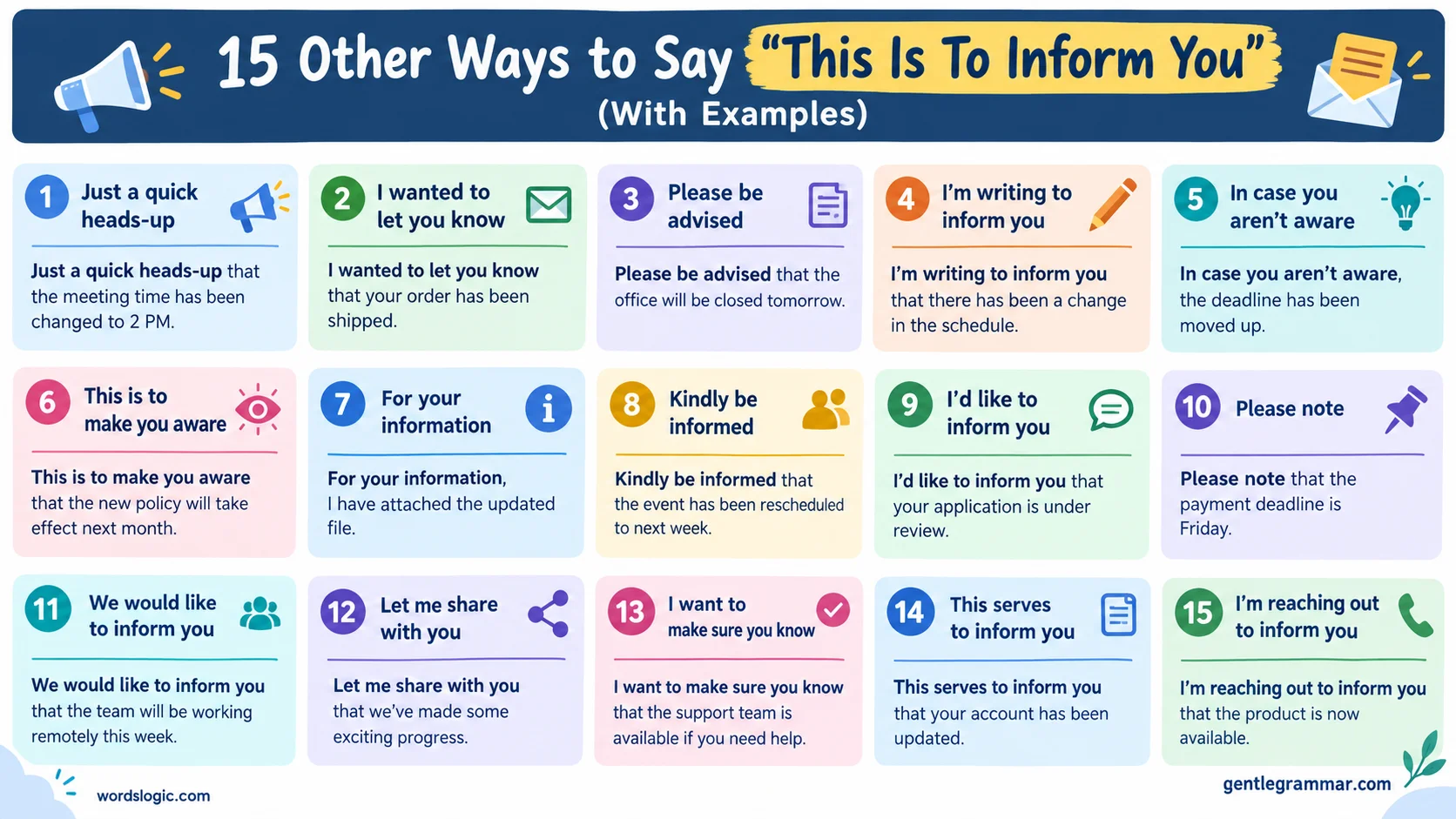
15 Other Ways to Say “This Is To Inform You” (With Examples) helps you write emails that sound clear, polite, and natural in everyday and professional situations.
Professional email writing is an important skill for day-to-day life, whether you are communicating in a professional context or managing your personal life. The phrase “I am writing to let you know” is a polite and clear way to inform someone about news, updates, or important information. However, repeating the same phrase in emails, letters, and messages can sound dull, mechanical, or robotic, like a form letter rather than a message from a real person.
In my experience, swapping familiar phrases for alternatives that fit the moment makes communication warmer, clearer, and appropriately formal, depending on the reader and the situation. For example, “I wish to inform you” suits a formal email, while “Just letting you know” sounds more natural in a casual text to a friend.
What Does “This Is To Inform You” Mean?
“This is to inform you” is a formal expression used to introduce information that someone needs to know. It signals that the sender is communicating an update, announcement, decision, reminder, or change. For example, “This is to inform you that the meeting has been rescheduled” tells the reader about a change in plans. The phrase is common in official letters, administrative notices, business emails, and institutional communication. Although it is grammatically correct, it can sound impersonal or unnecessarily formal in everyday messages. A simpler expression, such as “Please note” or “I’m writing to let you know,” may communicate the same information more naturally.
Common Situations Where “This Is To Inform You” Is Used
People often use this phrase when sending official announcements, workplace updates, school notices, policy changes, appointment information, and customer notifications. It can also appear in formal letters about deadlines, applications, payments, or decisions. For instance, a school administrator might announce a change in examination dates, while a manager might notify employees about a revised work schedule. In casual conversations and text messages, however, the phrase may feel too formal. Choosing an alternative allows you to match your wording to the reader, the importance of the information, and the relationship between sender and recipient.
Is It Professional or Polite to Say “This Is To Inform You”?
Yes, “This is to inform you” is professional and generally polite, particularly in formal correspondence. It communicates information clearly without using rude or disrespectful language. However, its tone is quite official and can feel distant in friendly emails or routine workplace conversations. It is suitable for notices, administrative letters, and situations where a formal record is useful. When writing to a colleague or familiar customer, phrases such as “I’d like to let you know” or “Please be aware” may sound more natural. The best choice depends on whether you want to emphasize formality, courtesy, urgency, or a straightforward update.
Advantages and Disadvantages of Saying “This Is To Inform You”
Advantages
The phrase establishes a formal, clear, and official tone. It prepares readers for important information and works well in notices, institutional letters, and business correspondence. Because it is direct and widely understandable, it can help introduce decisions, changes, and announcements without making the message overly emotional.
Disadvantages
The wording can sound stiff, impersonal, or outdated in everyday communication. It also uses more words than simpler alternatives such as “Please note” or “I wanted to let you know.” If repeated in several emails, it can make writing feel mechanical. In sensitive situations, it may lack the warmth or consideration needed to communicate personal news. A more specific opening can often explain the purpose of the message more naturally.
15 Alternatives to “This Is To Inform You”
- I’m writing to let you know
- Please be informed
- Please note
- I’d like to inform you
- I wanted to let you know
- Please be advised
- We would like to notify you
- I’m pleased to share
- I regret to inform you
- Kindly note
- This is a notice that
- I’m reaching out to let you know
- We wish to inform you
- For your information
- I’d like to bring to your attention
1. I’m Writing to Let You Know
Meaning
“I’m writing to let you know” introduces information in a clear, friendly, and professional way. It tells the reader that the purpose of the message is to share an update.
Definition
A polite opening used in written communication to explain that you are sharing information with someone.
Detailed Explanation
This expression sounds more natural and personal than “This is to inform you.” It works especially well when you want to explain a change, share an update, or communicate something important without sounding overly formal. The phrase is direct but still considerate because it acknowledges that you are deliberately reaching out to the reader. Unlike an official notice, it can feel conversational while remaining appropriate for professional emails. It is particularly useful when you want your message to sound like it came from a real person rather than an institution.
Scenario Examples
Scenario 1: Workplace update
Example: I’m writing to let you know that our team meeting has been moved to Thursday.
Scenario 2: Personal communication
Example: I’m writing to let you know that I’ll arrive a little later than expected.
Scenario 3: Customer communication
Example: I’m writing to let you know that your replacement order has been shipped.
Best Use
Use this expression in professional emails, personal messages, customer updates, and routine workplace communication. It is a strong general-purpose choice when you want a polite but natural opening.
Tone
Tone: Friendly, professional, informative.
Its conversational wording makes it approachable without sacrificing clarity.
2. Please Be Informed
Meaning
“Please be informed” tells someone that they should know or take note of particular information. It is a formal expression that emphasizes the importance of the message.
Definition
A formal instruction or request asking the reader to take notice of information being communicated.
Detailed Explanation
This phrase is closely related to the original expression, but it sounds more official and administrative. It is often used in formal notices, institutional correspondence, and workplace announcements. The word “please” adds a degree of courtesy, although the overall wording may still feel impersonal. In many everyday emails, “Please note” sounds shorter and more natural. Choose “Please be informed” when the communication needs an official tone rather than a warm, conversational one.
Scenario Examples
Scenario 1: Office announcement
Example: Please be informed that the office will close at 2 p.m. on Friday.
Scenario 2: School communication
Example: Please be informed that the examination timetable has been updated.
Scenario 3: Administrative notice
Example: Please be informed that applications received after the deadline may not be considered.
Best Use
This expression works best in formal notices, administrative emails, institutional letters, and official announcements. Avoid using it unnecessarily in casual conversations or friendly messages.
Tone
Tone: Formal, official, direct.
It communicates information with authority, making it suitable for situations where the reader needs an explicit notice.
3. Please Note
Meaning
“Please note” asks someone to pay attention to a particular detail, announcement, or instruction. It is especially useful when the information is important for the reader to remember.
Definition
A concise expression used to draw attention to relevant information.
Detailed Explanation
Unlike the original phrase, which broadly introduces information, “Please note” specifically emphasizes what the reader should notice or remember. It is concise, professional, and easy to understand. The expression works well for deadlines, schedule changes, requirements, and reminders. However, it is not always a direct substitute when you want to share personal news or deliver a sensitive message. For those situations, a more personal opening may be more considerate.
Scenario Examples
Scenario 1: Meeting reminder
Example: Please note that tomorrow’s meeting will begin at 10:30 a.m.
Scenario 2: Customer instructions
Example: Please note that returns must be requested within 14 days of delivery.
Scenario 3: School announcement
Example: Please note that students must bring their identification cards to the examination hall.
Best Use
Choose this phrase for professional emails, instructions, notices, reminders, and formal documents where a specific detail needs attention.
Tone
Tone: Professional, concise, courteous.
Its brief wording respects the reader’s time while clearly highlighting important information.
4. I’d Like to Inform You
Meaning
“I’d like to inform you” introduces information that the sender wants to communicate. It is a polite, formal expression that places slightly more emphasis on the sender’s intention.
Definition
A courteous phrase used to introduce an announcement, update, or important piece of information.
Detailed Explanation
This expression is a close alternative to “This is to inform you,” but its use of “I’d like to” makes the opening sound somewhat more personal. It can be appropriate when communicating decisions, changes, or official updates to colleagues and clients. The phrase remains formal, so it may feel too elaborate for a quick message between familiar coworkers. When the news is ordinary, “I wanted to let you know” is often smoother. For important workplace communication, however, this wording provides a respectful introduction.
Scenario Examples
Scenario 1: Project update
Example: I’d like to inform you that the first phase of the project has been completed.
Scenario 2: Appointment change
Example: I’d like to inform you that your appointment has been moved to Monday afternoon.
Scenario 3: Workplace announcement
Example: I’d like to inform you that the new reporting procedure will take effect next month.
Best Use
Use it in formal business emails, professional correspondence, official updates, and messages to clients or senior colleagues.
Tone
Tone: Respectful, formal, professional.
The wording communicates intention and courtesy, making it suitable for announcements that deserve a measured tone.
5. I Wanted to Let You Know
Meaning
“I wanted to let you know” is a natural way to share information with another person. It sounds personal and considerate, particularly when the message concerns an update or a change.
Definition
A conversational expression used to introduce information that the sender wishes to share.
Detailed Explanation
This phrase often feels warmer than the original because it focuses on personal communication rather than an official announcement. Although “wanted” is past tense, it is commonly used as a polite conversational opening and does not necessarily mean the opportunity to share the information has passed. It works in both professional and personal settings. It is especially useful when you want to soften an update without hiding its meaning. For a formal legal or administrative notice, a more precise expression may be preferable.
Scenario Examples
Scenario 1: Informing a colleague
Example: I wanted to let you know that I’ve uploaded the revised report.
Scenario 2: Personal plans
Example: I wanted to let you know that I won’t be able to join you for dinner tonight.
Scenario 3: Customer update
Example: I wanted to let you know that your refund has been processed.
Best Use
This expression works well in friendly work emails, personal messages, customer service, and everyday conversations.
Tone
Tone: Warm, considerate, conversational.
It makes an update feel more personal without becoming overly casual.
6. Please Be Advised
Meaning
“Please be advised” tells someone to take notice of information that may affect them or require their attention. It is common in formal and procedural communication.
Definition
A formal expression introducing information, instructions, or a notice that the recipient should consider.
Detailed Explanation
This phrase can sound more authoritative than the original, particularly when it introduces rules, deadlines, restrictions, or policy changes. It is useful when the reader needs to understand a requirement or consequence. However, it may sound impersonal or overly legalistic in an ordinary email. It is not necessarily rude, but its formality can create distance between the sender and recipient. For a friendlier message, “Please note” often delivers the information with less weight.
Scenario Examples
Scenario 1: Policy update
Example: Please be advised that the updated attendance policy takes effect on November 1.
Scenario 2: Service interruption
Example: Please be advised that online payments will be temporarily unavailable during scheduled maintenance.
Scenario 3: Contract communication
Example: Please be advised that the agreement must be signed before the service can begin.
Best Use
Use this expression in policy notices, contractual correspondence, formal business messages, and procedural announcements. Reserve it for situations where an official tone is appropriate.
Tone
Tone: Formal, authoritative, procedural.
It signals that the information may have practical consequences or needs careful attention.
7. We Would Like to Notify You
Meaning
“We would like to notify you” introduces information being communicated by a company, organization, school, or team. It emphasizes an official notification rather than a personal update.
Definition
A formal expression used by an individual or organization to communicate information to a recipient.
Detailed Explanation
This wording is useful when the sender represents an organization rather than speaking only on a personal behalf. Compared with “This is to inform you,” it clearly identifies the message as a notification from a group or institution. It can introduce account updates, service changes, policy announcements, or scheduled maintenance. The phrase is professional but somewhat formal, so it may be unnecessarily elaborate for simple exchanges. Use it when the communication needs to sound organized and official.
Scenario Examples
Scenario 1: Company announcement
Example: We would like to notify you that our customer support hours will change next month.
Scenario 2: Account communication
Example: We would like to notify you that your account details have been updated.
Scenario 3: School administration
Example: We would like to notify you that the parent-teacher meeting will take place on Wednesday.
Best Use
This phrase is best for company emails, customer notifications, school announcements, and official organizational communication.
Tone
Tone: Professional, formal, informative.
The use of “we” gives the message an institutional voice and helps establish that the update comes from an organization.
8. I’m Pleased to Share
Meaning
“I’m pleased to share” introduces information that the sender is happy to communicate. It is particularly suitable for good news, achievements, opportunities, and positive updates.
Definition
A positive expression used to present information that the sender is happy or excited to communicate.
Detailed Explanation
Unlike the original phrase, this alternative communicates positive emotion as well as information. It helps make good news feel more engaging and personal. It is appropriate for professional announcements when the information concerns an achievement, a successful outcome, or an exciting development. It would sound unnatural when introducing bad news, disciplinary action, or an inconvenient policy change. The word “pleased” also makes the expression slightly more formal than simply saying “I’m happy to share.”
Scenario Examples
Scenario 1: Workplace achievement
Example: I’m pleased to share that our team has completed the project ahead of schedule.
Scenario 2: Job announcement
Example: I’m pleased to share that I’ve accepted a new position with the company.
Scenario 3: Event announcement
Example: I’m pleased to share that registration for our annual workshop is now open.
Best Use
Choose this expression for positive workplace updates, professional announcements, personal achievements, and invitations to opportunities.
Tone
Tone: Positive, warm, professional.
It adds enthusiasm to the message while maintaining a polished and respectful style.
9. I Regret to Inform You
Meaning
“I regret to inform you” introduces information that is disappointing, unfortunate, or likely to cause concern. It signals that the sender understands the news is unwelcome.
Definition
A formal expression used to communicate bad news with a degree of sympathy or regret.
Detailed Explanation
This phrase is not a general substitute for the original expression because it adds a specific emotional meaning: the information is unfortunate or disappointing. It is commonly used when communicating unsuccessful applications, cancellations, rejections, or other unwelcome decisions. Its formal tone can help maintain professionalism during difficult conversations. However, it may sound unnecessarily dramatic for a minor inconvenience. For everyday bad news, a more direct and compassionate explanation may feel more natural.
Scenario Examples
Scenario 1: Job application
Example: I regret to inform you that we have selected another candidate for the position.
Scenario 2: Event cancellation
Example: I regret to inform you that tomorrow’s workshop has been canceled because of unforeseen circumstances.
Scenario 3: Business decision
Example: I regret to inform you that we are unable to approve your request at this time.
Best Use
Use this phrase in formal rejection letters, professional correspondence, application decisions, and announcements involving significant disappointment.
Tone
Tone: Formal, regretful, considerate.
It acknowledges that the message may disappoint the recipient, although the actual explanation should still be clear and respectful.
10. Kindly Note
Meaning
“Kindly note” draws attention to information the reader should remember or consider. It is often used in formal business communication, especially in some varieties of international English.
Definition
A polite-sounding expression used to highlight a relevant detail, instruction, or reminder.
Detailed Explanation
This phrase serves a similar purpose to “Please note,” but it uses “kindly” to frame the request as courteous. It is common in workplace emails, administrative notices, and customer communication, although its naturalness varies by region and organization. In some contexts, it may sound more formal or less conversational than “Please note.” It is most appropriate when the sender wants to highlight a practical detail rather than share personal news. The expression should not be used to disguise a harsh or demanding message; the rest of the wording matters too.
Scenario Examples
Scenario 1: Payment reminder
Example: Kindly note that the outstanding balance is due by October 30.
Scenario 2: Workplace instructions
Example: Kindly note that all reports must be submitted in PDF format.
Scenario 3: Customer communication
Example: Kindly note that delivery times may vary depending on your location.
Best Use
This expression works best in business emails, administrative reminders, service updates, and formal workplace instructions, particularly where this wording is customary.
Tone
Tone: Courteous, formal, instructional.
It signals politeness while directing the reader’s attention to a specific detail.
11. This Is a Notice That
Meaning
“This is a notice that” introduces an official announcement or statement about a particular matter. It emphasizes the message itself as a notice.
Definition
A formal phrase used to announce a change, requirement, decision, or event.
Detailed Explanation
This expression is more suitable for official announcements than personal correspondence. It often appears in written notices about building access, office schedules, service interruptions, policy changes, or administrative requirements. Compared with the original phrase, it places greater emphasis on the formal status of the communication. It can sound stiff in an ordinary email, and the construction is sometimes less natural than simply stating the change. For important public-facing announcements, a clear heading followed by the information may work even better.
Scenario Examples
Scenario 1: Building announcement
Example: This is a notice that the main entrance will be closed for repairs on Saturday.
Scenario 2: Office schedule
Example: This is a notice that the office will operate on reduced hours during the holiday period.
Scenario 3: Service update
Example: This is a notice that water service will be interrupted between 9 a.m. and noon.
Best Use
Use this phrase for posted notices, administrative announcements, building updates, and formal public information. For routine emails, a more direct opening is usually smoother.
Tone
Tone: Official, direct, impersonal.
It identifies the communication as a notice rather than a personal conversation.
12. I’m Reaching Out to Let You Know
Meaning
“I’m reaching out to let you know” explains that the sender is contacting someone to share information. It combines a reference to making contact with a clear statement of purpose.
Definition
A conversational expression used to introduce an update or important information when contacting someone.
Detailed Explanation
This phrase emphasizes the act of getting in touch, making it useful when contacting someone you have not spoken to recently or when initiating a professional conversation. It sounds warmer and more conversational than the original formal expression. However, “reaching out” can be unnecessary when you are already in an ongoing email exchange. In those cases, going straight to the information is often more efficient. The phrase works best when the act of contacting the recipient is relevant to the message.
Scenario Examples
Scenario 1: Professional follow-up
Example: I’m reaching out to let you know that the revised proposal is ready for your review.
Scenario 2: Checking in with a colleague
Example: I’m reaching out to let you know that I’ll be covering your shift on Friday.
Scenario 3: Contacting a client
Example: I’m reaching out to let you know that we have an available appointment next Tuesday.
Best Use
Choose this expression for professional outreach, follow-up emails, client communication, and messages that begin a new conversation.
Tone
Tone: Friendly, professional, approachable.
It makes the contact feel intentional and personable, especially when the sender is initiating communication.
13. We Wish to Inform You
Meaning
“We wish to inform you” introduces information that an organization or group intends to communicate. It has a formal, institutional quality.
Definition
A formal phrase used by a company, institution, or group to introduce an announcement or update.
Detailed Explanation
This expression is similar to “We would like to notify you,” but it sounds somewhat more traditional and ceremonial. It is useful when an organization needs to announce a decision, policy change, event, or administrative update. The word “wish” communicates the intention to share information rather than the emotional warmth found in expressions such as “We’re happy to share.” In modern routine business emails, it can feel unnecessarily elaborate. A shorter sentence is usually preferable when the announcement is straightforward.
Scenario Examples
Scenario 1: Institutional announcement
Example: We wish to inform you that the library will remain closed on public holidays.
Scenario 2: Company policy
Example: We wish to inform you that the revised leave policy will take effect on January 1.
Scenario 3: Event communication
Example: We wish to inform you that the annual conference will be held at the city convention center.
Best Use
This phrase is suitable for formal letters, institutional announcements, organizational notices, and traditional business correspondence.
Tone
Tone: Formal, traditional, official.
It gives the communication a structured and institutional feel rather than a casual or personal one.
14. For Your Information
Meaning
“For your information” introduces details that the recipient may find useful or needs to know. Depending on the context, it can also sound corrective or slightly impatient.
Definition
An expression used to share information that may be relevant to the recipient.
Detailed Explanation
This phrase is not always interchangeable with the original because it emphasizes the recipient’s awareness of the information rather than the sender’s act of notifying them. It works well when sharing background details, documents, facts, or updates that may help someone make a decision. However, when used during a disagreement, “For your information” can sound defensive or confrontational, even if that is not the sender’s intention. A neutral sentence explaining why the information matters can avoid this problem. In formal correspondence, “For reference” may be more appropriate when attaching supporting material.
Scenario Examples
Scenario 1: Sharing a document
Example: For your information, I’ve attached the updated project schedule.
Scenario 2: Providing background
Example: For your information, the building’s reception desk closes at 5 p.m.
Scenario 3: Clarifying a process
Example: For your information, all purchase requests must be approved by the department manager.
Best Use
Use it when sharing helpful background information, supporting documents, relevant facts, and routine professional updates. Avoid it when a neutral or warm tone is especially important and the context might make it sound irritated.
Tone
Tone: Informative, direct, context-dependent.
It can be neutral in written updates but may sound defensive if the surrounding conversation is tense.
15. I’d Like to Bring to Your Attention
Meaning
“I’d like to bring to your attention” introduces a matter that deserves the recipient’s notice or consideration. It often suggests that the information is particularly important or has been overlooked.
Definition
A formal expression used to highlight an issue, detail, concern, or matter that requires attention.
Detailed Explanation
This phrase differs from the original because it does more than announce information: it asks the reader to focus on a particular issue. It can be useful when raising a concern, pointing out a discrepancy, or highlighting a deadline or risk. The wording is more formal and deliberate than “I wanted to let you know.” It may sound overly serious for routine updates, so it is best reserved for matters that genuinely need attention. When possible, follow it with a precise explanation of the issue and any action required.
Scenario Examples
Scenario 1: Workplace concern
Example: I’d like to bring to your attention a discrepancy in the figures reported last week.
Scenario 2: Project deadline
Example: I’d like to bring to your attention that the final submission deadline is approaching.
Scenario 3: Customer service issue
Example: I’d like to bring to your attention a problem with the invoice attached to your order.
Best Use
Use this expression in professional emails, formal complaints, reports, and messages that highlight a concern or important detail.
Tone
Tone: Formal, respectful, deliberate.
It communicates that something deserves consideration without automatically sounding accusatory.
FAQs:
What is another way to say “This Is To Inform You”?
A natural alternative is “I’m writing to let you know.” It sounds professional and approachable, making it suitable for emails, workplace updates, and personal messages. For shorter announcements, “Please note” is another useful option.
What does “This Is To Inform You” mean?
“This is to inform you” means that the sender is communicating information the recipient needs to know. It commonly introduces official announcements, decisions, reminders, and updates in formal correspondence.
Is “This Is To Inform You” professional?
Yes. It is a formal and generally polite expression used in business emails, administrative notices, and official letters. However, it may sound stiff in everyday workplace conversations, where simpler wording often feels more natural.
What is a more polite way to say “This Is To Inform You”?
“I’d like to inform you” is a polite alternative for formal communication, while “I wanted to let you know” sounds warmer and more conversational. The best choice depends on your relationship with the recipient and the nature of the information.
Which alternative works best in formal communication?
“Please be informed” and “Please be advised” can work well in formal notices and procedural messages. For professional emails that should sound natural rather than overly official, “I’d like to inform you” is often a better choice. When highlighting a specific detail, “Please note” is concise and effective.
Conclusion:
Choosing the right alternative to “This Is To Inform You” can make your communication clearer, more natural, and better suited to your audience. While the original phrase works well in official notices and formal correspondence, other expressions can communicate the same information with greater warmth, precision, or simplicity. “I’m writing to let you know” is a versatile choice for everyday professional emails, while “Please note” works well for reminders and important details.
For disappointing news, “I regret to inform you” communicates a different emotional meaning, so context matters. Before choosing an expression, consider your relationship with the recipient, the importance of the message, and the tone you want to convey. The best wording is not necessarily the most formal; it is the one that communicates your message clearly, respectfully, and appropriately.
