
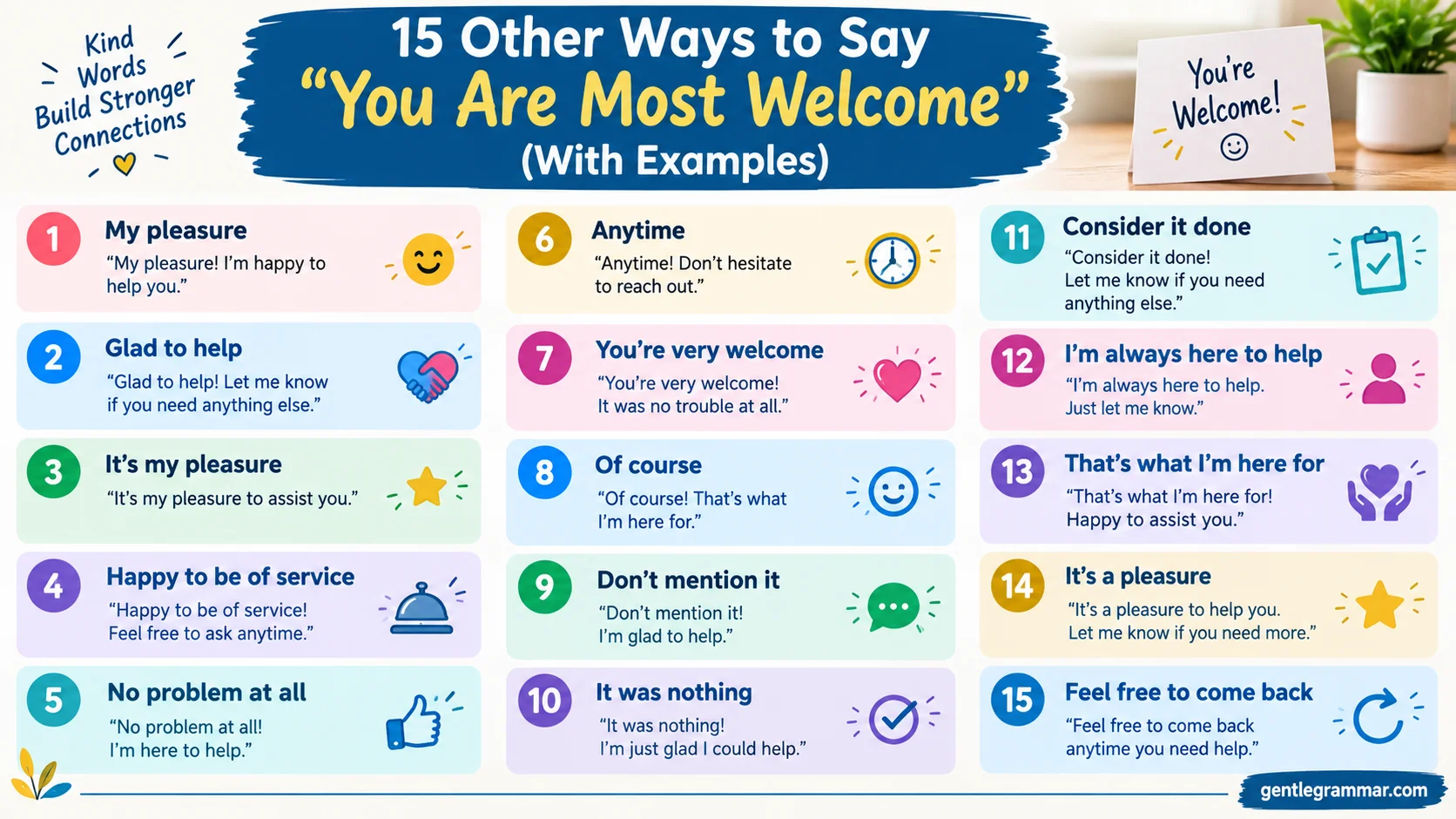
Using 15 Other Ways to Say “You Are Most Welcome” (With Examples) can help you improve vocabulary, refine tone, and enhance clarity in spoken English and written English.
Welcoming someone with kindness and respect is a simple yet powerful way to make conversations feel natural. I have seen how language learners, bloggers, content writers, and professionals benefit from varied expressions that build confidence, fluency, and communication skills. These phrases can boost reader engagement, strengthen professional communication, and support writing improvement by avoiding repetition.
Instead of using one reply after thanks, try alternative phrases, welcome expressions, and polite replies in emails, blog content, social media, and online communication. These simple expressions and powerful words make conversational English, professional writing, and everyday English sound more natural. They also support vocabulary development, English vocabulary, writing skill.
What Does “You Are Most Welcome” Mean?
“You are most welcome” is a polite expression used in response to someone who has thanked you. It communicates that you were happy to help, that their gratitude is appreciated, and that they do not need to feel indebted to you. The word “most” adds emphasis, making the response sound especially warm, courteous, or gracious. For example, if a colleague thanks you for helping with a presentation, you might reply, “You are most welcome.” The expression is grammatically correct and commonly understood in English, although its level of formality can vary by region and situation.
Common Situations Where “You Are Most Welcome” Is Used
This expression works in several situations where someone expresses gratitude. In everyday conversation, you can use it after helping a friend, answering a question, or doing a small favor. In text messages and personal communication, it can make a response feel thoughtful rather than abrupt.
In the workplace, it can be appropriate when responding to a colleague, manager, client, or customer who thanks you for your assistance. It can also fit school settings when a teacher or classmate appreciates your help. Some speakers prefer simpler alternatives such as “You’re welcome” or “Happy to help” because they sound more conversational. Choosing another expression can help you match the level of warmth, formality, and familiarity you want to communicate.
Is It Professional or Polite to Say “You Are Most Welcome”?
Yes, “You are most welcome” is polite and can be professional in the right context. It expresses courtesy and acknowledges another person’s appreciation without sounding dismissive. In a formal email, a customer-service exchange, or a conversation with someone you do not know well, it can communicate respect and goodwill. However, it may sound slightly formal or more emphatic than necessary in a casual conversation between friends or close colleagues. In those situations, “No problem,” “Of course,” or “Happy to help” may sound more natural. The best choice depends on your relationship with the person, the nature of the favor, and whether you want your response to feel formal, friendly, or reassuring.
Advantages and Disadvantages of Saying “You Are Most Welcome”
Advantages
- Polite and respectful: It acknowledges someone’s gratitude graciously.
- Warm and considerate: The word “most” can add extra emphasis to your response.
- Suitable for many settings: It can work in personal conversations and professional exchanges.
- Clear and familiar: Most English speakers understand the intended meaning.
Disadvantages
- Slightly formal: It may feel more elaborate than necessary in relaxed conversations.
- Less conversational for some speakers: Everyday alternatives such as “You’re welcome” may sound more natural.
- Limited emotional detail: It does not always express enthusiasm, reassurance, or genuine enjoyment as clearly as a more specific response.
- Can become repetitive: Using the same expression after every thank-you may make conversations feel less personal.
Synonyms for “You Are Most Welcome”
- You’re Welcome
- My Pleasure
- Happy to Help
- It Was My Pleasure
- Not at All
- No Problem at All
- Anytime
- Of Course
- Glad I Could Help
- Don’t Mention It
- You’re Very Welcome
- The Pleasure Is Mine
- I’m Happy I Could Help
- It’s Nothing
- Always Happy to Help
1. You’re Welcome
Meaning
“You’re welcome” is the standard, polite response to someone who thanks you. It acknowledges their appreciation and communicates that helping them was perfectly acceptable.
Definition
A common expression used to respond courteously to thanks.
Detailed Explanation
This phrase communicates the same basic message as “You are most welcome,” but it usually sounds simpler and more conversational. It works well when you want to acknowledge gratitude without adding extra emphasis. Unlike the original expression, it does not particularly stress how pleased you were to help. Its versatility makes it a reliable choice for both casual and professional interactions.
Scenario Examples
– Scenario: A friend thanks you for sharing your notes.
Example: “You’re welcome! I hope they help you prepare for the exam.”
– Scenario: A coworker appreciates your assistance with a report.
Example: “You’re welcome. Let me know if you need anything else.”
– Scenario: A customer thanks you for answering a question.
Example: “You’re welcome, and thank you for reaching out.”
Best Use
Use this expression in everyday conversation, text messages, emails, customer service, and workplace communication. It is especially useful when you want a natural, universally understood response.
Tone
Tone: Polite, neutral, friendly.
It sounds courteous without being overly formal or emotionally expressive.
2. My Pleasure
Meaning
“My pleasure” communicates that you were genuinely pleased to help someone. It makes the response feel warmer and more personal than a simple acknowledgment.
Definition
A courteous expression indicating that helping someone was enjoyable or satisfying.
Detailed Explanation
This alternative emphasizes your willingness to help rather than simply responding to gratitude. It can make a person feel that their request was not a burden. In professional settings, it communicates graciousness and a service-minded attitude. However, it may sound slightly insincere if delivered mechanically when you were clearly reluctant to help.
Scenario Examples
– Scenario: A guest thanks you for showing them around.
Example: “My pleasure! I hope you enjoyed the tour.”
– Scenario: A colleague appreciates your help before an important meeting.
Example: “My pleasure. I was glad to help you prepare.”
– Scenario: A customer thanks you after receiving assistance.
Example: “My pleasure. We’re happy we could resolve your question.”
Best Use
Choose this phrase for customer communication, professional emails, hospitality, and thoughtful personal favors.
Tone
Tone: Warm, gracious, professional.
It suggests that helping was welcome and that you feel positively about the interaction.
3. Happy to Help
Meaning
“Happy to help” tells someone that you were willing and pleased to provide assistance. It sounds approachable and focuses on your readiness to be useful.
Definition
A friendly expression showing that assisting someone was welcome.
Detailed Explanation
This phrase is particularly effective when you want to sound cooperative rather than formal. It works well after answering a question, solving a problem, or completing a task for someone. Compared with “You are most welcome,” it places more emphasis on your willingness to assist. It can also encourage further communication, especially in workplaces where teamwork matters.
Scenario Examples
– Scenario: A teammate thanks you for explaining a spreadsheet.
Example: “Happy to help! The formulas can be confusing at first.”
– Scenario: A customer appreciates your guidance.
Example: “Happy to help. Please contact us if you have another question.”
– Scenario: A classmate thanks you for explaining a lesson.
Example: “Happy to help! We can review the next chapter together, too.”
Best Use
Use it in team communication, friendly emails, customer support, school settings, and casual conversations.
Tone
Tone: Friendly, helpful, approachable.
It emphasizes cooperation and makes it easy for someone to ask for assistance again.
4. It Was My Pleasure
Meaning
“It was my pleasure” expresses that you were pleased to help or do something for another person. It is particularly suitable when the favor or interaction has already been completed.
Definition
A polite statement indicating that a past action was enjoyable or welcome.
Detailed Explanation
This expression is similar to “My pleasure,” but the past-tense wording draws attention to something you have already done. It often sounds thoughtful and slightly more formal than everyday replies. It can be appropriate after helping a customer, supporting a colleague, or doing a meaningful favor. Because it is somewhat polished, a shorter expression may feel more natural during quick, informal exchanges.
Scenario Examples
– Scenario: A former student thanks you for helping with an application.
Example: “It was my pleasure. I hope everything goes well with your application.”
– Scenario: A client appreciates your assistance with a project.
Example: “It was my pleasure working with you on this project.”
– Scenario: A friend thanks you for organizing a birthday dinner.
Example: “It was my pleasure. I’m glad everyone had a good time.”
Best Use
Choose this phrase for completed favors, professional correspondence, formal conversations, and meaningful personal gestures.
Tone
Tone: Courteous, polished, appreciative.
It conveys graciousness while placing the emphasis on the completed interaction.
5. Not at All
Meaning
“Not at all” is a polite way to suggest that helping someone was no trouble. It reassures the other person that they have not inconvenienced you.
Definition
An expression used to minimize the inconvenience associated with a favor or request.
Detailed Explanation
This expression is a natural response when someone thanks you for a small favor or apologizes for asking for help. It focuses on reassurance rather than on how much you enjoyed helping. In some English-speaking regions, it sounds particularly natural in polite conversation. However, context matters because “not at all” can also answer questions about whether something is true or applicable, so the surrounding conversation should make your meaning clear.
Scenario Examples
– Scenario: A colleague thanks you for holding the elevator.
Example: “Not at all. I saw you coming.”
– Scenario: A neighbor thanks you for collecting a package.
Example: “Not at all. I was home anyway.”
– Scenario: A guest apologizes for asking you to move a chair.
Example: “Not at all. Let me move it for you.”
Best Use
Use it in polite everyday conversations, small favors, and courteous interactions where you want to reassure someone.
Tone
Tone: Polite, reassuring, understated.
It communicates that the favor was easy and that the other person need not worry about imposing on you.
6. No Problem at All
Meaning
“No problem at all” reassures someone that helping them was not an inconvenience. It is a relaxed way to respond to thanks.
Definition
A casual expression indicating that a request or favor caused no difficulty.
Detailed Explanation
This expression is more informal than “You are most welcome” and is common in everyday conversation. The words “at all” add reassurance by emphasizing that there was no difficulty. It is particularly useful among friends, familiar coworkers, and people communicating through text messages. In highly formal correspondence, a more polished expression may be preferable because “problem” can draw attention to the inconvenience, even while denying it.
Scenario Examples
– Scenario: A friend thanks you for giving them a ride.
Example: “No problem at all. I’m glad I could take you home.”
– Scenario: A coworker thanks you for forwarding a document.
Example: “No problem at all. I’ve sent the updated version, too.”
– Scenario: A family member appreciates your help setting the table.
Example: “No problem at all. We got everything ready together.”
Best Use
Choose this phrase for casual conversations, texting, family interactions, and friendly workplace exchanges.
Tone
Tone: Relaxed, friendly, reassuring.
It keeps the conversation easygoing and removes any sense of obligation.
7. Anytime
Meaning
“Anytime” suggests that you would be willing to help the person again in the future. It can communicate friendliness and ongoing support.
Definition
A brief expression indicating a willingness to help again whenever needed.
Detailed Explanation
Unlike “You are most welcome,” this expression can extend beyond the favor that has just been completed. It implies that the person can approach you for similar help in the future. It is particularly natural among friends, relatives, and trusted colleagues. However, it can sound like a genuine offer of future assistance, so use it when you are comfortable making that implication.
Scenario Examples
– Scenario: A friend thanks you for helping them move.
Example: “Anytime! Just let me know if you need a hand again.”
– Scenario: A classmate thanks you for sharing study materials.
Example: “Anytime. We can exchange notes before the next test.”
– Scenario: A teammate thanks you for explaining a work process.
Example: “Anytime! Feel free to ask if anything is unclear.”
Best Use
Use it in friendly messages, close working relationships, and recurring situations where you are happy to offer support again.
Tone
Tone: Casual, supportive, generous.
It sounds welcoming and may strengthen the sense of an ongoing relationship.
8. Of Course
Meaning
“Of course” communicates that helping someone was natural or expected. It can suggest that the request was reasonable and that you were happy to accommodate it.
Definition
An expression indicating that something was readily acceptable or not a burden.
Detailed Explanation
This phrase can make a response feel effortless and reassuring. It is especially useful when someone thanks you for something you consider a normal part of friendship, teamwork, or your responsibilities. Unlike the original expression, it does not explicitly emphasize gratitude or pleasure. Depending on your voice and wording, it can also sound abrupt or dismissive, so a friendly delivery or a few additional words may help.
Scenario Examples
– Scenario: A friend thanks you for listening to their concerns.
Example: “Of course. I’m always glad to listen when you need to talk.”
– Scenario: A coworker thanks you for sharing a meeting summary.
Example: “Of course. I wanted to make sure everyone had the details.”
– Scenario: A student thanks a teacher for clarifying an instruction.
Example: “Of course. I’m happy to explain it again.”
Best Use
Choose this phrase for everyday conversation, teamwork, familiar professional relationships, and reassuring personal exchanges.
Tone
Tone: Reassuring, natural, friendly.
It communicates that helping was a reasonable and welcome thing to do.
9. Glad I Could Help
Meaning
“Glad I could help” expresses satisfaction that your assistance was useful. It acknowledges the other person’s gratitude while highlighting the positive result.
Definition
A friendly statement showing that you are pleased your help made a difference.
Detailed Explanation
This expression is especially suitable when you know your assistance solved a problem or made a task easier. It focuses on the usefulness of your contribution rather than simply dismissing the need for thanks. Compared with “You are most welcome,” it sounds more specific and conversational. It can also be sincere without being overly emotional, making it a practical option for both personal and professional interactions.
Scenario Examples
– Scenario: A friend thanks you for helping them prepare for an interview.
Example: “Glad I could help. I hope the interview goes well!”
– Scenario: A teammate thanks you for troubleshooting a technical issue.
Example: “Glad I could help. Everything should be working now.”
– Scenario: A student thanks you for reviewing an assignment.
Example: “Glad I could help you understand the feedback.”
Best Use
Use it when your help has made a clear, practical difference, particularly in workplace messages, study-related conversations, and personal support.
Tone
Tone: Positive, helpful, sincere.
It expresses satisfaction with the outcome rather than merely responding to the thank-you.
10. Don’t Mention It
Meaning
“Don’t mention it” means the person does not need to thank you or make a big deal out of your favor. It presents the help as something you were happy to provide.
Definition
A polite expression suggesting that a favor does not require special acknowledgment.
Detailed Explanation
This phrase is useful when you want to downplay a small act of kindness. It can sound friendly and modest, especially when someone is thanking you repeatedly for something simple. Compared with “You are most welcome,” it places less emphasis on accepting gratitude and more on suggesting that the favor was no trouble. However, after a major sacrifice or significant act of support, it may unintentionally minimize the importance of what you did.
Scenario Examples
– Scenario: A neighbor thanks you for watering their plants.
Example: “Don’t mention it. I was happy to help while you were away.”
– Scenario: A friend thanks you for bringing them a cup of coffee.
Example: “Don’t mention it. I was getting one for myself anyway.”
– Scenario: A coworker thanks you for sharing a small office supply.
Example: “Don’t mention it. We all need a hand sometimes.”
Best Use
Use this expression for small favors, familiar relationships, and situations where you want to be modest about your contribution.
Tone
Tone: Modest, friendly, understated.
It gently shifts attention away from the favor and keeps the exchange relaxed.
11. You’re Very Welcome
Meaning
“You’re very welcome” is a warmer, more emphatic version of the standard response to thanks. It conveys courtesy while adding a little extra warmth.
Definition
A polite expression that emphasizes your willingness to acknowledge someone’s gratitude.
Detailed Explanation
This phrase is close in meaning to “You are most welcome” and is one of the more direct alternatives. The word “very” adds emphasis without changing the basic message. It can sound especially natural when someone has expressed heartfelt thanks or when you want to respond with extra courtesy. In ordinary conversations, the shorter version may be sufficient, but the fuller expression can make your reply feel more deliberate.
Scenario Examples
– Scenario: A colleague thanks you for staying late to help.
Example: “You’re very welcome. I’m glad we finished everything on time.”
– Scenario: A relative thanks you for arranging transportation.
Example: “You’re very welcome. I wanted to make things easier for you.”
– Scenario: A customer expresses appreciation for your assistance.
Example: “You’re very welcome. Thank you for giving us the opportunity to assist you.”
Best Use
Choose it for polite conversations, professional correspondence, customer communication, and situations involving sincere gratitude.
Tone
Tone: Courteous, warm, reassuring.
It provides extra emphasis while remaining respectful and straightforward.
12. The Pleasure Is Mine
Meaning
“The pleasure is mine” means that you benefited from or enjoyed the interaction too. It is especially appropriate when someone thanks you for spending time with them or providing a meaningful service.
Definition
A gracious expression indicating that the experience was enjoyable for you as well.
Detailed Explanation
This phrase often sounds more formal and polished than everyday expressions of thanks. It is particularly useful when someone thanks you after a meeting, an introduction, a visit, or a shared experience. Rather than focusing only on the favor, it suggests that the interaction itself was rewarding. It is not always a perfect substitute for the original phrase because it implies personal enjoyment, not merely a willingness to help.
Scenario Examples
– Scenario: A guest thanks you for hosting a small gathering.
Example: “The pleasure is mine. I enjoyed having everyone together.”
– Scenario: A business contact thanks you for meeting with them.
Example: “The pleasure is mine. I appreciated hearing about your project.”
– Scenario: A new acquaintance thanks you for taking time to talk.
Example: “The pleasure is mine. It was lovely getting to know you.”
Best Use
Use it in introductions, business meetings, hospitality, and pleasant social interactions where both people benefited from the exchange.
Tone
Tone: Elegant, gracious, somewhat formal.
It communicates mutual enjoyment and is most effective when the interaction genuinely felt positive.
13. I’m Happy I Could Help
Meaning
“I’m happy I could help” expresses personal satisfaction that you were able to support someone. It can sound more reflective and personal than a brief acknowledgment.
Definition
A statement expressing happiness about having been able to provide useful assistance.
Detailed Explanation
This expression is useful when you want to communicate that your assistance mattered to you. It highlights both your positive feelings and your ability to help. Compared with “Happy to help,” it places more emphasis on the assistance you have already provided. The wording can feel especially thoughtful when someone has faced a challenge or needed meaningful support, although a shorter reply may be better for a quick exchange.
Scenario Examples
– Scenario: A friend thanks you for helping them prepare for a difficult conversation.
Example: “I’m happy I could help you feel more prepared.”
– Scenario: A coworker appreciates your guidance on a new task.
Example: “I’m happy I could help you get comfortable with the process.”
– Scenario: A family member thanks you for organizing an important appointment.
Example: “I’m happy I could help make the arrangements easier.”
Best Use
Choose this expression for personal messages, supportive conversations, teamwork, and situations where you want to acknowledge a positive outcome.
Tone
Tone: Sincere, supportive, personal.
It conveys genuine satisfaction that your assistance was useful.
14. It’s Nothing
Meaning
“It’s nothing” is an informal way to downplay a favor. It suggests that the action required little effort or was not a burden.
Definition
A modest expression used to indicate that a favor was relatively small or easy to do.
Detailed Explanation
This phrase is generally used when you want to reassure someone that they do not owe you anything for a small act of kindness. It sounds casual and can be natural among friends or family members. However, it is less directly appreciative than “You are most welcome” and can sometimes make a significant favor sound unimportant. When someone has expressed deep gratitude for meaningful support, a more emotionally attentive response may be preferable.
Scenario Examples
– Scenario: A sibling thanks you for bringing them something from another room.
Example: “It’s nothing. I was heading that way anyway.”
– Scenario: A friend thanks you for lending them a pen during class.
Example: “It’s nothing. You can borrow it whenever you need it.”
– Scenario: A neighbor thanks you for passing along a letter delivered to the wrong house.
Example: “It’s nothing. I’m glad it reached you.”
Best Use
Use it in casual conversations and minor favors where a modest, relaxed response feels appropriate.
Tone
Tone: Casual, modest, understated.
It minimizes the effort involved, so avoid it when the other person deserves a more heartfelt acknowledgment.
15. Always Happy to Help
Meaning
“Always happy to help” communicates that you are willing to assist someone not only now but also in the future. It combines warmth with an ongoing offer of support.
Definition
A friendly expression showing continuing willingness to provide assistance.
Detailed Explanation
This phrase goes beyond acknowledging gratitude for a completed favor. It reassures the other person that they can approach you again when they need help. It is especially useful in relationships where cooperation and continued communication are important. In a professional setting, it can demonstrate a helpful attitude, but it should reflect your actual willingness to assist rather than imply unlimited availability.
Scenario Examples
– Scenario: A colleague thanks you for explaining a complicated procedure.
Example: “Always happy to help. Reach out if you have questions about the next step.”
– Scenario: A friend thanks you for supporting them during a stressful week.
Example: “Always happy to help. You can talk to me whenever you need to.”
– Scenario: A customer thanks you for resolving an issue.
Example: “Always happy to help. Please get in touch if you need further assistance.”
Best Use
Choose it for ongoing professional relationships, friendly messages, teamwork, and situations where you genuinely want to offer future support.
Tone
Tone: Supportive, welcoming, dependable.
It communicates a continuing willingness to help, making it particularly suitable for relationships built on trust and cooperation.
FAQs:
What is another way to say “You Are Most Welcome”?
A common alternative is “You’re welcome.” If you want to sound warmer, choose “My pleasure.” For a friendly and helpful tone, “Happy to help” works well. The best expression depends on whether you are speaking to a friend, colleague, customer, or someone who has thanked you for a meaningful favor.
What does “You Are Most Welcome” mean?
“You are most welcome” is a courteous response to someone’s thanks. It communicates that you acknowledge their gratitude and were willing to help. The word “most” adds emphasis, making the response sound particularly gracious or warm.
Is “You Are Most Welcome” professional?
Yes. “You are most welcome” is polite and can be professional in emails, customer service, meetings, and workplace conversations. However, it may sound more formal than necessary in a casual exchange. “My pleasure” and “Happy to help” are also useful professional options, depending on the situation.
What is a more polite way to say “You Are Most Welcome”?
“My pleasure” and “You’re very welcome” are both courteous alternatives. “My pleasure” emphasizes that you were pleased to assist, while “You’re very welcome” adds warmth to the standard expression. For a more formal interaction, “The pleasure is mine” may fit when you genuinely enjoyed the exchange.
Which alternative works best in formal communication?
“My pleasure” is a versatile choice for formal and professional communication. “It was my pleasure” works well when referring to completed assistance, while “The pleasure is mine” suits certain meetings, introductions, and social exchanges. Choose the wording that fits the relationship and the nature of the interaction.
Conclusion:
Choosing the right response to someone’s gratitude can make your communication feel more natural, thoughtful, and sincere. Although “You are most welcome” is a polite and gracious expression, other phrases can help you communicate a more specific feeling. “My pleasure” emphasizes enjoyment, “Happy to help” sounds approachable, and “Always happy to help” expresses ongoing support. In contrast, “Not at all” and “It’s nothing” work better when you want to downplay a small favor.
The most suitable alternative depends on your relationship, setting, and intended tone. A response to a close friend may differ from one you send to a customer or colleague. Instead of relying on the same expression every time, consider what you want the other person to feel. A simple, well-chosen phrase can acknowledge their appreciation and leave the conversation on a positive note.
