
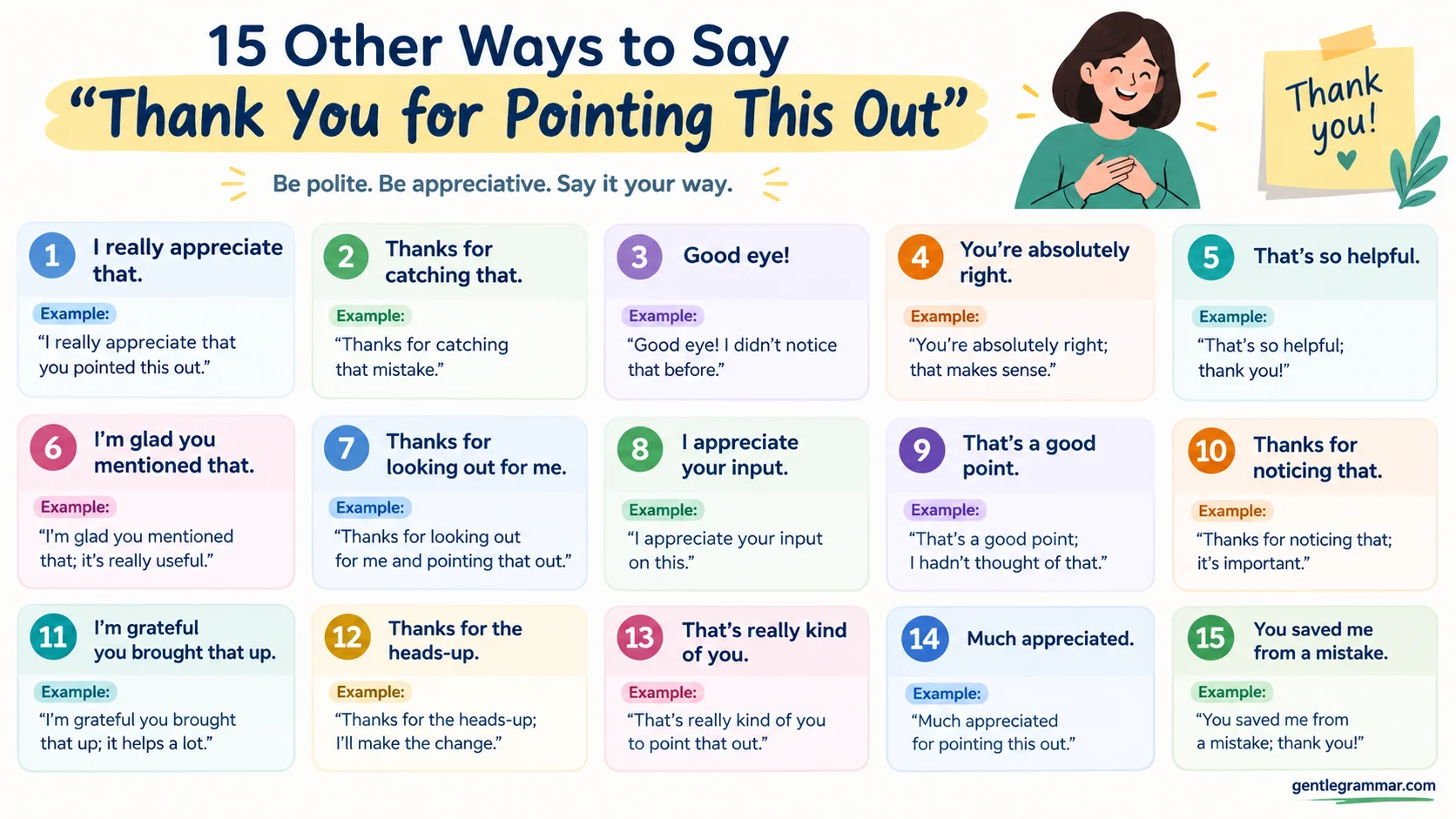
In a professional environment, expressing gratitude can support collaboration and mutual respect.
When someone brings an issue to attention, I have experienced how Other Ways to Say “Thank You for Pointing This Out” can make appreciation sound more natural and clear. The right words, better wording, and useful phrases can make a big difference in professional conversations and casual conversations. Using alternative phrases and phrase variations keeps communication natural.
In daily use, I have noticed that some expressions may sound flat in a simple chat, so using other ways can add warmth and clarity. I Will Be In Touch, for example, may need a different expression depending on the situation and level of formality needed. Choosing thoughtful words and the right wording can show genuine care and quietly strengthen relationships. In an article, saying things clearly, consistently, and naturally can help with acknowledging contributions, noting valuable observations, and adding thoughtful clarifying input.
What Does “Thank You for Pointing This Out” Mean?
“Thank you for pointing this out” means you appreciate someone drawing your attention to something you had not noticed or considered. The phrase is commonly used when another person identifies a mistake, problem, missing detail, concern, or useful piece of information. It communicates gratitude and acknowledgment without necessarily admitting that the other person was completely right about everything. For example, if a colleague notices an incorrect figure in a report, saying “Thank you for pointing this out” acknowledges their observation and shows that you value their attention to detail.
The phrase can be used in both professional and everyday communication. Depending on the situation, it may sound polite and neutral, appreciative and warm, or slightly formal. The exact feeling depends on the surrounding words, relationship between the speakers, and seriousness of the issue being discussed.
Common Situations Where “Thank You for Pointing This Out” Is Used
“Thank you for pointing this out” is useful whenever someone helps you notice, understand, or reconsider something. At work, you might use it after a colleague identifies an error in a document, raises a concern during a meeting, or notices an overlooked detail. In school, a student might say it to a teacher who highlights a mistake in an assignment. In everyday conversation, the phrase can acknowledge a friend or family member who brings something important to your attention.
It also works well in emails, text messages, customer communication, and online discussions. Someone may use it when responding to feedback, correcting information, or acknowledging a concern. People often look for alternatives when they want their response to sound less repetitive, more personal, more formal, or more specific to the situation.
Is It Professional or Polite to Say “Thank You for Pointing This Out”?
Yes. “Thank you for pointing this out” is generally polite, respectful, and professional. It is especially appropriate when someone has identified an issue that deserves attention. The wording is neutral enough for workplace emails, meetings, customer communication, and formal discussions while still sounding natural.
The phrase can also be friendly in casual settings, although some alternatives may feel more relaxed. For example, “Thanks for catching that” sounds more conversational, while “I appreciate you flagging this” is particularly natural in workplace communication. The best wording depends on whether you want to emphasize gratitude, correction, attention to detail, or professional acknowledgment.
Advantages and Disadvantages of Saying “Thank You for Pointing This Out”
Advantages
The main advantage is its clarity. The phrase immediately tells the other person that you noticed and appreciated their contribution. It is also polite and versatile, so it can work in professional emails, conversations, meetings, and everyday exchanges. Another benefit is that it does not automatically make a strong judgment about the issue; it simply acknowledges that someone brought something to your attention.
Disadvantages
The phrase can become repetitive if you use it frequently in emails or workplace conversations. It may also sound somewhat neutral when you want to express stronger appreciation. In a very casual conversation, it can feel slightly formal compared with expressions such as “Good catch” or “Thanks for spotting that.” In some situations, a more specific alternative can communicate exactly what you appreciate.
Synonyms for “Thank You for Pointing This Out”
- Thanks for Bringing This to My Attention
- I Appreciate You Flagging This
- Thanks for Catching That
- I Appreciate You Noticing This
- Thanks for Highlighting This
- I Appreciate the Heads-Up
- Thanks for Letting Me Know
- I’m Glad You Brought This Up
- Thank You for Drawing My Attention to This
- Thanks for Calling This Out
- I Appreciate You Pointing That Out
- Thanks for Spotting That
- Good Catch
- I Appreciate You Raising This
- Thanks for Bringing This to My Attention
1. Thanks for Bringing This to My Attention
Meaning
“Thanks for bringing this to my attention” means thank you for making me aware of something. It closely matches the meaning of “Thank You for Pointing This Out” but places more emphasis on the fact that the information was previously outside your awareness.
Definition
A polite expression used to acknowledge someone who has made you aware of an issue, detail, concern, or piece of information.
Detailed Explanation
This phrase is especially useful when someone has shared information that requires your attention or action. It sounds professional and respectful without being overly formal. Unlike “Thanks for catching that,” it does not necessarily suggest that you made a mistake. It works well when the person has simply helped you become aware of something important.
Scenario Examples
Scenario: A customer reports a problem with an order.
Example: “Thanks for bringing this to my attention. I’ll check the order details right away.”
Scenario: A colleague notices that a deadline has changed.
Example: “Thanks for bringing this to my attention. I hadn’t seen the updated schedule.”
Best Use
Use this expression in professional emails, customer communication, workplace discussions, and formal messages.
Tone
Tone: Professional, polite, appreciative
It sounds respectful while clearly acknowledging the other person’s help.
2. I Appreciate You Flagging This
Meaning
“I appreciate you flagging this” means I’m grateful that you identified or warned me about this issue. The word “flagging” is common in workplace communication.
Definition
A professional expression used to thank someone for identifying something that may require attention or action.
Detailed Explanation
This wording is particularly natural when someone has identified a problem, risk, mistake, or concern. It suggests that the person has helped you notice something that should not be ignored. Compared with the original phrase, it has a slightly more workplace-oriented feel. It is less natural in very personal conversations.
Scenario Examples
Scenario: A teammate notices a problem with a project timeline.
Example: “I appreciate you flagging this before we send the schedule to the client.”
Scenario: A manager identifies a possible issue in a report.
Example: “I appreciate you flagging this discrepancy. I’ll review the figures.”
Best Use
This works especially well in professional emails, meetings, project discussions, and business communication.
Tone
Tone: Professional, direct, respectful
“Flagging” gives the expression a practical workplace tone.
3. Thanks for Catching That
Meaning
“Thanks for catching that” means thank you for noticing something I might have missed. It often refers to an error, mistake, or overlooked detail.
Definition
A casual and friendly way to thank someone for noticing and identifying a mistake or problem.
Detailed Explanation
This expression is more conversational than the original phrase. It is especially natural when someone has prevented an error from being overlooked. “Catching” suggests quick observation and useful intervention, so it fits situations involving proofreading, editing, calculations, or practical mistakes. It is not usually the best choice for highly formal correspondence.
Scenario Examples
Scenario: A coworker notices a typo in your presentation.
Example: “Thanks for catching that typo before the presentation.”
Scenario: A friend notices that you left your phone behind.
Example: “Thanks for catching that. I would have left without it.”
Best Use
Use it in casual workplace communication, texting, everyday conversation, and friendly messages.
Tone
Tone: Friendly, casual, appreciative
It sounds warm and natural without being overly formal.
4. I Appreciate You Noticing This
Meaning
“I appreciate you noticing this” expresses gratitude because someone paid attention to a detail and brought it to your attention.
Definition
A polite expression thanking someone for observing something important or easy to overlook.
Detailed Explanation
This phrase emphasizes the other person’s attention and observation rather than simply the information they provided. It is useful when the detail required careful attention or when you want to recognize someone’s effort. It can be softer than “Thanks for catching that” because it does not necessarily imply that something was wrong.
Scenario Examples
Scenario: A colleague notices a small formatting issue in a document.
Example: “I appreciate you noticing this before we finalized the document.”
Scenario: A friend notices that you seem unusually quiet.
Example: “I appreciate you noticing this. I’ve had a lot on my mind today.”
Best Use
It fits workplace communication, personal conversations, thoughtful messages, and situations involving careful observation.
Tone
Tone: Warm, thoughtful, appreciative
It gives extra credit to the person for paying attention.
5. Thanks for Highlighting This
Meaning
“Thanks for highlighting this” means thank you for drawing special attention to an important point.
Definition
A polite expression used when someone emphasizes an issue, detail, fact, or idea that deserves attention.
Detailed Explanation
This phrase is useful when the other person has not necessarily found a mistake but has helped emphasize something important. It is common in work, education, presentations, and discussions. Compared with “Thank You for Pointing This Out,” it can sound slightly more focused on the importance of the information itself. It works particularly well when responding to feedback or discussion points.
Scenario Examples
Scenario: A colleague emphasizes an important customer concern.
Example: “Thanks for highlighting this. We should make it part of the next meeting agenda.”
Scenario: A teacher emphasizes a common writing mistake.
Example: “Thanks for highlighting this. I’ll pay closer attention to it in my next assignment.”
Best Use
Use it in professional communication, academic settings, presentations, reports, and thoughtful discussions.
Tone
Tone: Professional, attentive, appreciative
It signals that the highlighted information deserves consideration.
6. I Appreciate the Heads-Up
Meaning
“I appreciate the heads-up” means thank you for warning or informing me about something before it becomes a problem.
Definition
An informal expression of gratitude for advance information or a useful warning.
Detailed Explanation
This expression is not a perfect synonym for every use of “Thank You for Pointing This Out.” It works best when someone gives you early notice about something. It has a relaxed, conversational feel and is common in everyday and workplace interactions. Because it is informal, another expression may be better for very formal correspondence.
Scenario Examples
Scenario: A coworker tells you that a meeting has moved to another room.
Example: “I appreciate the heads-up. I’ll head over there now.”
Scenario: A friend warns you about heavy traffic.
Example: “I appreciate the heads-up. I’ll take another route.”
Best Use
It works best in casual conversation, texting, friendly workplace messages, and informal emails.
Tone
Tone: Casual, friendly, appreciative
“Heads-up” makes the response sound relaxed and conversational.
7. Thanks for Letting Me Know
Meaning
“Thanks for letting me know” means thank you for giving me information I needed or did not previously have.
Definition
A common expression used to thank someone for providing information or an update.
Detailed Explanation
This is one of the most flexible alternatives, although it is broader than the original phrase. It works when someone tells you something rather than necessarily identifying a problem. It can therefore sound neutral and natural in many contexts. Choose it when your main purpose is to acknowledge useful information rather than emphasize that someone noticed an error.
Scenario Examples
Scenario: A coworker tells you the client will arrive late.
Example: “Thanks for letting me know. I’ll adjust the schedule.”
Scenario: A friend tells you they cannot attend dinner.
Example: “Thanks for letting me know. We can plan another day.”
Best Use
Use it in emails, texts, workplace communication, customer messages, and everyday conversations.
Tone
Tone: Neutral, polite, friendly
Its flexibility makes it suitable for both casual and professional situations.
8. I’m Glad You Brought This Up
Meaning
“I’m glad you brought this up” means I’m pleased that you mentioned this because it is worth discussing or addressing.
Definition
An appreciative expression used when someone raises a topic, concern, question, or issue that deserves attention.
Detailed Explanation
This phrase can communicate more warmth than the original wording because it suggests that the conversation itself is valuable. It is particularly useful when someone raises a concern, question, or important topic, rather than simply spotting a typo. It can also encourage further discussion instead of closing the conversation.
Scenario Examples
Scenario: A team member raises a concern about a project.
Example: “I’m glad you brought this up. Let’s discuss how we can address it.”
Scenario: A partner mentions something that has been bothering them.
Example: “I’m glad you brought this up. I didn’t realize it was affecting you that way.”
Best Use
It works well in meetings, personal conversations, relationship discussions, and collaborative communication.
Tone
Tone: Warm, open, encouraging
It shows appreciation while inviting further conversation.
9. Thank You for Drawing My Attention to This
Meaning
“Thank you for drawing my attention to this” means thank you for making me notice or consider something important.
Definition
A relatively formal expression used to thank someone for directing your attention toward a particular matter.
Detailed Explanation
This expression is very close in meaning to “Thank You for Pointing This Out,” but it has a more formal and polished sound. It is useful when writing carefully worded professional correspondence. In casual conversation, it may sound more formal than necessary. It is particularly suitable when the issue deserves deliberate attention rather than a quick response.
Scenario Examples
Scenario: A customer identifies a billing issue.
Example: “Thank you for drawing my attention to this billing discrepancy. We’ll investigate it promptly.”
Scenario: A colleague identifies a missing section in a report.
Example: “Thank you for drawing my attention to this omission. I’ll add the missing information.”
Best Use
Use it for formal emails, business correspondence, customer communication, and official or carefully worded messages.
Tone
Tone: Formal, respectful, professional
The wording sounds polished and deliberate.
10. Thanks for Calling This Out
Meaning
“Thanks for calling this out” means thank you for openly identifying or emphasizing something that needs attention.
Definition
A conversational expression used to thank someone for drawing attention to an issue, mistake, or concern.
Detailed Explanation
“Calling this out” can be stronger and more direct than the original phrase. It often suggests that something needed to be openly acknowledged rather than quietly overlooked. The expression is common in modern workplace and online communication, but it can occasionally sound confrontational depending on the context. Use it when the directness feels appropriate.
Scenario Examples
Scenario: A teammate points out an unfair assumption in a discussion.
Example: “Thanks for calling this out. We should consider that perspective.”
Scenario: A colleague identifies an issue everyone else overlooked.
Example: “Thanks for calling this out before we moved forward.”
Best Use
It works well in workplace discussions, group conversations, online discussions, and direct communication.
Tone
Tone: Direct, conversational, appreciative
Its direct wording makes it useful when an issue needs clear acknowledgment.
11. I Appreciate You Pointing That Out
Meaning
“I appreciate you pointing that out” means I’m grateful that you noticed something and made me aware of it.
Definition
A polite expression that directly acknowledges someone’s observation or correction.
Detailed Explanation
This is one of the closest alternatives to “Thank You for Pointing This Out.” The difference is mostly stylistic: “I appreciate” can sound slightly more personal and deliberate than “thank you.” It works especially well when someone has provided useful correction or feedback. Because it remains neutral and respectful, it can fit a wide range of situations.
Scenario Examples
Scenario: A coworker corrects a date in your email draft.
Example: “I appreciate you pointing that out. I had the wrong date in my notes.”
Scenario: Someone mentions an important detail during a discussion.
Example: “I appreciate you pointing that out. That changes how I see the issue.”
Best Use
Use it in professional communication, meetings, emails, feedback discussions, and everyday conversations.
Tone
Tone: Polite, appreciative, professional
It feels personal without becoming overly emotional.
12. Thanks for Spotting That
Meaning
“Thanks for spotting that” means thank you for noticing something that I had missed.
Definition
A friendly expression used to thank someone for quickly noticing a mistake, detail, or problem.
Detailed Explanation
This phrase is especially natural when the person has demonstrated good attention or quick observation. It often applies to small errors, missing details, or practical problems. Compared with “Thanks for bringing this to my attention,” it sounds more casual and usually implies that the other person noticed something specific. It is not ideal when the issue is sensitive or highly formal.
Scenario Examples
Scenario: A friend notices that your car lights are still on.
Example: “Thanks for spotting that. I would have drained the battery.”
Scenario: A coworker sees a duplicated paragraph in your report.
Example: “Thanks for spotting that before I sent the report.”
Best Use
It fits casual conversations, friendly workplace messages, proofreading, and everyday situations.
Tone
Tone: Casual, friendly, appreciative
“Spotting” gives the expression a quick and conversational feel.
13. Good Catch
Meaning
“Good catch” means you noticed something important that could easily have been missed.
Definition
A short, informal expression used to praise someone for identifying an error, problem, or overlooked detail.
Detailed Explanation
“Good catch” is much more concise than “Thank You for Pointing This Out.” It often carries a small element of praise, making it useful when someone prevented a mistake or noticed something quickly. Because it is brief and informal, it may not be suitable for formal customer letters or official correspondence. It works naturally when the relationship is comfortable.
Scenario Examples
Scenario: A teammate notices an incorrect number in a spreadsheet.
Example: “Good catch. That figure should be 250, not 205.”
Scenario: A friend notices that you have forgotten an important date.
Example: “Good catch—I completely overlooked that.”
Best Use
Use it in casual workplace conversations, texting, team chats, and everyday communication.
Tone
Tone: Casual, positive, encouraging
It combines gratitude with a quick compliment.
14. I Appreciate You Raising This
Meaning
“I appreciate you raising this” means I’m grateful that you brought an issue, concern, question, or topic forward for discussion.
Definition
A professional expression used to thank someone for bringing a matter forward so it can be considered or addressed.
Detailed Explanation
This alternative is particularly useful when someone raises a concern or issue rather than simply identifying a minor mistake. It can sound more constructive than “calling this out” because it focuses on bringing the matter into the conversation. The expression is common in professional, academic, and collaborative settings. It can also show that you welcome thoughtful feedback.
Scenario Examples
Scenario: An employee raises a concern about a new process.
Example: “I appreciate you raising this. Let’s look at whether the process needs to change.”
Scenario: A student asks about a confusing part of an assignment.
Example: “I appreciate you raising this. The instructions could have been clearer.”
Best Use
Use it in meetings, workplace communication, academic discussions, feedback conversations, and collaborative settings.
Tone
Tone: Professional, constructive, respectful
It encourages people to bring meaningful concerns into the open.
15. Thanks for Bringing This to My Attention
Meaning
“Thanks for bringing this to my attention” means thank you for making me aware of something that I need to consider or address.
Definition
A polite expression used to acknowledge someone who has identified or communicated an issue, detail, or important matter.
Detailed Explanation
This wording is highly practical when you need to acknowledge information and show that you will consider it. It is particularly effective in professional communication because it sounds calm, respectful, and action-oriented. It can refer to a mistake, complaint, concern, or simple piece of information. Compared with a casual phrase such as “Good catch,” it creates a more polished impression.
Scenario Examples
Scenario: A customer reports an issue with a service.
Example: “Thanks for bringing this to my attention. We’ll review what happened.”
Scenario: A colleague points out a missing attachment.
Example: “Thanks for bringing this to my attention. I’ll send the attachment shortly.”
Best Use
It is particularly suitable for professional emails, customer service, workplace communication, and formal or semi-formal messages.
Tone
Tone: Professional, polite, measured
It acknowledges the issue without sounding defensive or overly emotional.
FAQs:
What is another way to say “Thank You for Pointing This Out”?
Natural alternatives include “Thanks for bringing this to my attention,” “I appreciate you flagging this,” “Thanks for catching that,” and “I appreciate you pointing that out.” The best choice depends on whether you are responding to a mistake, concern, warning, or general piece of information.
What does “Thank You for Pointing This Out” mean?
“Thank You for Pointing This Out” means you appreciate someone making you aware of something you had not noticed or considered. It is often used when someone identifies a mistake, problem, detail, concern, or useful piece of information.
Is “Thank You for Pointing This Out” professional?
Yes. The expression is generally polite, neutral, and professional. It can be used in workplace emails, meetings, customer communication, and other situations where you want to acknowledge someone’s observation respectfully.
What is a more polite way to say “Thank You for Pointing This Out”?
For a polished and respectful response, try “I appreciate you bringing this to my attention” or “Thank you for drawing my attention to this.” Both expressions sound considerate and work well when responding to feedback or an identified issue.
Which alternative works best in formal communication?
For formal communication, “Thank you for drawing my attention to this” and “Thanks for bringing this to my attention” are strong choices. They clearly acknowledge the information while maintaining a respectful and professional tone.
Conclusion:
Choosing the right expression can make a simple acknowledgment feel more natural, thoughtful, and appropriate to the situation. “Thank You for Pointing This Out” is already a useful and polite phrase, but different alternatives can emphasize different ideas. Some expressions highlight professional awareness, while others recognize a helpful correction, welcome a concern, or add a friendly touch.
The best wording depends on what the other person actually did and the relationship you have with them. For a workplace email, you might prefer “I appreciate you flagging this,” while “Good catch” may feel more natural with a colleague you know well. When responding to feedback, remember that small differences in tone can make your message clearer and more respectful.
