
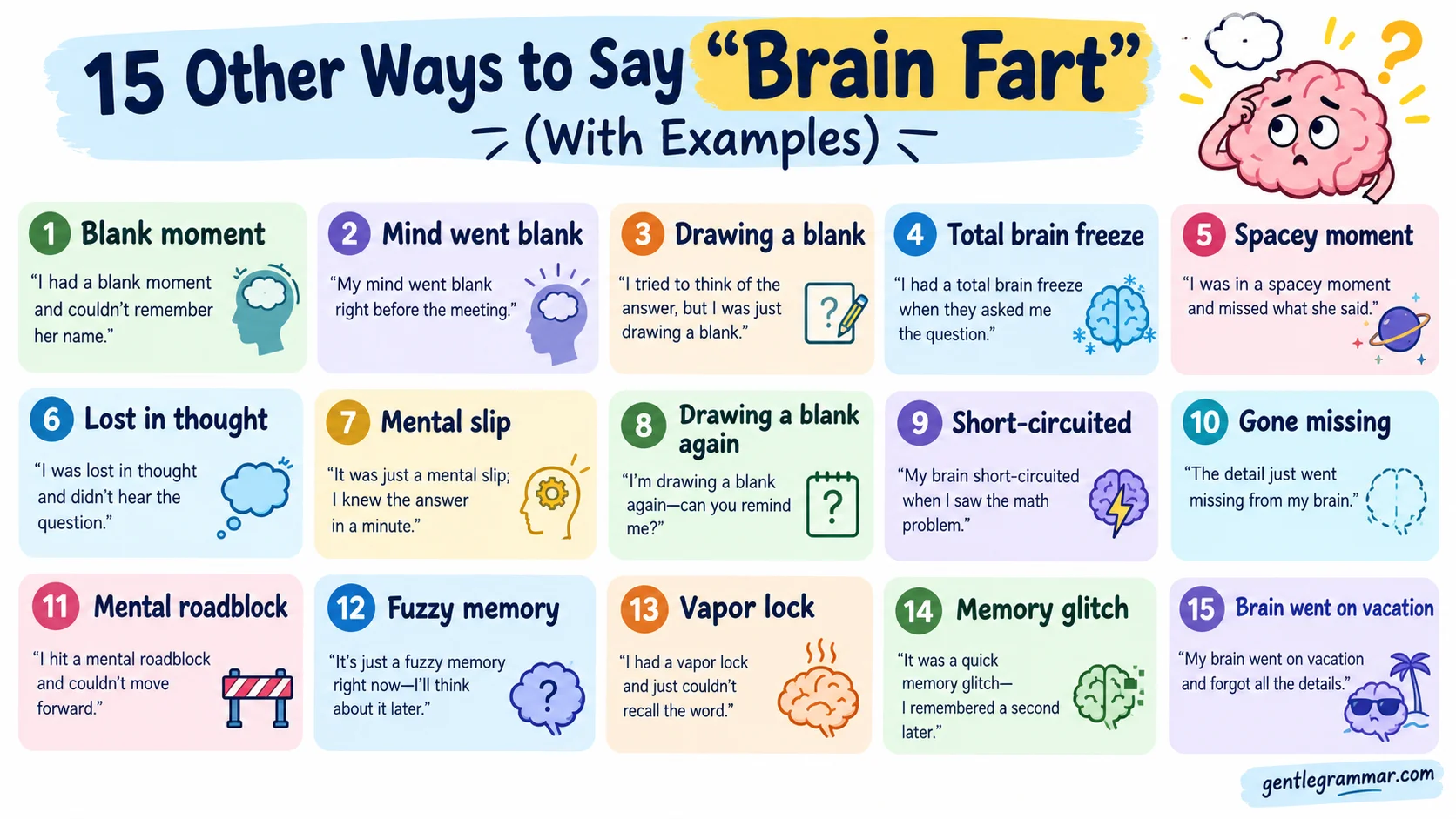
In my experience, Other Ways to Say “Brain Fart” can help when a temporary mental lapse makes a familiar word suddenly disappear in conversation.
A brain fart is a funny, informal, and natural expression for a moment when the mind seems to stop working temporarily. It can happen to us all, and it is a common experience, even when it feels awkward, uncomfortable, or confusing. I have noticed these cognitive hiccups over the years, such as forgetfulness, a mental blank, losing my train of thought, or being unable to remember someone’s name.
You might walk into a room and forget your idea, misplace something, make a mistake, or experience a brief lapse while cooking, speaking, or thinking. These moments can involve memory, recall, attention, focus, and the thought process, and even smart people can experience them. Experts may describe these as temporary cognitive difficulties, while the humor of the phrase can help us laugh and keep the experience in the right perspective.
What Does “Brain Fart” Mean?
A brain fart is an informal expression for a temporary mental lapse, moment of forgetfulness, or brief failure to think of something you normally know. Someone might use it after forgetting a familiar word, making a simple mistake, overlooking an obvious detail, or temporarily losing track of a thought. The expression is usually humorous and self-deprecating, rather than a serious description of a cognitive problem. For example, someone might say, “I had a brain fart and completely forgot where I put my keys.”
The phrase is generally understood as a short-lived mental mistake rather than a permanent problem. Its meaning depends heavily on context, but in everyday English it often communicates, “I knew this, but my mind briefly stopped working properly.” Because brain fart is slangy and informal, speakers may choose a softer or more professional expression when communicating in a workplace, school, formal message, or other serious setting.
Common Situations Where “Brain Fart” Is Used
People commonly use brain fart in casual conversations, texting, joking, and friendly personal communication. It can describe forgetting a name, making an easy calculation incorrectly, losing a thought during a conversation, or accidentally saying something that was not intended. The phrase often adds humor to an otherwise minor mistake.
For example, a friend might laugh and say, “Sorry, total brain fart—I forgot we already talked about that.” On social media or in a relaxed group chat, the expression can make a mistake sound lighthearted rather than embarrassing. However, people may want an alternative when talking to a manager, customer, teacher, client, or someone they do not know well.
Is It Professional or Polite to Say “Brain Fart”?
Brain fart is generally casual, informal, and humorous. It is common in relaxed spoken English, but it is not usually the best choice for formal writing or professional communication. The word “fart” gives the expression a deliberately silly quality, so it may sound too playful in a business email, academic assignment, customer response, or formal discussion.
Among friends, however, the expression can be perfectly natural and harmless when everyone is comfortable with informal language. In a professional setting, expressions such as “a momentary lapse,” “a memory lapse,” or “I momentarily forgot” can communicate the same basic idea with greater clarity and professionalism.
Advantages and Disadvantages of Saying “Brain Fart”
Advantages
The main advantage of brain fart is its informal and humorous tone. It can make a small mistake feel less serious and show that the speaker is not taking the error too seriously. It is also concise and widely understandable in casual English. When used appropriately, it can create a relaxed feeling between people who are comfortable joking with one another.
Disadvantages
The biggest limitation is its very casual wording. The phrase may sound inappropriate in formal or professional communication, particularly when speaking to customers, senior colleagues, teachers, or unfamiliar people. It can also make a situation sound more humorous than intended. If the speaker wants to emphasize forgetfulness, loss of concentration, or a temporary inability to remember something, a more precise expression may communicate the idea better.
Synonyms for “Brain Fart”
- Mental Lapse
- Memory Lapse
- Momentary Lapse
- Mind Went Blank
- Blanked Out
- Lost My Train of Thought
- Forgot for a Moment
- Temporary Forgetfulness
- Moment of Forgetfulness
- Mental Hiccup
- Slip of the Mind
- Momentary Distraction
- Temporary Confusion
- Spacing Out
- Lost My Thought
1. Mental Lapse
Meaning
A mental lapse is a short period in which someone makes a small thinking or memory error. It is one of the closest alternatives to brain fart because it can describe a temporary failure to remember, notice, or think clearly.
Definition
Mental lapse: A brief and usually minor failure of memory, attention, or thought.
Detailed Explanation
Mental lapse sounds much more neutral and professional than brain fart. It does not have the humorous or slightly crude quality of the original expression. You can use it when you want to acknowledge a small mistake without making the situation sound silly. It works especially well when discussing an error in a workplace, school, or other semi-formal setting.
Scenario Examples
Scenario: You forget a simple detail during a meeting.
Example: “I had a brief mental lapse and forgot to mention the final deadline.”
Scenario: You make an easy mistake while completing a task.
Example: “It was just a mental lapse—I entered the wrong number.”
Best Use
Best for professional communication, workplace conversations, emails, and neutral everyday speech.
Tone
Tone: Neutral, professional, and understated. It describes the mistake without adding humor or embarrassment.
2. Memory Lapse
Meaning
A memory lapse refers specifically to a temporary failure to remember something. It is useful when the problem is clearly related to recalling information rather than general concentration.
Definition
Memory lapse: A brief period when you cannot remember something that you normally know or can recall.
Detailed Explanation
This expression is more specific than brain fart because it focuses on memory. If you temporarily forget someone’s name, an appointment, a fact, or where you placed something, memory lapse can describe the situation naturally. It sounds more polished and matter-of-fact than the slang expression.
Scenario Examples
Scenario: You temporarily forget someone’s name.
Example: “I’m sorry, I’m having a memory lapse. Could you remind me of your name?”
Scenario: You forget an appointment time.
Example: “I had a memory lapse and wrote the meeting down for the wrong day.”
Best Use
Best for everyday conversation, workplace communication, polite explanations, and situations involving forgotten information.
Tone
Tone: Polite, neutral, and slightly formal. It focuses on the memory problem without making it humorous.
3. Momentary Lapse
Meaning
A momentary lapse describes a brief mistake or temporary failure in attention, judgment, memory, or concentration.
Definition
Momentary lapse: A short-lived failure to think, remember, notice, or respond correctly.
Detailed Explanation
This expression is broader than memory lapse because the problem does not have to involve forgetting. You can use it for a brief error in concentration or judgment as well. The word momentary emphasizes that the issue was short-lived and does not necessarily reflect someone’s usual ability.
Scenario Examples
Scenario: You overlook an obvious detail in a document.
Example: “That was a momentary lapse in concentration, and I missed the typo.”
Scenario: You make a small error while explaining something.
Example: “I had a momentary lapse and gave you the wrong figure.”
Best Use
Best for professional settings, formal explanations, workplace communication, and polite descriptions of minor mistakes.
Tone
Tone: Professional, restrained, and respectful. It makes a mistake sound temporary rather than careless.
4. Mind Went Blank
Meaning
Mind went blank means that you temporarily could not remember what you wanted to say or could not think of an answer.
Definition
Mind went blank: A temporary inability to think of, remember, or express something.
Detailed Explanation
This is a natural spoken expression when someone suddenly loses access to a thought. It is particularly useful during conversations, presentations, interviews, tests, or stressful moments. Unlike brain fart, it usually focuses on the experience of being unable to think of something at that moment.
Scenario Examples
Scenario: You forget an answer during a presentation.
Example: “I knew the answer, but my mind went blank when everyone looked at me.”
Scenario: Someone asks you a familiar question unexpectedly.
Example: “Sorry, my mind just went blank for a second.”
Best Use
Best for spoken English, presentations, interviews, classroom situations, and casual personal communication.
Tone
Tone: Natural, relatable, and slightly vulnerable. It explains the experience without sounding crude.
5. Blanked Out
Meaning
Blanked out means that you temporarily could not remember or think of something.
Definition
Blanked out: Temporarily failed to remember or think of something.
Detailed Explanation
This is a casual expression that closely matches the everyday meaning of brain fart in many situations. It works particularly well when you know the information but cannot retrieve it at that particular moment. It is more neutral than the original phrase but remains informal enough for friendly conversation.
Scenario Examples
Scenario: You forget a person’s name during a conversation.
Example: “I completely blanked out when I tried to remember his name.”
Scenario: You forget what you were about to say.
Example: “I was about to make my point, but I blanked out.”
Best Use
Best for casual conversation, texting, friendly messages, and informal spoken English.
Tone
Tone: Casual, direct, and relatable. It sounds natural without the humorous edge of brain fart.
6. Lost My Train of Thought
Meaning
Lost my train of thought means that you were following an idea or explanation but temporarily forgot where you were going with it.
Definition
Lost my train of thought: Temporarily stopped remembering the idea or line of reasoning you were developing.
Detailed Explanation
This expression is especially useful when the issue is losing track of an idea, rather than forgetting a fact. It often occurs during conversations, presentations, writing, or explanations. It sounds natural and polite, making it useful in both casual and many professional situations.
Scenario Examples
Scenario: Someone interrupts you during a discussion.
Example: “Sorry, I lost my train of thought when the phone rang.”
Scenario: You pause during a presentation.
Example: “Give me a second—I lost my train of thought.”
Best Use
Best for meetings, presentations, conversations, classroom discussions, writing, and everyday speech.
Tone
Tone: Polite, conversational, and thoughtful. It describes a disruption in your thinking without suggesting serious confusion.
7. Forgot for a Moment
Meaning
Forgot for a moment simply means that you temporarily failed to remember something.
Definition
Forgot for a moment: Temporarily did not remember something that you normally know.
Detailed Explanation
This is one of the clearest and simplest expressions on the list. It does not imply anything unusual or dramatic; it simply explains that the information slipped from your memory briefly. Because the wording is straightforward, it can work in many situations without sounding overly formal.
Scenario Examples
Scenario: A friend reminds you about an earlier conversation.
Example: “Oh, right! I forgot for a moment.”
Scenario: You temporarily forget where you left an item.
Example: “I forgot for a moment that I had put the keys in my bag.”
Best Use
Best for everyday conversation, texting, personal messages, and simple explanations.
Tone
Tone: Simple, neutral, and natural. It avoids slang and does not make the mistake sound bigger than it is.
8. Temporary Forgetfulness
Meaning
Temporary forgetfulness describes a short period in which someone has difficulty remembering something.
Definition
Temporary forgetfulness: A brief inability to remember information that is normally familiar.
Detailed Explanation
This phrase has a slightly more formal and descriptive quality than brain fart. It focuses specifically on forgetting rather than losing concentration or making a judgment error. It can be useful when you want your wording to sound careful and neutral.
Scenario Examples
Scenario: You forget a familiar word during a conversation.
Example: “I was experiencing some temporary forgetfulness and couldn’t recall the word.”
Scenario: You overlook something you normally remember.
Example: “It was just temporary forgetfulness; I remembered it a few minutes later.”
Best Use
Best for polite explanations, formal writing, educational contexts, and neutral communication.
Tone
Tone: Formal, neutral, and measured. It sounds more descriptive than conversational.
9. Moment of Forgetfulness
Meaning
A moment of forgetfulness describes a brief instance when someone forgets something.
Definition
Moment of forgetfulness: A short instance of failing to remember something.
Detailed Explanation
This expression is gentle and easy to understand. It can be useful when you want to describe a small memory mistake without making it sound humorous or overly serious. Compared with brain fart, it has a softer and more considerate quality.
Scenario Examples
Scenario: You forget to bring something you promised to bring.
Example: “It was just a moment of forgetfulness—I left the document at home.”
Scenario: You forget a familiar detail.
Example: “I had a moment of forgetfulness and couldn’t remember the address.”
Best Use
Best for polite conversation, personal communication, explanations, and gentle descriptions of minor mistakes.
Tone
Tone: Gentle, polite, and understated. It softens the mistake without denying that it happened.
10. Mental Hiccup
Meaning
A mental hiccup is a playful expression for a brief problem with thinking, remembering, or concentrating.
Definition
Mental hiccup: A small and temporary interruption in normal thinking or memory.
Detailed Explanation
This expression is intentionally lighthearted, much like brain fart, but it sounds less crude. The word hiccup suggests something brief that interrupts an otherwise normal process. It works well when you want to acknowledge a small mistake while keeping the mood relaxed.
Scenario Examples
Scenario: You make a simple mistake while answering a friend.
Example: “Sorry, just a mental hiccup—I knew what you meant.”
Scenario: You forget a detail during a relaxed conversation.
Example: “I had a little mental hiccup and forgot the name of that restaurant.”
Best Use
Best for casual conversations, friendly messages, informal writing, and humorous situations.
Tone
Tone: Playful, casual, and friendly. It keeps the mistake light without using the original slang.
11. Slip of the Mind
Meaning
A slip of the mind describes a brief instance of forgetting something.
Definition
Slip of the mind: A temporary failure to remember something that would normally be remembered.
Detailed Explanation
This expression presents forgetfulness as something that briefly slipped away from your attention. It can sound gentler and more polished than brain fart. It is particularly useful when you want to acknowledge an omission without sounding overly casual.
Scenario Examples
Scenario: You forget to include a detail in a message.
Example: “Leaving that information out was simply a slip of the mind.”
Scenario: You forget someone’s name temporarily.
Example: “Her name was a slip of the mind—I remembered it a moment later.”
Best Use
Best for polite personal communication, explanations, reflective writing, and gentle descriptions of forgetfulness.
Tone
Tone: Gentle, slightly formal, and considerate. It puts less emphasis on the mistake itself.
12. Momentary Distraction
Meaning
A momentary distraction means that something briefly pulled your attention away from what you were doing or thinking about.
Definition
Momentary distraction: A short period when attention is temporarily diverted by something else.
Detailed Explanation
This expression differs from brain fart because the main issue is attention rather than memory. It is appropriate when you forgot something because another thought, sound, message, person, or event briefly captured your attention. It can therefore explain the reason for a mistake more precisely in some situations.
Scenario Examples
Scenario: You miss part of a conversation because your phone rings.
Example: “Sorry, I had a momentary distraction and missed that last part.”
Scenario: You overlook a detail while working.
Example: “The error happened because of a momentary distraction.”
Best Use
Best for workplace communication, polite explanations, meetings, and situations where attention was interrupted.
Tone
Tone: Neutral, professional, and explanatory. It focuses on the temporary loss of attention rather than personal ability.
13. Temporary Confusion
Meaning
Temporary confusion describes a short period when something is unclear or difficult to understand.
Definition
Temporary confusion: A brief state of uncertainty or difficulty understanding something correctly.
Detailed Explanation
This expression is not a direct synonym for every use of brain fart because confusion involves uncertainty or lack of clarity, not simply forgetting. It works when your mistake happened because you briefly misunderstood information or became unsure about what was happening. The phrase is more neutral and serious than the original slang.
Scenario Examples
Scenario: Two instructions appear similar and you choose the wrong one.
Example: “I experienced some temporary confusion about which form to submit.”
Scenario: You misunderstand a detail during a discussion.
Example: “There was some temporary confusion about the meeting time.”
Best Use
Best for professional communication, customer service, formal explanations, and situations involving uncertainty.
Tone
Tone: Neutral, professional, and careful. It explains uncertainty without making the situation sound humorous.
14. Spacing Out
Meaning
Spacing out means temporarily becoming less aware of what is happening because your attention drifts away.
Definition
Spacing out: Briefly losing concentration or awareness because your thoughts have wandered.
Detailed Explanation
This is a casual expression, but it is not exactly the same as brain fart. It usually describes a loss of attention rather than a simple memory mistake. Someone might space out during a long conversation, lecture, meeting, or routine task and then realize they missed something.
Scenario Examples
Scenario: A friend asks whether you heard the question.
Example: “Sorry, I was spacing out for a second. Could you repeat that?”
Scenario: You miss an instruction during a long meeting.
Example: “I was spacing out near the end and missed that announcement.”
Best Use
Best for casual conversation, texting, friendships, classroom situations, and informal discussions.
Tone
Tone: Casual, relaxed, and slightly humorous. It works well when the situation is minor and informal.
15. Lost My Thought
Meaning
Lost my thought describes temporarily forgetting the idea you were thinking about or preparing to express.
Definition
Lost my thought: Temporarily forgot the idea or point that was in your mind.
Detailed Explanation
This expression is useful when you are speaking or writing and suddenly cannot remember the idea you were developing. It is narrower than brain fart because it focuses on losing a particular thought rather than making any kind of mental mistake. The wording is straightforward and can sound natural when explaining a pause in conversation.
Scenario Examples
Scenario: You stop while explaining an idea.
Example: “I had a good point, but I lost my thought halfway through.”
Scenario: You pause while writing a message.
Example: “I started typing and then lost my thought completely.”
Best Use
Best for casual conversation, personal messages, writing, and situations where an idea temporarily disappears.
Tone
Tone: Casual, direct, and conversational. It explains a brief interruption in thinking without sounding overly formal.
FAQs:
What is another way to say “Brain Fart”?
A natural alternative depends on what happened. Mental lapse is useful for a general temporary mistake, while memory lapse works when you forgot something. If you lost track of an idea while speaking, lost my train of thought is more precise.
What does “Brain Fart” mean?
Brain fart is an informal expression for a brief mental mistake, moment of forgetfulness, or temporary difficulty thinking of something. It is usually used humorously in casual conversation.
Is “Brain Fart” professional?
Generally, brain fart is not formal or professional wording. It is casual slang with a humorous quality. In professional communication, expressions such as mental lapse, momentary lapse, or memory lapse are usually more appropriate.
What is a more polite way to say “Brain Fart”?
For a polite alternative, you can say “I had a momentary lapse,” “I forgot for a moment,” or “I had a memory lapse,” depending on what happened. These expressions communicate the idea without the slangy tone of brain fart.
Which alternative works best in formal communication?
Mental lapse or momentary lapse can work well in formal communication when describing a minor thinking error. If the problem specifically involved forgetting information, memory lapse is more precise. The best wording depends on whether the issue involved memory, attention, or losing a thought.
Conclusion:
Choosing the right expression can make a small difference in how your message is received. Brain fart is useful when you are speaking casually and want to describe a minor mental mistake with a touch of humor, but it may not fit every setting. Expressions such as mental lapse, memory lapse, momentary lapse, and mind went blank offer different levels of formality and different shades of meaning.
The most natural choice depends on what actually happened: forgetting information, losing a thought, becoming distracted, or briefly becoming confused. When you understand these differences, your wording becomes more precise and appropriate for the situation. Instead of automatically using brain fart, choose the expression that best matches your tone, audience, and context.
