
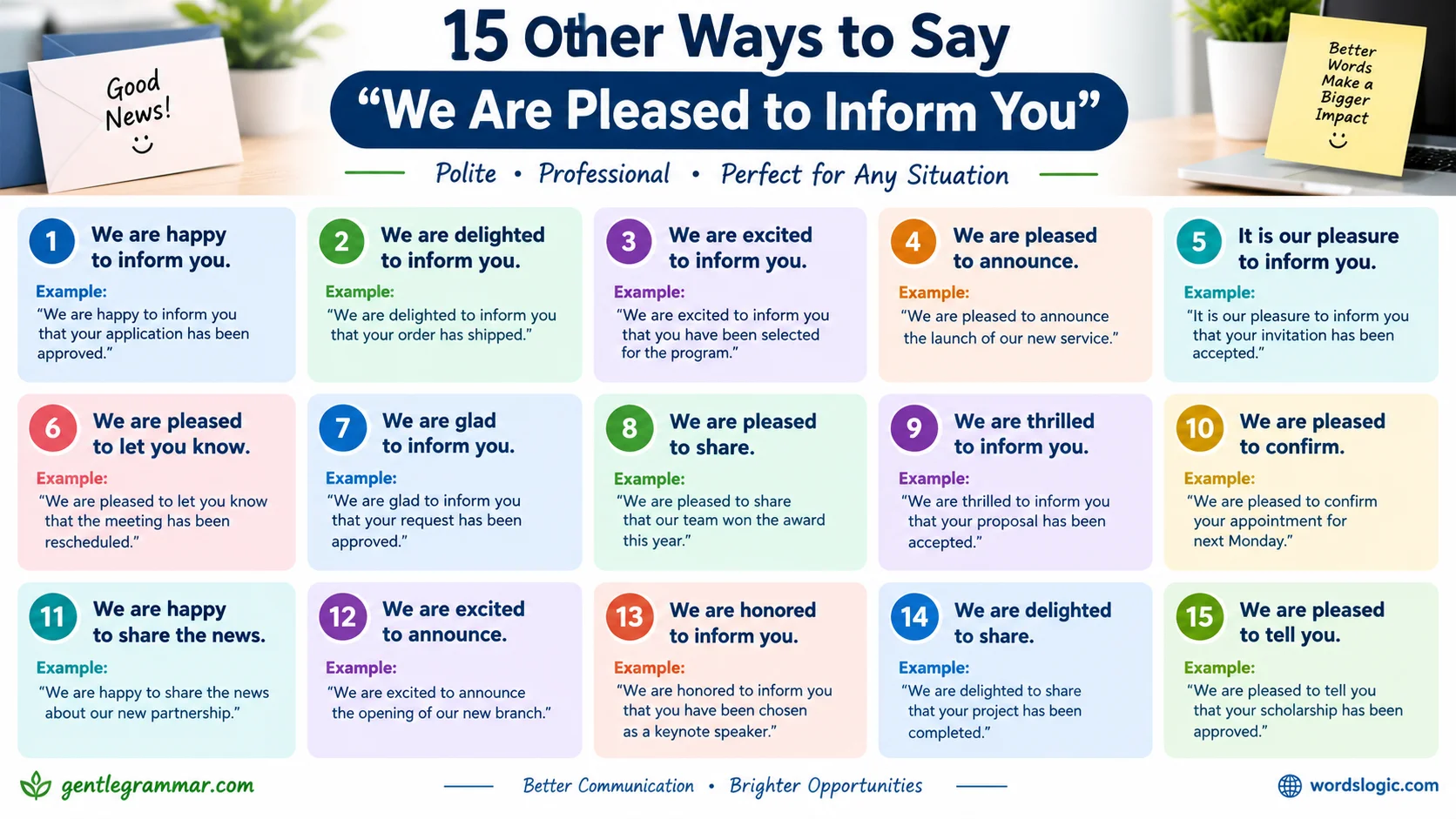
When I need to deliver good news, Other Ways to Say “We Are Pleased to Inform You” can make emails feel more natural, clear, and professional when sharing important updates.
For approved applications or rescheduled event updates, the polite, formal phrase works well in emails and letters because it ensures that information is clearly communicated. Still, choosing the right words can create a positive sentiment that resonates with someone receiving the message. Because words matter, I consider whether I should share exciting news in a professional way.
In professional settings, Happy to announce may be a common go-to, but it can become repetitive or dull. From my experience, knowing other ways to say happy to announce helps you sound fluent, confident, and natural when writing a LinkedIn post, email, or company press release. The way a message received can shape the outcome, so careful choosing matters when sharing updates.
What Does “We Are Pleased to Inform You” Mean?
“We Are Pleased to Inform You” is a formal and polite expression used to introduce important information, news, or an announcement. It usually suggests that the information being shared is positive, welcome, or beneficial to the recipient. For example, a company might write, “We are pleased to inform you that your application has been approved.” The phrase communicates both the information itself and a sense of professional courtesy and goodwill.
The expression is especially common in business letters, official emails, customer communications, workplace announcements, and formal notices. The word “pleased” adds a positive emotional element, while “inform you” keeps the message focused on providing information. Depending on the situation, a writer may choose a warmer, simpler, more enthusiastic, or more direct expression instead.
Common Situations Where “We Are Pleased to Inform You” Is Used
“We Are Pleased to Inform You” is most commonly used when an organization, company, school, or professional wants to communicate positive or significant news. It may appear in an employment message, an admission notice, a customer update, a business announcement, or a formal notification.
In professional communication, the phrase can introduce news such as an approved application, successful selection, new service, promotion, partnership, award, or important organizational update. It can also work in formal written correspondence when the writer wants to maintain a respectful tone.
People may choose an alternative when the original sounds too formal, traditional, or repetitive. For example, “We are happy to inform you” can feel slightly warmer, while “We are pleased to announce” is often more suitable when introducing a public or organizational announcement.
Is It Professional or Polite to Say “We Are Pleased to Inform You”?
Yes. “We Are Pleased to Inform You” is generally professional, polite, and formal. It communicates information respectfully and is particularly suitable for official correspondence. The phrase has a courteous tone because “pleased” presents the information positively rather than making the message sound purely administrative.
However, its formal style may feel somewhat stiff or traditional in casual communication. In a friendly email, text message, or conversational workplace message, a simpler expression may sound more natural. The best wording depends on the relationship with the reader, the importance of the information, and whether the message is written or spoken.
Advantages and Disadvantages of Saying “We Are Pleased to Inform You”
Advantages
One major advantage is its professional tone. The phrase is respectful and appropriate for many official situations, particularly when an organization is communicating positive news. It also creates a sense of courtesy and goodwill, making the announcement feel more considerate than a blunt statement such as “We inform you that.”
Another benefit is that the expression clearly signals that important information is coming next. Readers can immediately understand that the following statement contains the main news or decision.
Disadvantages
The main limitation is its formality. In everyday conversation or informal messaging, it can sound unnecessarily official. It may also feel somewhat conventional when used repeatedly in business correspondence.
Another limitation is that “pleased” does not always communicate the exact emotion the writer wants. If the news is exciting, celebratory, or particularly personal, a phrase that expresses enthusiasm or warmth may communicate the feeling more effectively.
Synonyms for “We Are Pleased to Inform You”
- We Are Delighted to Inform You
- We Are Happy to Inform You
- We Are Pleased to Announce
- We Are Delighted to Announce
- We Are Happy to Announce
- We Would Like to Inform You
- We Wish to Inform You
- We Are Writing to Let You Know
- We Are Glad to Let You Know
- We Are Pleased to Share
- We Are Delighted to Share
- We Are Happy to Share
- We Have the Pleasure of Informing You
- It Is Our Pleasure to Inform You
- We Are Excited to Let You Know
1. We Are Delighted to Inform You
Meaning
“We Are Delighted to Inform You” communicates that the sender is very pleased and genuinely happy to provide the information. It is closely related to “We Are Pleased to Inform You,” but “delighted” expresses a stronger positive feeling.
Definition
We Are Delighted to Inform You means that the sender is very happy to give the recipient some information, usually concerning positive or welcome news.
Detailed Explanation
This expression has a warm and highly positive tone while remaining professional. It works particularly well when the news is important and genuinely exciting, such as a successful application, award, promotion, or acceptance. Compared with “pleased,” the word “delighted” communicates stronger enthusiasm. It is therefore useful when the writer wants the announcement to feel more celebratory.
Scenario Examples
Scenario: A university tells an applicant that they have been accepted.
Example: “We are delighted to inform you that you have been accepted into the graduate program.”
Scenario: A company announces a successful partnership.
Example: “We are delighted to inform you that our partnership agreement has now been finalized.”
Best Use
Best for formal emails, official letters, academic communication, business announcements, and positive decisions.
Tone
Tone: Warm, professional, enthusiastic. The stronger word “delighted” makes the message feel more celebratory than the original phrase.
2. We Are Happy to Inform You
Meaning
“We Are Happy to Inform You” expresses that the sender is pleased to share information with the recipient. It is slightly less formal and more approachable than the original expression.
Definition
We Are Happy to Inform You means that the sender is glad to provide the recipient with particular information or news.
Detailed Explanation
This expression retains the positive feeling of “pleased” but uses simpler, more conversational vocabulary. It can make a professional message feel friendlier without becoming overly casual. It is particularly useful when communicating good news to customers, colleagues, applicants, or members of an organization.
Scenario Examples
Scenario: A customer has received approval for a request.
Example: “We are happy to inform you that your request has been approved.”
Scenario: A workplace announces a new benefit.
Example: “We are happy to inform you that employees will now have access to the new wellness program.”
Best Use
Best for professional emails, customer communication, workplace announcements, and friendly formal messages.
Tone
Tone: Friendly, positive, professional. It sounds approachable while still being appropriate for business communication.
3. We Are Pleased to Announce
Meaning
“We Are Pleased to Announce” is used when introducing news that is being formally announced, especially to a group or wider audience.
Definition
We Are Pleased to Announce means that the sender is formally sharing positive or important news with an audience.
Detailed Explanation
This expression differs from “We Are Pleased to Inform You” mainly in purpose and audience. “Announce” often suggests that the information is intended for a broader group rather than one individual. It is especially natural when introducing a new appointment, event, partnership, achievement, product, or organizational development.
Scenario Examples
Scenario: A company introduces a new department head.
Example: “We are pleased to announce the appointment of Sarah Khan as our new Operations Director.”
Scenario: An organization announces an upcoming event.
Example: “We are pleased to announce that our annual conference will take place in November.”
Best Use
Best for company announcements, newsletters, websites, press-style messages, events, and organizational updates.
Tone
Tone: Formal, positive, official. “Announce” gives the sentence a stronger public-information quality.
4. We Are Delighted to Announce
Meaning
“We Are Delighted to Announce” combines a strong expression of happiness with a formal announcement.
Definition
We Are Delighted to Announce means that the sender is very happy to publicly share important or positive news.
Detailed Explanation
This expression is more enthusiastic than “We Are Pleased to Announce.” It is suitable when the news represents a significant achievement, exciting development, or celebratory occasion. Although it remains professional, the word “delighted” adds warmth and enthusiasm.
Scenario Examples
Scenario: A company celebrates an important milestone.
Example: “We are delighted to announce that our organization has reached its tenth anniversary.”
Scenario: A school announces an award.
Example: “We are delighted to announce that our students have won first place in the regional competition.”
Best Use
Best for celebratory announcements, company news, awards, milestones, events, and public communications.
Tone
Tone: Enthusiastic, celebratory, professional. It conveys stronger excitement than a neutral formal announcement.
5. We Are Happy to Announce
Meaning
“We Are Happy to Announce” introduces positive news in a way that feels professional but approachable.
Definition
We Are Happy to Announce means that the sender is glad to publicly share particular information or news.
Detailed Explanation
This wording is simpler and less formal than “We Are Delighted to Announce.” It works well when an organization wants to sound friendly and accessible rather than highly ceremonial. It is especially useful for company newsletters, community updates, customer announcements, and internal communications.
Scenario Examples
Scenario: A business launches a new service.
Example: “We are happy to announce the launch of our new online support service.”
Scenario: A community group shares good news.
Example: “We are happy to announce that registration for the summer program is now open.”
Best Use
Best for newsletters, customer updates, community messages, internal emails, and business announcements.
Tone
Tone: Friendly, positive, approachable. It sounds less formal while preserving professionalism.
6. We Would Like to Inform You
Meaning
“We Would Like to Inform You” is a neutral and courteous way to introduce information without emphasizing the sender’s emotional reaction.
Definition
We Would Like to Inform You means that the sender wishes to provide the recipient with particular information.
Detailed Explanation
This phrase is more neutral and direct than “We Are Pleased to Inform You.” It does not necessarily suggest that the information is positive, although it can be used for positive, neutral, or important updates. That flexibility makes it useful when the writer wants to sound professional without adding emotional language.
Scenario Examples
Scenario: A company informs customers about a schedule change.
Example: “We would like to inform you that our customer service hours will change next month.”
Scenario: A school sends an official notice.
Example: “We would like to inform you that the examination schedule has been updated.”
Best Use
Best for formal emails, notices, customer service, administrative communication, and official correspondence.
Tone
Tone: Professional, neutral, courteous. It focuses on the information rather than the sender’s feelings.
7. We Wish to Inform You
Meaning
“We Wish to Inform You” is a formal expression used to introduce important information or an official notice.
Definition
We Wish to Inform You means that the sender intends to give the recipient specific information.
Detailed Explanation
This wording has a more traditional and official feel than many of the other alternatives. Unlike “pleased,” “wish” does not necessarily suggest that the news is positive. It can therefore be appropriate for formal notices involving changes, requirements, decisions, or announcements. Because of its formal character, it is less common in casual conversation.
Scenario Examples
Scenario: A company announces a policy change.
Example: “We wish to inform you that our privacy policy will be updated on January 1.”
Scenario: An institution communicates an administrative decision.
Example: “We wish to inform you that your application is currently under review.”
Best Use
Best for official notices, formal letters, institutional communication, policies, and administrative messages.
Tone
Tone: Formal, respectful, official. It sounds more traditional and administrative than most conversational alternatives.
8. We Are Writing to Let You Know
Meaning
“We Are Writing to Let You Know” is a natural way to explain that the purpose of the message is to provide information.
Definition
We Are Writing to Let You Know means that the sender is contacting the recipient specifically to share information.
Detailed Explanation
This phrase is more conversational and direct than “We Are Pleased to Inform You.” It works especially well in emails because it naturally acknowledges the act of writing. The expression does not automatically imply that the news is positive, so it can introduce many kinds of updates.
Scenario Examples
Scenario: A business updates a customer about an order.
Example: “We are writing to let you know that your order has been shipped.”
Scenario: A manager communicates a schedule update.
Example: “We are writing to let you know that Friday’s meeting has been moved to Monday.”
Best Use
Best for emails, customer communication, workplace messages, service updates, and personal written communication.
Tone
Tone: Clear, friendly, professional. It feels more natural and less ceremonial than the original phrase.
9. We Are Glad to Let You Know
Meaning
“We Are Glad to Let You Know” communicates that the sender is happy to share information, particularly good news.
Definition
We Are Glad to Let You Know means that the sender is pleased to tell the recipient something.
Detailed Explanation
This expression is warm and approachable while still being suitable for many professional situations. It sounds less formal than “We Are Pleased to Inform You” and can create a stronger sense of personal connection. It is particularly effective when the news directly benefits or reassures the recipient.
Scenario Examples
Scenario: A customer receives confirmation of a refund.
Example: “We are glad to let you know that your refund has been processed.”
Scenario: A colleague receives positive project news.
Example: “We are glad to let you know that the client has approved the proposal.”
Best Use
Best for customer emails, workplace communication, friendly professional messages, and positive updates.
Tone
Tone: Warm, reassuring, friendly. “Glad” makes the message feel more personal than a purely formal notification.
10. We Are Pleased to Share
Meaning
“We Are Pleased to Share” expresses satisfaction about sharing information, news, results, or an opportunity with others.
Definition
We Are Pleased to Share means that the sender is happy to make particular information available to the recipient or audience.
Detailed Explanation
This expression has a collaborative feeling because the verb “share” suggests that information is being offered to others rather than simply delivered to them. It can sound warmer than “inform,” especially when discussing achievements, resources, news, or opportunities. It is useful when the audience is expected to engage with or benefit from what is being shared.
Scenario Examples
Scenario: A company shares its annual results.
Example: “We are pleased to share our annual report with our valued customers.”
Scenario: A school provides a new resource.
Example: “We are pleased to share these learning resources with all enrolled students.”
Best Use
Best for newsletters, reports, customer communication, educational messages, websites, and organizational updates.
Tone
Tone: Warm, collaborative, professional. “Share” creates a more inclusive feeling than “inform.”
11. We Are Delighted to Share
Meaning
“We Are Delighted to Share” communicates strong happiness about providing information, news, or something valuable to others.
Definition
We Are Delighted to Share means that the sender is very happy to make particular information or news available to an audience.
Detailed Explanation
This phrase combines the warmth of “share” with the stronger positive emotion of “delighted.” It is particularly useful when the information represents a major achievement, exciting opportunity, or meaningful development. The expression feels more enthusiastic than “We Are Pleased to Share” while remaining suitable for professional writing.
Scenario Examples
Scenario: An organization shares an important achievement.
Example: “We are delighted to share the news of our team’s success at the international competition.”
Scenario: A company provides a new benefit.
Example: “We are delighted to share details of our new employee development program.”
Best Use
Best for celebratory company communications, newsletters, public announcements, achievements, and community updates.
Tone
Tone: Enthusiastic, warm, celebratory. It communicates genuine excitement while maintaining a polished style.
12. We Are Happy to Share
Meaning
“We Are Happy to Share” is a friendly expression used when the sender wants to provide information or something useful to others.
Definition
We Are Happy to Share means that the sender is glad to provide or make something available.
Detailed Explanation
This alternative sounds less formal and more approachable than the original phrase. It is useful when the sender wants to create a friendly relationship with readers rather than simply issue an official notice. The phrase can introduce information, resources, updates, results, or positive news.
Scenario Examples
Scenario: A company shares a helpful guide with customers.
Example: “We are happy to share our new guide to getting started with the service.”
Scenario: A teacher provides additional learning material.
Example: “We are happy to share some additional resources for your upcoming project.”
Best Use
Best for friendly professional emails, educational communication, newsletters, customer messages, and community updates.
Tone
Tone: Friendly, helpful, approachable. It emphasizes generosity and openness.
13. We Have the Pleasure of Informing You
Meaning
“We Have the Pleasure of Informing You” is a highly formal and courteous expression for introducing information.
Definition
We Have the Pleasure of Informing You means that the sender formally communicates information while emphasizing the courtesy of doing so.
Detailed Explanation
This expression is more traditional and formal than most alternatives on this list. It can be appropriate in official correspondence, ceremonial announcements, and formal institutional writing. It is not usually the best choice for casual conversation because its wording can feel elaborate.
Scenario Examples
Scenario: An institution communicates an official acceptance.
Example: “We have the pleasure of informing you that your application has been successful.”
Scenario: An organization announces a formal appointment.
Example: “We have the pleasure of informing you of the appointment of Mr. Ahmed as Chairperson.”
Best Use
Best for formal letters, official correspondence, institutional notices, and ceremonial communication.
Tone
Tone: Highly formal, respectful, traditional. Its wording creates a sense of official courtesy.
14. It Is Our Pleasure to Inform You
Meaning
“It Is Our Pleasure to Inform You” expresses that the sender considers it a positive and courteous act to provide the information.
Definition
It Is Our Pleasure to Inform You means that the sender is pleased to formally give the recipient important information.
Detailed Explanation
This expression has a formal, polished style and is often associated with official or ceremonial communication. Compared with “We Are Pleased to Inform You,” it places slightly more emphasis on the sender’s pleasure in delivering the message. It works particularly well when the news is positive and deserves a respectful presentation.
Scenario Examples
Scenario: A company confirms an employee’s promotion.
Example: “It is our pleasure to inform you that you have been promoted to Senior Account Manager.”
Scenario: An organization confirms an award.
Example: “It is our pleasure to inform you that you have been selected for this year’s community leadership award.”
Best Use
Best for formal letters, official announcements, awards, appointments, promotions, and institutional correspondence.
Tone
Tone: Formal, respectful, celebratory. It gives positive news a polished and dignified presentation.
15. We Are Excited to Let You Know
Meaning
“We Are Excited to Let You Know” expresses strong enthusiasm about sharing information with the recipient.
Definition
We Are Excited to Let You Know means that the sender is very enthusiastic about telling the recipient something, usually positive or important news.
Detailed Explanation
This is one of the most energetic and conversational alternatives on the list. Unlike the traditional formality of “We Are Pleased to Inform You,” it openly communicates excitement. It works especially well for product launches, events, promotions, new opportunities, and other news where enthusiasm is appropriate. It may be too casual for highly formal legal or administrative notices.
Scenario Examples
Scenario: A company launches a new product.
Example: “We are excited to let you know that our new mobile app is now available.”
Scenario: A team announces an upcoming event.
Example: “We are excited to let you know that registration for this year’s conference is officially open.”
Best Use
Best for marketing emails, customer updates, product announcements, event promotions, social media, and friendly workplace communication.
Tone
Tone: Enthusiastic, friendly, energetic. It creates excitement and is more conversational than traditional formal wording.
FAQs:
What is another way to say “We Are Pleased to Inform You”?
There are several natural alternatives, depending on the situation. “We Are Delighted to Inform You” is warmer and more enthusiastic, while “We Would Like to Inform You” is more neutral. For a public announcement, “We Are Pleased to Announce” may be more appropriate.
What does “We Are Pleased to Inform You” mean?
“We Are Pleased to Inform You” means that the sender is politely and positively providing information to the recipient. It is usually used for important or welcome news in professional or formal communication.
Is “We Are Pleased to Inform You” professional?
Yes. It is a professional and polite expression, particularly suitable for formal emails, letters, business announcements, institutional communication, and official notices. Its main characteristic is its relatively formal style.
What is a more polite way to say “We Are Pleased to Inform You”?
The original phrase is already polite, but “It Is Our Pleasure to Inform You” or “We Have the Pleasure of Informing You” can create an even more formal and courteous tone. For a warmer style, “We Are Delighted to Inform You” may be suitable when the news is especially positive.
Which alternative works best in formal communication?
The appropriate choice depends on the type of formal communication. “We Would Like to Inform You” works well for neutral official information, while “We Have the Pleasure of Informing You” suits highly formal correspondence. For positive announcements, “We Are Pleased to Announce” can be a natural choice.
Conclusion:
Choosing the right wording can make an important message feel more professional, warm, clear, or enthusiastic. “We Are Pleased to Inform You” is a reliable formal expression, but it is not suitable for every communication style. A neutral phrase such as “We Would Like to Inform You” may work better for an administrative notice, while “We Are Delighted to Announce” can add enthusiasm to celebratory news. Similarly, “We Are Happy to Share” can make a professional message feel more approachable.
The best alternative depends on your audience, relationship, purpose, and desired tone. Rather than choosing a phrase simply because it sounds formal, consider what you want the reader to feel and understand. When used thoughtfully, small changes in wording can make professional and personal communication much more natural.
