
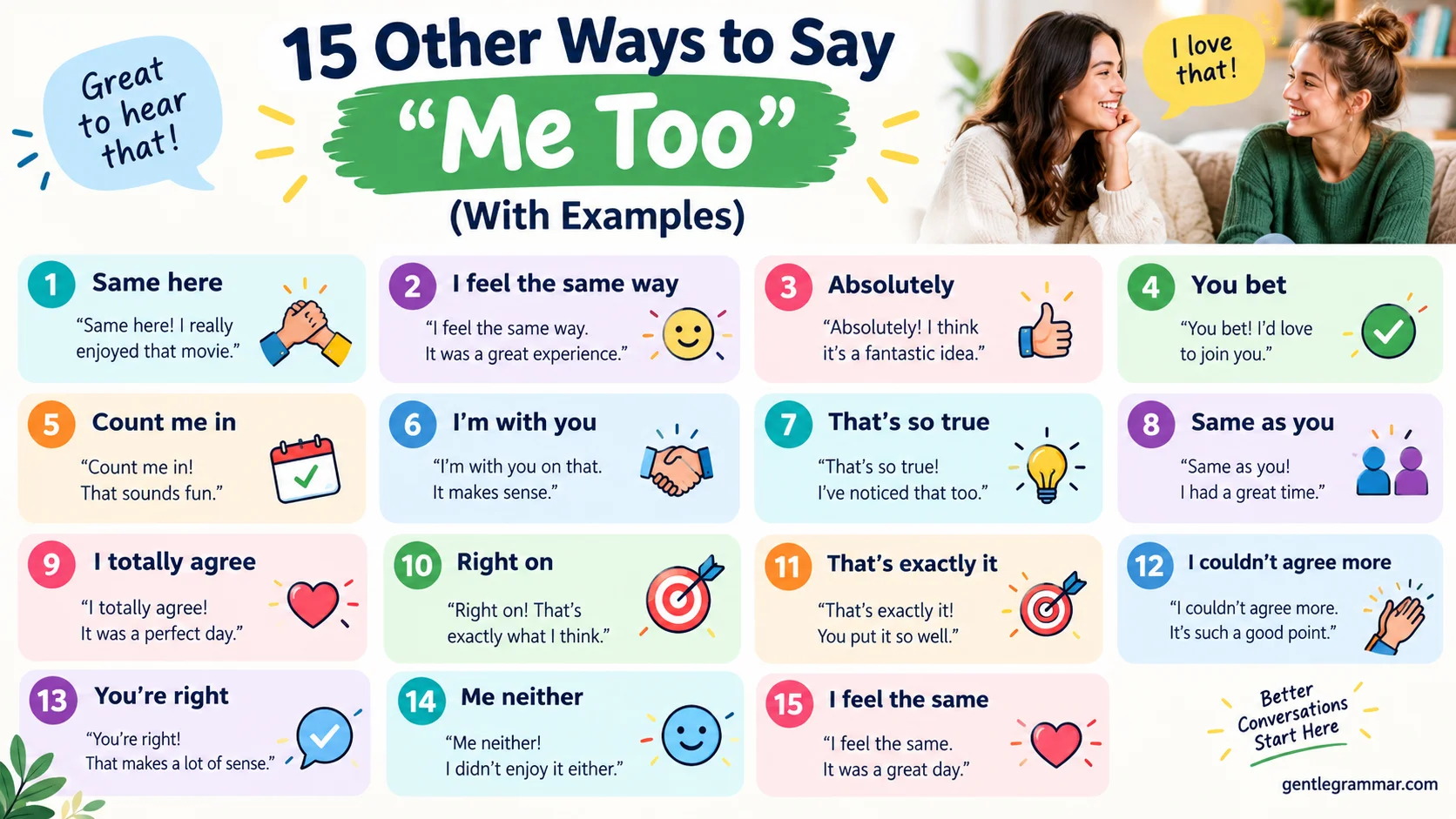
From my experience of learning grammar, I see how nuances of language make simple words carry subtle meanings, especially the phrase me too, which essentially shows agreement and shared experience; 15 Other Ways to Say “Me Too” (With Examples) explores these useful expressions clearly.
When we break down to me, it is spelled with one O and acts as a preposition that precedes a noun, giving information about position. Something can be given TO me, headed in my direction, with the assumption that I do indeed receive it. It doesn’t have to be a material object; advice and guidance can be given, while.
I feel the same. In this context, contextually and semantically, NLP patterns are related to shared experience and everyday communication. Just as English has many ways to say agreement, Spanish gives a person different ways to agree while talking. You can relate to someone’s feeling, order the same food as someone else, or use a list of 10 ways to make your meaning clear.
What Does “Me Too” Mean?
“Me too” is an everyday expression used to show that you share the same feeling, opinion, experience, preference, or situation as another person. For example, if someone says, “I love rainy evenings,” replying “Me too” means that you also love rainy evenings. It is a short way of saying “I feel the same way” or “I do too.”
The expression is generally casual and conversational. Its exact meaning depends on what came before it. If someone says, “I’m tired,” “Me too” means “I’m tired too.” If someone says, “I want to visit Japan,” “Me too” means “I also want to visit Japan.” In everyday English, lowercase “me too” is an ordinary agreement phrase. It should not be confused with #MeToo, the name associated with a social movement concerning sexual harassment and sexual violence.
Common Situations Where “Me Too” Is Used
People commonly use “me too” in everyday conversation when they want to agree quickly and naturally. It works well in conversations with friends, family members, classmates, partners, and other people with whom casual language is appropriate. It can also appear in texts, online conversations, comments, and social media discussions.
The phrase is especially useful when the other person’s statement describes a shared preference, feeling, experience, or desire. For example, someone might say, “I’m excited for the weekend,” and you can simply answer, “Me too.” In a professional or formal setting, however, a fuller expression such as “I feel the same way” or “I agree” may communicate your response more clearly.
Is It Professional or Polite to Say “Me Too”?
“Me too” is polite but generally informal. It is perfectly natural in friendly conversations, casual messages, and relaxed workplace conversations when the relationship allows for conversational language. It is short, friendly, and rarely sounds rude by itself.
In formal emails, reports, presentations, or professional discussions, a more specific expression may be preferable. For example, “I agree,” “I share that view,” or “I feel the same way” can sound more polished. The best choice depends on what you are agreeing with and how formal the situation is.
Advantages and Disadvantages of Saying “Me Too”
Advantages
The main advantage of “me too” is simplicity. It lets you express agreement immediately without repeating the other person’s entire statement. It also sounds friendly, natural, and conversational, which makes it useful in texting and everyday speech. Because it is short, it keeps a conversation moving smoothly.
Disadvantages
The main limitation is that “me too” can be vague. It may not tell the listener exactly what part of their statement you share. It can also sound repetitive if used frequently. In formal communication, a more specific response may better explain your position and demonstrate what you agree with.
Synonyms for “Me Too”
- Same here
- I feel the same way
- I do too
- So do I
- Likewise
- I agree
- I’m with you
- I feel that way too
- I share that feeling
- I think so too
- That goes for me too
- I’m in the same boat
- I can relate
- I have the same feeling
- I share your view
1. Same here
Meaning
“Same here” means that you are in the same situation or have the same feeling, preference, or experience as the person who just spoke.
Definition
Same here is a casual expression used to say “the same is true for me.”
Detailed Explanation
This is one of the most natural alternatives to “me too” in casual English. It often feels slightly more conversational because it emphasizes that your situation is the same as the other person’s. It works especially well when someone mentions how they feel or describes a current situation. It is not usually the best choice for formal writing.
Scenario Examples
Scenario: A friend says they are exhausted after a long day.
Example: “I’m completely exhausted today.” — “Same here.”
Scenario: A coworker casually mentions that they are ready for the weekend.
Example: “I’m really looking forward to Saturday.” — “Same here!”
Scenario: Two classmates discuss their preference for studying in the morning.
Example: “I concentrate better before lunch.” — “Same here.”
Best Use
Use “same here” in casual conversation, texting, friendly messages, and relaxed workplace conversations.
Tone
Tone: Casual, friendly, conversational. It feels natural and uncomplicated, making it particularly useful in spoken English.
2. I feel the same way
Meaning
“I feel the same way” tells someone that you share their emotion, opinion, or personal reaction.
Definition
I feel the same way means “my feelings or views are similar to yours.”
Detailed Explanation
This expression is more emotionally explicit than “me too.” It is particularly appropriate when another person has shared a feeling, concern, hope, or personal opinion. It can sound warmer and more thoughtful because it acknowledges the other person’s emotional perspective. It is also suitable for situations where a one-word agreement would feel too brief.
Scenario Examples
Scenario: A friend talks about missing someone who moved away.
Example: “I really miss having her around.” — “I feel the same way.”
Scenario: A colleague says the team needs more time to prepare.
Example: “I think we should take another day to review everything.” — “I feel the same way.”
Best Use
Use it in personal conversations, supportive messages, thoughtful discussions, and professional conversations involving opinions or feelings.
Tone
Tone: Warm, sincere, respectful. It shows that you have considered what the other person said rather than simply giving a quick response.
3. I do too
Meaning
“I do too” expresses that you also do something mentioned in the previous statement.
Definition
I do too means “I also do that” or “that is true for me as well.”
Detailed Explanation
This phrase is a natural grammatical response when the original statement contains a verb that can be echoed with “do.” For example, “I enjoy cooking” can be answered with “I do too.” It is concise while being slightly more structured than “me too.” Because it depends on the grammatical structure of the previous statement, it is not suitable for every situation.
Scenario Examples
Scenario: A friend says they enjoy reading before bed.
Example: “I read for a few minutes every night.” — “I do too.”
Scenario: Someone says they regularly walk to work.
Example: “I usually walk to the office.” — “I do too.”
Best Use
Use it in everyday conversation, casual discussions, and situations where the preceding statement naturally takes “do” as the matching verb.
Tone
Tone: Casual, natural, straightforward. It sounds comfortable in spoken English without being overly informal.
4. So do I
Meaning
“So do I” means that you also perform or experience the action described by another person.
Definition
So do I is an agreement structure meaning “I do the same thing too.”
Detailed Explanation
This is a common and grammatically polished way to agree with a statement such as “I enjoy hiking.” It has the same basic meaning as “I do too,” but the structure is slightly more formal or deliberate. The verb must match the statement being answered, so other forms such as “So am I” or “So can I” may be needed with different verbs. For that reason, it is useful to understand the grammar rather than treat it as a universal replacement.
Scenario Examples
Scenario: A friend says they often listen to music while working.
Example: “I listen to music when I work.” — “So do I.”
Scenario: A classmate says they enjoy learning languages.
Example: “I really enjoy learning new languages.” — “So do I.”
Best Use
Use it in conversation, classroom discussions, informal professional communication, and situations where you want grammatically clear agreement.
Tone
Tone: Natural, clear, slightly more polished than “me too.” It is still comfortable in everyday conversation.
5. Likewise
Meaning
“Likewise” means “the same applies to me” or “the same is true in return.”
Definition
Likewise is an adverb used to express that something just mentioned also applies to you or to another situation.
Detailed Explanation
“Likewise” can replace “me too” when you want a shorter and somewhat more polished expression of agreement. It is especially useful when responding to a statement about feelings, attitudes, or wishes. It can also be used in professional or polite conversations, although its exact meaning depends on context. Unlike “me too,” it can sometimes communicate reciprocity, such as responding to “It was nice meeting you” with “Likewise.”
Scenario Examples
Scenario: Someone says they enjoyed meeting you.
Example: “It was a pleasure speaking with you.” — “Likewise.”
Scenario: A colleague says they appreciate your help.
Example: “I really appreciate your support.” — “Likewise.”
Best Use
Use it in polite conversation, professional communication, greetings, and situations involving reciprocal feelings or sentiments.
Tone
Tone: Polite, concise, moderately formal. It can sound more polished than “me too” without becoming stiff.
6. I agree
Meaning
“I agree” directly communicates that you share someone’s opinion, judgment, or conclusion.
Definition
I agree means “I have the same opinion or believe your statement is correct.”
Detailed Explanation
This is a stronger and more specific alternative when “me too” would be too vague. It is most appropriate when someone has expressed an opinion, recommendation, or argument rather than simply describing a feeling or preference. “I agree” can work in both casual and professional settings. However, it does not always replace “me too” when the original statement describes an action or personal experience.
Scenario Examples
Scenario: Coworkers discuss a proposed change to a project.
Example: “We should review the figures before sending the report.” — “I agree.”
Scenario: A friend gives an opinion about a movie.
Example: “The ending felt rushed.” — “I agree.”
Best Use
Use it in workplace communication, discussions, meetings, academic conversations, debates, and everyday conversations involving opinions.
Tone
Tone: Direct, clear, respectful. It sounds more professional and specific than a simple “me too.”
7. I’m with you
Meaning
“I’m with you” means that you support someone’s position, feeling, idea, or point of view.
Definition
I’m with you is an informal expression meaning “I agree with you” or “I support what you are saying.”
Detailed Explanation
This expression can communicate more than simple agreement because it may suggest support or solidarity. It works particularly well when someone is expressing a preference, making a decision, or explaining a position. Depending on context, it can also mean that you literally understand or are following someone, so the surrounding conversation matters. It is generally more personal than “I agree.”
Scenario Examples
Scenario: A friend wants to leave a noisy restaurant.
Example: “This place is way too loud for me.” — “I’m with you. Let’s go somewhere quieter.”
Scenario: A colleague proposes simplifying a complicated process.
Example: “I think we should make this process easier for everyone.” — “I’m with you on that.”
Best Use
Use it in friendly conversations, team discussions, personal messages, and informal professional settings where supportive agreement is appropriate.
Tone
Tone: Supportive, friendly, confident. It suggests that you are on the same side of an idea or situation.
8. I feel that way too
Meaning
“I feel that way too” means that you share the same emotion, reaction, or personal feeling.
Definition
I feel that way too means “I have the same emotional response or feeling.”
Detailed Explanation
This phrase is especially useful when responding to someone’s emotional statement. It is more specific than “me too” because it clearly identifies the response as a feeling. It can sound empathetic without being overly emotional. Because it focuses on feelings rather than actions or factual agreement, it should not be used as a universal substitute for every use of “me too.”
Scenario Examples
Scenario: A friend says they are nervous about an upcoming move.
Example: “I’m excited, but I’m also a little nervous.” — “I feel that way too.”
Scenario: Someone discusses frustration about a difficult situation.
Example: “I wish we had received clearer instructions.” — “I feel that way too.”
Best Use
Use it in personal conversations, supportive messages, relationship discussions, and situations involving emotions or reactions.
Tone
Tone: Empathetic, warm, reassuring. It shows that you understand and share the person’s emotional response.
9. I share that feeling
Meaning
“I share that feeling” tells someone that you experience the same emotion or sentiment.
Definition
I share that feeling means “I have the same feeling or emotional response.”
Detailed Explanation
This expression is more deliberate and thoughtful than “me too.” It is useful when someone’s statement involves emotion, concern, hope, appreciation, or another personal sentiment. It does not naturally fit every factual statement because it specifically focuses on feelings. In professional settings, it can sound respectful when discussing shared concerns or reactions.
Scenario Examples
Scenario: A colleague expresses concern about a change at work.
Example: “I’m concerned about how quickly this is happening.” — “I share that feeling.”
Scenario: A friend talks about being excited about an upcoming event.
Example: “I’m so excited to finally see everyone again.” — “I share that feeling.”
Best Use
Use it in thoughtful conversations, supportive communication, professional discussions about concerns, and personal messages.
Tone
Tone: Sincere, thoughtful, moderately formal. It sounds more deliberate than everyday “me too.”
10. I think so too
Meaning
“I think so too” means that you share the same opinion or conclusion as another person.
Definition
I think so too means “I have the same opinion” or “I reach the same conclusion.”
Detailed Explanation
This expression is useful when someone makes an observation, prediction, or opinion and you want to say that you agree with their thinking. The wording is slightly softer than a firm “I agree,” which can make it useful when you share an opinion but do not want to sound overly certain. It is not normally used simply to say that you share an emotion or physical condition.
Scenario Examples
Scenario: A friend predicts that a restaurant will be busy.
Example: “I think it’ll be crowded tonight.” — “I think so too.”
Scenario: A student considers whether an answer is correct.
Example: “I think this is the right solution.” — “I think so too.”
Best Use
Use it in everyday discussions, classroom conversations, predictions, opinions, and informal decision-making.
Tone
Tone: Casual, agreeable, slightly tentative. It communicates agreement without sounding overly forceful.
11. That goes for me too
Meaning
“That goes for me too” means that what another person has just said also applies to you.
Definition
That goes for me too means “the same statement is true for me.”
Detailed Explanation
This expression is particularly useful when the other person’s statement applies to a situation, condition, preference, or group of people. It can sound more expressive than simply saying “me too.” It works best when there is a clear statement that can logically be extended to you. Because it is longer and more conversational, it is generally better suited to speech and informal writing.
Scenario Examples
Scenario: A friend says they need a quiet evening after a busy week.
Example: “After this week, I just need some peace and quiet.” — “That goes for me too.”
Scenario: A coworker says they want more time to prepare for a presentation.
Example: “I could really use another day to prepare.” — “That goes for me too.”
Best Use
Use it in casual conversations, workplace discussions, group situations, and personal messages.
Tone
Tone: Conversational, friendly, emphatic. It gives your agreement a little more emphasis than “me too.”
12. I’m in the same boat
Meaning
“I’m in the same boat” means that you are experiencing a similar difficult, unusual, or challenging situation.
Definition
I’m in the same boat is an idiom meaning “I am dealing with the same situation as you.”
Detailed Explanation
Unlike “me too,” this idiom is normally used for shared circumstances, especially problems, challenges, uncertainty, or inconvenience. It is not usually the best choice for simple preferences such as “I like chocolate.” The expression can create a sense of shared experience and solidarity, making it useful when someone needs reassurance that they are not alone.
Scenario Examples
Scenario: Two students are struggling with a difficult assignment.
Example: “I’m having trouble understanding this chapter.” — “I’m in the same boat.”
Scenario: Several coworkers are adjusting to a new software system.
Example: “I’m still trying to figure out the new system.” — “I’m in the same boat.”
Best Use
Use it in casual conversation, supportive messages, workplace discussions, and situations involving shared challenges.
Tone
Tone: Informal, empathetic, reassuring. The idiom creates a feeling of shared experience
13. I can relate
Meaning
“I can relate” means that you understand someone’s experience or feelings because something similar has happened to you.
Definition
I can relate means “I understand because I have had a similar experience.”
Detailed Explanation
This phrase is related to “me too,” but it usually emphasizes understanding and shared experience rather than simple agreement. You can use it when someone describes a problem, emotion, or personal experience that feels familiar. It does not necessarily mean you agree with their opinion. This makes it especially useful when responding with empathy.
Scenario Examples
Scenario: A friend talks about feeling nervous before a presentation.
Example: “I always get nervous before speaking in front of a crowd.” — “I can relate.”
Scenario: Someone discusses the difficulty of balancing work and personal responsibilities.
Example: “Some days, it feels impossible to keep up with everything.” — “I can relate.”
Best Use
Use it in personal conversations, online discussions, supportive messages, and casual situations involving shared experiences.
Tone
Tone: Empathetic, friendly, understanding. It focuses on connection rather than simple agreement.
14. I have the same feeling
Meaning
“I have the same feeling” communicates that you experience the same emotional response or impression as someone else.
Definition
I have the same feeling means “I feel similarly about this situation.”
Detailed Explanation
This wording is useful when the conversation centers on an emotion, instinct, concern, or impression. It is more explicit than “me too,” so the listener immediately understands that you are referring to a feeling. It can sometimes sound more deliberate or formal than natural everyday alternatives such as “same here.” Use it when clarity about the emotional response matters.
Scenario Examples
Scenario: A friend says something about a situation feels unusual.
Example: “Something about this plan doesn’t feel right.” — “I have the same feeling.”
Scenario: A colleague says they are optimistic about a new project.
Example: “I have a good feeling about this project.” — “I have the same feeling.”
Best Use
Use it in personal conversations, thoughtful discussions, workplace conversations, and situations involving emotions or impressions.
Tone
Tone: Thoughtful, clear, moderately formal. It makes the shared feeling explicit.
15. I share your view
Meaning
“I share your view” means that you have the same opinion or perspective as another person.
Definition
I share your view means “I hold the same opinion or perspective as you.”
Detailed Explanation
This is one of the more formal and professional alternatives to “me too.” It is best suited to opinions, positions, assessments, and viewpoints rather than simple emotions or physical experiences. The expression can be useful when you want to show agreement while maintaining a respectful and professional tone. It should not be used when you merely share an activity or preference.
Scenario Examples
Scenario: Two colleagues discuss a proposed business decision.
Example: “I believe we should focus on quality before expanding.” — “I share your view.”
Scenario: A student agrees with a classmate’s interpretation of a topic.
Example: “I think the author was emphasizing personal responsibility.” — “I share your view.”
Best Use
Use it in professional communication, academic discussions, formal conversations, meetings, and written correspondence involving opinions.
Tone
Tone: Professional, respectful, measured. It sounds more formal and precise than “me too.”
FAQs:
What is another way to say “Me Too”?
Natural alternatives include “Same here,” “I feel the same way,” “I do too,” “So do I,” and “Likewise.” The best choice depends on whether you are agreeing with a feeling, opinion, action, or situation.
What does “Me Too” mean?
“Me too” means that the same thing is true for you. It can communicate a shared feeling, preference, experience, action, or situation. For example, if someone says, “I love coffee,” “Me too” means that you also love coffee.
Is “Me Too” professional?
“Me too” is generally casual rather than formal. It can be perfectly acceptable in relaxed workplace conversations, but alternatives such as “I agree,” “I share your view,” or “I feel the same way” may be more appropriate in formal communication.
What is a more polite way to say “Me Too”?
“I feel the same way” is a warm and polite alternative when discussing feelings. “Likewise” can also work well, particularly when responding to a polite sentiment or professional statement.
Which alternative works best in formal communication?
There is no single alternative for every situation. “I agree” works well for opinions, while “I share your view” is more formal and suited to professional or academic discussions. If the subject is an emotion, “I feel the same way” can be more natural.
Conclusion:
Choosing an alternative to “me too” is less about finding one perfect synonym and more about matching your wording to the situation. “Same here” feels relaxed and conversational, while “I feel the same way” gives emotional agreement more warmth. Expressions such as “I agree” and “I share your view” are better suited to opinions and professional discussions, while “I can relate” emphasizes shared experience rather than simple agreement.
The key is to consider meaning, tone, formality, and context before choosing your words. “Me too” remains a perfectly natural expression for everyday conversation, but having several alternatives gives you more flexibility and helps your communication sound more precise and personal.
