
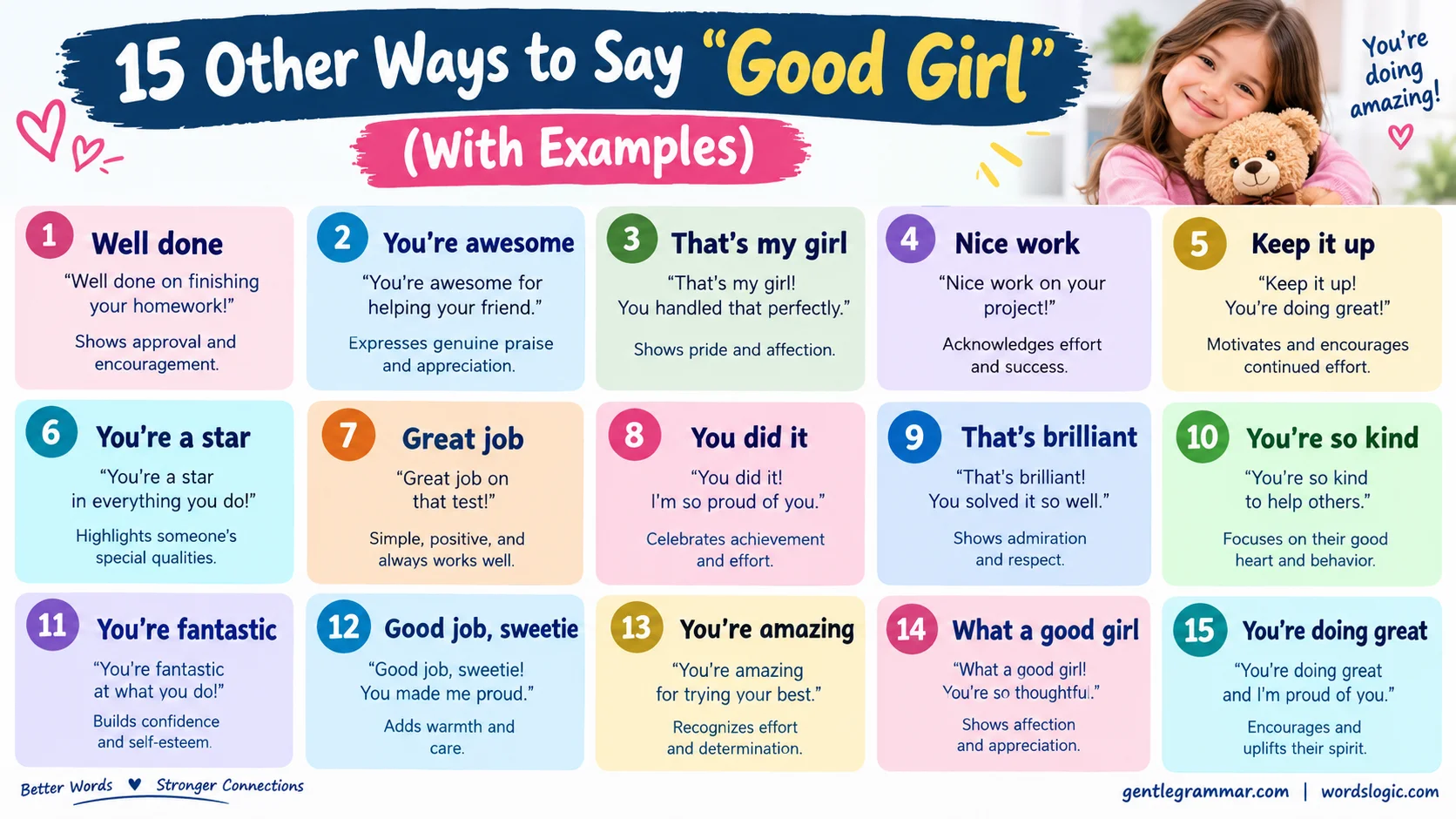
Looking for 15 Other Ways to Say “Good Girl” (With Examples)? The best phrase depends on the speaker, audience, relationship, and situation, so choose words that express praise, encouragement, affection, and genuine appreciation naturally.
In my experience, praising a child for behaving well, recognizing good behavior, or celebrating an achievement calls for warm, encouraging words. A friend, colleague, partner, or family member may appreciate a thoughtful compliment, positive feedback, reassurance, or supportive response. When praising a pet, simple pet praise and familiar commands can work well. However, the meaning of “good girl” changes with tone, context, and speaker intention.
Although it can sound affectionate and kind, an adult woman may find it childish, patronizing, infantilizing, condescending, or overly personal. Respectful communication, appropriate wording, and considerate language help people feel valued without crossing personal boundaries.
What Does “Good Girl” Mean?
“Good girl” is an expression used to praise, encourage, or show approval of a female child, a woman in certain personal relationships, or a female animal, especially a pet. It usually communicates that someone has done something well, behaved appropriately, followed instructions, or made a positive effort. When speaking to a child, the phrase may express affection and encouragement. When praising a dog, it commonly serves as a friendly reward for good behavior. Among adults, its meaning depends heavily on the relationship and tone; it may sound affectionate, playful, flirtatious, or patronizing. Therefore, understanding the context and relationship is important before using it.
Common Situations Where “Good Girl” Is Used
People use this expression in several everyday situations. Parents and caregivers may say it to encourage a child after a positive action, while pet owners often use it to reward a dog for following a command. In close personal relationships, the phrase can communicate affection, approval, or playful encouragement, depending on the people involved.
However, the wording does not suit every setting. In a classroom, workplace, or professional conversation, a more specific compliment such as praising someone’s effort, achievement, or decision is often more respectful. In text messages and social media posts, expressions such as “You did amazing” or “I’m proud of you” can convey encouragement without sounding childish or overly familiar. Choosing an appropriate alternative helps make the message clearer and more considerate.
Is It Professional or Polite to Say “Good Girl”?
The expression is generally casual and personal rather than professional. It can sound warm and encouraging when a parent praises a young child or an owner rewards a pet. Among consenting adults who share that style of communication, it may also be affectionate or playful. However, using it toward an adult colleague, employee, student, or acquaintance can sound condescending because it may suggest that the speaker has authority over the other person.
In professional communication, it is usually better to praise the actual achievement. For example, “Excellent work,” “You handled that well,” or “I appreciate your effort” recognizes someone’s contribution without making assumptions about your relationship. When speaking to a child, a pet, or someone close to you, the original expression may be perfectly natural. The most respectful choice depends on the recipient’s preferences and the situation.
Advantages and Disadvantages of Saying “Good Girl”
Advantages
One advantage of this phrase is its simplicity. It is short, easy to understand, and can communicate approval immediately. When used with a young child or a pet, a warm tone and positive body language can make the praise feel reassuring and encouraging. In a close relationship, it may also express affection or familiarity when both people enjoy the wording. Its meaning is often clear in situations where the speaker and listener already understand one another.
Disadvantages
The main limitation is that tone and context strongly affect its meaning. An adult may interpret the phrase as patronizing, overly familiar, or uncomfortable, especially in a workplace or unequal relationship. It can also be vague because it does not explain what the person did well. More specific praise often feels more meaningful because it recognizes effort, kindness, progress, or achievement. Choosing a different expression can make your compliment more respectful and better suited to the person receiving it.
Synonyms for “Good Girl”
- Well done!
- Great job!
- You did amazing!
- I’m proud of you.
- You’re doing so well.
- That’s my girl!
- You’re a star!
- You did a wonderful job.
- I’m impressed!
- You’re such a good helper.
- Keep up the great work!
- You should be proud of yourself.
- You handled that beautifully.
- Good job, sweetheart!
- What a clever girl!
1. Well Done!
Meaning
“Well done!” expresses approval when someone completes a task successfully or achieves something worthwhile. It focuses on the result or accomplishment rather than the person’s behavior in general.
Definition
A short expression of praise used to recognize successful effort or achievement.
Detailed Explanation
“Well done!” is a versatile alternative that works for children and adults alike. Unlike “good girl,” it does not suggest a difference in authority between the speaker and the person receiving praise. It is suitable when someone has completed a task, learned something new, or overcome a challenge. Because it emphasizes an accomplishment, it can feel more respectful and specific to the situation.
Scenario Examples
Scenario: A child finishes a difficult puzzle.
Example: “Well done! You figured out where all the pieces belong.”
Scenario: A colleague completes an important presentation.
Example: “Well done on the presentation. You explained everything clearly.”
Scenario: A dog successfully follows a training command.
Example: “Well done! You came when I called you.”
Best Use
Use this expression when recognizing achievement, progress, or successful effort. It works in everyday conversations, classrooms, workplaces, and pet-training situations.
Tone
Tone: Encouraging, respectful, and positive.
Its emphasis on accomplishment makes it appropriate for many ages and relationships.
2. Great Job!
Meaning
“Great job!” communicates enthusiasm and approval when someone does something successfully. It is a friendly way to recognize a task completed well.
Definition
An informal expression of praise for good performance or effort.
Detailed Explanation
“Great job!” sounds energetic and conversational, making it useful when you want your praise to feel immediate and genuine. Compared with “good girl,” it focuses on what the person accomplished rather than labeling the person. It is especially useful when a child learns a skill, a friend finishes a project, or someone makes progress toward a goal. Adding a detail about the achievement can make the compliment even more meaningful.
Scenario Examples
Scenario: A student solves a challenging math problem.
Example: “Great job! Your method was correct.”
Scenario: A friend finishes a creative project.
Example: “Great job on the artwork. I love how you used the colors.”
Scenario: A dog learns to sit on command.
Example: “Great job! You sat exactly when I asked.”
Best Use
Use it for casual praise, encouragement, school activities, teamwork, and pet training. It also works well in text messages.
Tone
Tone: Friendly, enthusiastic, and informal.
The expression feels upbeat without being overly personal.
3. You Did Amazing!
Meaning
“You did amazing!” expresses strong admiration for someone’s performance, effort, or achievement. It is often used when you want to make praise feel enthusiastic and personal.
Definition
An informal compliment that recognizes an impressive performance or accomplishment.
Detailed Explanation
This expression places emphasis on how well someone performed. It can feel more energetic than a simple “good girl,” especially after a challenging or memorable achievement. In standard formal writing, “You did an amazing job” is more conventional because “amazing” directly describes the noun “job.” However, “You did amazing!” is common in casual conversation. Choose it when enthusiasm matters more than formality.
Scenario Examples
Scenario: A friend performs on stage for the first time.
Example: “You did amazing tonight! Your confidence really showed.”
Scenario: A child participates in a school competition.
Example: “You did amazing at the competition. I loved seeing you try your best.”
Scenario: A partner completes a difficult personal goal.
Example: “You did amazing getting through that challenge.”
Best Use
Use it in casual conversations, supportive messages, celebrations, and personal encouragement. For professional writing, consider “You performed exceptionally well.”
Tone
Tone: Enthusiastic, supportive, and celebratory.
It conveys excitement and admiration rather than simple approval.
4. I’m Proud of You.
Meaning
“I’m proud of you” communicates personal pride in someone’s actions, growth, choices, or achievements. It expresses an emotional connection rather than merely judging whether someone did something correctly.
Definition
A statement that expresses admiration and personal pride in another person’s efforts or accomplishments.
Detailed Explanation
This expression is especially meaningful when someone has worked hard, faced a challenge, or made a positive change. Unlike “good girl,” it tells the recipient how you feel about what they have done. It can recognize effort even when the result is not perfect. Because it carries emotional warmth, it often suits family members, close friends, partners, and mentors better than distant professional relationships.
Scenario Examples
Scenario: A child tries something that initially frightened them.
Example: “I’m proud of you for giving it a try, even though you were nervous.”
Scenario: A friend makes progress toward a personal goal.
Example: “I’m proud of you for staying committed to something that matters to you.”
Scenario: A partner handles a difficult conversation thoughtfully.
Example: “I’m proud of you for speaking honestly and calmly.”
Best Use
Use it for emotional support, personal milestones, perseverance, and meaningful achievements. It is especially effective when the relationship is close.
Tone
Tone: Warm, affectionate, sincere, and reassuring.
The expression emphasizes connection and personal appreciation.
5. You’re Doing So Well.
Meaning
“You’re doing so well” recognizes ongoing progress, effort, or improvement. It encourages someone who is learning, practicing, or working through a challenge.
Definition
A supportive statement that acknowledges positive progress over time.
Detailed Explanation
This phrase is particularly helpful when the person has not finished the task yet. While “good girl” may sound like approval of a particular behavior, this alternative highlights continued effort and improvement. It reassures the recipient that progress matters, even when the outcome is still developing. Its gentle wording makes it useful for children, learners, friends, and people who need encouragement rather than evaluation.
Scenario Examples
Scenario: A child learns to read new words.
Example: “You’re doing so well with your reading. Keep practicing those sounds.”
Scenario: A friend is learning to cook.
Example: “You’re doing so well! That meal looks much better than your first attempt.”
Scenario: A student practices speaking a new language.
Example: “You’re doing so well with your pronunciation. I can understand you much more easily now.”
Best Use
Use it during learning, practice, personal development, and gradual improvement. It is especially suitable when the person needs reassurance.
Tone
Tone: Gentle, encouraging, and supportive.
It focuses on growth instead of demanding perfection.
6. That’s My Girl!
Meaning
“That’s my girl!” expresses affection, pride, or enthusiastic approval toward a girl or woman with whom the speaker shares an appropriate personal connection. It can also be used to praise a female pet.
Definition
An affectionate expression used to celebrate someone’s success or a positive action.
Detailed Explanation
This phrase is more personal than “well done” because the word “my” signals familiarity or a close bond. Parents may use it when celebrating a child’s achievement, while friends or partners may use it playfully if the wording feels comfortable to both. In some contexts, however, it can sound possessive or overly familiar. It is not a neutral substitute for professional praise, so the relationship matters.
Scenario Examples
Scenario: A parent watches a child complete a challenging activity.
Example: “That’s my girl! You kept trying until you got it right.”
Scenario: A close friend finally speaks up for herself.
Example: “That’s my girl! I’m glad you stood up for what you believe.”
Scenario: A dog responds correctly during training.
Example: “That’s my girl! You brought the ball right back.”
Best Use
Use it in close personal relationships, family settings, playful encouragement, or pet training when the recipient is comfortable with the phrase.
Tone
Tone: Affectionate, familiar, proud, and sometimes playful.
Its personal quality makes it less suitable for formal or distant relationships.
7. You’re a Star!
Meaning
“You’re a star!” is a cheerful compliment that recognizes someone as especially helpful, impressive, or wonderful in a particular situation.
Definition
An informal expression of praise for someone who has done something particularly well or helpfully.
Detailed Explanation
Calling someone a star communicates admiration in a lighthearted way. Unlike “good girl,” the expression does not focus on obedience or good behavior; instead, it celebrates the person’s contribution or achievement. It is especially natural when someone goes out of their way to help or does something that makes a positive difference. In some English-speaking regions, particularly British English, it is a familiar and friendly compliment.
Scenario Examples
Scenario: A coworker helps finish a task before a deadline.
Example: “You’re a star for helping me get these files organized.”
Scenario: A child helps prepare the table for dinner.
Example: “You’re a star! Thanks for putting all the plates out.”
Scenario: A friend helps someone move house.
Example: “You’re an absolute star for giving up your afternoon to help me.”
Best Use
Use it for friendly appreciation, helpful actions, everyday accomplishments, and informal workplace communication.
Tone
Tone: Cheerful, appreciative, and warm.
It makes praise feel light and generous rather than authoritative.
8. You Did a Wonderful Job.
Meaning
“You did a wonderful job” praises the quality of someone’s work or performance. It communicates that the result was especially good or that the person handled the task with care.
Definition
A compliment recognizing high-quality work or an excellent performance.
Detailed Explanation
This phrase sounds more complete and polished than “great job.” It works well when you want to recognize the quality of a finished task rather than simply offer quick encouragement. It can be used with children, friends, colleagues, students, or service providers, depending on the situation. Unlike “good girl,” it directs attention toward a specific result and avoids labeling the recipient’s character.
Scenario Examples
Scenario: A student prepares a thoughtful class project.
Example: “You did a wonderful job explaining the topic and organizing your research.”
Scenario: A friend prepares a meal for guests.
Example: “You did a wonderful job with dinner. Everything tasted delicious.”
Scenario: An employee organizes a successful event.
Example: “You did a wonderful job coordinating the event and keeping everything on schedule.”
Best Use
Use it for finished work, projects, presentations, creative tasks, and thoughtful efforts. It suits both personal and many professional situations.
Tone
Tone: Warm, appreciative, and polished.
Its complete wording makes it suitable when a little more substance is appropriate.
9. I’m Impressed!
Meaning
“I’m impressed!” communicates genuine admiration when someone does something skillfully, unexpectedly well, or with noticeable effort.
Definition
A statement expressing admiration for someone’s ability, achievement, or performance.
Detailed Explanation
This phrase emphasizes the speaker’s reaction to what the other person has accomplished. It can be especially effective when someone exceeds expectations or demonstrates a skill that deserves recognition. Unlike “good girl,” it does not imply that the speaker is rewarding the person for obedience. However, the expression can sound surprised or evaluative if delivered in the wrong tone, so sincere wording and delivery are important.
Scenario Examples
Scenario: A friend repairs something without professional help.
Example: “I’m impressed! I didn’t realize you knew how to fix a bicycle.”
Scenario: A student gives a confident presentation.
Example: “I’m impressed by how clearly you explained such a complicated subject.”
Scenario: A colleague finds a practical solution to a problem.
Example: “I’m impressed with the solution you came up with. It saves everyone time.”
Best Use
Use it when someone shows skill, initiative, creativity, or unexpected improvement. It works well in conversations, feedback, and informal professional settings.
Tone
Tone: Admiring, sincere, and slightly evaluative.
It communicates that the person’s actions have made a strong positive impression.
10. You’re Such a Good Helper.
Meaning
“You’re such a good helper” praises someone for assisting others, cooperating, or contributing to a shared task. It is especially natural when speaking to young children.
Definition
A friendly compliment that recognizes helpfulness and cooperation.
Detailed Explanation
This expression is more specific than “good girl” because it identifies the behavior being appreciated. It can encourage children to participate in everyday responsibilities, such as tidying up or helping prepare a meal. It also allows the speaker to acknowledge kindness rather than focusing only on following instructions. When speaking to adults, a more natural option is usually “You’ve been a great help” or “Thanks for being so helpful.”
Scenario Examples
Scenario: A child helps put toys away.
Example: “You’re such a good helper! We got the playroom tidy together.”
Scenario: A young child helps prepare a snack.
Example: “You’re such a good helper for bringing the napkins to the table.”
Scenario: A child assists a classmate with supplies.
Example: “You were a thoughtful helper when you shared your pencils.”
Best Use
Use it with young children in family, childcare, or classroom settings. For adults, choose wording that recognizes their contribution without sounding childish.
Tone
Tone: Gentle, encouraging, and affectionate.
It reinforces a specific helpful action instead of offering general approval.
11. Keep Up the Great Work!
Meaning
“Keep up the great work!” encourages someone to continue performing well or maintaining positive progress.
Definition
An encouraging expression that recognizes current success and urges someone to continue making an effort.
Detailed Explanation
This phrase looks toward future effort rather than focusing only on what has already happened. It is useful when someone has developed a good habit, maintained a high standard, or made steady progress. Compared with “good girl,” it is less personal and more focused on continued performance. Because it can sound like feedback from a supervisor or teacher, it is particularly suitable in educational and professional contexts.
Scenario Examples
Scenario: A student consistently completes assignments carefully.
Example: “Keep up the great work! Your assignments have been clear and well organized.”
Scenario: A teammate makes steady progress on a project.
Example: “Keep up the great work. We’re making excellent progress on the launch.”
Scenario: A child practices a musical instrument regularly.
Example: “Keep up the great work with your piano practice. Your timing is improving.”
Best Use
Use it for ongoing projects, learning, workplace feedback, training, and long-term goals.
Tone
Tone: Motivational, positive, and forward-looking.
It combines recognition of current effort with encouragement to continue.
12. You Should Be Proud of Yourself.
Meaning
“You should be proud of yourself” encourages someone to recognize their own achievement, effort, or personal growth.
Definition
A supportive statement that invites someone to feel personal pride in what they have accomplished.
Detailed Explanation
This phrase shifts the focus from the speaker’s approval to the recipient’s own sense of achievement. It can be particularly meaningful when someone has overcome a difficult situation or reached a goal through persistence. Unlike “good girl,” it does not position the speaker as the person who decides whether the recipient deserves praise. Use it sincerely, however, because “should” may feel pressuring if the person is disappointed or not ready to celebrate.
Scenario Examples
Scenario: A friend completes a demanding course.
Example: “You should be proud of yourself for finishing the course while working full-time.”
Scenario: A child finally learns to swim independently.
Example: “You should be proud of yourself. You practiced patiently and learned something new.”
Scenario: A person takes a positive step after a difficult period.
Example: “You should be proud of yourself for facing that conversation honestly.”
Best Use
Use it for personal growth, difficult achievements, milestones, and encouraging independence.
Tone
Tone: Reassuring, empowering, and supportive.
It helps the recipient recognize their own progress rather than depend entirely on external approval.
13. You Handled That Beautifully.
Meaning
“You handled that beautifully” praises the way someone managed a situation, especially when it required patience, tact, kindness, or good judgment.
Definition
A compliment recognizing skillful and thoughtful handling of a situation.
Detailed Explanation
This expression is more specific than general praise because it evaluates how a person responded to a particular circumstance. It is especially suitable when someone manages conflict, gives difficult feedback, or supports another person with sensitivity. The word “beautifully” adds warmth and admiration without making the compliment overly emotional. Unlike “good girl,” the phrase recognizes maturity and judgment rather than compliance.
Scenario Examples
Scenario: A friend responds calmly to an uncomfortable question.
Example: “You handled that beautifully. You were honest without embarrassing anyone.”
Scenario: A teacher helps resolve a disagreement between students.
Example: “You handled that situation beautifully by listening to both sides.”
Scenario: A colleague delivers difficult news with care.
Example: “You handled that conversation beautifully. Your explanation was clear and considerate.”
Best Use
Use it for sensitive conversations, conflict resolution, leadership, and situations requiring emotional intelligence.
Tone
Tone: Thoughtful, admiring, and respectful.
It praises judgment and the manner in which a challenge was handled.
14. Good Job, Sweetheart!
Meaning
“Good job, sweetheart!” combines praise for an accomplishment with an affectionate term of endearment. It communicates both approval and warmth.
Definition
An affectionate expression used to recognize a successful action while showing fondness.
Detailed Explanation
The words “good job” recognize an achievement, while “sweetheart” adds a personal and caring tone. This combination may sound natural when a parent praises a child or when close partners use affectionate language they both enjoy. However, terms of endearment can feel overly familiar when used with strangers, colleagues, or adults who do not welcome them. In those settings, “Excellent work” or “You did a great job” is generally a safer choice.
Scenario Examples
Scenario: A parent praises a child after a school performance.
Example: “Good job, sweetheart! You remembered all your lines.”
Scenario: A partner finishes a difficult household task.
Example: “Good job, sweetheart. I know that took a lot of effort.”
Scenario: A child learns to tie their shoes.
Example: “Good job, sweetheart! You managed to tie them all by yourself.”
Best Use
Use it in family conversations and close relationships where affectionate language is welcome. Avoid it in professional settings unless the relationship clearly supports that level of familiarity.
Tone
Tone: Affectionate, caring, and encouraging.
The endearment makes the praise more personal than a neutral compliment.
15. What a Clever Girl!
Meaning
“What a clever girl!” praises a girl or woman for showing intelligence, ingenuity, or a quick understanding of something. It is also commonly used to praise a female pet for solving a small problem or learning a behavior.
Definition
An expression of admiration for clever thinking, quick learning, or a smart action.
Detailed Explanation
This expression is most appropriate when someone has demonstrated a clever idea or figured something out independently. Unlike “good girl,” it identifies a particular quality—cleverness—rather than offering general approval. It can sound playful and affectionate when used with a child or pet. When directed toward an adult woman, however, the wording may sound patronizing depending on the relationship, so “That was clever” is often more neutral.
Scenario Examples
Scenario: A child finds an inventive way to organize toys.
Example: “What a clever girl! You found a way to fit everything into one box.”
Scenario: A dog discovers how to open a puzzle toy.
Example: “What a clever girl! You worked out how to get the treat.”
Scenario: A young learner solves a tricky riddle.
Example: “What a clever girl! You spotted the clue that everyone else missed.”
Best Use
Use it for children, playful praise, clever solutions, and pet training. When praising an adult in a formal setting, a neutral expression such as “That was a clever solution” may sound more respectful.
Tone
Tone: Playful, admiring, and affectionate.
It celebrates intelligence and ingenuity rather than general good behavior.
FAQs:
What is another way to say “good girl”?
Useful alternatives include “Well done!”, “Great job!”, “I’m proud of you,” and “You’re doing so well.” Choose an expression that matches the situation. For example, “I’m proud of you” conveys emotional warmth, while “Well done!” recognizes a successful achievement.
What does “good girl” mean?
“Good girl” is a phrase used to praise or encourage a female child, woman in certain personal contexts, or female pet. It can communicate approval, affection, or satisfaction with someone’s behavior. Its meaning depends on the relationship, tone, and circumstances.
Is “good girl” professional?
Generally, no—not in ordinary workplace communication. It can sound patronizing when directed toward an adult colleague or employee. Expressions such as “Excellent work,” “You handled that well,” and “I appreciate your contribution” are usually more appropriate professionally.
What is a more polite way to say “good girl”?
A respectful alternative is “You did a wonderful job.” Other options include “Well done,” “I’m impressed,” and “You should be proud of yourself.” When speaking to an adult, praise the person’s actions or accomplishments rather than using language that may sound childish.
Which alternative works best in formal communication?
“You did an excellent job” or “I appreciate the quality of your work” works well in many formal situations. These expressions recognize achievement without suggesting an overly personal relationship. For a professional email, choose wording that specifically describes the person’s contribution.
Conclusion:
Choosing a thoughtful alternative to “good girl” helps you communicate praise in a way that feels natural, sincere, and appropriate. While the original phrase can be affectionate when speaking to a child or pet, it may sound overly familiar or patronizing when used with an adult in a professional setting. Expressions such as “Well done!” and “Great job!” recognize achievements, while “I’m proud of you” communicates deeper emotional support.
For situations that require more specific recognition, phrases such as “You handled that beautifully” or “I’m impressed” can make your appreciation clearer. Consider the person’s age, your relationship, and the reason for offering praise before choosing your words. The most meaningful compliment is one that makes the recipient feel genuinely recognized and respected.
