
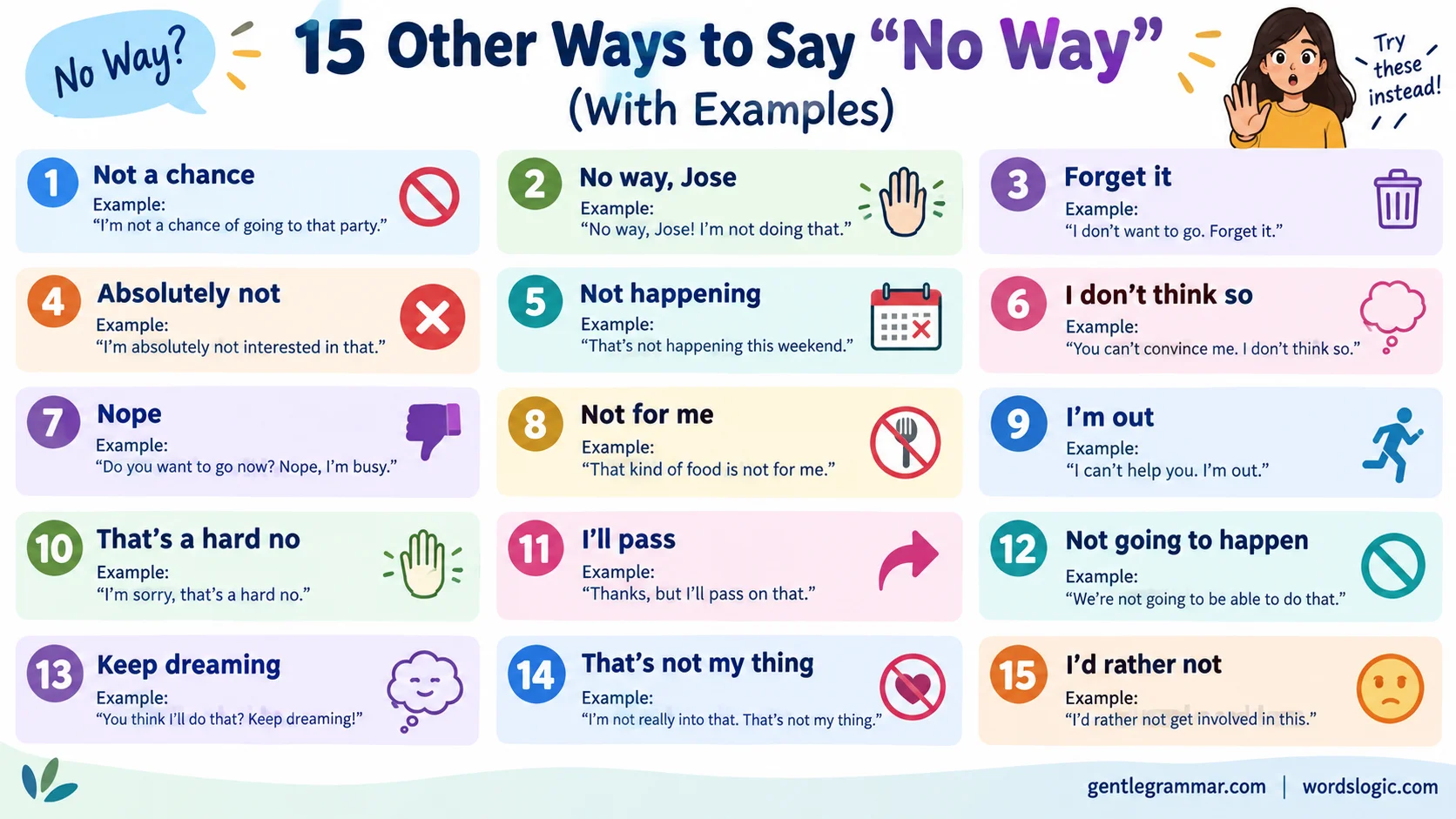
Knowing how to refuse politely or express surprise can improve everyday communication. 15 Other Ways to Say “No Way” (With Examples) helps you choose natural phrases for different situations.
The right wording depends on your tone, audience, and purpose. When declining an idea, joking with friends, or reacting to surprising news, you can use casual expressions, funny responses, or softer phrases. In professional emails and formal settings, respectful language and a professional tone help you avoid sounding rude. Small changes can transform a negative response into a clear, friendly, and considerate message.
Choosing appropriate expressions also strengthens communication skills in casual conversations and professional settings. Polite refusal, direct refusal, disagreement, and disbelief each require a suitable response style. Phrases such as “I don’t think so,” “You’ve got to be kidding,” and “I’m afraid not” offer different ways to communicate clearly. By avoiding repetitive wording and using natural alternatives, you can make your replies more expressive, thoughtful, and meaningful.
What Does “No Way” Mean?
“No way” is an informal English expression with several common meanings. First, it can express surprise or disbelief when someone hears unexpected news. For example, “No way! You got the job?” shows excitement and amazement. Second, it can communicate a strong refusal, as in “No way am I lending him my car.” Third, it can express that something is impossible or extremely unlikely, such as “There’s no way we can finish this project by noon.” The intended meaning depends on the context, tone of voice, and surrounding words.
Common Situations Where “No Way” Is Used
People commonly use “No way” in casual conversations, text messages, social media comments, and personal discussions. Friends might use it to react to surprising news, celebrate an unexpected achievement, or express disbelief about an unusual story. In relationships, it can communicate excitement or disagreement, although the tone matters.
The expression also appears when someone refuses an invitation, rejects an idea, or believes a task is impossible. In workplace and school settings, however, a more specific response may be clearer. For example, “I don’t think that’s possible” explains a practical limitation, while “I can’t agree to that” communicates disagreement without sounding unnecessarily confrontational.
Choosing an alternative helps you express surprise, refusal, impossibility, or disagreement more precisely.
Is It Professional or Polite to Say “No Way”?
“No way” is generally casual and informal, but it is not automatically rude. Among colleagues who know each other well, saying “No way! Congratulations!” can sound friendly and enthusiastic. However, responding “No way” to a manager’s request or a customer’s suggestion may sound dismissive, particularly if your tone is abrupt.
For professional communication, choose wording that explains your reaction or decision. “I’m afraid that’s not possible” is a polite way to communicate a limitation, while “I don’t believe that’s correct” expresses disagreement. If you are reacting positively to unexpected news, “That’s incredible!” sounds enthusiastic without being overly casual. The goal is to match your wording to the situation, rather than avoid informal expressions altogether.
Advantages and Disadvantages of Saying “No Way”
Advantages
“No way” is short, memorable, and easy to understand in everyday English. It can communicate a strong emotional reaction without requiring a long explanation. Depending on the delivery, it may convey excitement, disbelief, determination, or refusal. Its flexibility makes it especially useful in informal conversations and text messages.
Disadvantages
Because the expression has several meanings, listeners may misunderstand the intended message. A surprised “No way!” sounds very different from a firm “No way!” used to reject a request. It can also sound too blunt for formal situations and may fail to explain why something is impossible or unacceptable. Using a more specific phrase helps communicate your intention with greater clarity.
Synonyms for “No Way”
- You’re kidding!
- Are you serious?
- I can’t believe it!
- That’s unbelievable!
- You’ve got to be kidding me!
- Absolutely not.
- Not a chance.
- There’s no way.
- I don’t think so.
- Out of the question.
- That’s impossible.
- I highly doubt it.
- No chance whatsoever.
- That’s incredible!
- I refuse to believe it!
1. You’re kidding!
Meaning
“You’re kidding!” expresses surprise or disbelief when someone shares unexpected information. It usually suggests that the news sounds so surprising that you initially find it difficult to believe.
Definition
An informal expression used to ask whether someone is joking or to react to surprising news.
Detailed Explanation
This expression is especially natural when reacting to friends, relatives, or familiar colleagues. It often communicates playful disbelief rather than a serious accusation that someone is lying. Depending on your tone, it can express excitement, amazement, or mild shock. Unlike “No way,” it directly addresses the person sharing the information, making the reaction feel conversational and personal.
Scenario Examples
Scenario: Your friend tells you that they won concert tickets.
Example: “You’re kidding! I thought they were sold out!”
Scenario: A coworker shares unexpected good news.
Example: “You’re kidding! You got promoted already?”
Scenario: Your sibling tells you about an unusual event.
Example: “You’re kidding! That actually happened?”
Best Use
Use this expression in casual conversations, friendly messages, and informal workplace discussions. It works best when the news is surprising and you want to encourage the other person to share more.
Tone
Tone: Casual, playful, surprised.
It sounds friendly when delivered warmly, but it may sound skeptical if said sharply.
2. Are you serious?
Meaning
“Are you serious?” expresses surprise, disbelief, or a desire to confirm whether something is true. It can also communicate concern or frustration, depending on the circumstances.
Definition
A question asking whether a person genuinely means what they have said.
Detailed Explanation
This expression is useful when you want confirmation instead of simply reacting emotionally. It can communicate excitement about good news or concern about an unexpected situation. Compared with “No way,” it more clearly invites the speaker to confirm the information. However, when delivered with irritation, it may sound confrontational, especially if the other person feels challenged or criticized.
Scenario Examples
Scenario: Your friend says they are moving abroad next month.
Example: “Are you serious? When did you decide that?”
Scenario: A classmate says the exam has been postponed.
Example: “Are you serious? I was studying all night!”
Scenario: Your partner shares an unexpected plan.
Example: “Are you serious? That’s a big decision.”
Best Use
Use it in everyday conversations, text messages, and discussions where clarification matters. In formal settings, a softer question such as “Is that confirmed?” may be more appropriate.
Tone
Tone: Curious, surprised, direct.
The expression sounds interested when spoken gently but may communicate frustration when delivered abruptly.
3. I can’t believe it!
Meaning
“I can’t believe it!” communicates strong surprise, amazement, or disbelief. It is particularly useful when something unexpected has happened and you need to express an emotional reaction.
Definition
An expression showing that something seems difficult to believe because it is surprising or extraordinary.
Detailed Explanation
This phrase focuses on the speaker’s reaction rather than questioning another person’s honesty. It can express happiness, shock, disappointment, or even sadness. Compared with “No way,” it often sounds more emotionally expressive and less like a direct refusal. The surrounding conversation determines whether the reaction is positive or negative, so adding a few words can make your meaning clearer.
Scenario Examples
Scenario: Your friend unexpectedly wins an award.
Example: “I can’t believe it! You’ve worked so hard for this.”
Scenario: You hear that an old school friend is visiting.
Example: “I can’t believe it! I haven’t seen her in years.”
Scenario: Someone tells you that an important event was canceled.
Example: “I can’t believe it. We made all those arrangements.”
Best Use
Use this expression in personal conversations, social media posts, and messages about unexpected events. It is especially effective when you want to show an emotional response.
Tone
Tone: Emotional, expressive, surprised.
Its emotional strength makes it suitable for both happy and disappointing news.
4. That’s unbelievable!
Meaning
“That’s unbelievable!” expresses amazement or disbelief about an event, statement, or situation. It suggests that something is extraordinary, unexpected, or difficult to accept as true.
Definition
A reaction to something that seems remarkably surprising or hard to believe.
Detailed Explanation
This expression focuses on the situation itself rather than directly questioning the speaker. It can be positive, as when someone accomplishes something extraordinary, or negative, as when something unfair occurs. Compared with “You’re kidding!”, it can sound slightly more emphatic and less playful. In professional settings, it may be appropriate when reacting positively, although negative situations often benefit from more precise wording.
Scenario Examples
Scenario: Your teammate finishes a challenging project ahead of schedule.
Example: “That’s unbelievable! We thought it would take another week.”
Scenario: A friend describes an unexpected travel experience.
Example: “That’s unbelievable! You saw the northern lights?”
Scenario: You learn that an event has been postponed for the third time.
Example: “That’s unbelievable. They should have informed everyone sooner.”
Best Use
Use it for remarkable achievements, unexpected news, unusual experiences, and strong emotional reactions. In formal communication, choose a more specific description when the situation involves a serious complaint.
Tone
Tone: Emphatic, amazed, expressive.
The phrase can sound admiring or critical depending on the circumstances.
5. You’ve got to be kidding me!
Meaning
“You’ve got to be kidding me!” expresses strong disbelief, frustration, or astonishment. It is often used when something seems ridiculous, unexpected, or particularly difficult to accept.
Definition
An informal expression used to react strongly to surprising or frustrating information.
Detailed Explanation
This phrase is more intense than “You’re kidding!” and can communicate irritation as well as surprise. It is common when someone hears bad news, encounters an unexpected problem, or discovers that something has gone wrong. It can also be playful among friends. Because it carries a stronger emotional charge, it may sound disrespectful if used toward a supervisor, customer, or someone discussing a sensitive issue.
Scenario Examples
Scenario: Your train is canceled just before an important appointment.
Example: “You’ve got to be kidding me! I’m already running late.”
Scenario: A friend reveals an unexpectedly expensive purchase.
Example: “You’ve got to be kidding me! That much for a coffee machine?”
Scenario: Your teammate announces another last-minute meeting.
Example: “You’ve got to be kidding me! We just finished one.”
Best Use
Use it in informal conversations with friends, relatives, or trusted colleagues. Avoid it when you need to remain calm, diplomatic, or professional.
Tone
Tone: Frustrated, emphatic, informal.
Its strength makes it expressive, but it can easily sound irritated.
6. Absolutely not.
Meaning
“Absolutely not” expresses a firm refusal or strong disagreement. Unlike expressions that mainly communicate surprise, this phrase makes it clear that the speaker will not agree to something.
Definition
A direct statement that completely rejects a request, suggestion, possibility, or proposal.
Detailed Explanation
This expression is appropriate when you need to establish a clear boundary or reject something decisively. It communicates more certainty than “I don’t think so” and leaves little room for misunderstanding. Although it is grammatically neutral and can be used in professional environments, its firmness may sound harsh without an explanation. Adding a brief reason can help preserve a respectful tone.
Scenario Examples
Scenario: Someone asks to borrow your car without permission.
Example: “Absolutely not. I need it for work tomorrow.”
Scenario: A friend suggests sharing a private password.
Example: “Absolutely not. I don’t share my account details.”
Scenario: A project team proposes ignoring an important safety requirement.
Example: “Absolutely not. We need to follow the approved procedure.”
Best Use
Use it when refusing requests, protecting boundaries, rejecting unsuitable proposals, or addressing important rules. In delicate professional conversations, follow the refusal with a clear explanation.
Tone
Tone: Firm, decisive, direct.
It communicates certainty and can sound respectful when delivered calmly.
7. Not a chance.
Meaning
“Not a chance” means that something will not happen or that you will not agree to a particular request. It can express strong refusal or confidence that a proposed outcome is impossible.
Definition
An informal expression indicating that there is no realistic possibility of something happening or being accepted.
Detailed Explanation
This phrase is direct and conversational, making it useful for expressing a definite refusal. It can also communicate confidence, as in a competition where someone believes they will not lose. Compared with “Absolutely not,” it usually sounds more casual and may carry a playful or challenging quality. In professional settings, a more explanatory phrase is often preferable because “Not a chance” can sound dismissive.
Scenario Examples
Scenario: A friend challenges you to wake up at 4 a.m. on your day off.
Example: “Not a chance. I’m sleeping in!”
Scenario: Your teammate asks whether you can finish an unrealistic amount of work tonight.
Example: “Not a chance unless we get extra help.”
Scenario: Someone suggests that your team will give up before the final round.
Example: “Not a chance. We’re going to keep trying.”
Best Use
Use it in casual discussions, friendly disagreements, playful challenges, and firm refusals. Add context when the listener needs to understand the practical reason behind your answer.
Tone
Tone: Confident, casual, assertive.
It can sound playful between friends or dismissive in a serious conversation.
8. There’s no way.
Meaning
“There’s no way” expresses that something seems impossible, highly unlikely, or unacceptable. Its precise meaning depends on whether the speaker is describing a situation or reacting to surprising information.
Definition
An expression used to indicate that something cannot reasonably happen or is extremely difficult to believe.
Detailed Explanation
This phrase is flexible because it can describe practical limitations as well as emotional disbelief. For example, it can mean that a task cannot be completed in the available time or that a surprising story seems unbelievable. Compared with “No way,” the full expression often makes a statement about the circumstances rather than simply reacting. When used to describe a limitation, explaining the reason makes the message more informative.
Scenario Examples
Scenario: Your group has only ten minutes to complete a long presentation.
Example: “There’s no way we can finish all the slides in ten minutes.”
Scenario: A friend tells you that someone completed a marathon without training.
Example: “There’s no way! How did they manage that?”
Scenario: A colleague suggests scheduling three major meetings at the same time.
Example: “There’s no way that schedule will work for everyone.”
Best Use
Use it in everyday conversations, planning discussions, and reactions to surprising claims. In professional communication, explain the constraint instead of relying on the expression alone.
Tone
Tone: Direct, skeptical, emphatic.
It is natural in casual speech but may sound overly negative without supporting details.
9. I don’t think so.
Meaning
“I don’t think so” communicates disagreement, doubt, or a belief that something is unlikely to happen. It is generally softer than a direct refusal.
Definition
A phrase used to express a negative opinion or indicate that something probably is not true or possible.
Detailed Explanation
This expression is useful when you want to disagree without sounding overly forceful. It can indicate uncertainty, but it can also communicate a clear negative answer, depending on context. Compared with “Absolutely not,” it leaves more room for discussion and sounds less confrontational. However, it may seem vague if the listener needs a definite decision, so a brief explanation can help clarify your position.
Scenario Examples
Scenario: A friend asks whether the store will still be open after midnight.
Example: “I don’t think so. It usually closes at ten.”
Scenario: A coworker suggests that a deadline can be moved without approval.
Example: “I don’t think so. We’ll need the manager’s confirmation.”
Scenario: Someone asks if you are available for an extra commitment.
Example: “I don’t think so, but let me check my calendar.”
Best Use
Use it in polite disagreements, workplace conversations, everyday decisions, and situations where you are not completely certain. When the answer must be final, use more definite wording.
Tone
Tone: Mild, cautious, diplomatic.
Its softer delivery makes it helpful when maintaining a cooperative conversation matters.
10. Out of the question.
Meaning
“Out of the question” means that something is unacceptable, impossible under the circumstances, or not open for consideration.
Definition
An expression indicating that a suggestion, action, or possibility will not be considered.
Detailed Explanation
This phrase is useful when a decision or boundary is firm and the proposed option cannot be accepted. It often sounds more serious than “Not a chance” because it emphasizes that an option is not available for discussion. It can be used at home, at school, or at work, particularly when rules, limits, or practical constraints matter. Because it is quite definite, a short explanation can prevent the response from sounding unnecessarily severe.
Scenario Examples
Scenario: Your child asks to stay out late on a school night.
Example: “Staying out until midnight is out of the question.”
Scenario: A project manager discusses skipping a required review.
Example: “Skipping the final quality check is out of the question.”
Scenario: A friend suggests spending money you have already set aside for rent.
Example: “Using the rent money for a holiday is out of the question.”
Best Use
Use it for firm boundaries, nonnegotiable rules, serious planning decisions, and unacceptable proposals. In sensitive situations, explain the reasons behind the decision.
Tone
Tone: Firm, serious, decisive.
It communicates a clear limit rather than simple surprise or disbelief.
11. That’s impossible.
Meaning
“That’s impossible” states that something cannot be done or cannot happen under the circumstances. It can refer to genuine limitations or express a strong belief that a claim is unrealistic.
Definition
A direct statement that an action, event, or outcome cannot occur or be achieved.
Detailed Explanation
This expression is useful when discussing practical obstacles, technical limitations, or tasks that cannot reasonably be completed. It is more literal than “No way” and often sounds less emotional. However, it can be too absolute when a problem is merely difficult rather than genuinely impossible. In workplace communication, explaining the specific limitation or offering an alternative makes the response more constructive.
Scenario Examples
Scenario: Your friend asks you to be in two cities at the same time.
Example: “That’s impossible. The flights alone take six hours.”
Scenario: A team is asked to deliver a complex project in one afternoon.
Example: “That’s impossible with our current staffing and resources.”
Scenario: Someone claims they can complete a long journey in five minutes.
Example: “That’s impossible unless you’ve found a shortcut through time!”
Best Use
Use it when discussing practical limitations, technical problems, unrealistic schedules, and claims that conflict with known facts. Consider “That seems unlikely” when you are not certain.
Tone
Tone: Matter-of-fact, direct, sometimes skeptical.
It sounds strongest when the facts clearly support the conclusion.
12. I highly doubt it.
Meaning
“I highly doubt it” expresses strong skepticism about whether something is true or likely to happen. It indicates that the speaker does not expect the suggested outcome.
Definition
A phrase communicating a strong belief that a claim or prediction is probably incorrect.
Detailed Explanation
This expression is particularly useful when you want to challenge a prediction or claim without stating that it is absolutely impossible. Unlike “Absolutely not,” it communicates doubt rather than a firm refusal. It can sound reasonable in discussions where evidence, expectations, or previous experience influence your judgment. However, the phrase may sound dismissive if you use it to respond to someone’s hopes without explaining your reasoning.
Scenario Examples
Scenario: A friend predicts that an unreliable delivery will arrive an hour early.
Example: “I highly doubt it. The tracking page still says tomorrow.”
Scenario: A colleague claims that the team can avoid a required approval step.
Example: “I highly doubt it. The policy requires sign-off.”
Scenario: Someone predicts that a notoriously difficult game will be easy.
Example: “I highly doubt it, but I’m willing to give it a try.”
Best Use
Use it in discussions about predictions, uncertain outcomes, claims, and expectations. Support your opinion with evidence when the topic is important.
Tone
Tone: Skeptical, measured, confident.
It communicates strong doubt without necessarily closing the conversation.
13. No chance whatsoever.
Meaning
“No chance whatsoever” expresses an extremely firm belief that something will not happen or that a request will not be accepted.
Definition
A strong expression indicating that there is absolutely no possibility of a particular outcome.
Detailed Explanation
The words “whatsoever” add emphasis, making this expression stronger than “No chance.” It can communicate certainty about a decision, a prediction, or a practical limitation. Because of its intensity, it may sound dramatic in ordinary conversation and overly blunt in professional correspondence. Use it when the situation genuinely calls for a forceful statement rather than when a softer response would keep communication productive.
Scenario Examples
Scenario: Your friends ask whether you will enter a competition you have no interest in joining.
Example: “No chance whatsoever. I’ll happily cheer from the audience.”
Scenario: A team member asks whether an unapproved feature can go live today.
Example: “No chance whatsoever without the required testing.”
Scenario: Someone asks if you will reveal a surprise party before the event.
Example: “No chance whatsoever! I’m keeping the secret.”
Best Use
Use it in strong refusals, emphatic predictions, and playful conversations where exaggeration is understood. Choose a more diplomatic expression for sensitive workplace discussions.
Tone
Tone: Emphatic, resolute, informal.
The added emphasis communicates certainty but can make the response sound intense.
14. That’s incredible!
Meaning
“That’s incredible!” expresses admiration, amazement, or excitement about something remarkable. Unlike many alternatives on this list, it usually communicates a positive reaction rather than refusal.
Definition
An enthusiastic expression used to describe something extraordinary, impressive, or difficult to imagine.
Detailed Explanation
This phrase works particularly well when reacting to achievements, exciting news, and unusual experiences. Although “incredible” can sometimes mean hard to believe, everyday conversation often uses it as a compliment. Compared with “No way,” it directs attention toward what is impressive rather than questioning whether the information is true. It is also suitable for many professional settings when responding to a genuine accomplishment or positive development.
Scenario Examples
Scenario: Your colleague tells you that their research was accepted for publication.
Example: “That’s incredible! Congratulations on getting it published.”
Scenario: Your friend shares a photograph from an extraordinary trip.
Example: “That’s incredible! The scenery looks amazing.”
Scenario: A student explains how much their reading skills have improved.
Example: “That’s incredible! Your hard work is really paying off.”
Best Use
Use it for achievements, exciting announcements, impressive results, and positive reactions. It works in personal conversations, friendly emails, and many professional settings.
Tone
Tone: Positive, enthusiastic, appreciative.
Its encouraging quality makes it a good choice when you want to celebrate someone else’s news.
15. I refuse to believe it!
Meaning
“I refuse to believe it!” expresses strong disbelief about information that seems shocking, upsetting, or difficult to accept. It suggests that the speaker is unwilling to accept something as true.
Definition
An emphatic statement showing resistance to accepting a claim or situation as believable.
Detailed Explanation
This expression is more dramatic than “I can’t believe it!” because the word “refuse” suggests a deliberate unwillingness to accept the information. It may be used playfully when a friend shares an unbelievable story, but it can also communicate emotional resistance to unpleasant news. Unlike a straightforward denial, it describes the speaker’s reaction and does not prove that the information is false. Use it carefully when the subject is serious or sensitive.
Scenario Examples
Scenario: Your friend tells you that your favorite restaurant has closed.
Example: “I refuse to believe it! We were just there last month.”
Scenario: A fan hears an unexpected announcement about a beloved fictional character.
Example: “I refuse to believe it. There has to be another explanation.”
Scenario: Your sibling reveals an unbelievable story from school.
Example: “I refuse to believe it until I hear the whole story!”
Best Use
Use it in emotional conversations, playful disbelief, dramatic storytelling, and reactions to surprising claims. Avoid using it to dismiss serious information that deserves careful consideration.
Tone
Tone: Dramatic, emotional, emphatic.
It conveys stronger resistance than ordinary expressions of surprise and can sound playful or intense depending on the context.
FAQs:
What is another way to say “No Way”?
Some common alternatives are “You’re kidding!”, “Are you serious?”, “I can’t believe it!”, “Absolutely not,” and “Not a chance.” Choose based on your intended meaning. Use the first three to express surprise or disbelief, and the last two when you want to refuse something firmly.
What does “No Way” mean?
“No way” commonly expresses surprise, disbelief, refusal, or impossibility. For example, “No way! You won?” expresses amazement, while “No way am I doing that” communicates a strong refusal. The context and tone determine the intended meaning.
Is “No Way” professional?
“No way” is generally informal, but it can be acceptable among familiar colleagues in relaxed conversations. In formal emails, client discussions, or important workplace decisions, alternatives such as “I don’t believe that’s possible” or “I’m afraid I can’t agree to that” may communicate your message more appropriately.
What is a more polite way to say “No Way”?
A polite alternative depends on what you mean. For a refusal, try “I’m afraid that’s not possible” or “I don’t think I can agree to that.” For surprise, use “Really?” or “That’s surprising.” These expressions communicate your reaction without sounding unnecessarily blunt.
Which alternative works best in formal communication?
For a firm refusal, “I’m afraid that’s not possible” is often a suitable choice. For disagreement, “I don’t believe that is correct” may be more appropriate, while “Is that confirmed?” works when you need clarification. The best wording depends on whether you are declining a request, questioning information, or reacting to unexpected news.
Conclusion:
Choosing the right expression helps you communicate more clearly and make your conversations feel more natural. Although “No way” is useful in everyday English, its meaning can change from excitement and disbelief to refusal or impossibility. Alternatives such as “You’re kidding!” and “That’s incredible!” are effective for expressing surprise, while “Absolutely not” and “Out of the question” communicate firmer boundaries.
When choosing among these 15 alternatives, consider your relationship with the listener, the seriousness of the situation, and the feeling you want to convey. A phrase that sounds playful between friends may seem dismissive in a business email, while a direct refusal may be necessary when setting an important boundary. Pay attention to context, not just dictionary meaning. The best expression is the one that communicates your intention accurately, respectfully, and naturally.
