
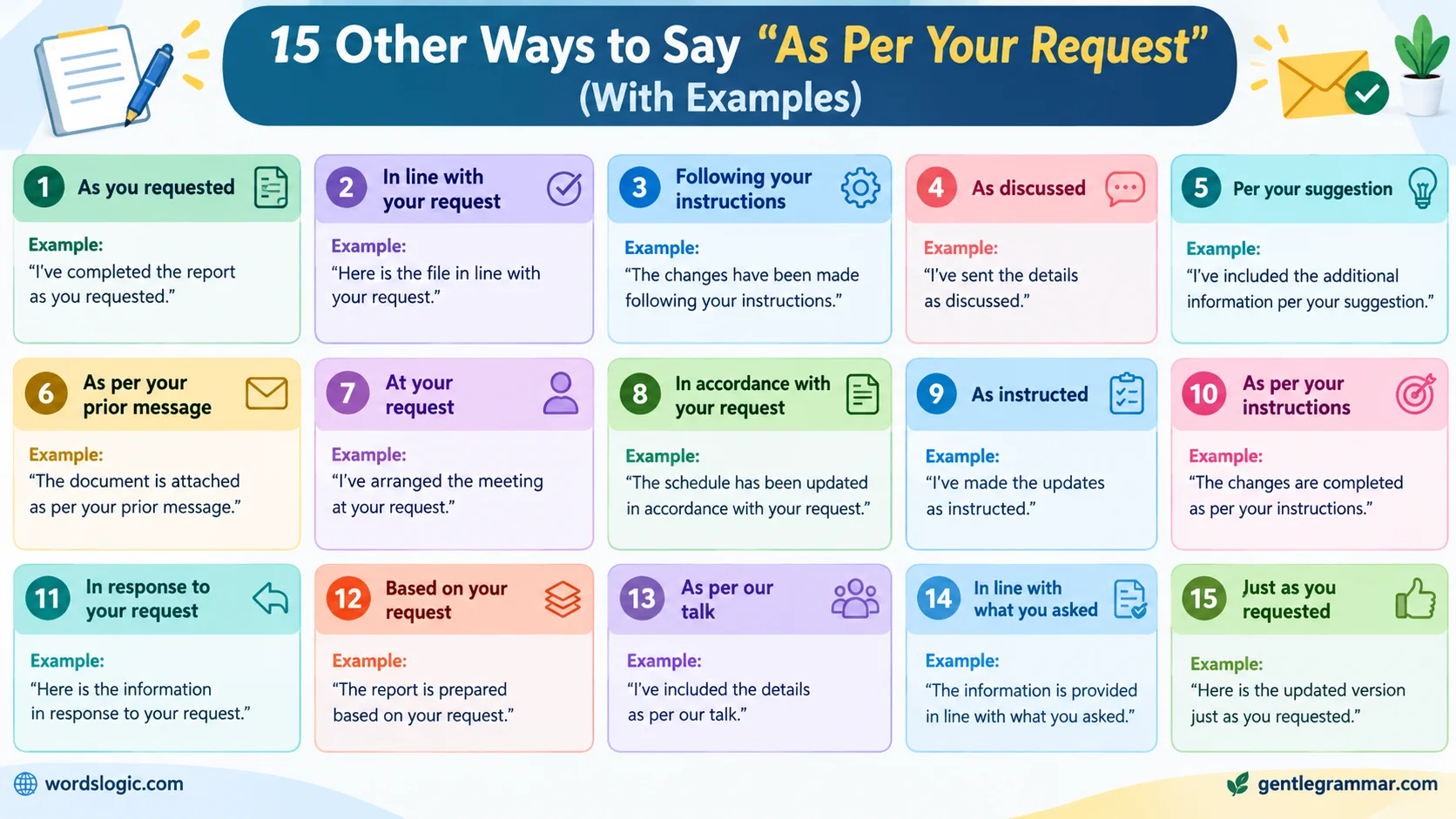
15 Other Ways to Say “As Per Your Request” (With Examples) helps you choose clear, polite phrases for emails, business communication, and professional writing.
“As per your request” is a common phrase in workplace communication, but it can sound repetitive, overly formal, or redundant. The words “as” and “per” do not always need to appear together. In my experience, natural wording, concise wording, and clear messaging make emails easier to understand. Learning alternative phrases can improve your communication skills, writing style, and word choice while helping you sound natural.
You can choose formal expressions or informal expressions depending on your audience and purpose. When responding to requests, acknowledging requests, or fulfilling requests, a streamlined phrase can remove redundancy while maintaining a professional tone or friendly tone. Good email writing and written communication depend on email etiquette, sentence structure, grammar, and appropriate language usage.
What Does “As Per Your Request” Mean?
“As per your request” means that something is being done, provided, or completed according to what another person asked for. The phrase indicates that the speaker is responding to a specific instruction, preference, or request. For example, if a colleague asks you to send a report, you might write, “As per your request, I have attached the report.” This confirms that you are providing the requested document. The expression is common in professional emails, business correspondence, customer service, and formal communication. Although it is grammatically acceptable, it can sound somewhat formal or bureaucratic in everyday conversations.
Common Situations Where “As Per Your Request” Is Used
People commonly use this phrase when responding to workplace requests, document submissions, customer inquiries, and administrative instructions. For example, an employee might use it when sending a revised presentation, while a customer service representative might use it when confirming that an account detail has been updated.
It also appears in formal letters, school correspondence, and business reports. However, the best wording depends on the situation. A simple phrase such as “As requested” may be more concise in an email, while “I’ve included the information you asked for” may sound warmer and more conversational. Choosing an appropriate alternative helps you communicate clearly without making your message unnecessarily formal.
Is It Professional or Polite to Say “As Per Your Request”?
Yes, “as per your request” is generally professional and polite. It acknowledges another person’s instructions and shows that you have acted on them. It is especially suitable for formal emails, business documents, customer communication, and situations where a clear record of a request matters.
However, the phrase can sound stiff when used in casual messages or repeated in every email. In many professional situations, “As requested” is shorter and equally effective. If you want to sound more approachable, try “I’ve included the details you asked for” or “Here’s the information you requested.” The goal is to match your wording to the relationship, the task, and the level of formality required.
Advantages and Disadvantages of Saying “As Per Your Request”
Advantages
- Professional tone: The phrase works well in formal correspondence and business documents.
- Clear acknowledgment: It signals that you are responding to someone’s specific request.
- Useful documentation: It can help establish why a file, change, or action was provided.
- Direct communication: Readers can quickly understand that the action relates to an earlier instruction.
Disadvantages
- Can sound stiff: The wording may feel overly formal in friendly conversations.
- May become repetitive: Using it in every email can make your writing sound formulaic.
- Offers limited warmth: It acknowledges the request but does not necessarily express appreciation or friendliness.
- Can be unnecessarily wordy: Shorter alternatives often communicate the same idea more naturally.
The original phrase remains useful, but choosing a suitable alternative can make your message more concise and better suited to its audience.
Synonyms for “As Per Your Request”
- As Requested
- As You Requested
- As You Asked
- Following Your Request
- In Accordance With Your Request
- In Response to Your Request
- As You Instructed
- At Your Request
- Per Your Instructions
- As Discussed
- As Agreed
- I’ve Included What You Asked For
- Here’s the Information You Requested
- I’ve Taken Care of That
- As You Specified
1. As Requested
Meaning
“As requested” means that something has been completed or provided because another person asked for it. It communicates the same basic idea as “as per your request” but in a shorter, more direct way.
Definition
A concise expression indicating that an action or delivery follows someone’s request.
Detailed Explanation
“As requested” is one of the most natural alternatives for professional writing. It removes unnecessary words while keeping the message clear and respectful. You can use it when sending attachments, sharing information, or confirming that a task is complete. Unlike some more formal alternatives, it fits comfortably into both business emails and everyday workplace messages.
Scenario Examples
Scenario: You are sending a colleague a spreadsheet they requested.
Example: “As requested, I’ve attached the updated spreadsheet.”
Scenario: A manager asks you to revise a report.
Example: “As requested, the revised report is ready for review.”
Scenario: A customer requests a copy of an invoice.
Example: “As requested, I’ve sent a copy of your invoice.”
Best Use
Use this phrase in professional emails, reports, customer service messages, and document submissions. It is especially useful when you want to keep a message brief.
Tone
Tone: Professional, concise, neutral.
It sounds respectful without adding unnecessary formality or emotion.
2. As You Requested
Meaning
“As you requested” means that you have completed an action or provided something in response to a particular person’s request. It emphasizes the connection between the recipient’s request and your response.
Definition
A phrase confirming that something has been done according to what the recipient personally asked for.
Detailed Explanation
This expression sounds slightly more personal than “as requested” because it directly acknowledges the recipient. It is useful when you want to show that you listened carefully and followed through. The wording works well when responding to a specific individual rather than making a general announcement. It remains professional while sounding less impersonal than some traditional business expressions.
Scenario Examples
Scenario: A supervisor asks you to change the order of slides in a presentation.
Example: “As you requested, I’ve moved the budget section to the beginning.”
Scenario: A client asks for a particular file format.
Example: “As you requested, the proposal is attached as a PDF.”
Best Use
Choose this phrase for one-to-one emails, workplace updates, and personalized customer communication when acknowledging the recipient’s specific instructions.
Tone
Tone: Polite, personal, professional.
The direct reference to “you” makes the acknowledgment feel more tailored to the recipient.
3. As You Asked
Meaning
“As you asked” means that you are doing something because the other person asked you to do it. It communicates the same general idea as the original phrase in simpler, more conversational language.
Definition
An expression confirming that you have acted on someone’s request.
Detailed Explanation
This alternative is straightforward and easy to understand. It generally sounds more conversational than “as per your request,” making it suitable for everyday workplace interactions and personal communication. In a formal report or legal document, it may sound less polished than “as requested.” In an ordinary email, however, it can make your wording feel natural and approachable.
Scenario Examples
Scenario: A colleague asks you to share meeting notes.
Example: “As you asked, I’ve shared the notes from yesterday’s meeting.”
Scenario: A friend wants you to send a photograph.
Example: “As you asked, here’s the picture we took at dinner.”
Best Use
Use it in casual emails, team chats, friendly messages, and everyday conversations. For highly formal documents, consider a more conventional expression.
Tone
Tone: Friendly, direct, conversational.
Its simple wording sounds natural without sacrificing clarity.
4. Following Your Request
Meaning
“Following your request” means that an action is taking place as a result of someone’s request. It highlights the action being taken after the request was received.
Definition
An expression indicating that something is being done in response to a request.
Detailed Explanation
This phrase is useful when explaining why you are taking a particular action. It can sound slightly more procedural than “as requested,” especially when introducing a change or an additional step. It is not always interchangeable with the original phrase because “following” can emphasize the sequence of events rather than simply confirming completion. Use it when that relationship is relevant to the message.
Scenario Examples
Scenario: A customer asks for a change to an appointment.
Example: “Following your request, we’ve moved your appointment to Thursday.”
Scenario: A department head asks for additional information.
Example: “Following your request, I’ve added a section covering the projected costs.”
Best Use
This expression fits business correspondence, administrative updates, project communication, and formal explanations.
Tone
Tone: Professional, procedural, respectful.
It emphasizes the action taken after receiving the request.
5. In Accordance With Your Request
Meaning
“In accordance with your request” means that an action has been carried out in agreement with what someone asked for.
Definition
A formal expression indicating that an action follows a person’s request or stated requirements.
Detailed Explanation
This is a more formal alternative than “as per your request.” It is particularly appropriate when the message concerns an official procedure, a documented instruction, or a decision that needs to be clearly recorded. The phrase can sound unnecessarily heavy in a short, friendly email. It also suggests that the action conforms to the request, so use it only when that is accurate.
Scenario Examples
Scenario: An administrator confirms a requested change to a record.
Example: “In accordance with your request, your mailing address has been updated.”
Scenario: A project coordinator confirms that a deliverable follows the agreed specifications.
Example: “In accordance with your request, the final document includes the additional section.”
Best Use
Use this phrase in formal business letters, administrative correspondence, official records, and procedural communication.
Tone
Tone: Formal, precise, official.
Its longer structure emphasizes compliance and careful documentation.
6. In Response to Your Request
Meaning
“In response to your request” means that you are providing information or taking action because someone asked for it.
Definition
A phrase introducing an action, explanation, or piece of information given in reply to a request.
Detailed Explanation
This alternative places more emphasis on the act of responding than on whether a task has been completed. It works especially well when providing an explanation, answering an inquiry, or sharing requested details. For example, it can introduce a letter containing information a customer requested. If you simply want to announce that a file is attached, “As requested” is usually more concise.
Scenario Examples
Scenario: A customer asks for information about a service.
Example: “In response to your request, I’ve included our current service options below.”
Scenario: A colleague requests clarification about a policy.
Example: “In response to your request, I’ve summarized the relevant guidelines.”
Best Use
Choose this expression for formal replies, detailed emails, customer inquiries, and written explanations.
Tone
Tone: Professional, informative, courteous.
It signals that the message directly addresses an earlier inquiry.
7. As You Instructed
Meaning
“As you instructed” means that you have followed directions given by another person. Unlike a general request, an instruction often communicates a more specific direction about how something should be done.
Definition
A phrase confirming that an action follows someone’s explicit directions.
Detailed Explanation
This expression is appropriate when the recipient has given clear instructions rather than simply asked for something. It can communicate accuracy and accountability in workplace settings. However, it may sound too authoritative if the original interaction was an informal suggestion or a simple favor. Choose it when the recipient genuinely provided directions and you want to confirm that you followed them.
Scenario Examples
Scenario: A manager tells you to reorganize a report using a new format.
Example: “As you instructed, I’ve reorganized the report by department.”
Scenario: A project lead specifies which files should be included in a submission.
Example: “As you instructed, I’ve included the signed forms and supporting documents.”
Best Use
Use this phrase for project updates, task confirmations, procedural emails, and workplace communication involving specific directions.
Tone
Tone: Direct, professional, accountable.
It emphasizes following instructions rather than simply fulfilling a request.
8. At Your Request
Meaning
“At your request” means that something is being done, arranged, or provided because a person asked for it.
Definition
A formal expression indicating that an action occurs at someone’s request.
Detailed Explanation
This expression is particularly natural when explaining why an arrangement was made or why a particular action was taken. It is often used in official communication, event planning, and customer correspondence. It can also sound slightly formal in everyday messages. Unlike “as requested,” which frequently confirms that something has been delivered, “at your request” often introduces the reason for an action or arrangement.
Scenario Examples
Scenario: An event organizer changes a guest’s seating arrangement.
Example: “At your request, we’ve reserved a seat near the entrance.”
Scenario: A company provides a document to a client.
Example: “At your request, we have prepared a printed copy of the agreement.”
Best Use
Use it in formal correspondence, service arrangements, event planning, and official communications when explaining why something was done.
Tone
Tone: Formal, courteous, service-oriented.
It conveys that the action was taken to accommodate someone’s wishes.
9. Per Your Instructions
Meaning
“Per your instructions” means that something has been done according to the directions provided by another person.
Definition
A concise business expression confirming compliance with someone’s instructions.
Detailed Explanation
This phrase is common in workplace emails where accuracy and accountability matter. It is direct and efficient, especially when reporting that a task has been completed according to specific directions. However, it is not always a perfect substitute for “as per your request” because instructions and requests are different: instructions specify what to do, while requests may simply ask for an outcome. Use this phrase when clear directions were actually provided.
Scenario Examples
Scenario: A team leader gives specific instructions for updating a database.
Example: “Per your instructions, I’ve updated the database entries.”
Scenario: An accountant is asked to organize expenses under separate categories.
Example: “Per your instructions, the expenses are grouped by project.”
Best Use
Choose this phrase for internal business emails, task completion reports, administrative work, and procedural updates.
Tone
Tone: Businesslike, direct, precise.
Its concise wording emphasizes that the instructions have been followed.
10. As Discussed
Meaning
“As discussed” means that the information or action relates to something previously talked about. It refers to an earlier conversation, meeting, or exchange rather than necessarily confirming a specific request.
Definition
A phrase connecting a current message to a previous discussion.
Detailed Explanation
This expression works well when documenting decisions or following up on a conversation. It is useful when both people already understand the background and do not need the entire discussion repeated. However, it should not replace “as per your request” automatically. A discussion may involve suggestions or shared decisions without anyone making a direct request. Use this alternative when the earlier conversation is the important context.
Scenario Examples
Scenario: Two colleagues agree to review a proposal after a meeting.
Example: “As discussed, I’ll send you the revised proposal by Friday.”
Scenario: A teacher and student talk about an assignment deadline.
Example: “As discussed, you can submit the completed assignment on Monday.”
Best Use
Use it in meeting follow-ups, project emails, business correspondence, and messages that confirm previously discussed plans.
Tone
Tone: Professional, collaborative, matter-of-fact.
It creates continuity between an earlier conversation and the current message.
11. As Agreed
Meaning
“As agreed” means that an action or arrangement follows a decision that the relevant people previously accepted.
Definition
A phrase confirming that something is being done according to a mutual agreement.
Detailed Explanation
This alternative is best when the parties have already reached a shared decision. It emphasizes mutual understanding and commitment, rather than one person making a request. For instance, if you and a client agreed on a delivery date, this phrase can introduce a confirmation of that arrangement. It would be misleading to use it when the other person merely asked for something and no agreement was reached.
Scenario Examples
Scenario: A freelancer confirms a deadline agreed upon with a client.
Example: “As agreed, I’ll deliver the final draft by Wednesday afternoon.”
Scenario: Two departments settle on a meeting time.
Example: “As agreed, the review meeting will begin at 10 a.m.”
Best Use
Use this phrase in project planning, client emails, scheduling, business agreements, and follow-up messages.
Tone
Tone: Professional, cooperative, assured.
It emphasizes a decision accepted by both parties.
12. I’ve Included What You Asked For
Meaning
“I’ve included what you asked for” means that the requested information or material is now part of the message, document, or attachment.
Definition
A conversational expression confirming that the requested content has been provided.
Detailed Explanation
This phrase is more explicit and approachable than the original expression. It tells the reader exactly what you have done without relying on formal business language. It works particularly well when sharing information within an email or attaching a document. However, it is most accurate when you have actually included the requested material; it may not fit a situation where you completed an unrelated action or arranged a service.
Scenario Examples
Scenario: A colleague requests additional figures for a presentation.
Example: “I’ve included what you asked for in the final two slides.”
Scenario: A friend asks you to add a recipe to a shared document.
Example: “I’ve included what you asked for in our meal-planning file.”
Best Use
Use it in everyday workplace emails, friendly messages, document sharing, and collaborative projects.
Tone
Tone: Helpful, conversational, clear.
Its natural wording emphasizes the material provided rather than the formality of the request.
13. Here’s the Information You Requested
Meaning
“Here’s the information you requested” means that you are now providing the specific information someone previously asked you to share.
Definition
A direct expression introducing information supplied in response to a request.
Detailed Explanation
This phrase is particularly useful when your main purpose is to answer a question or provide details. It tells the recipient immediately what the message contains, which makes it a strong opening for an email. It sounds professional without being overly formal and is often warmer than traditional administrative wording. Unlike “as per your request,” it specifically introduces information rather than confirming any kind of action.
Scenario Examples
Scenario: A customer asks about the available subscription plans.
Example: “Here’s the information you requested about our subscription options.”
Scenario: A coworker needs the figures from a recent meeting.
Example: “Here’s the information you requested, including the updated quarterly totals.”
Best Use
Choose it for customer emails, informational replies, workplace messages, and responses to questions.
Tone
Tone: Helpful, polite, informative.
It focuses on making the requested information easy to find.
14. I’ve Taken Care of That
Meaning
“I’ve taken care of that” means that you have handled or completed a task someone mentioned or asked you to do.
Definition
An informal expression indicating that a task or responsibility has been dealt with.
Detailed Explanation
This phrase sounds more conversational than “as per your request” and is particularly useful when giving a quick status update. It reassures the recipient that the task has been handled without requiring a lengthy explanation. However, it does not specify exactly what was completed, so additional details may be necessary when the task is important or needs documentation. In formal communication, a more precise confirmation may be preferable.
Scenario Examples
Scenario: A coworker asks you to book a meeting room.
Example: “I’ve taken care of that—the room is reserved for Thursday.”
Scenario: A family member reminds you to pay a shared bill.
Example: “I’ve taken care of that, so we’re all set for this month.”
Best Use
Use it in team chats, informal workplace conversations, quick status updates, and personal messages when the context is already clear.
Tone
Tone: Reassuring, casual, confident.
It communicates that the matter has been handled and encourages the conversation to move forward.
15. As You Specified
Meaning
“As you specified” means that something has been completed according to the particular details, requirements, or preferences another person provided.
Definition
A phrase confirming that an action follows someone’s stated specifications.
Detailed Explanation
This expression is especially useful when a request includes precise requirements, such as formatting rules, design preferences, technical details, or product specifications. It communicates more than general acknowledgment because it emphasizes that the requested details have been followed. It is less suitable for vague requests or simple favors. When the recipient has not provided specific requirements, “As requested” is usually more natural.
Scenario Examples
Scenario: A client asks for a report with particular headings and formatting.
Example: “As you specified, the report uses the new template and includes a separate summary page.”
Scenario: A customer orders a customized item.
Example: “As you specified, the name is printed in silver lettering.”
Best Use
Use this phrase in technical correspondence, design projects, customized orders, and professional communication involving detailed requirements.
Tone
Tone: Precise, professional, detail-oriented.
It highlights careful attention to the recipient’s stated preferences.
FAQs:
What is another way to say “as per your request”?
“As requested” is one of the best alternatives. It is concise, professional, and suitable for most workplace emails. Depending on the situation, you could also use “As you requested,” “In response to your request,” or “Here’s the information you requested.”
What does “as per your request” mean?
It means that something has been done or provided because someone asked for it. For example, “As per your request, I’ve attached the invoice” confirms that the invoice is being sent in response to the recipient’s request.
Is “as per your request” professional?
Yes. It is generally considered professional and polite, especially in formal correspondence and administrative communication. However, “As requested” often sounds more concise and natural in modern business emails.
What is a more polite way to say “as per your request”?
A polite alternative is “As you requested” because it directly acknowledges the recipient. You can also write, “I’ve included the information you asked for,” which sounds helpful and approachable without being overly formal.
Which alternative works best in formal communication?
“In accordance with your request” is suitable for formal or official correspondence, particularly when documenting a procedure or action. For routine professional emails, “As requested” is usually sufficient and easier to read.
Conclusion:
Choosing the right alternative to “as per your request” can make your communication clearer, more natural, and better suited to the situation. For most professional emails, “As requested” is an excellent choice because it is concise and respectful. If you want to acknowledge someone personally, “As you requested” works well, while “In response to your request” is useful when introducing an explanation or specific information.
Other expressions, such as “As agreed” and “As discussed,” should be reserved for situations involving a genuine agreement or previous conversation. Remember that similar phrases do not always have identical meanings. Consider what happened, who you are addressing, and how formal your message needs to be before choosing your wording. The best expression is the one that communicates your intention accurately and naturally.
