
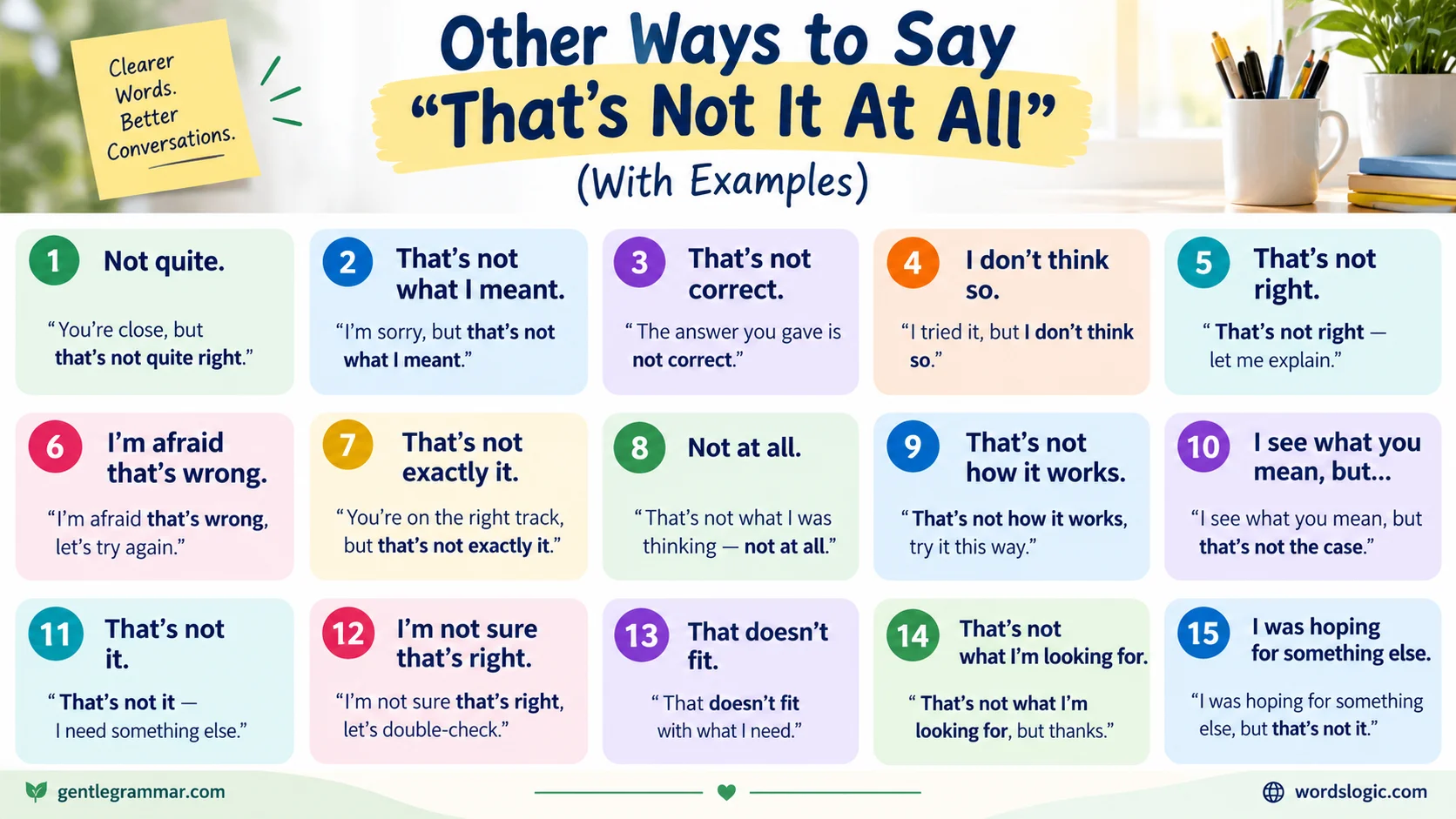
The phrase “That’s Not It At All” is useful when someone misunderstands your idea or gives an incorrect explanation.
For example, imagine sharing a project idea with a colleague who summarizes it differently from what you intended. You might say, “That’s not it at all. The issue is the checkout experience.” The expression signals that the other person has misunderstood your meaning, intention, or situation. The 15 Other Ways to Say “That’s Not It At All” (With Examples) can help you correct an inaccurate interpretation while choosing a tone that suits the context.
A coworker might blame pricing for a campaign problem when the real issue is a confusing checkout process. In such situations, a direct correction can identify the incorrect assumption, inaccurate explanation, wrong answer, or main point that someone has missed. Your speaker’s tone might sound calm, corrective, surprised, frustrated, or emphatic. Choosing the right expression helps communicate the actual meaning without making the conversation unnecessarily confrontational.
What Does “That’s Not It At All” Mean?
“That’s Not It At All” means that something someone has said, suggested, or understood is completely incorrect or does not reflect the actual situation. People use this expression to correct a misunderstanding, reject an inaccurate interpretation, or explain that another person has missed the main point. For example, if a friend assumes you are upset with them when you are actually tired, you might say, “That’s not it at all. I’ve just had a long day.”
The phrase is direct and emphatic. The words “not at all” strengthen the disagreement, making it clear that the speaker does not consider the other person’s interpretation accurate. Depending on the situation and delivery, it can sound reassuring, frustrated, defensive, or matter-of-fact. Its meaning is usually clear in everyday English, but a softer or more specific expression may communicate the intended message more effectively.
Common Situations Where “That’s Not It At All” Is Used
This expression is common in everyday conversations when someone misunderstands a person’s intentions, feelings, or explanation. Friends might use it to clear up confusion, while partners may use it to explain that a comment or action has been interpreted incorrectly. In text messages and social media discussions, it can help correct a claim or clarify what someone meant, although its directness may sometimes make a written reply sound defensive.
In workplace conversations, school discussions, and customer communication, the phrase can be useful when someone has misunderstood a proposal, instruction, answer, or concern. However, professional settings often benefit from more specific wording, such as explaining which detail is incorrect or clarifying the intended point. Choosing a suitable alternative helps keep the conversation constructive while making the correction unmistakable.
Is It Professional or Polite to Say “That’s Not It At All”?
“That’s Not It At All” is generally acceptable in casual and professional conversation, but its tone depends on context. With a friendly voice, it can be a straightforward way to correct a misunderstanding without intending offense. In a tense discussion, however, it may sound dismissive because it rejects the other person’s interpretation without immediately explaining why.
For a more diplomatic workplace response, consider phrases such as “I think there may be a misunderstanding” or “That isn’t quite what I meant.” These expressions acknowledge the possibility of confusion and invite clarification. In formal emails, customer service messages, or sensitive conversations, specific and respectful wording is often more helpful than a strong denial. The original phrase is most appropriate when the correction needs emphasis and the relationship allows direct communication.
Advantages and Disadvantages of Saying “That’s Not It At All”
Advantages
The main advantage is clarity. The phrase quickly communicates that someone’s interpretation is incorrect, helping prevent a misunderstanding from continuing. It is short, easy to remember, and natural in spoken English. It can also reassure someone who has misunderstood your feelings or intentions, particularly when followed by a calm explanation.
Disadvantages
The phrase can sound blunt or defensive if the other person is already upset. Because it does not explain which part is wrong, the listener may need additional information to understand the correction. It can also feel unnecessarily strong when the misunderstanding is minor or when the speaker wants to acknowledge that the other person has a reasonable point. A more precise or considerate alternative may be better in formal writing, sensitive discussions, and situations where maintaining a cooperative tone matters.
Synonyms for “That’s Not It At All”
- That’s Not What I Mean
- That’s Not Quite Right
- You’ve Got It Wrong
- That’s a Misunderstanding
- That’s Not the Case
- Not Exactly
- That’s Far from the Truth
- I Think You’ve Misunderstood
- That’s Not How It Happened
- Let Me Clarify
- That’s Not What I Intended
- You’re Missing the Point
- That’s Not an Accurate Interpretation
- I See It Differently
- That’s Not What I Was Trying to Say
1. That’s Not What I Mean
Meaning
“That’s Not What I Mean” explains that someone has misunderstood your intended message. It focuses on what you were trying to communicate rather than simply declaring the other person wrong.
Definition
A statement used to correct someone’s understanding of your words or intentions.
Detailed Explanation
This expression is useful when your words have been interpreted differently from what you intended. It is generally less confrontational than saying that someone’s understanding is completely wrong. The phrase often encourages you to explain your original point more clearly. It works especially well when the confusion comes from your wording rather than the other person’s assumptions.
Scenario Examples
– Scenario: A friend misunderstands your advice as criticism.
Example: “That’s not what I mean. I’m just trying to help you avoid the same mistake.”
– Scenario: A colleague interprets your suggestion as a demand.
Example: “That’s not what I mean; I was suggesting another option, not asking you to change everything.”
– Scenario: Your partner thinks you want to end a conversation permanently.
Example: “That’s not what I mean. I just need a little time to think.”
Best Use
Use it in personal conversations, text messages, workplace discussions, and situations where your intentions need clarification.
Tone
Tone: Clarifying, conversational, considerate.
It corrects an interpretation while leaving room for a calm explanation.
2. That’s Not Quite Right
Meaning
“That’s Not Quite Right” indicates that something is incorrect or not entirely accurate. It often sounds softer than an emphatic rejection.
Definition
A polite expression used to point out an error or inaccuracy.
Detailed Explanation
This phrase works well when you want to correct information without making the other person feel embarrassed. The words “not quite” soften the disagreement and can suggest that the answer is close but needs adjustment. Unlike the original phrase, it does not necessarily mean that everything is completely wrong. It is particularly useful when discussing facts, instructions, or small misunderstandings.
Scenario Examples
– Scenario: A classmate gives an almost-correct answer.
Example: “That’s not quite right. The second step comes before the calculation.”
– Scenario: A coworker summarizes your proposal incorrectly.
Example: “That’s not quite right; the revised plan only applies to the next quarter.”
– Scenario: A friend remembers a meeting time incorrectly.
Example: “That’s not quite right. We agreed to meet at half past six.”
Best Use
Use it for polite corrections, classroom discussions, professional conversations, and minor factual errors.
Tone
Tone: Gentle, polite, measured.
Its softer wording makes it useful when preserving a friendly atmosphere matters.
3. You’ve Got It Wrong
Meaning
“You’ve Got It Wrong” means that someone has understood something incorrectly or reached the wrong conclusion.
Definition
A direct statement telling someone that their understanding or judgment is mistaken.
Detailed Explanation
This expression is stronger and more personal than “That’s not quite right.” It directly addresses the other person’s understanding, so it may sound confrontational during a sensitive discussion. It can be appropriate when an important misconception needs immediate correction. However, adding a clear explanation can make the message more productive than simply telling someone they are wrong.
Scenario Examples
– Scenario: Someone wrongly accuses you of sharing confidential information.
Example: “You’ve got it wrong. I haven’t discussed this with anyone outside the team.”
– Scenario: A friend assumes you ignored their message deliberately.
Example: “You’ve got it wrong. I was away from my phone all afternoon.”
– Scenario: Two people disagree about what was decided.
Example: “You’ve got it wrong; we agreed to review the proposal before making a decision.”
Best Use
Use it in direct conversations where an important misunderstanding must be corrected. Choose gentler wording for formal emails or emotionally sensitive situations.
Tone
Tone: Firm, direct, assertive.
It communicates confidence but can sound accusatory if delivered harshly.
4. That’s a Misunderstanding
Meaning
“That’s a Misunderstanding” suggests that confusion or incorrect interpretation has caused the disagreement. It focuses on the problem rather than blaming a particular person.
Definition
An expression used to explain that people have understood a situation differently from what was intended.
Detailed Explanation
This wording is useful when both people may have contributed to a communication problem. It avoids the personal criticism that can come with saying someone has got something wrong. The phrase can also help lower tension by presenting the issue as something that can be resolved through clarification. In formal situations, it is often more diplomatic to follow it with a brief explanation of what actually happened.
Scenario Examples
– Scenario: A client believes a service includes an extra feature.
Example: “That’s a misunderstanding. The additional feature is available under the premium plan.”
– Scenario: Friends disagree about an invitation.
Example: “I think that’s a misunderstanding. I invited everyone for Saturday, not Friday.”
– Scenario: A team member misreads a project instruction.
Example: “That’s a misunderstanding; we’re updating the draft, not replacing the entire document.”
Best Use
Use it in customer service, professional emails, group discussions, and personal conversations where diplomacy is important.
Tone
Tone: Neutral, diplomatic, constructive.
It shifts attention toward resolving the confusion rather than assigning blame.
5. That’s Not the Case
Meaning
“That’s Not the Case” means that a particular statement or assumption does not match the facts.
Definition
A formal or neutral expression used to reject an inaccurate claim about a situation.
Detailed Explanation
This phrase is especially effective when discussing facts, policies, circumstances, or claims. It sounds more measured than an emotional denial because it focuses on the situation itself. Unlike “That’s not what I mean,” it can correct a factual assumption even when nobody has misunderstood your words. In professional writing, it works best when followed by the accurate information.
Scenario Examples
– Scenario: A customer thinks an order has been canceled.
Example: “That’s not the case. Your order has been processed and is awaiting dispatch.”
– Scenario: A colleague believes a deadline has changed.
Example: “That’s not the case; the original submission date remains in place.”
– Scenario: A friend assumes you dislike a particular person.
Example: “That’s not the case. We simply have different interests.”
Best Use
Use it in formal emails, business discussions, factual corrections, and situations involving policies or decisions.
Tone
Tone: Neutral, professional, factual.
It is useful when accuracy matters more than emotional emphasis.
6. Not Exactly
Meaning
“Not Exactly” communicates that something is not entirely accurate or does not fully describe the situation.
Definition
A short expression used to qualify, correct, or gently disagree with a statement.
Detailed Explanation
This is a natural choice when you want to disagree without making a conversation feel overly serious. It can suggest that the other person is partly right but has missed an important detail. Its meaning depends heavily on context and delivery; a sarcastic tone can make it sound dismissive. Because it is brief, you may need to explain the difference immediately afterward.
Scenario Examples
– Scenario: A friend asks whether you enjoyed a difficult trip.
Example: “Not exactly. The destination was lovely, but the journey was exhausting.”
– Scenario: A colleague describes your role as managing the whole department.
Example: “Not exactly. I coordinate the project, but the department manager makes the final decisions.”
– Scenario: Someone assumes you are moving to another city permanently.
Example: “Not exactly. I’m only staying there for a few weeks.”
Best Use
Use it in casual conversation, friendly messages, interviews, and situations where a short correction is enough.
Tone
Tone: Casual, understated, mildly corrective.
Its brevity makes it conversational, but important misunderstandings may require more detail.
7. That’s Far from the Truth
Meaning
“That’s Far from the Truth” strongly communicates that a statement is seriously inaccurate or very different from reality.
Definition
An emphatic expression used to reject a claim that substantially misrepresents the facts.
Detailed Explanation
This phrase is much stronger than a gentle correction. It signals that the speaker believes the claim is not merely slightly mistaken but substantially false. It can be useful when responding to serious accusations or correcting a significant misrepresentation. Because it carries emotional force, it may escalate an argument if used for a minor disagreement.
Scenario Examples
– Scenario: Someone claims that you refused to help during an emergency.
Example: “That’s far from the truth. I stayed until everyone was safe.”
– Scenario: A public post misrepresents the purpose of your community event.
Example: “That’s far from the truth; the event was organized to raise funds for local families.”
– Scenario: A friend thinks you never appreciated their support.
Example: “That’s far from the truth. Your support meant a great deal to me.”
Best Use
Use it when correcting serious inaccuracies, misleading claims, or deeply mistaken assumptions. Avoid it when a mild clarification would be enough.
Tone
Tone: Strong, emphatic, emotionally charged.
It conveys conviction and may communicate hurt or frustration, depending on the context.
8. I Think You’ve Misunderstood
Meaning
“I Think You’ve Misunderstood” suggests that someone has interpreted your words, instructions, or intentions incorrectly.
Definition
A tactful expression used to point out a possible misunderstanding.
Detailed Explanation
Adding “I think” makes the correction less absolute and can soften its impact. The phrase identifies the likely source of the problem without immediately accusing the other person of being careless. It is particularly helpful when instructions or explanations could have been unclear. For an even more cooperative approach, you can acknowledge your own wording and explain what you intended.
Scenario Examples
– Scenario: A manager thinks you are requesting an extension when you are asking for clarification.
Example: “I think you’ve misunderstood. I’m asking which version you would like me to submit.”
– Scenario: A friend believes your joke was intended as an insult.
Example: “I think you’ve misunderstood. I wasn’t making fun of you.”
– Scenario: A student misinterprets an assignment.
Example: “I think you’ve misunderstood the instructions. We’re supposed to compare the two stories, not summarize them separately.”
Best Use
Use it in workplace discussions, educational settings, personal conversations, and situations where a respectful correction is needed.
Tone
Tone: Considerate, explanatory, mildly formal.
It encourages clarification, although the wording can still sound blaming if said impatiently.
9. That’s Not How It Happened
Meaning
“That’s Not How It Happened” means that someone’s account of an event does not match your understanding of what actually occurred.
Definition
A statement used to correct an inaccurate description or recollection of an event.
Detailed Explanation
This expression is specific to situations involving events, experiences, or recollections. Unlike a general disagreement, it challenges the way an incident has been described. It can be appropriate when correcting a factual account, but disagreements about memories can be sensitive because people may recall events differently. Explaining what you remember, rather than assuming dishonesty, can keep the conversation constructive.
Scenario Examples
– Scenario: A friend recounts an argument inaccurately.
Example: “That’s not how it happened. I asked you a question before I left.”
– Scenario: A colleague describes the order of events during a meeting.
Example: “That’s not how it happened; we received the revised figures after the meeting ended.”
– Scenario: Family members remember a canceled plan differently.
Example: “That’s not how it happened. We postponed the visit because the roads were closed.”
Best Use
Use it when discussing past events, disagreements about what occurred, meeting records, or personal recollections.
Tone
Tone: Firm, factual, corrective.
It challenges an account directly, so a calm explanation helps avoid unnecessary conflict.
10. Let Me Clarify
Meaning
“Let Me Clarify” signals that you want to make your meaning, position, or explanation clearer.
Definition
A phrase used to introduce additional information that resolves confusion or removes ambiguity.
Detailed Explanation
Rather than simply rejecting someone’s interpretation, this expression moves the conversation toward an explanation. It works well when your original message was incomplete or open to more than one interpretation. In a professional setting, it can sound organized and confident, particularly before a correction or additional detail. However, if delivered sharply, it can also sound impatient, so the explanation that follows matters.
Scenario Examples
– Scenario: A client misunderstands a proposed fee.
Example: “Let me clarify: the quoted price covers installation, but not ongoing maintenance.”
– Scenario: A friend thinks you are canceling a plan.
Example: “Let me clarify. I can still meet today; I just need to arrive a little later.”
– Scenario: A colleague misunderstands your feedback.
Example: “Let me clarify: I like the overall design, but the introduction needs more detail.”
Best Use
Use it in business emails, presentations, meetings, customer support, and everyday discussions requiring a clear explanation.
Tone
Tone: Professional, composed, informative.
It emphasizes the next explanation rather than the other person’s mistake.
11. That’s Not What I Intended
Meaning
“That’s Not What I Intended” means that the effect or interpretation of your words or actions differs from your original purpose.
Definition
An expression used to explain that your intention was different from how another person understood your behavior.
Detailed Explanation
This phrase is especially useful when someone has been hurt, offended, or confused by something you said or did. It distinguishes your intention from the impact of your behavior without necessarily claiming that the other person’s feelings are invalid. It sounds more personal than “That’s not the case” because it focuses on your own motives. In sensitive conversations, acknowledging the impact and explaining your intention can be more helpful than relying on this statement alone.
Scenario Examples
– Scenario: Your comment makes a friend feel excluded.
Example: “That’s not what I intended. I should have made it clear that you were invited too.”
– Scenario: A manager’s feedback sounds harsher than expected.
Example: “That’s not what I intended. I wanted to highlight the issue so we could fix it together.”
– Scenario: Your message is interpreted as sarcasm.
Example: “That’s not what I intended; I was genuinely thanking you for your help.”
Best Use
Use it in personal relationships, apologies, sensitive workplace conversations, and discussions about unintended offense.
Tone
Tone: Personal, sincere, explanatory.
It can help repair communication, especially when paired with empathy and accountability.
12. You’re Missing the Point
Meaning
“You’re Missing the Point” means that someone is focusing on the wrong detail or failing to understand the main idea.
Definition
A direct expression used when someone overlooks the central issue of a discussion.
Detailed Explanation
This phrase differs from the original because it does not necessarily say that every part of the other person’s statement is wrong. Instead, it suggests that the person has overlooked what matters most. It is useful during discussions about priorities, reasoning, or the purpose behind a decision. However, it can sound impatient or dismissive, especially when the other person is making a genuine effort to understand.
Scenario Examples
– Scenario: A team debates the appearance of a report instead of its accuracy.
Example: “You’re missing the point. We need to correct the figures before discussing the layout.”
– Scenario: Friends argue about a small detail in a larger disagreement.
Example: “You’re missing the point. I’m not upset about the money; I’m upset that you didn’t tell me.”
– Scenario: A student focuses on memorizing an answer rather than understanding it.
Example: “You’re missing the point. The goal is to understand why the method works.”
Best Use
Use it in problem-solving, debates, classroom discussions, and conversations about the main issue. Choose a softer alternative when the listener may feel criticized.
Tone
Tone: Direct, assertive, occasionally impatient.
It redirects attention to the central issue but can sound confrontational without further explanation.
13. That’s Not an Accurate Interpretation
Meaning
“That’s Not an Accurate Interpretation” means that someone’s explanation of a statement, event, or piece of information is not faithful to the available facts or intended meaning.
Definition
A formal expression used to correct an interpretation that does not accurately reflect the information.
Detailed Explanation
This expression is more formal and analytical than most everyday alternatives. It is useful when the issue concerns how a document, comment, policy, or event has been understood. Rather than making a personal accusation, it evaluates the accuracy of the interpretation itself. Because the wording is somewhat formal, it may sound unnatural in a relaxed conversation with friends.
Scenario Examples
– Scenario: A reviewer misrepresents the findings of a report.
Example: “That’s not an accurate interpretation of the findings; the report identifies a possible risk, not a confirmed outcome.”
– Scenario: A colleague misunderstands a written policy.
Example: “That’s not an accurate interpretation of the policy. Approval is required only for expenses above the stated limit.”
– Scenario: A discussion group misreads the message of a novel.
Example: “That’s not an accurate interpretation of the passage because the narrator is describing fear, not excitement.”
Best Use
Use it in formal writing, analytical discussions, academic work, policy clarification, and professional reviews.
Tone
Tone: Formal, precise, objective.
Its measured wording suits situations where accuracy and careful reasoning matter.
14. I See It Differently
Meaning
“I See It Differently” communicates that you have a different perspective or interpretation from someone else.
Definition
A polite expression used to introduce a contrasting opinion without directly declaring the other person wrong.
Detailed Explanation
This phrase is not an exact synonym for the original because it expresses a difference in perspective rather than necessarily identifying an incorrect statement. It is valuable when people can reasonably disagree about an idea, decision, or personal experience. The wording allows you to disagree while acknowledging that another viewpoint exists. When the issue involves a verifiable fact, however, it is better to explain the evidence rather than frame the matter as a difference of opinion.
Scenario Examples
– Scenario: Coworkers disagree about which project deserves priority.
Example: “I see it differently. I think finishing the client project first will prevent further delays.”
– Scenario: Friends interpret a movie’s ending in different ways.
Example: “I see it differently. I thought the final scene suggested that she had already made her decision.”
– Scenario: A family discusses the best way to spend a holiday.
Example: “I see it differently; I’d rather keep the plans simple so everyone can relax.”
Best Use
Use it in meetings, respectful debates, personal discussions, and conversations involving subjective opinions.
Tone
Tone: Diplomatic, thoughtful, respectful.
It encourages an exchange of perspectives instead of turning a disagreement into a contest over who is right.
15. That’s Not What I Was Trying to Say
Meaning
“That’s Not What I Was Trying to Say” explains that someone has taken your words to mean something different from your intended message.
Definition
A conversational expression used to correct an unintended interpretation of something you said.
Detailed Explanation
This phrase is more specific than a general denial because it focuses on the meaning you wanted to communicate. It is particularly helpful when a comment has been misunderstood or has caused an unintended reaction. Compared with “That’s not what I mean,” the past-progressive wording often refers to an earlier statement and the speaker’s original intention. It can sound defensive if repeated without clarification, so explain what you actually meant next.
Scenario Examples
– Scenario: A friend thinks your suggestion means you dislike their current plan.
Example: “That’s not what I was trying to say. I just thought we could compare a few more options.”
– Scenario: Your partner interprets a question as criticism.
Example: “That’s not what I was trying to say. I wanted to understand what happened, not blame you.”
– Scenario: A teammate misunderstands your feedback on a draft.
Example: “That’s not what I was trying to say. The idea is strong; I only meant that the supporting details need work.”
Best Use
Use it in personal messages, relationship conversations, workplace discussions, and situations where your original words have been misinterpreted.
Tone
Tone: Conversational, explanatory, sometimes defensive.
It works best when followed by a clearer explanation of your intended meaning.
FAQs:
What is another way to say “That’s Not It At All”?
A natural alternative is “That’s Not What I Mean.” It works when someone has misunderstood your intentions or message. For a gentler correction, use “That’s Not Quite Right.” For a professional conversation, “Let Me Clarify” can be more constructive.
What does “That’s Not It At All” mean?
It means that someone’s understanding, assumption, or interpretation is completely incorrect or does not reflect the real situation. The phrase is direct and emphatic, although its tone can range from reassuring to frustrated depending on the context.
Is “That’s Not It At All” professional?
Yes, it can be appropriate in professional conversations, especially when a clear correction is necessary. However, it may sound blunt in a formal email or sensitive discussion. “That’s Not the Case” and “Let Me Clarify” are useful alternatives when you want a more measured tone.
What is a more polite way to say “That’s Not It At All”?
“I Think You’ve Misunderstood” can communicate the correction tactfully, while “That’s Not Quite Right” is useful for gentle factual corrections. If the misunderstanding concerns your intentions, “That’s Not What I Mean” may be more appropriate.
Which alternative works best in formal communication?
“That’s Not an Accurate Interpretation” works well when correcting a formal explanation, report, policy, or claim. For a professional email about a misunderstanding, “Let Me Clarify” is often a natural choice because it introduces an explanation rather than simply rejecting the other person’s statement.
Conclusion:
Choosing the right expression can make a disagreement easier to resolve and help you communicate your intentions more clearly. While “That’s Not It At All” is useful when you need to reject an incorrect interpretation firmly, it is not always the best choice for every situation. Softer alternatives such as “That’s Not Quite Right” can make a correction feel more considerate, while “Let Me Clarify” encourages a constructive conversation. In more formal settings, “That’s Not an Accurate Interpretation” offers greater precision.
Remember that similar phrases can carry different levels of directness, politeness, and emotional emphasis. Before choosing an alternative, consider what was misunderstood, who you are speaking to, and whether you need to correct a fact, explain your intentions, or express a different perspective. The best wording is the one that communicates your meaning clearly while respecting the person listening.
