
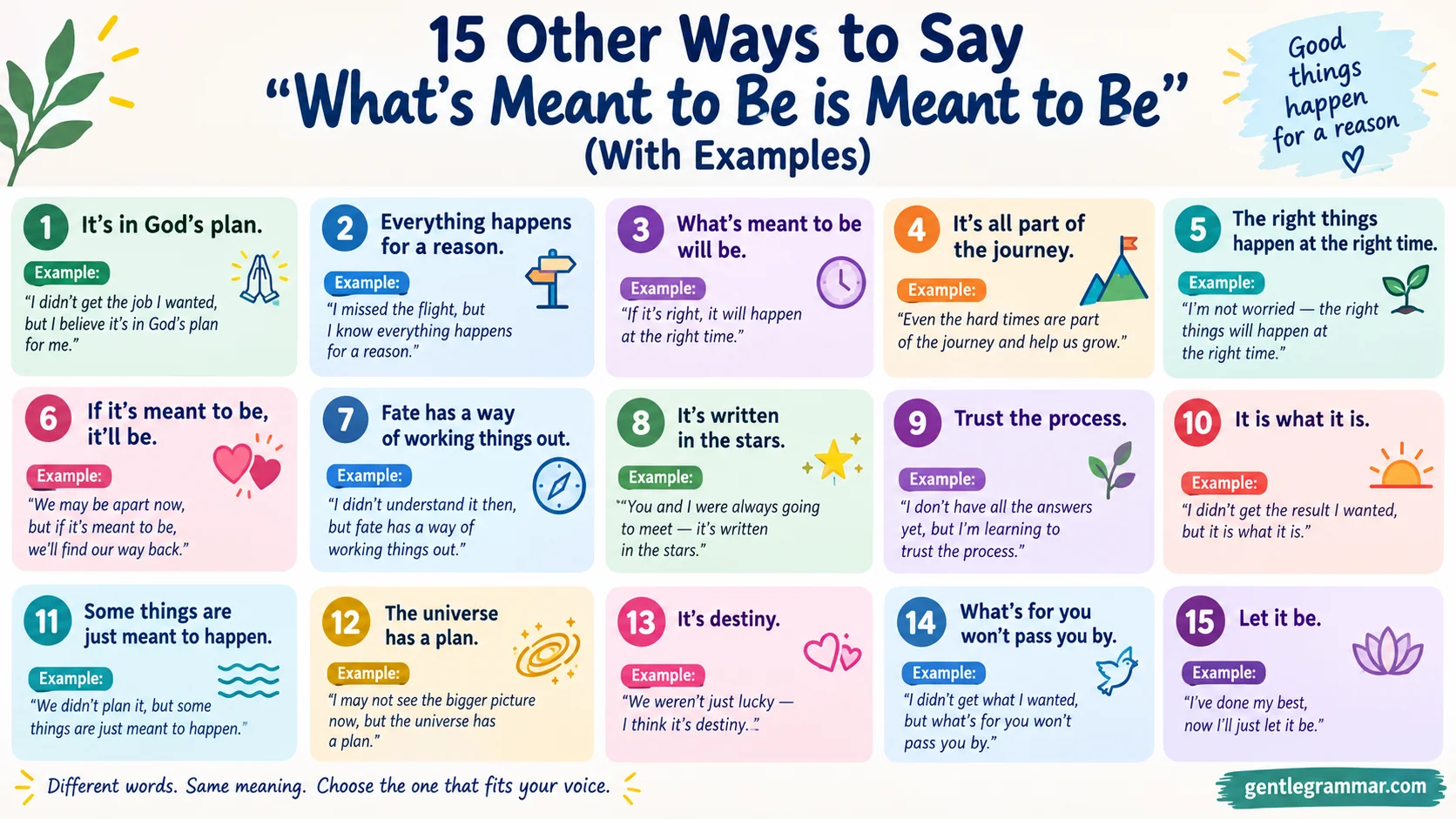
15 Other Ways to Say “What’s Meant to Be is Meant to Be” (With Examples) can help you express trust, acceptance, and hope when life takes an unexpected turn.
This expression reflects the idea that some things happen naturally, even when our plans change. Whether we meet the right person, discover an unexpected opportunity, or experience a surprising moment, we may begin to see how timing, personal choices, and circumstances shape our journey.
From my experience, this phrase has a deep connection to destiny and purpose. It reminds us that not everything requires force or an immediate explanation. Sometimes, making peace with uncertainty allows us to accept things beyond our control while continuing to make thoughtful decisions and take responsibility for our actions.
What Does “What’s Meant to Be is Meant to Be” Mean?
“What’s Meant to Be is Meant to Be” means that certain events, relationships, or outcomes will happen if they are supposed to happen. People often use this expression to accept uncertainty, find comfort after disappointment, or express the belief that some things are beyond their control. It can suggest that life has a natural course, that circumstances will eventually work themselves out, or that a particular outcome should not be forced.
The phrase is commonly associated with acceptance, fate, destiny, and trust in the future. For example, someone who does not get a job they wanted might say it to remind themselves that another opportunity could be a better fit. In a romantic relationship, it can mean that two people will find their way to each other if their connection is right. The expression does not prove that events are predetermined; rather, it communicates a personal outlook on life and uncertainty.
Common Situations Where “What’s Meant to Be is Meant to Be” Is Used
This phrase is especially common in personal conversations, relationships, text messages, and social media posts. Someone might use it after a breakup, when plans fall through, or when an opportunity does not work out as expected. It can offer reassurance without requiring a detailed explanation.
In friendships and family conversations, the expression can help someone accept disappointment and look ahead. In romantic situations, it may express patience and faith that the right relationship will develop naturally. People also use it when discussing career decisions, missed opportunities, or major life changes. However, it is less common in formal workplace communication, where a more practical expression, such as accepting an outcome and focusing on the next step, may sound clearer.
Is It Professional or Polite to Say “What’s Meant to Be is Meant to Be”?
The phrase is generally polite, conversational, and reassuring, but its suitability depends on the situation. Among friends, partners, and family members, it can communicate acceptance and hope. It may also sound thoughtful in an informal discussion about an uncertain future.
In professional settings, however, it can seem too casual, philosophical, or passive, particularly when someone needs practical guidance. For example, telling a colleague that a failed project was simply meant to be may appear dismissive of the effort involved. A more appropriate response might acknowledge the setback and focus on what can be learned. When comforting someone, consider their feelings before using the expression, because not everyone finds the idea of fate reassuring.
Advantages and Disadvantages of Saying “What’s Meant to Be is Meant to Be”
Advantages
The phrase offers a simple way to express acceptance and emotional reassurance. It can help people stop dwelling on circumstances they cannot change and encourage them to remain open to future possibilities. Its familiar, gentle tone makes it useful in personal conversations, especially when there is no easy solution to a disappointing situation. It can also remind people that one setback does not determine their entire future.
Disadvantages
The expression can sometimes sound vague or overly passive, particularly when a situation calls for action. Someone who has experienced a painful loss may feel that the phrase minimizes their emotions if it is offered too quickly. It can also suggest that outcomes are entirely predetermined, which may not reflect everyone’s beliefs. In professional conversations, it rarely communicates a concrete plan. Choosing a more specific expression can provide greater comfort, acknowledge personal responsibility, or emphasize the importance of taking the next step.
Synonyms for “What’s Meant to Be is Meant to Be”
- Everything Happens for a Reason
- If It’s Meant to Be, It Will Be
- What Will Be, Will Be
- Trust the Process
- Let Fate Take Its Course
- Things Will Work Out as They Should
- The Right Things Will Find Their Way to You
- It Was Not Meant to Be
- Time Will Tell
- Go with the Flow
- Accept What You Cannot Change
- What’s Yours Will Come to You
- The Universe Has Its Own Timing
- Some Things Are Beyond Our Control
- Everything Will Fall into Place
1. Everything Happens for a Reason
Meaning
“Everything Happens for a Reason” expresses the belief that events, including difficult ones, may have a purpose or lead to something meaningful.
Definition
A phrase suggesting that life events have reasons or may eventually produce valuable outcomes.
Detailed Explanation
This expression is often used to find meaning in disappointment or unexpected change. Compared with the original phrase, it places more emphasis on purpose behind events rather than accepting whatever happens. It can provide hope when someone is struggling to understand a setback. However, it may not comfort someone who is grieving or experiencing a serious hardship, especially if they do not share this belief.
Scenario Examples
Scenario 1: A missed opportunity
Example: “I was disappointed about not getting the position, but maybe everything happens for a reason.”
Scenario 2: Comforting a friend
Example: “I know things feel difficult right now. Maybe everything happens for a reason, even if we cannot see it yet.”
Best Use
Use this phrase in personal conversations, reflective writing, and encouraging messages when someone is trying to find meaning in an experience.
Tone
Tone: Hopeful, reflective, reassuring.
It encourages a positive interpretation of events, although it should be used sensitively when someone is hurting.
2. If It’s Meant to Be, It Will Be
Meaning
This expression means that if something is truly right or destined to happen, it will happen without being forced.
Definition
A saying that encourages patience and trust in a possible future outcome.
Detailed Explanation
This is one of the closest alternatives to the original expression. It focuses on allowing relationships, opportunities, or plans to develop naturally rather than trying to control every detail. It is especially common in romantic conversations when two people are unsure about their future together. Unlike a statement of certainty, it leaves the outcome open and encourages patience rather than demanding an immediate answer.
Scenario Examples
Scenario 1: An uncertain relationship
Example: “We care about each other, but the timing is complicated. If it’s meant to be, it will be.”
Scenario 2: Waiting for an opportunity
Example: “I have submitted my application. If it’s meant to be, it will be.”
Best Use
Use it in romantic conversations, personal messages, and situations involving uncertainty.
Tone
Tone: Gentle, patient, romantic.
Its wording offers reassurance without insisting that a particular outcome must happen.
3. What Will Be, Will Be
Meaning
“What Will Be, Will Be” means that the future cannot always be controlled, so it is sometimes better to accept uncertainty.
Definition
An expression of acceptance toward events that cannot be fully predicted or controlled.
Detailed Explanation
This saying shares the original phrase’s emphasis on acceptance, but it sounds more matter-of-fact. It does not necessarily suggest that an event has a purpose or that destiny is guiding it. Instead, it recognizes that some outcomes remain uncertain despite our best efforts. Depending on the speaker’s delivery, it can sound peaceful and practical or slightly resigned.
Scenario Examples
Scenario 1: Waiting for exam results
Example: “I studied as much as I could. What will be, will be.”
Scenario 2: An uncertain plan
Example: “We have done everything we can to prepare for the trip. What will be, will be.”
Best Use
Use it in casual conversation when the outcome is uncertain and worrying will not change it.
Tone
Tone: Calm, accepting, sometimes resigned.
The phrase helps people acknowledge uncertainty without making promises about the future.
4. Trust the Process
Meaning
“Trust the Process” means having patience with the steps you are taking, even when the final result is not yet clear.
Definition
An encouraging expression that emphasizes patience, consistency, and confidence in gradual progress.
Detailed Explanation
Unlike the original expression, this phrase emphasizes continued effort rather than destiny alone. It suggests that progress may take time and that immediate results are not always a reliable measure of success. It works particularly well when someone is learning a skill, building a career, or working toward a personal goal. The expression does not mean that success is guaranteed; it encourages patience while the person continues making sensible decisions.
Scenario Examples
Scenario 1: Career development
Example: “You are gaining experience every month. Trust the process and keep building your skills.”
Scenario 2: Learning something new
Example: “My progress in English feels slow, but I am going to trust the process and keep practicing.”
Best Use
Use it in motivational messages, coaching, education, and personal development.
Tone
Tone: Encouraging, confident, practical.
It offers reassurance while reminding people that their own actions still matter.
5. Let Fate Take Its Course
Meaning
This phrase means allowing events to develop naturally rather than trying to control every outcome.
Definition
An expression of willingness to let circumstances unfold without excessive interference.
Detailed Explanation
“Let Fate Take Its Course” has a stronger connection to destiny and forces beyond personal control. It can sound more dramatic or philosophical than the original phrase. People may use it when a relationship, decision, or uncertain situation needs time to develop. However, it is not always the best choice when taking action could prevent harm or improve an outcome.
Scenario Examples
Scenario 1: A developing relationship
Example: “We have only been dating for a few weeks. Let’s enjoy getting to know each other and let fate take its course.”
Scenario 2: An uncertain future
Example: “We have shared our feelings honestly. Now, perhaps we should let fate take its course.”
Best Use
Use it in reflective conversations, romantic discussions, and creative writing.
Tone
Tone: Philosophical, romantic, somewhat dramatic.
It emphasizes surrendering control more strongly than a practical expression of patience.
6. Things Will Work Out as They Should
Meaning
This phrase expresses confidence that a situation will eventually reach an acceptable or appropriate outcome.
Definition
A reassuring statement that encourages someone to remain patient while an uncertain situation develops.
Detailed Explanation
This alternative sounds more directly comforting than the original phrase. It focuses on the hope that events will settle into a reasonable outcome rather than explicitly referring to destiny. It can help when a friend is worried about a decision, a relationship, or a change in plans. Because it suggests that things will turn out well or appropriately, it is best used as encouragement rather than as a guarantee.
Scenario Examples
Scenario 1: A friend facing change
Example: “Moving to another city feels overwhelming, but I believe things will work out as they should.”
Scenario 2: Waiting for a decision
Example: “We have explained our position to the committee. Let’s be patient and see what happens; things will work out as they should.”
Best Use
Use it in supportive conversations, personal messages, and moments of uncertainty.
Tone
Tone: Reassuring, optimistic, gentle.
It gives comfort without directly claiming that fate determines the result.
7. The Right Things Will Find Their Way to You
Meaning
This expression suggests that suitable people, opportunities, and experiences can enter your life at the appropriate time.
Definition
A hopeful saying that encourages patience and openness to future possibilities.
Detailed Explanation
This phrase places greater emphasis on hope and positive possibilities than the original expression. It is often used when someone is worried about finding love, choosing a career, or reaching an important personal goal. The wording feels warm because it suggests that worthwhile opportunities may still be ahead. However, it should not imply that people must wait passively; taking action can help them recognize and pursue opportunities.
Scenario Examples
Scenario 1: Dating after a breakup
Example: “Take your time to heal. The right things will find their way to you.”
Scenario 2: Looking for work
Example: “Do not let one rejection discourage you. Keep applying, and stay open to new possibilities.”
Best Use
Use it in encouraging texts, personal reflections, and conversations about relationships or future opportunities.
Tone
Tone: Warm, optimistic, comforting.
It offers hope about the future without focusing heavily on the idea of fate.
8. It Was Not Meant to Be
Meaning
“It Was Not Meant to Be” means that a particular outcome did not happen and is being accepted as something that was not destined to work out.
Definition
A phrase used to accept an unsuccessful relationship, plan, or opportunity as an outcome that was not right or destined to happen.
Detailed Explanation
This expression is different from the original because it looks backward at a specific disappointment rather than discussing what may happen in the future. It can help someone make peace with a breakup, a missed opportunity, or a plan that fell apart. The phrase may soften the feeling of failure by framing the outcome as something to accept rather than endlessly question. Still, it should not be used to dismiss genuine mistakes or situations that could be improved.
Scenario Examples
Scenario 1: A romantic breakup
Example: “We tried to make the relationship work, but perhaps it was not meant to be.”
Scenario 2: A missed opportunity
Example: “I really wanted that scholarship, but it was not meant to be this year.”
Best Use
Use it when reflecting on past disappointments, particularly in relationships and personal opportunities.
Tone
Tone: Reflective, accepting, sometimes bittersweet.
It acknowledges that something did not work out without necessarily explaining why.
9. Time Will Tell
Meaning
This expression means that the truth or final outcome will become clear as time passes.
Definition
A saying that recognizes uncertainty and suggests waiting for more information before reaching a conclusion.
Detailed Explanation
“Time Will Tell” is more neutral than the original phrase because it does not assume that fate or destiny is involved. It simply acknowledges that the outcome is not yet known. It works well when someone is uncertain about a relationship, a decision, or a developing situation. Rather than offering firm reassurance, it encourages patience and lets future events provide the answer.
Scenario Examples
Scenario 1: A new relationship
Example: “We are still learning about each other. Time will tell whether we are a good match.”
Scenario 2: A new business idea
Example: “The launch has gone well so far, but time will tell whether customers keep coming back.”
Best Use
Use it in everyday conversations, discussions about future outcomes, and situations where evidence has yet to emerge.
Tone
Tone: Neutral, thoughtful, realistic.
It is useful when you want to acknowledge uncertainty without making a prediction.
10. Go with the Flow
Meaning
“Go with the Flow” means adapting to circumstances instead of trying to plan or control every detail.
Definition
An informal expression that encourages flexibility and acceptance as situations change.
Detailed Explanation
This phrase is more relaxed and action-oriented than the original expression. It encourages people to respond to what happens rather than insisting that everything follow a predetermined plan. It can be especially useful during travel, social events, or the early stages of a relationship. However, going with the flow does not mean ignoring important decisions or abandoning personal boundaries.
Scenario Examples
Scenario 1: Making weekend plans
Example: “We have no fixed schedule for Saturday, so let’s go with the flow.”
Scenario 2: Getting to know someone
Example: “There is no need to rush our relationship. Let’s go with the flow and see how things develop.”
Best Use
Use it in casual conversation, friendly texts, social plans, and informal relationship discussions.
Tone
Tone: Relaxed, flexible, casual.
It emphasizes adapting to the present rather than believing that a specific outcome is destined.
11. Accept What You Cannot Change
Meaning
This expression means recognizing circumstances that are beyond your control and learning to respond to them constructively.
Definition
A practical statement encouraging acceptance of unchangeable situations while preserving energy for what can still be influenced.
Detailed Explanation
Unlike the original phrase, this alternative is based on realistic acceptance rather than belief in destiny. It does not suggest that everything happens for a reason or that future events are predetermined. Instead, it encourages people to distinguish between what they can influence and what they cannot. This can be useful after a disappointment, although acceptance does not mean that a person should ignore injustice or give up on changes that remain possible.
Scenario Examples
Scenario 1: A disappointing result
Example: “I cannot change my final grade now, so I need to accept what I cannot change and prepare better next time.”
Scenario 2: A canceled event
Example: “The weather has canceled our outdoor plans. We cannot change that, so let’s find something enjoyable to do indoors.”
Best Use
Use it in personal reflection, problem-solving conversations, and situations requiring a realistic perspective.
Tone
Tone: Practical, mature, direct.
It is a grounded alternative when emotional reassurance needs to be paired with acceptance.
12. What’s Yours Will Come to You
Meaning
This expression suggests that something truly right for you, such as a relationship or opportunity, will eventually reach you.
Definition
A hopeful saying that encourages patience and confidence that suitable things can enter your life.
Detailed Explanation
This phrase is particularly common in conversations about love, personal growth, and opportunities. It has a more personal, reassuring quality than the original because it focuses on what belongs in your life. However, the wording can sound fatalistic if interpreted as a reason never to take initiative. A balanced interpretation is to remain patient while continuing to make choices that align with your values and goals.
Scenario Examples
Scenario 1: Waiting for love
Example: “You do not need to rush into a relationship just because your friends are dating. What’s yours will come to you.”
Scenario 2: Comparing career progress
Example: “Your career does not have to follow anyone else’s timeline. Keep developing your skills and stay open to opportunities.”
Best Use
Use it in personal encouragement, relationship conversations, and reflective social media captions.
Tone
Tone: Comforting, optimistic, personal.
It encourages patience, though it should not be treated as a promise that a particular outcome will happen.
13. The Universe Has Its Own Timing
Meaning
This phrase expresses the belief that important events may happen at a time different from the one we expect.
Definition
A spiritual or reflective saying that encourages patience with the timing of life events.
Detailed Explanation
“The Universe Has Its Own Timing” emphasizes patience and timing rather than simply accepting an outcome. It is often used when someone feels behind in love, career, education, or personal development. The expression may resonate with people who use spiritual language to make sense of uncertainty. It is not a factual explanation for why events occur, so a more neutral phrase may be preferable when speaking with someone who does not share that worldview.
Scenario Examples
Scenario 1: A delayed career opportunity
Example: “I thought I would have my dream job by now, but maybe the universe has its own timing.”
Scenario 2: A relationship developing slowly
Example: “We met at an unexpected point in our lives. Perhaps the universe has its own timing.”
Best Use
Use it in spiritual reflections, personal messages, and conversations about patience or life milestones.
Tone
Tone: Spiritual, hopeful, contemplative.
Its reference to the universe gives it a more spiritual feeling than the original phrase.
14. Some Things Are Beyond Our Control
Meaning
This phrase means that certain events cannot be prevented or changed by individual effort alone.
Definition
A realistic expression acknowledging the limits of personal control over events and outcomes.
Detailed Explanation
This alternative is more direct and practical than the original expression. It does not suggest that events are destined to happen; it simply recognizes that people cannot control every circumstance. It can help during delays, unexpected changes, or disappointing outcomes. Because it is neutral rather than particularly optimistic, it works when you want to acknowledge reality without making assumptions about what the future holds.
Scenario Examples
Scenario 1: A delayed flight
Example: “The airline has postponed our flight because of the storm. Some things are beyond our control.”
Scenario 2: An unexpected change at work
Example: “The client changed the deadline at the last minute. Some things are beyond our control, but we can adjust our schedule.”
Best Use
Use it in workplace conversations, everyday discussions, and situations involving circumstances you cannot influence.
Tone
Tone: Realistic, calm, matter-of-fact.
It acknowledges limitations without requiring a belief in fate or destiny.
15. Everything Will Fall into Place
Meaning
This expression means that separate problems, decisions, or circumstances are expected to come together in a satisfactory way over time.
Definition
An optimistic saying that expresses hope that a confusing or difficult situation will eventually become clearer or more manageable.
Detailed Explanation
“Everything Will Fall into Place” is more reassuring and future-focused than the original phrase. It emphasizes the possibility of things becoming clearer or working out as circumstances develop. People often use it when someone feels overwhelmed by several decisions or worries about an uncertain future. Unlike a statement about destiny, it focuses on the hope of a satisfying outcome, although it should not replace practical planning when action is needed.
Scenario Examples
Scenario 1: Starting university
Example: “You have a lot to learn in your first semester, but give yourself time. Everything will fall into place.”
Scenario 2: Organizing a major event
Example: “We still have a few details to confirm, but everything will fall into place once the final arrangements are made.”
Best Use
Use it in encouraging messages, personal conversations, and situations where someone needs reassurance during a period of change.
Tone
Tone: Optimistic, soothing, supportive.
It offers confidence that confusion may give way to clarity without claiming that success is inevitable.
FAQs:
What is another way to say “What’s Meant to Be is Meant to Be”?
A natural alternative is “If It’s Meant to Be, It Will Be.” It communicates patience and the belief that the right outcome will happen without being forced. For a more practical message, you can say “Accept What You Cannot Change.”
What does “What’s Meant to Be is Meant to Be” mean?
It means that certain events or outcomes will happen if they are supposed to happen. People often use the phrase to express acceptance, faith in the future, or belief in destiny, especially when a relationship or opportunity does not work out as expected.
Is “What’s Meant to Be is Meant to Be” professional?
The phrase is generally informal and conversational. It can work in friendly workplace discussions, but it may sound too philosophical in formal emails, business reports, or conversations about setbacks that require practical solutions.
What is a more polite way to say “What’s Meant to Be is Meant to Be”?
A gentle alternative is “Things Will Work Out as They Should.” It offers reassurance without sounding dismissive. You could also say, “Let’s give it time and see how things develop,” when you want to acknowledge uncertainty without making assumptions about destiny.
Which alternative works best in formal communication?
“Some Things Are Beyond Our Control” is a suitable option when explaining uncertainty in a professional context. It acknowledges limitations without relying on spiritual beliefs or assumptions about fate. For workplace situations, you can make the message more constructive by identifying what can be done next.
Conclusion:
Choosing the right expression can make a meaningful difference when talking about fate, relationships, disappointment, and uncertainty. While “What’s Meant to Be is Meant to Be” encourages acceptance, other phrases communicate different ideas. “If It’s Meant to Be, It Will Be” emphasizes patience, while “Trust the Process” encourages continued effort. Similarly, “Some Things Are Beyond Our Control” offers a realistic perspective, and “Everything Will Fall into Place” provides reassurance during uncertain times.
The best alternative depends on what you want to communicate and how the other person might interpret your words. Consider the situation, the relationship, and the emotional tone before choosing an expression. Remember that accepting uncertainty does not mean giving up. Sometimes, it means letting go of what you cannot control while continuing to work toward what matters to you.
