
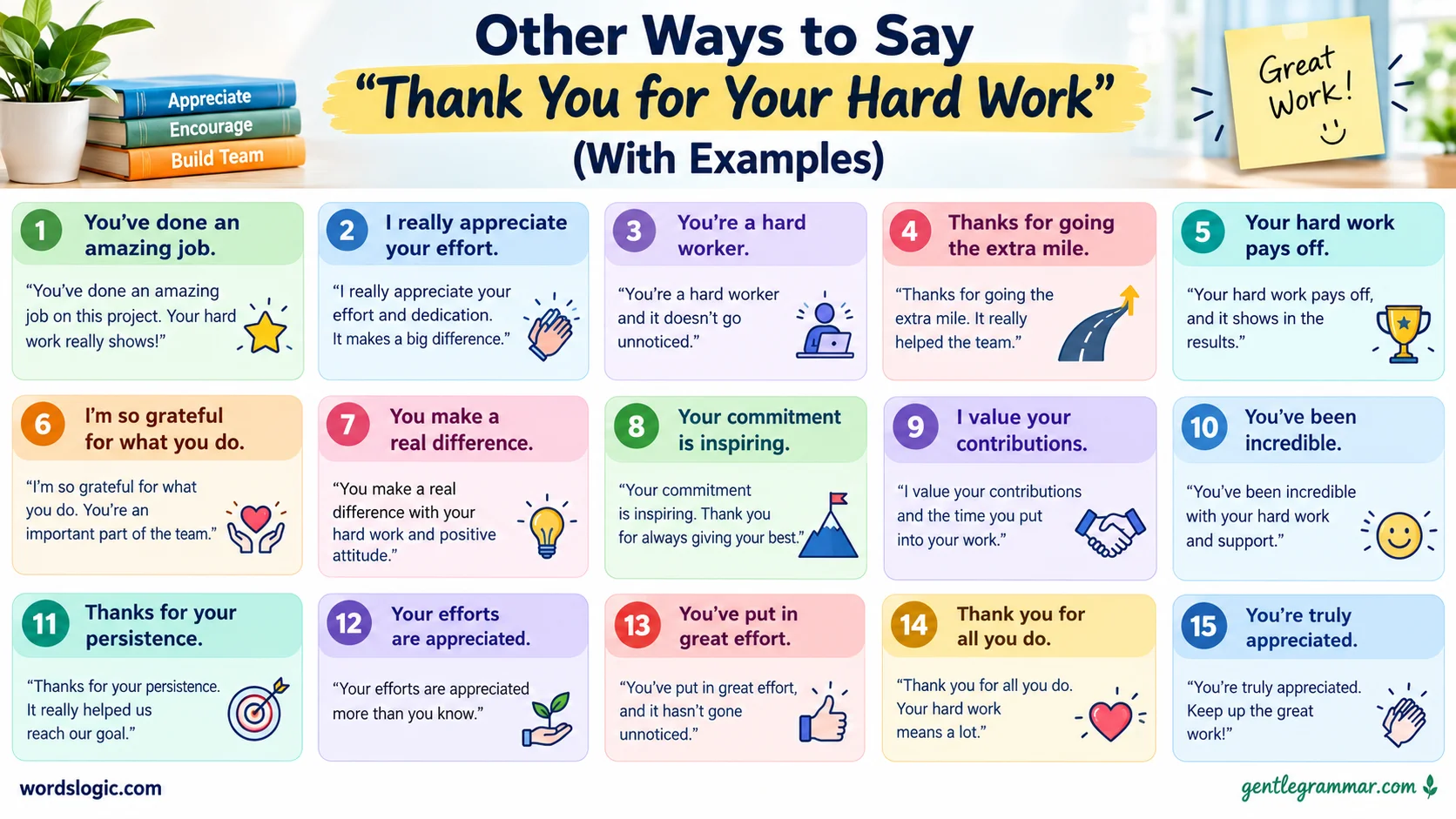
A sincere acknowledgment of effort can make people feel valued and respected. When someone gives their time, energy, and attention to a task, simple appreciation phrases can show that their work matters.
For example, “I truly appreciate your dedication and the effort you put into this project” is a thoughtful appreciation message that recognizes both the result and the work behind it. In my experience with professional communication, the best appreciation expressions are specific, honest, and connected to what a person has actually done.
Whether you are acknowledging contributions, acknowledging dedication, or acknowledging hard work, your words should explain why the person’s help made a difference. This approach to appreciation at work supports respect, trust, teamwork, and a positive workplace culture. Managers can use it for appreciation for employees, while colleagues can express appreciation for coworkers, appreciation for team members, and appreciation for support through a short message.
What Does “Thank You for Your Hard Work” Mean?
“Thank you for your hard work” is an expression of gratitude and appreciation used to recognize the effort someone has put into a task, project, responsibility, or shared goal. It tells the person that you have noticed their contribution and value the time, energy, and dedication they invested.
In everyday English, this phrase can acknowledge anything from a colleague completing a demanding project to a student preparing carefully for an assignment. It focuses on the effort behind the outcome, not just the final result. Depending on the situation and delivery, it can sound professional, friendly, respectful, or heartfelt. It is especially useful when you want someone to know that their work has not gone unnoticed.
Common Situations Where “Thank You for Your Hard Work” Is Used
This phrase fits many situations where someone has made a meaningful effort.
- At work: A manager may thank an employee for meeting a deadline, supporting a team, or handling a difficult assignment.
- In team communication: A colleague might acknowledge the extra time others spent preparing a presentation or organizing an event.
- At school or university: A teacher can recognize students who worked diligently on a group project.
- In personal relationships: You might thank a partner or family member for taking on extra responsibilities or helping during a stressful period.
- In customer or business communication: A professional can acknowledge a client’s cooperation or a service provider’s efforts when the wording genuinely fits the situation.
- In messages and social media: A short note can publicly recognize someone’s contribution without sounding overly formal.
An alternative can make the message more specific. For example, “I appreciate your dedication” emphasizes commitment, while “Thank you for going the extra mile” recognizes effort beyond what was expected.
Is It Professional or Polite to Say “Thank You for Your Hard Work”?
Yes. “Thank you for your hard work” is both polite and professional in most workplace situations. It communicates appreciation without being overly formal, making it suitable for emails, team meetings, performance discussions, and everyday conversations with colleagues. Managers can use it to acknowledge employees, and coworkers can use it to recognize one another’s contributions.
The phrase is also warm enough for personal communication. However, if you want to highlight a particular achievement, you might say “Your contribution made a real difference.” If someone has shown consistent commitment, “I appreciate your dedication” may feel more meaningful. In formal writing, specific and sincere wording is usually more effective than exaggerated praise. The best expression depends on your relationship with the recipient, the effort involved, and the message you want to communicate.
Advantages and Disadvantages of Saying “Thank You for Your Hard Work”
Advantages
The phrase is clear, respectful, and versatile. It recognizes the effort someone has invested without requiring a lengthy explanation. It works in professional emails, spoken conversations, personal notes, and team messages. Because it is familiar and easy to understand, it is also useful for English learners. It can acknowledge both visible achievements and the less noticeable work that helped a project succeed.
Disadvantages
Although the expression is appropriate in many situations, it can sound general or routine if repeated without mentioning the person’s actual contribution. It may also focus on effort rather than results, so someone who delivered an important achievement might appreciate more specific recognition. In emotionally significant situations, the phrase alone may feel too brief. Adding a personal detail or choosing a more targeted expression can make your appreciation sound more genuine.
15 Alternatives to “Thank You for Your Hard Work”
- I Appreciate Your Efforts
- Thank You for Your Dedication
- I Appreciate Your Commitment
- Thanks for Going the Extra Mile
- Your Hard Work Is Truly Appreciated
- Thank You for All Your Help
- I’m Grateful for Your Contribution
- Thank You for Your Outstanding Work
- I Appreciate Everything You’ve Done
- Thank You for Your Time and Effort
- Your Efforts Made a Difference
- I’m Impressed by Your Dedication
- Thank You for Your Continued Support
- I Couldn’t Have Done It Without You
- You’ve Done a Fantastic Job
1. I Appreciate Your Efforts
Meaning
“I appreciate your efforts” expresses gratitude for the time, energy, and work someone has invested in a task. It acknowledges what the person has done, even if the outcome was not perfect.
Definition
A polite expression that recognizes and values someone’s attempt, contribution, or hard work.
Detailed Explanation
This expression sounds slightly more measured and professional than “Thank you for your hard work.” It is particularly useful when you want to acknowledge the process rather than judge the final result. The word “appreciate” communicates that the person’s contribution matters to you. It can also recognize work that happened behind the scenes.
Scenario Examples
Scenario 1: A workplace project
Example: “I appreciate your efforts in getting the presentation ready before the meeting.”
Scenario 2: A student struggling with an assignment
Example: “I appreciate your efforts to improve your writing this semester.”
Scenario 3: A team facing a difficult deadline
Example: “I appreciate everyone’s efforts to keep things moving during a challenging week.”
Best Use
Use this phrase in professional emails, team discussions, academic settings, and polite personal messages. It works particularly well when you want to recognize effort without making assumptions about the outcome.
Tone
Tone: Professional, respectful, appreciative.
It communicates sincere recognition without sounding overly emotional or exaggerated.
2. Thank You for Your Dedication
Meaning
“Thank you for your dedication” recognizes someone’s strong commitment and consistent effort toward a responsibility, goal, or organization.
Definition
A way to express gratitude for another person’s continued commitment to something important.
Detailed Explanation
Unlike general thanks for hard work, this phrase emphasizes loyalty, persistence, and commitment over time. It is especially suitable when someone has repeatedly demonstrated reliability or remained focused through difficulties. It sounds more formal and substantial than a casual thank-you. Use it when you want to recognize an ongoing pattern of effort rather than a single task.
Scenario Examples
Scenario 1: An employee completing a long-term project
Example: “Thank you for your dedication throughout this project. Your consistency helped us stay on track.”
Scenario 2: A volunteer supporting a community organization
Example: “Thank you for your dedication to helping families in our community.”
Scenario 3: A teacher supporting students
Example: “Thank you for your dedication to your students and their progress.”
Best Use
This expression works best in formal appreciation emails, staff recognition, volunteer acknowledgments, educational settings, and long-term professional relationships.
Tone
Tone: Respectful, sincere, formal.
The emphasis on dedication makes the message feel meaningful when someone’s commitment deserves recognition.
3. I Appreciate Your Commitment
Meaning
“I appreciate your commitment” acknowledges that someone has taken a responsibility seriously and remained willing to work toward a goal.
Definition
A statement of gratitude for another person’s willingness to stay involved and follow through on an obligation.
Detailed Explanation
This phrase highlights dependability more than the amount of work completed. It is useful when a person has honored an agreement, stayed engaged with a team, or continued working toward a shared objective. Compared with “Thank you for your hard work,” it places greater emphasis on reliability and follow-through. It can sound professional without being stiff or overly formal.
Scenario Examples
Scenario 1: A team member meeting regular deadlines
Example: “I appreciate your commitment to keeping our weekly reports accurate and on time.”
Scenario 2: A business partner working toward a shared goal
Example: “We appreciate your commitment to finding a solution that works for both teams.”
Scenario 3: A colleague supporting a new initiative
Example: “I appreciate your commitment to making this transition as smooth as possible.”
Best Use
Choose this expression for business partnerships, ongoing projects, team responsibilities, and situations where consistency matters.
Tone
Tone: Professional, confident, appreciative.
It conveys respect for the person’s reliability and willingness to follow through.
4. Thanks for Going the Extra Mile
Meaning
“Thanks for going the extra mile” recognizes someone who has done more than was expected to help, solve a problem, or achieve a goal.
Definition
An informal expression of gratitude for making an additional effort beyond normal responsibilities.
Detailed Explanation
This phrase is more specific than a general thank-you because it suggests that the person exceeded expectations. It is especially effective when someone volunteered extra time, found a creative solution, or helped others without being asked. The expression is conversational and upbeat, so it may feel more natural in a friendly workplace than in a highly formal letter. Use it when the additional effort is genuine rather than simply part of someone’s regular duties.
Scenario Examples
Scenario 1: A colleague helping after hours
Example: “Thanks for going the extra mile to make sure the client received everything before the deadline.”
Scenario 2: A friend helping with a move
Example: “Thanks for going the extra mile and helping me unpack everything, too.”
Scenario 3: An employee improving a customer experience
Example: “You went the extra mile to resolve that issue, and I really appreciate it.”
Best Use
Use this phrase in friendly workplace messages, informal recognition, customer service appreciation, and personal conversations.
Tone
Tone: Warm, upbeat, conversational.
It adds enthusiasm and specifically recognizes effort beyond what was expected.
5. Your Hard Work Is Truly Appreciated
Meaning
“Your hard work is truly appreciated” tells someone that their effort is noticed and valued, even if you do not describe every part of their contribution.
Definition
A statement expressing sincere recognition of the work another person has completed or continues to perform.
Detailed Explanation
This wording places the emphasis on the value of the person’s work rather than on the speaker’s act of saying thanks. It can sound reassuring when employees or teammates need to know that their contributions are recognized. The word “truly” adds warmth and sincerity, although it is best used when the appreciation is genuine. It is a useful choice for group messages or situations where several people deserve acknowledgment.
Scenario Examples
Scenario 1: A manager addressing a team
Example: “Your hard work is truly appreciated, especially during this busy period.”
Scenario 2: A project coordinator thanking volunteers
Example: “Your hard work is truly appreciated, and your contribution helped us complete the event.”
Scenario 3: A colleague recognizing behind-the-scenes work
Example: “Your hard work is truly appreciated. The preparation you did made today’s meeting much easier.”
Best Use
This phrase fits team announcements, workplace emails, appreciation notes, and messages recognizing collective effort.
Tone
Tone: Sincere, reassuring, professional.
It emphasizes that the effort matters and has not gone unnoticed.
6. Thank You for All Your Help
Meaning
“Thank you for all your help” expresses gratitude for the assistance and support someone has provided.
Definition
A friendly expression used to thank a person for helping with a task, problem, or responsibility.
Detailed Explanation
This alternative focuses on help rather than hard work itself. It is especially suitable when someone has assisted you directly, shared their knowledge, or made a difficult task easier. The wording is less formal and more personal than some workplace appreciation phrases. It is not an exact substitute when you want to recognize someone’s independent effort, but it works naturally when their contribution involved supporting you.
Scenario Examples
Scenario 1: A coworker explaining a new system
Example: “Thank you for all your help while I was learning the new software.”
Scenario 2: A friend helping organize a celebration
Example: “Thank you for all your help with the decorations. I couldn’t have finished everything on time alone.”
Scenario 3: A classmate assisting with a group assignment
Example: “Thank you for all your help with the research and slides.”
Best Use
Use it in personal messages, friendly emails, teamwork, school projects, and everyday conversations.
Tone
Tone: Friendly, warm, straightforward.
Its simple wording makes appreciation feel natural without sounding overly formal.
7. I’m Grateful for Your Contribution
Meaning
“I’m grateful for your contribution” recognizes the specific value someone has added to a project, group, or shared effort.
Definition
A statement expressing sincere thanks for another person’s part in achieving a goal or completing an activity.
Detailed Explanation
This expression is particularly useful when you want to recognize what someone brought to a team rather than simply how hard they worked. Their contribution might involve expertise, creativity, time, practical assistance, or a useful idea. The word “contribution” makes the message sound somewhat more formal and focused on the person’s impact. It is suitable for individual recognition as well as professional acknowledgments.
Scenario Examples
Scenario 1: A colleague suggesting a useful solution
Example: “I’m grateful for your contribution to the planning process. Your suggestion helped us identify a better approach.”
Scenario 2: A community event organizer thanking a participant
Example: “We’re grateful for your contribution to this year’s fundraiser.”
Scenario 3: A team leader recognizing a specialist
Example: “I’m grateful for your contribution to the report, particularly your careful analysis of the data.”
Best Use
Choose this phrase for project summaries, formal thank-you emails, collaborative work, community activities, and professional recognition.
Tone
Tone: Thoughtful, respectful, professional.
It recognizes the importance of someone’s input without exaggerating their role.
8. Thank You for Your Outstanding Work
Meaning
“Thank you for your outstanding work” expresses gratitude while also praising the exceptional quality of someone’s performance.
Definition
An appreciative statement recognizing work that is especially effective, impressive, or high in quality.
Detailed Explanation
This expression goes beyond acknowledging effort because “outstanding” evaluates the quality of the work. It is appropriate when someone has delivered a particularly strong result, handled a difficult assignment skillfully, or produced work that stands out. It is stronger than a routine thank-you, so it should be reserved for situations where the praise is justified. If the goal is simply to recognize persistence, a less evaluative expression may be more accurate.
Scenario Examples
Scenario 1: A designer completing a successful campaign
Example: “Thank you for your outstanding work on the campaign. The final materials are clear and polished.”
Scenario 2: A student presenting a well-researched project
Example: “Thank you for your outstanding work on this presentation. Your research was thorough.”
Scenario 3: An employee solving a complex problem
Example: “Thank you for your outstanding work in resolving the issue so efficiently.”
Best Use
Use this phrase for performance recognition, completed projects, professional praise, and situations involving demonstrably high-quality work.
Tone
Tone: Appreciative, complimentary, professional.
It conveys stronger praise than a standard expression of thanks.
9. I Appreciate Everything You’ve Done
Meaning
“I appreciate everything you’ve done” expresses broad gratitude for the many actions and efforts someone has contributed over time.
Definition
A personal statement recognizing the full range of another person’s help, effort, or support.
Detailed Explanation
This wording feels more personal than thanking someone for a single task. It is especially useful when a person’s contribution includes several small actions that are difficult to summarize individually. The phrase can also carry emotional warmth when someone has supported you during a demanding period. Because it is broad, adding a specific detail can make the appreciation more memorable and sincere.
Scenario Examples
Scenario 1: A colleague covering several responsibilities
Example: “I appreciate everything you’ve done to help the team manage this transition.”
Scenario 2: A family member providing practical support
Example: “I appreciate everything you’ve done for us over the past few weeks.”
Scenario 3: A friend helping with an important event
Example: “I appreciate everything you’ve done to make the day special.”
Best Use
This phrase works well in personal notes, farewell messages, meaningful workplace acknowledgments, and situations involving several acts of support.
Tone
Tone: Warm, heartfelt, appreciative.
It communicates gratitude for the bigger picture rather than focusing on one isolated task.
10. Thank You for Your Time and Effort
Meaning
“Thank you for your time and effort” recognizes both the time someone gave and the work they put into a task.
Definition
A polite expression of gratitude for another person’s attention, availability, and practical effort.
Detailed Explanation
This phrase is especially useful when someone has attended a meeting, reviewed a document, answered questions, or helped with a task that required their time and concentration. It recognizes two different things: their willingness to make time and their effort in using that time productively. Compared with a general thank-you, it is more specific about the resources someone contributed. It is also a natural choice when you do not know the full extent of the work involved.
Scenario Examples
Scenario 1: A colleague reviewing a proposal
Example: “Thank you for your time and effort in reviewing the proposal before submission.”
Scenario 2: A job applicant attending an interview
Example: “Thank you for your time and effort throughout the interview process.”
Scenario 3: A volunteer attending a planning session
Example: “Thank you for your time and effort in helping us prepare for the workshop.”
Best Use
Use it in professional emails, interviews, consultations, meetings, volunteer coordination, and formal requests for feedback.
Tone
Tone: Polite, respectful, professional.
It acknowledges both the person’s availability and the work they contributed.
11. Your Efforts Made a Difference
Meaning
“Your efforts made a difference” tells someone that their work had a positive and noticeable impact.
Definition
A statement recognizing that another person’s actions helped improve a situation or achieve a meaningful result.
Detailed Explanation
This expression focuses on the effect of the person’s work rather than on the effort alone. It can be particularly encouraging when someone has spent time solving a problem or helping others through a difficult situation. Unlike a general thank-you, it explains why the contribution mattered. Use it when you can identify a genuine result, whether that means a smoother process, a successful event, or practical help for another person.
Scenario Examples
Scenario 1: An employee improving a process
Example: “Your efforts made a difference in how quickly we handle customer requests.”
Scenario 2: A volunteer supporting a local project
Example: “Your efforts made a difference to the families who attended the event.”
Scenario 3: A teammate helping resolve a disagreement
Example: “Your efforts made a difference in helping everyone reach an agreement.”
Best Use
Choose this phrase for team feedback, volunteer appreciation, project updates, encouragement, and situations where the impact can be identified.
Tone
Tone: Encouraging, sincere, positive.
It connects someone’s effort to a meaningful outcome, helping the appreciation feel specific.
12. I’m Impressed by Your Dedication
Meaning
“I’m impressed by your dedication” communicates admiration for someone’s commitment, persistence, and willingness to keep working toward a goal.
Definition
An expression of respect that acknowledges another person’s sustained commitment or determination.
Detailed Explanation
Unlike a straightforward thank-you, this phrase expresses the speaker’s admiration as well as appreciation. It is useful when someone has shown patience, stayed focused during a setback, or continued working toward a demanding objective. The wording can feel more personal because it describes your reaction to the person’s commitment. However, it is not simply a synonym for gratitude: it highlights respect and admiration more strongly than thanks.
Scenario Examples
Scenario 1: A colleague working through a challenging assignment
Example: “I’m impressed by your dedication to getting the details right, even under a tight deadline.”
Scenario 2: A student developing a difficult skill
Example: “I’m impressed by your dedication to practicing every week.”
Scenario 3: A team member supporting a long-term initiative
Example: “I’m impressed by your dedication to keeping this project moving forward.”
Best Use
Use it in mentoring, performance feedback, academic encouragement, and professional or personal conversations about sustained effort.
Tone
Tone: Respectful, admiring, encouraging.
It communicates that you value not only the work but also the commitment behind it.
13. Thank You for Your Continued Support
Meaning
“Thank you for your continued support” expresses gratitude for someone’s ongoing assistance, cooperation, or encouragement.
Definition
A polite expression used to recognize support that has continued over a period of time.
Detailed Explanation
This phrase focuses on support rather than work itself, making it especially appropriate for relationships that involve repeated cooperation. It can acknowledge a colleague who regularly helps a team, a business partner who remains involved in a project, or a person who provides encouragement over time. The word “continued” suggests an established relationship or a pattern of support. It is less suitable when thanking someone for a single task with no broader context.
Scenario Examples
Scenario 1: A manager writing to a team
Example: “Thank you for your continued support as we introduce the new workflow.”
Scenario 2: A business communicating with a long-term client
Example: “Thank you for your continued support and cooperation throughout the year.”
Scenario 3: A friend helping during a difficult period
Example: “Thank you for your continued support. It means a lot to know I can count on you.”
Best Use
This expression fits business correspondence, long-term projects, customer relationships, team communication, and personal messages about ongoing support.
Tone
Tone: Polite, appreciative, reassuring.
It recognizes an ongoing relationship rather than a one-time act of effort.
14. I Couldn’t Have Done It Without You
Meaning
“I couldn’t have done it without you” tells someone that their help was important to your success or completion of a task.
Definition
A heartfelt expression of gratitude that emphasizes how much another person’s assistance mattered.
Detailed Explanation
This phrase is more personal and emotionally expressive than a standard acknowledgment of hard work. It works best when the other person genuinely played an important role in helping you complete something. It may refer to practical assistance, encouragement, specialist knowledge, or teamwork. Because it gives the other person significant credit, avoid using it when their contribution was minor or when the result was primarily your own achievement.
Scenario Examples
Scenario 1: A coworker helping with a demanding presentation
Example: “I couldn’t have done it without you. Thanks for helping me organize the final slides.”
Scenario 2: A friend helping with a major move
Example: “I couldn’t have done it without you. Moving everything in one day would have been impossible alone.”
Scenario 3: A project partner working alongside you
Example: “I couldn’t have done it without you. Your research helped us finish the report on time.”
Best Use
Choose this expression for close teamwork, personal favors, shared achievements, and situations where someone’s help was genuinely important.
Tone
Tone: Heartfelt, personal, grateful.
It makes the recipient’s importance clear and is warmer than a conventional workplace thank-you.
15. You’ve Done a Fantastic Job
Meaning
“You’ve done a fantastic job” praises someone for performing a task or completing work particularly well.
Definition
An enthusiastic expression of approval for the quality of someone’s work or performance.
Detailed Explanation
This phrase emphasizes achievement and quality more than effort alone. It is a good choice when someone has completed a task successfully, delivered a strong presentation, or handled a responsibility with skill. The word “fantastic” makes the praise enthusiastic and conversational rather than highly formal. Although it can accompany gratitude, it is primarily a compliment, so adding a direct thank-you may be appropriate when you want to express both ideas.
Scenario Examples
Scenario 1: A colleague delivering a presentation
Example: “You’ve done a fantastic job with the presentation. The key points were easy to follow.”
Scenario 2: A student completing an assignment
Example: “You’ve done a fantastic job explaining your ideas in this essay.”
Scenario 3: An employee completing an important task
Example: “You’ve done a fantastic job organizing the event. Everything ran smoothly.”
Best Use
Use it for everyday praise, team feedback, educational encouragement, successful projects, and informal professional recognition.
Tone
Tone: Enthusiastic, encouraging, complimentary.
It celebrates the quality of the result and helps the person feel recognized for a job well done.
FAQs:
What is another way to say “Thank You for Your Hard Work”?
You can say “I appreciate your efforts,” “Thank you for your dedication,” or “Your hard work is truly appreciated.” For a more personal message, “I appreciate everything you’ve done” is a warm choice. Select the expression that best reflects the person’s contribution and your relationship with them.
What does “Thank You for Your Hard Work” mean?
It means you are grateful for the time, energy, and effort someone has invested in a task or responsibility. The phrase recognizes the work behind an outcome and lets the person know that their contribution matters.
Is “Thank You for Your Hard Work” professional?
Yes. It is a polite, professional, and widely appropriate expression for workplace emails, team meetings, employee recognition, and conversations with colleagues. Adding a specific detail about someone’s contribution can make the appreciation more meaningful.
What is a more polite way to say “Thank You for Your Hard Work”?
“Thank you for your time and effort” is a polite option, especially in formal communication. “I appreciate your commitment” is also suitable when recognizing someone’s reliability, while “I’m grateful for your contribution” works well in professional correspondence.
Which alternative works best in formal communication?
“Thank you for your dedication” is an excellent choice when acknowledging sustained commitment. For a specific contribution to a project, “I’m grateful for your contribution” is also appropriate. In either case, mentioning what the person accomplished makes the message clearer and more sincere.
Conclusion:
Expressing appreciation is about more than choosing polite words. The right message helps people understand that their time, effort, dedication, and contributions are valued. While “Thank You for Your Hard Work” is suitable for most professional and personal situations, alternatives can communicate more specific feelings. You might acknowledge someone’s commitment, recognize exceptional results, appreciate ongoing support, or explain how their efforts made a difference.
Before choosing an expression, consider your relationship with the recipient, the situation, and the feeling you want to convey. A formal email may call for measured wording, while a personal message may benefit from a warmer approach. Most importantly, make your appreciation genuine and specific. A short, thoughtful message that recognizes what someone actually did often means more than elaborate praise.
