
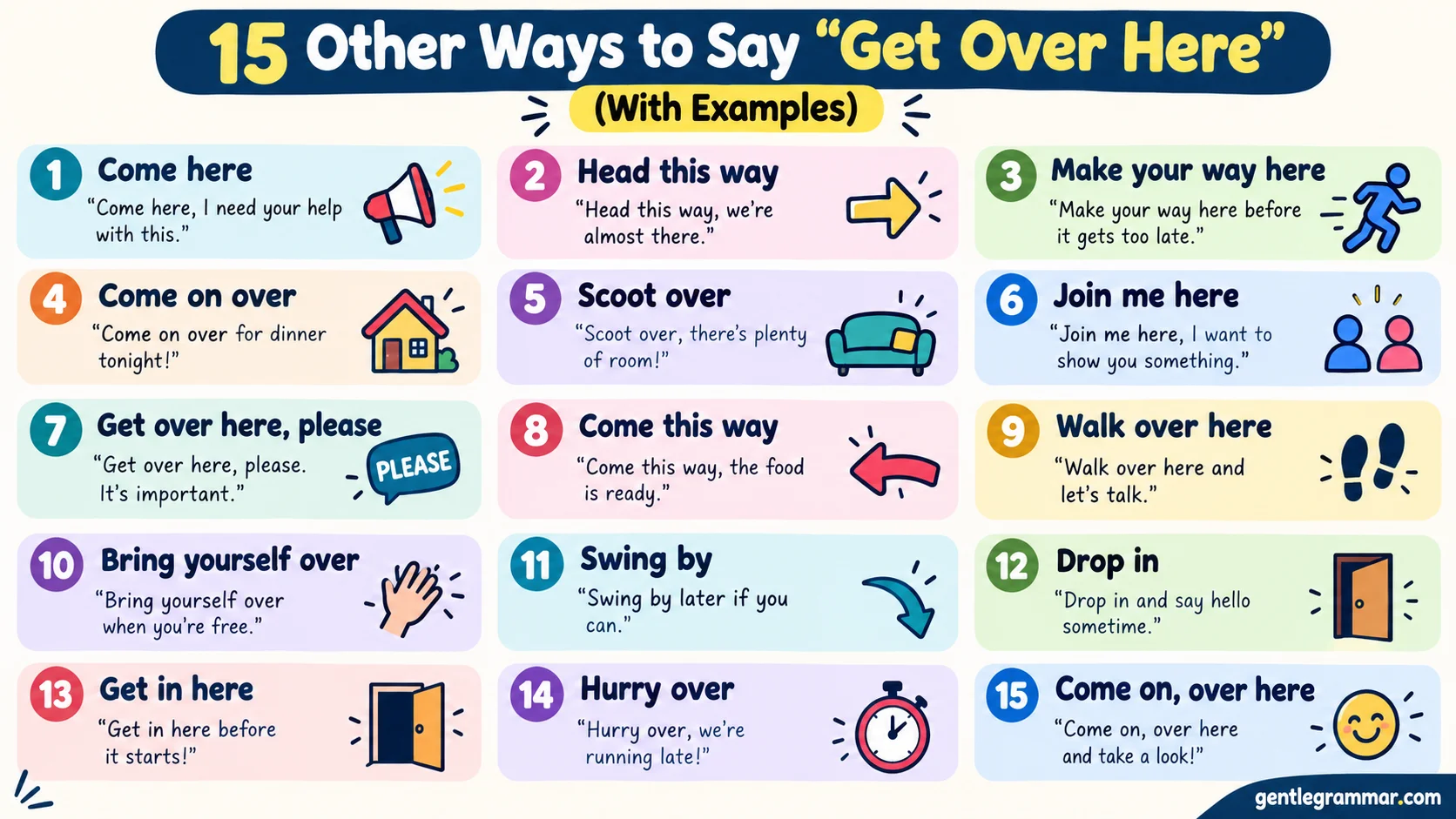
Learning 15 Other Ways to Say “Get Over Here” (With Examples) can help you choose words that sound natural, friendly, polite, or urgent in different situations.
In everyday conversations, I have found that “Get Over Here” can change the entire feel of an interaction depending on the tone, situation, and relationship. This direct expression can grab attention and create immediate engagement, but it may sound commanding, overly direct, or even robotic when a softer approach is needed. Whether you are texting a friend, speaking to a family member, calling a coworker, or inviting someone closer, the right words help you communicate your intention with greater clarity.
In casual chats, formal settings, and professional conversations, consider politeness, familiarity, urgency, and personality before choosing your words. This guide explores 15 alternatives, their meanings, definitions, and realistic examples to help you choose the right phrase for each situation and improve your communication skills.
What Does “Get Over Here” Mean?
“Get over here” means come to this place or move closer to me. People use it when they want someone to approach their current location, usually within the same room, building, or nearby area. The expression is informal and direct, and it often assumes that the speaker and listener are familiar with each other. Depending on the situation, it can communicate excitement, affection, impatience, urgency, or authority. For example, a friend might say it after spotting someone across a room, while a parent might use it to call a child who is wandering away. Although the phrase is not automatically rude, its commanding wording can sound harsh if spoken angrily or used with someone who expects a more respectful request.
Common Situations Where “Get Over Here” Is Used
This expression commonly appears in everyday conversations, family interactions, friendships, romantic relationships, and casual text messages. Someone might use it when they have exciting news to share, want a friend to join a group, or need a loved one nearby. In playful situations, it can express enthusiasm or affection. In more serious circumstances, it may communicate that someone’s immediate attention is needed.
At work or school, the phrase can also be understood, but its directness may not suit every relationship. A teacher, manager, or colleague might prefer a clearer and more courteous expression when asking someone to approach. In customer communication and formal writing, alternatives are generally more appropriate because they communicate the request without sounding demanding. Choosing the right wording depends on your relationship with the listener, the urgency of the situation, and the level of respect or warmth you want to convey.
Is It Professional or Polite to Say “Get Over Here”?
“Get over here” is generally casual and direct rather than formally polite. Among close friends, siblings, or partners, it can sound natural, playful, or affectionate. Its tone depends heavily on facial expressions, voice, and the relationship between the people speaking. Said with a smile, it might be an enthusiastic invitation; delivered sharply, it can sound like an order.
In professional settings, the expression may be too forceful, particularly when speaking to a supervisor, client, customer, or unfamiliar colleague. Phrases such as “Could you come over here, please?” or “Could you join me for a moment?” are usually more considerate. When urgency matters, a direct request can still be appropriate, but clear and respectful wording helps prevent unnecessary tension.
Advantages and Disadvantages of Saying “Get Over Here”
Advantages
The main advantage of “get over here” is its clarity. It quickly tells someone to move closer without requiring a long explanation. The expression works well in informal conversations, especially when the speaker and listener already understand each other. It can also communicate excitement, playful teasing, or urgency through the speaker’s tone of voice.
Disadvantages
The phrase can sound bossy, impatient, or confrontational when used without a friendly tone. It may not be suitable for professional conversations, formal requests, or situations where the other person deserves more courtesy. It also leaves little room for the listener to decline or ask whether the request is convenient. Choosing a softer alternative can make the same invitation feel more welcoming and respectful.
Synonyms for “Get Over Here”
- Come here.
- Come over here, please.
- Could you come over here?
- Come this way.
- Come closer.
- Come join me.
- Come over for a moment.
- Step over here.
- Can you come here for a second?
- Would you mind coming over?
- Join me over here.
- Get over this way.
- Hurry over here.
- Come see this.
- Get over here a minute.
1. Come here.
Meaning
“Come here” means move toward the person speaking. It communicates the same basic idea as “get over here,” but it can sound more neutral and less forceful.
Definition
A direct expression used to ask or tell someone to approach the speaker.
Detailed Explanation
This phrase is common in everyday spoken English. It can express affection, curiosity, or a simple need to talk, depending on how it is delivered. Unlike the original expression, it does not emphasize the act of getting to a location as strongly. It is suitable when you want to keep your message short and clear without sounding unnecessarily intense.
Scenario Examples
– Scenario: A friend wants to show you something on their phone.
Example: “Come here. You have to see this picture!”
– Scenario: A parent calls their child from the next room.
Example: “Come here, sweetheart. I want to tell you something.”
– Scenario: A partner wants to share a private moment.
Example: “Come here and give me a hug.”
Best Use
Use this expression in casual conversation, family interactions, and close relationships. It also works when a quick, straightforward request is more useful than a long explanation.
Tone
Tone: Direct, familiar, flexible.
Its tone can be warm or commanding, so your voice and relationship with the listener matter.
2. Come over here, please.
Meaning
“Come over here, please” asks someone to approach while adding a polite word. It keeps the direct meaning of the original expression but makes the request more considerate.
Definition
A courteous request for someone to move to the speaker’s location.
Detailed Explanation
The word “please” softens the instruction and shows consideration for the other person. This wording is useful when you need someone’s attention without sounding impatient. It is not highly formal, but it can be appropriate in many everyday professional and personal situations. Compared with the original phrase, it places more emphasis on courtesy than urgency.
Scenario Examples
– Scenario: A colleague is standing across the office.
Example: “Come over here, please. I’d like to show you the updated document.”
– Scenario: A parent calls children to the dinner table.
Example: “Come over here, please. Dinner is ready.”
– Scenario: A shop assistant needs to speak with a customer nearby.
Example: “Come over here, please, so I can help you with that item.”
Best Use
Choose this expression for polite everyday requests, conversations with colleagues, and situations where you want to sound clear without being harsh.
Tone
Tone: Courteous, direct, respectful.
The added politeness makes the instruction gentler, although it remains a fairly direct request.
3. Could you come over here?
Meaning
“Could you come over here?” asks someone to approach in the form of a question. It sounds less commanding than telling someone to move.
Definition
A polite question asking whether someone can come to the speaker’s location.
Detailed Explanation
This expression gives the listener more room to respond than a direct command. It is especially useful when the person may be busy or you want to acknowledge their time. The phrase is generally suitable for workplace conversations as well as everyday interactions. Although it is grammatically a question, it usually functions as a request rather than a question about physical ability.
Scenario Examples
– Scenario: You need a coworker’s help with a spreadsheet.
Example: “Could you come over here? I’m having trouble with this formula.”
– Scenario: A student wants to ask a teacher something privately.
Example: “Could you come over here for a moment? I have a question about the assignment.”
– Scenario: You are talking to a friend at a gathering.
Example: “Could you come over here? I want you to meet someone.”
Best Use
Use it in professional communication, classrooms, social gatherings, and conversations where politeness is important.
Tone
Tone: Polite, considerate, neutral.
The question format makes the request sound less forceful and more appropriate when speaking to someone you do not know well.
4. Come this way.
Meaning
“Come this way” directs someone toward a particular direction or location. Unlike “get over here,” it can guide someone without necessarily emphasizing that they must approach the speaker immediately.
Definition
An expression used to guide a person along a particular route or toward a specific place.
Detailed Explanation
This phrase is particularly helpful when you want someone to follow you or move toward a designated area. It is common in settings where people need guidance, such as offices, shops, schools, and events. The wording sounds less personal and more directional than the original phrase. It is not always a direct synonym because it may refer to a route rather than movement toward the speaker.
Scenario Examples
– Scenario: A receptionist guides a visitor to an office.
Example: “Come this way, and I’ll show you where the meeting is taking place.”
– Scenario: A friend leads the group toward a quieter area.
Example: “Come this way. There’s more room near the garden.”
– Scenario: A teacher directs students toward the classroom entrance.
Example: “Come this way, everyone. We’ll begin the activity inside.”
Best Use
It works best for giving directions, guiding visitors, leading groups, and helping people find a particular place.
Tone
Tone: Helpful, guiding, composed.
The expression sounds natural when the speaker is leading the way rather than summoning someone impatiently.
5. Come closer.
Meaning
“Come closer” means move nearer to the speaker or another person. It focuses on reducing the physical distance between people rather than simply arriving at a particular location.
Definition
A request or instruction to move nearer to someone or something.
Detailed Explanation
This expression is useful when someone is already nearby but needs to move within a shorter distance. It can feel affectionate in a personal relationship or practical when someone needs to hear or see something clearly. However, it can also sound intense if the context is uncomfortable or the speaker has authority over the listener. Unlike the original phrase, it emphasizes proximity, not necessarily coming to a different location.
Scenario Examples
– Scenario: Someone is speaking quietly in a noisy room.
Example: “Come closer so I can hear what you’re saying.”
– Scenario: A parent wants to take a family photograph.
Example: “Come closer, everyone. Let’s fit into the picture.”
– Scenario: A partner wants a more affectionate moment.
Example: “Come closer. I want to hold your hand.”
Best Use
Use it when someone needs to be nearer for conversation, photographs, affection, or practical reasons.
Tone
Tone: Intimate, gentle, or direct.
The surrounding situation determines whether the phrase feels romantic, friendly, or purely practical.
6. Come join me.
Meaning
“Come join me” invites someone to be with you or take part in an activity. It is warmer and more inclusive than “get over here.”
Definition
An invitation for someone to come to the speaker and participate in something or spend time together.
Detailed Explanation
This expression emphasizes participation and companionship rather than simply changing someone’s location. It is a natural choice when you want another person to sit with you, take part in a conversation, or enjoy an activity. Unlike the original phrase, it generally sounds more inviting than commanding. However, it is most appropriate when you genuinely want the person to participate, not when you need to give an urgent instruction.
Scenario Examples
– Scenario: You are sitting alone during a break at work.
Example: “Come join me. There’s an empty chair right here.”
– Scenario: A friend is standing away from a group playing a game.
Example: “Come join me! We’re about to start another round.”
– Scenario: A family member is preparing tea.
Example: “Come join me in the kitchen while I make some tea.”
Best Use
Use this expression for social invitations, shared activities, friendly gatherings, and relaxed workplace interactions.
Tone
Tone: Warm, welcoming, inclusive.
The phrase communicates that the other person is wanted and welcome, rather than simply being summoned.
7. Come over for a moment.
Meaning
“Come over for a moment” asks someone to approach or visit briefly. It suggests that the interaction will probably be short.
Definition
A request for someone to come to the speaker for a short conversation or task.
Detailed Explanation
This expression helps communicate that you do not intend to keep the person for long. It can be useful when you need to explain something, ask a quick question, or share a small piece of information. Compared with “get over here,” it sounds more measured and less abrupt. It can also refer to visiting someone’s home, depending on the context, so the surrounding sentence helps clarify the intended meaning.
Scenario Examples
– Scenario: A manager needs to clarify a small detail.
Example: “Come over for a moment so we can review this figure.”
– Scenario: A friend is in the next room.
Example: “Come over for a moment. I want your opinion on something.”
– Scenario: A neighbor is standing outside.
Example: “Come over for a moment if you’re free. I’d like to show you the new plants.”
Best Use
Choose it for brief conversations, quick questions, and informal invitations where the expected time commitment is small.
Tone
Tone: Calm, practical, conversational.
The phrase sounds less urgent than the original because it frames the interaction as a short, manageable request.
8. Step over here.
Meaning
“Step over here” tells someone to move to a nearby spot. It often suggests a short physical movement rather than a longer journey.
Definition
A direct instruction to move a short distance to a specified place.
Detailed Explanation
The word “step” gives this expression a physical, immediate quality. It can be useful when showing someone an object, moving them out of a busy area, or asking them to stand beside you. In certain situations, it may sound authoritative, particularly when used by a supervisor, teacher, or security officer. It is more specific than “get over here” because it often implies a nearby position and a relatively small movement.
Scenario Examples
– Scenario: A photographer adjusts a person’s position.
Example: “Step over here so the light falls better on your face.”
– Scenario: A teacher needs to speak with a student briefly.
Example: “Step over here after class, please.”
– Scenario: A friend wants to show you a detail on a wall.
Example: “Step over here and look at this little mark.”
Best Use
Use it for physical positioning, demonstrations, quick adjustments, and situations where someone only needs to move a short distance.
Tone
Tone: Direct, practical, sometimes authoritative.
Adding a polite word or using a friendly voice can soften the instruction.
9. Can you come here for a second?
Meaning
“Can you come here for a second?” asks someone to approach for a brief interaction. It sounds conversational and often suggests that the speaker has a quick question or something to show.
Definition
An informal request for someone to come over briefly.
Detailed Explanation
This phrase is common in spoken English because it makes a request feel manageable. The expression “for a second” is usually figurative; the interaction may take longer than one actual second. It is less forceful than the original phrase, although the wording can still sound impatient if delivered sharply. It is especially useful when you want to get someone’s attention without making the request seem overly serious.
Scenario Examples
– Scenario: A sibling is in another part of the house.
Example: “Can you come here for a second? I need help opening this jar.”
– Scenario: A coworker is finishing a task nearby.
Example: “Can you come here for a second? I want to check one detail with you.”
– Scenario: A friend is looking at their phone.
Example: “Can you come here for a second? You’ll laugh when you see this.”
Best Use
Use it in casual conversations, quick workplace discussions, and everyday situations where you need a brief moment of someone’s attention.
Tone
Tone: Casual, friendly, mildly direct.
Its question format softens the request, while the reference to a short time makes it feel convenient.
10. Would you mind coming over?
Meaning
“Would you mind coming over?” is a courteous way to ask someone to approach or visit. It emphasizes consideration for the listener rather than giving a direct instruction.
Definition
A polite question asking whether someone is willing to come to the speaker’s location.
Detailed Explanation
This wording is more deferential than “get over here” because it acknowledges that the other person may have other priorities. It works well when you want to avoid sounding demanding, particularly in unfamiliar or professional relationships. Depending on context, “coming over” can mean moving across a room or visiting someone’s home. The expression is not usually the best choice for an emergency because its polite phrasing may sound less immediate.
Scenario Examples
– Scenario: A colleague is working at another desk.
Example: “Would you mind coming over? I’d appreciate your thoughts on this proposal.”
– Scenario: You want a friend to visit your home.
Example: “Would you mind coming over this afternoon? I could use some company.”
– Scenario: A family member is nearby at a gathering.
Example: “Would you mind coming over for a moment? There’s something I’d like to discuss.”
Best Use
It is well suited to polite requests, workplace conversations, invitations, and situations where you want to show consideration.
Tone
Tone: Courteous, gentle, respectful.
The phrasing gives the listener more freedom to respond, making it less commanding than the original.
11. Join me over here.
Meaning
“Join me over here” invites or directs someone to come to the speaker’s location and be part of the same activity or conversation.
Definition
An invitation to move to the speaker’s location and share an activity or conversation.
Detailed Explanation
This phrase combines a clear location with a sense of inclusion. It works especially well when the speaker is already doing something and wants another person to participate. Compared with “get over here,” it feels more cooperative because it focuses on being together rather than simply obeying an instruction. It can be used at social events, during group activities, and in relaxed professional situations.
Scenario Examples
– Scenario: A colleague is reviewing a presentation with the team.
Example: “Join me over here, and we can go through the final slides together.”
– Scenario: A friend has found a comfortable place at a picnic.
Example: “Join me over here. There’s plenty of room on the blanket.”
– Scenario: A family member is helping prepare a celebration.
Example: “Join me over here while we decorate the table.”
Best Use
Choose it for group activities, collaborative work, gatherings, and friendly invitations.
Tone
Tone: Inclusive, friendly, cooperative.
The emphasis on joining creates a feeling of shared participation instead of a simple command.
12. Get over this way.
Meaning
“Get over this way” tells someone to move in the speaker’s direction or toward a particular nearby area. It is a colloquial alternative that retains much of the original phrase’s directness.
Definition
An informal instruction to move toward the speaker or a specified location.
Detailed Explanation
This expression is conversational and may be more common in some dialects or regional speech patterns than others. It can sound natural among friends or family members who use direct, informal language. However, it is not necessarily more polite than “get over here,” because the word “get” still gives the instruction a commanding quality. It is best used when the listener already understands the location and the informal tone is appropriate.
Scenario Examples
– Scenario: A friend is standing near the entrance of a crowded room.
Example: “Get over this way so we can hear each other.”
– Scenario: A family member is calling someone toward the garden.
Example: “Get over this way; the flowers are starting to bloom.”
– Scenario: A group is arranging itself for a photograph.
Example: “Get over this way so everyone fits in the frame.”
Best Use
Use it in informal spoken English, especially when giving straightforward directions to people you know well.
Tone
Tone: Casual, direct, colloquial.
It preserves the original phrase’s urgency and informality, so it is not the best option for formal requests.
13. Hurry over here.
Meaning
“Hurry over here” tells someone to approach quickly. Unlike the general request to come closer, it clearly communicates speed and urgency.
Definition
A direct instruction asking someone to move quickly to the speaker’s location.
Detailed Explanation
This expression is useful when time matters or when the speaker is excited about something happening. It can communicate enthusiasm when a friend has discovered something interesting, but it may sound demanding in a serious conversation. Unlike softer alternatives, it does not merely invite the person to approach; it asks them to do so quickly. For that reason, use it when the urgency is genuine or the relationship makes a lively command feel natural.
Scenario Examples
– Scenario: A friend spots a beautiful sunset.
Example: “Hurry over here! The sky looks incredible right now.”
– Scenario: Someone needs immediate help carrying a heavy object.
Example: “Hurry over here; I need another pair of hands.”
– Scenario: A family member is about to miss an important moment.
Example: “Hurry over here! They’re about to cut the birthday cake.”
Best Use
Use it when time is important, during exciting moments, or when quick action is genuinely needed. For serious emergencies, give specific instructions rather than relying on this phrase alone.
Tone
Tone: Urgent, energetic, emphatic.
The word “hurry” makes the request stronger and more time-sensitive than the original phrase.
14. Come see this.
Meaning
“Come see this” invites someone to approach because there is something worth looking at. The focus is on sharing what you have noticed, rather than simply moving the other person toward you.
Definition
An informal expression asking someone to come and look at something.
Detailed Explanation
This phrase is especially useful when you want to share a discovery, image, object, or interesting event. It gives the listener a reason to approach, which can make the request feel more engaging than a bare instruction. The expression may sound enthusiastic, curious, or urgent depending on the speaker’s delivery. It is not a complete substitute in every context because it specifically suggests that the person should look at something.
Scenario Examples
– Scenario: A friend finds a funny video.
Example: “Come see this. I think you’ll find it hilarious.”
– Scenario: A student notices an interesting detail in a science experiment.
Example: “Come see this before the reaction finishes.”
– Scenario: A homeowner discovers a problem in the garden.
Example: “Come see this crack in the wall; I think we should get it checked.”
Best Use
Choose it for sharing discoveries, showing photographs, demonstrating something, or drawing attention to an interesting detail.
Tone
Tone: Curious, engaging, conversational.
The phrase gives the listener a clear purpose for coming over, making it useful for both positive discoveries and practical concerns.
15. Get over here a minute.
Meaning
“Get over here a minute” asks someone to approach for a short conversation or task. It combines the original expression’s directness with the suggestion that the interaction will be brief.
Definition
An informal instruction for someone to come over for a short time.
Detailed Explanation
This expression is common in relaxed conversations and can be used when someone needs to ask a quick question or explain something in person. The words “a minute” suggest that the listener will not be occupied for long, although the conversation may take more than a minute. Like the original phrase, the wording can sound commanding if the speaker uses a sharp voice. It is more appropriate among familiar people than in formal communication, where a courteous request may work better.
Scenario Examples
– Scenario: A sibling wants to discuss weekend plans.
Example: “Get over here a minute. We need to decide what we’re doing on Saturday.”
– Scenario: A friend wants to point out a detail in a board game.
Example: “Get over here a minute; I think you’ve missed something.”
– Scenario: A parent needs to remind a child about an upcoming activity.
Example: “Get over here a minute so we can check your school schedule.”
Best Use
Use it in casual family conversations, friendships, and quick interactions with people who are comfortable with direct wording.
Tone
Tone: Informal, straightforward, familiar.
It suggests a brief interaction but retains the original expression’s commanding quality, so it may not suit a formal or sensitive situation.
FAQs:
What is another way to say “Get Over Here”?
Some natural alternatives include “Come here,” “Come over here, please,” “Could you come over here?” and “Come join me.” Choose a phrase based on whether you want to sound direct, polite, welcoming, or urgent.
What does “Get Over Here” mean?
“Get over here” means move toward the speaker or come to the speaker’s location. It is an informal expression that can communicate excitement, affection, impatience, or urgency depending on the context.
Is “Get Over Here” professional?
Generally, “get over here” is informal and direct, so it may sound too commanding in professional communication. A phrase such as “Could you come over here?” is often more suitable when speaking with colleagues, managers, or customers.
What is a more polite way to say “Get Over Here”?
“Would you mind coming over?” is a considerate alternative. You can also say “Come over here, please” when you want a polite but straightforward request.
Which alternative works best in formal communication?
“Could you come over here?” is a useful option for many professional situations because it makes the request sound courteous without being overly formal. When you need to discuss something specific, explaining the purpose of the request can make your wording even clearer.
Conclusion:
Choosing the right alternative to “get over here” helps you communicate your intentions without creating unnecessary tension. Although the original expression works well among friends and family, other phrases can make your request sound more welcoming, respectful, professional, or urgent. For instance, “Come here” is simple and direct, while “Would you mind coming over?” shows greater consideration. Similarly, “Come join me” emphasizes companionship, and “Hurry over here” communicates urgency.
The best expression depends on your relationship with the listener, the situation, and the tone you want to convey. Before choosing your words, consider whether you are giving directions, sharing something exciting, asking for help, or inviting someone to spend time with you. Understanding these differences will help you use everyday English more naturally and confidently. A small change in wording can make a request feel much more appropriate.
