
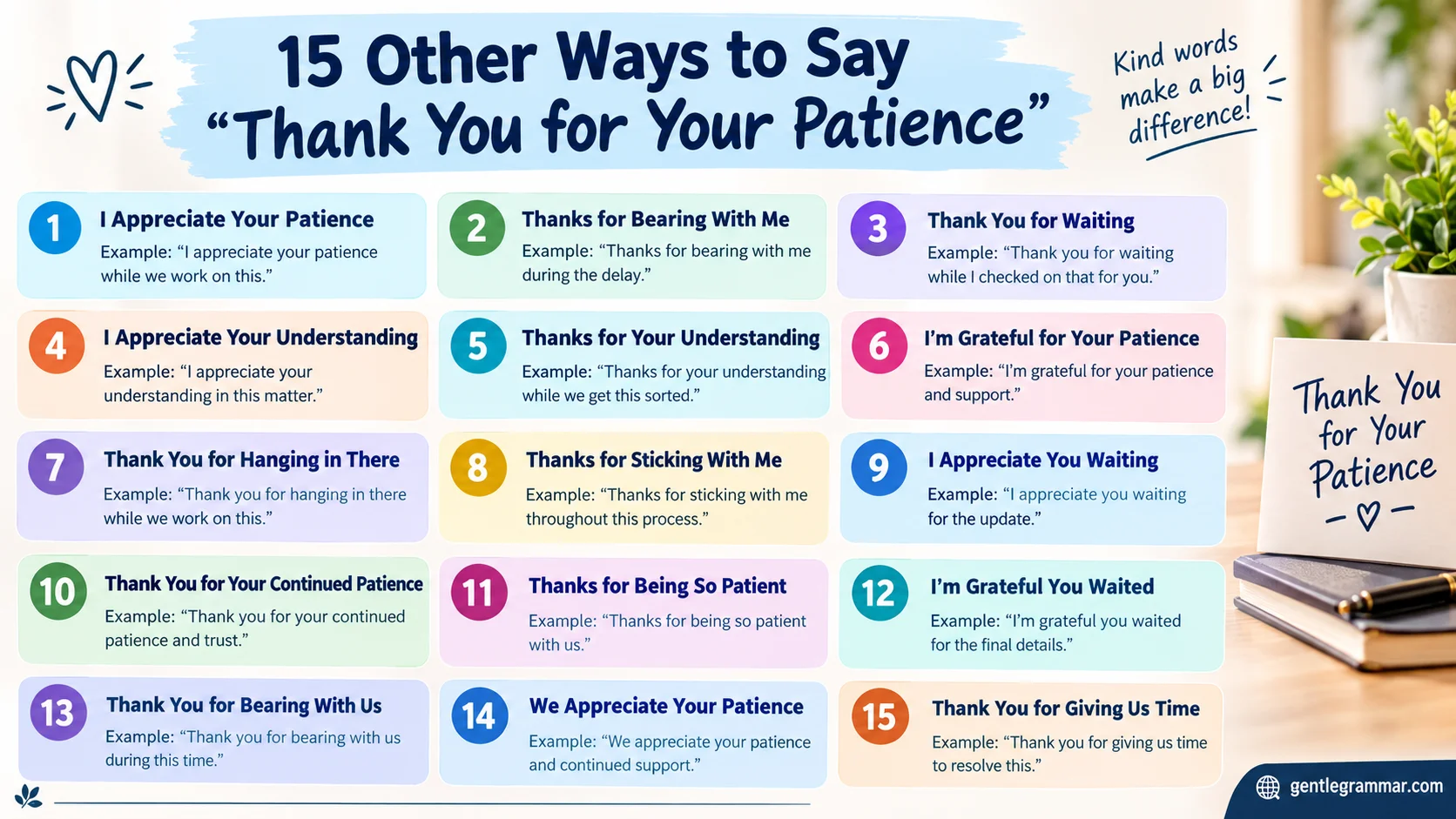
Learn Other Ways to Say “Thank You for Your Patience” to show genuine appreciation and make professional messages feel warm and sincere.
In a professional setting, choosing the right words to say thank you can make a huge difference. A genuine, polished thank you message is useful when thanking a boss for having your back, a colleague for saving the day, or a client for trusting you. From my experience, thoughtful words build bridges, help people feel seen, and make sending gratitude feel less like stress in any work situation. This cheat sheet can also help when a friend, coworker, family member, or someone else shows kindness.
A meaningful, sincere message can show appreciation, while different ways to say thanks can suit each situation. Wellness coaches, etiquette coaches, and relationship experts also provide useful insight into other ways to express thanks, show gratitude, and understand the importance of expressing gratitude.In customer service, unexpected situations happen every day, making clear communication and professional communication especially useful.
What Does “Thank You for Your Patience” Mean?
“Thank you for your patience” is a polite expression used to show appreciation when someone has had to wait, tolerate a delay, or give you additional time. It recognizes that waiting may have required understanding or self-control from the other person. For example, a business might use the phrase when a customer is waiting for a delayed order, while an individual might say it after taking longer than expected to respond to a message.
The phrase normally communicates appreciation and respect rather than simply acknowledging that someone waited. It can also soften an apology or explanation for a delay. Depending on the setting, it can sound professional and courteous, although it may feel somewhat formal in very casual conversations. The best alternative depends on whether you want to emphasize waiting, understanding, gratitude, or the relationship between the people involved.
Common Situations Where “Thank You for Your Patience” Is Used
People commonly use “thank you for your patience” when there has been a delay or when something requires more time than originally expected. In workplace communication, it may appear in emails about projects, technical problems, appointments, or customer requests. Companies often use it when responding to customers who are waiting for assistance, an order, a refund, or a service update.
The phrase also works in personal communication, although friends and family may prefer more relaxed wording such as “Thanks for waiting” or “Thanks for bearing with me.” In school or academic settings, it can acknowledge a delayed response, schedule change, or extended process. In formal writing, the expression is especially useful because it sounds respectful without being excessively emotional.
An alternative may be useful when you want to make the message feel less corporate, more personal, more apologetic, or more appreciative. The small difference in wording can make your message better suited to the relationship and situation.
Is It Professional or Polite to Say “Thank You for Your Patience”?
Yes. “Thank you for your patience” is both polite and professional in most situations. It is especially common in customer service, workplace emails, announcements, support messages, and other situations involving a delay. The phrase acknowledges the other person’s time without blaming them or making excuses.
Its main limitation is that it can sometimes sound formal or formulaic, particularly in a casual conversation with someone you know well. A friend may find “Thanks for waiting” more natural, while a customer may expect the more polished “Thank you for your patience.” The phrase itself is not cold or unfriendly; its tone largely depends on the surrounding message and the relationship between the speakers.
Advantages and Disadvantages of Saying “Thank You for Your Patience”
Advantages
The biggest advantage is politeness. The expression directly recognizes that another person has given you time and waited for something. It is also versatile, working in emails, spoken conversations, customer service messages, workplace notices, and formal communication. Because it does not over-explain the situation, it can be brief and professional.
Another benefit is that it communicates respect for the other person’s time. It can also acknowledge an inconvenience without making a lengthy apology. This makes it particularly useful when a delay is already understood by everyone involved.
Disadvantages
The phrase can become repetitive or formulaic if it appears frequently in business communication. Some readers may also find it slightly impersonal when the situation calls for a warmer response. For example, “Thanks for sticking with me” may feel more personal when someone has supported you through a difficult or lengthy process.
It also does not always express the exact feeling you intend. If the main point is that someone physically waited for you, “Thank you for waiting” is more specific. If you want to recognize their cooperation or understanding, an expression centered on understanding may be more appropriate.
Synonyms for “Thank You for Your Patience”
- I Appreciate Your Patience
- Thanks for Bearing With Me
- Thank You for Waiting
- I Appreciate Your Understanding
- Thanks for Your Understanding
- I’m Grateful for Your Patience
- Thank You for Hanging in There
- Thanks for Sticking With Me
- I Appreciate You Waiting
- Thank You for Your Continued Patience
- Thanks for Being So Patient
- I’m Grateful You Waited
- Thank You for Bearing With Us
- We Appreciate Your Patience
- Thank You for Giving Us Time
1. I Appreciate Your Patience
Meaning
“I appreciate your patience” expresses gratitude for someone’s willingness to wait or remain patient during a delay.
Definition
A polite statement meaning “I am grateful that you have been patient while this situation takes time.”
Detailed Explanation
This expression is very close in meaning to “thank you for your patience,” but it can sound slightly more personal and sincere. The word “appreciate” emphasizes that you recognize the other person’s patience as something valuable. It works particularly well when you are speaking directly to someone rather than making a general announcement. It can also feel a little less formulaic than the original phrase.
Scenario Examples
Scenario: You are responding to a coworker who has been waiting for a document.
Example: “I appreciate your patience while I finished reviewing the figures.”
Scenario: A customer has waited while you investigate an issue.
Example: “I appreciate your patience while we look into the problem.”
Best Use
Best for professional emails, customer communication, workplace conversations, and polite personal messages.
Tone
Tone: Professional, respectful, warm
It sounds appreciative without becoming overly emotional.
2. Thanks for Bearing With Me
Meaning
“Thanks for bearing with me” thanks someone for putting up with a delay, difficulty, mistake, or complicated situation.
Definition
A friendly expression meaning “Thank you for being patient with me while I deal with this.”
Detailed Explanation
This phrase is more conversational and personal than “thank you for your patience.” “Bearing with me” suggests that the situation may have been inconvenient, confusing, or somewhat difficult. It is especially natural when you have caused the delay or are working through a problem in real time. Because it is informal, it is usually better suited to people you already have a comfortable relationship with.
Scenario Examples
Scenario: You are fixing technical problems during an online meeting.
Example: “Thanks for bearing with me while I get the presentation working.”
Scenario: You are taking longer than expected to organize information.
Example: “Thanks for bearing with me—I’m almost finished.”
Best Use
Best for workplace conversations, friendly emails, meetings, texting, and informal professional communication.
Tone
Tone: Friendly, informal, appreciative
It sounds personal and acknowledges that the other person has had to tolerate some inconvenience.
3. Thank You for Waiting
Meaning
“Thank you for waiting” directly thanks someone for remaining in place or delaying their next action until you were ready.
Definition
A simple expression of gratitude for someone’s time spent waiting.
Detailed Explanation
This is more specific than “thank you for your patience.” It focuses on the actual act of waiting, rather than the person’s patience or understanding. That makes it especially natural when someone is waiting for you to arrive, respond, finish something, or provide assistance. It can sound straightforward and sincere without unnecessary formality.
Scenario Examples
Scenario: You arrive late to meet a friend.
Example: “Thank you for waiting for me. I’m sorry I’m late.”
Scenario: A customer has waited while you retrieve information.
Example: “Thank you for waiting. I have the details you requested.”
Best Use
Best for everyday conversation, customer service, appointments, meetings, and personal messages.
Tone
Tone: Polite, direct, simple
Its strength is its clarity: it tells the person exactly what you are thanking them for.
4. I Appreciate Your Understanding
Meaning
“I appreciate your understanding” thanks someone for accepting a situation, limitation, explanation, or inconvenience.
Definition
A polite expression meaning “I am grateful that you understand and accept the situation.”
Detailed Explanation
This phrase is not an exact replacement in every situation because understanding and patience are different ideas. Someone can understand why a delay happened without necessarily waiting patiently. Use this expression when the other person’s cooperation or acceptance matters as much as their waiting. It is particularly useful when explaining changes, restrictions, cancellations, or unavoidable delays.
Scenario Examples
Scenario: A business must change an appointment time.
Example: “I appreciate your understanding as we adjust the schedule.”
Scenario: You need additional time to complete a shared project.
Example: “I appreciate your understanding while we work through these unexpected changes.”
Best Use
Best for professional emails, customer communication, workplace notices, and sensitive situations.
Tone
Tone: Professional, respectful, considerate
It emphasizes understanding and cooperation rather than simply waiting.
5. Thanks for Your Understanding
Meaning
“Thanks for your understanding” expresses appreciation when someone accepts or respects your circumstances.
Definition
A friendly and polite way to say “Thank you for understanding the situation.”
Detailed Explanation
This version is shorter and more conversational than “I appreciate your understanding.” It works well when you need to acknowledge an inconvenience without making the message sound excessively formal. It is useful for personal and professional communication, particularly when you have already explained the reason for a delay or change. Unlike “thank you for waiting,” it focuses on acceptance and cooperation.
Scenario Examples
Scenario: You need to postpone a casual meeting.
Example: “I have to move our meeting to Friday. Thanks for your understanding.”
Scenario: A teacher explains a change to students.
Example: “The deadline has moved to Monday. Thanks for your understanding.”
Best Use
Best for emails, workplace messages, school communication, and everyday conversations.
Tone
Tone: Friendly, polite, moderately formal
It strikes a useful balance between professional wording and conversational language.
6. I’m Grateful for Your Patience
Meaning
“I’m grateful for your patience” expresses stronger personal appreciation for someone remaining patient.
Definition
A warm statement meaning “I feel genuinely thankful that you have remained patient.”
Detailed Explanation
The word “grateful” gives this expression more emotional warmth than the standard “thank you.” It is appropriate when the person’s patience has genuinely mattered to you. The phrase can still work professionally, but it has a more personal feeling than a routine customer-service expression. It is especially effective when the delay has been lengthy or particularly inconvenient.
Scenario Examples
Scenario: Someone has patiently supported you during a long process.
Example: “I’m grateful for your patience while we worked through everything.”
Scenario: You are writing a heartfelt professional message after a prolonged delay.
Example: “I’m truly grateful for your patience and continued support.”
Best Use
Best for personal messages, thoughtful professional communication, and situations involving a significant delay.
Tone
Tone: Warm, sincere, appreciative
It communicates genuine gratitude rather than a routine courtesy.
7. Thank You for Hanging in There
Meaning
“Thank you for hanging in there” thanks someone for continuing to wait, participate, or remain supportive during a difficult or lengthy situation.
Definition
A casual expression meaning “Thank you for continuing to stay with the situation despite the difficulty or delay.”
Detailed Explanation
This phrase is much more informal and encouraging than “thank you for your patience.” It suggests that the situation has taken effort or lasted longer than expected. “Hanging in there” often carries a sense of encouragement, making it suitable when the person has had to remain committed through uncertainty. It would usually sound too casual for highly formal correspondence.
Scenario Examples
Scenario: A team is dealing with a lengthy technical problem.
Example: “Thanks for hanging in there while we get the server back online.”
Scenario: You are reassuring friends during a delayed plan.
Example: “Thanks for hanging in there—we should be ready to leave soon.”
Best Use
Best for casual conversation, team messages, social media, texting, and friendly workplace communication.
Tone
Tone: Casual, encouraging, warm
The expression feels human and supportive rather than formal.
8. Thanks for Sticking With Me
Meaning
“Thanks for sticking with me” thanks someone for continuing to support, help, or stay involved with you.
Definition
A warm expression of gratitude for someone’s continued support or commitment.
Detailed Explanation
This phrase can include patience, but it means more than simply waiting. It suggests that the person has remained supportive despite confusion, delays, mistakes, or challenges. That makes it particularly useful in relationships and collaborative situations. It is generally too personal to replace a standard corporate phrase in every context.
Scenario Examples
Scenario: You are working through a complicated project with a colleague.
Example: “Thanks for sticking with me while we figured out the best approach.”
Scenario: You have made several changes to a plan with a friend.
Example: “Thanks for sticking with me through all these last-minute changes.”
Best Use
Best for personal messages, teamwork, friendships, and informal professional communication.
Tone
Tone: Warm, personal, supportive
It emphasizes continued commitment, not just patience.
9. I Appreciate You Waiting
Meaning
“I appreciate you waiting” directly acknowledges and values the time someone spent waiting.
Definition
A polite expression meaning “I am grateful that you waited for me or for this situation.”
Detailed Explanation
This wording is direct and personal because it identifies the specific action the other person took. It can feel more conversational than “I appreciate your patience.” The phrase works particularly well when there is a clear moment of waiting, such as answering a call, meeting someone, or retrieving information. It is less suitable when the issue is primarily someone’s understanding of a difficult situation.
Scenario Examples
Scenario: You need another minute before joining a meeting.
Example: “I appreciate you waiting while I finish this last task.”
Scenario: Someone waits for you after an appointment runs late.
Example: “I appreciate you waiting for me. I know it took longer than expected.”
Best Use
Best for everyday conversation, meetings, appointments, customer interactions, and personal communication.
Tone
Tone: Polite, personal, straightforward
It clearly recognizes the other person’s time and effort.
10. Thank You for Your Continued Patience
Meaning
“Thank you for your continued patience” thanks someone for remaining patient over an extended period.
Definition
A formal expression of appreciation for ongoing patience during a continuing delay or process.
Detailed Explanation
The word “continued” is important because it indicates that the waiting or delay has lasted for some time. This makes the phrase more specific than the standard expression. It is particularly common when an issue has not yet been completely resolved and you need to provide another update. Because of its formal tone, it is often more natural in business communication than casual conversation.
Scenario Examples
Scenario: A company is still resolving a service issue.
Example: “Thank you for your continued patience as we work toward a resolution.”
Scenario: A project is taking longer than originally planned.
Example: “Thank you for your continued patience while the final review is completed.”
Best Use
Best for formal emails, customer service, company announcements, project updates, and official communication.
Tone
Tone: Formal, professional, respectful
It clearly signals that the delay or process is ongoing.
11. Thanks for Being So Patient
Meaning
“Thanks for being so patient” gives personal thanks for someone’s patience.
Definition
A friendly expression meaning “Thank you for remaining patient with me or with this situation.”
Detailed Explanation
This expression sounds more natural and conversational than the formal “thank you for your patience.” The word “so” adds warmth and suggests that you think the person has shown a notable amount of patience. It is particularly suitable when speaking to someone you know or when the communication is informal. In a formal business letter, a more neutral expression may be preferable.
Scenario Examples
Scenario: A friend waits while you finish getting ready.
Example: “Thanks for being so patient. I’m ready now!”
Scenario: A coworker gives you extra time to complete a task.
Example: “Thanks for being so patient while I sorted out the numbers.”
Best Use
Best for friends, family, coworkers, texting, and relaxed workplace conversations.
Tone
Tone: Friendly, warm, casual
It feels personal because you are commenting directly on the person’s behavior.
12. I’m Grateful You Waited
Meaning
“I’m grateful you waited” expresses sincere appreciation after someone has actually waited for you or for something to happen.
Definition
A warm statement meaning “I sincerely appreciate the fact that you chose to wait.”
Detailed Explanation
This expression focuses on a completed action: the person waited, and you are now acknowledging it. “Grateful” makes the message more heartfelt than a simple “thanks.” It works especially well when the person could reasonably have left, moved on, or chosen not to wait. Because it is personal and emotional, it is less common in routine corporate messages.
Scenario Examples
Scenario: Someone waits for you after you are delayed.
Example: “I’m grateful you waited instead of heading home.”
Scenario: A friend stays while you handle an unexpected problem.
Example: “I’m grateful you waited while I dealt with that issue.”
Best Use
Best for personal communication, meaningful conversations, and situations where someone made a deliberate choice to wait.
Tone
Tone: Sincere, warm, personal
It places emphasis on genuine gratitude.
13. Thank You for Bearing With Us
Meaning
“Thank you for bearing with us” thanks people for tolerating or remaining patient during a difficult process or delay involving an organization or group.
Definition
A polite expression meaning “Thank you for continuing to cooperate with us despite the inconvenience.”
Detailed Explanation
This phrase is similar to “thanks for bearing with me,” but “us” makes it appropriate when a company, team, school, or organization is speaking to an audience. It acknowledges that the process may have caused inconvenience or frustration. The wording is more conversational than some formal corporate expressions while remaining respectful. It is not usually the best choice for a deeply personal message.
Scenario Examples
Scenario: A website experiences an extended outage.
Example: “Thank you for bearing with us while we restore normal service.”
Scenario: A team is handling a complicated event change.
Example: “Thank you for bearing with us as we work through the schedule changes.”
Best Use
Best for business communication, customer service, announcements, support messages, and team communication.
Tone
Tone: Professional, friendly, apologetic
It acknowledges that the situation may have been inconvenient.
14. We Appreciate Your Patience
Meaning
“We appreciate your patience” expresses collective gratitude from a company, organization, or team.
Definition
A professional statement meaning “Our team is grateful that you have remained patient.”
Detailed Explanation
This expression is closely related to “thank you for your patience,” but the use of “we” clearly presents the appreciation as coming from a group. It is especially natural when communicating on behalf of a business or organization. The phrase has a polished, professional quality and works well in customer-facing messages. For a personal conversation, however, “I appreciate your patience” usually sounds more natural.
Scenario Examples
Scenario: A company is processing a large number of requests.
Example: “We appreciate your patience while our team works through the requests.”
Scenario: A business is completing a delayed order.
Example: “We appreciate your patience as we prepare your order for shipment.”
Best Use
Best for customer service, company emails, websites, public notices, support messages, and official updates.
Tone
Tone: Professional, courteous, neutral
The wording represents collective appreciation rather than individual gratitude.
15. Thank You for Giving Us Time
Meaning
“Thank you for giving us time” thanks someone for allowing a person or group additional time to complete something.
Definition
A polite expression of appreciation for allowing extra time to solve, prepare, review, or complete something.
Detailed Explanation
This phrase is not a direct synonym in every situation. It focuses specifically on the other person allowing additional time, rather than simply remaining patient. That distinction makes it useful when you have requested an extension or need more time to finish a task. It can sound particularly respectful when acknowledging someone’s flexibility.
Scenario Examples
Scenario: A client allows your team more time to complete a proposal.
Example: “Thank you for giving us time to review the details properly.”
Scenario: You ask a colleague to allow extra time for a difficult task.
Example: “Thank you for giving us time to work through the issue before making a decision.”
Best Use
Best for professional communication, negotiations, project discussions, deadlines, and situations involving additional time.
Tone
Tone: Respectful, professional, appreciative
It highlights the person’s flexibility and willingness to allow more time.
FAQs:
What is another way to say “Thank You for Your Patience”?
Common alternatives include “I appreciate your patience,” “Thank you for waiting,” “Thanks for bearing with me,” and “We appreciate your patience.” The best choice depends on the situation. For example, “Thank you for waiting” is specific to waiting, while “I appreciate your understanding” focuses more on acceptance and cooperation.
What does “Thank You for Your Patience” mean?
“Thank you for your patience” means that you are grateful someone remained patient while waiting for something or while dealing with a delay or inconvenience. It is a polite way to recognize the value of another person’s time and cooperation.
Is “Thank You for Your Patience” professional?
Yes. “Thank you for your patience” is professional, polite, and widely suitable for workplace and customer communication. It is especially useful when explaining delays, providing updates, or responding to people who have been waiting for assistance.
What is a more polite way to say “Thank You for Your Patience”?
Several expressions can sound equally polite, depending on your purpose. “I appreciate your patience” is a polished alternative, while “I appreciate your understanding” is better when you want to recognize someone’s cooperation with a difficult situation. For a more heartfelt message, “I’m grateful for your patience” adds warmth.
Which alternative works best in formal communication?
For formal communication, expressions such as “I appreciate your patience,” “Thank you for your continued patience,” and “We appreciate your patience” work naturally. Choose based on context: “continued patience” is useful for an ongoing delay, while “we appreciate your patience” is appropriate when an organization or team is speaking on behalf of itself.
Conclusion:
Choosing an alternative to “thank you for your patience” is not simply about replacing one phrase with another. The right wording depends on what you actually want to acknowledge: waiting, understanding, flexibility, continued support, or genuine gratitude. “I appreciate your patience” works well in professional settings, while “thanks for bearing with me” feels more conversational. Other expressions, such as “thank you for waiting” or “thank you for giving us time,” communicate more specific ideas.
When choosing your wording, consider the relationship, context, formality, and emotional tone of your message. A small change can make your communication feel more natural and intentional. Whether you are writing a customer email, texting a friend, or responding to a colleague, use “thank you for your patience” or one of these alternatives when it accurately reflects what you want to say.
