
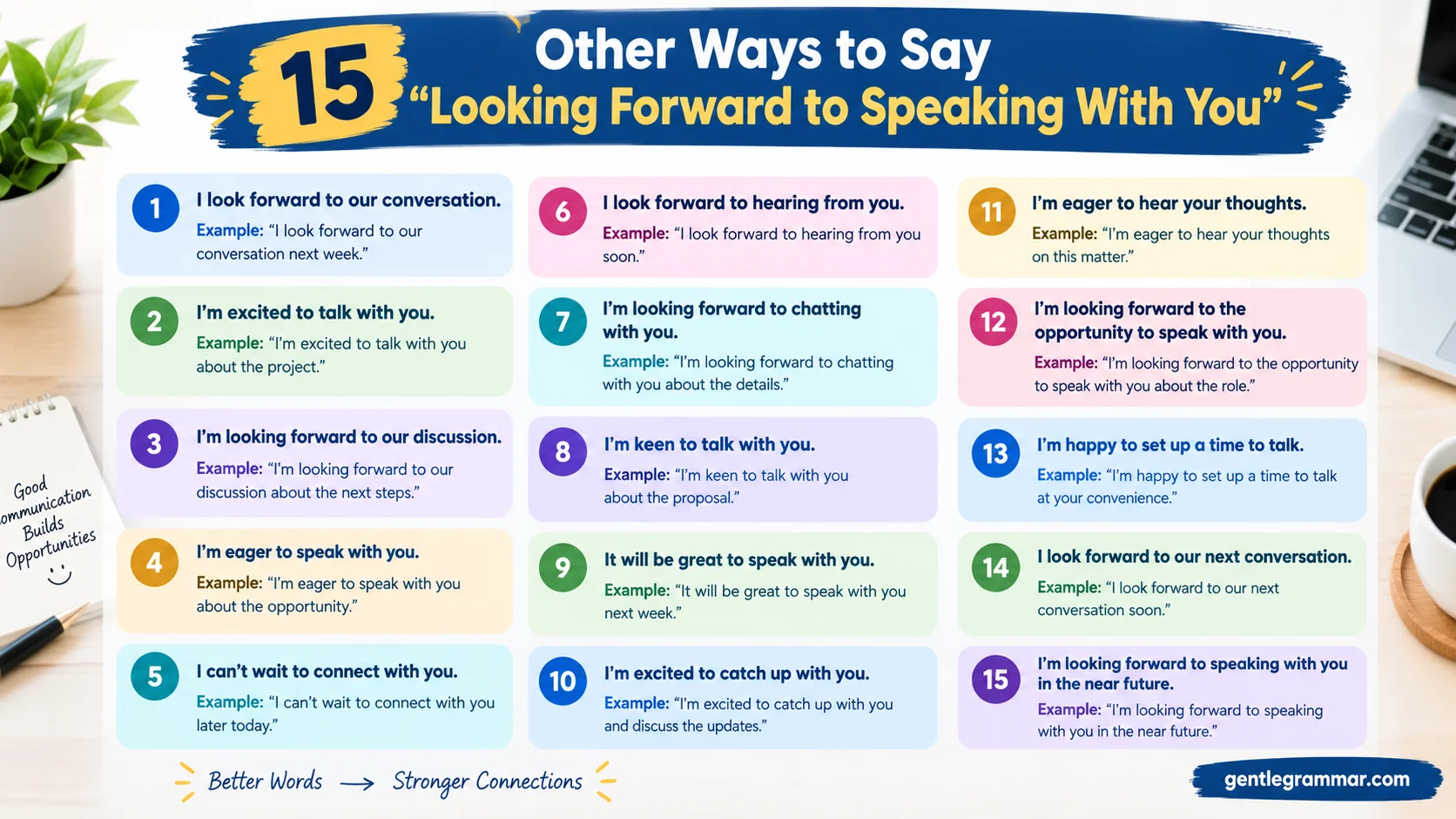
Learn 15 Other Ways to Say “Looking Forward to Speaking With You” (With Examples) for a warm, clear, and professional message after a call today.
After a productive interview, a client discovery call, or a quick message exchange with a new contact, the end of a message should feel warm, natural, and respectful. Looking Forward to Speaking With You is a reliable phrase because it shows anticipation, respect, and openness without becoming overly casual or too formal. In modern communication, tone-sensitive situations appear in email.
LinkedIn, Slack, and text, where a phrase can sound warmer, colder, or more professional than intended. Using 15 Other Ways can help keep a professional email polite, natural, and widely understood, while a strong closing keeps every message from feeling repetitive and supports clear professional communication.
What Does “Looking Forward to Speaking With You” Mean?
“Looking Forward to Speaking With You” means that you expect and feel positive about having a conversation with someone in the future. It communicates anticipation and usually suggests that the speaker is pleased about an upcoming phone call, video meeting, interview, appointment, or personal conversation. The phrase is commonly shortened from the complete sentence “I’m looking forward to speaking with you.”
The expression is generally positive, polite, and respectful. In professional communication, it can show that you are interested in continuing a conversation without sounding overly emotional. In personal communication, it can also express genuine enthusiasm about talking to someone. The exact feeling depends on context: “I’m looking forward to speaking with you” may sound professionally courteous in an email, while the same phrase can feel warmly personal when used between people who already know each other.
Common Situations Where “Looking Forward to Speaking With You” Is Used
People often use this phrase when a conversation has been planned or expected. For example, a hiring manager may write it at the end of an interview invitation, a client may use it before a scheduled call, or a student may include it in an email to a teacher or advisor.
It also works in personal communication, particularly when two people have arranged to talk after being apart or when they are preparing for an important conversation. A message such as “I’m looking forward to speaking with you tonight” sounds friendly without being overly casual.
The phrase is especially common in emails and other written communication because it provides a positive closing without making the message too emotional. Someone might want an alternative when they need a more specific tone, such as formal, enthusiastic, relaxed, warm, or relationship-focused wording.
Is It Professional or Polite to Say “Looking Forward to Speaking With You”?
Yes. “Looking Forward to Speaking With You” is generally professional and polite, particularly when written as “I’m looking forward to speaking with you.” It is suitable for job interviews, business meetings, customer communication, networking, academic communication, and many other situations where a respectful tone is appropriate.
The phrase is also flexible enough for less formal situations. However, it can sound somewhat standard or conventional in professional emails because it is frequently used as a closing expression. If you want to show stronger enthusiasm, emphasize a specific upcoming discussion, or sound more relaxed, another phrase may communicate your intention more precisely.
Grammar also matters. In a complete sentence, “I look forward to speaking with you” is a polished form, while “I’m looking forward to speaking with you” emphasizes the speaker’s present anticipation. Both are natural, but the choice can subtly affect the tone.
Advantages and Disadvantages of Saying “Looking Forward to Speaking With You”
Advantages
The phrase is clear, positive, and versatile. It tells the other person that you expect to speak with them and that you have a favorable attitude toward the upcoming conversation. It works especially well when you want to end an email on a courteous note without adding unnecessary detail.
Another advantage is its professional neutrality. It can express interest without sounding excessively enthusiastic or overly familiar. That makes it useful when communicating with someone you do not know well.
Disadvantages
Because the expression is so common, it can sometimes feel formulaic, especially when used repeatedly in professional emails. It may also be too neutral when you want to express genuine excitement or personal warmth.
The phrase can also be less precise than an alternative that identifies the purpose of the conversation. For example, “I look forward to discussing the proposal with you” tells the reader more specifically what you anticipate. In a close personal relationship, a phrase such as “I’m looking forward to our chat” may feel more natural and conversational.
Synonyms and Alternatives for “Looking Forward to Speaking With You”
- I Look Forward to Our Conversation
- I Look Forward to Speaking With You
- I’m Eager to Speak With You
- I’m Looking Forward to Our Chat
- I’m Excited About Our Upcoming Conversation
- I’m Looking Forward to Connecting With You
- I’m Keen to Speak With You
- I Look Forward to Our Discussion
- I’m Eager to Discuss This With You
- It Will Be a Pleasure to Speak With You
- I’m Glad We’ll Have a Chance to Talk
- I’m Looking Forward to Catching Up
- I’m Pleased to Have the Opportunity to Speak With You
- I’m Excited to Speak With You
- I’m Looking Forward to Talking With You
1. I Look Forward to Our Conversation
Meaning
“I Look Forward to Our Conversation” expresses positive anticipation about a future discussion. It focuses on the conversation itself rather than simply the act of speaking.
Definition
Definition: A polite expression showing that you are pleased or interested in having a future conversation with someone.
Detailed Explanation
This expression is a strong alternative when you want to sound polished and professional. It works particularly well when a conversation has already been scheduled or clearly expected. Compared with “Looking Forward to Speaking With You,” it places slightly more emphasis on the shared conversation. It is especially useful in business, academic, and formal correspondence.
Scenario Examples
Scenario: You have arranged a meeting with a potential business partner.
Example: “Thank you for arranging the meeting. I look forward to our conversation on Thursday.”
Scenario: You are replying to someone who has invited you to discuss a project.
Example: “I appreciate the invitation and look forward to our conversation.”
Scenario: You are preparing for an academic discussion.
Example: “Thank you for your time. I look forward to our conversation about the research proposal.”
Best Use
This phrase works best in professional emails, business correspondence, academic communication, meetings, and formal messages.
Tone
Tone: Professional, courteous, composed
It sounds positive without being overly enthusiastic, making it a dependable choice when you want warmth with professionalism.
2. I Look Forward to Speaking With You
Meaning
“I Look Forward to Speaking With You” communicates that you anticipate a future conversation positively. It is the complete, polished version of the shortened phrase often used in email closings.
Definition
Definition: A courteous expression used to show that you are pleased about an upcoming conversation.
Detailed Explanation
This wording is extremely close in meaning to the primary phrase and is one of the most natural choices for professional communication. The use of “I look forward to” gives the sentence a formal, polished quality. It can be used after arranging an interview, call, consultation, or meeting. Unlike more enthusiastic alternatives, it communicates positive anticipation in a measured way.
Scenario Examples
Scenario: A recruiter has scheduled an interview with you.
Example: “Thank you for the opportunity. I look forward to speaking with you tomorrow.”
Scenario: You have arranged a phone call with a client.
Example: “I’ll review the documents before our call and look forward to speaking with you.”
Scenario: You are responding to a professional introduction.
Example: “It’s a pleasure to connect. I look forward to speaking with you soon.”
Best Use
Use it for job interviews, business emails, professional calls, consultations, networking, and formal correspondence.
Tone
Tone: Professional, polite, neutral
Its strength is its balance. It sounds interested and respectful without suggesting an unusually strong emotional reaction.
3. I’m Eager to Speak With You
Meaning
“I’m Eager to Speak With You” shows that you are enthusiastic and genuinely interested in having a conversation.
Definition
Definition: A phrase expressing strong interest in talking with someone soon or about a particular matter.
Detailed Explanation
“Eager” is stronger than the more neutral “looking forward to.” It suggests enthusiasm, readiness, or strong interest. This makes it useful when the upcoming conversation is particularly important or when you want to show that you are highly engaged. In a formal setting, however, it can sound more emotionally expressive than a standard professional closing.
Scenario Examples
Scenario: You are excited about discussing a potential collaboration.
Example: “Your proposal sounds promising, and I’m eager to speak with you about the next steps.”
Scenario: You are waiting for an important career conversation.
Example: “I’m eager to speak with you and learn more about the position.”
Scenario: You want to discuss an idea with someone whose work interests you.
Example: “I’ve enjoyed reading your work, and I’m eager to speak with you about your approach.”
Best Use
This phrase fits professional communication, networking, interviews, collaborations, and important personal conversations where genuine enthusiasm is appropriate.
Tone
Tone: Enthusiastic, confident, interested
The word “eager” makes this expression more energetic than the original phrase.
4. I’m Looking Forward to Our Chat
Meaning
“I’m Looking Forward to Our Chat” expresses pleasant anticipation about a friendly, informal conversation.
Definition
Definition: A casual expression showing that you are happy about an upcoming conversation.
Detailed Explanation
“Chat” is more relaxed than “speaking” or “conversation,” so this alternative works best when the relationship is familiar and informal. It can make a message feel warmer and less businesslike. It is not necessarily appropriate for every formal situation, particularly when communicating with someone in a highly formal role. The expression works especially naturally in everyday messages and friendly workplace conversations.
Scenario Examples
Scenario: You have arranged to talk with a friend later.
Example: “I’ll call you after dinner. I’m looking forward to our chat!”
Scenario: You are messaging a coworker you know well.
Example: “Thanks for setting aside some time. I’m looking forward to our chat tomorrow.”
Scenario: You are preparing for a relaxed online meeting.
Example: “It’ll be nice to catch up. Looking forward to our chat.”
Best Use
Use it for texting, friendly emails, casual workplace communication, personal messages, and familiar relationships.
Tone
Tone: Friendly, casual, warm
The word “chat” makes the expression sound approachable and conversational rather than formal.
5. I’m Excited About Our Upcoming Conversation
Meaning
This phrase shows strong positive anticipation about a conversation that is expected to happen in the future.
Definition
Definition: An enthusiastic expression indicating that you are especially pleased about an upcoming conversation.
Detailed Explanation
This alternative is more expressive than the standard “Looking Forward to Speaking With You.” The word “excited” communicates stronger enthusiasm, so it is useful when you genuinely want to emphasize how much you anticipate the conversation. “Upcoming conversation” also clearly points to something that is already expected or scheduled. Because of its emotional warmth, it may be better suited to friendly, creative, networking, or enthusiastic professional contexts than highly formal correspondence.
Scenario Examples
Scenario: You are about to meet someone whose work you admire.
Example: “I’ve followed your work for some time, so I’m excited about our upcoming conversation.”
Scenario: You are preparing for a creative collaboration.
Example: “The project has already generated some great ideas, and I’m excited about our upcoming conversation.”
Scenario: You are arranging a personal call with someone close to you.
Example: “It’s been too long! I’m excited about our upcoming conversation.”
Best Use
It works well in personal communication, networking, creative projects, enthusiastic professional messages, and informal emails.
Tone
Tone: Warm, enthusiastic, expressive
It communicates more visible excitement than the original expression.
6. I’m Looking Forward to Connecting With You
Meaning
“I’m Looking Forward to Connecting With You” expresses positive anticipation about establishing or continuing communication with another person.
Definition
Definition: A polite expression indicating that you are pleased about having an opportunity to communicate or build a connection.
Detailed Explanation
“Connecting” is broader than “speaking.” It can refer to a phone call, video meeting, professional introduction, networking conversation, or other meaningful interaction. That makes it particularly useful when the exact form of communication has not been specified. It can also carry a subtle sense of relationship-building, which is why it is common in networking and professional introductions.
Scenario Examples
Scenario: Someone has introduced you to a professional contact.
Example: “Thank you for the introduction. I’m looking forward to connecting with you.”
Scenario: You have arranged an online meeting.
Example: “I’ve added the meeting to my calendar and am looking forward to connecting with you next week.”
Scenario: You are replying to a new networking contact.
Example: “It was great to hear from you. I’m looking forward to connecting with you soon.”
Best Use
This phrase is particularly suitable for networking, business communication, professional introductions, LinkedIn messages, emails, and virtual meetings.
Tone
Tone: Professional, friendly, modern
It combines professional courtesy with interpersonal warmth and is less narrowly focused on a spoken conversation.
7. I’m Keen to Speak With You
Meaning
“I’m Keen to Speak With You” means that you are very interested in having a conversation with someone.
Definition
Definition: An expression showing strong interest or willingness to speak with another person.
Detailed Explanation
“Keen” conveys enthusiasm or strong interest without necessarily sounding as emotionally strong as “excited.” It is especially natural in British and other varieties of English, although many speakers elsewhere understand it easily. The phrase can be professional, but its naturalness depends partly on the speaker’s regional variety. It is a good choice when you want to communicate active interest rather than simply polite anticipation.
Scenario Examples
Scenario: You want to discuss a possible business opportunity.
Example: “I’m keen to speak with you about how we could work together.”
Scenario: You are interested in learning more about a role.
Example: “The position sounds very interesting, and I’m keen to speak with you about it.”
Scenario: You want to discuss an idea with a colleague.
Example: “I’m keen to speak with you before we finalize the plans.”
Best Use
Use it in professional emails, workplace communication, networking, and conversations where you want to show active interest.
Tone
Tone: Interested, confident, moderately enthusiastic
It sounds engaged and purposeful without necessarily carrying the strong emotional emphasis of “excited.”
8. I Look Forward to Our Discussion
Meaning
“I Look Forward to Our Discussion” communicates that you anticipate a focused or meaningful exchange of ideas.
Definition
Definition: A formal or professional expression showing positive anticipation of a planned discussion.
Detailed Explanation
“Discussion” is more specific than “conversation” because it often suggests that the participants will consider a topic, exchange ideas, solve a problem, or make a decision. This makes it especially useful in professional and academic settings. It can sound more purposeful than “speaking with you.” If the upcoming interaction is simply a friendly chat, however, “discussion” may sound unnecessarily formal.
Scenario Examples
Scenario: You are meeting with a manager about a project.
Example: “I’ve reviewed the proposed changes and look forward to our discussion tomorrow.”
Scenario: You are meeting an academic advisor.
Example: “Thank you for reviewing my proposal. I look forward to our discussion.”
Scenario: You are preparing for a business negotiation.
Example: “We appreciate your time and look forward to our discussion next week.”
Best Use
This expression is ideal for business meetings, academic settings, workplace discussions, negotiations, interviews, and formal correspondence.
Tone
Tone: Formal, professional, purposeful
The word “discussion” gives the sentence a more serious and focused quality.
9. I’m Eager to Discuss This With You
Meaning
“I’m Eager to Discuss This With You” expresses strong interest in talking about a specific subject or issue.
Definition
Definition: An enthusiastic way to say that you are ready and interested in discussing a particular matter with someone.
Detailed Explanation
This phrase is more specific than “Looking Forward to Speaking With You” because it identifies what you want to talk about. That can make an email feel more purposeful and less like a generic closing. “Eager” adds enthusiasm, while “discuss this” focuses attention on the subject. It works particularly well when both people already understand what “this” refers to.
Scenario Examples
Scenario: You have received a proposal that needs further discussion.
Example: “I’ve reviewed your proposal and am eager to discuss this with you.”
Scenario: You are responding to a colleague about a new idea.
Example: “Your suggestion has several interesting possibilities, and I’m eager to discuss this with you.”
Scenario: You want to address a project plan.
Example: “I’ve made a few notes on the timeline and am eager to discuss this with you.”
Best Use
Use it for workplace communication, project discussions, business emails, academic matters, and focused professional conversations.
Tone
Tone: Professional, enthusiastic, purposeful
It combines clear subject focus with genuine interest.
10. It Will Be a Pleasure to Speak With You
Meaning
“It Will Be a Pleasure to Speak With You” communicates that you expect the future conversation to be welcome and enjoyable.
Definition
Definition: A courteous expression used to say that you will be pleased to have a conversation with someone.
Detailed Explanation
This phrase is more formal and gracious than the everyday “I’m looking forward to speaking with you.” It is useful when you want to show respect, appreciation, or courtesy toward the other person. It can be particularly appropriate when speaking with a senior professional, distinguished guest, client, or someone you have just been introduced to. In a casual friendship, however, it may sound overly formal.
Scenario Examples
Scenario: You are arranging a meeting with a senior professional.
Example: “Thank you for making time in your schedule. It will be a pleasure to speak with you.”
Scenario: You have been invited to participate in a professional interview.
Example: “I appreciate the invitation. It will be a pleasure to speak with you next week.”
Scenario: You are responding to a formal introduction.
Example: “Thank you for reaching out. It will be a pleasure to speak with you.”
Best Use
It fits formal emails, professional introductions, business correspondence, interviews, official communication, and respectful invitations.
Tone
Tone: Formal, gracious, respectful
The phrase emphasizes courtesy and respect more strongly than casual enthusiasm.
11. I’m Glad We’ll Have a Chance to Talk
Meaning
“I’m Glad We’ll Have a Chance to Talk” expresses genuine happiness that an opportunity to have a conversation has been arranged.
Definition
Definition: A warm expression showing that you are pleased about getting an opportunity to talk with someone.
Detailed Explanation
This wording feels more personal than a conventional business closing. It emphasizes the opportunity to talk, which can make the message sound sincere and spontaneous. It is especially useful when the conversation has taken some effort to arrange or when the relationship makes a friendly tone appropriate. It is less formal than “I look forward to our discussion.”
Scenario Examples
Scenario: You have finally found time to speak with a friend.
Example: “Our schedules have been hectic, so I’m glad we’ll have a chance to talk this weekend.”
Scenario: A colleague has offered to help you with a problem.
Example: “Thanks for making time. I’m glad we’ll have a chance to talk about it.”
Scenario: You are preparing for a personal conversation.
Example: “I’m glad we’ll have a chance to talk things through.”
Best Use
This phrase works well for personal messages, friendly workplace communication, supportive conversations, and informal emails.
Tone
Tone: Warm, sincere, conversational
It feels less scripted because it focuses on the opportunity to talk rather than a conventional closing formula.
12. I’m Looking Forward to Catching Up
Meaning
“I’m Looking Forward to Catching Up” means that you are happy about having a conversation with someone you already know, particularly after some time apart.
Definition
Definition: A friendly expression showing anticipation about reconnecting and talking about what has happened since you last spoke.
Detailed Explanation
This is not a universal synonym for “Looking Forward to Speaking With You.” The expression “catching up” normally implies an existing relationship or previous familiarity. It suggests that both people will share updates, stories, or news. Because of that specific meaning, it should generally not be used for a first-time professional introduction.
Scenario Examples
Scenario: You are meeting an old friend after several months.
Example: “It’s been far too long. I’m looking forward to catching up over coffee.”
Scenario: You are reconnecting with a former coworker.
Example: “I’m looking forward to catching up and hearing what you’ve been working on.”
Scenario: You are planning a family call.
Example: “Sunday works perfectly. I’m looking forward to catching up with everyone.”
Best Use
Use it for friends, family, former coworkers, familiar colleagues, reunions, and personal messages.
Tone
Tone: Friendly, familiar, warm
The phrase signals existing familiarity, making it more personal than a general professional expression.
13. I’m Pleased to Have the Opportunity to Speak With You
Meaning
This phrase shows that you are grateful and positive about being given an opportunity to talk with someone.
Definition
Definition: A formal expression used to communicate appreciation for the chance to have a conversation.
Detailed Explanation
This wording emphasizes the opportunity itself rather than simply anticipation. It can be useful when speaking with someone whose time or expertise you particularly value. Compared with “I’m looking forward to speaking with you,” it sounds more formal and appreciative. It is especially suitable when the conversation represents an important professional or academic opportunity.
Scenario Examples
Scenario: You have been invited to interview for a position.
Example: “Thank you for considering my application. I’m pleased to have the opportunity to speak with you.”
Scenario: You have been invited to meet with a specialist about a project.
Example: “I appreciate your time and am pleased to have the opportunity to speak with you.”
Scenario: You are attending an academic meeting.
Example: “I’m pleased to have the opportunity to speak with you about the proposed research.”
Best Use
It works particularly well in formal emails, interviews, academic communication, professional introductions, and important meetings.
Tone
Tone: Formal, appreciative, respectful
The phrase conveys gratitude and respect more strongly than ordinary anticipation.
14. I’m Excited to Speak With You
Meaning
“I’m Excited to Speak With You” communicates strong enthusiasm about an upcoming conversation.
Definition
Definition: An energetic expression showing that you are very pleased about the opportunity to talk with someone.
Detailed Explanation
This is a more emotionally expressive alternative to the standard phrase. “Excited” tells the other person that you are not merely anticipating the conversation—you are genuinely enthusiastic about it. It can work well when the circumstances naturally call for enthusiasm, such as a creative collaboration, networking opportunity, new relationship, or exciting project. In highly formal communication, a more restrained phrase may be preferable.
Scenario Examples
Scenario: You are preparing for a creative collaboration.
Example: “Your ideas are fascinating, and I’m excited to speak with you about the project.”
Scenario: You have been selected for a professional opportunity.
Example: “Thank you for the invitation. I’m excited to speak with you and learn more about the role.”
Scenario: You are messaging someone after a positive introduction.
Example: “It was great connecting online. I’m excited to speak with you next week.”
Best Use
Use it for friendly professional messages, networking, creative projects, personal communication, and situations where genuine enthusiasm is appropriate.
Tone
Tone: Enthusiastic, warm, energetic
It is stronger and more expressive than the neutral “I look forward to speaking with you.”
15. I’m Looking Forward to Talking With You
Meaning
“I’m Looking Forward to Talking With You” expresses positive anticipation about a future conversation.
Definition
Definition: A natural expression indicating that you are pleased about the prospect of talking with someone.
Detailed Explanation
This phrase has almost the same basic meaning as the primary expression, but “talking” tends to sound slightly more conversational than “speaking.” It can fit both personal and professional contexts, depending on the rest of the message. In a formal email, “speaking with you” may sound a little more polished, while “talking with you” can feel more relaxed. The difference is subtle rather than absolute.
Scenario Examples
Scenario: You have arranged a phone call with a colleague.
Example: “Thanks for sending the information. I’m looking forward to talking with you tomorrow.”
Scenario: You are messaging a friend about a planned call.
Example: “I’ve missed our long conversations. I’m looking forward to talking with you tonight.”
Scenario: You are preparing for a professional discussion.
Example: “Thank you for your response. I’m looking forward to talking with you about the next steps.”
Best Use
This expression fits everyday conversation, professional emails, phone calls, friendly messages, and personal communication.
Tone
Tone: Friendly, natural, conversational
“Talking” gives the expression a slightly more relaxed and approachable feel.
FAQs:
What is another way to say “Looking Forward to Speaking With You”?
A natural alternative is “I look forward to our conversation.” Other choices include “I’m eager to speak with you,” “I’m looking forward to connecting with you,” and “I’m looking forward to our chat.” The best wording depends on whether you want to sound formal, professional, enthusiastic, or casual.
What does “Looking Forward to Speaking With You” mean?
“Looking Forward to Speaking With You” means that you expect and feel positive about having a conversation with someone in the future. It communicates polite anticipation and is commonly used before meetings, calls, interviews, appointments, and personal conversations.
Is “Looking Forward to Speaking With You” professional?
Yes. “I look forward to speaking with you” is widely suitable for professional communication. It has a courteous and measured tone, making it appropriate for emails, interviews, meetings, networking, customer communication, and workplace conversations.
What is a more polite way to say “Looking Forward to Speaking With You”?
For a more formal and respectful tone, you can use “It will be a pleasure to speak with you” or “I’m pleased to have the opportunity to speak with you.” These expressions place more emphasis on courtesy and appreciation.
Which alternative works best in formal communication?
For formal communication, “I look forward to our discussion”, “It will be a pleasure to speak with you,” and “I’m pleased to have the opportunity to speak with you” are useful choices. The best expression depends on whether you want to emphasize the discussion, courtesy, or opportunity.
Conclusion:
Choosing the right alternative to “Looking Forward to Speaking With You” can make a small but meaningful difference in communication. The original phrase is already polite, professional, and versatile, but different situations may call for different wording. “I look forward to our discussion” can sound more purposeful, while “I’m looking forward to our chat” feels relaxed and friendly. “I’m eager to speak with you” adds enthusiasm, whereas “It will be a pleasure to speak with you” adds formality and respect.
The key is to consider your relationship with the reader, the purpose of the conversation, and the tone you want to create. Similar expressions are not always interchangeable, so choose the phrase that naturally fits the moment. When used thoughtfully, even a simple closing can make your message feel more genuine and appropriate.
