
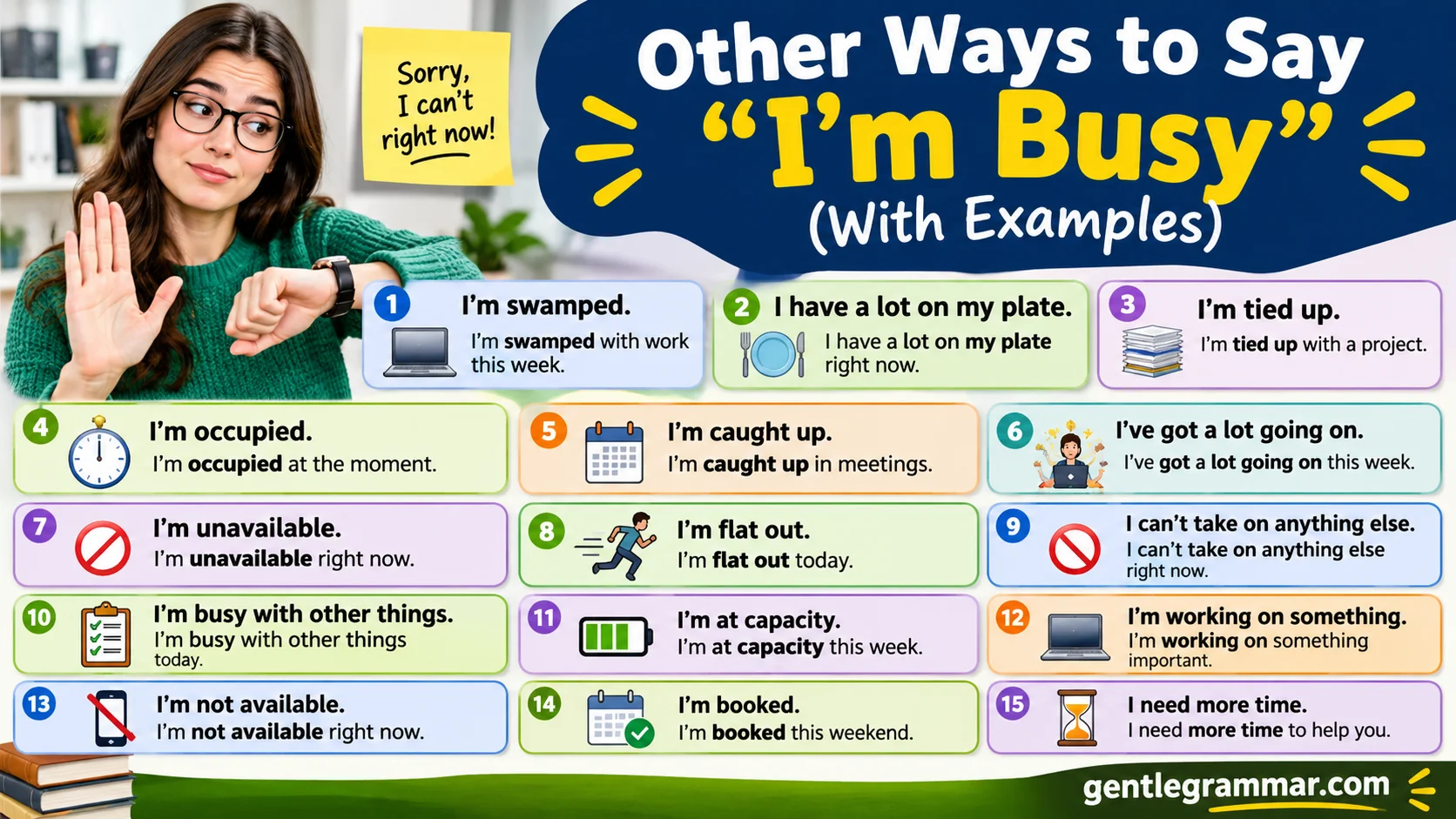
Explore 15 Other Ways to Say “I’m Busy” (With Examples) to choose polite, natural phrases for work, friends, family, and everyday conversations.
In busy lives, we often need to tell others we can’t do something because there is too much to do. The phrase I’m busy may sound brief, blunt, friendly, or dismissive, so the tone, meaning, and level of formality matter. Using the right wording lets you explain your current situation without making the other person feel ignored. For example, “I’m tied up right now” works when you have work, tasks, or responsibilities to handle, while “I’ve got a lot on my plate” can describe a heavy workload. These natural alternatives give you different ways to share your situation in an interesting, clear, and easy to understand way.
The best alternative phrases depend on your context, availability, time constraints, personal commitments, and work commitments. If you are currently busy with other things, you could say “I’m occupied right now” or “I’m unavailable at the moment.” If you want to say I am busy politely or without being rude, choose polite wording that keeps your message respectful. With friends and family, a funny way can suit lighter conversations, while a formal expression is more suitable for a boss or client.
What Does “I’m Busy” Mean?
“I’m busy” means that you currently have something taking up your time or attention, so you cannot give someone your full attention or handle another task immediately. It can refer to work, studying, personal responsibilities, appointments, errands, or simply having several things to deal with at once.
The phrase is usually direct and informal. Depending on your tone, it can be neutral and practical, or it can sound impatient if you say it abruptly. For example, “I’m busy right now” usually communicates that you cannot talk or help at the moment, while “I’m really busy today” can describe a generally crowded schedule.
Common Situations Where “I’m Busy” Is Used
People commonly say “I’m busy” during everyday conversations, phone calls, text messages, and workplace interactions. You might use it when a friend asks to meet, a colleague needs help while you are working, or someone calls when you are already handling another task.
The phrase also appears in personal communication and social media messages. However, because it is so short, some people prefer a more specific alternative expression when they want to sound warmer or more helpful. Saying “I’m tied up at the moment” or “I have a lot on my plate today,” for example, can explain your situation without sounding like you are simply rejecting the other person.
Is It Professional or Polite to Say “I’m Busy”?
“I’m busy” is not inherently rude or unprofessional. It depends heavily on the situation and how you say it. In casual conversation, it is completely normal. At work, however, saying only “I’m busy” can sometimes sound too blunt or dismissive, especially when speaking to a customer, manager, client, or colleague.
For professional communication, a more considerate expression often works better. You can briefly explain that you are occupied, working on a deadline, or unable to respond immediately, then suggest another time if appropriate. This keeps the message clear while showing respect for the other person’s time.
Advantages and Disadvantages of Saying “I’m Busy”
Advantages
The biggest advantage is clarity. “I’m busy” immediately tells the other person that you are not available right now. It is short, easy to understand, and works naturally in everyday speech. It can also be useful when you need to respond quickly and do not have time for a longer explanation.
Disadvantages
The main limitation is its lack of nuance. Depending on your tone, “I’m busy” can sound abrupt or uninterested. It also does not explain whether you are busy for five minutes, the entire afternoon, or the whole week. In professional or sensitive situations, a more specific phrase can communicate your availability without creating unnecessary distance.
Synonyms for “I’m Busy”
- I’m Tied Up Right Now
- I’m Occupied at the Moment
- I Have a Lot on My Plate
- I’m Swamped Right Now
- I’m Juggling a Few Things
- I’m In the Middle of Something
- I’m Up to My Ears
- I Have a Full Schedule
- I’m Short on Time
- I’m Under a Lot of Pressure
- I’m Working on a Deadline
- I Have My Hands Full
- I’m Preoccupied Right Now
- I Can’t Talk Right Now
- I’m Not Available at the Moment
1. I’m Tied Up Right Now
Meaning
“I’m tied up right now” means you are occupied with something and cannot give your attention to another matter at the moment. It is a natural, polite alternative to “I’m busy.”
Definition
I’m tied up right now means I’m currently occupied and unavailable.
Detailed Explanation
This expression usually sounds softer than simply saying “I’m busy.” It suggests that something is taking up your time rather than implying that you do not want to speak with someone. It works especially well when you expect to become available later. The phrase is common in both spoken English and workplace communication.
Scenario Examples
Scenario: A friend calls while you are cooking dinner.
Example: “I’m tied up right now. Can I call you back in a little while?”
Scenario: A colleague asks for help during an important task.
Example: “I’m tied up right now, but I can take a look after lunch.”
Best Use
Use it for everyday conversations, phone calls, texts, and workplace messages when you want to say you are temporarily unavailable.
Tone
Tone: Polite, natural, and moderately casual. It sounds less abrupt than “I’m busy.”
2. I’m Occupied at the Moment
Meaning
“I’m occupied at the moment” means you are currently engaged with something and cannot focus on another request.
Definition
I’m occupied at the moment means I am currently engaged with another task or activity.
Detailed Explanation
This wording is more formal and restrained than “I’m busy.” It can work well when you want to communicate unavailability without sounding irritated. “At the moment” also makes the situation feel temporary. In casual conversations, though, it may sound slightly more formal than necessary.
Scenario Examples
Scenario: You are working when someone asks to speak with you.
Example: “I’m occupied at the moment. Could we speak later?”
Scenario: You are helping another customer.
Example: “I’m occupied at the moment, but I’ll be with you shortly.”
Best Use
Use it in professional communication, customer service, and polite workplace conversations.
Tone
Tone: Formal, polite, and neutral. It creates more distance than casual expressions such as “I’m tied up.”
3. I Have a Lot on My Plate
Meaning
“I have a lot on my plate” means you have many responsibilities, tasks, or problems to deal with at the same time.
Definition
I have a lot on my plate means I have many things to handle right now.
Detailed Explanation
Unlike “I’m busy,” this phrase emphasizes the number or weight of your responsibilities. It can suggest that your schedule is demanding rather than merely full for a short period. The expression is especially useful when someone expects you to take on another task. It does not necessarily mean you cannot help at all, only that you already have plenty to manage.
Scenario Examples
Scenario: A coworker asks you to take on another project.
Example: “I’d love to help, but I have a lot on my plate this week.”
Scenario: A friend asks why you have not made plans recently.
Example: “I’ve had a lot on my plate lately, so I haven’t had much free time.”
Best Use
Use it in casual conversations, workplace discussions, and personal messages when you want to explain a demanding schedule.
Tone
Tone: Conversational, honest, and slightly sympathetic. It communicates pressure without sounding harsh.
4. I’m Swamped Right Now
Meaning
“I’m swamped right now” means you have far too much to do and are struggling to find free time.
Definition
I’m swamped right now means I am extremely busy with many tasks or responsibilities.
Detailed Explanation
This is stronger than simply saying “I’m busy.” It suggests that your workload is unusually heavy. The phrase is common in everyday and workplace English, especially when discussing deadlines or a demanding period. Because it is informal, it is usually better for conversation than formal business writing.
Scenario Examples
Scenario: A coworker asks whether you can review a document today.
Example: “I’m swamped right now, but I should have some time tomorrow.”
Scenario: A friend wants to meet during exam week.
Example: “I’m completely swamped with studying this week.”
Best Use
Use it for casual conversations and informal workplace communication when your workload is especially heavy.
Tone
Tone: Casual, direct, and slightly stressed. It strongly communicates that you have a lot to handle.
5. I’m Juggling a Few Things
Meaning
“I’m juggling a few things” means you are trying to manage several responsibilities or activities at the same time.
Definition
I’m juggling a few things means I’m handling several tasks or commitments simultaneously.
Detailed Explanation
This expression focuses on managing multiple priorities, rather than simply having no free time. It can sound more constructive than “I’m swamped” because it suggests you are actively balancing your responsibilities. It is useful when you want to explain why you need some flexibility.
Scenario Examples
Scenario: Someone asks why you cannot answer a call immediately.
Example: “I’m juggling a few things right now. Can I call you later?”
Scenario: A manager asks when you can start another assignment.
Example: “I’m juggling a few things this week, but I can start on Monday.”
Best Use
Use it in workplace conversations, casual messages, and discussions about competing priorities.
Tone
Tone: Casual, capable, and practical. It emphasizes multitasking rather than frustration.
6. I’m In the Middle of Something
Meaning
“I’m in the middle of something” means you are currently doing another activity and do not want to stop it immediately.
Definition
I’m in the middle of something means I’m currently engaged in another task or activity.
Detailed Explanation
This phrase is more specific than “I’m busy” because it suggests that something is already underway. It is particularly natural when someone interrupts you. Unlike “I’m swamped,” it does not imply that you have a huge workload. You may simply need a few minutes before you can give the person your attention.
Scenario Examples
Scenario: Someone calls while you are preparing dinner.
Example: “I’m in the middle of something. Can I call you back?”
Scenario: A colleague approaches while you are writing an important email.
Example: “I’m in the middle of something right now. Give me ten minutes.”
Best Use
Use it for everyday conversations, phone calls, texting, and informal workplace situations.
Tone
Tone: Direct, natural, and neutral. It is especially useful when someone interrupts you.
7. I’m Up to My Ears
Meaning
“I’m up to my ears” means you are extremely busy or deeply involved in work, responsibilities, or problems.
Definition
I’m up to my ears means I have an overwhelming amount to deal with.
Detailed Explanation
This is an idiomatic expression that adds emotional strength to the idea of being busy. It suggests that you have more work or responsibilities than you can comfortably handle. It is usually followed by something specific, such as “in paperwork” or “in deadlines.” Because it is strongly conversational, it is not ideal for formal business writing.
Scenario Examples
Scenario: You have several reports due.
Example: “I’m up to my ears in paperwork this week.”
Scenario: A friend asks why you cannot go out.
Example: “I’m up to my ears with work right now.”
Best Use
Use it in casual speech, friendly messages, and informal conversations.
Tone
Tone: Strong, informal, and expressive. It emphasizes being very busy rather than merely occupied.
8. I Have a Full Schedule
Meaning
“I have a full schedule” means your planned activities or commitments are already taking up most or all of your available time.
Definition
I have a full schedule means I have little or no free time because of existing commitments.
Detailed Explanation
This is one of the more neutral and professional alternatives to “I’m busy.” It focuses on your schedule rather than your emotions or workload. It can also sound more organized and less abrupt when explaining why you cannot accept an invitation or appointment. However, it usually describes planned commitments rather than unexpected interruptions.
Scenario Examples
Scenario: A client asks for an appointment this week.
Example: “My schedule is quite full this week. Would next Tuesday work?”
Scenario: A friend suggests meeting tomorrow.
Example: “I have a full schedule tomorrow, but I’m free this weekend.”
Best Use
Use it for professional communication, appointments, emails, scheduling, and polite personal messages.
Tone
Tone: Professional, neutral, and polite. It sounds organized rather than overwhelmed.
9. I’m Short on Time
Meaning
“I’m short on time” means you have very little time available to complete something or respond to someone.
Definition
I’m short on time means I do not have much time available right now.
Detailed Explanation
This expression focuses specifically on a lack of available time, not necessarily on having too much work. You might be busy because a deadline is approaching or because you need to leave soon. It can therefore be more precise than “I’m busy.” The phrase is natural in both everyday and professional communication.
Scenario Examples
Scenario: A colleague wants a long discussion before a meeting.
Example: “I’m short on time right now. Could we keep this brief?”
Scenario: You are getting ready to leave for an appointment.
Example: “I’m short on time, so I’ll have to head out soon.”
Best Use
Use it when time itself is the main problem, especially in conversations, work, and practical situations.
Tone
Tone: Direct, practical, and neutral. It clearly communicates a time limitation.
10. I’m Under a Lot of Pressure
Meaning
“I’m under a lot of pressure” means you have significant demands, stress, or expectations that are making your situation difficult.
Definition
I’m under a lot of pressure means I’m dealing with demanding circumstances that are causing stress.
Detailed Explanation
This expression goes beyond being busy. It communicates the emotional or mental strain caused by your responsibilities. You should use it when stress is genuinely part of the situation rather than simply when your calendar is full. It can invite empathy, so it may not be the best choice when you only want to say that you are temporarily unavailable.
Scenario Examples
Scenario: You are facing several important work deadlines.
Example: “I’m under a lot of pressure this week, so I may need some extra time.”
Scenario: A student is preparing for several exams.
Example: “I’m under a lot of pressure with exams coming up.”
Best Use
Use it for personal conversations, workplace discussions, and situations where stress or pressure is an important part of the message.
Tone
Tone: Serious, honest, and emotional. It communicates more than simple busyness.
11. I’m Working on a Deadline
Meaning
“I’m working on a deadline” means you are focused on completing something that must be finished by a particular time.
Definition
I’m working on a deadline means I’m currently focused on completing time-sensitive work.
Detailed Explanation
This expression gives a specific reason for your limited availability. It is especially useful at work because it explains why you cannot immediately switch to another task. It sounds more informative than simply saying “I’m busy.” It works best when a real deadline is involved.
Scenario Examples
Scenario: A colleague wants to chat while you are finishing a report.
Example: “I’m working on a deadline right now. Can we talk this afternoon?”
Scenario: A client requests an immediate response.
Example: “I’m working toward a deadline today, but I’ll get back to you as soon as I can.”
Best Use
Use it for workplace communication, emails, projects, school assignments, and time-sensitive tasks.
Tone
Tone: Professional, focused, and direct. It provides a clear reason for your limited availability.
12. I Have My Hands Full
Meaning
“I have my hands full” means you already have plenty to manage and do not have much capacity for anything else.
Definition
I have my hands full means I am already dealing with many responsibilities or tasks.
Detailed Explanation
This phrase can describe a busy schedule, a demanding responsibility, or even a situation that requires constant attention. It is broader than “I’m short on time.” For example, someone caring for young children might say they have their hands full even when they are not working against a deadline. The expression is common and natural in everyday English.
Scenario Examples
Scenario: A friend asks whether you can take on another commitment.
Example: “I’d love to help, but I have my hands full this week.”
Scenario: Someone asks about your new responsibilities.
Example: “I have my hands full with the new project, but I’m enjoying it.”
Best Use
Use it in casual conversations, personal messages, and informal workplace situations.
Tone
Tone: Conversational, warm, and honest. It can communicate busyness without sounding cold.
13. I’m Preoccupied Right Now
Meaning
“I’m preoccupied right now” means your attention is strongly focused on something else, often a thought, concern, or responsibility.
Definition
I’m preoccupied right now means my attention is occupied by something else.
Detailed Explanation
This phrase is slightly different from simply being busy because it focuses more on your attention and state of mind than your schedule. You might be physically available but mentally focused elsewhere. It can therefore be useful when someone wants to talk but you are distracted by an important concern. It sounds more formal and thoughtful than everyday expressions such as “I’m tied up.”
Scenario Examples
Scenario: A friend notices that you are distracted during a conversation.
Example: “Sorry, I’m a little preoccupied right now. Can we talk later?”
Scenario: You are thinking about an important personal matter at work.
Example: “I’m preoccupied with a few things today, so I may be quieter than usual.”
Best Use
Use it for personal conversations, thoughtful messages, and situations where mental distraction matters more than physical busyness.
Tone
Tone: Thoughtful, reserved, and slightly formal. It highlights mental distraction rather than workload.
14. I Can’t Talk Right Now
Meaning
“I can’t talk right now” means you are unavailable for a conversation at this specific moment.
Definition
I can’t talk right now means I’m unable to have a conversation at the moment.
Detailed Explanation
This is a practical alternative when the issue is specifically talking, rather than being busy in general. It can be useful during a phone call, meeting, class, or another situation where speaking would be difficult. The phrase is very clear, but its tone depends on what you add afterward. “I can’t talk right now, but I’ll call you later” sounds much warmer than stopping after the first sentence.
Scenario Examples
Scenario: A friend calls while you are in a meeting.
Example: “I can’t talk right now. I’ll call you when I’m free.”
Scenario: Someone calls while you are in class.
Example: “Sorry, I can’t talk right now. Can I text you later?”
Best Use
Use it for phone calls, texts, quick messages, meetings, classes, and other situations where speaking is not possible.
Tone
Tone: Direct and practical. Adding a reason or future time can make it sound more considerate.
15. I’m Not Available at the Moment
Meaning
“I’m not available at the moment” means you cannot give someone your time or attention right now.
Definition
I’m not available at the moment means I cannot respond, meet, or assist right now.
Detailed Explanation
This is one of the most neutral and professional alternatives to “I’m busy.” It does not explain why you are unavailable, which makes it useful when you prefer to keep the details private. The phrase can refer to a conversation, appointment, meeting, or request. In a professional setting, it sounds more polished than simply saying “I’m busy.”
Scenario Examples
Scenario: A customer asks to speak with a manager.
Example: “The manager isn’t available at the moment, but I can take a message.”
Scenario: A colleague asks whether you can meet immediately.
Example: “I’m not available at the moment. Would 3 p.m. work for you?”
Best Use
Use it in professional communication, customer service, emails, scheduling, and polite personal messages.
Tone
Tone: Professional, respectful, and neutral. It communicates unavailability without sounding irritated.
FAQs:
What is another way to say “I’m Busy”?
There are many natural alternatives, including “I’m tied up right now,” “I have a lot on my plate,” “I’m short on time,” and “I’m not available at the moment.” The best choice depends on whether you want to sound casual, professional, direct, or sympathetic.
What does “I’m Busy” mean?
“I’m busy” means you currently have something taking your time or attention, so you cannot focus on another person or task. It is a common, direct expression used in everyday English.
Is “I’m Busy” professional?
Yes, “I’m busy” can be used professionally, but it may sound too brief in some workplace situations. A phrase such as “I’m working on a deadline” or “I’m not available at the moment” can provide a more polished explanation.
What is a more polite way to say “I’m Busy”?
A polite option is “I’m tied up right now” or “I’m not available at the moment.” If you know when you will be free, adding that information makes the message even more helpful.
Which alternative works best in formal communication?
“I’m not available at the moment” and “I have a full schedule” are strong choices for formal or professional situations. If a deadline is causing the limited availability, “I’m working on a deadline” is more specific.
Conclusion:
Choosing an alternative to “I’m busy” can help you communicate more precisely. Sometimes you simply need to say that you cannot talk. Other times, you want to explain that your schedule is full, your workload is heavy, or your attention is elsewhere. Expressions such as “I’m tied up right now,” “I have my hands full,” and “I’m short on time” each communicate a slightly different idea.
The key is to match your wording to the situation. For a friend, casual language may feel most natural. At work, a clearer and more professional phrase can show consideration while protecting your time. Instead of relying on “I’m busy” every time, choose the expression that best explains what you actually mean.
