
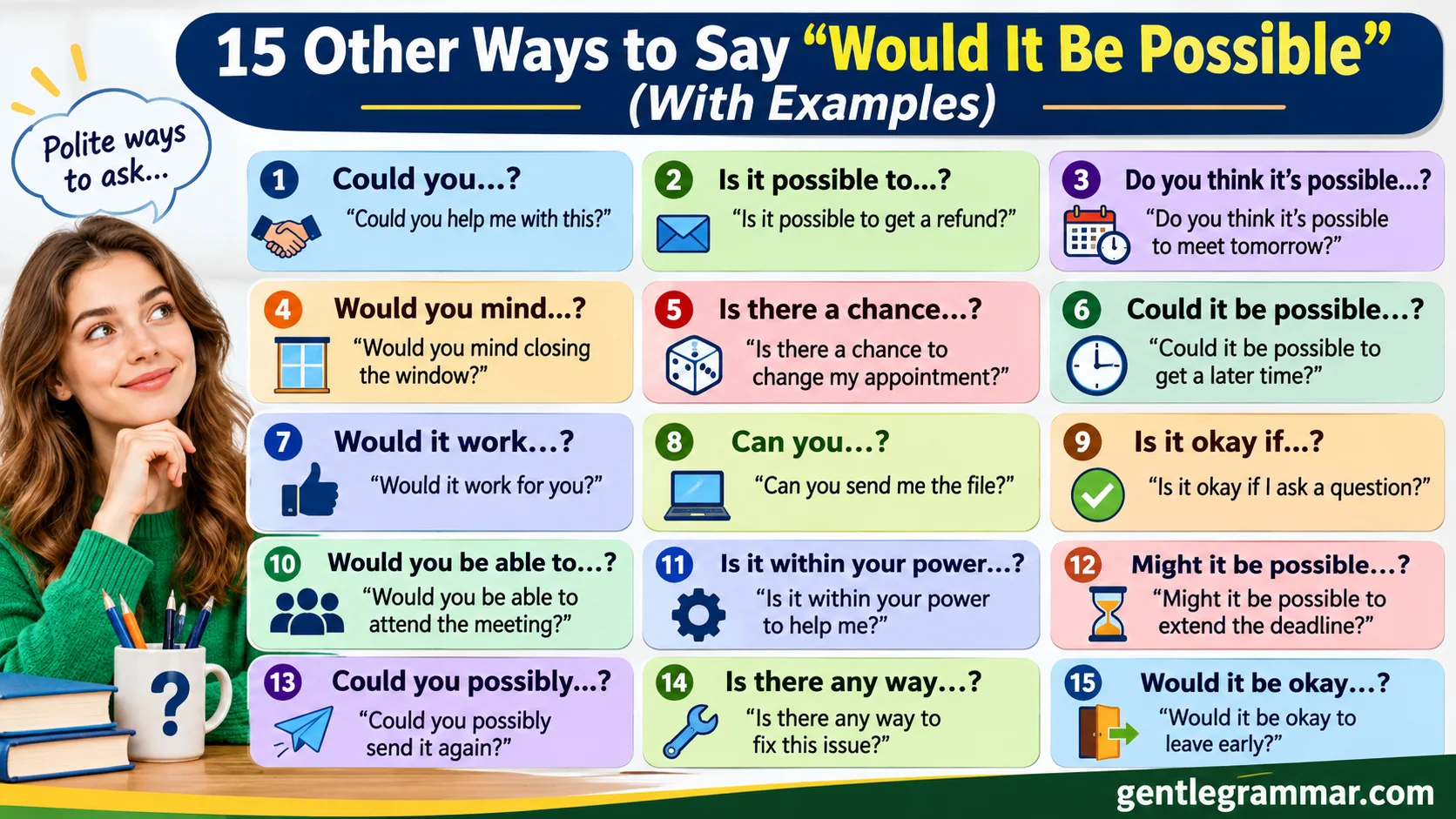
This guide to 15 Other Ways to Say “Would It Be Possible” (With Examples) shows how small wording choices make requests sound more respectful.
When I learned to communicate professionally, I realized that the words we choose really matter. A formal, polite, and gentle phrase can make a request sound less direct and more respectful. For example, asking a server for a salad instead of bread creates a softer tone that flows smoothly and maintains warmth in a conversation. Good manners, empathy, and care build a connection between your intention and the other person’s respect.
With time, you can explore ways to say similar things differently through simple swaps like “Might you have time for this?” and “Could you help me with this?” Each option makes your message sound natural and considerate, helping you get your point across without losing professionalism. This subtle skill helps you maintain a thoughtful tone, create rapport in a workplace setting, and handle a polite inquiry or gentle reminder. It all comes down to how you phrase your words because respectful communication can leave a lasting impression.
What Does “Would It Be Possible” Mean?
“Would It Be Possible” is a polite way to ask whether something can be done. It usually introduces a request or question about availability, permission, or feasibility. For example, “Would it be possible to reschedule the meeting?” asks whether changing the meeting time can be arranged. The phrase does not demand an action, so it generally sounds respectful, careful, and considerate.
The expression is especially useful when you want to give the other person room to say yes or no. It can refer to something practical, such as changing an appointment, or something more personal, such as asking someone for a favor. Depending on the situation, alternatives can make the request warmer, more direct, more formal, or more conversational.
Common Situations Where “Would It Be Possible” Is Used
People commonly use “Would It Be Possible” when making requests that require another person’s cooperation. You might use it in a work email to ask for a deadline extension, in a text to ask someone to change plans, or in customer communication to request an adjustment. It also works well when asking about permission or whether a particular arrangement can be made.
The phrase is useful when you want to avoid sounding demanding. However, it can sometimes feel slightly formal or indirect in casual conversations. Choosing an alternative allows you to match the wording to the relationship and situation rather than using the same polite formula every time.
Is It Professional or Polite to Say “Would It Be Possible”?
Yes. “Would It Be Possible” is generally polite, professional, and respectful. It works particularly well in emails, workplace conversations, customer service, academic communication, and other situations where you want to make a request without sounding forceful.
Its level of formality depends on what follows it. “Would it be possible to send the report today?” sounds professional, while “Would it be possible for you to pick me up?” can sound perfectly natural in personal conversation. In very casual situations, simpler wording such as “Could you” or “Can you” may sound more natural.
Advantages and Disadvantages of Saying “Would It Be Possible”
Advantages
The main advantage is its polite and non-demanding tone. It gives the listener freedom to decide whether the request can be fulfilled. It is also flexible enough for professional emails, personal requests, scheduling questions, and customer communication. Because it focuses on possibility rather than obligation, it can make a sensitive request feel easier to receive.
Disadvantages
The phrase can sometimes sound more indirect than necessary, especially in casual conversation. If you use it repeatedly in emails, your writing may also become formulaic. In situations where you simply need a clear answer, “Could you” or “Can you” may communicate the request more naturally and efficiently.
Synonyms for “Would It Be Possible”
- Could You
- Would You Be Able To
- Could I Ask You To
- Is It Possible To
- Would You Mind
- Could We Arrange
- Would You Consider
- Might It Be Possible
- Would You Be Willing To
- Could You Please
- Is There Any Chance
- Would It Work To
- Could We Possibly
- Would You Be Open To
- Is There a Way To
1. Could You
Meaning
“Could you” is a common and natural way to make a polite request. It asks whether someone is willing or able to do something.
Definition
Could you means “Would you be able or willing to do this?” It is one of the most useful everyday alternatives to “Would It Be Possible.”
Detailed Explanation
“Could you” is usually shorter and more direct than “Would It Be Possible.” Despite being direct, it still sounds polite when used appropriately. It works especially well when you already know that the person may be able to help. In everyday English, it often feels more natural than a longer possibility-based phrase.
Scenario Examples
Scenario: You need a coworker to send a document.
Example: “Could you send me the latest version of the report?”
Scenario: You are asking a friend for help.
Example: “Could you give me a ride to the airport tomorrow?”
Scenario: You need a customer-service representative to make a change.
Example: “Could you update the delivery address for me?”
Best Use
Use this expression for emails, workplace requests, everyday conversation, and polite messages.
Tone
Tone: Polite, direct, and natural. It sounds respectful without being overly formal.
2. Would You Be Able To
Meaning
“Would you be able to” asks whether someone has the ability, opportunity, or availability to do something.
Definition
Would you be able to means “Would you have the ability or opportunity to do this?”
Detailed Explanation
This expression is especially useful when the request depends on someone’s availability or practical ability. It can sound slightly more formal than “Could you.” It is a good choice when you want to recognize that the other person may have limitations or other commitments. That makes it particularly useful in professional communication.
Scenario Examples
Scenario: You need a manager to review something.
Example: “Would you be able to review this proposal by Friday?”
Scenario: You are asking a colleague for help with a meeting.
Example: “Would you be able to join the call at 2 p.m.?”
Best Use
It works well in professional emails, workplace requests, scheduling, and respectful personal requests.
Tone
Tone: Professional, considerate, and polite. It emphasizes the person’s ability or availability.
3. Could I Ask You To
Meaning
“Could I ask you to” introduces a request in a particularly considerate way.
Definition
Could I ask you to means “May I request that you do something?”
Detailed Explanation
This wording makes the request itself feel more carefully framed. It is useful when the request requires some effort from the other person. Compared with “Would It Be Possible,” it focuses more directly on the act of asking someone for help. It can therefore sound personal and respectful at the same time.
Scenario Examples
Scenario: You need a colleague to make a small correction.
Example: “Could I ask you to check the figures once more?”
Scenario: You are speaking to someone during an event.
Example: “Could I ask you to move your chair slightly?”
Best Use
Use it for polite workplace requests, formal conversations, and situations where you want to show consideration.
Tone
Tone: Respectful, careful, and somewhat formal. It is softer than a blunt command.
4. Is It Possible To
Meaning
“Is it possible to” directly asks whether something can be done or arranged.
Definition
Is it possible to means “Can this be done or arranged?”
Detailed Explanation
This phrase is very close in meaning to “Would It Be Possible,” but it is usually more direct and neutral. It focuses on feasibility rather than on politely asking another person to take action. It is especially useful when you are asking about rules, arrangements, services, or technical possibilities.
Scenario Examples
Scenario: You are contacting a hotel.
Example: “Is it possible to check in before noon?”
Scenario: You are asking about a service.
Example: “Is it possible to change the delivery date?”
Best Use
It works well in customer service, professional emails, formal questions, and practical conversations.
Tone
Tone: Neutral, polite, and straightforward. It focuses on possibility and feasibility.
5. Would You Mind
Meaning
“Would you mind” is a polite way to ask someone to do something or allow something.
Definition
Would you mind means “Would this bother you or cause you an inconvenience?”
Detailed Explanation
This expression is slightly different from “Would It Be Possible” because it focuses on the other person’s willingness or comfort. It is common in everyday English and can sound very natural between people who already have some familiarity. Remember that “Would you mind” uses a different grammatical pattern, so it is usually followed by a verb ending in -ing.
Scenario Examples
Scenario: You want someone to close a window.
Example: “Would you mind closing the window?”
Scenario: You need a colleague to wait briefly.
Example: “Would you mind waiting here for a moment?”
Best Use
Use it in everyday conversation, workplace interactions, polite requests, and personal communication.
Tone
Tone: Friendly, polite, and considerate. It often feels more conversational than “Would It Be Possible.”
6. Could We Arrange
Meaning
“Could we arrange” suggests finding a suitable way to organize or schedule something.
Definition
Could we arrange means “Can we organize or set up this arrangement?”
Detailed Explanation
This phrase works best when the request involves planning, scheduling, or coordination. Unlike “Would It Be Possible,” it assumes that both people may participate in finding a solution. It sounds collaborative rather than one-sided. That makes it especially useful for workplace and scheduling situations.
Scenario Examples
Scenario: You need to schedule a meeting.
Example: “Could we arrange a meeting for early next week?”
Scenario: You want to coordinate a delivery.
Example: “Could we arrange a different delivery time?”
Best Use
Use it for business communication, scheduling, meetings, appointments, and practical arrangements.
Tone
Tone: Cooperative, professional, and solution-focused.
7. Would You Consider
Meaning
“Would you consider” asks someone to think seriously about a particular option.
Definition
Would you consider means “Would you be willing to think about or possibly accept this idea?”
Detailed Explanation
This phrase is not always a direct substitute for “Would It Be Possible.” It works better when you are proposing an option, change, compromise, or idea. It gives the other person space to evaluate the suggestion. As a result, it can sound more diplomatic than simply asking someone to do something.
Scenario Examples
Scenario: You are negotiating a deadline.
Example: “Would you consider giving us an additional two days?”
Scenario: You are discussing a workplace change.
Example: “Would you consider moving the meeting to Thursday?”
Best Use
It is useful in negotiations, workplace communication, formal requests, and sensitive discussions.
Tone
Tone: Diplomatic, respectful, and persuasive. It invites consideration rather than immediate agreement.
8. Might It Be Possible
Meaning
“Might it be possible” is a very polite and cautious way to ask whether something can happen.
Definition
Might it be possible means “Could this possibly be done or arranged?”
Detailed Explanation
This wording is more formal and tentative than most alternatives on this list. It can be useful when making a delicate request or writing in a formal setting. In casual conversation, however, it may sound unnecessarily formal. The phrase creates considerable distance between the speaker and the request.
Scenario Examples
Scenario: You are making a formal request to an organization.
Example: “Might it be possible to receive a copy of the original document?”
Scenario: You are writing a very formal business message.
Example: “Might it be possible to arrange a brief meeting next week?”
Best Use
Use it mainly in formal correspondence, diplomatic requests, and carefully worded professional communication.
Tone
Tone: Very polite, formal, and tentative. It can sound more traditional than everyday English.
9. Would You Be Willing To
Meaning
“Would you be willing to” asks whether someone is prepared to do something.
Definition
Would you be willing to means “Would you agree or be prepared to do this?”
Detailed Explanation
This expression focuses on willingness, not ability. Someone might be able to do something but still not want to do it, so this phrase is useful when their agreement matters. It can be especially appropriate when asking for cooperation, flexibility, or a personal favor.
Scenario Examples
Scenario: You are asking a colleague to help with a project.
Example: “Would you be willing to take the lead on this project?”
Scenario: You are discussing a compromise.
Example: “Would you be willing to meet halfway on the price?”
Best Use
It works well in negotiations, professional requests, collaborative discussions, and sensitive conversations.
Tone
Tone: Respectful, diplomatic, and considerate. It gives importance to the other person’s choice.
10. Could You Please
Meaning
“Could you please” is a direct but polite way to ask someone to do something.
Definition
Could you please means “Would you kindly do this?”
Detailed Explanation
This expression is more action-oriented than “Would It Be Possible.” It is useful when you know what you need and simply want to ask the other person to do it. Adding please softens the request. However, the phrase can sound demanding if it is used repeatedly or with an impatient tone.
Scenario Examples
Scenario: You need an employee to send a file.
Example: “Could you please send the signed form today?”
Scenario: You are contacting customer service.
Example: “Could you please confirm when the order will arrive?”
Best Use
Use it for professional emails, customer communication, workplace requests, and everyday polite requests.
Tone
Tone: Polite, clear, and direct. It is less tentative than “Would It Be Possible.”
11. Is There Any Chance
Meaning
“Is there any chance” asks whether something might be possible, available, or likely.
Definition
Is there any chance means “Is there some possibility that this could happen?”
Detailed Explanation
This phrase is often more casual and conversational than “Would It Be Possible.” It can also communicate a little more hope or uncertainty. It works naturally when you are asking for flexibility, a favor, or an exception. In highly formal writing, a different expression may sound more appropriate.
Scenario Examples
Scenario: You want to change a reservation.
Example: “Is there any chance we could move our reservation to Friday?”
Scenario: You are asking a friend for a favor.
Example: “Is there any chance you could pick me up after work?”
Best Use
Use it in casual conversations, friendly messages, personal requests, and informal workplace communication.
Tone
Tone: Friendly, hopeful, and conversational. It feels less formal than the original phrase.
12. Would It Work To
Meaning
“Would it work to” asks whether a proposed plan or solution would be practical.
Definition
Would it work to means “Would this plan or arrangement be suitable?”
Detailed Explanation
This phrase shifts attention from whether something is technically possible to whether it would work well in practice. It is useful when proposing a time, method, or solution. Because it sounds collaborative, it often works better than a formal request when two people are trying to make plans together.
Scenario Examples
Scenario: You are choosing a meeting time.
Example: “Would it work to meet at 3 p.m. instead?”
Scenario: You are discussing a project schedule.
Example: “Would it work to submit the first draft on Monday?”
Best Use
Use it for scheduling, planning, teamwork, and everyday problem-solving.
Tone
Tone: Practical, collaborative, and conversational. It focuses on finding a workable solution.
13. Could We Possibly
Meaning
“Could we possibly” politely asks whether something can be done, often with an added sense of hesitation.
Definition
Could we possibly means “Could we perhaps do this?”
Detailed Explanation
This expression is useful when you want to make a request without sounding forceful. The word possibly adds a layer of softness and uncertainty. It can be particularly effective when the request is inconvenient or requires flexibility. However, using it too often may make your communication sound overly cautious.
Scenario Examples
Scenario: You want to change a meeting time.
Example: “Could we possibly move the meeting to Thursday?”
Scenario: You are asking a colleague for extra time.
Example: “Could we possibly have until Friday to finish the report?”
Best Use
It fits polite workplace requests, personal favors, scheduling, and situations where flexibility is needed.
Tone
Tone: Polite, tentative, and considerate. It softens a request without making it extremely formal.
14. Would You Be Open To
Meaning
“Would you be open to” asks whether someone is receptive to an idea, option, or change.
Definition
Would you be open to means “Would you be willing to consider this possibility?”
Detailed Explanation
This phrase is especially useful when you are suggesting something that the other person has not already agreed to. It emphasizes openness and willingness to consider an idea rather than simply asking whether it is possible. It can sound collaborative and respectful during discussions where several solutions are available.
Scenario Examples
Scenario: You are discussing a work arrangement.
Example: “Would you be open to working remotely on Friday?”
Scenario: You are trying to find a compromise.
Example: “Would you be open to trying a different approach?”
Best Use
Use it for workplace discussions, negotiations, collaborative planning, and personal conversations about changes.
Tone
Tone: Open-minded, diplomatic, and collaborative. It encourages discussion rather than demanding an answer.
15. Is There a Way To
Meaning
“Is there a way to” asks whether a method or solution exists for accomplishing something.
Definition
Is there a way to means “Is there a method or solution that would make this possible?”
Detailed Explanation
This expression focuses on finding a solution rather than simply asking for permission or ability. It is useful when you are facing a problem and want to know whether another option exists. Compared with “Would It Be Possible,” it often sounds more practical and problem-solving. It can be used in both personal and professional situations.
Scenario Examples
Scenario: You are having trouble changing an appointment.
Example: “Is there a way to move my appointment to next week?”
Scenario: You are working with customer support.
Example: “Is there a way to update my order before it ships?”
Scenario: You are discussing a project limitation.
Example: “Is there a way to finish this without delaying the launch?”
Best Use
Use it for problem-solving, customer service, workplace discussions, technical questions, and everyday requests.
Tone
Tone: Practical, neutral, and solution-focused. It works well when you want to explore available options.
FAQs:
What is another way to say “Would It Be Possible”?
Useful alternatives include “Could you,” “Would you be able to,” “Is it possible to,” and “Could we possibly.” The best choice depends on whether you want to sound casual, professional, direct, or especially tentative.
What does “Would It Be Possible” mean?
“Would It Be Possible” is a polite way to ask whether something can be done, arranged, or allowed. It gives the other person room to accept or decline the request.
Is “Would It Be Possible” professional?
Yes. It is generally professional and polite, especially in emails, workplace communication, customer service, and formal requests. In casual conversation, shorter options such as “Could you?” may sound more natural.
What is a more polite way to say “Would It Be Possible”?
For a softer request, you could use “Might it be possible,” “Would you be willing to,” or “Would you consider.” These expressions can make a request sound more careful or diplomatic, depending on the context.
Which alternative works best in formal communication?
“Would you be able to” is a strong general choice for professional communication because it is polite without sounding excessively formal. For highly formal writing, “Might it be possible” can work when a more tentative tone is appropriate.
Conclusion:
Choosing the right wording can change how a request feels. “Would It Be Possible” is already a respectful expression, but it may not be the best choice for every situation. Sometimes “Could you” sounds more natural, while “Would you be able to” feels more professional. In other cases, “Would you consider” or “Would you be open to” better communicates that you are inviting discussion rather than simply asking for an action.
The important point is to consider tone, context, relationship, and intention before choosing an alternative. A workplace email may need more careful wording than a text to a friend. Likewise, a request for help is different from a suggestion for compromise. When you understand these differences, you can use “Would It Be Possible” and its alternatives with greater confidence and naturalness.
