
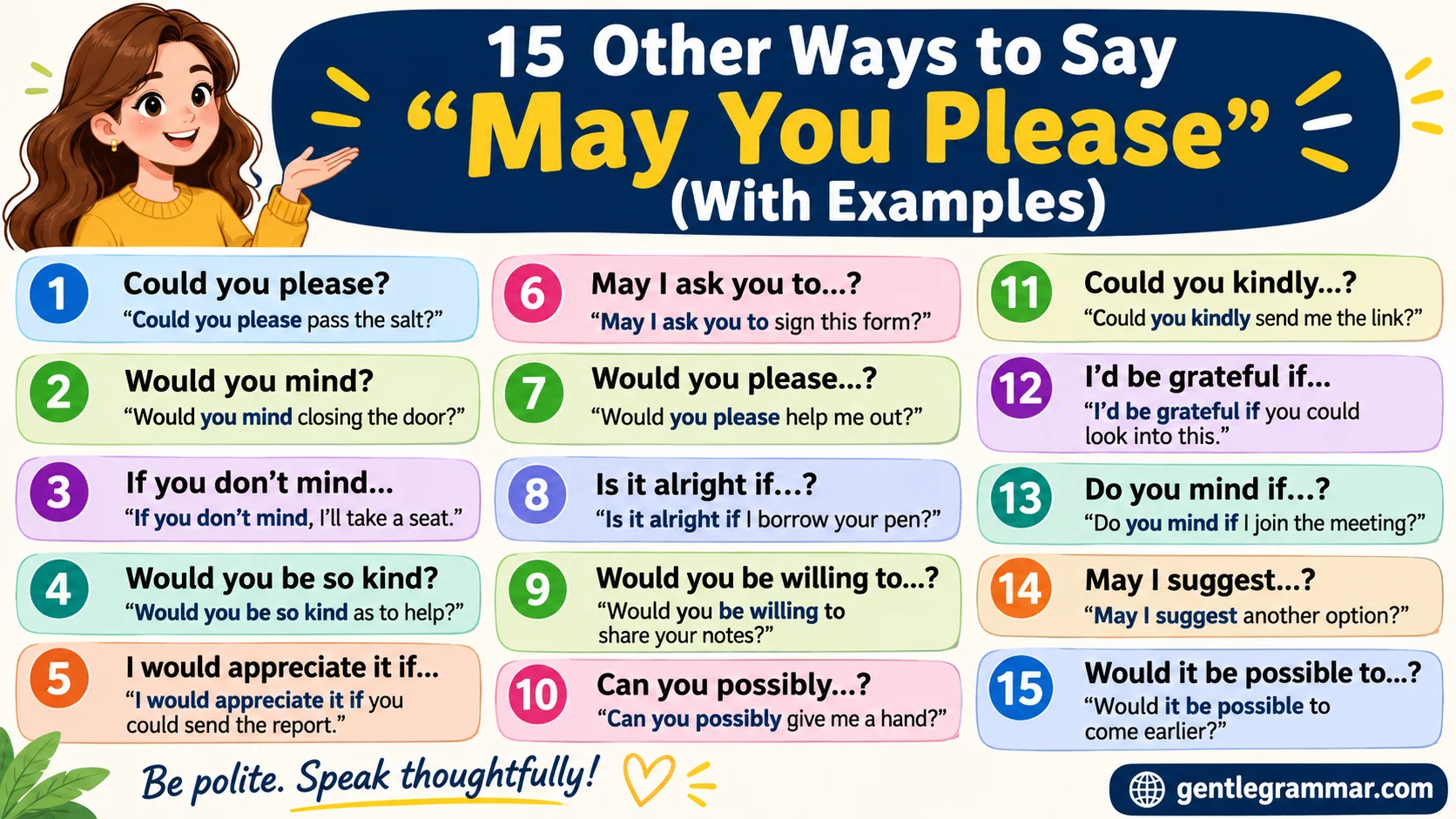
The phrase # 15 Other Ways to Say “May You Please” (With Examples) helps you choose natural request phrases for clearer, warmer, and more polite communication.
In my senior year of high school, an English teacher, Mr. Pantalone, gave our class an extended definition essay about a single word. We had to write five paragraphs, and it was a hard assignment because he warned us not to be predictable. I chose harmony, and my essay earned 99%. He praised me as a student who avoided the usual Webster’s Dictionary opening, where the writer defines the word like a dictionary definition.
I felt like the man of the hour, but after class I asked why my paper did not receive a hundred. He pointed to a single missing comma halfway through the essay and added it with a red pen. I was indignant, especially after hearing the reason for receiving ninety-nine instead of a perfect score. His comment about a perfect score for an imperfect paper was a Mic drop.
What Does “May You Please” Mean?
“May you please” is intended to introduce a polite request for someone to do something. For example, “May you please send me the document?” means that the speaker is asking the other person to send the document in a respectful way. However, the wording is less natural in everyday English than expressions such as “Could you please” or “Would you please.” Native speakers usually use may to ask for permission, as in “May I leave early?” rather than to ask another person to perform an action.
The phrase therefore communicates respectful intent, but its grammar and usage can feel somewhat formal or awkward depending on the sentence. If your goal is to make a request sound natural, especially in workplace communication, a different expression will usually work better.
Common Situations Where “May You Please” Is Used
Someone might use “may you please” when making a request in a conversation, email, message, workplace setting, or formal communication. It may appear when a person wants to sound respectful and careful, such as when asking someone to provide information, complete a task, send a file, or offer assistance.
However, the phrase is not equally natural in every setting. In a text to a friend, “Could you please” or “Can you” usually sounds more conversational. In professional writing, “Would you please”, “Could you kindly”, or “Would you mind” may create a smoother request. The best alternative depends on how formal, direct, or warm you want to sound.
Is It Professional or Polite to Say “May You Please”?
The intention behind “may you please” is polite, but the construction itself is unusual in standard modern English. It does not normally sound rude. Instead, it can make the speaker seem overly formal or unfamiliar with the most natural structure for requests. For professional communication, a phrase such as “Could you please” is generally a safer and more natural choice.
There is an important distinction between “May I please” and “May you please.” “May I please” is a natural way to ask for permission, while “may you please” attempts to ask another person to take an action. If you want your workplace or customer-facing message to sound polished, choose an alternative that clearly matches the intended request.
Advantages and Disadvantages of Saying “May You Please”
Advantages
The main advantage is its clear polite intention. The word “please” signals that the speaker is making a request rather than giving an order. In some contexts, the formal wording may also communicate that the speaker wants to be particularly respectful.
Disadvantages
The biggest limitation is naturalness. “May you please” can sound awkward because English speakers generally do not use “may” this way when requesting an action from another person. It may also create unnecessary distance in casual conversation. In professional settings, a more established request structure can make your message sound confident, fluent, and respectful.
Synonyms for “May You Please”
- Could You Please
- Would You Please
- Could You Kindly
- Would You Kindly
- Would You Mind
- Could You Possibly
- Would You Be Able to
- Could You Help Me
- Can You Please
- Would You Be So Kind as to
- Please Could You
- I’d Appreciate It If You Could
- I’d Be Grateful If You Could
- Would It Be Possible for You to
- If You Could, Please
1. Could You Please
Meaning
“Could you please” is a natural and widely used way to make a polite request. It asks whether someone is willing or able to do something.
Definition
Could you please means “Would you be willing to do this?” It is a polite request rather than a question about past ability.
Detailed Explanation
This is usually the best everyday replacement for “may you please.” It sounds respectful without being stiff, so it works in both personal and professional communication. It can also be used with strangers, coworkers, customers, teachers, and friends. Compared with “may you please,” it follows a much more natural request pattern.
Scenario Examples
Scenario: You need a coworker to send a file.
Example: “Could you please send me the updated report?”
Scenario: You are asking someone for directions.
Example: “Could you please tell me how to get to the station?”
Scenario: You are texting a family member.
Example: “Could you please pick up some bread on your way home?”
Best Use
Use it for emails, workplace requests, everyday conversation, customer communication, and polite messages.
Tone
Tone: Polite, natural, respectful
It is courteous without sounding overly formal.
2. Would You Please
Meaning
“Would you please” is a polite way to ask someone to do something. It can sound slightly more formal or deliberate than “could you please.”
Definition
Would you please means “Would you be willing to do this?” in the context of a request.
Detailed Explanation
This expression is especially useful when you want your request to sound firm but courteous. It can sometimes carry more emphasis than “could you please,” particularly when someone has already been asked to do something. It is suitable for professional communication, though it can sound somewhat formal in casual conversation.
Scenario Examples
Scenario: A colleague has not yet completed a requested task.
Example: “Would you please send the figures before the meeting?”
Scenario: You want someone to lower their voice.
Example: “Would you please keep your voice down?”
Best Use
Use it for workplace communication, formal requests, instructions, and situations where you need polite firmness.
Tone
Tone: Polite, direct, moderately formal
It keeps the request respectful while giving it a little more authority.
3. Could You Kindly
Meaning
“Could you kindly” introduces a courteous request and is especially common in professional or formal writing.
Definition
Could you kindly means “Could you please do this?” with an added sense of courtesy.
Detailed Explanation
This expression can make a request sound polished and respectful. It is often seen in business emails, customer service messages, and formal correspondence. However, “kindly” can feel more formal than “please,” so it may sound unusual in a relaxed text message.
Scenario Examples
Scenario: You need a customer to provide missing information.
Example: “Could you kindly provide your order number?”
Scenario: You are writing to a professional contact.
Example: “Could you kindly confirm your availability for Thursday?”
Best Use
Use it in professional emails, customer communication, formal requests, and business correspondence.
Tone
Tone: Professional, courteous, formal
The word “kindly” adds a more polished and respectful quality.
4. Would You Kindly
Meaning
“Would you kindly” is a courteous request that can sound more formal and deliberate than everyday alternatives.
Definition
It means “Would you please do this?” in a respectful, formal style.
Detailed Explanation
This phrase works well when you want to make a request without sounding overly casual. It is appropriate when addressing someone with professional distance or when writing formal instructions. Depending on the situation and the speaker’s tone, it can occasionally sound firm or even slightly stern, so context matters.
Scenario Examples
Scenario: A receptionist asks a visitor to complete a form.
Example: “Would you kindly complete this form before entering?”
Scenario: A manager needs a document from an employee.
Example: “Would you kindly forward the final version to me?”
Best Use
Use it for formal communication, professional correspondence, and respectful instructions.
Tone
Tone: Formal, courteous, direct
It sounds more polished than conversational.
5. Would You Mind
Meaning
“Would you mind” is a polite way to ask whether someone would object to doing something.
Definition
Would you mind means “Would this be a problem for you?” or “Would you be willing to do this?”
Detailed Explanation
Unlike “could you please,” this phrase focuses on the person’s willingness rather than simply asking for an action. It is often softer and more considerate. Remember that the grammar normally changes after it: “Would you mind helping me?” is natural, while “Would you mind to help me?” is not.
Scenario Examples
Scenario: You want a coworker to close a window.
Example: “Would you mind closing the window?”
Scenario: You need someone to wait briefly.
Example: “Would you mind waiting here for a few minutes?”
Best Use
Use it for polite everyday requests, workplace conversations, and situations where you want to sound considerate.
Tone
Tone: Gentle, considerate, polite
It softens the request by acknowledging the other person’s choice.
6. Could You Possibly
Meaning
“Could you possibly” makes a request sound especially tentative and considerate.
Definition
It means “Would it be possible for you to do this?”
Detailed Explanation
This expression is useful when you realize that your request may be inconvenient or difficult. The word “possibly” makes the request less forceful and gives the other person room to decline. It can therefore sound more cautious than a straightforward “Could you please.”
Scenario Examples
Scenario: You need help at short notice.
Example: “Could you possibly cover my shift this afternoon?”
Scenario: You want a colleague to make an exception.
Example: “Could you possibly move our meeting to Friday?”
Best Use
Use it for delicate requests, favors, unexpected requests, and situations where you want extra politeness.
Tone
Tone: Gentle, tentative, respectful
It shows that you understand the request may not be convenient.
7. Would You Be Able to
Meaning
“Would you be able to” politely asks whether someone has the ability, availability, or opportunity to do something.
Definition
It means “Would it be possible for you to do this?”
Detailed Explanation
This alternative is particularly useful when the person’s availability or practical ability matters. It sounds less demanding because it does not assume they can complete the task. It works especially well in professional settings where schedules, responsibilities, or resources may affect someone’s answer.
Scenario Examples
Scenario: You need a colleague to attend a meeting.
Example: “Would you be able to join the meeting at 3 p.m.?”
Scenario: You are asking a technician for assistance.
Example: “Would you be able to check the equipment today?”
Best Use
Use it for workplace emails, scheduling, professional requests, and situations involving availability.
Tone
Tone: Professional, considerate, neutral
It gives the other person space to say yes or no.
8. Could You Help Me
Meaning
“Could you help me” is a friendly request for assistance rather than a general request for an action.
Definition
It means “Would you be willing to assist me?”
Detailed Explanation
This phrase works best when you need someone’s support, guidance, or involvement. It sounds more personal than “could you please” because it directly identifies the need for help. It is especially natural when you do not yet know exactly how much assistance you will need.
Scenario Examples
Scenario: You are struggling with a computer problem.
Example: “Could you help me figure out why this file won’t open?”
Scenario: You are asking a friend for assistance.
Example: “Could you help me move this table?”
Best Use
Use it for personal requests, workplace assistance, customer support, and everyday conversation.
Tone
Tone: Friendly, cooperative, approachable
It invites collaboration instead of simply assigning a task.
9. Can You Please
Meaning
“Can you please” is a common way to make a direct but polite request.
Definition
It means “Are you able or willing to do this?” followed by a courteous request.
Detailed Explanation
This expression is more conversational than “could you please.” It is extremely common in spoken English and informal messages. In some situations, it can sound more direct, especially if spoken sharply, so your tone of voice matters.
Scenario Examples
Scenario: You are texting a friend.
Example: “Can you please call me when you get home?”
Scenario: You need someone to send a photo.
Example: “Can you please send me the picture from yesterday?”
Best Use
Use it for texting, casual conversation, everyday requests, and familiar relationships.
Tone
Tone: Casual, direct, polite
It is natural when you already have a comfortable relationship with the person.
10. Would You Be So Kind as to
Meaning
“Would you be so kind as to” is a highly courteous way to ask someone to do something.
Definition
It means “Would you kindly do this?” in a notably formal style.
Detailed Explanation
This expression is much more formal than “could you please.” It may appear in formal correspondence, traditional writing, or carefully worded requests. In ordinary conversation, however, it can sound overly elaborate. Use it when the formal style genuinely fits the situation rather than simply because you want to sound polite.
Scenario Examples
Scenario: A formal letter requests information.
Example: “Would you be so kind as to provide the requested documents?”
Scenario: A formal event organizer asks for confirmation.
Example: “Would you be so kind as to confirm your attendance?”
Best Use
Use it for formal letters, ceremonial communication, and highly respectful written requests.
Tone
Tone: Very formal, courteous, traditional
It creates considerable distance and formality between the speaker and listener.
11. Please Could You
Meaning
“Please could you” is a polite request structure commonly used in British English.
Definition
It means “Could you please do this?” with “please” placed before the request verb.
Detailed Explanation
This wording is perfectly natural in many varieties of English, especially British English. It has the same basic purpose as “could you please,” but the word order differs. It can sound courteous and natural in conversation as well as writing.
Scenario Examples
Scenario: You are asking a coworker for a document.
Example: “Please could you send me the latest version?”
Scenario: A student asks a teacher for clarification.
Example: “Please could you explain that part again?”
Best Use
Use it in polite conversation, workplace communication, British English, and respectful requests.
Tone
Tone: Polite, natural, respectful
It sounds courteous without being excessively formal.
12. I’d Appreciate It If You Could
Meaning
“I’d appreciate it if you could” expresses gratitude while making a request.
Definition
It means “I would be grateful if you were able to do this.”
Detailed Explanation
This phrase adds a personal note of appreciation to the request. It can be useful when the person’s help would genuinely make a difference. Because it emphasizes gratitude, it often sounds warmer than a simple command or direct question.
Scenario Examples
Scenario: You need a colleague to review a document.
Example: “I’d appreciate it if you could review this before Friday.”
Scenario: You are asking someone to keep you informed.
Example: “I’d appreciate it if you could let me know about any changes.”
Best Use
Use it for professional emails, thoughtful requests, and situations where you want to acknowledge the value of someone’s help.
Tone
Tone: Warm, professional, appreciative
It combines a request with genuine courtesy.
13. I’d Be Grateful If You Could
Meaning
“I’d be grateful if you could” expresses sincere appreciation for someone’s assistance.
Definition
It means “I would be very thankful if you were able to do this.”
Detailed Explanation
This wording is slightly more heartfelt than “I’d appreciate it if you could.” It works particularly well when the requested help is meaningful or requires extra effort. It should not be used for every tiny request, because the stronger expression of gratitude can feel excessive in routine situations.
Scenario Examples
Scenario: You need someone to provide an important reference.
Example: “I’d be grateful if you could send the reference by Monday.”
Scenario: You are asking someone for help during a difficult situation.
Example: “I’d be grateful if you could give me some advice.”
Best Use
Use it for meaningful favors, formal requests, professional correspondence, and situations requiring sincere appreciation.
Tone
Tone: Warm, respectful, sincere
It communicates that the person’s help would genuinely matter to you.
14. Would It Be Possible for You to
Meaning
“Would it be possible for you to” politely asks whether someone can accommodate a particular request.
Definition
It means “Is it possible for you to do this?”
Detailed Explanation
This wording is useful when you want to avoid sounding demanding. Instead of assuming that the person can fulfill your request, it asks whether the action is possible for them. It is especially appropriate when the request involves scheduling, arrangements, changes, or special accommodations.
Scenario Examples
Scenario: You need to change an appointment.
Example: “Would it be possible for you to move our appointment to Tuesday?”
Scenario: You are making a workplace request.
Example: “Would it be possible for you to provide the figures by tomorrow?”
Best Use
Use it for professional communication, scheduling, formal requests, and requests involving flexibility.
Tone
Tone: Polite, cautious, professional
It sounds considerate because it recognizes that the request may not be convenient.
15. If You Could, Please
Meaning
“If you could, please” softens a request by presenting the action as something you would appreciate if the person is able to do it.
Definition
It means “Please do this if you are able to.”
Detailed Explanation
This structure is useful when you want to make a request without sounding forceful. It can suggest that the task is helpful but not an absolute demand. Depending on the sentence, it can work in both everyday and professional communication.
Scenario Examples
Scenario: You are asking a coworker to add something to a document.
Example: “If you could, please add the missing details to the final page.”
Scenario: You are asking a friend for a small favor.
Example: “If you could, please bring my jacket when you come over.”
Best Use
Use it for polite requests, workplace messages, everyday conversation, and situations where you want to soften your wording.
Tone
Tone: Gentle, polite, low-pressure
It leaves some room for the other person rather than making the request sound like an order.
FAQs:
What is another way to say “May You Please”?
The most natural alternative is usually “Could you please.” Other useful options include “Would you please,” “Could you kindly,” and “Would you mind.” The best choice depends on whether you want to sound casual, professional, formal, or especially considerate.
What does “May You Please” mean?
“May you please” is intended to introduce a polite request, such as asking someone to send a document or complete a task. However, the construction is less natural in modern English than “Could you please.” “May I please” is more commonly used when asking for permission.
Is “May You Please” professional?
It is understandable and has a polite intention, but it is not the most natural professional phrasing. In workplace emails, “Could you please,” “Would you be able to,” or “I’d appreciate it if you could” will usually sound smoother.
What is a more polite way to say “May You Please”?
There are several options, depending on the situation. “Could you kindly” sounds professional, while “I’d be grateful if you could” adds warmth and appreciation. For a very formal request, “Would you be so kind as to” may work.
Which alternative works best in formal communication?
“Would you be able to,” “Could you kindly,” and “Would it be possible for you to” are strong choices for formal communication. If you want to sound professional without becoming overly formal, “Could you please” is usually the safest option.
Conclusion:
Choosing the right request phrase can make a small message feel much more natural. “May you please” communicates a polite intention, but it is less idiomatic than many alternatives in modern English. For everyday requests, “Could you please” is a particularly natural choice. For professional situations, expressions such as “Could you kindly” or “Would you be able to” can sound polished and respectful.
When you want to emphasize appreciation, “I’d appreciate it if you could” or “I’d be grateful if you could” adds warmth. The important point is to match your wording to the relationship, situation, level of formality, and feeling you want to convey. A good alternative does more than replace words; it helps your request sound like something a real person would naturally say.
