
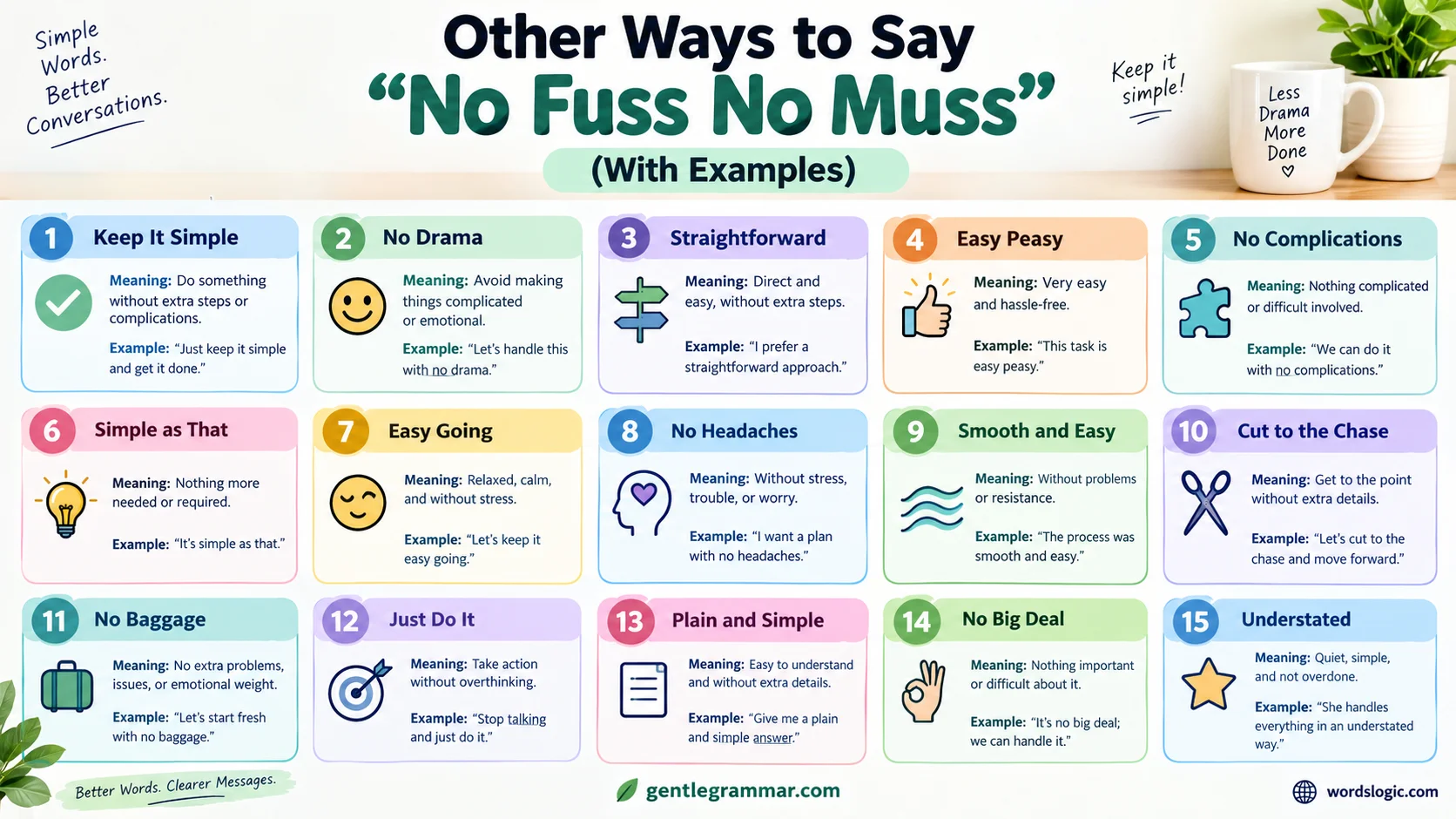
15 Other Ways to Say “No Fuss, No Muss” (With Examples), which explores useful alternatives for different situations.
The expression sounds friendly and memorable, but it is not appropriate for every situation. A professional email, academic paper, customer complaint, or legal document may require a neutral alternative, such as straightforward, hassle-free, or without complications. Understanding these alternatives helps you match your language to your audience and choose the right synonym for effective communication. A professional, reassuring, efficient, or conversational expression can preserve the basic idea while improving clarity, efficiency, simplicity, convenience, and ease.
In my experience, the best English expression depends on the context, audience awareness, and word choice. Useful synonyms and alternative phrases include informal language for friends and formal language for workplace communication, software learning, and the learning process. When someone faces difficulty, a short explanation is often better than a long explanation, especially when the goal is a simple process without unnecessary complexity, complications, or hassle.
What Does “No Fuss, No Muss” Mean?
“No fuss, no muss” is an informal expression meaning that something can be done easily, neatly, and without unnecessary trouble or complication. It suggests that a task, arrangement, or process does not require much effort, attention, or drama. For example, if someone says, “We can organize the meeting online—no fuss, no muss,” they mean the arrangement is straightforward and does not need a complicated process.
The expression is often used to emphasize convenience and simplicity. Depending on the context, it can also suggest that something is tidy, quick, or free from unnecessary discussion. Although the phrase is friendly and memorable, it is generally more suitable for casual conversation than formal documents. In professional settings, expressions such as “simple and straightforward” or “with minimal hassle” may communicate the same idea more clearly.
Common Situations Where “No Fuss, No Muss” Is Used
People use “no fuss, no muss” when they want to emphasize that something is easy to arrange or complete. In everyday conversation, it might describe a quick dinner plan, a simple household task, or an uncomplicated way to solve a problem. In text messages, it can reassure a friend that making plans will be easy and stress-free.
At work, the expression may describe an uncomplicated procedure, a quick meeting, or an easy customer service process, although more neutral wording often sounds better in formal emails. It can also suit social media captions about simple routines, convenient products, or low-key events. In school and personal communication, it may describe an easy assignment or a straightforward arrangement. Choosing an alternative can help you sound more professional, more precise, or more reassuring, depending on the audience.
Is It Professional or Polite to Say “No Fuss, No Muss”?
“No fuss, no muss” is generally friendly, casual, and informal. It is not rude, and it can make a conversation feel relaxed, especially when speaking with friends, colleagues you know well, or customers in an informal setting. However, its playful wording may feel too conversational for a formal report, business proposal, or official email.
For professional communication, expressions such as “simple and straightforward,” “with minimal hassle,” and “easy to arrange” are usually more appropriate. These alternatives preserve the idea of simplicity without sounding overly casual. When reassuring someone who is worried about a process, “It should be straightforward” may also sound more considerate than dismissing the process as no trouble at all. The best choice depends on your relationship with the reader and the level of formality you need.
Advantages and Disadvantages of Saying “No Fuss, No Muss”
Advantages
The main advantage of “no fuss, no muss” is that it communicates simplicity in a friendly, memorable way. Its playful rhythm makes it easy to understand and suitable for informal conversations. It can reassure someone that an arrangement will not require excessive effort or unnecessary complications. The expression also adds a relaxed, approachable quality to everyday communication.
Disadvantages
The phrase may sound too informal in official or highly professional writing. Its broad meaning can also leave out useful details: something might be easy to arrange but not necessarily quick, inexpensive, or completely effortless. In sensitive conversations, the expression could unintentionally make another person’s concerns seem unimportant. A more specific alternative can communicate exactly what you mean without losing the emphasis on simplicity.
Synonyms for “No Fuss, No Muss”
- Simple and straightforward
- Without any hassle
- Easy as pie
- A piece of cake
- No trouble at all
- Quick and easy
- Smooth sailing
- Nothing complicated
- As simple as that
- Without any drama
- Hassle-free
- Easy to manage
- Plain and simple
- With minimal effort
- A breeze
1. Simple and straightforward
Meaning
Simple and straightforward describes something that is easy to understand, arrange, or complete without unnecessary complications. Like “no fuss, no muss,” it emphasizes an uncomplicated process.
Definition
A task or situation that is clear, practical, and easy to handle.
Detailed Explanation
This expression is more neutral and professional than the original phrase. It focuses on clarity and simplicity rather than the playful idea of avoiding a fuss. You can use it when explaining instructions, procedures, plans, or decisions. It is especially helpful when you want to reassure someone without sounding overly casual.
Scenario Examples
– Scenario: Explaining a new workplace procedure.
Example: “The registration process is simple and straightforward, so you should be able to finish it quickly.”
– Scenario: Arranging a meeting with a colleague.
Example: “Let’s keep the agenda simple and straightforward.”
– Scenario: Helping a student understand an assignment.
Example: “The instructions are simple and straightforward once you read through them.”
Best Use
Use this expression in professional emails, instructions, presentations, customer communication, and everyday conversation. It works particularly well when clarity matters.
Tone
Tone: Clear, professional, practical.
It sounds confident and helpful without being stiff or overly formal.
2. Without Any Hassle
Meaning
Without any hassle means completing something without unnecessary inconvenience, difficulty, or frustration. It emphasizes how little trouble a person expects to encounter.
Definition
Doing something without causing or experiencing unnecessary difficulty.
Detailed Explanation
This alternative is close in meaning to “no fuss, no muss,” especially when convenience is the main point. It is conversational but works in many business situations, including customer service and discussions about arrangements. Unlike “simple and straightforward,” it emphasizes the absence of inconvenience rather than the clarity of a process. It is useful when reassuring someone that an arrangement should be easy to manage.
Scenario Examples
– Scenario: A friend offers to collect you from the airport.
Example: “You can ride with me without any hassle.”
– Scenario: A customer asks about changing an order.
Example: “We’ll help you update your delivery details without any hassle.”
– Scenario: Organizing a small gathering.
Example: “I’ll book the table online without any hassle.”
Best Use
Choose this phrase for friendly messages, customer support, travel arrangements, and informal professional communication. In formal reports, a phrase such as “with minimal inconvenience” may fit better.
Tone
Tone: Reassuring, friendly, convenient.
It emphasizes making things easier for the other person.
3. Easy as Pie
Meaning
Easy as pie means that something is very easy to do. It is an informal expression that focuses on the lack of difficulty rather than the absence of drama or unnecessary complications.
Definition
Something that requires very little skill or effort.
Detailed Explanation
This expression is playful and works best when you want to make an easy task sound approachable. While “no fuss, no muss” can describe an uncomplicated arrangement, “easy as pie” specifically emphasizes how little difficulty a task involves. It is natural in everyday spoken English but may sound too casual in formal business writing. Use it when talking to someone who might be worried about trying something new.
Scenario Examples
– Scenario: Showing a friend how to use an application.
Example: “Once you set up your account, sharing photos is easy as pie.”
– Scenario: Discussing a simple recipe.
Example: “Making this salad is easy as pie; you just chop the vegetables and mix everything together.”
– Scenario: Encouraging a younger student.
Example: “Don’t worry about the quiz. The first section is easy as pie.”
Best Use
Use it in casual conversations, friendly texts, lighthearted instructions, and informal writing. Avoid it when discussing a genuinely difficult task or communicating in a highly formal setting.
Tone
Tone: Cheerful, relaxed, playful.
Its informal character makes simple tasks sound less intimidating.
4. A Piece of Cake
Meaning
A piece of cake means something is very easy to accomplish. It is a familiar English idiom that highlights how little difficulty a task presents.
Definition
A task that is extremely easy to complete.
Detailed Explanation
This expression is similar to “easy as pie,” but it is particularly common when describing an individual task, test, activity, or challenge. “No fuss, no muss” suggests a lack of complications, whereas “a piece of cake” emphasizes ease. It can be used to reassure someone that a particular task is manageable. However, it may sound dismissive if the other person is genuinely struggling.
Scenario Examples
– Scenario: A friend asks whether a basic computer task is difficult.
Example: “Don’t worry; backing up your photos is a piece of cake.”
– Scenario: Talking about an exam after finishing it.
Example: “The first half of the test was a piece of cake.”
– Scenario: Explaining how to assemble a small shelf.
Example: “With the instructions in front of you, putting it together should be a piece of cake.”
Best Use
It works best in informal conversation, friendly messages, and everyday discussions about easy tasks. In professional writing, “easy to complete” is usually more neutral.
Tone
Tone: Casual, upbeat, encouraging.
It conveys confidence that a task will not be difficult.
5. No Trouble at All
Meaning
No trouble at all means that something is not an inconvenience or burden. It is especially useful when reassuring someone who is asking for help or apologizing for a request.
Definition
A way of saying that something requires no meaningful inconvenience or difficulty.
Detailed Explanation
Unlike the original expression, which describes an uncomplicated process, “no trouble at all” often communicates a person’s willingness to help. It is particularly useful in polite exchanges, such as responding to a favor request or thanking someone for their assistance. The phrase can sound warmer and more considerate because it directly addresses another person’s concern about causing inconvenience. However, it does not necessarily mean the task itself is easy.
Scenario Examples
– Scenario: A colleague apologizes for asking you to review a document.
Example: “No trouble at all. I’ll take a look before the meeting.”
– Scenario: A friend thanks you for giving them a lift.
Example: “No trouble at all; I was heading that way anyway.”
– Scenario: A customer asks for a small adjustment.
Example: “No trouble at all. I’ll update your booking now.”
Best Use
Choose it for polite conversations, customer service, workplace interactions, and personal messages when you want to reassure someone that their request is welcome.
Tone
Tone: Courteous, warm, reassuring.
It communicates helpfulness rather than simply describing an easy process.
6. Quick and Easy
Meaning
Quick and easy describes something that takes little time and requires little effort. It emphasizes both speed and simplicity.
Definition
Something that can be completed in a short time without much difficulty.
Detailed Explanation
This phrase is useful when both convenience and speed matter. Compared with “no fuss, no muss,” it gives the reader more specific information about what makes a process appealing. However, something can be quick and easy without being entirely free of complications. Use this expression when discussing short tasks, convenient services, simple meals, or efficient procedures.
Scenario Examples
– Scenario: Sharing a lunch idea with a friend.
Example: “I’ll make a quick and easy pasta dish for dinner.”
– Scenario: Explaining an online application.
Example: “The form is quick and easy to complete.”
– Scenario: Planning a short team check-in.
Example: “Let’s have a quick and easy meeting to confirm the final details.”
Best Use
Use it in everyday conversations, workplace messages, product descriptions, instructions, and practical recommendations when speed is an important benefit.
Tone
Tone: Practical, efficient, approachable.
It highlights convenience without relying on playful or overly casual language.
7. Smooth Sailing
Meaning
Smooth sailing describes a situation that progresses easily, without major obstacles or unexpected difficulties.
Definition
A process or experience that proceeds without significant problems.
Detailed Explanation
This expression is especially suitable for describing how something unfolds over time. While “no fuss, no muss” often emphasizes the simplicity of an arrangement, “smooth sailing” suggests that the process continues without setbacks. It is commonly used when discussing projects, travel, plans, or a transition that goes well. It does not guarantee that every step is effortless; it simply describes a relatively trouble-free experience.
Scenario Examples
– Scenario: Asking a colleague how a project is progressing.
Example: “Everything has been smooth sailing since we finalized the schedule.”
– Scenario: A friend asks about your first week at a new school.
Example: “The first week was smooth sailing once I found my classrooms.”
– Scenario: Describing a trip.
Example: “After we cleared security, the rest of the journey was smooth sailing.”
Best Use
Use it in casual workplace conversations, project updates, travel discussions, and personal storytelling. For formal reports, “progressed without major issues” may be more precise.
Tone
Tone: Optimistic, relaxed, reassuring.
It suggests steady progress and an absence of significant obstacles.
8. Nothing Complicated
Meaning
Nothing complicated means that a task, arrangement, or explanation does not involve complex steps or difficult details.
Definition
Something that is straightforward and does not require complicated procedures.
Detailed Explanation
This expression works well when you want to set expectations or explain that an arrangement will remain simple. It is more literal than “no fuss, no muss” and does not have the same playful rhythm. Depending on delivery, it can sound reassuring or slightly blunt. Adding a friendly explanation helps ensure that the wording feels helpful rather than dismissive.
Scenario Examples
– Scenario: Explaining plans for a casual birthday dinner.
Example: “We’ll order some food and catch up—nothing complicated.”
– Scenario: Describing a small task to a teammate.
Example: “It’s nothing complicated; just check the figures against the original report.”
– Scenario: Planning a relaxed weekend with a partner.
Example: “Let’s stay home, watch a movie, and do nothing complicated this weekend.”
Best Use
Use it in casual conversation, informal planning, and straightforward workplace discussions. For official instructions, specify the steps rather than relying on this general expression.
Tone
Tone: Relaxed, direct, uncomplicated.
It communicates that there is no need to make the situation more elaborate than necessary.
9. As Simple as That
Meaning
As simple as that emphasizes that something is straightforward and needs no additional explanation or complicated process.
Definition
A phrase used to indicate that something is as straightforward as it sounds.
Detailed Explanation
This expression is useful when explaining a process or summarizing a decision in a few words. It can create a confident, conversational finish, especially after a short explanation. However, it can sometimes sound dismissive if the listener believes the situation is more complicated. Compared with “no fuss, no muss,” it places greater emphasis on the simplicity of the explanation or solution.
Scenario Examples
– Scenario: Showing a friend how to share a file.
Example: “Upload the document, copy the link, and send it. As simple as that.”
– Scenario: Explaining a household routine.
Example: “Put the dishes in the dishwasher, add detergent, and press start—as simple as that.”
– Scenario: Discussing how to confirm attendance.
Example: “Reply to the invitation with your name and preferred time. It’s as simple as that.”
Best Use
Choose it for everyday explanations, friendly instructions, short messages, and informal presentations. Use a softer expression if someone needs more support or detailed guidance.
Tone
Tone: Confident, conversational, direct.
It works best when the simplicity is genuine and does not minimize another person’s concerns.
10. Without Any Drama
Meaning
Without any drama means handling a situation without unnecessary conflict, emotional tension, or exaggerated reactions.
Definition
Doing something without creating avoidable conflict or emotional complications.
Detailed Explanation
This alternative focuses more on emotions and interpersonal behavior than on the mechanical simplicity of a task. It is useful when describing plans, disagreements, or arrangements that everyone hopes to keep peaceful. However, it is not a perfect synonym for “no fuss, no muss”: a process may be easy yet still involve serious emotions. The phrase can also sound judgmental if it implies that someone’s concerns are unreasonable.
Scenario Examples
– Scenario: Friends are organizing a group outing.
Example: “Let’s agree on a time and place without any drama.”
– Scenario: Discussing a change of plans with a partner.
Example: “We can reschedule dinner without any drama; things come up.”
– Scenario: Talking about dividing responsibilities with a roommate.
Example: “Let’s work out who handles each chore without any drama.”
Best Use
Use it in informal conversations about relationships, group plans, and conflict avoidance. In sensitive or professional discussions, “without unnecessary conflict” may sound more respectful.
Tone
Tone: Casual, peace-seeking, sometimes blunt.
Its effect depends on context; it can encourage calm cooperation or unintentionally trivialize someone’s feelings.
11. Hassle-Free
Meaning
Hassle-free describes something designed or arranged to avoid unnecessary difficulties, inconvenience, or extra work.
Definition
Free from avoidable complications or inconvenience.
Detailed Explanation
This compact adjective is particularly useful when describing services, systems, experiences, or arrangements. It shares the convenience-focused meaning of “no fuss, no muss” but sounds more concise and is common in professional and commercial language. For example, a hassle-free return process suggests that customers will not face unnecessary obstacles. Still, the phrase is a claim about convenience, so use it only when the circumstances support it.
Scenario Examples
– Scenario: Describing an online booking system.
Example: “Our website offers a hassle-free way to schedule an appointment.”
– Scenario: Recommending a travel arrangement.
Example: “Booking the airport transfer in advance made the journey more hassle-free.”
– Scenario: Explaining a return policy to a customer.
Example: “We aim to provide a hassle-free return process with clear instructions.”
Best Use
Use it in customer communication, service descriptions, product copy, travel planning, and everyday recommendations. For formal writing, make the specific benefits clear.
Tone
Tone: Practical, reassuring, service-oriented.
It highlights convenience and reduced effort.
12. Easy to Manage
Meaning
Easy to manage describes a task, responsibility, or situation that a person can handle without excessive difficulty.
Definition
Something that is manageable and does not place unreasonable demands on the person responsible.
Detailed Explanation
This expression is useful when the focus is on a person’s ability to handle a responsibility rather than on whether the process itself is simple. It can reassure someone about a workload, schedule, budget, or set of tasks. Unlike “no fuss, no muss,” it does not necessarily suggest that there will be no inconvenience at all. It simply indicates that the demands are reasonable and under control.
Scenario Examples
– Scenario: A manager is discussing a new employee’s workload.
Example: “We’ll divide the assignments into smaller tasks so the workload stays easy to manage.”
– Scenario: Planning weekly household expenses.
Example: “If we set a monthly budget, our spending should be easier to manage.”
– Scenario: A student is organizing revision sessions.
Example: “Studying one chapter each evening makes the workload easy to manage.”
Best Use
Choose it for workplace planning, budgeting, schoolwork, scheduling, and discussions about responsibilities.
Tone
Tone: Practical, supportive, measured.
It reassures people by emphasizing control and realistic demands.
13. Plain and Simple
Meaning
Plain and simple emphasizes that something is clear, uncomplicated, or true without unnecessary details.
Definition
A phrase meaning straightforward, uncomplicated, or stated without embellishment.
Detailed Explanation
This expression can describe a simple process, but it can also emphasize a direct statement or an uncomplicated truth. That makes it broader in some ways than “no fuss, no muss.” It is often used to cut through unnecessary explanations or emphasize a point. Depending on the speaker’s delivery, it can sound refreshingly clear or overly forceful.
Scenario Examples
– Scenario: Explaining why a team needs a clearer schedule.
Example: “We need a realistic deadline, plain and simple.”
– Scenario: A friend asks why you chose a particular phone.
Example: “It has the features I need and fits my budget—plain and simple.”
– Scenario: Discussing a simple dinner plan.
Example: “We’ll make sandwiches and eat in the garden. Plain and simple.”
Best Use
Use it in informal discussions, direct explanations, personal opinions, and casual planning. In sensitive workplace conversations, choose more diplomatic wording if the expression might sound impatient.
Tone
Tone: Direct, confident, sometimes emphatic.
It signals that the speaker wants to avoid unnecessary elaboration.
14. With Minimal Effort
Meaning
With minimal effort means accomplishing something while using very little time, energy, or work compared with what might otherwise be required.
Definition
Doing something while requiring as little effort as reasonably possible.
Detailed Explanation
This expression is more precise and formal than “no fuss, no muss.” It emphasizes the amount of work involved rather than whether there are complications or emotional tension. It can be useful when discussing efficient processes, simple routines, or ways to reduce unnecessary work. However, it should not imply that a task requires no effort when meaningful work is still necessary.
Scenario Examples
– Scenario: Explaining a feature that simplifies a recurring task.
Example: “The new template lets us prepare the weekly report with minimal effort.”
– Scenario: Discussing a simple way to organize files.
Example: “With clearly named folders, you can find the documents you need with minimal effort.”
– Scenario: Sharing a practical household tip.
Example: “Preparing the ingredients beforehand makes dinner easier to cook with minimal effort.”
Best Use
Use it in professional writing, productivity discussions, process descriptions, instructions, and practical advice. Be specific about the effort being reduced when precision matters.
Tone
Tone: Efficient, neutral, professional.
It emphasizes economy of work rather than friendliness or emotional ease.
15. A Breeze
Meaning
A breeze is an informal expression for something that is very easy to do or experience.
Definition
A task or activity that requires little difficulty or effort.
Detailed Explanation
Calling something “a breeze” suggests that it feels effortless or pleasant to complete. Like “a piece of cake,” it emphasizes ease, but it can also suggest that the experience was comfortable rather than challenging. It is a natural alternative when describing a straightforward assignment, journey, or activity. In a serious situation, though, it may sound too casual or suggest that the task was easier than it actually was.
Scenario Examples
– Scenario: A colleague asks how a short presentation went.
Example: “Once I practiced the slides, the presentation was a breeze.”
– Scenario: A friend asks whether setting up a new phone was difficult.
Example: “Transferring my contacts was a breeze.”
– Scenario: A student describes a familiar assignment.
Example: “The homework was a breeze because we’d already covered the topic in class.”
Best Use
Choose it for casual conversations, friendly texts, informal reviews, and everyday discussions about easy experiences.
Tone
Tone: Lighthearted, positive, relaxed.
It conveys that something felt pleasantly easy rather than complicated or demanding.
FAQs:
What is another way to say “no fuss, no muss”?
Some natural alternatives include “simple and straightforward,” “without any hassle,” “quick and easy,” and “hassle-free.” The best choice depends on what you want to emphasize. Use “simple and straightforward” for clarity, “without any hassle” for convenience, and “quick and easy” when both speed and simplicity matter.
What does “no fuss, no muss” mean?
“No fuss, no muss” means doing something without unnecessary trouble, complications, or inconvenience. It is an informal expression commonly used to describe easy arrangements, simple processes, or uncomplicated solutions.
Is “no fuss, no muss” professional?
The expression is generally informal but friendly. It can work in relaxed workplace conversations, but it may sound too casual in formal reports or official emails. “Simple and straightforward” is often a better choice for professional writing.
What is a more polite way to say “no fuss, no muss”?
“No trouble at all” is a polite alternative when reassuring someone that their request is not an inconvenience. If you’re explaining a process, “I’d be happy to help make this straightforward” can sound welcoming and considerate.
Which alternative works best in formal communication?
“Simple and straightforward” is an excellent general choice for formal communication because it is clear, neutral, and professional. “With minimal effort” may be more appropriate when discussing efficiency, while “without unnecessary complications” works well when describing procedures or arrangements.
Conclusion:
Choosing the right alternative to “no fuss, no muss” helps you communicate simplicity without losing the tone you want. Some expressions, such as “simple and straightforward,” work well in professional settings, while others, like “a piece of cake” and “a breeze,” feel more natural in casual conversations. If you’re reassuring someone, “no trouble at all” can express warmth and willingness to help. When discussing a process, “hassle-free” or “quick and easy” may communicate convenience more clearly.
Remember that similar phrases do not always mean exactly the same thing. Consider whether you want to emphasize speed, ease, reduced effort, or the absence of conflict. The best wording is the one that fits your audience, situation, and intended meaning. Use these alternatives thoughtfully to make your communication clearer, more natural, and more considerate.
