
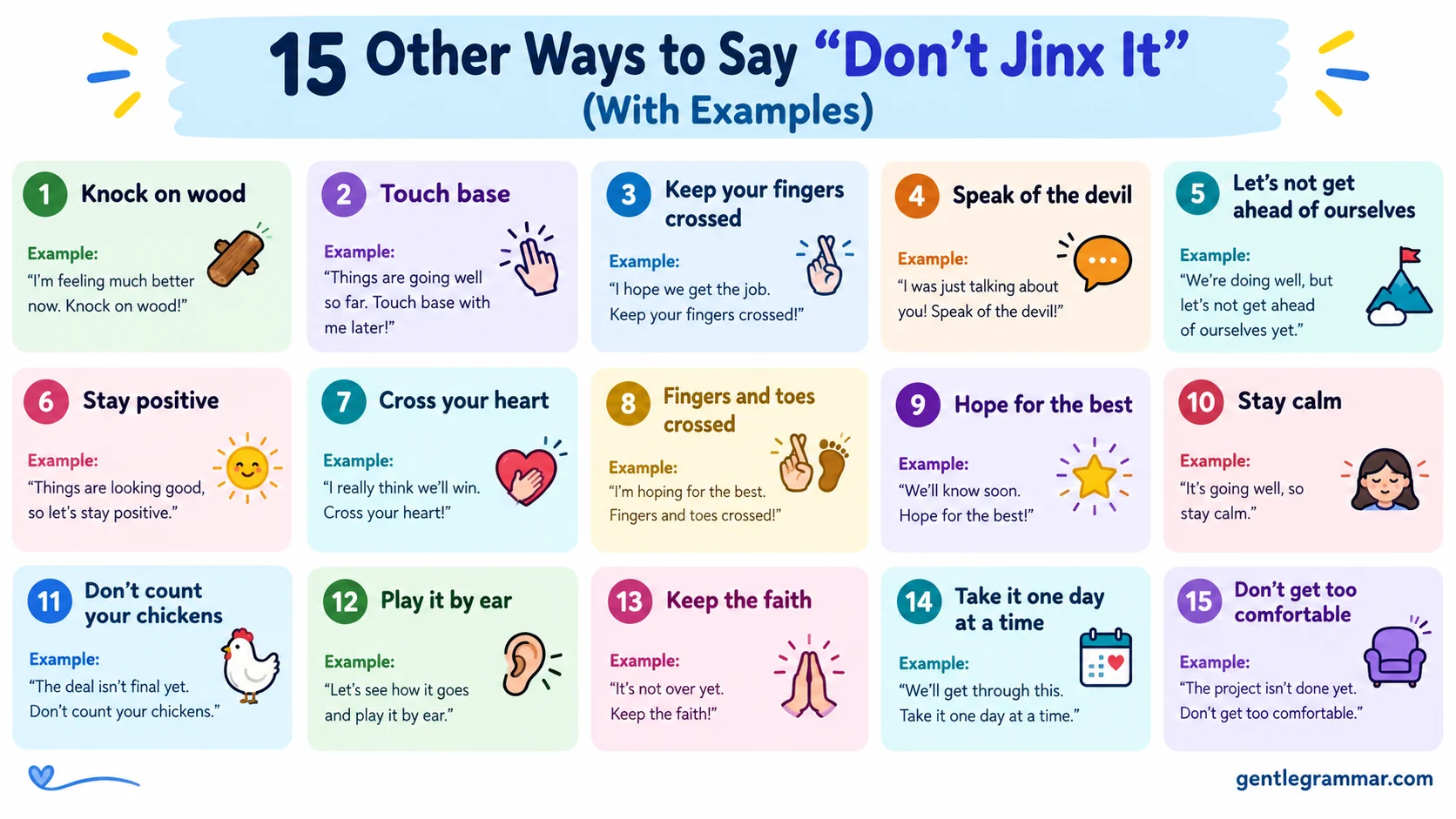
Learning 15 Other Ways to Say “Don’t Jinx It” (With Examples) helps you express hope, excitement, and caution without sounding overly superstitious.
I follow the principle of staying wise when things seem perfect, because I want to avoid a jinx. Many people, including myself, have learned that being overly confident or celebrating a positive outcome too soon can make us worry that we might bring bad luck. The common idiom “Don’t Jinx It” helps us express hope and stop expressing certainty before something good happens.
When someone proclaims that things are going well, this phrase offers gentle caution. It reminds us that talking too much about good news can lead to thoughts of negative luck. Although this idea comes from superstition, people often use it playfully in everyday conversations, rather than expressing a serious belief.
What Does “Don’t Jinx It” Mean?
“Don’t jinx it” means not to say or do something that people jokingly believe might cause a good situation to go wrong. The phrase reflects the superstition that talking too confidently about a positive outcome could somehow bring bad luck. For example, if your favorite team is winning, you might tell a friend, “Don’t jinx it!” when they start celebrating before the game ends.
In everyday English, the expression is usually playful rather than serious. People use it when they want to protect their optimism, avoid celebrating too early, or acknowledge that an outcome is not yet certain. It does not mean that words literally control events. Depending on the situation, it can communicate excitement, nervousness, hope, or a lighthearted fear of tempting fate.
Common Situations Where “Don’t Jinx It” Is Used
People commonly say “Don’t jinx it” when something is going well but has not reached its final outcome. Friends might use it while watching a close sports match, discussing a promising relationship, or waiting for exam results. In text messages and social media conversations, it can express cautious excitement with just a few words.
The phrase also appears in conversations about work, travel, health-related hopes, and everyday plans. For example, a coworker might mention that the office has been unusually quiet, prompting someone to reply, “Don’t jinx it!” because they hope the peaceful day continues. In professional settings, however, a more neutral expression may work better. Alternatives let you communicate cautious optimism without relying on superstition or sounding too casual.
Is It Professional or Polite to Say “Don’t Jinx It”?
“Don’t jinx it” is generally polite, casual, and friendly, especially when speaking with people you know well. It usually sounds playful rather than critical, although your tone of voice can make it seem more serious. Among friends, family members, and familiar coworkers, it is a natural way to suggest that someone should not celebrate before an outcome is certain.
In formal emails, business presentations, and conversations with unfamiliar clients, the expression may sound too informal or superstitious. Alternatives such as “Let’s not count our chickens before they hatch” or “Let’s wait until everything is confirmed” can communicate a similar caution more clearly. Choose wording that fits your audience and the situation, particularly when discussing deadlines, business results, or important decisions.
Advantages and Disadvantages of Saying “Don’t Jinx It”
Advantages
The main advantage of “Don’t jinx it” is its simplicity. It expresses cautious hope in just three words and often creates a sense of shared excitement. Because it is familiar in casual English, it works well in conversations, texts, and playful exchanges. It can also soften a reminder not to celebrate too early by making the message humorous instead of overly serious.
Disadvantages
The phrase can sound too informal in professional communication, especially when discussing concrete plans or measurable results. Someone unfamiliar with the expression may misunderstand its connection to superstition. It can also sound unnecessarily negative if the listener interprets it as discouraging optimism. In situations where clarity matters more than humor, a direct phrase about waiting for confirmation or avoiding premature conclusions may communicate the intended message better.
Synonyms for “Don’t Jinx It”
- Let’s Not Tempt Fate
- Don’t Count Your Chickens Before They Hatch
- Let’s Not Get Ahead of Ourselves
- Keep Your Fingers Crossed
- Knock on Wood
- Let’s Wait and See
- Don’t Celebrate Just Yet
- Let’s Not Speak Too Soon
- I Don’t Want to Tempt Fate
- Hopefully, It Stays That Way
- Let’s Not Assume Anything Yet
- Fingers Crossed
- Better Not Say It Out Loud
- Let’s Play It Safe
- Let’s Hope for the Best
1. Let’s Not Tempt Fate
Meaning
“Let’s not tempt fate” means we should avoid acting too confident about a good situation because something unexpected could still happen. Like “Don’t jinx it,” it expresses cautious optimism and a desire not to invite bad luck.
Definition
A phrase used to discourage overconfidence when an outcome is still uncertain.
Detailed Explanation
This expression has a slightly more serious and thoughtful feel than “Don’t jinx it.” It suggests that people should remain humble about a positive outcome instead of assuming everything will go perfectly. Although it refers to fate, speakers often use it humorously rather than as a literal statement about luck. It works when you want to acknowledge uncertainty without spoiling the excitement.
Scenario Examples
Scenario: Your friend says their flight will definitely leave on time.
Example: “Let’s not tempt fate. I’ll celebrate when we’re actually in the air.”
Scenario: Your team has completed most of a difficult project.
Example: “We’re nearly finished, but let’s not tempt fate until the final review is done.”
Scenario: Your partner says nothing can ruin your weekend getaway.
Example: “Let’s not tempt fate! We still have to get through the drive.”
Best Use
Use this expression in casual conversations, friendly workplace discussions, and situations where a positive outcome is not guaranteed. It is also suitable for lighthearted conversations with people you do not know particularly well.
Tone
Tone: Cautious, conversational, slightly superstitious.
It acknowledges uncertainty while keeping the mood friendly and optimistic.
2. Don’t Count Your Chickens Before They Hatch
Meaning
“Don’t count your chickens before they hatch” means you should not assume something will happen before it actually does. It shares the caution behind “Don’t jinx it,” but focuses more on avoiding premature expectations.
Definition
An idiom warning people not to rely on an outcome before it is certain.
Detailed Explanation
This traditional expression is especially useful when someone is already planning around a result that has not been confirmed. Unlike “Don’t jinx it,” it does not mainly suggest that talking about success will bring bad luck. Instead, it advises people to remain realistic until the situation is settled. The phrase is longer and more proverbial, so it can sound more like practical advice than a playful warning.
Scenario Examples
Scenario: Your friend is planning how to spend a bonus they have not received yet.
Example: “Don’t count your chickens before they hatch. Your manager hasn’t approved the bonus.”
Scenario: A student expects to get into their first-choice university before receiving a decision.
Example: “I hope you get in, but don’t count your chickens before they hatch.”
Scenario: A salesperson expects a client to sign a contract after one promising meeting.
Example: “Let’s not count our chickens before they hatch. We still need the signed agreement.”
Best Use
This phrase works best when discussing money, job offers, exam results, business deals, and future plans. It is particularly useful when someone is assuming success rather than simply expressing hope.
Tone
Tone: Practical, cautionary, familiar.
It encourages realistic expectations without necessarily implying that good luck can be spoiled.
3. Let’s Not Get Ahead of Ourselves
Meaning
“Let’s not get ahead of ourselves” means we should not become too confident or make plans before we know what will happen. It is a natural alternative when someone is getting excited about an outcome that is not final.
Definition
An expression used to encourage people to take things one step at a time.
Detailed Explanation
This phrase focuses on managing expectations, rather than on superstition. It can gently bring a conversation back to the facts when people begin celebrating or planning too early. Compared with “Don’t jinx it,” it sounds more practical and is often suitable for professional discussions. The word “let’s” also makes it feel collaborative, so it can be less confrontational than telling someone directly to stop getting excited.
Scenario Examples
Scenario: Your team receives encouraging feedback from a potential client.
Example: “That’s promising, but let’s not get ahead of ourselves until they approve the proposal.”
Scenario: A friend has been on one successful date and is already planning a wedding.
Example: “I’m happy for you! Let’s not get ahead of ourselves, though.”
Scenario: Your class performs well in the first round of a competition.
Example: “We’ve had a great start. Let’s not get ahead of ourselves before the final round.”
Best Use
Choose this expression for work meetings, planning conversations, relationships, competitions, and situations involving uncertain results.
Tone
Tone: Balanced, friendly, practical.
It supports optimism while reminding everyone to stay grounded.
4. Keep Your Fingers Crossed
Meaning
“Keep your fingers crossed” means to hope that something goes well. It is related to “Don’t jinx it” because both expressions can appear when people are waiting for a positive outcome, but this phrase expresses hope rather than warning someone against tempting fate.
Definition
An expression encouraging hope for a favorable result.
Detailed Explanation
This phrase is especially useful when you want to show support without pretending that success is guaranteed. It can refer to anything from a job interview to a delayed flight or an important announcement. Unlike the original phrase, it does not tell anyone to stop talking about the outcome. Instead, it encourages a hopeful attitude while acknowledging uncertainty.
Scenario Examples
Scenario: Your friend has an important job interview.
Example: “You’ve prepared so well. I’ll keep my fingers crossed for you!”
Scenario: You are waiting for a concert ticket confirmation.
Example: “The payment went through, so now I’m keeping my fingers crossed for the confirmation email.”
Scenario: Your coworker is waiting for a client to approve a project.
Example: “Fingers crossed they give us the green light this afternoon.”
Best Use
Use this phrase in friendly texts, personal conversations, supportive messages, and informal workplace chats. In formal writing, a more specific expression of hope may sound clearer.
Tone
Tone: Hopeful, supportive, warm.
It emphasizes encouragement rather than fear of spoiling a good situation.
5. Knock on Wood
Meaning
“Knock on wood” is a common expression people use after mentioning something good that they hope will continue. It is closely connected to “Don’t jinx it” because both can reflect the playful superstition that acknowledging good luck might somehow end it.
Definition
A phrase used to express the hope that a fortunate situation will continue.
Detailed Explanation
People often say this after making a positive statement, such as having avoided illness or experiencing a smooth week at work. Some people physically tap a wooden surface while saying it, while others use the words alone in conversation or messages. Unlike “Don’t jinx it,” which can be directed at another person, “knock on wood” often follows your own statement. It is informal and widely understood as a lighthearted custom, not a guarantee of protection.
Scenario Examples
Scenario: You have had a month without technical problems.
Example: “The new system hasn’t crashed once this month, knock on wood.”
Scenario: A friend asks whether you have been feeling well lately.
Example: “I’ve been feeling great all winter. Knock on wood!”
Scenario: Your team has met every deadline so far.
Example: “We’re ahead of schedule for once—knock on wood.”
Best Use
This expression fits casual conversations, texts, friendly workplace exchanges, and comments about good luck or continued success.
Tone
Tone: Playful, hopeful, lightly superstitious.
It acknowledges good fortune while expressing the hope that it lasts.
6. Let’s Wait and See
Meaning
“Let’s wait and see” means we should allow a situation to develop before deciding what will happen. It offers a calm alternative to “Don’t jinx it” when you want to avoid making predictions too early.
Definition
An expression suggesting that people should wait for more information before reaching a conclusion.
Detailed Explanation
This phrase is less superstitious and more neutral than the original expression. It encourages patience instead of worrying about whether talking about success might bring bad luck. It is especially useful when the outcome depends on circumstances that nobody can control. Depending on your delivery, it can sound reassuring, cautious, or slightly noncommittal.
Scenario Examples
Scenario: A friend expects to hear back from a university soon.
Example: “Your application looks strong. Let’s wait and see what the admissions office says.”
Scenario: Your company introduces a new product.
Example: “The early feedback is encouraging, but let’s wait and see how customers respond over the next few weeks.”
Scenario: You and your partner are unsure whether the weather will improve for a picnic.
Example: “The forecast might change by morning. Let’s wait and see.”
Best Use
Use this phrase when discussing uncertain plans, decisions, results, forecasts, and professional outcomes. It is a good option when you want to avoid premature conclusions without sounding superstitious.
Tone
Tone: Calm, patient, neutral.
It keeps expectations measured without discouraging optimism.
7. Don’t Celebrate Just Yet
Meaning
“Don’t celebrate just yet” means that it is too early to celebrate because something important still needs to happen. Like “Don’t jinx it,” the phrase reminds people that a positive outcome is not guaranteed.
Definition
A warning against celebrating before success is confirmed.
Detailed Explanation
This expression is more direct than the original phrase because it specifically addresses premature celebration. It works particularly well when someone is already acting as if a result is final. Depending on your relationship, it can sound playful or serious. Adding a friendly explanation helps prevent it from sounding like you are trying to spoil someone else’s excitement.
Scenario Examples
Scenario: Your favorite team scores early in a championship match.
Example: “Great goal, but don’t celebrate just yet. There’s still another half to play.”
Scenario: Your friend receives a verbal job offer.
Example: “That’s fantastic news! Don’t celebrate just yet, though; make sure the written offer comes through.”
Scenario: A student finishes an exam and assumes they have earned the highest grade.
Example: “You worked hard, but don’t celebrate just yet. The results aren’t out.”
Best Use
This phrase is suitable for sports, exams, competitions, job offers, business deals, and other situations where a final result is still pending.
Tone
Tone: Direct, cautious, sometimes playful.
It puts the emphasis on waiting for confirmation rather than avoiding bad luck.
8. Let’s Not Speak Too Soon
Meaning
“Let’s not speak too soon” means we should avoid making a confident statement before we know whether it will prove true. It is one of the closest alternatives to “Don’t jinx it” when the concern is that a prediction might turn out to be wrong.
Definition
A phrase encouraging people to avoid premature predictions or conclusions.
Detailed Explanation
This expression often appears when people discuss a situation that could still change. It shares the cautious feeling of “Don’t jinx it,” but it focuses more on what people say than on the idea of tempting fate. It can sound thoughtful and slightly concerned without being overly dramatic. The inclusive wording makes it useful when you want everyone to remain cautious together.
Scenario Examples
Scenario: Your team has gone several games without losing.
Example: “We’re on a great streak, but let’s not speak too soon. The toughest match is next weekend.”
Scenario: A friend thinks their difficult week is finally over.
Example: “I hope so! Let’s not speak too soon until that last deadline is behind you.”
Scenario: A project manager notices that a complicated launch is going smoothly.
Example: “Everything looks good so far. Let’s not speak too soon until the rollout is complete.”
Best Use
Choose this expression for everyday conversation, sports, project updates, and situations where circumstances could change unexpectedly.
Tone
Tone: Cautious, thoughtful, collaborative.
It tempers confidence without suggesting that success is impossible.
9. I Don’t Want to Tempt Fate
Meaning
“I don’t want to tempt fate” means you are reluctant to make a confident statement because you do not want to risk an unfortunate outcome. It expresses the same basic concern as “Don’t jinx it,” but makes the feeling personal.
Definition
A statement expressing reluctance to make a prediction for fear that things might go wrong.
Detailed Explanation
This phrase works well when you want to explain why you are being careful about celebrating or making promises. Instead of telling another person what not to say, you describe your own attitude toward uncertainty. It can sound sincere, humorous, or mildly superstitious depending on the situation. It is especially natural when someone asks why you are not celebrating yet.
Scenario Examples
Scenario: Your friend asks whether you think your team will win the final.
Example: “I think we have a real chance, but I don’t want to tempt fate.”
Scenario: You have almost finished a long home renovation.
Example: “We’re nearly done, but I don’t want to tempt fate by calling it finished before the inspection.”
Scenario: Your partner asks whether your travel plans are finally settled.
Example: “Everything seems sorted, but I don’t want to tempt fate until we have the final confirmation.”
Best Use
Use this expression in personal conversations, casual workplace discussions, and situations where you want to explain your cautious optimism.
Tone
Tone: Personal, cautious, lightly superstitious.
It communicates your own hesitation rather than directly correcting someone else.
10. Hopefully, It Stays That Way
Meaning
“Hopefully, it stays that way” means you are pleased with the current situation and hope it continues. It is a useful alternative when someone mentions that something good has been happening and you want to express cautious optimism.
Definition
An expression of hope that a favorable situation will continue.
Detailed Explanation
Unlike “Don’t jinx it,” this phrase does not warn anyone against speaking too confidently. Instead, it recognizes that things are going well and expresses a wish for that to continue. It feels natural when discussing stable routines, peaceful circumstances, good results, or improvements. The word “hopefully” makes the statement optimistic without suggesting that the outcome is certain.
Scenario Examples
Scenario: Your office has had a peaceful week with fewer urgent requests.
Example: “It’s been surprisingly quiet around here. Hopefully, it stays that way.”
Scenario: Your friend says their new puppy is finally sleeping through the night.
Example: “That’s great news! Hopefully, it stays that way.”
Scenario: Your internet connection has stopped dropping during meetings.
Example: “The connection has been reliable all week. Hopefully, it stays that way.”
Best Use
This expression works well in everyday conversation, personal messages, workplace chats, and discussions about ongoing improvements. For formal communication, specify the situation you hope will continue.
Tone
Tone: Positive, relaxed, cautiously optimistic.
It expresses a genuine wish without sounding worried about the act of speaking.
11. Let’s Not Assume Anything Yet
Meaning
“Let’s not assume anything yet” means we should avoid treating an uncertain outcome as a fact. It is a practical alternative to “Don’t jinx it” when you want to keep expectations realistic.
Definition
A phrase encouraging people to wait for evidence before deciding what is true or likely to happen.
Detailed Explanation
This expression is less playful than the original and focuses on evidence and uncertainty. It is useful when people are drawing conclusions from incomplete information, such as an encouraging conversation or an early project result. It can also help a group avoid making plans based on unconfirmed details. Because it sounds direct, it is best delivered tactfully when others are excited.
Scenario Examples
Scenario: Your colleague believes a client has accepted a proposal after a positive call.
Example: “The call went well, but let’s not assume anything yet. We still need their written response.”
Scenario: Your friend thinks a quiet message means someone is upset with them.
Example: “Let’s not assume anything yet. They might simply be busy.”
Scenario: Your family expects a house purchase to go through after an initial discussion.
Example: “It’s encouraging, but let’s not assume anything yet until the paperwork is complete.”
Best Use
Choose this expression for professional communication, decision-making, negotiations, planning, and situations involving incomplete information.
Tone
Tone: Reasonable, direct, measured.
It encourages careful thinking rather than relying on luck or superstition.
12. Fingers Crossed
Meaning
“Fingers crossed” expresses hope that something will work out well. It is a shorter, more conversational version of “Keep your fingers crossed” and can replace “Don’t jinx it” when you want to show optimism about an uncertain outcome.
Definition
A brief expression of hope for a good result.
Detailed Explanation
This phrase is particularly natural in text messages because it communicates support with very few words. You might use it after submitting an application, booking a trip, or finishing an important task. Unlike “Don’t jinx it,” it does not ask anyone to avoid a prediction or stop talking about success. Instead, it emphasizes hope and anticipation.
Scenario Examples
Scenario: Your friend has applied for their dream job.
Example: “You’d be amazing in that role. Fingers crossed!”
Scenario: You are waiting for confirmation that your weekend reservation is complete.
Example: “The booking request is in. Fingers crossed we get the time we wanted.”
Scenario: Your class is waiting for the results of a competition.
Example: “We gave it everything we had. Fingers crossed for the results tomorrow.”
Best Use
Use this expression in text messages, social media comments, informal emails, and supportive conversations. It is less suitable for formal business reports or official correspondence.
Tone
Tone: Casual, encouraging, upbeat.
Its brevity makes it feel friendly and supportive rather than cautious or corrective.
13. Better Not Say It Out Loud
Meaning
“Better not say it out loud” means you would rather not openly express a hopeful prediction because you are afraid it might somehow bring bad luck. It captures the superstitious humor behind “Don’t jinx it.”
Definition
An informal expression suggesting that a hopeful thought should remain unspoken to avoid tempting fate.
Detailed Explanation
This phrase often appears when someone is pleased about a good situation but feels nervous about acknowledging it. It can create a playful sense of shared understanding, especially among people who enjoy joking about luck. Unlike the original phrase, it may refer to your own thoughts rather than a warning directed at another person. The wording is informal and can sound dramatic or humorous depending on the context.
Scenario Examples
Scenario: Your team has completed several difficult tasks without a setback.
Example: “We’re finally ahead of schedule. Better not say it out loud!”
Scenario: Your friend thinks their long-distance train will arrive on time for once.
Example: “I know! Better not say it out loud until we’re actually at the station.”
Scenario: You have had a surprisingly easy day at work.
Example: “It’s been peaceful all morning. Better not say it out loud in case the emails start pouring in.”
Best Use
This expression suits informal conversations, jokes among friends, text messages, and lighthearted comments about good fortune. Avoid it when a professional conversation requires a clear, factual statement.
Tone
Tone: Playful, familiar, superstitious.
It creates humor around the idea that mentioning good luck might somehow spoil it.
14. Let’s Play It Safe
Meaning
“Let’s play it safe” means we should choose a cautious approach to avoid unnecessary risks. It can replace “Don’t jinx it” when the real concern is protecting a positive outcome through sensible action rather than avoiding certain words.
Definition
An expression encouraging people to take precautions instead of risking an unwanted result.
Detailed Explanation
This phrase differs from the original because it recommends a practical step rather than expressing a superstition. It is useful when there is something concrete you can do to reduce the chance of a problem. For example, you might leave early for an important appointment or double-check a document before submitting it. It is more action-oriented and can be appropriate in professional situations where safety, reliability, or preparation matters.
Scenario Examples
Scenario: Your team is ahead of schedule on a major project.
Example: “We’re doing well, but let’s play it safe and test everything before the launch.”
Scenario: Your friend wants to drive through an area with a forecast of heavy rain.
Example: “Let’s play it safe and leave earlier, before the weather gets worse.”
Scenario: You are preparing a report for an important client.
Example: “The figures look right, but let’s play it safe and check the totals once more.”
Best Use
Choose this expression for workplace decisions, travel plans, safety precautions, deadlines, and situations where taking action can reduce risk.
Tone
Tone: Practical, responsible, cooperative.
It emphasizes sensible precautions instead of luck or superstition.
15. Let’s Hope for the Best
Meaning
“Let’s hope for the best” means we should remain hopeful even though we cannot be certain about the outcome. It is a positive alternative to “Don’t jinx it” when you want to acknowledge uncertainty without becoming overly cautious.
Definition
An expression encouraging optimism when the outcome is unknown.
Detailed Explanation
This phrase focuses on maintaining hope rather than avoiding bad luck. It can be reassuring when people are waiting for results or facing a situation they cannot fully control. Compared with “Don’t jinx it,” it sounds more openly encouraging and can carry a slightly more emotional tone. It does not mean you should ignore possible problems; it simply encourages a positive outlook while you wait.
Scenario Examples
Scenario: Your friend is waiting to hear whether their visa application has been approved.
Example: “You’ve submitted everything they requested. Let’s hope for the best.”
Scenario: Your team has sent a proposal to a new client.
Example: “We’ve done our part, so let’s hope for the best and prepare for their feedback.”
Scenario: Your family is waiting to see whether the weather will cooperate for an outdoor celebration.
Example: “We’ve made the arrangements. Let’s hope for the best and enjoy the day either way.”
Best Use
Use this expression in personal conversations, supportive messages, uncertain plans, and situations where encouragement matters more than caution.
Tone
Tone: Encouraging, optimistic, reassuring.
It helps people stay positive without promising that everything will turn out perfectly.
FAQs:
What is another way to say “Don’t Jinx It”?
A natural alternative is “Let’s not tempt fate.” Both expressions communicate caution when something good is happening but the outcome is not certain. You can also say “Let’s not speak too soon” when you want to avoid making a confident prediction.
What does “Don’t Jinx It” mean?
“Don’t jinx it” means not to say or do something that people jokingly believe might bring bad luck or cause a positive situation to go wrong. It is commonly used when someone wants to avoid celebrating too early or becoming overly confident.
Is “Don’t Jinx It” professional?
“Don’t jinx it” is generally casual and conversational, rather than formal. It can be perfectly appropriate among familiar coworkers, but a phrase such as “Let’s wait for confirmation” is often clearer in formal emails, reports, and business discussions.
What is a more polite way to say “Don’t Jinx It”?
A polite, gentle alternative is “Let’s not speak too soon.” It encourages caution without sounding overly negative. You could also say, “Let’s wait and see how things turn out,” especially when discussing an uncertain result with colleagues or acquaintances.
Which alternative works best in formal communication?
“Let’s not assume anything yet” works well when you need to communicate caution in a professional setting. It encourages people to wait for reliable information before reaching a conclusion. When discussing a specific task, you can also explain what needs to be confirmed before moving forward.
Conclusion:
Choosing the right expression can help you communicate optimism without sounding overconfident or discouraging others. While “Don’t jinx it” is a familiar and playful phrase, alternatives such as “Let’s not tempt fate,” “Let’s not get ahead of ourselves,” and “Let’s wait and see” offer different ways to express caution. Some phrases emphasize superstition, while others focus on patience, realistic expectations, or practical decisions.
The best choice depends on your audience, relationship, and situation. A lighthearted expression may fit a conversation with friends, whereas a more direct phrase may be better suited to a workplace discussion. Remember that similar expressions do not always have identical meanings. When you want to express hope while acknowledging uncertainty, choose words that feel natural, respectful, and appropriate to the moment.
