
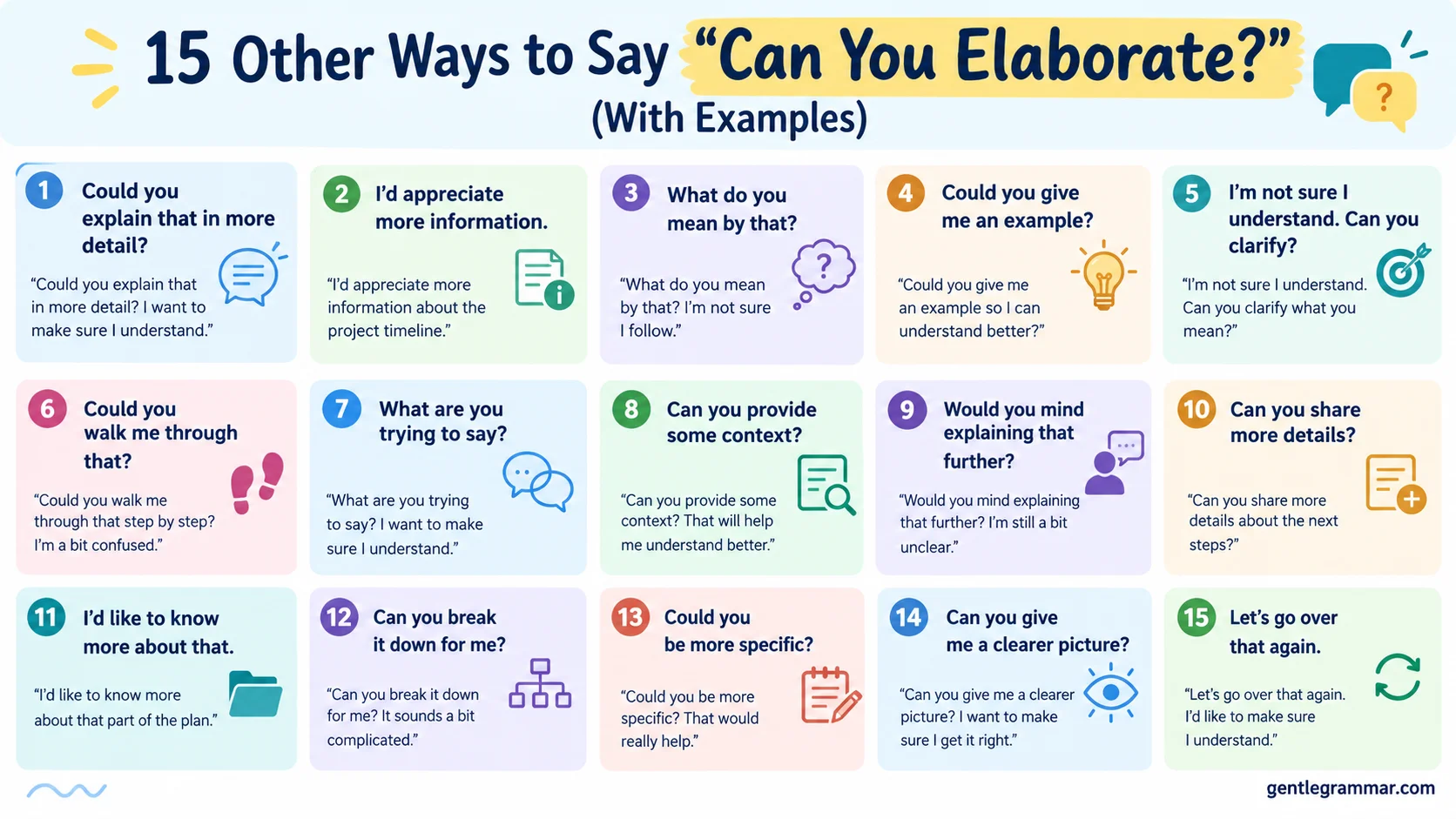
This guide to 15 Other Ways to Say “Can You Elaborate?” (With Examples) shows how polite questions make conversations clearer and more useful.
In everyday conversations, someone may request more detail because they want a clearer explanation of what another person has said. From my experience, listening carefully helps us understand a message more fully, but we sometimes need further information to understand another person’s perspective.
What seems obvious to one person may not be clear to others. Adding context, meaning, useful details, examples, and extra points can help people grasp new ideas better. Instead of repeating the same phrase or saying nothing, a gentle invitation to share more depth, clarity, and connection makes the exchange feel natural. It also gives the speaker room to elaborate without feeling pressured.
What Does “Can You Elaborate?” Mean?
“Can you elaborate?” is a question used to ask someone to explain something in greater detail. It usually means that you understand the general idea but want additional information, clarification, or examples to understand it better. The word elaborate means to develop an idea or provide more information about something that has already been mentioned.
In everyday English, this expression communicates interest, curiosity, and a desire for clarification. For example, if a colleague presents a new business strategy, you might ask, “Can you elaborate on how this approach will work?” You’re inviting them to explain their point more fully. The phrase can also be used in classrooms, interviews, professional discussions, and personal conversations. Depending on your tone and relationship with the other person, it can sound polite and professional or slightly direct.
Common Situations Where “Can You Elaborate?” Is Used
People use this expression whenever they need more information about something another person has said. In everyday conversations, it helps keep discussions going when someone introduces an interesting subject but doesn’t explain it completely. With friends or family, it can show genuine curiosity about someone’s plans, experiences, or opinions.
In workplace communication, the phrase is useful during meetings, presentations, interviews, and project discussions. For instance, a manager might ask an employee to elaborate on a proposed solution before making a decision. Students also use it when asking teachers to explain difficult concepts or expand on a lesson. In emails and formal writing, the expression can politely request additional details about instructions, proposals, or unfamiliar information. Choosing a suitable alternative can make the request sound warmer, more specific, or less demanding.
Is It Professional or Polite to Say “Can You Elaborate?”
Yes, “Can you elaborate?” is generally considered professional and polite when used with a respectful tone. It is common in business meetings, academic discussions, interviews, and workplace conversations. The expression shows that you’re paying attention and want to understand someone’s explanation more completely.
However, the phrase can sometimes sound slightly direct, especially when spoken without a friendly tone or additional context. In formal emails, expressions such as “Could you provide more details?” or “Would you mind explaining further?” may sound more considerate. With friends and familiar colleagues, simpler wording such as “Could you tell me a little more?” feels natural. Ultimately, politeness depends on delivery, context, and your relationship with the person you’re speaking to.
Advantages and Disadvantages of Saying “Can You Elaborate?”
Advantages
One major advantage of this expression is its clarity. It tells the other person that you need additional information without making your request unnecessarily complicated. It also encourages meaningful discussion and gives someone an opportunity to explain their ideas more completely. In professional settings, it can help prevent misunderstandings and support better decision-making. Additionally, it communicates interest in the speaker’s thoughts rather than simply moving to another topic.
Disadvantages
Although the phrase is useful, repeating it too often can make conversations sound predictable. It may also feel slightly formal in relaxed conversations with friends or family. Sometimes, the request is too broad because it doesn’t explain which part needs clarification. For example, asking someone to elaborate on an entire presentation may leave them unsure where to begin. A more specific question can often produce a clearer and more helpful response.
Synonyms for “Can You Elaborate?” (With Examples)
- Could You Explain That in More Detail?
- Could You Say More About That?
- Can You Expand on That?
- Could You Clarify What You Mean?
- Could You Provide More Details?
- I’d Like to Hear More.
- What Do You Mean by That?
- Could You Walk Me Through It?
- Can You Give Me an Example?
- Could You Shed More Light on This?
- Would You Mind Explaining Further?
- Could You Go Into Greater Detail?
- Tell Me a Little More About That.
- What’s the Reasoning Behind That?
- Could You Unpack That for Me?
1. Could You Explain That in More Detail?
Meaning
“Could you explain that in more detail?” means asking someone to provide a fuller explanation of something they’ve already mentioned. It communicates that you want to understand the subject beyond its basic description.
Definition
A polite request for additional explanation and supporting information about a particular topic.
Detailed Explanation
This expression is a natural alternative when someone has introduced an idea but hasn’t provided enough information. It is slightly more specific than the original phrase because it clearly asks for a fuller explanation. The word could makes the request sound considerate rather than demanding. It’s particularly useful when discussing complicated subjects, instructions, or important decisions. You can use it in both professional and everyday conversations.
Scenario Examples
Scenario 1: During a workplace meeting, a colleague introduces a new marketing strategy but skips some important details.
Example: “Could you explain that in more detail, especially how it will affect our customers?”
Scenario 2: A teacher introduces a difficult topic during a lesson.
Example: “Could you explain that in more detail? I’m having trouble understanding the last step.”
Scenario 3: A friend mentions an exciting career opportunity.
Example: “That sounds interesting! Could you explain that in more detail?”
Best Use
Use this expression in professional meetings, academic discussions, emails, and everyday conversations. It’s especially appropriate when you need a complete explanation rather than a quick answer.
Tone
Tone: Polite, professional, curious, and respectful.
Its considerate wording makes it suitable for situations where you want additional information without putting pressure on the speaker.
2. Could You Say More About That?
Meaning
“Could you say more about that?” invites someone to continue discussing a subject. It suggests that you’re interested in what they’ve said and would appreciate hearing additional thoughts.
Definition
A friendly request for someone to share more information or continue explaining an idea.
Detailed Explanation
This expression feels warmer and more conversational than the original phrase. Rather than focusing entirely on clarification, it encourages the speaker to continue sharing their thoughts. It’s especially useful when someone mentions something interesting but hasn’t finished explaining it. The wording is open-ended, so the other person can decide which details they want to discuss. It works well in personal conversations, interviews, and relaxed professional discussions.
Scenario Examples
Scenario 1: Your friend tells you about a memorable experience during a recent trip.
Example: “That sounds amazing! Could you say more about that place?”
Scenario 2: A colleague shares an idea during a brainstorming session.
Example: “I like where you’re going with this. Could you say more about that?”
Scenario 3: Someone shares an interesting opinion during a group discussion.
Example: “That’s an interesting perspective. Could you say more about that?”
Best Use
Choose this expression for friendly conversations, interviews, brainstorming sessions, and informal workplace discussions. It’s particularly effective when you want to encourage someone to share rather than simply answer a specific question.
Tone
Tone: Friendly, warm, encouraging, and curious.
It shows genuine interest and helps the speaker feel comfortable continuing the conversation.
3. Can You Expand on That?
Meaning
“Can you expand on that?” means asking someone to develop an idea by adding more information, explanation, or supporting points.
Definition
A direct request to provide a fuller explanation of an existing statement or idea.
Detailed Explanation
This expression is particularly useful when someone presents a brief opinion, suggestion, or argument that deserves further discussion. It focuses on developing the original point rather than introducing an entirely different subject. Compared with the original phrase, it sounds slightly more direct and conversational. It is common in meetings, presentations, interviews, and academic discussions. If you want a softer approach, adding “please” or using “Could you” can make the request more courteous.
Scenario Examples
Scenario 1: A team member suggests changing the company’s customer service process.
Example: “Can you expand on that? I’d like to understand how the new process would work.”
Scenario 2: A student gives a short answer during a classroom discussion.
Example: “You’ve made an interesting point. Can you expand on that?”
Scenario 3: A friend shares an unusual opinion about a movie.
Example: “I hadn’t thought about it that way. Can you expand on that?”
Best Use
This phrase works best in meetings, classroom discussions, presentations, interviews, and conversations about ideas or opinions. It is less suitable when you simply need a basic factual answer.
Tone
Tone: Direct, interested, confident, and conversational.
It encourages deeper discussion while keeping the request short and straightforward.
4. Could You Clarify What You Mean?
Meaning
“Could you clarify what you mean?” asks someone to make their statement easier to understand. It’s particularly helpful when their words are confusing, unclear, or open to different interpretations.
Definition
A polite request for clearer information about someone’s statement or intended meaning.
Detailed Explanation
Unlike a general request for more details, this expression focuses on understanding the speaker’s actual meaning. It is useful when someone uses unfamiliar terminology, makes an ambiguous statement, or explains something in a confusing way. The word clarify suggests that the original message needs to become clearer rather than simply longer. It can sound professional and respectful when delivered with a friendly tone. However, if someone has already explained their point clearly, asking this question may unnecessarily suggest that their explanation was confusing.
Scenario Examples
Scenario 1: A manager gives an employee an instruction that could be interpreted in two different ways.
Example: “Could you clarify what you mean by completing the report before the end of the day?”
Scenario 2: A friend makes a statement that you don’t fully understand.
Example: “I’m not sure I follow. Could you clarify what you mean?”
Scenario 3: A client describes a change to a project without explaining its purpose.
Example: “Could you clarify what you mean by the revised requirements?”
Best Use
Use this expression in professional emails, workplace discussions, customer communication, academic conversations, and situations involving misunderstandings.
Tone
Tone: Respectful, careful, professional, and direct.
It prioritizes accuracy and understanding, making it especially useful when assumptions could cause problems.
5. Could You Provide More Details?
Meaning
“Could you provide more details?” means asking someone to share specific information that is missing from their explanation.
Definition
A courteous request for additional facts, descriptions, or relevant information about something.
Detailed Explanation
This expression is particularly useful when you need concrete information rather than a longer discussion. It often suggests that the speaker should include relevant facts, dates, steps, requirements, or examples. Compared with the original phrase, it sounds more practical and information-focused. It’s a strong choice for professional communication because it clearly identifies what you need. However, in personal conversations, it may sound slightly formal depending on your relationship.
Scenario Examples
Scenario 1: A customer asks about the delivery process for an online order.
Example: “Could you provide more details about the expected delivery date?”
Scenario 2: You’re reviewing a project proposal from a colleague.
Example: “Could you provide more details about the estimated budget and timeline?”
Scenario 3: A friend tells you about an upcoming event.
Example: “Could you provide more details about where it’s happening?”
Best Use
This expression is ideal for business emails, customer service, project discussions, applications, and requests for specific information.
Tone
Tone: Professional, polite, neutral, and practical.
Its straightforward wording helps you request missing information without sounding overly demanding.
6. I’d Like to Hear More.
Meaning
“I’d like to hear more” communicates that you’re interested in someone’s thoughts, experiences, or explanation and would welcome additional information.
Definition
A friendly statement expressing a desire to learn more about something another person has shared.
Detailed Explanation
This expression differs from a direct question because it communicates interest without placing an immediate demand on the speaker. It feels warmer and more personal than the original phrase. You can use it when someone shares exciting news, discusses a personal experience, or introduces an interesting idea. It also works well when you want someone to continue talking at their own pace. In professional situations, it can encourage discussion without interrupting the natural flow of a meeting.
Scenario Examples
Scenario 1: A friend tells you about a new business they’re planning to start.
Example: “That sounds exciting. I’d like to hear more about your plans.”
Scenario 2: A colleague shares an idea for improving the workplace.
Example: “That’s worth exploring. I’d like to hear more.”
Scenario 3: Your partner mentions something important that happened during their day.
Example: “You sounded excited when you mentioned that. I’d like to hear more.”
Best Use
Choose this phrase for personal conversations, friendly messages, interviews, networking, and collaborative discussions. It is especially useful when emotional warmth matters.
Tone
Tone: Warm, interested, supportive, and approachable.
It shows that you value what the other person has to say rather than simply requesting additional information.
7. What Do You Mean by That?
Meaning
“What do you mean by that?” asks someone to explain the meaning behind a particular statement, comment, or expression.
Definition
A direct question requesting an explanation of someone’s words or intended message.
Detailed Explanation
This expression is useful when a specific statement catches your attention or leaves you uncertain. Unlike a broad request for elaboration, it focuses on one particular comment. It can sound curious in a friendly conversation, but it may also sound challenging if delivered sharply. For this reason, your tone matters considerably. If you’re speaking in a professional environment, “Could you clarify what you mean by that?” may feel more diplomatic.
Scenario Examples
Scenario 1: A friend makes an unusual comment about your weekend plans.
Example: “You said I should rethink my decision. What do you mean by that?”
Scenario 2: Someone uses an unfamiliar expression during a conversation.
Example: “I’ve never heard that phrase before. What do you mean by that?”
Scenario 3: A colleague makes a vague statement about a project.
Example: “You mentioned that the current approach isn’t sustainable. What do you mean by that?”
Best Use
Use this expression in everyday conversations, discussions about opinions, and situations where a particular statement needs clarification. In formal communication, consider a softer version.
Tone
Tone: Curious, direct, questioning, and sometimes challenging.
It depends heavily on delivery. A friendly voice communicates interest, while a sharp tone may suggest disagreement or suspicion.
8. Could You Walk Me Through It?
Meaning
“Could you walk me through it?” asks someone to explain a process, situation, or idea step by step.
Definition
A polite request for a clear, organized explanation of how something works or happens.
Detailed Explanation
This expression is different from a general request for more information because it emphasizes the sequence of events or actions. It is especially helpful when learning a new task, understanding a procedure, or following complicated instructions. The wording feels collaborative because it suggests that the speaker will guide you through the explanation. It’s commonly used in workplaces, training sessions, and educational settings. For a simple opinion or casual story, however, it may sound unnecessarily technical.
Scenario Examples
Scenario 1: Your supervisor introduces a new software tool at work.
Example: “Could you walk me through how to submit a report using this system?”
Scenario 2: A friend explains how they organized a complicated event.
Example: “That sounds like a lot of work. Could you walk me through how you managed everything?”
Scenario 3: A teacher demonstrates a mathematical problem.
Example: “Could you walk me through the calculation one step at a time?”
Best Use
This expression is best for training, tutorials, workplace instructions, technical discussions, and educational situations where a step-by-step explanation is helpful.
Tone
Tone: Collaborative, polite, practical, and respectful.
It communicates that you want guidance and are willing to follow the explanation carefully.
9. Can You Give Me an Example?
Meaning
“Can you give me an example?” asks someone to provide a specific illustration that makes an idea easier to understand.
Definition
A request for a practical instance or illustration of something being discussed.
Detailed Explanation
Sometimes, an explanation makes sense in theory but remains difficult to understand in practice. This expression helps bridge that gap by asking the speaker to demonstrate what they mean. Unlike the original phrase, it doesn’t necessarily request a longer explanation. Instead, it asks for a concrete example that supports the existing information. It’s particularly helpful when discussing abstract concepts, instructions, or unfamiliar ideas. You can also make it more polite by saying, “Could you give me an example?”
Scenario Examples
Scenario 1: A teacher explains the difference between two grammatical structures.
Example: “I understand the rule, but can you give me an example of how to use it?”
Scenario 2: A manager describes a new workplace policy.
Example: “Can you give me an example of how this policy would apply to a real customer situation?”
Scenario 3: A friend explains a particular type of humor.
Example: “I think I understand what you mean. Can you give me an example?”
Best Use
Use this expression in classrooms, training sessions, workplace discussions, tutorials, and everyday conversations whenever practical illustrations would improve understanding.
Tone
Tone: Curious, straightforward, practical, and friendly.
It shows that you want to understand something through a real situation rather than relying only on general explanations.
10. Could You Shed More Light on This?
Meaning
“Could you shed more light on this?” means asking someone to provide information that makes a subject clearer or easier to understand.
Definition
A polite expression requesting additional insight or explanation about an unclear topic.
Detailed Explanation
This expression has a slightly more polished and professional feel than the original phrase. The words shed more light suggest making something easier to see or understand. It’s particularly useful when discussing complicated situations, unfamiliar information, or issues that require further investigation. Unlike a request for specific facts, it can invite the speaker to share explanations, background, or helpful perspectives. It’s also suitable for written communication, although simpler wording may feel more natural in casual conversations.
Scenario Examples
Scenario 1: A project manager discusses an unexpected delay.
Example: “Could you shed more light on what’s causing the delay?”
Scenario 2: A colleague shares a financial report with several unexplained figures.
Example: “Could you shed more light on these numbers before we finalize the presentation?”
Scenario 3: A friend mentions a disagreement involving mutual acquaintances.
Example: “I don’t know the full story. Could you shed more light on what happened?”
Best Use
This expression works well in professional emails, meetings, discussions, reports, and conversations involving complicated or unclear information.
Tone
Tone: Polite, thoughtful, professional, and inquisitive.
It sounds considerate while showing that you want a clearer understanding of the subject.
11. Would You Mind Explaining Further?
Meaning
“Would you mind explaining further?” politely asks someone to continue their explanation or provide additional information.
Definition
A courteous request for a more complete explanation of something already discussed.
Detailed Explanation
This expression is especially useful when you want to sound considerate and respectful. Its wording is softer than a direct request because it gives the other person room to respond comfortably. It is suitable when speaking to managers, clients, teachers, or people you don’t know particularly well. Unlike some casual alternatives, it maintains a professional and respectful tone without sounding excessively formal. However, the word “mind” can make the sentence feel a little more formal in relaxed conversations.
Scenario Examples
Scenario 1: You’re attending a meeting with a senior manager who introduces a new company policy.
Example: “Would you mind explaining further how this change will affect our department?”
Scenario 2: A client provides incomplete information about a service request.
Example: “Would you mind explaining further what you’d like us to change?”
Scenario 3: A teacher introduces a concept that requires additional explanation.
Example: “Would you mind explaining further how this theory applies to the example?”
Best Use
Choose this phrase for professional meetings, formal conversations, customer communication, academic discussions, and respectful emails.
Tone
Tone: Respectful, formal, considerate, and polite.
It is a good choice when maintaining courtesy is more important than keeping the conversation casual.
12. Could You Go Into Greater Detail?
Meaning
“Could you go into greater detail?” asks someone to provide a more thorough explanation of a subject, including additional information that may have been left out.
Definition
A polite request for a deeper and more comprehensive discussion of a particular topic.
Detailed Explanation
This expression is particularly useful when a short explanation isn’t enough to address the subject properly. It suggests that you want the speaker to explore specific points more thoroughly. Compared with the original phrase, it sounds slightly more formal and emphasizes depth rather than simply adding a few extra details. It works well in presentations, reports, academic discussions, and professional meetings. For everyday conversations, a shorter alternative may feel more relaxed.
Scenario Examples
Scenario 1: A researcher presents the results of a study.
Example: “Could you go into greater detail about the factors that influenced these results?”
Scenario 2: A colleague explains a proposed company expansion.
Example: “Could you go into greater detail about the expected costs and potential challenges?”
Scenario 3: A student discusses a historical event during a presentation.
Example: “Could you go into greater detail about what happened after the agreement was signed?”
Best Use
This expression is suitable for formal presentations, business discussions, research, academic writing, and detailed professional conversations.
Tone
Tone: Professional, thoughtful, formal, and inquisitive.
It communicates that a subject deserves a more thorough explanation rather than a quick response.
13. Tell Me a Little More About That.
Meaning
“Tell me a little more about that” invites someone to share additional information in a relaxed and friendly way.
Definition
An informal request encouraging someone to continue talking about a particular subject or experience.
Detailed Explanation
This expression feels natural in conversations where friendliness and personal interest matter. It doesn’t sound like a formal request for clarification. Instead, it encourages someone to share more about something they’ve mentioned. The phrase a little more also makes the request feel gentle and manageable. It is particularly suitable when talking about someone’s interests, experiences, plans, or personal stories. In formal emails, however, a more professional expression may be preferable.
Scenario Examples
Scenario 1: A friend tells you they’re learning photography.
Example: “That’s a creative hobby! Tell me a little more about that.”
Scenario 2: Your partner mentions a possible career change.
Example: “You’ve been thinking about this for a while. Tell me a little more about that.”
Scenario 3: Someone shares their experience volunteering at a local organization.
Example: “That sounds rewarding. Tell me a little more about your experience.”
Best Use
Use this expression in friendly conversations, personal messages, social gatherings, informal interviews, and discussions about someone’s experiences or interests.
Tone
Tone: Warm, casual, encouraging, and interested.
It makes the conversation feel personal and gives the other person an easy opportunity to continue.
14. What’s the Reasoning Behind That?
Meaning
“What’s the reasoning behind that?” asks someone to explain the logic, thought process, or reasons supporting a particular decision or opinion.
Definition
A question requesting the explanation or justification behind someone’s thinking.
Detailed Explanation
This expression is more specific than the original phrase because it focuses on the reasons behind an idea rather than asking for additional information generally. It’s useful when discussing decisions, strategies, arguments, and opinions. The wording can encourage thoughtful discussion and help you understand how someone reached a conclusion. However, depending on your delivery, it may sound challenging or suggest that you’re questioning their judgment. A friendly tone helps communicate genuine curiosity instead of criticism.
Scenario Examples
Scenario 1: A manager decides to change the team’s working schedule.
Example: “What’s the reasoning behind that? I’d like to understand how it will benefit the team.”
Scenario 2: A friend recommends choosing a different university.
Example: “That’s an interesting suggestion. What’s the reasoning behind that?”
Scenario 3: A colleague proposes removing a feature from a product.
Example: “What’s the reasoning behind that decision? Are there customer concerns we should consider?”
Best Use
This expression is particularly useful in decision-making meetings, debates, strategic discussions, academic conversations, and situations where understanding someone’s logic matters.
Tone
Tone: Analytical, direct, thoughtful, and inquisitive.
It encourages people to explain their thought process, although it can sound challenging if used without a respectful tone.
15. Could You Unpack That for Me?
Meaning
“Could you unpack that for me?” asks someone to break down a complicated idea, statement, or situation into smaller, easier-to-understand parts.
Definition
A conversational request for a deeper explanation of something complex or difficult to understand.
Detailed Explanation
This expression is especially useful when someone introduces an idea that contains several connected points. Rather than simply asking for more information, you’re inviting them to examine the subject piece by piece. It has a modern, conversational feel and is commonly suitable for discussions involving opinions, strategies, emotions, or complicated concepts. Compared with the original phrase, it suggests that the topic may need careful examination. It is less appropriate for very formal documents or simple requests for factual information.
Scenario Examples
Scenario 1: A colleague introduces a complicated proposal during a team meeting.
Example: “Could you unpack that for me? I want to understand how each part connects.”
Scenario 2: A friend shares a complicated explanation about a personal situation.
Example: “I’m trying to follow everything. Could you unpack that for me?”
Scenario 3: A teacher introduces a difficult philosophical argument.
Example: “Could you unpack that argument and explain its main points?”
Best Use
Choose this expression for brainstorming sessions, thoughtful conversations, academic discussions, workplace meetings, and situations involving complex ideas.
Tone
Tone: Curious, conversational, thoughtful, and collaborative.
It communicates that you want to explore an idea more deeply instead of accepting a brief explanation.
FAQs:
What is another way to say “Can You Elaborate?”
You can say “Could you explain that in more detail?”, “Could you say more about that?”, or “Can you expand on that?” These expressions ask someone to provide additional information. The best choice depends on whether you want a professional, friendly, or direct tone.
What does “Can You Elaborate?” mean?
“Can you elaborate?” means asking someone to explain something more fully. It indicates that you want additional information, clarification, examples, or a deeper understanding of a subject that has already been mentioned.
Is “Can You Elaborate?” professional?
Yes. It’s generally appropriate for workplace meetings, presentations, interviews, and academic discussions. It sounds professional and direct without being unnecessarily complicated. However, “Could you elaborate?” may sound slightly more polite in formal situations.
What is a more polite way to say “Can You Elaborate?”
“Would you mind explaining further?” and “Could you explain that in more detail?” are polite alternatives. Both expressions make it easier to request additional information while maintaining a respectful tone.
Which alternative works best in formal communication?
“Could you provide more details?” is an excellent choice for formal communication, particularly in business emails and customer correspondence. If you need someone to clarify an unclear statement, “Could you clarify what you mean?” may be more appropriate.
Conclusion:
Choosing the right words can make even a simple question feel more thoughtful and engaging. Although “Can You Elaborate?” is a useful expression, you don’t have to rely on it in every conversation. Alternatives such as “Could you provide more details?” work well in professional settings, while “I’d like to hear more” creates a warmer and more personal connection. Other expressions, including “Could you walk me through it?
Could you unpack that for me?”, are useful when discussing complicated ideas. Remember that similar phrases can communicate different levels of politeness, curiosity, and directness. Consider your audience, the subject, and the situation before choosing your wording. The best expression is the one that encourages clear communication and meaningful conversation.
