
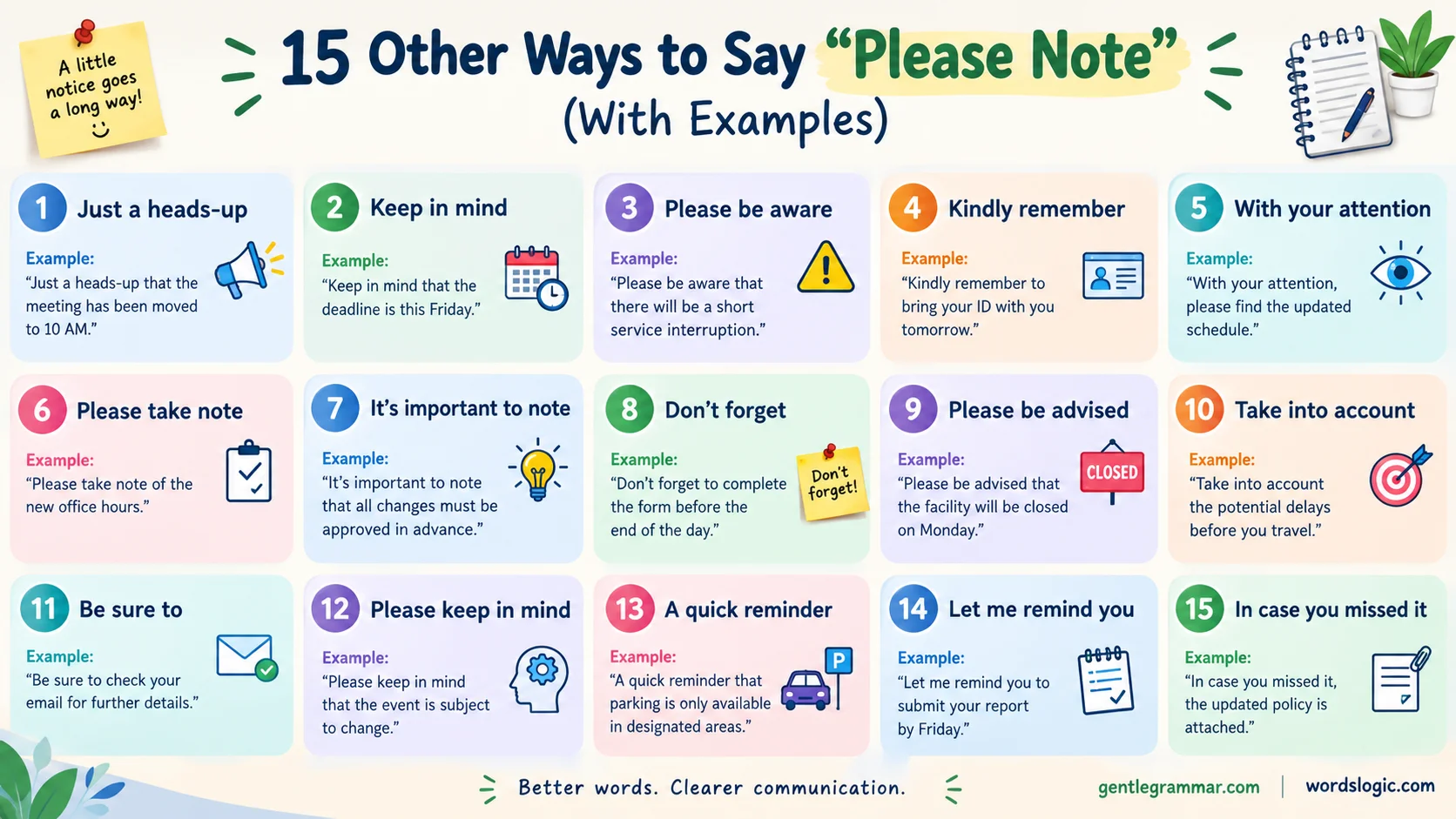
Exploring 15 Other Ways to Say “Please Note” (With Examples) can help you find natural alternatives that improve clarity, tone, and readability.
Phrases such as “be advised,” “kindly note,” and “I’d like to highlight” draw attention to important information, specific details, and instructions. These polite expressions suit workplace communication, business correspondence, academic writing, and customer communication. A small change in word choice can add a personal touch, maintain professional language, and make your message easier to understand.
When choosing alternatives, consider the speaker, the listener, and the purpose of the message. Simple, natural phrasing helps readers acknowledge key points, understand potential issues, and notice important details. For example, “kindly be aware” works well for gentle reminders, while “I’d like to highlight” introduces essential information or warnings. In emails, reports, formal writing, and everyday conversations, suitable phrases provide guidance and improve information sharing.
What Does “Please Note” Mean?
“Please note” is a polite expression used to draw someone’s attention to important information. It tells the reader or listener that a particular detail deserves attention, should be remembered, or may affect what they need to do next. For example, a teacher might say, “Please note that the assignment is due on Friday,” while a business might write, “Please note that our office will be closed on Monday.” The phrase is common in emails, notices, instructions, announcements, and professional documents. Although it is generally polite, it can sometimes sound formal or impersonal, especially when repeated several times. Its exact tone depends on the surrounding message and the relationship between the people communicating.
Common Situations Where “Please Note” Is Used
People commonly use this phrase when sharing important updates, deadlines, rules, reminders, and changes. In workplace emails, it can introduce a revised schedule, a policy change, or a detail that employees need to remember. Teachers may use it to highlight assignment instructions, while customer service teams may use it to explain delivery arrangements or business hours. It also appears in public announcements, formal letters, reports, and website notices.
In everyday communication, however, a simpler expression may sound more natural. For example, “Just a reminder” can feel friendlier when discussing a deadline, while “Keep in mind” works well when someone needs to consider a particular detail. Choosing an alternative helps you match your wording to the audience, purpose, and level of formality.
Is It Professional or Polite to Say “Please Note”?
Yes, “Please note” is generally professional and polite. It is direct without being openly demanding, making it suitable for business emails, official announcements, customer communication, and written instructions. It can also help distinguish important information from the rest of a message. However, depending on the context, it may sound somewhat formal, impersonal, or authoritative. When communicating with a colleague you know well, “Just so you know” may sound more conversational. When emphasizing a requirement, “Please be aware” may communicate greater seriousness. The best choice depends on whether you want to inform, remind, warn, or encourage someone to take action.
Advantages and Disadvantages of Saying “Please Note”
Advantages
- Clear and direct: It immediately signals that the following information deserves attention.
- Professionally appropriate: It works well in business correspondence, official notices, and instructions.
- Concise: It introduces important details without requiring a lengthy explanation.
- Generally polite: The word “please” softens the direct request for attention.
- Versatile: It can introduce reminders, changes, deadlines, and other relevant information.
Disadvantages
- Can sound impersonal: Frequent use may make messages feel formal or distant.
- May become repetitive: Using it in every email or announcement reduces its impact.
- Can feel authoritative: In some situations, it may sound like an instruction rather than a friendly reminder.
- Does not explain urgency: Readers may not know whether the information is simply helpful or requires immediate action.
- May not suit casual conversations: A more conversational phrase can sound warmer between friends or familiar colleagues.
Synonyms for “Please Note”
- Please Be Aware
- Kindly Note
- Keep in Mind
- Just a Reminder
- Please Remember
- Take Note
- For Your Information
- Please Be Advised
- It’s Worth Mentioning
- Bear in Mind
- Just So You Know
- I’d Like to Point Out
- Please Keep in Mind
- A Quick Heads-Up
- Important to Remember
1. Please Be Aware
Meaning
“Please be aware” asks someone to recognize or understand information that may be important to them. Like “Please note,” it draws attention to a detail, but it can sound slightly more serious when the information involves a potential problem, a restriction, or a change.
Definition
A polite expression used to make someone conscious of relevant information or circumstances.
Detailed Explanation
This phrase works particularly well when the reader needs to understand a situation before making a decision. It is common in workplace announcements, policy updates, safety instructions, and customer notices. Compared with “Please note,” it can emphasize awareness and understanding rather than simply remembering a detail. Use it when the information could affect someone’s plans or responsibilities.
Scenario Examples
Scenario 1: Workplace announcement
Example: Please be aware that the meeting room has changed to Conference Room B.
Scenario 2: Customer communication
Example: Please be aware that delivery may take an additional two business days during the holiday period.
Scenario 3: School instructions
Example: Please be aware that students must submit their projects before the final class.
Best Use
Use this expression in professional emails, policy announcements, customer notices, and important instructions. It is especially useful when the information could affect expectations or decisions.
Tone
Tone: Professional, polite, and slightly serious.
The wording is respectful, but it signals that the reader should pay attention to the information rather than treat it as an ordinary detail.
2. Kindly Note
Meaning
“Kindly note” introduces information that the recipient should notice or remember. It serves much the same purpose as the original phrase and is frequently found in formal business correspondence.
Definition
A courteous expression requesting that someone pay attention to a particular detail.
Detailed Explanation
This alternative is useful when you want to maintain a respectful tone in written communication. It is common in business emails, administrative notices, and formal messages, particularly in regions where this wording is widely used. However, it may sound stiff or less conversational to some English speakers. In a friendly email, “Just a reminder” may feel more natural, while “Kindly note” suits a more official message.
Scenario Examples
Scenario 1: Payment instructions
Example: Kindly note that all outstanding invoices should be paid by October 25.
Scenario 2: Office communication
Example: Kindly note that the reception desk will close at 4 p.m. on Friday.
Scenario 3: Training session
Example: Kindly note that attendance is required for all three training sessions.
Best Use
Choose this expression for formal emails, administrative communication, business notices, and official instructions. Consider your audience, since preferences for this wording vary across English-speaking regions.
Tone
Tone: Courteous, formal, and administrative.
It communicates respect while keeping the message focused on the information the recipient needs to remember.
3. Keep in Mind
Meaning
“Keep in mind” asks someone to remember or consider information while thinking about a situation or making a decision. Unlike “Please note,” it often emphasizes how a detail should influence the reader’s judgment.
Definition
An expression meaning to remember or consider something important.
Detailed Explanation
This phrase is particularly useful when you are offering advice, explaining a limitation, or helping someone make a sensible decision. It sounds less official than “Please note” and often feels more conversational. It can introduce a fact that someone should consider rather than a rule they must follow. The phrase is also flexible enough for both personal conversations and professional communication.
Scenario Examples
Scenario 1: Planning a project
Example: Keep in mind that the design team needs two days to review the final draft.
Scenario 2: Helping a friend
Example: Keep in mind that the restaurant gets busy after seven, so we should book a table.
Scenario 3: Classroom guidance
Example: Keep in mind that the exam will cover material from all four chapters.
Best Use
Use it when sharing advice, practical considerations, planning information, and helpful reminders. It works well in conversations, emails, presentations, and educational materials.
Tone
Tone: Friendly, thoughtful, and advisory.
It encourages the other person to consider something without making the message sound like a formal instruction.
4. Just a Reminder
Meaning
“Just a reminder” gently brings previously shared information back to someone’s attention. It is particularly suitable when the recipient already knows about a deadline, appointment, event, or responsibility.
Definition
A friendly expression used to remind someone of information they have already received or are expected to remember.
Detailed Explanation
This phrase is often warmer and more conversational than “Please note.” It works best when the purpose is to help someone remember something rather than introduce completely new information. In workplace communication, it can encourage timely action without sounding overly strict. However, using it for genuinely new information can be misleading, because the recipient may assume they have been told about the matter before.
Scenario Examples
Scenario 1: Meeting reminder
Example: Just a reminder that our project meeting starts at 10 a.m. tomorrow.
Scenario 2: Friendly message
Example: Just a reminder that we’re meeting at the café at six.
Scenario 3: Assignment deadline
Example: Just a reminder that your completed assignment is due this Thursday.
Best Use
Choose this expression for appointment reminders, deadline notifications, follow-up emails, and friendly messages. It is especially effective when the information has already been communicated.
Tone
Tone: Friendly, gentle, and helpful.
The word “just” can soften the reminder, making it feel less demanding when the context is appropriate.
5. Please Remember
Meaning
“Please remember” asks someone to keep a particular fact, instruction, or responsibility in mind. It is a useful alternative when remembering the information is more important than simply noticing it.
Definition
A polite request to retain important information in one’s memory or act in accordance with it.
Detailed Explanation
This expression is more explicit about remembering than “Please note.” It is useful for recurring responsibilities, important deadlines, instructions, and personal requests. Depending on the sentence, it can sound caring or firm. For example, a parent may use it to offer a gentle reminder, while a manager may use it to reinforce an important workplace requirement. If the information is merely an update, however, a less directive expression may be more suitable.
Scenario Examples
Scenario 1: Family communication
Example: Please remember to bring your identification card when you leave home.
Scenario 2: Workplace instructions
Example: Please remember to save a copy of the report before submitting it.
Scenario 3: School announcement
Example: Please remember that the library closes at 5 p.m. during the week.
Best Use
Use it for important reminders, instructions, personal requests, and recurring responsibilities. It is especially appropriate when the recipient needs to retain information for later.
Tone
Tone: Polite, direct, and sometimes caring.
Its emphasis on memory makes it more personal than a neutral announcement, although the exact tone depends on the relationship.
6. Take Note
Meaning
“Take note” directs attention to information that deserves particular consideration or should be remembered. It is more commanding than some of the friendlier alternatives.
Definition
An expression telling someone to pay attention to and remember a relevant detail.
Detailed Explanation
This phrase is useful when highlighting a specific requirement, change, observation, or instruction. In formal announcements and presentations, it can help an important detail stand out. Without “please,” it may sound abrupt in a personal message or a sensitive conversation. It can also imply that the information has practical consequences, so it is best used when the detail genuinely matters.
Scenario Examples
Scenario 1: Team announcement
Example: Take note of the revised submission process before uploading your files.
Scenario 2: Classroom instruction
Example: Take note of the three exceptions listed on the board; they will help you understand the rule.
Scenario 3: Project planning
Example: Take note of the client’s feedback about the opening section before revising the proposal.
Best Use
Use this expression in presentations, instructional materials, training sessions, and direct workplace communication. Add “please” when a softer or more courteous tone is needed.
Tone
Tone: Direct, instructional, and focused.
It signals that the information deserves attention, but its firmness means it should be used thoughtfully with colleagues, customers, or people you do not know well.
7. For Your Information
Meaning
“For your information” introduces information shared so the recipient can know about a situation, update, or fact. Unlike “Please note,” it does not necessarily ask the person to remember anything or take action.
Definition
A phrase used to provide someone with information that may be relevant or useful to them.
Detailed Explanation
Often shortened to FYI, this expression is common in workplace emails and everyday digital communication. It is particularly suitable when you are sharing an update that the recipient may find useful but does not need to respond to immediately. In a formal or tense exchange, however, “For your information” can sound defensive or sarcastic if the surrounding wording suggests frustration. A neutral introduction and a clear explanation help prevent that misunderstanding.
Scenario Examples
Scenario 1: Email update
Example: For your information, the client has approved the revised budget.
Scenario 2: Team communication
Example: FYI, the updated presentation is now available in the shared folder.
Scenario 3: Event planning
Example: For your information, the parking lot behind the venue will be closed on Saturday.
Best Use
Choose this expression for informational emails, internal updates, shared documents, and routine announcements. Use FYI for brief, informal workplace messages when the audience understands the abbreviation.
Tone
Tone: Neutral, informative, and context-dependent.
It can sound efficient and helpful in routine communication, but a sharper surrounding message can make it seem dismissive.
8. Please Be Advised
Meaning
“Please be advised” informs someone of a situation, decision, requirement, or change that may have practical or official consequences. It is more formal than the original phrase in many everyday contexts.
Definition
A formal expression used to notify someone of important information or an official position.
Detailed Explanation
This wording is common in legal correspondence, formal notices, administrative letters, and certain customer communications. It is useful when the sender needs to communicate a policy, restriction, or decision clearly. However, it can sound impersonal or bureaucratic in a friendly conversation. It also does not automatically mean that the recipient must take action; the following sentence should explain any required steps.
Scenario Examples
Scenario 1: Official notice
Example: Please be advised that applications received after the deadline cannot be considered.
Scenario 2: Customer service
Example: Please be advised that your replacement order has been dispatched.
Scenario 3: Building management
Example: Please be advised that maintenance work will take place in the main lobby on Tuesday.
Best Use
Use it in official correspondence, administrative notices, formal customer updates, and policy communications. For a warmer message to a colleague, a simpler phrase will usually feel more natural.
Tone
Tone: Formal, authoritative, and impersonal.
It conveys the information in an official manner, making it suitable for notices where clarity and formality matter more than warmth.
9. It’s Worth Mentioning
Meaning
“It’s worth mentioning” introduces a relevant detail that adds useful context to a discussion. Rather than directly instructing someone to pay attention, it explains that the information deserves consideration.
Definition
An expression used to introduce a point that is useful, relevant, or significant enough to include.
Detailed Explanation
This phrase works well when adding a supporting fact, qualification, or helpful observation. It sounds more conversational than “Please note” and is especially natural in explanations, presentations, reports, and discussions. It does not necessarily indicate urgency or impose an obligation on the reader. Because it presents the detail as something worth considering, it is less suitable for mandatory instructions or urgent warnings.
Scenario Examples
Scenario 1: Product discussion
Example: It’s worth mentioning that the newer model includes a two-year warranty.
Scenario 2: Project review
Example: It’s worth mentioning that the first draft was completed ahead of schedule.
Scenario 3: Travel planning
Example: It’s worth mentioning that the museum offers free admission on the first Sunday of each month.
Best Use
Use this expression when adding helpful context, supporting facts, qualifications, or observations to a conversation, report, or presentation.
Tone
Tone: Thoughtful, conversational, and explanatory.
It invites the reader to consider an additional detail without making the message sound like an order.
10. Bear in Mind
Meaning
“Bear in mind” means to remember or consider something while making a decision or evaluating a situation. It is closely related to “Keep in mind,” although it can sound slightly more polished in written explanations.
Definition
An expression asking someone to consider a fact or circumstance when thinking about something.
Detailed Explanation
This phrase is useful when the information should influence how someone interprets a situation or plans their next steps. It often introduces a limitation, consideration, or practical reality. Although it works in professional writing, it is not especially formal or bureaucratic. It also tends to focus on ongoing consideration rather than simply drawing attention to a new announcement.
Scenario Examples
Scenario 1: Project scheduling
Example: Bear in mind that the approval process may take longer during the holiday season.
Scenario 2: Giving advice
Example: Bear in mind that learning a new language takes consistent practice.
Scenario 3: Budget planning
Example: Bear in mind that the quoted price does not include installation costs.
Best Use
Choose it for advice, planning discussions, professional explanations, and situations involving important considerations or limitations.
Tone
Tone: Measured, practical, and advisory.
It encourages careful thought rather than immediate action, making it useful when the reader needs to weigh different factors.
11. Just So You Know
Meaning
“Just so you know” introduces information that someone may find useful or should be aware of. It is more conversational than “Please note” and often appears in spoken English, text messages, and informal emails.
Definition
A casual expression used to share relevant information with another person.
Detailed Explanation
This phrase works well when you want to keep someone informed without making the exchange feel official. It can introduce a helpful update, a small correction, or a detail that affects shared plans. Depending on the delivery and context, it may occasionally sound defensive or carry an implied warning. In a formal business letter or official policy notice, “Please be aware” or “For your information” may be a better fit.
Scenario Examples
Scenario 1: Texting a friend
Example: Just so you know, I’m running about ten minutes late.
Scenario 2: Workplace chat
Example: Just so you know, Maya will be presenting the first section of the meeting.
Scenario 3: Personal communication
Example: Just so you know, I left your package with the receptionist.
Best Use
Use it in casual conversations, text messages, friendly emails, and informal workplace chats. It is particularly useful when sharing information without creating a sense of urgency.
Tone
Tone: Casual, friendly, and informative.
It makes a message feel more personal, although the recipient may interpret it differently if the subject is sensitive or the wording is sharp.
12. I’d Like to Point Out
Meaning
“I’d like to point out” introduces a specific fact, detail, or observation that the speaker believes deserves attention. Unlike a simple reminder, it often signals that the speaker wants to emphasize something in a discussion.
Definition
A polite expression used to draw attention to a particular fact, observation, or issue.
Detailed Explanation
This expression is useful when explaining a point, correcting a misunderstanding, or highlighting information that might otherwise be overlooked. It is common in meetings, presentations, professional discussions, and detailed written explanations. Compared with “Please note,” it makes the speaker’s intention to emphasize a point more explicit. In a disagreement, however, it may sound argumentative if followed by criticism, so a neutral explanation can help maintain a respectful tone.
Scenario Examples
Scenario 1: Team meeting
Example: I’d like to point out that the new timeline gives us an extra week for testing.
Scenario 2: Academic discussion
Example: I’d like to point out that the second example uses a different verb tense.
Scenario 3: Reviewing a proposal
Example: I’d like to point out that the revised version includes all the changes we discussed.
Best Use
Choose this phrase for meetings, presentations, explanations, constructive feedback, and discussions where a particular detail needs emphasis.
Tone
Tone: Professional, explanatory, and assertive.
It allows you to highlight a point politely, but it can sound firm when used to challenge another person’s statement.
13. Please Keep in Mind
Meaning
“Please keep in mind” politely asks someone to consider information throughout a decision, activity, or discussion. It combines the courtesy of “please” with the advisory meaning of “keep in mind.”
Definition
A polite expression asking someone to remember or consider a relevant fact or circumstance.
Detailed Explanation
This phrase is useful when you want to communicate an important consideration without making the message sound like a strict command. It often introduces practical limitations, expectations, or circumstances that could affect a person’s plans. Compared with “Please note,” it encourages the reader to think about how the information applies to their situation. It is slightly longer, so a shorter expression may work better when a message needs to be especially concise.
Scenario Examples
Scenario 1: Customer communication
Example: Please keep in mind that custom orders require additional processing time.
Scenario 2: Workplace planning
Example: Please keep in mind that the design must follow the company’s accessibility guidelines.
Scenario 3: Group travel
Example: Please keep in mind that we’ll need to leave early to reach the airport on time.
Best Use
Use it in professional emails, customer instructions, planning discussions, and considerate reminders where the reader should take a circumstance into account.
Tone
Tone: Polite, considerate, and advisory.
The wording encourages cooperation and reflection rather than simply issuing an instruction.
14. A Quick Heads-Up
Meaning
“A quick heads-up” is an informal expression used to alert someone to an upcoming event, change, issue, or useful piece of information. It is especially natural when the recipient may need to prepare for something.
Definition
A brief, informal warning or advance notice about something relevant.
Detailed Explanation
This phrase is more casual than “Please note” and often suggests that the information is being shared in advance. It works well for small changes, scheduling updates, practical warnings, and workplace messages between colleagues. Unlike a formal notice, it creates a sense of friendly communication. However, it is not the best choice for serious legal notifications, official policies, or situations requiring a highly formal tone.
Scenario Examples
Scenario 1: Team chat
Example: A quick heads-up: the client has moved our call to 2:30 p.m.
Scenario 2: Message to a friend
Example: Just a quick heads-up, the road near the station is closed today.
Scenario 3: Office communication
Example: A quick heads-up that the internet may be unavailable during tomorrow’s maintenance window.
Best Use
Choose this expression for informal emails, team chats, text messages, advance warnings, and friendly workplace updates.
Tone
Tone: Casual, helpful, and approachable.
It suggests that the sender wants to keep the recipient informed without turning a small update into a formal announcement.
15. Important to Remember
Meaning
“Important to remember” emphasizes that a particular fact or instruction should not be forgotten. It places more weight on the importance of the information than a neutral attention-getting phrase does.
Definition
An expression highlighting information that deserves to be remembered because it matters to a task, decision, or situation.
Detailed Explanation
This wording is useful when you want to stress a key principle, requirement, or fact that will remain relevant over time. It often appears in educational material, presentations, instructional guides, and advice. Unlike “Please note,” it emphasizes the lasting significance of the information rather than merely introducing a detail. It may sound slightly incomplete when used alone, so it is often followed by “that” and a full statement, or placed within a complete sentence.
Scenario Examples
Scenario 1: Study advice
Example: It’s important to remember that understanding the method matters just as much as getting the correct answer.
Scenario 2: Workplace training
Example: One important thing to remember is that customer information must remain confidential.
Scenario 3: Project instructions
Example: Important to remember: every team member must review the final document before approval.
Best Use
Use this expression in educational writing, training materials, presentations, practical advice, and instructions that emphasize lasting principles.
Tone
Tone: Emphatic, instructional, and thoughtful.
It highlights significance rather than urgency, helping readers distinguish an essential point from an ordinary detail.
FAQs:
What is another way to say “Please Note”?
Some useful alternatives are “Please be aware,” “Keep in mind,” “For your information,” “Just a reminder,” and “Please remember.” The best choice depends on your purpose. Use “Just a reminder” for previously shared information, “Keep in mind” for advice, and “Please be aware” for important updates or potential concerns.
What does “Please Note” mean?
“Please note” means pay attention to or remember the information that follows. It is commonly used to highlight deadlines, instructions, changes, announcements, and important details. The expression is polite and direct, although it may sound formal in casual conversations.
Is “Please Note” professional?
Yes. “Please note” is appropriate for professional communication, including emails, reports, customer notices, and workplace announcements. It communicates important information clearly without necessarily sounding demanding. However, using it repeatedly may make a message feel impersonal, so varying your wording can improve its tone.
What is a more polite way to say “Please Note”?
“Kindly note” is a courteous alternative often used in formal correspondence. “Please keep in mind” is another considerate option, especially when sharing advice or explaining a relevant circumstance. For a friendly reminder, “Just a reminder” may sound warmer and more natural.
Which alternative works best in formal communication?
“Please be advised” is useful for official notices, administrative letters, and formal notifications. “Kindly note” also works in formal business correspondence, depending on the audience and regional language preferences. For a straightforward professional email, “Please be aware” is often a clear and practical choice. Select the expression that matches the seriousness of the information and whether the reader needs to take action.
Conclusion:
Choosing the right alternative to “Please note” can make your communication clearer, more natural, and better suited to your audience. Although the original phrase works well in professional emails and official announcements, other expressions can communicate a more specific intention. For example, “Just a reminder” is useful for deadlines, “Keep in mind” encourages thoughtful consideration, and “A quick heads-up” suits informal updates.
The most effective wording depends on your purpose, audience, and tone. A formal notice may require direct language, while a message to a colleague or friend may benefit from a warmer expression. Remember that similar phrases are not always interchangeable: some emphasize awareness, others encourage memory, and a few highlight urgency or importance.
When deciding which phrase to use, consider what you want the reader to understand or do. A small change in wording can help your message feel more considerate, precise, and appropriate for the situation.
