
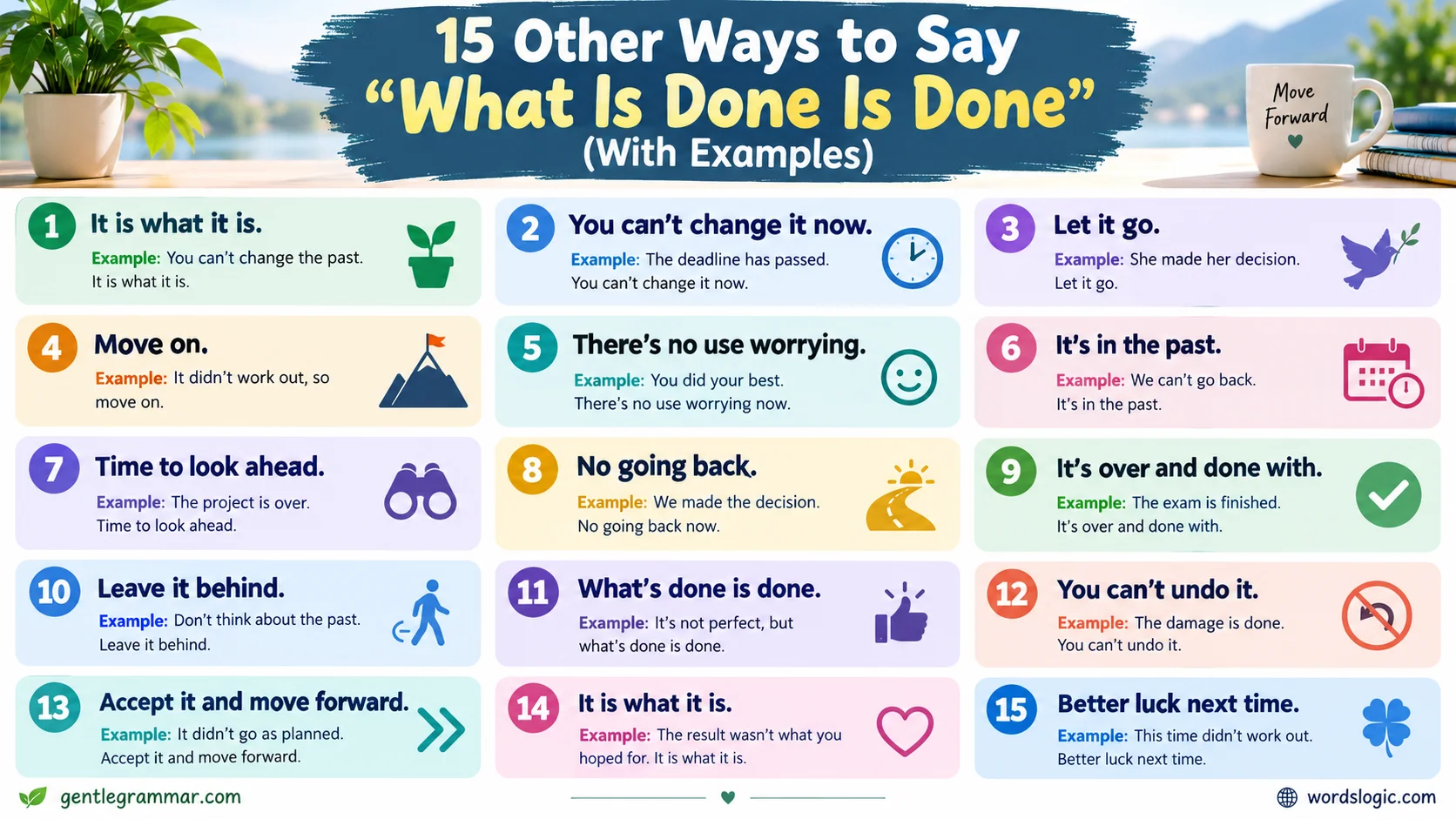
In everyday English, “What Is Done Is Done” is a common expression that encourages acceptance and helps people focus on the future instead of worrying about the past.
This guide to 15 Other Ways to Say “What Is Done Is Done” (With Examples) helps you accept mistakes, release regret, and focus on what comes next. Whether you make an important mistake in an assignment, notice an error in a work message, or regret a personal decision, some things cannot be changed once they have already happened. A colleague, friend, or coworker may offer a straightforward message to help you handle a difficult moment.
Rather than dwelling on mistakes, holding onto regrets, or revisiting blame, it is better to take accountability and learn valuable lessons. From my experience, accepting past events can reduce an emotional burden and give you a clearer mind. You cannot control our future by changing yesterday, but you can accept what happened, release regret, practice forgiveness, and make room for new beginnings.
What Does “What Is Done Is Done” Mean?
“What Is Done Is Done” means that something has already happened and cannot be changed now. It encourages people to accept the past rather than waste time worrying about decisions, mistakes, or events they can no longer control. The phrase often comes up after a disagreement, a missed opportunity, an unsuccessful attempt, or a decision that cannot be reversed.
The expression can communicate acceptance, resignation, or a desire to move forward. Its emotional meaning depends on how it is delivered. Said gently, it can reassure someone who feels guilty about a mistake. Used abruptly, it may sound dismissive, as though the speaker does not want to discuss the consequences. Although the phrase encourages acceptance, it does not necessarily mean that an apology, correction, or lesson is no longer needed.
Common Situations Where “What Is Done Is Done” Is Used
People commonly use this expression in everyday conversations when discussing past decisions or events that cannot be undone. For example, a friend might say it after an argument to suggest that both people should stop revisiting the same disagreement. It can also appear in text messages when someone wants to comfort another person after a disappointing experience.
At work or school, the phrase may come up after a missed deadline, an unsuccessful presentation, or a decision that has already been finalized. In personal relationships, it can encourage acceptance after a misunderstanding or difficult conversation. However, the wording may feel too blunt when someone is still hurting. In those cases, a more empathetic expression can acknowledge the person’s feelings before encouraging them to move forward.
Is It Professional or Polite to Say “What Is Done Is Done”?
“What Is Done Is Done” is generally a neutral, conversational expression rather than a formal business phrase. It is acceptable in many workplace conversations, especially when colleagues are discussing a completed task, a past decision, or a setback. Its suitability depends on the speaker’s tone and the circumstances.
The phrase can sound practical and reassuring when everyone understands that the situation cannot be reversed. However, it may come across as dismissive or insensitive if someone is upset about a serious mistake or its consequences. In a professional email, expressions such as “We should focus on the next steps” or “Let’s learn from this experience” often communicate the same forward-looking attitude more constructively. Choose wording that acknowledges the situation instead of suggesting that the discussion is over.
Advantages and Disadvantages of Saying “What Is Done Is Done”
Advantages
The phrase is short, familiar, and easy to understand. It reminds people that repeatedly worrying about an unchangeable event may not help them solve the problem. In casual conversations, it can offer reassurance and encourage a practical mindset. It is also flexible enough to apply to personal decisions, everyday setbacks, and completed work.
Disadvantages
The expression can sound too final or emotionally distant, especially when the listener needs sympathy or an explanation. It does not automatically acknowledge responsibility, repair damaged relationships, or address the effects of a mistake. In professional communication, it may also seem abrupt if used to shut down a discussion. A more specific alternative can show empathy, encourage accountability, or explain what should happen next.
Synonyms for “What Is Done Is Done”
- There’s No Turning Back
- The Past Is the Past
- What’s Happened Has Happened
- Let Bygones Be Bygones
- It Is What It Is
- There’s Nothing We Can Do About It Now
- We Can’t Change the Past
- Let’s Move On
- It’s Water Under the Bridge
- No Use Crying Over Spilled Milk
- The Damage Is Done
- Let’s Learn From It
- All We Can Do Is Move Forward
- It’s Time to Put It Behind Us
- We Have to Accept What Happened
1. There’s No Turning Back
Meaning
“There’s No Turning Back” means that a decision or action has reached a point where returning to the previous situation is difficult or impossible. Like “What Is Done Is Done,” it emphasizes that the past cannot simply be undone.
Definition
A phrase expressing that a situation cannot easily be reversed.
Detailed Explanation
This expression sounds more decisive and dramatic than the original phrase. It often suggests commitment to a course of action rather than simple acceptance of a past event. It works well when someone has made an important decision and must deal with its consequences. Unlike the original, it can also refer to something that is still unfolding.
Scenario Examples
– Scenario: A friend has accepted a job in another city.
Example: “You’ve signed the contract and found an apartment. There’s no turning back now, so let’s make the most of it.”
– Scenario: A team has launched a new product.
Example: “The campaign is live, and there’s no turning back. Let’s focus on supporting our customers.”
Best Use
Use this phrase in decisive conversations, major life changes, and situations where reversing a choice is no longer practical. Avoid it when someone needs gentle reassurance.
Tone
Tone: Firm, determined, slightly dramatic.
It conveys commitment and finality rather than emotional comfort.
2. The Past Is the Past
Meaning
“The Past Is the Past” means that previous events belong to an earlier time and should not control the present. It encourages people to stop dwelling on things they cannot change.
Definition
An expression that encourages accepting previous events and focusing on the present.
Detailed Explanation
This phrase is particularly useful when someone repeatedly revisits old mistakes or disagreements. It can sound warmer than “What Is Done Is Done” when spoken with understanding. However, it can also sound dismissive if the listener is still dealing with the effects of what happened. The phrase encourages acceptance, but it does not mean people should ignore unresolved problems.
Scenario Examples
– Scenario: Two friends are discussing an old misunderstanding.
Example: “We both said things we regret, but the past is the past. I’d rather focus on our friendship now.”
– Scenario: Someone feels embarrassed about a poor exam result.
Example: “The past is the past. You can use that experience to prepare better next time.”
Best Use
This expression works well in personal conversations, friendships, and discussions about old mistakes or disappointments.
Tone
Tone: Reassuring, reflective, sometimes firm.
Its warmth depends on whether the speaker acknowledges the other person’s feelings.
3. What’s Happened Has Happened
Meaning
“What’s Happened Has Happened” means that an event has already occurred and cannot be changed. It recognizes reality rather than wishing for a different outcome.
Definition
A statement that acknowledges an unchangeable past event.
Detailed Explanation
This expression closely matches the meaning of the original phrase. It places emphasis on accepting facts, even when the outcome is disappointing. It can sound matter-of-fact or resigned, depending on the situation. Choose it when you want to acknowledge what happened without pretending that the outcome was ideal.
Scenario Examples
– Scenario: A friend regrets sending an angry message.
Example: “What’s happened has happened. You can still apologize and explain what you meant.”
– Scenario: A project did not meet its target.
Example: “What’s happened has happened. Let’s review the results and decide what to improve.”
Best Use
Use this phrase in everyday conversation, personal messages, and practical discussions about mistakes or disappointing outcomes.
Tone
Tone: Matter-of-fact, accepting, slightly resigned.
It acknowledges reality without necessarily expressing approval or forgiveness.
4. Let Bygones Be Bygones
Meaning
“Let Bygones Be Bygones” means choosing not to hold on to past disagreements, resentment, or hurt feelings. It is more specifically about forgiveness and reconciliation than simply accepting that an event occurred.
Definition
An expression encouraging people to leave past conflicts behind and make peace.
Detailed Explanation
This traditional expression is especially useful when two people want to repair a relationship after a disagreement. Unlike “What Is Done Is Done,” it suggests a willingness to stop blaming each other and begin again. It does not necessarily mean the hurt was unimportant or that trust has been fully restored. It works best when both people are ready to move forward.
Scenario Examples
– Scenario: Two coworkers disagree about a decision made months ago.
Example: “We’ve both explained our sides. Let’s let bygones be bygones and work together on the next project.”
– Scenario: Siblings want to reconnect after an argument.
Example: “We’ve missed enough family gatherings over this. Let’s let bygones be bygones.”
Best Use
Use it in relationships, family conversations, friendships, and workplace situations where reconciliation is the goal.
Tone
Tone: Forgiving, conciliatory, warm.
It emphasizes making peace rather than simply accepting an outcome.
5. It Is What It Is
Meaning
“It Is What It Is” means accepting a situation as it stands, even if it is disappointing or inconvenient. It recognizes reality without necessarily suggesting that the situation is fair or desirable.
Definition
A casual expression of acceptance when a situation cannot easily be changed.
Detailed Explanation
This is a common conversational alternative when someone wants to stop worrying about circumstances beyond their control. It is shorter and more casual than the original phrase. The expression can communicate calm acceptance, but it may also sound indifferent when someone needs support or a solution. Use it when acceptance is appropriate, not when action or accountability is still required.
Scenario Examples
– Scenario: Your outdoor plans are canceled because of rain.
Example: “The forecast isn’t changing, so it is what it is. Let’s have dinner indoors instead.”
– Scenario: A friend is disappointed about a decision they cannot influence.
Example: “I know you wanted a different result. It is what it is, but you still have other options.”
Best Use
Use it in casual conversations, texting, and everyday discussions about unavoidable circumstances.
Tone
Tone: Casual, resigned, practical.
It can sound relaxed or indifferent depending on delivery.
6. There’s Nothing We Can Do About It Now
Meaning
“There’s Nothing We Can Do About It Now” means that the opportunity to change a particular outcome has passed, or that no practical action is currently available.
Definition
A statement acknowledging that the current situation cannot be changed through available action.
Detailed Explanation
This phrase is more explicit and practical than “What Is Done Is Done.” It identifies a lack of available options rather than simply encouraging acceptance. It can help a group stop debating an irreversible outcome and consider what remains possible. However, the wording may sound discouraging if a person still needs emotional support or if solutions have not been fully explored.
Scenario Examples
– Scenario: A traveler arrives after the last train has departed.
Example: “There’s nothing we can do about it now. Let’s check when the next train leaves.”
– Scenario: A school assignment has already been submitted.
Example: “There’s nothing we can do about the submitted version now, but we can prepare more carefully next time.”
Best Use
Use it in practical conversations, planning discussions, and situations where no immediate remedy is available.
Tone
Tone: Direct, realistic, pragmatic.
It emphasizes limited options rather than forgiveness or emotional closure.
7. We Can’t Change the Past
Meaning
“We Can’t Change the Past” means that earlier events, choices, or mistakes cannot be undone. It encourages people to recognize their limitations while deciding how to respond in the present.
Definition
A statement acknowledging that past events are beyond our ability to alter.
Detailed Explanation
This phrase is straightforward and closely related to the original expression. It can feel more reflective because it directly names the limits of changing history. It is useful when someone is stuck in regret and needs a reminder that their next actions still matter. Unlike a dismissive statement, it can lead naturally into a discussion about learning, apologizing, or making improvements.
Scenario Examples
– Scenario: Someone wishes they had handled a breakup differently.
Example: “We can’t change the past, but you can take what you’ve learned into your next relationship.”
– Scenario: A manager discusses a costly earlier decision.
Example: “We can’t change the past, so let’s identify what went wrong and strengthen our approval process.”
Best Use
Use it in personal reflection, supportive conversations, and professional reviews where lessons from previous events matter.
Tone
Tone: Reflective, realistic, encouraging.
It acknowledges limitations while leaving room for future action.
8. Let’s Move On
Meaning
“Let’s Move On” means that it is time to stop focusing on the current topic or past event and direct attention elsewhere.
Definition
A phrase encouraging people to leave a discussion or setback behind and focus on what comes next.
Detailed Explanation
This expression is more action-oriented than “What Is Done Is Done.” It suggests that continuing to discuss the past may no longer be productive. In a friendly conversation, it can help people put a minor disagreement aside. In a sensitive discussion, though, it may sound impatient or dismissive if the other person has not had a chance to explain their concerns.
Scenario Examples
– Scenario: Friends keep arguing about a minor disagreement.
Example: “We’ve talked this through, and neither of us wants to argue anymore. Let’s move on.”
– Scenario: A team has finished discussing an unsuccessful proposal.
Example: “We’ve identified the main issues. Let’s move on to the revised plan.”
Best Use
Use it in meetings, everyday conversations, and discussions where it is appropriate to redirect attention.
Tone
Tone: Direct, practical, forward-looking.
It signals a transition and works best when everyone has had a fair opportunity to speak.
9. It’s Water Under the Bridge
Meaning
“It’s Water Under the Bridge” means that a past disagreement or unpleasant experience is no longer considered important enough to hold against someone.
Definition
An idiom expressing that a past problem has been forgiven or left behind.
Detailed Explanation
This expression is especially useful when someone apologizes for something that happened earlier. It reassures them that you are no longer holding the incident against them. Compared with the original phrase, it places more emphasis on forgiveness and emotional closure. However, it is not appropriate for every unresolved problem, particularly when meaningful harm still needs to be addressed.
Scenario Examples
– Scenario: A former colleague apologizes for an old disagreement.
Example: “Don’t worry about that meeting. It’s water under the bridge, and I’m glad we’re working together again.”
– Scenario: A friend apologizes for canceling plans in the past.
Example: “It’s water under the bridge. Let’s just enjoy catching up today.”
Best Use
Use it in friendly conversations, personal messages, and reconciliations after minor past conflicts.
Tone
Tone: Warm, forgiving, reassuring.
It communicates that the speaker has let go of lingering resentment.
10. No Use Crying Over Spilled Milk
Meaning
“No Use Crying Over Spilled Milk” means that there is little benefit in becoming upset about something that has already happened and cannot be undone.
Definition
An idiom reminding people that regretting an irreversible mistake will not change the result.
Detailed Explanation
This expression is more vivid and informal than “What Is Done Is Done.” It often encourages someone to stop dwelling on a small mistake and focus on what they can do next. The wording can sound lighthearted when the problem is minor. However, it may seem insensitive if the loss is serious or the person is genuinely distressed.
Scenario Examples
– Scenario: A student realizes they studied the wrong chapter for a completed quiz.
Example: “There’s no use crying over spilled milk. Let’s check which chapters will be on the next test.”
– Scenario: Someone accidentally breaks an inexpensive mug.
Example: “It’s only a mug. No use crying over spilled milk—we can replace it.”
Best Use
Use it in casual conversations about minor mistakes, everyday mishaps, and manageable disappointments.
Tone
Tone: Informal, practical, sometimes humorous.
Its light tone makes it less suitable for serious loss or painful personal experiences.
11. The Damage Is Done
Meaning
“The Damage Is Done” means that harm or negative consequences have already occurred and may not be fully reversible.
Definition
A statement that acknowledges harm that has already taken place.
Detailed Explanation
This phrase has a more serious and negative meaning than the original expression. It focuses on the consequences of an event rather than on accepting the past peacefully. It may be useful when discussing a broken item, damaged reputation, or a mistake that has already affected others. Because it can sound pessimistic, avoid using it when the situation is still repairable or when someone needs encouragement.
Scenario Examples
– Scenario: A confidential document has accidentally been shared with the wrong recipient.
Example: “The damage is done, so let’s notify the appropriate people and limit any further exposure.”
– Scenario: A harsh comment has hurt a friend’s feelings.
Example: “The damage is done, but a sincere apology may help repair the relationship.”
Best Use
Use it in serious discussions about consequences, mistakes, and situations requiring damage control.
Tone
Tone: Serious, blunt, concerned.
It emphasizes the harm already caused, not simply the need to move forward.
12. Let’s Learn From It
Meaning
“Let’s Learn From It” means that instead of dwelling on a past mistake or disappointing outcome, people should identify what they can do differently in the future.
Definition
An expression encouraging people to turn past experiences into useful lessons.
Detailed Explanation
This alternative is more constructive than “What Is Done Is Done” because it shifts attention toward improvement. It acknowledges that something has happened while encouraging people to understand why it happened. The word “let’s” also creates a sense of shared responsibility rather than blaming one person. It is especially useful when the experience can help prevent similar problems later.
Scenario Examples
– Scenario: A marketing campaign attracts fewer customers than expected.
Example: “The campaign didn’t deliver the results we wanted. Let’s learn from it and adjust our approach.”
– Scenario: A friend makes a poor financial decision.
Example: “You’ve realized what went wrong. Let’s learn from it rather than keep beating yourself up.”
Best Use
Use it in workplace reviews, educational settings, personal development, and supportive conversations.
Tone
Tone: Constructive, encouraging, collaborative.
It focuses on growth and improvement rather than regret.
13. All We Can Do Is Move Forward
Meaning
“All We Can Do Is Move Forward” means that when the past cannot be changed, the most useful option is to concentrate on future actions.
Definition
A statement encouraging forward progress after an unchangeable event.
Detailed Explanation
This phrase sounds more hopeful than the original expression because it directs attention toward possibilities that remain. It acknowledges that control over the past is limited without suggesting that the future is equally fixed. It can comfort someone who feels stuck after a setback. It also works in professional settings when a team needs to shift from reviewing an outcome to taking practical action.
Scenario Examples
– Scenario: A friend is disappointed after not getting a job.
Example: “I know you wanted that position, but all we can do is move forward and prepare for the next opportunity.”
– Scenario: A project has experienced an unexpected setback.
Example: “We’ve addressed what we can. All we can do is move forward with the revised schedule.”
Best Use
Use it in motivational conversations, workplace planning, and personal messages after disappointment or change.
Tone
Tone: Hopeful, supportive, determined.
It combines acceptance of the past with an emphasis on future possibilities.
14. It’s Time to Put It Behind Us
Meaning
“It’s Time to Put It Behind Us” means that people should stop allowing a past event to dominate their attention and begin focusing on the present.
Definition
An expression encouraging people to leave an old problem or disagreement in the past.
Detailed Explanation
This phrase is more intentional than “What Is Done Is Done.” It suggests that someone is ready to stop revisiting an issue and create space for a fresh start. It can work well when a group has discussed a problem thoroughly and agreed on a way forward. However, it may feel premature if someone still needs an apology, clarification, or meaningful resolution.
Scenario Examples
– Scenario: Two friends have resolved an argument.
Example: “We’ve apologized and talked everything through. I think it’s time to put it behind us.”
– Scenario: A team has completed an investigation into a minor process error.
Example: “We’ve made the necessary changes, so it’s time to put it behind us and concentrate on the next phase.”
Best Use
Use it in relationships, team discussions, and personal conversations after a problem has been addressed.
Tone
Tone: Reassuring, decisive, forward-looking.
It signals readiness for a fresh start without necessarily implying that the event never mattered.
15. We Have to Accept What Happened
Meaning
“We Have to Accept What Happened” means recognizing reality, even when the outcome is disappointing or difficult to understand.
Definition
A statement encouraging acknowledgment and acceptance of an event that has already occurred.
Detailed Explanation
This phrase is more explicit and serious than the original expression. It emphasizes the need to acknowledge the facts instead of denying them or wishing they were different. It can be helpful when a group needs to agree on the reality of a situation before deciding what to do next. However, acceptance does not mean approving of what happened or giving up on correcting its consequences.
Scenario Examples
– Scenario: A family must adjust after a planned move falls through.
Example: “We have to accept what happened and decide which options are still available to us.”
– Scenario: A project team acknowledges that an important deadline was missed.
Example: “We have to accept what happened, take responsibility, and agree on a realistic recovery plan.”
Best Use
Use it in serious conversations, decision-making, professional discussions, and personal situations that require honest acknowledgment.
Tone
Tone: Sincere, direct, realistic.
It encourages facing the facts without necessarily giving up on improvement.
FAQs:
What is another way to say “What Is Done Is Done”?
Some natural alternatives are “The Past Is the Past,” “What’s Happened Has Happened,” and “We Can’t Change the Past.” For a more encouraging message, use “All We Can Do Is Move Forward.” The best choice depends on whether you want to express acceptance, forgiveness, or determination.
What does “What Is Done Is Done” mean?
It means that something has already happened and cannot be undone. The expression encourages people to accept the past instead of repeatedly worrying about an unchangeable event. It does not necessarily mean that they should ignore mistakes or avoid taking responsibility.
Is “What Is Done Is Done” professional?
It can be appropriate in casual workplace conversations, but it is not especially formal. In a business email or meeting, “Let’s focus on the next steps” may sound more constructive because it directs attention toward action rather than resignation.
What is a more polite way to say “What Is Done Is Done”?
A considerate alternative is “We can’t change the past, but we can learn from it.” This wording acknowledges what happened while offering a constructive way forward. It is especially useful when someone feels disappointed, embarrassed, or responsible for a mistake.
Which alternative works best in formal communication?
“We should focus on the next steps” is often a good choice for formal communication because it emphasizes practical action. If the message needs to acknowledge an earlier mistake, “Let’s learn from this experience” can also work well. Both phrases sound more constructive than simply dismissing the past.
Conclusion:
Knowing different ways to say “What Is Done Is Done” helps you express acceptance without sounding cold, dismissive, or overly serious. Although these expressions share a common idea, each carries a slightly different meaning. “The Past Is the Past” encourages acceptance, “Let Bygones Be Bygones” emphasizes forgiveness, and “Let’s Learn From It” focuses on personal growth. Meanwhile, “All We Can Do Is Move Forward” offers a more hopeful perspective after disappointment.
Before choosing an alternative, consider your audience, the situation, and the feelings involved. A casual conversation with a friend may call for different wording than a professional meeting or a sensitive personal discussion. Remember that accepting the past doesn’t mean ignoring responsibility. The most helpful expression acknowledges what happened while leaving room for understanding, improvement, and positive change.
