
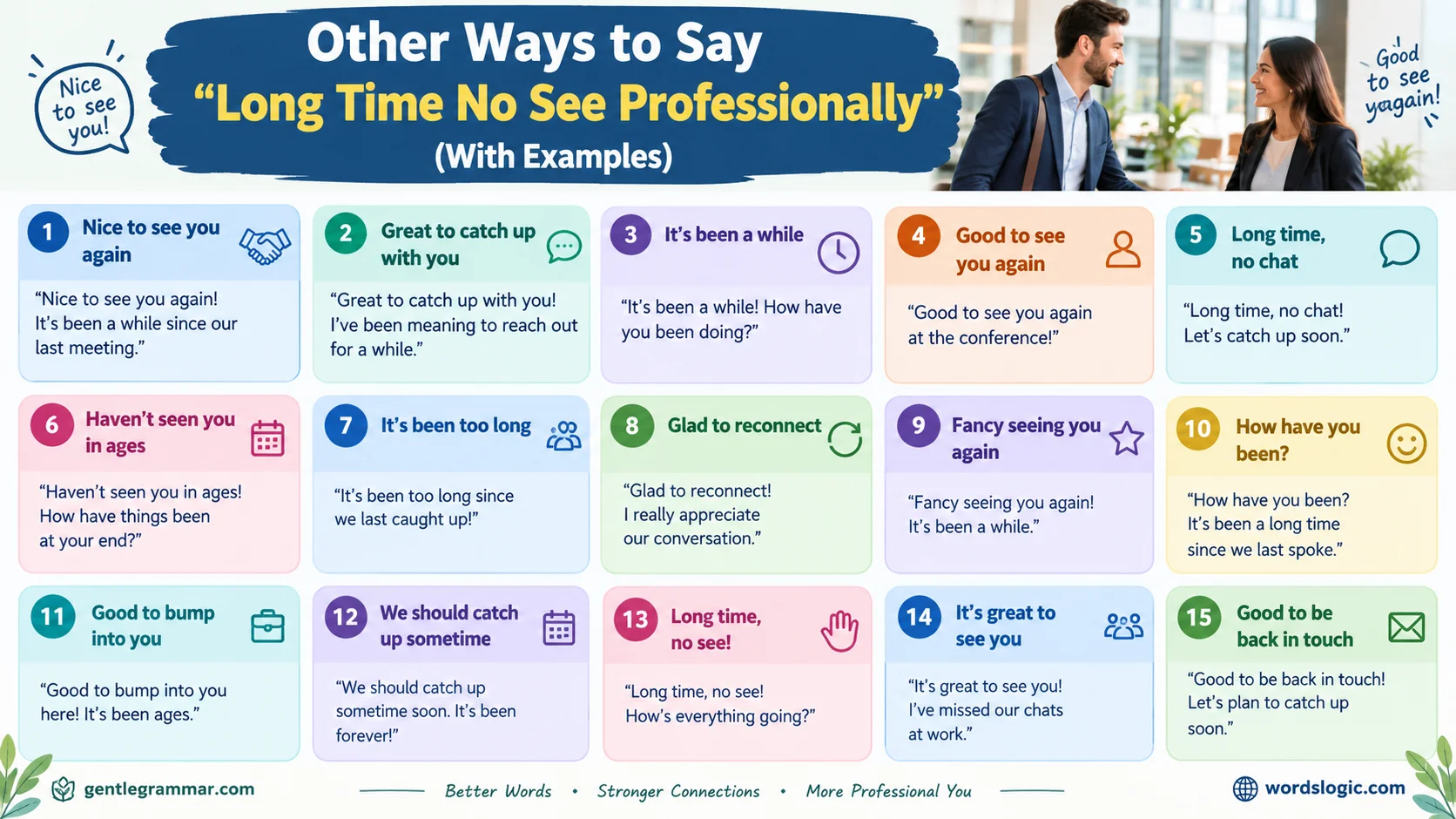
15 Other Ways to Say “Long Time No See Professionally” (With Examples) helps people find natural expressions for reconnecting at work.
At a networking event, you might see a former coworker you have not spoken to for years and automatically say, “Long time no see!” This simple phrase expresses warmth in plain English and works as a casual greeting because it acknowledges the gap without overexplaining. However, workplace conversations often call for a more polished, friendly greeting.
In modern communication, including email, LinkedIn, video calls, and text messages, tone shapes perception. The words you choose can signal familiarity, professionalism, authority, and emotional intelligence. Thoughtful alternatives help you reconnect intentionally without sounding careless or overly formal, creating a better impression in a LinkedIn message or business meeting.
What Does “Long Time No See Professionally” Mean?
“Long time no see professionally” refers to finding a polite and appropriate way to greet someone you have not seen or spoken to for a while in a work-related setting. The expression “long time no see” is an informal greeting that acknowledges a period of separation. When used professionally, the goal is to communicate the same friendly sentiment with wording that fits the relationship and situation.
For example, when reconnecting with a former colleague, you might say, “It’s been a while since we last spoke.” When contacting a previous client, “I hope you’ve been doing well” may sound more polished. Both expressions recognize the gap in communication while maintaining a professional and considerate tone.
Common Situations Where “Long Time No See Professionally” Is Used
People often need alternatives to this greeting when reconnecting with someone in their professional network. The best wording depends on how well they know the person and how long it has been since their last conversation.
- Workplace conversations: Greeting a former colleague after working on separate projects.
- Professional emails: Reaching out to a previous manager, client, or business partner.
- Networking: Reconnecting with someone met at a conference or industry event.
- Business relationships: Restarting a conversation with a customer or former client.
- LinkedIn messages: Contacting an old coworker or professional acquaintance.
- Meetings and video calls: Acknowledging a familiar face after months or years apart.
- School and career connections: Greeting a former classmate who now works in the same industry.
In these situations, alternatives can make the greeting feel more polished, personal, or suitable for the relationship. A short email may call for a neutral opening, while a conversation with a trusted colleague can comfortably be more relaxed.
Is It Professional or Polite to Say “Long Time No See Professionally”?
The phrase “long time no see” is generally friendly, informal, and conversational. It is not inherently rude, and it can be perfectly appropriate when greeting a colleague you know well. However, it may sound too casual in a formal email, a first interaction with a senior executive, or communication with a client you do not know personally.
For more formal situations, expressions such as “It’s been a while since we last connected” or “I hope you’ve been doing well” are often better choices. They preserve the welcoming feeling without assuming too much familiarity. In a relaxed workplace, “It’s great to see you again” can sound natural and warm. The key is to consider your relationship, the communication channel, and the impression you want to make.
Advantages and Disadvantages of Saying “Long Time No See Professionally”
Advantages
“Long time no see” is short, recognizable, and easy to understand. It immediately acknowledges that some time has passed and can help make a reunion feel comfortable. Among familiar colleagues, it can break the ice without requiring a lengthy introduction. Its casual nature can also make a conversation feel genuine and approachable rather than overly formal.
Disadvantages
The phrase can sound too informal in business correspondence, especially when communicating with senior leaders, new clients, or unfamiliar contacts. It also does not express much about the relationship or the reason for reconnecting. Depending on the situation, a more thoughtful greeting may communicate professional courtesy, genuine interest, or a clear intention to reconnect more effectively.
Synonyms for “Long Time No See Professionally”
- It’s been a while since we last connected.
- I hope you’ve been doing well.
- It’s great to reconnect with you.
- It’s been some time since we last spoke.
- I’m glad we have a chance to catch up.
- It’s a pleasure to hear from you again.
- I hope all has been going well on your end.
- It’s good to be in touch again.
- I trust you’ve been keeping well.
- It’s been a while since we last worked together.
- I’m pleased to reconnect after some time.
- It’s wonderful to hear from you again.
- I hope things have been going smoothly for you.
- I wanted to reach out and see how you’ve been.
- It’s nice to have the opportunity to reconnect.
1. It’s been a while since we last connected.
Meaning
This expression acknowledges that some time has passed since you and another person last communicated. It sounds professional, neutral, and friendly, making it a strong alternative when you want to recognize the gap without being overly casual.
Definition
A polite way to acknowledge a period without communication between two people.
Detailed Explanation
“Connected” can refer to a conversation, email exchange, meeting, or professional interaction. Unlike “long time no see,” this wording works naturally even when you have not met the person face-to-face. It does not imply that either person was responsible for the lack of contact. The expression also provides a smooth opening for restarting a discussion.
Scenario Examples
Scenario 1: Reconnecting with a former colleague
Example: “Hi Daniel, it’s been a while since we last connected. How have things been going with your team?”
Scenario 2: Contacting a previous client
Example: “Hello, Ms. Carter. It’s been a while since we last connected, and I wanted to see whether your business needs have changed.”
Scenario 3: Professional networking
Example: “It’s been a while since we last connected at the industry conference. I’d love to hear about your recent projects.”
Best Use
Use this phrase in professional emails, LinkedIn messages, networking conversations, and client communication. It is especially useful when you want to acknowledge the time apart before introducing a new topic.
Tone
Tone: Professional, courteous, approachable.
The wording is polished without sounding stiff, so it suits a wide range of workplace relationships.
2. I hope you’ve been doing well.
Meaning
This phrase expresses goodwill toward someone you have not spoken to recently. Instead of focusing on the length of the separation, it emphasizes the other person’s well-being.
Definition
A polite greeting that expresses the wish that someone has been well.
Detailed Explanation
This expression feels considerate because it begins with a positive sentiment rather than a comment about the communication gap. It is less direct than saying that you have not spoken in a long time. It also works when you do not know exactly how much time has passed. For a more personal connection, you can follow it with a question about the person’s work or recent activities.
Scenario Examples
Scenario 1: Sending a professional email
Example: “Hi Olivia, I hope you’ve been doing well. I wanted to ask whether you might be available to discuss the upcoming project.”
Scenario 2: Reconnecting with a former manager
Example: “Hello, Mr. Lewis. I hope you’ve been doing well since your move to the new department.”
Scenario 3: Messaging a business contact
Example: “Hi Alex, I hope you’ve been doing well. I recently came across an opportunity that made me think of our previous conversation.”
Best Use
Choose this expression for email openings, client messages, professional networking, and polite follow-ups. It is particularly suitable when you want to sound considerate without drawing attention to how long you have been out of touch.
Tone
Tone: Warm, polite, thoughtful.
Its emphasis on well-being creates a friendly impression without requiring personal familiarity.
3. It’s great to reconnect with you.
Meaning
This expression communicates that you are pleased to be in contact with someone again. It highlights the positive value of renewing the relationship rather than simply acknowledging the time apart.
Definition
A friendly statement expressing happiness about resuming communication.
Detailed Explanation
“Reconnect” suggests that a previous professional or personal connection is becoming active again. Adding “great” makes the greeting more enthusiastic than a neutral acknowledgment. It works well when you genuinely welcome the opportunity to communicate again. However, it may sound slightly exaggerated if the relationship was distant or purely transactional.
Scenario Examples
Scenario 1: Meeting a former teammate
Example: “It’s great to reconnect with you after working on different teams for so long.”
Scenario 2: Reconnecting at a conference
Example: “It’s great to reconnect with you. I enjoyed our conversation at last year’s event.”
Scenario 3: Replying to a former client
Example: “It’s great to reconnect with you, and I look forward to hearing about your current priorities.”
Best Use
Use it during networking events, professional reunions, follow-up emails, and conversations with former colleagues or clients when the renewed connection is welcome.
Tone
Tone: Positive, warm, enthusiastic.
The word “great” adds genuine friendliness while “reconnect” keeps the message suitable for professional settings.
4. It’s been some time since we last spoke.
Meaning
This phrase politely acknowledges that you have not had a conversation with someone for a considerable period. It focuses specifically on the time since your last conversation.
Definition
A neutral statement noting that two people have not spoken for a while.
Detailed Explanation
This expression is more measured than “long time no see” and slightly more formal in sound. It works whether your previous conversation happened in person, over the phone, or online. Because it is relatively neutral, it does not suggest that you are especially close to the other person. You can use it before asking a question, sharing an update, or restarting a business discussion.
Scenario Examples
Scenario 1: Emailing a former supervisor
Example: “Hello, Dr. Morgan. It’s been some time since we last spoke, and I wanted to share an update on my recent work.”
Scenario 2: Reaching out to a professional contact
Example: “It’s been some time since we last spoke. Are you still involved in the renewable energy project?”
Scenario 3: Reconnecting with a former business partner
Example: “It’s been some time since we last spoke, so I thought I’d check in and see how things are progressing.”
Best Use
This phrase fits professional emails, formal conversations, and communication with people you respect but may not know closely.
Tone
Tone: Neutral, respectful, slightly formal.
Its restrained wording makes it useful when a highly enthusiastic or personal greeting would feel out of place.
5. I’m glad we have a chance to catch up.
Meaning
This expression shows that you welcome the opportunity to exchange news or discuss what has happened since your last conversation. It is more focused on sharing updates than merely greeting someone.
Definition
A statement expressing pleasure about having an opportunity to talk and exchange news.
Detailed Explanation
“Catch up” usually means discussing recent events or finding out what someone has been doing. This expression is particularly natural when you have arranged a meeting or conversation after a long gap. It sounds warmer than a simple acknowledgment and suggests that you are willing to listen. Because it emphasizes conversation, it is less suitable as a standalone opening in a strictly transactional email.
Scenario Examples
Scenario 1: Having coffee with a former coworker
Example: “I’m glad we have a chance to catch up. How have you been finding your new role?”
Scenario 2: Scheduling a professional call
Example: “Thanks for making time for the call. I’m glad we have a chance to catch up and discuss our latest projects.”
Scenario 3: Meeting an old classmate who is now a colleague
Example: “I’m glad we have a chance to catch up after all these years. I’d love to hear about your career.”
Best Use
Use this expression for meetings, informal business lunches, video calls, networking conversations, and friendly workplace interactions where exchanging updates is the main purpose.
Tone
Tone: Friendly, conversational, welcoming.
The phrase makes the upcoming conversation feel like a shared opportunity rather than a formal obligation.
6. It’s a pleasure to hear from you again.
Meaning
This phrase expresses genuine appreciation for receiving a message from someone you have communicated with before. It focuses on the pleasure of renewed contact, rather than on how long you have been apart.
Definition
A courteous statement showing that you are pleased to receive someone’s message again.
Detailed Explanation
This wording is especially useful when the other person initiates the conversation. It is more polished than “long time no see” because it fits naturally into written correspondence. “A pleasure” can sound a little formal, but it remains friendly when used sincerely. Remember that it refers specifically to hearing from someone, so it is not always the best choice when you unexpectedly meet them in person.
Scenario Examples
Scenario 1: Responding to a former client
Example: “Hello, James. It’s a pleasure to hear from you again. I’d be happy to discuss your new requirements.”
Scenario 2: Replying to an old colleague
Example: “It’s a pleasure to hear from you again! I hope your new position has been rewarding.”
Scenario 3: Responding to a business inquiry
Example: “Thank you for getting in touch. It’s a pleasure to hear from you again, and I appreciate the update.”
Best Use
Choose this expression for email replies, client correspondence, professional messages, and communication with established business contacts.
Tone
Tone: Courteous, professional, appreciative.
The phrase communicates goodwill while maintaining a respectful level of formality.
7. I hope all has been going well on your end.
Meaning
This expression communicates a general wish that things have been progressing positively for the other person. It is broader than asking whether someone is feeling well because it can refer to their work, projects, or circumstances.
Definition
A polite greeting expressing the hope that someone’s affairs and activities have been progressing smoothly.
Detailed Explanation
The phrase is useful when you want to acknowledge a contact after a period of silence without asking for personal details. “On your end” is common in workplace communication and refers to the other person’s side of a shared situation. This wording feels professional but not overly formal. It is especially helpful when you have previously worked together and want to resume a discussion naturally.
Scenario Examples
Scenario 1: Checking in with a project partner
Example: “Hi Priya, I hope all has been going well on your end. Have there been any updates on the project timeline?”
Scenario 2: Contacting a previous supplier
Example: “I hope all has been going well on your end since we completed our last order.”
Scenario 3: Messaging a former teammate
Example: “I hope all has been going well on your end. How is the new department working out for you?”
Best Use
Use this phrase in business emails, project-related correspondence, client check-ins, and messages to former coworkers. It is most effective when the other person’s work or circumstances are relevant to the conversation.
Tone
Tone: Considerate, professional, conversational.
The wording balances a friendly greeting with an interest in how things are progressing.
8. It’s good to be in touch again.
Meaning
This phrase expresses satisfaction that communication has resumed. It emphasizes being connected again rather than discussing the length of the gap.
Definition
A polite statement indicating that renewed communication is welcome.
Detailed Explanation
“It’s good to be in touch again” sounds relaxed but remains appropriate for many professional situations. It can be used after exchanging emails, starting a phone call, or reconnecting through a business network. Compared with “It’s great to reconnect with you,” it is a little more restrained and less enthusiastic. It works particularly well when you want to maintain a friendly relationship without suggesting a particularly close bond.
Scenario Examples
Scenario 1: Reopening an email conversation
Example: “Hello, Nina. It’s good to be in touch again. I wanted to follow up on the proposal we discussed earlier this year.”
Scenario 2: Messaging a former coworker
Example: “It’s good to be in touch again! I hope your transition to the new company went smoothly.”
Scenario 3: Contacting an industry connection
Example: “It’s good to be in touch again, and I’d be interested to hear about the work your team is doing.”
Best Use
This phrase works well in professional emails, networking messages, follow-ups, and casual workplace conversations.
Tone
Tone: Friendly, balanced, professional.
It conveys a positive attitude without the extra enthusiasm of stronger expressions.
9. I trust you’ve been keeping well.
Meaning
This expression politely conveys the hope that someone has remained well during the time you have been apart. It has a more traditional and formal feel than everyday greetings.
Definition
A courteous expression indicating confidence or hope that another person has been well.
Detailed Explanation
“I trust” is a conventional way to express an expectation or hope in polite correspondence. It gives the greeting a formal, slightly old-fashioned quality, which may suit certain business relationships. In everyday conversation, it can sound stiff or less natural than “I hope you’ve been doing well.” Use it when a measured and respectful style fits the recipient, rather than choosing it automatically for every workplace message.
Scenario Examples
Scenario 1: Writing to a senior business contact
Example: “Dear Mr. Bennett, I trust you’ve been keeping well. I am writing to revisit our earlier discussion.”
Scenario 2: Corresponding with a former academic supervisor
Example: “I trust you’ve been keeping well since the semester ended. I wanted to share an update on my research.”
Scenario 3: Sending a formal business email
Example: “Good morning, Ms. Patel. I trust you’ve been keeping well, and I appreciate your time.”
Best Use
Choose this expression for formal emails, traditional business correspondence, and communication with senior contacts when the style fits your workplace culture.
Tone
Tone: Formal, courteous, traditional.
The phrase communicates respect, although a simpler greeting may sound more natural in a modern, informal workplace.
10. It’s been a while since we last worked together.
Meaning
This expression acknowledges a gap since you and another person collaborated on a project, task, or professional responsibility. It specifically refers to your shared work history.
Definition
A statement noting that two people have not collaborated professionally for some time.
Detailed Explanation
Unlike a general greeting, this phrase reminds the recipient of a previous working relationship. It can be a natural way to restart a professional conversation when you have shared experience to build on. It also provides a relevant reason for getting back in touch, especially if you have a new project or opportunity in mind. Avoid it when you have never worked directly with the person, because it implies previous collaboration.
Scenario Examples
Scenario 1: Contacting a former teammate
Example: “Hi Marcus, it’s been a while since we last worked together. I saw your team is hiring and thought I’d reach out.”
Scenario 2: Reconnecting with a former consultant
Example: “It’s been a while since we last worked together, and I’d be interested in discussing a possible collaboration.”
Scenario 3: Greeting a former project manager
Example: “It’s been a while since we last worked together. I hope the launch of your latest project went well.”
Best Use
Use this expression for former teammates, consultants, project partners, and professional contacts with whom you have previously collaborated.
Tone
Tone: Professional, familiar, respectful.
The reference to shared work makes the greeting specific and relevant without becoming overly personal.
11. I’m pleased to reconnect after some time.
Meaning
This phrase expresses satisfaction about resuming communication after a period apart. It is a polished way to acknowledge the gap while keeping the focus on renewed professional contact.
Definition
A formal-leaning statement expressing pleasure about reconnecting after an interval.
Detailed Explanation
“I’m pleased” sounds more restrained than “I’m excited” or “It’s wonderful.” The phrase works particularly well when you want to sound courteous and purposeful. It can be used to open an email or introduce a discussion with a former business contact. Because the wording is somewhat formal, it may feel unnecessarily stiff in a casual chat with a close coworker.
Scenario Examples
Scenario 1: Reconnecting with a former client
Example: “I’m pleased to reconnect after some time and learn more about your team’s current priorities.”
Scenario 2: Contacting a former business associate
Example: “I’m pleased to reconnect after some time. I believe there may be an opportunity for us to collaborate again.”
Scenario 3: Sending a professional networking message
Example: “I’m pleased to reconnect after some time and hear about your recent achievements in the industry.”
Best Use
This expression is suitable for business correspondence, formal networking, professional introductions, and communication with established contacts.
Tone
Tone: Professional, measured, courteous.
It communicates positive intent without sounding overly familiar or emotionally expressive.
12. It’s wonderful to hear from you again.
Meaning
This expression shows strong happiness about receiving a message from someone you know. It is more enthusiastic than a neutral professional greeting and highlights the personal value of renewed contact.
Definition
A warm statement expressing great pleasure at hearing from someone again.
Detailed Explanation
The word “wonderful” adds emotional warmth and makes the greeting feel more personal. It is especially natural when the relationship has been positive and you genuinely welcome the message. The phrase can suit professional communication, but it is not equally appropriate for every business relationship. For a distant or strictly formal contact, “It’s a pleasure to hear from you again” may be more measured.
Scenario Examples
Scenario 1: Hearing from a former mentor
Example: “It’s wonderful to hear from you again! I often think about what I learned while working with you.”
Scenario 2: Replying to a former colleague
Example: “It’s wonderful to hear from you again. How have things been at the new office?”
Scenario 3: Receiving a message from a long-standing client
Example: “It’s wonderful to hear from you again, and I’d be delighted to explore how we can work together.”
Best Use
Use this phrase for friendly email replies, messages to former mentors, close colleagues, and established clients with whom you share a positive relationship.
Tone
Tone: Warm, enthusiastic, personable.
Its emotional emphasis makes it most effective when your happiness about reconnecting is genuine.
13. I hope things have been going smoothly for you.
Meaning
This expression conveys a wish that the other person’s work or life has been progressing without major difficulties. It is a thoughtful greeting that focuses on how things have been going overall.
Definition
A polite expression of hope that someone’s circumstances have been progressing well.
Detailed Explanation
This wording is broader than a question about health and can refer to work, responsibilities, or ongoing projects. It sounds considerate without asking for private information. It can also serve as a natural transition into a practical question or business update. If you are writing to someone who has recently experienced a known difficulty, consider a more specific and sensitive message instead.
Scenario Examples
Scenario 1: Contacting a former project lead
Example: “Hi Emma, I hope things have been going smoothly for you since the project wrapped up.”
Scenario 2: Reconnecting with a supplier
Example: “I hope things have been going smoothly for you. We are reviewing our upcoming orders and would like to discuss availability.”
Scenario 3: Messaging a former colleague
Example: “I hope things have been going smoothly for you at the new company. How are you finding the role?”
Best Use
Choose this expression for professional check-ins, client communication, supplier emails, and messages to former coworkers when you want to show consideration without sounding overly personal.
Tone
Tone: Thoughtful, polite, supportive.
The phrase suggests an interest in the recipient’s circumstances while maintaining a professional distance.
14. I wanted to reach out and see how you’ve been.
Meaning
This expression explains that you are contacting someone because you want to check in and find out how they are doing. It combines the purpose of the message with a friendly question.
Definition
A conversational statement introducing a message intended to check on someone’s well-being or recent activities.
Detailed Explanation
“I wanted to reach out” is common in professional emails and networking messages. Adding “see how you’ve been” makes the purpose more personal and less transactional. The wording is useful when you do not have an urgent business request and simply want to restart communication. However, if your message is mainly about a specific task, it is usually clearer to state that purpose directly after the greeting.
Scenario Examples
Scenario 1: Contacting a former coworker
Example: “Hi Sophie, I wanted to reach out and see how you’ve been since moving to the new team.”
Scenario 2: Reconnecting with a mentor
Example: “Hello, Professor Adams. I wanted to reach out and see how you’ve been. I recently completed the certification we discussed.”
Scenario 3: Messaging a professional contact
Example: “I wanted to reach out and see how you’ve been, as it has been some time since our last conversation.”
Best Use
Use this expression for personalized professional emails, networking messages, mentor check-ins, and friendly follow-ups when you want to initiate contact rather than simply respond.
Tone
Tone: Friendly, considerate, conversational.
The wording makes your intention clear and helps the message feel personal rather than automated.
15. It’s nice to have the opportunity to reconnect.
Meaning
This phrase expresses appreciation for being able to resume communication with someone. It emphasizes the opportunity itself, making it useful when a meeting or conversation has been arranged.
Definition
A polite statement showing appreciation for the chance to renew a previous connection.
Detailed Explanation
This expression sounds measured and professional, especially when used at the beginning of a meeting or formal message. It is slightly more elaborate than “It’s good to be in touch again.” The wording can be useful when reconnecting with someone after a professional transition or a long gap in collaboration. It may sound overly formal in a quick message to a close friend or colleague.
Scenario Examples
Scenario 1: Opening a business meeting
Example: “It’s nice to have the opportunity to reconnect and discuss how our teams might collaborate in the future.”
Scenario 2: Meeting a former industry contact
Example: “It’s nice to have the opportunity to reconnect after the conference. I enjoyed hearing about your work.”
Scenario 3: Reconnecting by email
Example: “It’s nice to have the opportunity to reconnect. I would welcome a conversation about our shared interests in the field.”
Best Use
Choose this phrase for business meetings, formal networking, professional introductions, and planned conversations with former contacts.
Tone
Tone: Polished, courteous, professional.
The expression communicates appreciation while keeping the focus on a constructive professional relationship.
FAQs:
What is another way to say “long time no see professionally”?
A natural alternative is “It’s been a while since we last connected.” It acknowledges the time apart while sounding professional and approachable. For a more personal greeting, you can say, “I hope you’ve been doing well.”
What does “long time no see” mean?
“Long time no see” is an informal greeting used when meeting or communicating with someone after a long period apart. It expresses recognition and often friendliness. The phrase does not necessarily mean the people have not seen each other literally; it can also refer to a lack of communication.
Is “long time no see” professional?
It can be appropriate in a relaxed workplace or when speaking with a familiar colleague. However, it is informal rather than strictly professional. In a formal email or message to a senior business contact, “It’s been a while since we last connected” may be a better choice.
What is a more polite way to say “long time no see”?
“I hope you’ve been doing well” is a polite, friendly option. It expresses goodwill without directly emphasizing the gap in communication. “It’s a pleasure to hear from you again” is also suitable when replying to a message from a previous professional contact.
Which alternative works best in formal communication?
“It’s been a while since we last connected” is a versatile choice for formal and semi-formal communication. For a more traditional business tone, “I’m pleased to reconnect after some time” may work well. Choose the wording that fits your relationship with the recipient and the purpose of your message.
Conclusion:
Choosing the right greeting can make reconnecting with a professional contact feel natural and comfortable. Although “long time no see” is friendly and widely understood, it may be too casual for certain business settings. Expressions such as “It’s been a while since we last connected,” “I hope you’ve been doing well,” and “It’s a pleasure to hear from you again” offer different levels of warmth and formality.
When deciding how to say long time no see professionally, consider whether you are writing to a former colleague, a client, a manager, or a networking contact. A warm greeting can help reopen a conversation, while a more measured expression can preserve professional boundaries. Ultimately, the best wording is the one that feels genuine, respectful, and appropriate for your relationship. A thoughtful opening makes it easier to move naturally into the conversation that follows.
