
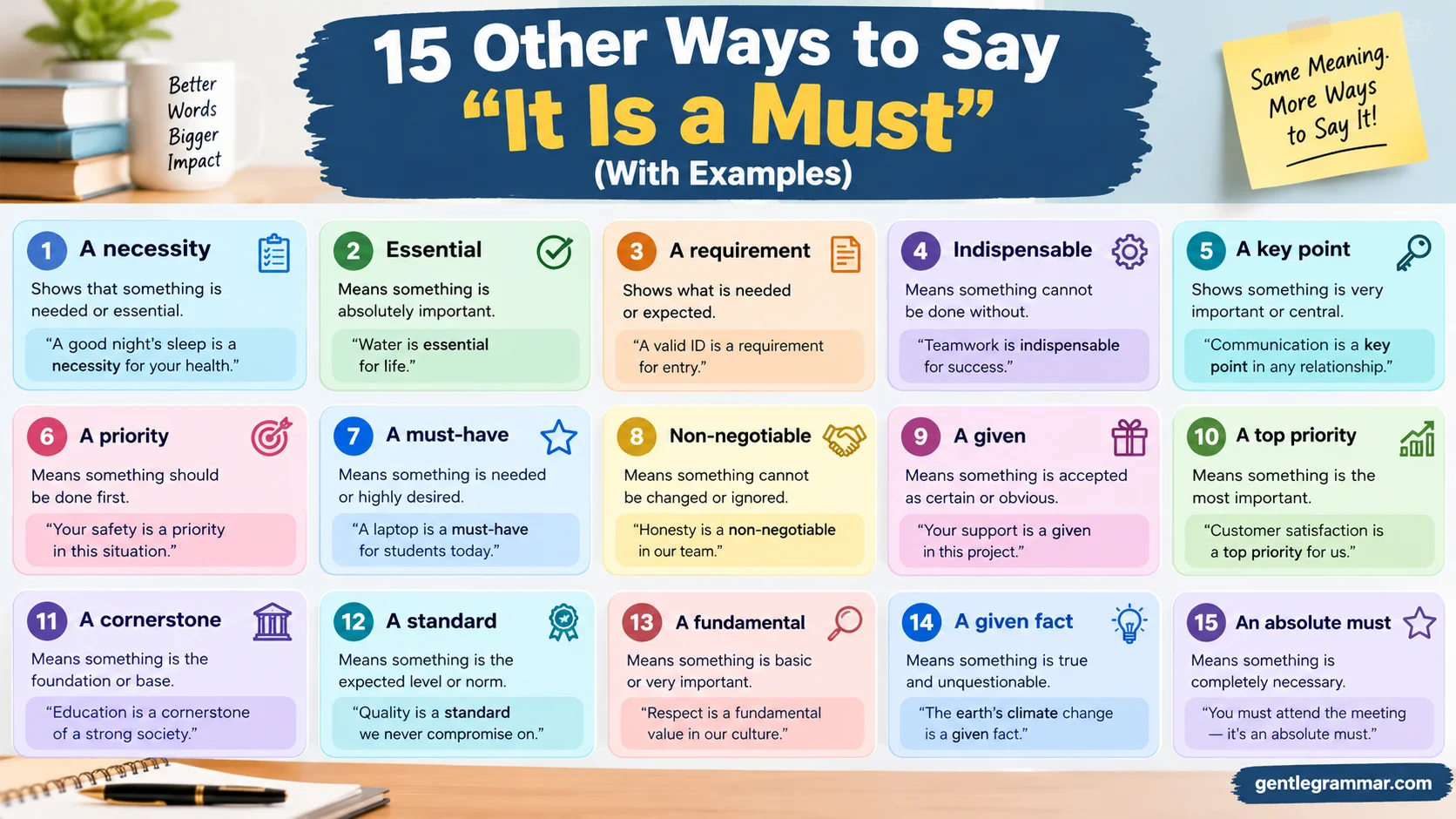
Other Ways to Say “It Is a Must” explains how essential and necessary language can make your writing clear, natural, and confident in English.
When I explain this idiomatic phrase, I focus on the word must, which can act as a modal verb, verb, auxiliary, or noun depending on the sentence and its usage. The phrase it is a must is grammatically correct, while it is must is grammatically incorrect. This difference is important in writing and speaking, especially in emails, social media, websites, product reviews, schoolwork, and professional writing.
For an activity, action, place, or experience, context helps show why something is required or highly recommended. Seeing a new exhibit at a museum or visiting a place may be something that should not be missed or ignored. The same idea can appear in product review, website content, brand blog post, or formal professional writing, where clarity, structure, and a strong message matter.
What Does “It Is a Must” Mean?
“It is a must” means that something is strongly necessary, highly advisable, or essential in a particular situation. When someone says, “Attending the meeting is a must,” they are emphasizing that attending is not something the listener should casually overlook. Depending on context, the phrase can mean that something is required, that it is extremely important, or that it is strongly recommended. In everyday English, “it is a must” is often used to add emphasis and communicate a sense of necessity or importance. However, it does not always mean that something is legally or officially required; sometimes it simply means that the speaker considers it very important.
Common Situations Where “It Is a Must” Is Used
People use “it is a must” in many situations where they want to emphasize necessity or strong recommendation. In everyday conversation, someone might say, “Trying that restaurant is a must,” meaning they highly recommend the experience. In workplace communication, the phrase can emphasize an important task or precaution, although a more formal expression may be preferable in official writing. It can also appear in social media posts, personal messages, travel recommendations, reviews, and informal advice.
The phrase is especially useful when the speaker wants to sound confident and decisive. However, alternatives can help when the original wording feels too repetitive, too direct, or not formal enough. Choosing a different expression allows you to communicate the same general idea while adjusting the tone, strength, and context.
Is It Professional or Polite to Say “It Is a Must”?
“It is a must” is generally clear, direct, and reasonably friendly, but its suitability depends on the setting. In casual conversation, recommendations, marketing-style writing, and personal communication, it can sound natural and energetic. For example, “This book is a must for anyone interested in history” is an understandable and common recommendation. In formal workplace or academic writing, however, phrases such as “it is essential,” “it is necessary,” or “it is required” may sound more precise.
The phrase itself is not inherently impolite. Its directness comes from the strong emphasis on necessity. If you are speaking to someone in a sensitive situation, a softer expression such as “It is strongly recommended” may feel more respectful. The key is to consider whether you are describing an actual requirement or simply expressing strong advice.
Advantages and Disadvantages of Saying “It Is a Must”
Advantages
The main advantage of “it is a must” is its clarity and emphasis. It immediately tells the listener that something deserves serious attention. The expression is also short, memorable, and easy to understand. It works particularly well when making recommendations, giving informal advice, or emphasizing an important part of an experience. Its conversational quality can make a message feel energetic rather than overly formal.
Disadvantages
The phrase can sometimes be too direct for formal or delicate communication. It may also be ambiguous about whether something is genuinely required or merely strongly recommended. Repeating “it is a must” frequently can make writing feel predictable. In professional contexts, a more precise phrase may communicate the intended level of obligation more effectively.
Synonyms for “It Is a Must”
- It Is Essential
- It Is Necessary
- It Is Imperative
- It Is Required
- It Is Vital
- It Is Crucial
- It Is Important
- You Need To
- You Have To
- You Should Definitely
- Be Sure To
- Make Sure To
- It Is Strongly Recommended
- It Is a Necessity
- It Is Highly Advisable
1. It Is Essential
Meaning
“It is essential” means that something is extremely important or necessary for a particular purpose or situation. It is one of the clearest formal alternatives to “it is a must.”
Definition
Essential means absolutely necessary or very important to achieving a particular result.
Detailed Explanation
“It is essential” usually sounds more precise and professional than “it is a must.” It emphasizes genuine importance rather than simply expressing enthusiasm or a strong personal recommendation. The phrase is especially useful when something needs to happen for a process to work properly. It can be used in professional, academic, instructional, and everyday communication.
Scenario Examples
Scenario: A manager explains an important workplace procedure.
Example: “It is essential that all employees complete the safety training.”
Scenario: You give advice to someone preparing for an examination.
Example: “It is essential to review your notes before the final test.”
Scenario: A travel writer discusses an important part of a trip.
Example: “It is essential to carry enough water during the hike.”
Best Use
Best for professional communication, formal writing, instructions, academic contexts, and serious advice.
Tone
Tone: Professional, serious, clear. It sounds stronger and more formal than the conversational “it is a must.”
2. It Is Necessary
Meaning
“It is necessary” means that something is needed or required for a particular situation, purpose, or outcome.
Definition
Necessary describes something that is needed because a situation cannot reasonably proceed without it.
Detailed Explanation
This expression focuses on need rather than enthusiasm. Compared with “it is a must,” it can sound more objective and less conversational. It is useful when explaining why an action, condition, or item is needed. The exact level of obligation depends on context, so it does not always mean that something is legally mandatory.
Scenario Examples
Scenario: A teacher explains preparation for a project.
Example: “It is necessary to check your sources before submitting the assignment.”
Scenario: A technician explains a repair.
Example: “It is necessary to restart the system after installing the update.”
Best Use
Best for instructions, explanations, workplace communication, academic writing, and practical advice.
Tone
Tone: Neutral, practical, direct. It sounds less emotional than “it is a must.”
3. It Is Imperative
Meaning
“It is imperative” means that something is extremely important and must be done, particularly because the consequences of ignoring it may be serious.
Definition
Imperative means absolutely necessary or requiring immediate attention or action.
Detailed Explanation
This is a considerably stronger and more formal expression than “it is a must.” It often appears when the speaker wants to emphasize urgency, responsibility, or serious consequences. Because of its formal character, it can sound excessive in casual conversation. Use it when the situation genuinely calls for strong emphasis.
Scenario Examples
Scenario: A company communicates an urgent security instruction.
Example: “It is imperative that employees report suspicious activity immediately.”
Scenario: A community leader discusses emergency preparations.
Example: “It is imperative to follow the evacuation instructions.”
Best Use
Best for formal writing, official communication, serious instructions, and urgent situations.
Tone
Tone: Formal, urgent, authoritative. It carries considerably more weight than a casual recommendation.
4. It Is Required
Meaning
“It is required” means that something is officially necessary or demanded by a rule, policy, process, or authority.
Definition
Required means officially needed or made necessary by a particular condition, rule, or procedure.
Detailed Explanation
This phrase is more specific than “it is a must” because it normally suggests an actual requirement rather than personal advice. It works particularly well when discussing forms, documents, qualifications, procedures, or rules. Avoid using it when something is merely recommended, because “required” can imply that there is an obligation. This distinction makes it especially valuable in professional communication.
Scenario Examples
Scenario: A university explains an application procedure.
Example: “A valid identification document is required for registration.”
Scenario: An employer explains workplace rules.
Example: “Completion of the training course is required before you begin the assignment.”
Best Use
Best for official instructions, policies, applications, workplace procedures, and formal notices.
Tone
Tone: Formal, precise, authoritative. It clearly communicates an obligation when an actual requirement exists.
5. It Is Vital
Meaning
“It is vital” means that something is extremely important to the success, safety, or well-being of a person or situation.
Definition
Vital means critically important or necessary for something to succeed or continue.
Detailed Explanation
“It is vital” adds a sense of importance and urgency without necessarily sounding as bureaucratic as “it is required.” It is useful when the consequences of overlooking something could be significant. Compared with “it is a must,” it often sounds more serious and purposeful. It can work in both formal and everyday communication when the subject genuinely deserves strong emphasis.
Scenario Examples
Scenario: A doctor gives general health-related instructions.
Example: “It is vital to follow the instructions provided with the treatment.”
Scenario: A project leader discusses teamwork.
Example: “It is vital that everyone communicates clearly before the deadline.”
Best Use
Best for serious advice, professional communication, safety-related messages, and important personal guidance.
Tone
Tone: Serious, emphatic, concerned. It highlights the consequences of neglecting something important.
6. It Is Crucial
Meaning
“It is crucial” means that something is extremely important to a particular outcome.
Definition
Crucial describes something that can strongly affect whether a goal, plan, or process succeeds.
Detailed Explanation
This expression emphasizes the importance of an action or factor without necessarily saying that it is an absolute requirement. That makes it slightly different from “it is a must.” For example, preparation can be crucial to success even if there are other ways to succeed. It is common in professional, academic, analytical, and everyday English.
Scenario Examples
Scenario: A manager discusses a major project.
Example: “It is crucial to communicate any delays as soon as possible.”
Scenario: A student discusses exam preparation.
Example: “It is crucial to understand the basic concepts before moving on.”
Best Use
Best for workplace communication, academic writing, planning, analysis, and serious conversation.
Tone
Tone: Professional, focused, emphatic. It stresses the importance of something without always implying a strict rule.
7. It Is Important
Meaning
“It is important” means that something deserves attention or should not be overlooked.
Definition
Important means having significant value, relevance, or influence in a particular situation.
Detailed Explanation
This is a softer and more flexible alternative to “it is a must.” It does not necessarily suggest that something is mandatory. Instead, it tells the listener that the matter deserves attention. Because of its moderate strength, it works in many situations where stronger wording could sound unnecessarily forceful.
Scenario Examples
Scenario: A teacher gives advice to students.
Example: “It is important to read the instructions carefully before starting.”
Scenario: You are discussing a relationship with a friend.
Example: “It is important to be honest when something is bothering you.”
Best Use
Best for everyday conversation, education, workplace communication, personal advice, and general writing.
Tone
Tone: Friendly, balanced, respectful. It is less forceful than “it is a must.”
8. You Need To
Meaning
“You need to” tells someone that an action is necessary or strongly advisable.
Definition
You need to means that a person should do something because it is needed for a particular reason.
Detailed Explanation
This expression is more direct and personal than “it is a must.” Instead of talking generally about an action, you address the listener directly. It can indicate genuine necessity, but its strength depends heavily on tone and context. In friendly conversation it may sound caring; in a workplace setting, it can sound like an instruction.
Scenario Examples
Scenario: A friend is preparing for a long journey.
Example: “You need to charge your phone before you leave.”
Scenario: A colleague has missed an important deadline.
Example: “You need to speak with the client before the end of the day.”
Best Use
Best for conversation, texting, practical advice, instructions, and direct communication.
Tone
Tone: Direct, practical, conversational. Depending on delivery, it can sound helpful or authoritative.
9. You Have To
Meaning
“You have to” means that someone must do something because of a rule, situation, responsibility, or strong necessity.
Definition
You have to means that an action is obligatory or necessary in the circumstances.
Detailed Explanation
This is one of the most natural everyday ways to express obligation. It is stronger than “you should” because it normally indicates that the person does not have much choice. However, context matters: “You have to try this dessert” can be enthusiastic rather than literally obligatory. This flexibility makes the phrase common in both conversation and informal writing.
Scenario Examples
Scenario: A friend recommends a movie enthusiastically.
Example: “You have to watch this movie; I think you’ll love it.”
Scenario: A workplace has a mandatory procedure.
Example: “You have to complete the form before submitting your request.”
Best Use
Best for everyday conversation, texting, informal instructions, recommendations, and situations involving clear obligation.
Tone
Tone: Direct, casual, emphatic. It can express either genuine obligation or enthusiastic recommendation.
10. You Should Definitely
Meaning
“You should definitely” means that the speaker strongly recommends an action.
Definition
You should definitely is an emphatic way of telling someone that an action is highly advisable or worth doing.
Detailed Explanation
Unlike “it is a must,” this phrase usually expresses strong advice rather than strict necessity. It is therefore useful when you want to encourage someone without making the action sound compulsory. It often feels warmer and more personal because the speaker is directly recommending something to another person. The word “definitely” increases the confidence and enthusiasm of the suggestion.
Scenario Examples
Scenario: A friend is visiting your city.
Example: “You should definitely visit the old market while you’re here.”
Scenario: A colleague asks about a useful professional resource.
Example: “You should definitely read that report before the meeting.”
Best Use
Best for friendly recommendations, conversations, texts, travel advice, and informal professional communication.
Tone
Tone: Friendly, enthusiastic, encouraging. It sounds persuasive without necessarily creating an obligation.
11. Be Sure To
Meaning
“Be sure to” tells someone to remember or make a point of doing something.
Definition
Be sure to means to take care that a particular action is completed.
Detailed Explanation
This phrase is a useful alternative when the goal is to give a reminder or friendly instruction. It is generally softer than “you have to,” while still drawing attention to an important action. It can sound warm and considerate, particularly when used between people who already have a comfortable relationship. In instructions, it can also provide a simple reminder without sounding overly commanding.
Scenario Examples
Scenario: A friend is leaving for a trip.
Example: “Be sure to send me a message when you arrive.”
Scenario: A teacher gives students a final reminder.
Example: “Be sure to include your name on the first page.”
Scenario: A host gives guests practical advice.
Example: “Be sure to bring a jacket because it gets cold after sunset.”
Best Use
Best for friendly messages, reminders, instructions, emails, and everyday conversation.
Tone
Tone: Friendly, helpful, considerate. It encourages action without sounding as forceful as a strict command.
12. Make Sure To
Meaning
“Make sure to” means to take responsibility for completing or remembering something important.
Definition
Make sure to means to check or take care that a particular action happens.
Detailed Explanation
This expression emphasizes care and responsibility. It is common when someone wants to prevent an important task from being forgotten. Compared with “it is a must,” it focuses more on the listener taking action than on the abstract importance of the task. It works naturally in both casual and professional communication.
Scenario Examples
Scenario: A manager gives a colleague a reminder.
Example: “Make sure to save a copy of the final document.”
Scenario: A parent gives a child practical advice.
Example: “Make sure to take your keys before you leave.”
Scenario: A friend is preparing for an appointment.
Example: “Make sure to arrive a few minutes early.”
Best Use
Best for reminders, instructions, workplace messages, emails, and practical everyday communication.
Tone
Tone: Direct, practical, responsible. It is clear without necessarily sounding harsh.
13. It Is Strongly Recommended
Meaning
“It is strongly recommended” means that something is not necessarily mandatory but is considered highly advisable.
Definition
Strongly recommended describes an action that someone advises you to take with considerable confidence or emphasis.
Detailed Explanation
This is a particularly useful choice when you want to distinguish strong advice from an actual requirement. It sounds more formal and objective than “it is a must.” The expression is common in instructions, policies, public guidance, professional communication, and informational writing. Because it does not automatically mean “required,” it should be used when the action remains optional.
Scenario Examples
Scenario: A company provides guidance to visitors.
Example: “It is strongly recommended that visitors arrive 15 minutes early.”
Scenario: A travel website provides practical advice.
Example: “It is strongly recommended to book accommodation in advance during peak season.”
Best Use
Best for formal writing, professional communication, official guidance, instructions, and recommendations.
Tone
Tone: Formal, respectful, advisory. It communicates strong advice without necessarily imposing a strict obligation.
14. It Is a Necessity
Meaning
“It is a necessity” means that something is needed or unavoidable in a particular situation.
Definition
A necessity is something that is required because it is needed for a specific purpose or circumstance.
Detailed Explanation
“It is a necessity” is a noun-based expression that emphasizes the condition of being necessary. It can sound somewhat more formal and deliberate than “it is a must.” The phrase works best when the speaker wants to discuss something as a genuine need rather than a simple preference. Depending on context, it can sound stronger and more serious than “it is important.”
Scenario Examples
Scenario: A business discusses reliable communication.
Example: “For a remote team, reliable internet access is a necessity.”
Scenario: Someone prepares for a long outdoor trip.
Example: “For this kind of journey, carrying enough water is a necessity.”
Best Use
Best for formal discussion, explanatory writing, practical advice, and situations involving genuine needs.
Tone
Tone: Serious, practical, somewhat formal. It emphasizes necessity rather than personal enthusiasm.
15. It Is Highly Advisable
Meaning
“It is highly advisable” means that something is strongly worth doing because it is likely to be beneficial or appropriate.
Definition
Highly advisable means strongly recommended as a sensible or beneficial course of action.
Detailed Explanation
This expression is more formal and measured than “it is a must.” It does not necessarily imply that something is compulsory. Instead, it tells the reader that a particular action is a wise choice under the circumstances. It is especially useful when you want to give strong guidance while avoiding overly forceful language.
Scenario Examples
Scenario: A professional gives preparation advice.
Example: “It is highly advisable to review the contract before signing it.”
Scenario: A traveler receives practical guidance.
Example: “It is highly advisable to keep a digital copy of your important documents.”
Scenario: A student prepares for an important presentation.
Example: “It is highly advisable to practice your presentation several times.”
Best Use
Best for formal emails, professional advice, academic writing, informational content, and careful recommendations.
Tone
Tone: Formal, respectful, advisory. It sounds serious while leaving room for the reader to make the final decision.
FAQs:
What is another way to say “It Is a Must”?
Natural alternatives include “It is essential,” “it is necessary,” “it is crucial,” “it is important,” and “it is strongly recommended.” The best choice depends on whether you mean a genuine requirement, strong advice, or simply something that deserves attention.
What does “It Is a Must” mean?
“It is a must” means that something is very important, necessary, or strongly recommended in a particular situation. The phrase does not always indicate an official requirement; sometimes it is simply an emphatic recommendation.
Is “It Is a Must” professional?
“It is a must” can be used professionally, particularly in informal workplace communication, recommendations, presentations, or promotional writing. For formal documents, “it is essential,” “it is necessary,” or “it is required” may provide greater precision.
What is a more polite way to say “It Is a Must”?
If you want to soften the message, “it is strongly recommended” or “it is highly advisable” can work well. These expressions communicate strong guidance without automatically making the action sound compulsory.
Which alternative works best in formal communication?
For formal communication, expressions such as “it is essential,” “it is necessary,” “it is required,” and “it is highly advisable” are useful, depending on the intended meaning. Use “it is required” when there is an actual requirement, and choose “it is highly advisable” when you are giving strong but non-mandatory advice.
Conclusion:
Choosing another way to say “it is a must” is not simply about replacing one phrase with another. The most effective wording depends on meaning, tone, context, and level of obligation. “It is essential” can sound professional and serious, while “you should definitely” feels more personal and enthusiastic. “It is required” communicates an actual requirement, whereas “it is strongly recommended” expresses firm advice without necessarily creating an obligation.
When choosing among these expressions, first decide what you truly mean: Is something required, necessary, highly important, or simply worth recommending? Once that distinction is clear, the right phrase becomes much easier to choose. The goal is not to avoid “it is a must,” but to use the wording that communicates your message most naturally and accurately.
