
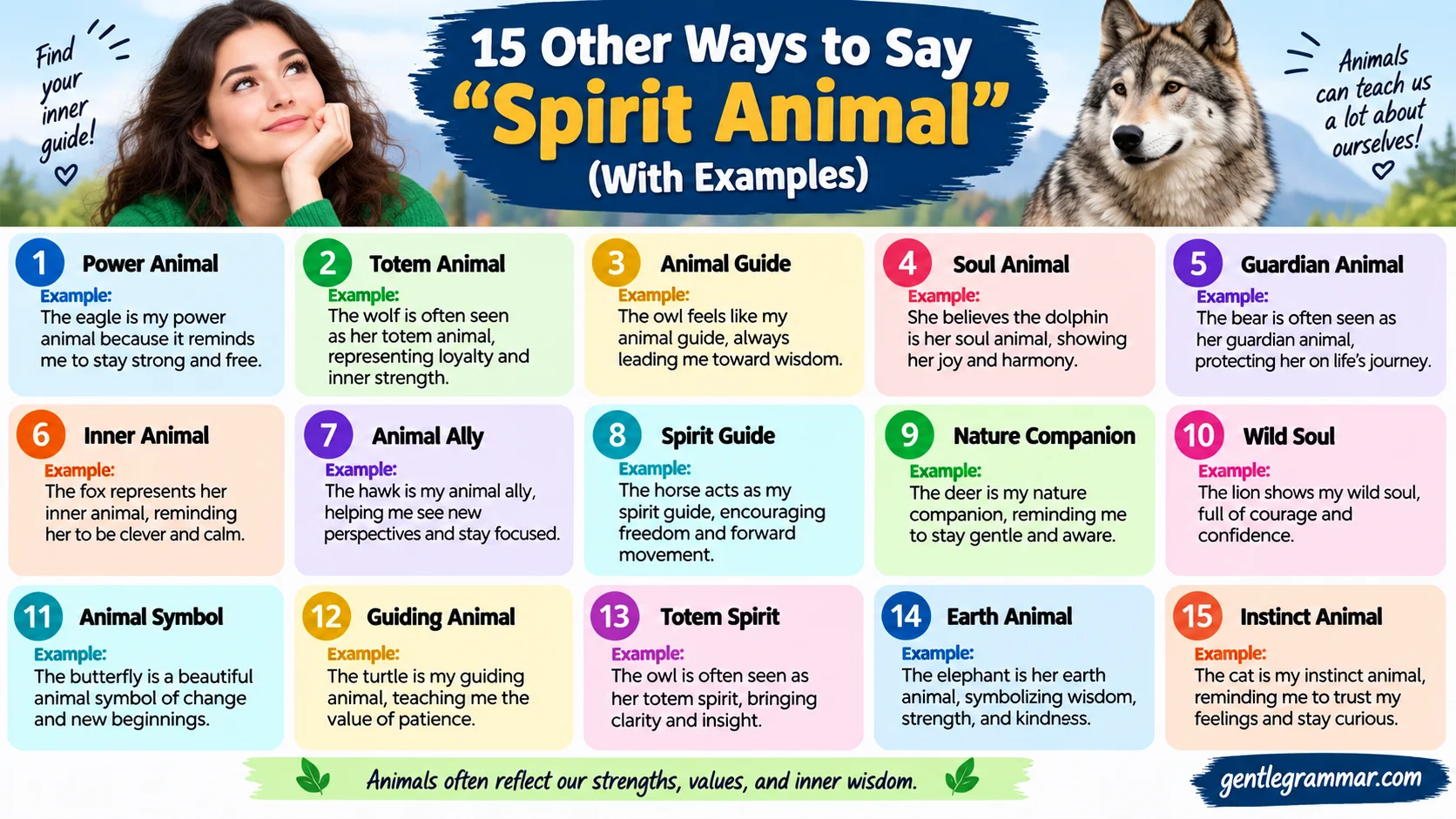
If you are exploring Other Ways to Say “Spirit Animal”, the idea can be understood through Indigenous cultures, where an animal may act as a guide, messenger, or source of protection, wisdom, and guidance during a person’s life journey.
Its characteristics may offer a symbolic reflection, totem, or power that is metaphorical and helps describe something that feels deeply connected, admired, or relatable. The concept has also become an idea shared humorously and irreverently online, with users in forums, blogs, and discussions about television shows such as Mad Men in 2006 and 2007 referring to Samuel Jackson or Peggy Olson as animal guides.
These spiritual traditions can help individuals embody a metaphor, develop strong connections, express appreciation, and maintain ongoing identification. A vivid dream about an animal, a wild creature, or a moment when you have locked eyes with one can create a felt shift deep inside, particularly when an unexplainable pull toward a particular animal keeps appearing in ways that seem meaningful and difficult to ignore.
What Does “Spirit Animal” Mean?
“Spirit animal” is commonly used in everyday English to describe an animal that someone feels strongly represents their personality, qualities, behavior, or identity. For example, a person who loves being independent might jokingly say, “A cat is my spirit animal,” meaning that the animal’s independence and personality remind them of themselves. Online and in casual conversation, the phrase is often used figuratively, humorously, or affectionately.
The expression can also have a deeper meaning when discussing spiritual or cultural traditions in which animals may have symbolic or spiritual significance. However, those traditions are not all the same, and “spirit animal” should not automatically be treated as a universal term for Indigenous or other cultural practices. In casual modern English, it is often simply a colorful way of saying that an animal strongly resonates with someone.
Common Situations Where “Spirit Animal” Is Used
People most often use “spirit animal” in informal conversation, social media posts, memes, captions, and personal discussions. Someone might describe a sleepy cat as their spirit animal after a long day, or say that an energetic dog matches their personality. The phrase can also appear when people discuss animals they admire because of qualities such as strength, independence, loyalty, curiosity, or playfulness.
The expression is much less common in formal workplace or academic writing. In those settings, alternatives such as “animal symbol,” “animal archetype,” or “animal representation” can communicate the idea more clearly. Choosing a different expression can also be useful when you want to avoid the casual or culturally loaded aspects that the phrase may carry in some contexts.
Is It Professional or Polite to Say “Spirit Animal”?
“Spirit animal” is generally casual and conversational, rather than professional. It can sound friendly, playful, humorous, or personal when used among people who understand the intended meaning. For example, telling a close friend, “That sleepy panda is my spirit animal today,” is clearly informal and lighthearted.
In professional, academic, educational, or culturally sensitive communication, another expression may be more appropriate. “Animal archetype,” “animal symbol,” or “animal representation” can describe the intended comparison without relying on the original phrase. The right choice depends on whether you are making a joke, describing a personality connection, discussing symbolism, or referring to an actual spiritual tradition.
Advantages and Disadvantages of Saying “Spirit Animal”
Advantages
The phrase is short, memorable, expressive, and familiar in casual English. It can quickly communicate that an animal seems to embody someone’s personality or current mood. Its playful quality also makes it useful for social media captions, friendly conversations, jokes, and informal writing.
Disadvantages
The main limitation is that “spirit animal” can be ambiguous. It may sound humorous in one context but spiritual or culturally significant in another. Some readers may also prefer more precise wording when discussing symbolism or cultural traditions. In formal communication, alternatives such as “animal archetype” or “animal symbol” may better express the intended meaning.
Synonyms for“Spirit Animal”
- Animal Archetype
- Animal Symbol
- Animal Guide
- Symbolic Animal
- Animal Representation
- Animal Alter Ego
- Animal Persona
- Kindred Animal
- Animal Counterpart
- Animal That Resonates With Me
- Animal I Identify With
- Animal Inspiration
- Symbolic Creature
- Animal Match
- Totem Animal
1. Animal Archetype
Meaning
“Animal archetype” describes an animal associated with a recognizable set of personality traits, behaviors, or symbolic qualities. It is particularly useful when you want to discuss an animal as a representation of a certain character type.
Definition
An animal archetype is an animal used to represent a recurring personality pattern, characteristic, or symbolic role.
Detailed Explanation
This expression is more analytical and structured than “spirit animal.” Instead of suggesting a personal spiritual connection, it focuses on the qualities an animal represents. A lion, for example, might function as an archetype of courage or leadership. This wording works especially well when discussing storytelling, personality, symbolism, or character development.
Scenario Examples
Scenario: You are discussing personality types with a friend.
Example: “The wolf is an interesting animal archetype for someone who values loyalty and independence.”
Scenario: You are writing about animals in literature.
Example: “The owl often appears as an animal archetype associated with wisdom.”
Best Use
Best for educational writing, literature, psychology-related discussions, creative writing, personality descriptions, and symbolic analysis.
Tone
Tone: Thoughtful, analytical, descriptive
It sounds more precise and less casual than “spirit animal.”
2. Animal Symbol
Meaning
An animal symbol is an animal that represents a particular idea, quality, emotion, value, or concept.
Definition
An animal symbol is an animal used to stand for something beyond the animal itself.
Detailed Explanation
This phrase focuses on symbolism rather than personal identity. It can describe an animal that represents courage, freedom, wisdom, loyalty, or another idea. Unlike “spirit animal,” it does not necessarily imply that the animal reflects someone’s personality. It is therefore a useful choice when discussing art, literature, culture, branding, or personal symbolism.
Scenario Examples
Scenario: You are discussing the meaning of an eagle in a story.
Example: “The eagle serves as an animal symbol of freedom throughout the novel.”
Scenario: You are explaining a personal preference.
Example: “For me, the butterfly is an animal symbol of change and renewal.”
Best Use
Best for formal writing, literature, art, symbolism, presentations, and thoughtful personal descriptions.
Tone
Tone: Neutral, clear, professional
Its straightforward wording makes it suitable for many contexts.
3. Animal Guide
Meaning
“Animal guide” suggests an animal associated with guidance, wisdom, direction, or personal reflection.
Definition
An animal guide is an animal viewed as a symbolic source of guidance or as a representation of qualities someone wants to understand or develop.
Detailed Explanation
This expression can carry a more spiritual or reflective feeling than “animal symbol.” It may be used when someone feels that an animal represents lessons or qualities that guide them. However, it should not automatically be presented as a universal term for a particular cultural tradition. In personal or contemporary spiritual writing, it can express the idea without assuming that every tradition uses the same terminology.
Scenario Examples
Scenario: Someone is talking about an animal that inspires their personal reflection.
Example: “I think of the owl as an animal guide because it reminds me to slow down and observe.”
Scenario: You are writing creatively about a character.
Example: “The fox becomes her animal guide, encouraging her to trust her instincts.”
Best Use
Best for personal reflection, spiritual writing, creative writing, storytelling, and symbolic discussions.
Tone
Tone: Reflective, spiritual, gentle
It feels more meaningful and contemplative than the playful use of “spirit animal.”
4. Symbolic Animal
Meaning
A symbolic animal is an animal that represents a particular meaning, quality, idea, or theme.
Definition
A symbolic animal is an animal whose presence or characteristics communicate an idea beyond its literal identity.
Detailed Explanation
This expression is useful when the emphasis is on what an animal represents rather than on someone’s personal connection with it. It can describe animals in stories, artwork, myths, dreams, logos, or personal symbolism. The phrase is also more neutral than “spirit animal,” making it a practical choice when you want clear and careful wording.
Scenario Examples
Scenario: You are analyzing a painting.
Example: “The raven appears as a symbolic animal representing mystery.”
Scenario: You are discussing a character’s personality.
Example: “The fox works as a symbolic animal for her clever and adaptable nature.”
Best Use
Best for formal writing, essays, literary analysis, art discussions, and symbolic descriptions.
Tone
Tone: Neutral, thoughtful, academic
It sounds clear without being overly technical.
5. Animal Representation
Meaning
“Animal representation” refers to an animal being used to represent a person, quality, idea, identity, or characteristic.
Definition
Animal representation is the use of an animal as a way to express or symbolize something else.
Detailed Explanation
This is one of the more precise and formal alternatives. It does not suggest that someone literally has a spiritual animal connection. Instead, it focuses on the relationship between the animal and the quality it represents. That makes it useful when explaining the concept objectively or discussing how animals are used in communication and storytelling.
Scenario Examples
Scenario: You are discussing a fictional character.
Example: “The bear is an animal representation of the character’s strength and protective nature.”
Scenario: You are writing an article about visual symbolism.
Example: “The butterfly provides an animal representation of transformation.”
Best Use
Best for academic writing, professional explanations, essays, presentations, and analytical discussions.
Tone
Tone: Formal, precise, objective
It is considerably less casual than “spirit animal.”
6. Animal Alter Ego
Meaning
An animal alter ego is an animal that someone feels reflects their personality, behavior, mood, or hidden side.
Definition
An animal alter ego is a playful comparison between a person and an animal that seems to embody their character.
Detailed Explanation
This expression is particularly useful when the intended meaning is humorous or personality-based. It suggests that if someone had an animal counterpart, that animal would behave much like them. Compared with “spirit animal,” it feels more playful and less spiritual. It works especially well when talking about personality quirks or funny habits.
Scenario Examples
Scenario: Your friend spends all weekend sleeping.
Example: “A house cat is definitely your animal alter ego.”
Scenario: Someone is always organizing everything around them.
Example: “My animal alter ego would probably be a very determined squirrel.”
Best Use
Best for texting, jokes, social media, casual conversation, and playful personality comparisons.
Tone
Tone: Playful, humorous, casual
The phrase clearly signals that the comparison is figurative.
7. Animal Persona
Meaning
An animal persona is an animal-based personality or character that reflects certain traits, behaviors, or characteristics.
Definition
An animal persona is a personality identity or character represented through an animal.
Detailed Explanation
“Animal persona” works well when you are creating or describing a character identity. It can refer to the animal someone chooses to represent them, especially in creative projects, games, storytelling, or online profiles. It is less likely than “spirit animal” to suggest spirituality and more likely to suggest a chosen personality image.
Scenario Examples
Scenario: Someone is creating a character for a story.
Example: “Her animal persona is a fox because she is observant and resourceful.”
Scenario: You are discussing an online avatar.
Example: “He chose a wolf as his animal persona because it fits his quiet personality.”
Best Use
Best for creative writing, character design, avatars, online identities, storytelling, and informal descriptions.
Tone
Tone: Creative, personal, expressive
It emphasizes identity and presentation rather than spirituality.
8. Kindred Animal
Meaning
A kindred animal is an animal that feels emotionally or personally similar to someone.
Definition
A kindred animal is an animal with which a person feels a strong sense of similarity, familiarity, or connection.
Detailed Explanation
This phrase has a warm and emotional quality. It suggests that someone recognizes something familiar in an animal’s behavior or character. It is not an exact replacement for every use of “spirit animal,” but it works beautifully when the intended idea is a feeling of personal connection. It can also sound more poetic and gentle.
Scenario Examples
Scenario: You have always felt connected to dogs.
Example: “Dogs have always felt like kindred animals to me because I value loyalty.”
Scenario: You are writing a reflective social media caption.
Example: “The deer feels like a kindred animal—quiet, alert, and gentle.”
Best Use
Best for personal writing, reflective posts, captions, conversations, and creative descriptions.
Tone
Tone: Warm, intimate, poetic
It emphasizes emotional connection rather than humor.
9. Animal Counterpart
Meaning
An animal counterpart is an animal that can be seen as a person’s equivalent or parallel in animal form.
Definition
An animal counterpart is an animal whose characteristics closely correspond to those of a person or character.
Detailed Explanation
This expression focuses on similarity and comparison. It works particularly well when you want to say that an animal behaves or thinks in a way that resembles someone. Unlike “spirit animal,” it does not carry an obvious spiritual suggestion. The wording can therefore be useful when discussing personality comparisons in a neutral way.
Scenario Examples
Scenario: A friend is energetic from morning until night.
Example: “Your animal counterpart would have to be a playful puppy.”
Scenario: You are comparing a fictional character with an animal.
Example: “The fox is her animal counterpart because both are cautious and clever.”
Best Use
Best for personality comparisons, creative writing, character analysis, casual conversation, and descriptive writing.
Tone
Tone: Neutral, descriptive, slightly playful
It communicates similarity without making the comparison sound spiritual.
10. Animal That Resonates With Me
Meaning
“Animal that resonates with me” describes an animal that feels personally meaningful because its qualities, behavior, or symbolism connect with you.
Definition
An animal that resonates with someone is an animal that strongly connects with their feelings, personality, values, or experiences.
Detailed Explanation
This is a particularly useful alternative when you want to express the personal connection behind “spirit animal” without using the original phrase. “Resonates with me” is flexible because it does not specify exactly why the connection exists. It can refer to personality, memories, symbolism, values, or emotions.
Scenario Examples
Scenario: You are talking about an animal you admire.
Example: “The elephant is an animal that really resonates with me because of its gentle strength.”
Scenario: You are writing a personal caption.
Example: “The sea turtle is the animal that resonates with me most—I love its calm, steady nature.”
Best Use
Best for personal conversations, social media, reflective writing, captions, and thoughtful messages.
Tone
Tone: Personal, thoughtful, sincere
It sounds natural when explaining why a particular animal feels meaningful.
11. Animal I Identify With
Meaning
“Animal I identify with” means an animal whose qualities or behavior feel similar to your own.
Definition
An animal someone identifies with is an animal whose characteristics they recognize in themselves.
Detailed Explanation
This phrase is direct and easy to understand. It focuses on personal similarity rather than spirituality or symbolism. It is especially useful when you want your meaning to be immediately clear to an English learner or a broad audience. Because it simply describes identification, it can fit both casual and somewhat more thoughtful contexts.
Scenario Examples
Scenario: Someone asks which animal best describes you.
Example: “A fox is the animal I identify with because I tend to observe before I act.”
Scenario: You are answering a personality question.
Example: “The dolphin is an animal I identify with because I’m social and curious.”
Best Use
Best for everyday conversation, interviews, questionnaires, social media, personal writing, and informal professional settings.
Tone
Tone: Clear, personal, straightforward
It avoids the figurative or spiritual implications of “spirit animal.”
12. Animal Inspiration
Meaning
“Animal inspiration” refers to an animal that inspires someone through its qualities, behavior, appearance, or symbolism.
Definition
Animal inspiration is an animal that provides motivation, creative ideas, admiration, or personal inspiration.
Detailed Explanation
This expression changes the emphasis from “this animal represents me” to “this animal inspires me.” That difference matters because you can admire an animal without feeling that it mirrors your personality. It is a strong choice when discussing creativity, personal growth, design, writing, or motivation.
Scenario Examples
Scenario: An artist draws birds because they love their movement.
Example: “Birds are a major source of animal inspiration for my paintings.”
Scenario: Someone admires an animal’s resilience.
Example: “The wolf has always been a source of animal inspiration for her writing.”
Best Use
Best for creative work, art, writing, personal development, design, captions, and reflective communication.
Tone
Tone: Positive, thoughtful, creative
It highlights admiration and influence rather than personal identity.
13. Symbolic Creature
Meaning
A symbolic creature is an animal or creature used to communicate a deeper idea, theme, quality, or emotion.
Definition
A symbolic creature is a creature whose role carries meaning beyond its literal existence.
Detailed Explanation
“Symbolic creature” has a slightly more literary and imaginative feel than “animal symbol.” It is especially useful when discussing fictional worlds, mythology, poetry, stories, artwork, or fantasy. It does not necessarily mean that the creature represents the speaker personally. Instead, the focus is on what the creature symbolizes within a particular context.
Scenario Examples
Scenario: You are analyzing a fantasy novel.
Example: “The raven appears as a symbolic creature connected with mystery and prophecy.”
Scenario: You are describing a character’s artistic design.
Example: “The stag becomes a symbolic creature representing patience and resilience.”
Best Use
Best for creative writing, literature, fantasy, mythology, poetry, and artistic discussions.
Tone
Tone: Literary, imaginative, expressive
It gives the idea a more creative and evocative quality.
14. Animal Match
Meaning
An animal match is an animal that seems to fit someone’s personality, habits, energy, or characteristics.
Definition
An animal match is an animal that closely corresponds to the qualities or behavior of a particular person.
Detailed Explanation
This is a casual and easy-to-understand expression. It works particularly well when someone is making a lighthearted personality comparison rather than discussing spirituality. “Animal match” suggests that an animal seems like a good fit for someone. It is useful in quizzes, games, conversations, and playful posts.
Scenario Examples
Scenario: Friends are comparing personalities.
Example: “A golden retriever would be a perfect animal match for your cheerful personality.”
Scenario: You are making a playful social media post.
Example: “Trying to figure out my animal match based on my weekend habits.”
Best Use
Best for casual conversation, social media, quizzes, games, texting, and playful discussions.
Tone
Tone: Casual, friendly, playful
It feels light and accessible without implying a spiritual belief.
15. Totem Animal
Meaning
“Totem animal” is a term sometimes used to describe an animal associated with a person, family, group, or symbolic tradition.
Definition
A totem animal is an animal connected with a particular symbolic, cultural, or spiritual tradition.
Detailed Explanation
This expression can overlap with some uses of “spirit animal,” but it is not a universal or interchangeable term for every situation. “Totem” has specific meanings in different cultural contexts, so it should be used carefully rather than as a casual replacement whenever someone likes an animal. When discussing an actual tradition, it is important to use the terminology that belongs to that tradition rather than assuming that all animal-based spiritual concepts are the same.
Scenario Examples
Scenario: You are discussing a cultural or historical source that specifically uses the term.
Example: “The article explains the significance of the totem animal within that particular tradition.”
Scenario: You are writing educational material about symbolism.
Example: “The term ‘totem animal’ should be understood within its specific cultural context.”
Best Use
Best for cultural discussions, historical writing, educational material, and contexts where the term is specifically appropriate.
Tone
Tone: Cultural, serious, contextual
It requires more care than the casual use of “spirit animal.”
FAQs:
What is another way to say “Spirit Animal”?
“Animal I identify with” or “animal that resonates with me” are natural alternatives.
What does “Spirit Animal” mean?
It usually means an animal that represents your personality, qualities, or behavior.
Is “Spirit Animal” professional?
It is generally casual and informal, so a neutral alternative may be better in professional writing.
What is a more polite way to say “Spirit Animal”?
Try “animal I identify with” or “animal symbol” for a more neutral expression.
Which alternative works best in formal communication?
“Animal symbol” or “animal archetype” usually works well in formal contexts.
Conclusion:
Choosing an alternative to “spirit animal” is less about finding one perfect synonym and more about expressing the exact idea you mean. If you are making a playful personality comparison, “animal match” or “animal alter ego” can feel natural. If you are discussing symbolism, “animal symbol” or “symbolic animal” offers greater precision. For a personal connection, “animal I identify with” or “animal that resonates with me” can sound warm and clear.
The important thing is to consider context, tone, meaning, and audience before choosing your wording. Similar expressions can carry very different implications, especially when spiritual or cultural ideas are involved. Use the phrase that communicates your intended meaning naturally and respectfully.
