
In my early career, I struggled after every mistake, unsure which words could express genuine regret.
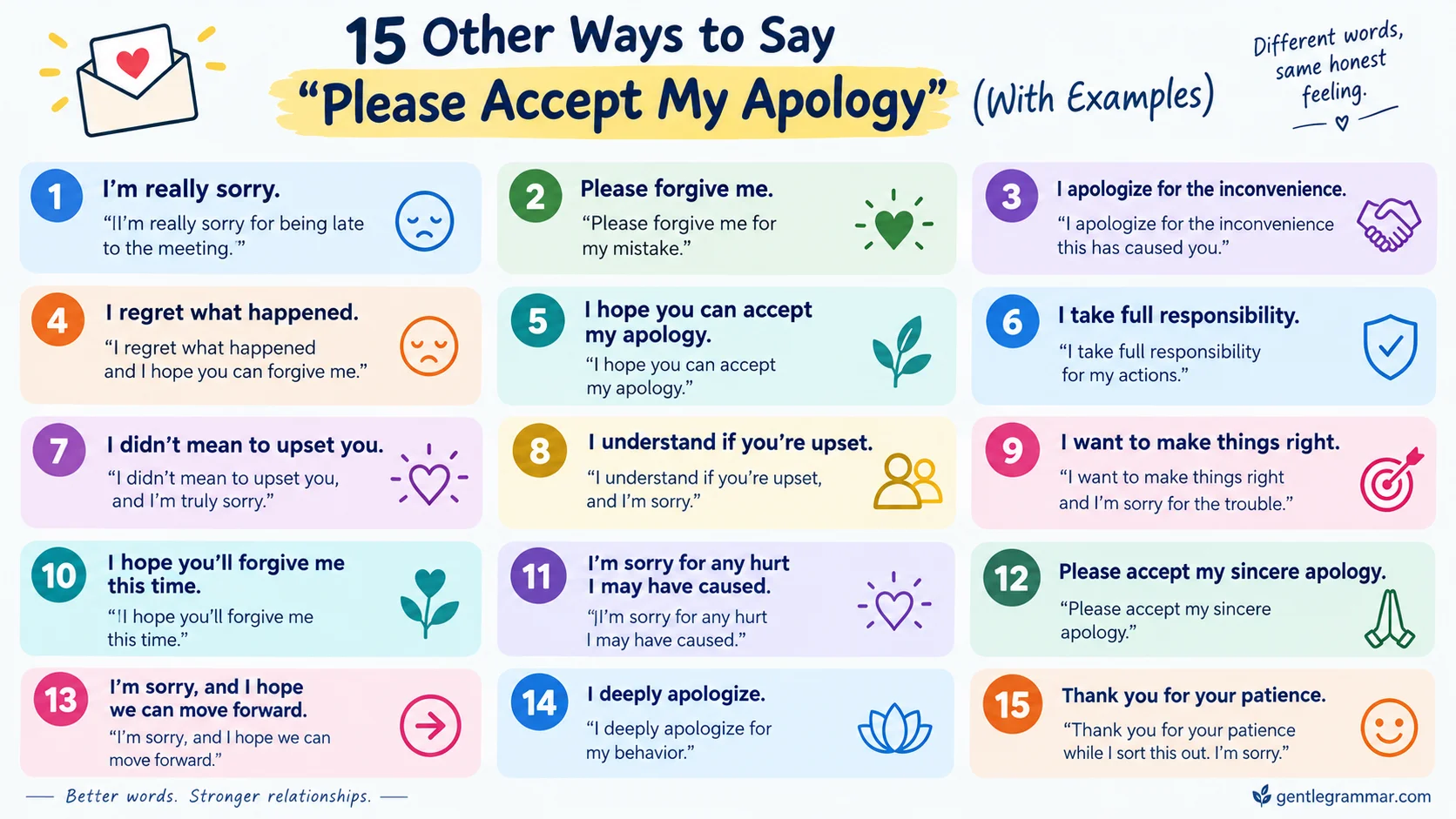
This guide to 15 Other Ways to Say “Please Accept My Apology” (With Examples) explores polite phrases that show sincerity, respect, and empathy in professional and personal conversations. Choosing the right apology wording can strengthen trust, improve communication, and help preserve relationships.
I learned that a simple sorry, a formal apology, or a thoughtful written message can make a big difference when it matches the situation. Whether you send an apology letter, offer a verbal apology, or speak in person, sincere words show that you respect the other person’s feelings. The right phrase can help both parties feel understood and make it easier to accept an apology positively.
What Does “Please Accept My Apology” Mean?
“Please Accept My Apology” is a polite expression used to ask someone to acknowledge and accept your expression of regret for something you have done wrong. It communicates that you recognize a mistake, understand that your actions may have caused inconvenience or hurt, and want to make things right. The phrase is often used when someone wants to show respect, accountability, and genuine remorse.
The wording is slightly formal because it makes a direct, courteous request rather than simply saying, “Sorry.” It can be appropriate after a misunderstanding, a missed commitment, an inappropriate comment, or a professional mistake. However, asking someone to accept an apology does not mean they must forgive you immediately. A meaningful apology also involves taking responsibility, listening to the other person, and making an effort to avoid repeating the mistake.
Common Situations Where “Please Accept My Apology” Is Used
This phrase is useful when you want to address a mistake thoughtfully and respectfully. In professional communication, you might use it in an email after missing a deadline, providing incorrect information, or inconveniencing a client. In personal relationships, it can help express regret after an argument, an insensitive remark, or a misunderstanding.
It also works in formal letters and customer service messages when a courteous tone is important. For a quick text to a close friend, though, it may sound more formal than necessary. In those situations, a simpler expression such as “I’m really sorry” may feel more natural. Choosing an alternative allows you to match your apology to the relationship, seriousness of the mistake, and communication setting.
Is It Professional or Polite to Say “Please Accept My Apology”?
Yes, “Please Accept My Apology” is both polite and professional in many situations. It communicates respect and shows that you are making a deliberate effort to address a mistake. It is particularly suitable for formal emails, business correspondence, customer communication, and situations where a simple “sorry” might seem insufficient. Its formal tone can also make it appropriate when apologizing to someone you do not know well.
However, the phrase may feel stiff in casual conversations or overly ceremonial when the mistake is minor. In a workplace email, “I sincerely apologize for the confusion” can sound more direct and specific. With a friend, “I’m really sorry I hurt your feelings” may communicate greater warmth. The best choice depends on whether you need professional courtesy, emotional sincerity, or everyday friendliness.
Advantages and Disadvantages of Saying “Please Accept My Apology”
Advantages
The phrase has a respectful and considerate tone that works well in formal and personal situations. It clearly communicates that you recognize a problem and want to address it. Because it is more deliberate than a casual “sorry,” it can be useful when the mistake has affected another person or disrupted an important arrangement. It also provides a straightforward way to express regret without using complicated language.
Disadvantages
The expression can sound formal or distant in close relationships, especially when the other person expects a personal explanation. The word “accept” may also unintentionally place pressure on someone to forgive you before they are ready. Additionally, the phrase does not explain what went wrong or how you intend to make amends. In sensitive situations, a more specific apology that acknowledges the harm and takes responsibility may be more meaningful.
15 Alternatives to “Please Accept My Apology”
- Please Forgive Me
- I Sincerely Apologize
- I’m Truly Sorry
- I Hope You Can Forgive Me
- I Offer My Sincere Apologies
- I’m Sorry for My Mistake
- Please Accept My Sincere Apologies
- I Take Full Responsibility
- I Regret My Actions
- I Hope You’ll Accept My Apologies
- My Sincere Apologies for the Inconvenience
- I’m Sorry for Hurting You
- I Ask for Your Forgiveness
- I’m Sorry, and I’ll Make It Right
- I Apologize for What Happened
1. Please Forgive Me
Meaning
“Please Forgive Me” is a heartfelt request for someone to let go of resentment or anger caused by your actions. Like the original phrase, it expresses regret, but it places more emphasis on personal forgiveness than on simply accepting an apology.
Definition
A respectful request asking someone to forgive you for something you did or said.
Detailed Explanation
This expression is especially useful when your mistake has affected a personal relationship. It sounds more emotionally direct than “Please Accept My Apology” because it asks for forgiveness rather than acknowledgment alone. It can communicate vulnerability and a genuine desire to rebuild trust. However, forgiveness is a personal decision, so the phrase works best when you give the other person time and space to respond.
Scenario Examples
– Scenario: You argued with a close friend and said something hurtful.
Example: “I spoke without thinking, and I know I hurt you. Please forgive me.”
– Scenario: You disappointed your partner by forgetting an important occasion.
Example: “I should have remembered how important today was to you. Please forgive me.”
Best Use
Use this expression in personal relationships, including friendships, family relationships, and romantic partnerships. It can also work in a serious written apology when forgiveness is an important part of repairing the relationship.
Tone
Tone: Emotional, sincere, personal.
It communicates a stronger desire for reconciliation than a general expression of regret.
2. I Sincerely Apologize
Meaning
“I Sincerely Apologize” communicates genuine regret for an action, mistake, or situation. It emphasizes the honesty of your apology and is particularly useful when you want to maintain a respectful, professional tone.
Definition
A formal expression used to convey honest regret for something that went wrong.
Detailed Explanation
This expression is a strong choice when you need to acknowledge a mistake without sounding overly emotional. The word “sincerely” emphasizes that your apology is genuine rather than routine or insincere. It works well in workplace correspondence, formal letters, and customer communication. Unlike a request for acceptance, it focuses directly on your own responsibility for expressing regret.
Scenario Examples
– Scenario: You sent a client an email containing incorrect information.
Example: “I sincerely apologize for the incorrect figures in my previous email.”
– Scenario: You interrupted a colleague during an important meeting.
Example: “I sincerely apologize for interrupting you earlier. I should have waited until you finished.”
Best Use
Choose this phrase for professional emails, business letters, workplace conversations, and formal apologies. It is especially effective when you can identify the specific mistake.
Tone
Tone: Professional, respectful, formal.
The wording communicates seriousness and courtesy without requiring an emotional appeal.
3. I’m Truly Sorry
Meaning
“I’m Truly Sorry” expresses heartfelt regret in a natural, conversational way. It is similar to the original phrase but feels more personal and less formal.
Definition
A sincere statement expressing that you genuinely regret something you did or said.
Detailed Explanation
This expression works when you want your apology to feel human and emotionally honest. The word “truly” adds emphasis, showing that your regret is genuine. It is suitable for conversations with friends, family members, partners, and colleagues with whom you have a comfortable relationship. In a serious situation, it becomes more meaningful when you explain what you regret rather than relying on the phrase alone.
Scenario Examples
– Scenario: You forgot to respond to a friend’s important message.
Example: “I know you needed my support yesterday, and I’m truly sorry I didn’t respond.”
– Scenario: You made an insensitive comment during a family conversation.
Example: “I realize my words were hurtful. I’m truly sorry for saying that.”
Best Use
Use this expression in personal messages, everyday conversations, and heartfelt apologies. It is also appropriate in less formal workplace communication when sincerity matters more than ceremonial wording.
Tone
Tone: Warm, genuine, compassionate.
Its conversational style helps communicate emotional sincerity without sounding stiff.
4. I Hope You Can Forgive Me
Meaning
“I Hope You Can Forgive Me” expresses regret while recognizing that the other person has the right to decide whether they are ready to forgive you. It is gentler than a direct request for acceptance.
Definition
A statement expressing hope that someone will eventually forgive you for a mistake or hurtful action.
Detailed Explanation
This expression acknowledges that repairing a relationship may take time. The word “hope” makes the request less demanding because it does not assume the other person will immediately forgive you. It is especially suitable when feelings have been hurt or trust has been affected. Compared with “Please Accept My Apology,” it focuses more clearly on the emotional process of forgiveness.
Scenario Examples
– Scenario: You shared something private that a friend had told you in confidence.
Example: “I shouldn’t have shared that information with anyone. I hope you can forgive me.”
– Scenario: You lost your temper during a disagreement with your partner.
Example: “I understand why you’re upset, and I hope you can forgive me when you’re ready.”
Best Use
This phrase works best in close relationships and emotionally sensitive situations where the other person may need time to process what happened.
Tone
Tone: Humble, gentle, emotionally considerate.
It communicates regret while respecting the other person’s feelings and freedom to choose.
5. I Offer My Sincere Apologies
Meaning
“I Offer My Sincere Apologies” is a formal way to express genuine regret. It presents the apology as a deliberate gesture of respect and responsibility.
Definition
A formal statement offering an honest expression of regret for a mistake, action, or inconvenience.
Detailed Explanation
This wording is more ceremonial than everyday expressions such as “I’m truly sorry.” It is useful when writing to an organization, a customer, a supervisor, or someone with whom you have a formal relationship. The word “offer” emphasizes the act of presenting an apology, while “sincere” communicates honesty. Although it sounds polished, it may feel distant in a conversation where a personal and direct acknowledgment would be more appropriate.
Scenario Examples
– Scenario: You are writing a formal letter after missing an important appointment.
Example: “I offer my sincere apologies for missing our scheduled meeting.”
– Scenario: Your business made an administrative error that affected a customer.
Example: “We offer our sincere apologies for the confusion caused by the incorrect invoice.”
Best Use
Choose this expression for formal letters, official correspondence, customer service, and organizational communication. Use a more conversational phrase when speaking to someone close to you.
Tone
Tone: Formal, courteous, measured.
Its polished wording suits situations where professional respect is important.
6. I’m Sorry for My Mistake
Meaning
“I’m Sorry for My Mistake” directly acknowledges that you made an error and expresses regret about it. Unlike a general apology, it clearly connects your regret to your own actions.
Definition
A straightforward apology that accepts responsibility for a specific error.
Detailed Explanation
This expression is useful because it combines regret with accountability. Rather than asking the other person to accept an apology, you identify the problem as your mistake. It is appropriate for everyday errors, workplace misunderstandings, missed instructions, and accidental oversights. When the mistake caused significant harm, it is helpful to add a brief explanation of how you will correct it.
Scenario Examples
– Scenario: You entered the wrong date into a shared calendar.
Example: “I’m sorry for my mistake. I’ve corrected the date on the calendar.”
– Scenario: You gave a classmate incorrect information about an assignment.
Example: “I’m sorry for my mistake. I checked the instructions again, and the deadline is Friday.”
Best Use
Use this expression in workplace discussions, school situations, everyday conversations, and practical written messages where a clear acknowledgment is needed.
Tone
Tone: Direct, responsible, straightforward.
It shows that you recognize your own error rather than shifting the blame elsewhere.
7. Please Accept My Sincere Apologies
Meaning
“Please Accept My Sincere Apologies” is a more emphatic version of the original phrase. It asks someone to accept your apology while stressing that your regret is genuine.
Definition
A polite and formal request for someone to acknowledge an honest expression of regret.
Detailed Explanation
Adding “sincere” gives the phrase a stronger emphasis on authenticity. It can be appropriate when the matter is important enough to require more than a casual apology, such as a significant professional oversight or a serious misunderstanding. The wording is respectful, although it can sound overly formal for minor mistakes. Remember that asking for acceptance should not become pressure on the recipient to forgive you immediately.
Scenario Examples
– Scenario: You need to apologize to a business partner for a scheduling error.
Example: “Please accept my sincere apologies for the confusion surrounding our meeting time.”
– Scenario: You are writing a formal message to a community organizer after missing a commitment.
Example: “Please accept my sincere apologies for being unable to attend the event as planned.”
Best Use
Use it in formal emails, professional letters, official messages, and serious written apologies where courteous wording is expected.
Tone
Tone: Formal, earnest, respectful.
The additional emphasis on sincerity makes the request more deliberate than a routine apology.
8. I Take Full Responsibility
Meaning
“I Take Full Responsibility” communicates that you accept accountability for your actions and their consequences. It is related to an apology, but it emphasizes ownership rather than forgiveness.
Definition
A statement acknowledging that you are accountable for a mistake, decision, or outcome.
Detailed Explanation
This expression is particularly valuable when an apology needs to be supported by action. It tells the other person that you are not trying to blame circumstances or shift the burden onto someone else. In professional settings, it can demonstrate maturity and a willingness to correct a problem. However, it does not automatically express regret, so pairing it with a direct apology can make the message more complete.
Scenario Examples
– Scenario: A team project was delayed because you failed to complete your part on time.
Example: “I take full responsibility for the delay and will send my completed section this afternoon.”
– Scenario: You made a decision that caused confusion among team members.
Example: “I take full responsibility for the unclear instructions and will make sure everyone receives the correct information.”
Best Use
Choose this expression for workplace accountability, leadership situations, serious mistakes, and discussions about corrective action. It is particularly useful when words need to be accompanied by a clear plan.
Tone
Tone: Accountable, confident, professional.
It communicates ownership and maturity rather than focusing primarily on emotional regret.
9. I Regret My Actions
Meaning
“I Regret My Actions” expresses sorrow or disappointment about something you have done. It places emphasis on recognizing that your behavior was wrong or had unwanted consequences.
Definition
A statement expressing remorse about one’s own behavior or decisions.
Detailed Explanation
This phrase can communicate a thoughtful recognition that your actions were harmful or inappropriate. It is often more serious and reflective than a simple apology, making it useful when you want to acknowledge the consequences of your behavior. However, regret alone does not necessarily show that you have apologized directly to the person affected. Adding an acknowledgment of the harm or a commitment to change can make your message more meaningful.
Scenario Examples
– Scenario: You spoke disrespectfully to a coworker during a stressful moment.
Example: “I regret my actions during yesterday’s meeting and recognize that I should have handled the disagreement differently.”
– Scenario: You made a personal decision that damaged a friendship.
Example: “I regret my actions and the distance they’ve created between us.”
Best Use
Use this expression in serious personal conversations, reflective statements, formal explanations, and situations where you need to acknowledge the consequences of your behavior.
Tone
Tone: Serious, reflective, remorseful.
It conveys thoughtful regret, although it may sound less personal than directly addressing the person you hurt.
10. I Hope You’ll Accept My Apologies
Meaning
“I Hope You’ll Accept My Apologies” communicates a respectful wish that the other person will acknowledge your apology. It is similar to the original phrase but sounds less like a direct request.
Definition
A polite expression of hope that someone will accept your apology.
Detailed Explanation
This phrase softens the request by presenting acceptance as something you hope for rather than something you expect. It can be useful in professional correspondence and personal messages when you want to express regret without sounding forceful. The plural “apologies” is common in formal English, especially when addressing several mistakes or offering a conventional expression of regret. However, the plural does not always mean you are apologizing for multiple separate incidents.
Scenario Examples
– Scenario: You are writing to a colleague after overlooking an important detail.
Example: “I apologize for overlooking that requirement, and I hope you’ll accept my apologies.”
– Scenario: You need to address a misunderstanding with a neighbor.
Example: “I didn’t intend to cause any trouble with the noise last night. I hope you’ll accept my apologies.”
Best Use
This expression fits polite emails, written apologies, neighborly communication, and situations where you want to leave the recipient room to respond.
Tone
Tone: Courteous, gentle, diplomatic.
It expresses a sincere wish for reconciliation without demanding an immediate response.
11. My Sincere Apologies for the Inconvenience
Meaning
“My Sincere Apologies for the Inconvenience” expresses regret for a problem that has caused someone extra effort, delay, discomfort, or disruption. It is more specific than a general request to accept an apology.
Definition
A formal expression of regret for trouble or disruption caused to another person.
Detailed Explanation
This phrase is especially appropriate when the problem concerns a service, appointment, delivery, schedule, or administrative process. It focuses on the inconvenience experienced by the recipient rather than on your personal feelings. The wording is professional and considerate, although it may seem impersonal when someone has experienced genuine emotional hurt. In those cases, acknowledge the person’s feelings directly instead of treating the issue as a minor inconvenience.
Scenario Examples
– Scenario: A scheduled appointment needs to be moved unexpectedly.
Example: “My sincere apologies for the inconvenience caused by rescheduling your appointment.”
– Scenario: A customer receives an order later than expected.
Example: “My sincere apologies for the inconvenience. Your replacement order is now being prepared.”
Best Use
Use it in customer service emails, business communication, appointment notices, service updates, and formal messages about delays or disruptions.
Tone
Tone: Professional, considerate, service-oriented.
It recognizes the practical impact of a problem and suits situations where courtesy and clear follow-up are important.
12. I’m Sorry for Hurting You
Meaning
“I’m Sorry for Hurting You” is a personal apology that directly acknowledges emotional pain caused by your words or actions. It is more specific and emotionally aware than a general request to accept an apology.
Definition
A statement expressing regret for causing another person emotional distress or hurt feelings.
Detailed Explanation
This expression is especially meaningful when the issue concerns someone’s feelings rather than a practical mistake. By naming the hurt, you show that you recognize the effect your behavior had on the other person. It can be more reassuring than a vague apology because it addresses the emotional impact directly. To make it more sincere, avoid immediately defending your intentions or telling the other person how they should feel.
Scenario Examples
– Scenario: You made a joke that embarrassed your friend in front of others.
Example: “I’m sorry for hurting you with that joke. I should have realized it wasn’t appropriate.”
– Scenario: You dismissed your partner’s concerns during a difficult conversation.
Example: “I’m sorry for hurting you by not listening. Your feelings deserved more attention.”
Best Use
Choose this phrase for romantic relationships, friendships, family conversations, and personal messages involving emotional harm. It is less suited to a routine business error unless the situation genuinely involves hurt feelings.
Tone
Tone: Compassionate, vulnerable, empathetic.
Its strength comes from recognizing the other person’s experience rather than focusing only on your own regret.
13. I Ask for Your Forgiveness
Meaning
“I Ask for Your Forgiveness” is a deliberate and somewhat formal request for someone to forgive your behavior. It places greater emphasis on reconciliation than on simply expressing regret.
Definition
A direct request asking another person to forgive a mistake or wrongdoing.
Detailed Explanation
This expression sounds more solemn than everyday language and can communicate that the matter is important to you. It may be appropriate after a serious disagreement or in a carefully written personal letter. However, its formality can feel dramatic in casual conversation. Because it directly asks for forgiveness, use it thoughtfully and allow the other person to decide when or whether they are ready.
Scenario Examples
– Scenario: You failed to keep a promise that mattered deeply to a family member.
Example: “I know how much that promise meant to you, and I ask for your forgiveness.”
– Scenario: You are writing a thoughtful letter after a long-running disagreement.
Example: “I have reflected on my behavior, and I ask for your forgiveness for the way I handled our disagreement.”
Best Use
Use this phrase in serious personal letters, heartfelt conversations, and situations where reconciliation is especially important. For everyday mistakes, a simpler apology usually sounds more natural.
Tone
Tone: Solemn, humble, earnest.
The formal wording communicates the seriousness of the request and the importance of forgiveness.
14. I’m Sorry, and I’ll Make It Right
Meaning
“I’m Sorry, and I’ll Make It Right” combines an apology with a promise to take corrective action. It expresses regret while showing that you intend to address the problem.
Definition
A statement that acknowledges a mistake and commits to making an appropriate effort to correct it.
Detailed Explanation
This phrase is especially useful when an apology needs practical follow-through. It reassures the other person that you are not relying on words alone and are willing to take steps to repair the situation. The expression is more action-oriented than “Please Accept My Apology,” making it suitable for missed commitments, service problems, and mistakes that can be corrected. Only use the promise if you can realistically follow through, and be specific about what you intend to do.
Scenario Examples
– Scenario: You accidentally damage something that belongs to a friend.
Example: “I’m sorry I broke your headphones, and I’ll make it right by replacing them.”
– Scenario: You send a customer an incomplete report.
Example: “I’m sorry the report was missing several details, and I’ll make it right by sending a corrected version today.”
Best Use
Choose this expression for practical mistakes, workplace communication, customer service, and personal situations where corrective action is possible.
Tone
Tone: Responsible, reassuring, solution-focused.
It connects regret with a clear willingness to put things right.
15. I Apologize for What Happened
Meaning
“I Apologize for What Happened” is a direct expression of regret about an event or situation. It is useful when you want to acknowledge that something went wrong, especially when the full circumstances are complicated.
Definition
A statement expressing regret about an incident, outcome, or situation.
Detailed Explanation
This expression can be helpful when you need to address an uncomfortable event without going into every detail immediately. It is often appropriate in formal communication, workplace discussions, and situations involving misunderstandings. However, the wording can sound vague if the other person expects you to identify your own role in the problem. When you are responsible, adding a specific acknowledgment makes the apology clearer and more accountable.
Scenario Examples
– Scenario: A workplace discussion became tense and upsetting.
Example: “I apologize for what happened during the meeting. I should have handled our disagreement more calmly.”
– Scenario: A group event was disrupted by a scheduling mix-up you helped cause.
Example: “I apologize for what happened with the schedule. I’ll make sure everyone receives the updated details.”
Best Use
Use this expression in formal discussions, workplace communication, written statements, and complicated situations where an incident needs to be acknowledged. For a deeply personal conflict, a more specific apology may feel more sincere.
Tone
Tone: Formal, measured, diplomatic.
It acknowledges a problem without immediately assigning blame, so additional clarity may be necessary when responsibility matters.
FAQs:
What is another way to say “Please Accept My Apology”?
A natural alternative is “I sincerely apologize.” It communicates genuine regret and works well in professional and personal situations. If you are apologizing to someone close to you, “Please forgive me” may feel more personal. The best expression depends on whether you want to emphasize regret, responsibility, or forgiveness.
What does “Please Accept My Apology” mean?
It means you are politely asking someone to accept your expression of regret for something you did or said. The phrase communicates respect, remorse, and a desire to address a mistake. However, accepting an apology and offering forgiveness are not necessarily the same thing, and the other person may need time to respond.
Is “Please Accept My Apology” professional?
Yes. “Please Accept My Apology” is generally professional and respectful. It works well in formal emails, business letters, customer communication, and workplace situations. For a more direct professional message, “I sincerely apologize for the error” can be more effective because it identifies the issue and expresses regret clearly.
What is a more polite way to say “Please Accept My Apology”?
“Please accept my sincere apologies” is a courteous alternative that emphasizes the sincerity of your regret. You can also say, “I hope you’ll accept my apologies” when you want to sound less direct. In either case, polite wording is most effective when accompanied by an honest acknowledgment of what went wrong.
Which alternative works best in formal communication?
“I sincerely apologize” is an excellent choice for most formal situations because it is clear, professional, and direct. For inconvenience caused to a customer, “My sincere apologies for the inconvenience” may be more appropriate. When a mistake requires corrective action, combine the apology with a specific explanation of what you will do to resolve the problem.
Conclusion:
Choosing the right words for an apology can help you communicate regret, demonstrate responsibility, and begin rebuilding trust. Although “Please Accept My Apology” is a polite and professional expression, other phrases may better suit the situation. For example, “I sincerely apologize” works well in formal communication, while “I’m truly sorry” feels more personal. If your actions have hurt someone, acknowledging their feelings directly can make your message more meaningful. When a mistake requires a practical solution, explaining how you intend to correct it is equally important.
Remember that similar expressions do not always communicate the same feelings. Consider your relationship with the recipient, the seriousness of the mistake, and the tone you want to convey. A sincere apology is not just about choosing impressive words; it is about taking responsibility, respecting the other person’s feelings, and following through with meaningful actions.
