
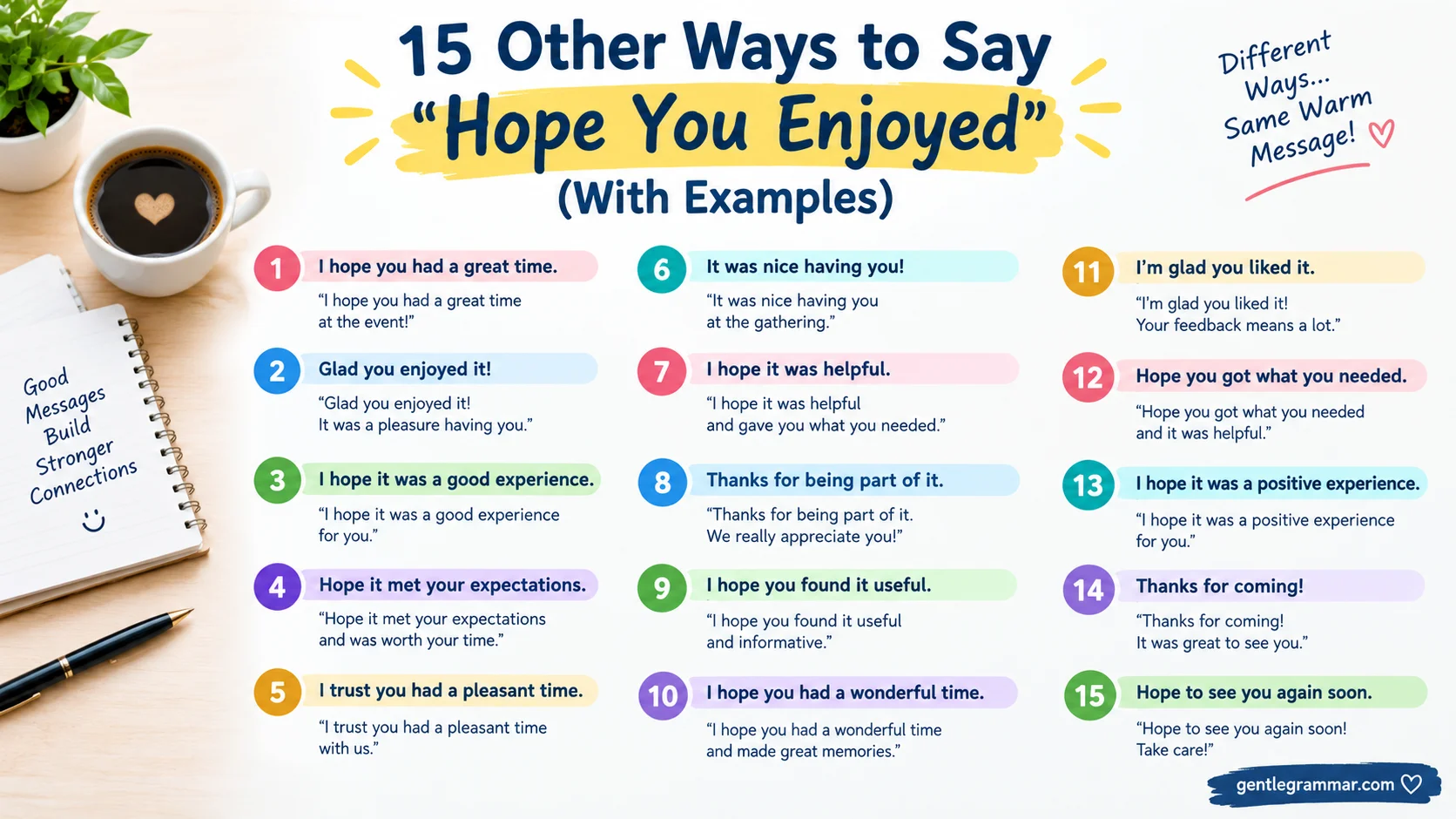
Explore Other Ways to Say “Hope You Enjoyed” to make professional and casual messages feel sincere, friendly, thoughtful, and less generic.
In different contexts, “I hope you’re doing well” is a common, polite greeting, but looking for alternatives can make your communication more personal. In this article, I share the best ways to use these expressions in emails, messages, and other communication for practical purposes. You can say you enjoyed the event after a conversation, meal, presentation, or evening, while showing gratitude and helping the recipient feel valued. Sharing a meal, joining a presentation, or creating a joyful.
Saying “It was a pleasure to have this moment together” adds a heartfelt touch that can remain formal in professional settings. From personal experience, a genuine expression works best when it matches the situation, audience, and tone. After a business meeting, training session, webinar, celebration, or social gathering, you can show care for another person’s experience by following up appropriately. These words can make communication more engaging, thoughtful, memorable, and impactful, helping strengthen relationships, encourage future communication, and demonstrate professional etiquette.
What Does “Hope You Enjoyed” Mean?
“Hope You Enjoyed” is a shortened form of “I hope you enjoyed it” or “I hope you enjoyed yourself.” It expresses a friendly wish that someone had a pleasant or satisfying experience with something that has already happened. The phrase commonly refers to an event, activity, meal, trip, show, visit, presentation, or another shared experience.
The wording is usually warm, casual, and considerate. It suggests that the speaker cares about the other person’s experience without directly demanding a response. The exact meaning depends on context: “Hope you enjoyed the dinner” focuses on the meal, while “Hope you enjoyed the concert” refers specifically to the concert.
Common Situations Where “Hope You Enjoyed” Is Used
People commonly use “Hope You Enjoyed” after an event, activity, meal, trip, performance, or experience. For example, a host might say it after a dinner, a teacher might use a similar expression after an activity, and a friend might send it after recommending a movie.
It also works well in texts, emails, social media messages, and personal communication. In professional settings, the phrase can be appropriate when the relationship is reasonably friendly, although a slightly more polished alternative may work better in formal correspondence. Choosing an alternative can also help when you want to express a more specific feeling, such as appreciation, warmth, or genuine interest in someone’s experience.
Is It Professional or Polite to Say “Hope You Enjoyed”?
Yes. “Hope You Enjoyed” is generally polite and friendly, but its level of formality depends on what follows it and who you are addressing. It sounds natural in casual conversations and friendly messages, while a complete version such as “I hope you enjoyed the presentation” can sound perfectly appropriate in many workplace situations.
For highly formal communication, you may prefer wording that is more specific and polished, such as “I hope you found the presentation useful.” The original phrase is not inherently unprofessional; it simply has a conversational quality that may not suit every formal context.
Advantages and Disadvantages of Saying “Hope You Enjoyed”
Advantages
The main advantage is its simplicity. “Hope You Enjoyed” is short, positive, and easy to understand. It communicates consideration without sounding overly serious. It also adapts easily to many situations, from a casual text after dinner to a friendly follow-up after an event.
Disadvantages
Its simplicity can sometimes make it feel generic or routine, especially when used repeatedly. It may also fail to communicate exactly what you mean if you want to ask about someone’s opinion, emphasize their experience, or show stronger appreciation. In formal situations, a more specific expression can sometimes sound more polished and purposeful.
Synonyms for “Hope You Enjoyed”
- I hope you had a great time
- I hope you enjoyed yourself
- I hope you had fun
- I hope you liked it
- I hope you had a wonderful time
- I hope you had a pleasant experience
- I hope you found it enjoyable
- I hope you had a good experience
- I hope you had a lovely time
- I hope you had a fantastic time
- I hope you enjoyed the experience
- I hope you got to enjoy yourself
- I hope you had a memorable time
- I hope it was enjoyable for you
- I hope you had a great experience
1. I hope you had a great time
Meaning
“I hope you had a great time” expresses a wish that someone really enjoyed an experience.
Definition
A friendly expression meaning that you hope someone’s recent experience was pleasant, enjoyable, and satisfying.
Detailed Explanation
This is one of the most natural alternatives to “Hope You Enjoyed.” It focuses on the person’s overall experience, rather than on a particular object or activity. It sounds warmer and more conversational than the shorter original phrase. Because it is broadly applicable, it works especially well after social events, trips, parties, and outings.
Scenario Examples
Scenario: A friend attended your birthday party.
Example: “Thanks for coming last night. I hope you had a great time!”
Scenario: A colleague attended a company event.
Example: “It was great seeing you at the reception. I hope you had a great time.”
Best Use
Best for casual conversation, friendly messages, social events, and personal communication.
Tone
Tone: Warm, friendly, conversational. It feels welcoming without being overly emotional.
2. I hope you enjoyed yourself
Meaning
“I hope you enjoyed yourself” means you hope the person felt happy and had a pleasant time.
Definition
A polite expression wishing someone a positive and enjoyable personal experience.
Detailed Explanation
This phrase places more attention on the person’s enjoyment than on the specific activity. It is particularly natural after social occasions such as dinners, parties, visits, and celebrations. Compared with “I hope you had a great time,” it can sound slightly more polished while remaining friendly.
Scenario Examples
Scenario: You hosted a dinner for several guests.
Example: “Thank you for joining us. I hope you enjoyed yourself.”
Scenario: A relative visited your home.
Example: “It was lovely having you here. I hope you enjoyed yourself.”
Best Use
Works well in personal messages, social situations, hospitality, and friendly communication.
Tone
Tone: Warm, courteous, personable. It shows consideration for the other person’s comfort and enjoyment.
3. I hope you had fun
Meaning
“I hope you had fun” expresses the wish that someone enjoyed an activity or event.
Definition
A casual expression used to say that you hope someone experienced pleasure or amusement.
Detailed Explanation
This is a particularly natural choice when the experience was lighthearted or entertaining. It is less suitable for serious events, formal presentations, or situations where “fun” would sound too informal. Compared with “Hope You Enjoyed,” it has a more relaxed and youthful feel.
Scenario Examples
Scenario: Your friend went to a music festival.
Example: “You looked like you were having a blast. I hope you had fun!”
Scenario: Your niece attended a school outing.
Example: “How was the trip? I hope you had fun.”
Best Use
Best for texting, friends, family, children, entertainment, outings, and informal conversations.
Tone
Tone: Casual, cheerful, upbeat. The word fun makes the expression especially relaxed.
4. I hope you liked it
Meaning
“I hope you liked it” means you hope someone had a positive opinion of something.
Definition
A casual expression asking or suggesting that you hope another person enjoyed or approved of something they experienced.
Detailed Explanation
Unlike “I hope you had a great time,” this expression focuses on the person’s reaction to a particular thing. It can refer to a meal, gift, movie, piece of writing, photograph, or recommendation. Because “liked” can refer to opinion rather than overall enjoyment, it is not always interchangeable with “Hope You Enjoyed.”
Scenario Examples
Scenario: You cooked dinner for a friend.
Example: “I tried a new recipe tonight. I hope you liked it.”
Scenario: You sent someone a playlist.
Example: “I added a few songs I thought you’d appreciate. I hope you liked it.”
Best Use
Best for gifts, food, creative work, recommendations, media, and personal messages.
Tone
Tone: Casual, friendly, direct. It invites a person’s reaction without making the question too formal.
5. I hope you had a wonderful time
Meaning
This phrase expresses a wish that someone experienced strong enjoyment and happiness.
Definition
A warm expression used to wish someone had an especially pleasant experience.
Detailed Explanation
“Wonderful” gives this alternative more emotional warmth than the basic “Hope You Enjoyed.” It is especially suitable when you want to sound genuinely enthusiastic about someone’s experience. It can be used for celebrations, vacations, weddings, visits, and other meaningful occasions.
Scenario Examples
Scenario: A friend traveled abroad.
Example: “Have a safe trip home! I hope you had a wonderful time in Italy.”
Scenario: Someone attended a wedding.
Example: “It looked like a beautiful celebration. I hope you had a wonderful time.”
Best Use
Ideal for special occasions, travel, celebrations, personal messages, and warm correspondence.
Tone
Tone: Warm, enthusiastic, affectionate. “Wonderful” adds stronger positive feeling.
6. I hope you had a pleasant experience
Meaning
This expression means you hope someone’s experience was comfortable, positive, and satisfactory.
Definition
A polite phrase expressing hope that someone received a good overall experience.
Detailed Explanation
This is more formal and professional than “Hope You Enjoyed.” It is useful when discussing an experience where comfort, satisfaction, or service matters. It does not necessarily imply excitement or strong emotion, making it appropriate for customer-facing communication.
Scenario Examples
Scenario: A hotel follows up with a guest.
Example: “Thank you for staying with us. We hope you had a pleasant experience.”
Scenario: A business follows up after an appointment.
Example: “Thank you for visiting our office. We hope you had a pleasant experience.”
Best Use
Best for customer service, hospitality, professional emails, formal communication, and business correspondence.
Tone
Tone: Professional, polite, respectful. It sounds more measured than casual alternatives.
7. I hope you found it enjoyable
Meaning
This means you hope the person considered an activity or experience enjoyable.
Definition
A moderately formal expression saying that you hope something provided pleasure or enjoyment.
Detailed Explanation
This wording works particularly well when referring to a specific activity, event, lesson, or presentation. It sounds more polished than “I hope you had fun” and less personal than “I hope you enjoyed yourself.” It can be useful when you want to acknowledge enjoyment without sounding overly enthusiastic.
Scenario Examples
Scenario: You organized a workshop.
Example: “Thank you for participating. I hope you found it enjoyable.”
Scenario: You recommended a documentary.
Example: “It explores the subject from an unusual angle. I hope you found it enjoyable.”
Best Use
Suitable for workshops, activities, educational settings, professional communication, and thoughtful personal messages.
Tone
Tone: Polished, neutral, considerate. It has a slightly more formal quality.
Read More:
8. I hope you had a good experience
Meaning
“I hope you had a good experience” expresses hope that something was positive and satisfactory.
Definition
A general expression wishing someone a satisfactory experience.
Detailed Explanation
This phrase is broader and more neutral than “I hope you had a wonderful time.” It works especially well when the experience may involve service, learning, travel, or an appointment rather than entertainment. It is also useful when you want to leave room for the person to mention anything that could have been better.
Scenario Examples
Scenario: A university department follows up with a student.
Example: “Thank you for attending the orientation. We hope you had a good experience.”
Scenario: A customer has completed a service appointment.
Example: “Thank you for choosing us. We hope you had a good experience.”
Best Use
Best for professional communication, customer service, education, travel, and general follow-ups.
Tone
Tone: Neutral, polite, professional. It is less emotionally expressive than “wonderful” or “fantastic.”
9. I hope you had a lovely time
Meaning
This phrase expresses hope that someone had a pleasant, enjoyable, and charming experience.
Definition
A warm expression used to wish someone an especially pleasant time.
Detailed Explanation
“Lovely” gives the phrase a gentle and affectionate quality. It is especially natural in British English, although it is also understood and used elsewhere. The expression feels more personal than “I hope you had a good experience” but less exuberant than “I hope you had a fantastic time.”
Scenario Examples
Scenario: A friend visits your town.
Example: “Thanks for stopping by. I hope you had a lovely time while you were here.”
Scenario: A family member attends a garden party.
Example: “The weather turned out beautifully. I hope you had a lovely time.”
Best Use
Works well for personal messages, visits, celebrations, social events, and warm correspondence.
Tone
Tone: Gentle, warm, gracious. “Lovely” gives it a softer emotional touch.
10. I hope you had a fantastic time
Meaning
This means you hope someone had an extremely enjoyable experience.
Definition
An enthusiastic expression wishing someone a very enjoyable and exciting time.
Detailed Explanation
“Fantastic” is stronger than “good” or “pleasant,” so this expression suits occasions that are expected to be exciting or memorable. It can sound overly enthusiastic in serious or formal contexts. Among casual alternatives, however, it conveys genuine excitement about the other person’s experience.
Scenario Examples
Scenario: Your friend went to a major concert.
Example: “You finally got to see your favorite band! I hope you had a fantastic time.”
Scenario: Someone took a weekend adventure trip.
Example: “I can’t wait to hear about it. I hope you had a fantastic time.”
Best Use
Best for friends, celebrations, concerts, vacations, adventures, and enthusiastic personal messages.
Tone
Tone: Enthusiastic, energetic, friendly. It communicates stronger excitement than the original phrase.
11. I hope you enjoyed the experience
Meaning
This phrase specifically refers to whether someone enjoyed the experience they just had.
Definition
A direct expression wishing that a particular experience was enjoyable and worthwhile.
Detailed Explanation
This alternative is useful when you want to name the experience itself rather than simply referring to “it.” That extra specificity can make a message clearer, particularly in professional or organized settings. It remains warm while sounding somewhat more deliberate than “Hope You Enjoyed.”
Scenario Examples
Scenario: You organize a museum tour.
Example: “Thank you for joining our guided tour. I hope you enjoyed the experience.”
Scenario: A guest attends a cooking class.
Example: “It was wonderful having you in the class. I hope you enjoyed the experience.”
Best Use
Suitable for events, tours, classes, workshops, professional follow-ups, and personal communication.
Tone
Tone: Friendly, polished, thoughtful. It balances warmth with specificity.
12. I hope you got to enjoy yourself
Meaning
This expression means you hope the person had an opportunity to relax and enjoy the situation.
Definition
A conversational expression wishing someone was able to have a pleasant or enjoyable time.
Detailed Explanation
The phrase “got to” adds the idea of having the opportunity to enjoy oneself. That makes it particularly useful when someone may have been busy, working, traveling, or dealing with responsibilities during an event. It feels more nuanced than simply saying that you hope they enjoyed something.
Scenario Examples
Scenario: A colleague attended a busy company retreat.
Example: “I know you had a packed schedule, but I hope you got to enjoy yourself.”
Scenario: A parent attended a family gathering while looking after children.
Example: “There was so much happening. I hope you still got to enjoy yourself.”
Best Use
Best for conversational messages, social gatherings, busy events, and situations where someone’s free time may have been limited.
Tone
Tone: Caring, conversational, understanding. It acknowledges that enjoyment is sometimes difficult when someone has other responsibilities.
13. I hope you had a memorable time
Meaning
This expression means you hope the person experienced something special enough to remember positively.
Definition
A warm phrase expressing hope that an experience was meaningful, special, or unforgettable.
Detailed Explanation
“Memorable” shifts the emphasis from simple enjoyment to lasting impact. It is especially appropriate for milestones, celebrations, trips, ceremonies, and important personal occasions. Unlike “I hope you had fun,” it can work even when the event was meaningful rather than entertaining.
Scenario Examples
Scenario: Someone attended a graduation ceremony.
Example: “Congratulations again! I hope you had a memorable time celebrating your achievement.”
Scenario: A couple went on a special vacation.
Example: “I hope you had a memorable time on your anniversary trip.”
Best Use
Best for milestones, celebrations, travel, anniversaries, graduations, and meaningful experiences.
Tone
Tone: Warm, thoughtful, sentimental. It suggests that the experience mattered beyond simple enjoyment.
14. I hope it was enjoyable for you
Meaning
This means you hope a particular activity or experience gave the person enjoyment.
Definition
A polite expression stating that you hope something was pleasant or enjoyable from the other person’s perspective.
Detailed Explanation
This wording is slightly more careful and formal than “Hope You Enjoyed.” The phrase “for you” emphasizes the individual’s perspective, which can make it sound considerate. It is useful when discussing an activity where the speaker wants to avoid assuming exactly how the other person felt.
Scenario Examples
Scenario: You arranged a professional training session.
Example: “Thank you for taking part in the session. I hope it was enjoyable for you.”
Scenario: You invited someone to a cultural event.
Example: “The performance was quite different from the usual shows. I hope it was enjoyable for you.”
Best Use
Works well in polite messages, professional communication, events, activities, and considerate follow-ups.
Tone
Tone: Polite, measured, considerate. It sounds less casual and more deliberate than “I hope you had fun.”
15. I hope you had a great experience
Meaning
This phrase expresses hope that someone’s experience was positive, satisfying, and enjoyable.
Definition
A friendly and versatile expression wishing someone a particularly positive overall experience.
Detailed Explanation
This is a useful middle ground between casual and professional language. “Great experience” can describe travel, events, services, classes, activities, or personal occasions without sounding excessively emotional. It is broader than simply asking whether someone “liked” something and often feels more purposeful than the shortened “Hope You Enjoyed.”
Scenario Examples
Scenario: A friend returns from a trip.
Example: “Welcome back! I hope you had a great experience.”
Scenario: A business follows up after a workshop.
Example: “Thank you for attending our workshop. We hope you had a great experience.”
Best Use
Suitable for professional communication, customer follow-ups, travel, events, workshops, and friendly conversations.
Tone
Tone: Positive, versatile, friendly. It can sound casual or professional depending on the surrounding message.
FAQs:
What is another way to say “Hope You Enjoyed”?
Natural alternatives include “I hope you had a great time,” “I hope you enjoyed yourself,” “I hope you had fun,” and “I hope you had a pleasant experience.” The best choice depends on whether your message is casual, professional, personal, or focused on a particular experience.
What does “Hope You Enjoyed” mean?
“Hope You Enjoyed” means “I hope you enjoyed it” or “I hope you enjoyed yourself.” It expresses a friendly wish that someone had a pleasant or satisfying experience.
Is “Hope You Enjoyed” professional?
Yes, it can be professional in the right context. However, it has a conversational and friendly quality. In formal business communication, a more specific phrase such as “I hope you had a pleasant experience” may sound more polished.
What is a more polite way to say “Hope You Enjoyed”?
“I hope you had a pleasant experience” is a more polished and formal option. “I hope you enjoyed the experience” is another good choice when you want to remain friendly while being more specific.
Which alternative works best in formal communication?
The most suitable options are generally “I hope you had a pleasant experience,” “I hope you had a good experience,” and “I hope you found it enjoyable.” Choose according to the situation and whether you are emphasizing satisfaction, enjoyment, or the specific activity.
Conclusion:
Choosing an alternative to “Hope You Enjoyed” is less about finding one perfect synonym and more about matching your wording to the situation. A casual message to a friend may sound best with “I hope you had fun,” while a customer follow-up may benefit from “I hope you had a pleasant experience.” For meaningful occasions, “I hope you had a memorable time” can communicate more emotional warmth.
The important thing is to consider tone, context, relationship, and purpose before choosing your expression. Similar phrases can carry noticeably different levels of warmth, formality, enthusiasm, and personal attention. When you choose words that fit the moment, even a short message can feel more thoughtful and natural.
