
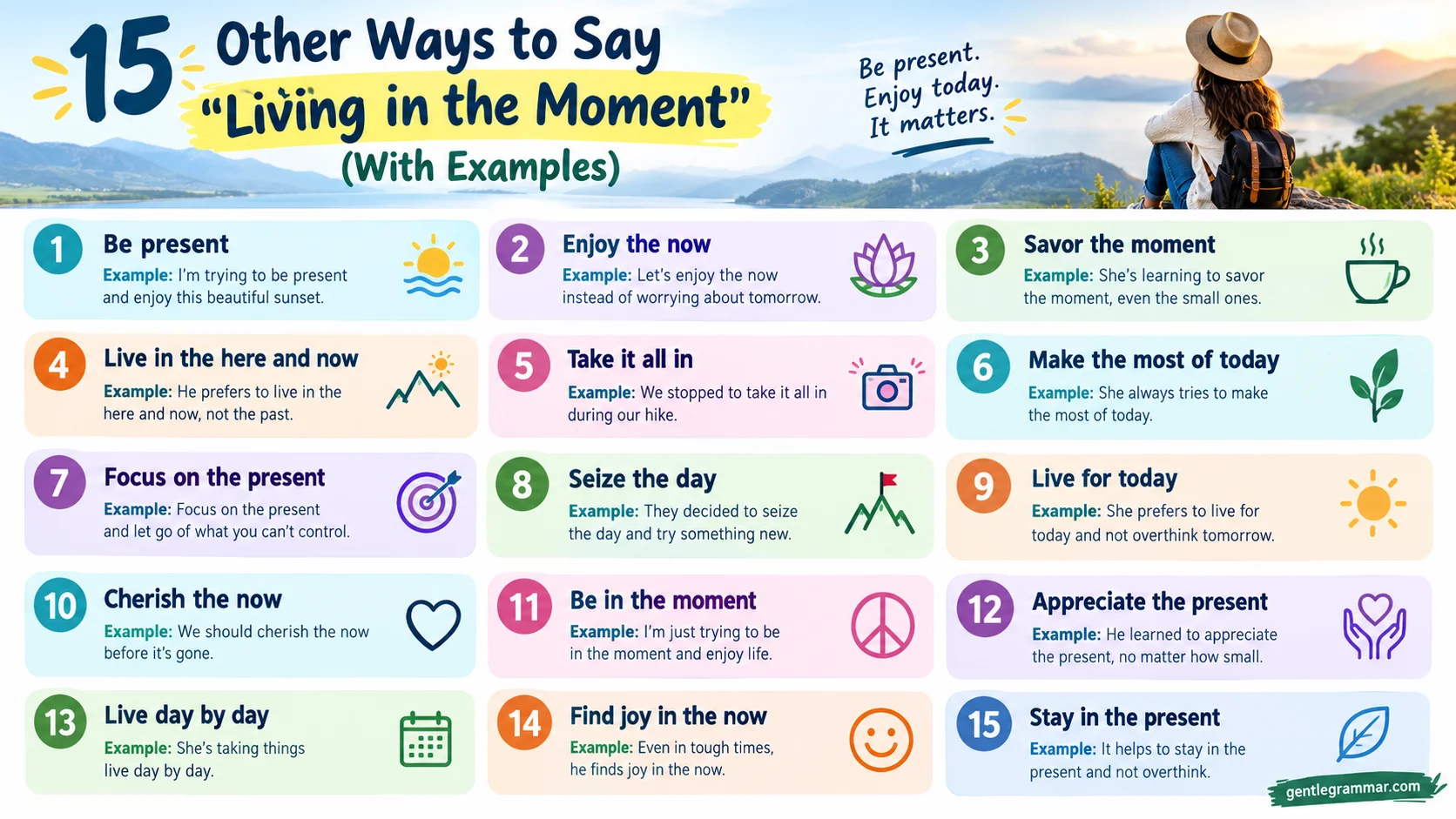
Other Ways to Say “Living in the Moment” can help express practicing mindfulness, gently returning your attention to the present, noticing small details, and reducing mental noise caused by constant distraction.
When people talk about living in the moment, they often mean slowing down to truly experience life as it happens, rather than replaying the past or worrying about the future. I find that different ways to express the idea, such as being fully present, savoring now, embracing awareness, and appreciating the current experience, make communication more natural and emotionally rich.
This can support happiness, personal growth, and enjoying everyday experiences, while giving people other ways to say the same thing with greater variety and precision. These expressions may describe feelings that are calm, thoughtful, casual, positive, or inspirational in conversations, social media posts, essays, messages, and professional writing. Another useful angle is Linger’s idea, where sensuous sensations draw out a moment and make lingering a satisfying activity.
What Does “Living in the Moment” Mean?
Living in the moment means giving your attention to what is happening right now rather than becoming consumed by past events or future possibilities. It often involves appreciating your current experience, noticing what is around you, and allowing yourself to participate fully in the present. The phrase can communicate a sense of mindfulness, appreciation, and emotional presence. It does not necessarily mean ignoring responsibilities or refusing to plan ahead; instead, it usually suggests finding a healthy balance between preparing for the future and actually experiencing the present.
In everyday English, “living in the moment” can also describe someone who chooses to enjoy an experience as it happens. For example, a person may put away their phone during dinner, enjoy a conversation without worrying about tomorrow, or appreciate a beautiful view without trying to turn the experience into something more. The exact nuance depends on context, but the central idea is being genuinely engaged with the present experience.
Common Situations Where “Living in the Moment” Is Used
“Living in the moment” is common in everyday conversation, personal communication, social media posts, and reflective writing. Someone might use it when talking about enjoying a vacation, spending time with loved ones, taking a break from stress, or appreciating a simple part of the day.
The phrase is also useful when discussing mindfulness and personal growth. A friend might encourage someone to stop worrying about what could happen and pay attention to what is happening now. On social media, the expression may appear alongside photographs of travel, nature, celebrations, family gatherings, or other meaningful experiences.
In professional or academic settings, the phrase can work when the subject is mindfulness, attention, well-being, or personal development, but a more precise expression may sometimes be preferable. Alternatives can help you adjust the wording to sound more formal, specific, reflective, or conversational.
Is It Professional or Polite to Say “Living in the Moment”?
“Living in the moment” is generally polite, positive, and natural, but it has a somewhat personal and conversational quality. It works well when discussing attitudes, experiences, relationships, mindfulness, or personal choices. For example, telling a friend to “try living in the moment” sounds supportive rather than formal.
In professional communication, the phrase can still be appropriate when the subject relates to mindfulness, work-life balance, attention, or personal development. However, expressions such as “be present” or “focus on the present” may sound more concise and professional. The best wording depends on your audience, purpose, and relationship with the reader.
Advantages and Disadvantages of Saying “Living in the Moment”
Advantages
One advantage of “living in the moment” is that it communicates the idea of present-focused attention in a familiar and easy-to-understand way. It has a warm, positive quality and can work naturally in conversations about happiness, relationships, travel, relaxation, and personal growth. The phrase also carries a useful emotional nuance: it suggests not only noticing the present but experiencing it fully.
Disadvantages
The phrase can sometimes sound broad or somewhat inspirational, especially in formal writing. It may also be interpreted differently depending on context. Some readers could understand it as simply enjoying the present, while others might interpret it as avoiding long-term planning. When you need greater precision, an alternative such as “be present,” “focus on the here and now,” or “appreciate the present” may communicate your intended meaning more clearly.
Synonyms for “Living in the Moment”
- Be Present
- Live in the Present
- Stay Present
- Enjoy the Present
- Embrace the Present Moment
- Focus on the Here and Now
- Savor the Moment
- Make the Most of the Moment
- Take Life as It Comes
- Be Mindful of the Present
- Appreciate the Present
- Live in the Now
- Stay in the Moment
- Focus on What Is Happening Now
- Be Fully Present
1. Be Present
Meaning
Be present means giving your attention to what is happening right now instead of becoming distracted by other thoughts or concerns. It is one of the simplest and most flexible alternatives to “living in the moment.”
Definition
Be present means to give your full attention to the current experience, person, or situation.
Detailed Explanation
This expression focuses strongly on attention and awareness rather than simply enjoying life. It can suggest listening carefully, noticing your surroundings, or staying emotionally engaged with an experience. Compared with “living in the moment,” it sounds shorter and more direct. It is particularly useful when encouraging someone to concentrate on what is happening instead of worrying about what comes next.
Scenario Examples
Scenario: A friend is distracted during a special dinner.
Example: “Put your phone away for a while and just be present with everyone.”
Scenario: A teacher encourages students to concentrate during an activity.
Example: “Try to be present and focus on what you are learning today.”
Scenario: Someone is worrying about an upcoming event.
Example: “You have prepared enough. Take a breath and be present.”
Best Use
Best for everyday conversation, personal advice, mindfulness discussions, professional development, and supportive messages.
Tone
Tone: Calm, direct, supportive.
The expression is concise and encouraging without sounding overly emotional.
2. Live in the Present
Meaning
Live in the present means focusing your attention and energy on your current life rather than becoming trapped in the past or constantly anticipating the future.
Definition
Live in the present means to experience and appreciate your current circumstances instead of allowing past or future concerns to dominate your thoughts.
Detailed Explanation
This phrase is very close in meaning to “living in the moment,” but it can sound slightly broader. It describes an attitude toward life, rather than one particular moment or activity. Someone who lives in the present may still make plans while choosing not to let future worries control their daily experience. It is a natural choice for reflective or motivational writing.
Scenario Examples
Scenario: A friend keeps thinking about an old mistake.
Example: “You learned from what happened. Now try to live in the present.”
Scenario: Someone is enjoying a weekend without thinking about Monday.
Example: “I decided to live in the present and enjoy the weekend.”
Best Use
Best for personal conversations, reflective writing, social media captions, motivational messages, and discussions about personal growth.
Tone
Tone: Reflective, encouraging, thoughtful.
It sounds like a broader life philosophy rather than a quick instruction.
3. Stay Present
Meaning
Stay present means keeping your attention on the current activity, conversation, or experience instead of allowing your mind to wander elsewhere.
Definition
Stay present means maintaining awareness of what is happening now.
Detailed Explanation
“Stay present” is especially useful when someone is distracted, anxious, or mentally preoccupied. It can sound more practical than “living in the moment” because it directly encourages continued attention. The phrase works in both personal and professional settings. It is also common in conversations about concentration and mindfulness.
Scenario Examples
Scenario: A speaker is nervous before a presentation.
Example: “Take a breath, stay present, and focus on one point at a time.”
Scenario: A parent wants to enjoy time with their child.
Example: “I’m trying to stay present instead of thinking about everything I have to do later.”
Best Use
Best for mindfulness, personal conversations, coaching, work, study, and situations involving distraction or stress.
Tone
Tone: Calm, practical, reassuring.
It sounds like a gentle reminder to maintain attention.
4. Enjoy the Present
Meaning
Enjoy the present emphasizes appreciating the experiences and opportunities available right now.
Definition
Enjoy the present means finding pleasure or appreciation in your current circumstances instead of constantly waiting for something else.
Detailed Explanation
This alternative places more emphasis on enjoyment than “be present” does. It is useful when the speaker wants to encourage someone to appreciate a pleasant experience instead of rushing toward the next goal. It does not necessarily imply mindfulness in a strict sense. The expression can therefore sound warm and optimistic.
Scenario Examples
Scenario: Friends are on a long-awaited vacation.
Example: “We worked hard for this trip, so let’s enjoy the present.”
Scenario: A parent is watching their child grow up.
Example: “They grow so quickly. I’m trying to enjoy the present instead of worrying about the future.”
Best Use
Best for family conversations, relationships, vacations, celebrations, personal messages, and reflective writing.
Tone
Tone: Warm, positive, appreciative.
It encourages pleasure and gratitude without sounding overly formal.
5. Embrace the Present Moment
Meaning
Embrace the present moment means accepting and fully experiencing what is happening now, including ordinary or imperfect experiences.
Definition
Embrace the present moment means to willingly accept and appreciate the current experience rather than resisting it or wishing it were different.
Detailed Explanation
The word embrace adds an element of acceptance that is not always present in “living in the moment.” This expression can suggest appreciating life as it currently is, even when circumstances are not perfect. It has a more thoughtful and expressive quality than the simpler alternatives. It is particularly effective in reflective or inspirational writing.
Scenario Examples
Scenario: Someone is worried because life has not gone according to plan.
Example: “I’m learning to embrace the present moment instead of waiting for everything to be perfect.”
Scenario: Someone is enjoying a quiet morning.
Example: “There is nowhere else I need to be. I’m simply embracing the present moment.”
Best Use
Best for personal writing, reflective conversations, social media, mindfulness discussions, and inspirational messages.
Tone
Tone: Thoughtful, warm, reflective.
“Embrace” gives the expression a deeper sense of acceptance and openness.
6. Focus on the Here and Now
Meaning
Focus on the here and now means directing your attention toward your current circumstances rather than becoming absorbed in the past or future.
Definition
Focus on the here and now means concentrating on what is happening in the present.
Detailed Explanation
This expression is more direct and practical than “living in the moment.” The words “here and now” clearly identify the present as the place where attention should remain. It can be useful when someone is overthinking, worrying, or becoming distracted. Unlike “enjoy the present,” it does not necessarily suggest that the current situation must be pleasant.
Scenario Examples
Scenario: A student is nervous about an upcoming exam.
Example: “You can prepare for tomorrow, but for now, focus on the here and now.”
Scenario: Someone is repeatedly discussing an old disagreement.
Example: “We cannot change yesterday, so let’s focus on the here and now.”
Best Use
Best for personal advice, counseling-style conversations, study situations, work discussions, and reflective writing.
Tone
Tone: Direct, calm, practical.
It clearly redirects attention without sounding harsh.
7. Savor the Moment
Meaning
Savor the moment means slowing down enough to fully appreciate and enjoy a special experience.
Definition
Savor the moment means to enjoy a meaningful or pleasant experience deeply rather than rushing through it.
Detailed Explanation
“Savor” has a stronger connection with enjoyment and appreciation than “living in the moment.” It is especially natural when describing memorable experiences, celebrations, achievements, or meaningful time with other people. The phrase suggests taking time to absorb the experience emotionally. It is less suitable when the focus is simply on attention or concentration.
Scenario Examples
Scenario: Someone has just reached an important personal milestone.
Example: “You worked for years to reach this point, so savor the moment.”
Scenario: A family is watching a beautiful sunset.
Example: “Let’s sit here for a few more minutes and savor the moment.”
Best Use
Best for celebrations, relationships, achievements, travel, special occasions, and emotional messages.
Tone
Tone: Warm, emotional, appreciative.
The word “savor” gives the expression a sense of depth and enjoyment.
8. Make the Most of the Moment
Meaning
Make the most of the moment means using or enjoying the current opportunity as fully as possible.
Definition
Make the most of the moment means getting the greatest value, enjoyment, or meaning from the present situation.
Detailed Explanation
This phrase adds an element of action and opportunity to the idea of living in the moment. Rather than simply noticing the present, it encourages someone to use the opportunity in front of them. It can refer to fun, meaningful experiences, or limited opportunities. The phrase is therefore somewhat more active than “be present.”
Scenario Examples
Scenario: Friends have only one evening together before someone moves away.
Example: “We may not get another chance like this, so let’s make the most of the moment.”
Scenario: A student receives an unexpected opportunity to speak at an event.
Example: “You prepared for this. Go out there and make the most of the moment.”
Best Use
Best for social situations, opportunities, celebrations, encouragement, personal messages, and informal professional communication.
Tone
Tone: Encouraging, energetic, positive.
It encourages active participation rather than passive observation.
9. Take Life as It Comes
Meaning
Take life as it comes means dealing with events as they happen instead of constantly trying to predict or control everything.
Definition
Take life as it comes means accepting and responding to circumstances one step at a time.
Detailed Explanation
This expression is related to living in the moment but has a different emphasis. It focuses more on acceptance and flexibility than on present-moment awareness. It can suggest being comfortable with uncertainty and handling situations as they develop. It should not be treated as an exact synonym because someone can live in the moment while still carefully planning for the future.
Scenario Examples
Scenario: A friend is anxious about an uncertain career path.
Example: “I don’t know exactly what will happen, so I’m trying to take life as it comes.”
Scenario: Someone is making spontaneous weekend plans.
Example: “We have no fixed schedule this weekend. We’ll just take life as it comes.”
Best Use
Best for casual conversation, personal advice, relationships, travel, and discussions about uncertainty.
Tone
Tone: Relaxed, accepting, casual.
It communicates flexibility rather than strict present-moment concentration.
10. Be Mindful of the Present
Meaning
Be mindful of the present means consciously paying attention to current thoughts, feelings, surroundings, and experiences.
Definition
Be mindful of the present means intentionally noticing and attending to what is happening now.
Detailed Explanation
This phrase has a stronger connection to mindfulness and awareness than the general expression “living in the moment.” It encourages deliberate attention rather than simply enjoying whatever happens. It can work particularly well when discussing emotional awareness or focused attention. The wording also has a somewhat more formal and thoughtful quality.
Scenario Examples
Scenario: Someone is becoming overwhelmed by future worries.
Example: “Try to be mindful of the present instead of imagining every possible outcome.”
Scenario: A person is taking a quiet walk.
Example: “During the walk, I tried to be mindful of the present and notice the sounds around me.”
Best Use
Best for mindfulness discussions, reflective writing, personal development, wellness-related communication, and thoughtful conversations.
Tone
Tone: Calm, thoughtful, mindful.
The expression sounds deliberate and reflective rather than casual.
11. Appreciate the Present
Meaning
Appreciate the present means recognizing the value or beauty of your current circumstances instead of taking them for granted.
Definition
Appreciate the present means noticing and valuing what you currently have or experience.
Detailed Explanation
This expression emphasizes gratitude and recognition more strongly than “living in the moment.” It is useful when someone wants to remind themselves that ordinary moments can have value. The phrase does not necessarily mean ignoring future plans; instead, it encourages people to recognize what is already meaningful. It works especially well in reflective and personal contexts.
Scenario Examples
Scenario: Someone realizes they have been too busy to enjoy family time.
Example: “I’m trying to appreciate the present instead of always thinking about the next task.”
Scenario: A person is grateful for a quiet evening at home.
Example: “Sometimes the simple evenings are the ones we should appreciate the present for.”
Best Use
Best for personal writing, family conversations, gratitude messages, relationships, and reflective social media posts.
Tone
Tone: Grateful, gentle, reflective.
The wording highlights appreciation rather than excitement.
12. Live in the Now
Meaning
Live in the now means concentrating on current life and experiences rather than dwelling on what has already happened or worrying excessively about what has not happened yet.
Definition
Live in the now means to focus on and experience the present time.
Detailed Explanation
This phrase is a concise, slightly more informal and expressive alternative to “living in the moment.” “The now” gives the expression a modern, conversational feel. It can sound motivational without being overly formal. However, it is more suitable for personal and casual contexts than highly formal writing.
Scenario Examples
Scenario: A friend keeps worrying about an uncertain future.
Example: “Nobody knows exactly what tomorrow will bring, so try to live in the now.”
Scenario: Someone is enjoying a night out with friends.
Example: “No work talk tonight. We’re going to live in the now.”
Best Use
Best for casual conversation, texting, social media, friendships, relationships, and motivational messages.
Tone
Tone: Casual, optimistic, encouraging.
Its simple wording makes it feel natural in everyday speech.
13. Stay in the Moment
Meaning
Stay in the moment means continuing to focus on the current experience instead of becoming distracted by other thoughts.
Definition
Stay in the moment means maintaining attention on what is happening right now.
Detailed Explanation
“Stay in the moment” is especially useful when someone is losing focus during an experience. It can be used as a gentle reminder during conversations, performances, activities, or emotionally important situations. Compared with “live in the moment,” it sounds more immediate and situational. It is therefore often something you say to yourself or another person during a particular experience.
Scenario Examples
Scenario: Someone is nervous during an important conversation.
Example: “Take a breath and stay in the moment. You don’t have to solve everything at once.”
Scenario: An athlete becomes distracted during a competition.
Example: “Forget the last play and stay in the moment.”
Best Use
Best for sports, conversations, stressful situations, performances, personal encouragement, and mindfulness.
Tone
Tone: Supportive, focused, reassuring.
It sounds like a practical reminder to maintain attention.
14. Focus on What Is Happening Now
Meaning
Focus on what is happening now means paying attention to current events or circumstances instead of getting caught up in past or future concerns.
Definition
Focus on what is happening now means directing your attention toward the present situation.
Detailed Explanation
This is one of the most explicit and clear alternatives. It leaves little ambiguity about what the speaker means and can be useful when precision matters. Unlike “savor the moment,” it does not imply that the current experience is enjoyable. It simply asks someone to pay attention to the present circumstances.
Scenario Examples
Scenario: A team is discussing an issue during a meeting.
Example: “Let’s focus on what is happening now before we start discussing next month.”
Scenario: A friend is worrying about several possible future problems.
Example: “You can deal with those questions later. For now, focus on what is happening now.”
Best Use
Best for workplace communication, problem-solving, everyday advice, study, and situations where clarity is important.
Tone
Tone: Direct, practical, neutral.
Its straightforward wording makes it useful when a clear instruction is needed.
15. Be Fully Present
Meaning
Be fully present means giving your complete attention to the person, activity, or experience in front of you.
Definition
Be fully present means being mentally and emotionally engaged with the current situation without unnecessary distraction.
Detailed Explanation
This expression goes beyond simply being physically present. It suggests mental attention, emotional engagement, and active participation. It can be particularly meaningful in relationships, conversations, teaching, leadership, and other situations where attention matters. Compared with “living in the moment,” it places more emphasis on the quality of your attention.
Scenario Examples
Scenario: A parent wants to give their child their full attention.
Example: “For the next hour, I’m going to be fully present with my family.”
Scenario: A manager is having an important conversation with an employee.
Example: “Good communication starts with taking the time to be fully present.”
Scenario: Someone is enjoying a special occasion.
Example: “I put my phone away so I could be fully present for the celebration.”
Best Use
Best for relationships, professional communication, leadership, teaching, meaningful conversations, and personal reflection.
Tone
Tone: Warm, attentive, respectful.
The word “fully” emphasizes complete engagement and makes the expression feel intentional.
FAQs:
What is another way to say “Living in the Moment”?
Natural alternatives include “be present,” “live in the present,” “stay present,” “enjoy the present,” and “focus on the here and now.” The best choice depends on whether you want to emphasize attention, enjoyment, mindfulness, or acceptance.
What does “Living in the Moment” mean?
“Living in the moment” means focusing on and experiencing the present instead of becoming overly concerned with the past or future. It often suggests being aware, appreciative, and emotionally engaged with what is happening now.
Is “Living in the Moment” professional?
Yes, it can be professional when the subject involves mindfulness, attention, personal development, or work-life balance. However, in more formal communication, expressions such as “be present” or “focus on the present” may sound more concise.
What is a more polite way to say “Living in the Moment”?
There is no single more polite version because “living in the moment” is already generally positive and polite. For a softer or more thoughtful tone, “embrace the present moment” or “appreciate the present” can work well.
Which alternative works best in formal communication?
For formal communication, “be present,” “focus on the here and now,” or “focus on what is happening now” can be useful depending on the context. Choose the expression that most precisely communicates whether you mean attention, awareness, or immediate circumstances.
Conclusion:
Choosing different wording can help you express the idea of living in the moment with greater precision. Some alternatives emphasize attention, such as “be present” and “stay present,” while others highlight enjoyment, such as “savor the moment” and “enjoy the present.” Expressions like “take life as it comes” focus more on acceptance, while “be fully present” emphasizes complete attention and engagement.
The right choice depends on your relationship with the reader, the situation, and the feeling you want to communicate. Similar expressions are not always exact synonyms, so paying attention to tone, context, formality, and emotional meaning can make your wording sound much more natural. When in doubt, choose the phrase that best matches what you genuinely want to express.
