
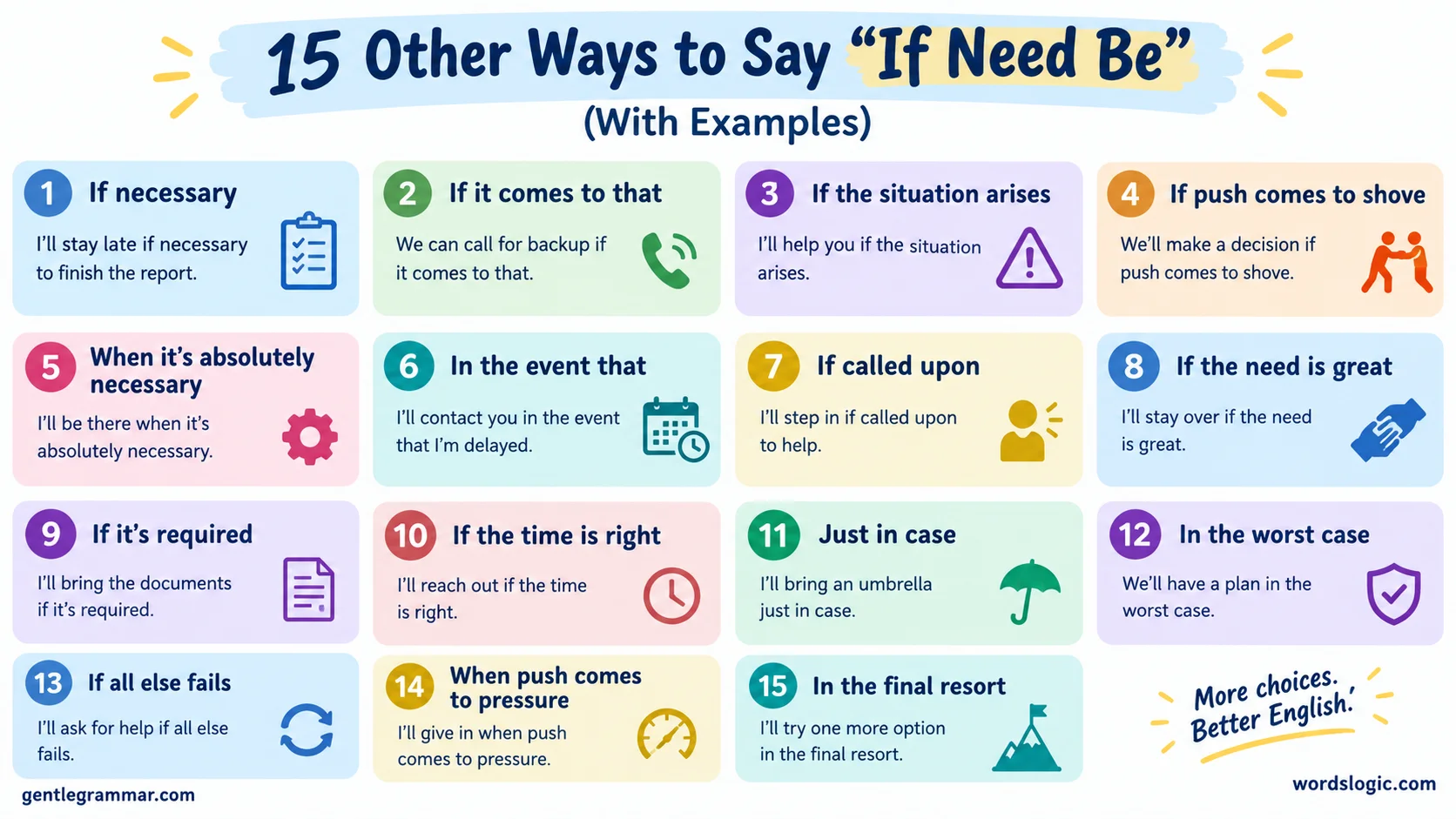
This guide, 15 Other Ways to Say “If Need Be” (With Examples), explores clear alternatives for everyday and professional conversations and messages.
Good effective communication starts with choosing the right words for a particular situation. The expression “If need be” is perfectly correct and useful when an action or condition is not always required but can be performed when circumstances demand it. This practical way of speaking keeps things open, offering flexibility and helping you respond responsibly when something becomes necessary.
For example, you might be willing to call someone, stay at home, or leave a plan unchanged without worrying about a possible cause of harm. However, the expression can sound formal, old-fashioned, or too direct, depending on the intended meaning. Choosing the right alternative makes your message sound more natural, polite, and conversational.
What Does “If Need Be” Mean?
“If need be” means if it becomes necessary or if a particular situation requires something to happen. People use this expression when they are willing to take an additional step, make a change, or do something extra if circumstances demand it. It suggests that an action is possible but not necessarily required at the moment. For example, someone might say, “I can stay late if need be,” meaning they are willing to remain at work if the situation requires extra time. The phrase communicates flexibility, readiness, and willingness without suggesting that the action will definitely happen.
Common Situations Where “If Need Be” Is Used
People commonly use “if need be” when discussing plans, responsibilities, and possible changes. In everyday conversations, someone might use it to show they are willing to help a friend or adjust their schedule. At work, it can communicate flexibility when discussing deadlines, additional tasks, or unexpected responsibilities. It also appears in emails, formal discussions, and written communication when someone wants to leave room for a necessary action.
For example, a colleague might say, “I can prepare another presentation if need be.” This tells the team that an additional presentation is possible if circumstances require it. The phrase is also useful in personal arrangements when plans might change. People sometimes choose alternatives because they want their message to sound more direct, conversational, or specific.
Is It Professional or Polite to Say “If Need Be”?
Yes, “if need be” is generally polite and professional. It communicates willingness without sounding demanding or overly casual. You can use it in workplace conversations, business emails, and discussions about responsibilities. Its slightly formal quality makes it suitable for situations where you want to express flexibility respectfully.
However, it can sound somewhat old-fashioned or less conversational than simpler expressions such as “if necessary” or “if required.” In professional writing, “if necessary” is often a clearer choice, while “if needed” feels more relaxed. The best wording depends on your audience and the message you want to communicate.
Advantages and Disadvantages of Saying “If Need Be”
Advantages
One advantage of “if need be” is that it communicates readiness and flexibility without making an unnecessary commitment. You show that you’re willing to take action if circumstances change. It also works in professional and personal conversations, making it a versatile expression. Its polite tone allows you to offer additional support without putting pressure on someone.
Disadvantages
The phrase can sound slightly formal or old-fashioned in casual conversations. Some readers may find simpler expressions easier to understand, especially in everyday messages. It can also be vague when the speaker doesn’t explain what action might become necessary. In situations that require clear instructions, a more specific expression may communicate the intended meaning better.
Synonyms for “If Need Be”
- If necessary
- If needed
- If required
- Should the need arise
- If the situation calls for it
- As needed
- When necessary
- If circumstances demand it
- In case of need
- If it comes to that
- If it becomes necessary
- As circumstances require
- If the occasion arises
- Whenever necessary
- If the need arises
1. If Necessary
Meaning
“If necessary” means doing something only when a particular situation makes it essential. It communicates the same basic idea as “if need be” but sounds more direct and straightforward.
Definition
A phrase meaning only when something becomes necessary or essential.
Detailed Explanation
This is one of the closest alternatives because it preserves the original meaning without changing the intended message. It sounds clear and professional in most situations. Unlike the slightly traditional expression “if need be,” this wording feels more modern and familiar. Choose it when you want your message to be understood immediately.
Scenario Examples
Scenario 1: A manager discusses additional arrangements for an upcoming project.
Example: We can arrange another meeting if necessary.
Scenario 2: A student offers to make changes to an assignment.
Example: I’ll revise the introduction if necessary.
Best Use
Use this expression in professional emails, formal discussions, academic writing, and everyday communication. It is especially useful when clarity matters.
Tone
Tone: Professional, neutral, direct.
It communicates flexibility without sounding overly casual or emotional.
2. If Needed
Meaning
“If needed” means something will be done when a person or situation requires it. It is a simple, conversational alternative to the original phrase.
Definition
A phrase meaning when something is required or becomes useful.
Detailed Explanation
This expression sounds more relaxed than “if necessary.” It works well when offering help, additional resources, or support without making the action compulsory. It can also suggest that something is available as a backup option. Its everyday wording makes it particularly suitable for friendly and workplace conversations.
Scenario Examples
Scenario 1: A colleague offers additional help with a presentation.
Example: I can help you with the slides if needed.
Scenario 2: Someone shares contact information with a friend.
Example: Here’s my number if you need it.
Best Use
Use it in text messages, emails, team discussions, and everyday conversations when you want to sound approachable.
Tone
Tone: Friendly, casual, helpful.
The wording feels natural and makes an offer sound comfortable rather than formal.
3. If Required
Meaning
“If required” means something will happen when a rule, situation, or particular need makes it necessary. It places slightly more emphasis on requirements than personal willingness.
Definition
A phrase meaning when something is officially or practically necessary.
Detailed Explanation
This expression is particularly useful when discussing responsibilities, procedures, and formal arrangements. It can sound more official than “if need be” because the word required suggests an established need or condition. For example, an employee might offer additional documents if a department requests them. It is less personal than “if needed” but useful when communicating specific obligations.
Scenario Examples
Scenario 1: An employee discusses paperwork with a supervisor.
Example: I can provide the supporting documents if required.
Scenario 2: A company explains its application process.
Example: Additional information will be requested if required.
Best Use
Use it in business correspondence, official instructions, applications, reports, and formal writing.
Tone
Tone: Formal, professional, precise.
It suits situations where requirements and procedures are more important than personal preference.
4. Should the Need Arise
Meaning
“Should the need arise” means if a particular need appears or develops in the future. It communicates readiness for a possible situation.
Definition
A formal expression meaning if a situation makes something necessary in the future.
Detailed Explanation
This phrase is a more formal alternative to “if need be.” It often appears in business correspondence, official communication, and carefully worded statements. The word should introduces a possible future condition rather than describing something that is already happening. It sounds polished but may feel unnecessarily formal in a casual text message.
Scenario Examples
Scenario 1: A business partner discusses future assistance.
Example: We can arrange additional support should the need arise.
Scenario 2: An employee explains their availability.
Example: I am happy to assist with the transition should the need arise.
Best Use
Use it in formal emails, business proposals, professional discussions, and official correspondence.
Tone
Tone: Formal, courteous, composed.
Its careful wording communicates preparedness while maintaining professional distance.
5. If the Situation Calls for It
Meaning
“If the situation calls for it” means doing something when the circumstances make that action appropriate or necessary.
Definition
An expression meaning when particular circumstances make an action suitable.
Detailed Explanation
This phrase focuses on the situation rather than simply whether something is needed. It is useful when the decision depends on circumstances, judgment, or changing conditions. Compared with “if need be,” it can communicate a little more thought and consideration. However, something that a situation calls for may be appropriate rather than strictly essential.
Scenario Examples
Scenario 1: A teacher discusses adjusting a lesson.
Example: We can extend the class if the situation calls for it.
Scenario 2: A friend discusses changing travel plans.
Example: We can book another hotel if the situation calls for it.
Best Use
Use it in planning discussions, workplace conversations, personal arrangements, and situations involving judgment.
Tone
Tone: Thoughtful, flexible, conversational.
It sounds natural when you want to leave room for a decision based on circumstances.
6. As Needed
Meaning
“As needed” means something should happen whenever a particular need exists. It can describe repeated actions rather than just one possible future action.
Definition
A phrase meaning according to the amount or frequency of need.
Detailed Explanation
This expression is slightly different from “if need be” because it often describes an ongoing arrangement. For example, a manager may ask employees to provide updates as needed throughout a project. It suggests that the action can happen whenever circumstances require it. The wording is concise and particularly useful in instructions.
Scenario Examples
Scenario 1: A manager explains how often employees should communicate.
Example: Please update the shared document as needed.
Scenario 2: A customer receives instructions about technical assistance.
Example: Contact our support team as needed.
Best Use
Use it in workplace instructions, policies, schedules, customer communication, and practical guidance.
Tone
Tone: Neutral, professional, practical.
It is effective when explaining an ongoing arrangement without specifying an exact schedule.
7. When Necessary
Meaning
“When necessary” means at the time something becomes essential. It emphasizes the timing of an action rather than simply its possibility.
Definition
An expression meaning at the point when a situation requires something.
Detailed Explanation
This phrase is useful when an action should take place only at the appropriate time. It shares the conditional meaning of the original expression but can sound more instructional. For instance, a team might make changes when necessary instead of changing everything in advance. It works particularly well when discussing procedures or decisions that depend on future circumstances.
Scenario Examples
Scenario 1: A supervisor explains how to handle project changes.
Example: We will adjust the schedule when necessary.
Scenario 2: A teacher discusses student support.
Example: Additional guidance will be provided when necessary.
Best Use
Use it in formal writing, workplace instructions, academic discussions, and procedural communication.
Tone
Tone: Neutral, measured, professional.
It sounds organized and practical without adding unnecessary emotion.
8. If Circumstances Demand It
Meaning
“If circumstances demand it” means taking action when the situation makes that action unavoidable or strongly necessary.
Definition
A phrase meaning when particular conditions make an action necessary.
Detailed Explanation
This expression is stronger than “if need be” because the word demand suggests considerable pressure or necessity. It is appropriate when discussing serious decisions, difficult conditions, or unexpected challenges. It does not simply suggest that an action might be convenient. Instead, it communicates that circumstances may leave little room for another choice.
Scenario Examples
Scenario 1: A company discusses emergency arrangements.
Example: We may need to relocate the equipment if circumstances demand it.
Scenario 2: A family discusses an unexpected situation.
Example: We’ll change our plans if circumstances demand it.
Best Use
Use it in serious discussions, formal reports, contingency planning, and conversations about difficult situations.
Tone
Tone: Serious, determined, formal.
The stronger wording makes it suitable when the circumstances involve significant pressure.
9. In Case of Need
Meaning
“In case of need” refers to a situation in which something may become necessary. It is generally used when preparing for a possible requirement.
Definition
An expression meaning for a situation in which help or action may be necessary.
Detailed Explanation
This phrase emphasizes preparation and availability rather than an immediate decision to act. It can work when arranging resources, keeping information available, or preparing for unexpected situations. However, it is less conversational than “if needed” and may sound slightly traditional. In many modern sentences, “in case it’s needed” or “if necessary” will sound more natural.
Scenario Examples
Scenario 1: A traveler shares emergency contact details.
Example: Keep this number with you in case of need.
Scenario 2: A school prepares additional learning materials.
Example: We have printed extra worksheets in case of need.
Best Use
Use it in preparedness instructions, formal notices, and situations involving backup arrangements. For casual conversation, consider a simpler expression.
Tone
Tone: Cautious, practical, slightly formal.
It communicates preparation for a possible need rather than a definite action.
10. If It Comes to That
Meaning
“If it comes to that” means if circumstances eventually reach a point where a particular action becomes necessary.
Definition
A conversational expression meaning if a situation develops to the point that something must happen.
Detailed Explanation
This expression is more informal than “if need be.” It often suggests that someone hopes a particular action will not become necessary but is prepared to consider it. The wording can also carry a sense of concern or reluctance, depending on the conversation. It is therefore not a perfect replacement in every professional or neutral situation.
Scenario Examples
Scenario 1: Two friends discuss alternative travel arrangements.
Example: We can take the train if it comes to that.
Scenario 2: A colleague discusses a difficult deadline.
Example: I’ll work over the weekend if it comes to that.
Best Use
Use it in casual conversations, personal discussions, and situations involving backup plans.
Tone
Tone: Informal, practical, slightly reluctant.
It often suggests that the speaker would prefer another solution first.
11. If It Becomes Necessary
Meaning
“If it becomes necessary” means if something changes and an action is eventually required.
Definition
A phrase meaning if future circumstances make an action essential.
Detailed Explanation
This expression is useful when the need does not exist yet but could develop later. It makes the conditional nature of the statement especially clear. Compared with “if need be,” it is slightly longer but often easier for English learners to understand. It also works well when discussing future decisions that depend on how a situation develops.
Scenario Examples
Scenario 1: A project manager discusses possible changes.
Example: We can extend the deadline if it becomes necessary.
Scenario 2: A student explains their backup study plan.
Example: I’ll ask for extra tutoring if it becomes necessary.
Best Use
Use it in professional discussions, academic communication, future planning, and everyday conversations.
Tone
Tone: Clear, neutral, considerate.
It explains a possible future requirement without sounding demanding.
12. As Circumstances Require
Meaning
“As circumstances require” means taking action according to what the situation demands.
Definition
A formal expression meaning in response to the needs of a particular situation.
Detailed Explanation
This phrase is useful when actions depend on changing conditions rather than a fixed plan. It sounds more formal and structured than the original expression. It is particularly appropriate for policies, professional arrangements, and written instructions. Unlike “if need be,” it can describe actions that happen repeatedly as circumstances change.
Scenario Examples
Scenario 1: A company explains how it will manage its resources.
Example: Additional staff will be assigned as circumstances require.
Scenario 2: A project team discusses changing responsibilities.
Example: We will redistribute the workload as circumstances require.
Best Use
Use it in formal documents, organizational communication, policies, and professional planning.
Tone
Tone: Formal, authoritative, measured.
It communicates adaptability while maintaining a structured and professional style.
13. If the Occasion Arises
Meaning
“If the occasion arises” means if a particular opportunity or situation presents itself.
Definition
An expression meaning if a suitable opportunity or situation occurs.
Detailed Explanation
This phrase is related to “if need be,” but it does not always communicate necessity. It often refers to an opportunity or event that might happen in the future. For example, someone might offer to introduce two people if the occasion arises. That means the introduction can happen if an appropriate opportunity appears. Choose it when the context involves a possible occasion rather than a strict requirement.
Scenario Examples
Scenario 1: A friend offers to introduce someone to a colleague.
Example: I’ll introduce you to my manager if the occasion arises.
Scenario 2: Two business contacts discuss a possible partnership.
Example: We can discuss future collaboration if the occasion arises.
Best Use
Use it in social conversations, networking, professional relationships, and discussions about future opportunities.
Tone
Tone: Polite, reserved, slightly formal.
It sounds considerate because it leaves the timing and circumstances open.
14. Whenever Necessary
Meaning
“Whenever necessary” means every time a situation makes something essential. It can communicate repeated readiness to take action.
Definition
A phrase meaning at any time that a particular need arises.
Detailed Explanation
This expression is useful when someone is willing to respond to changing needs more than once. It is slightly different from “if need be,” which can refer to one possible action. The word whenever places greater emphasis on repeated occasions. It works well when discussing ongoing support, regular adjustments, or responsibilities that may arise at different times.
Scenario Examples
Scenario 1: A supervisor explains the availability of assistance.
Example: You can contact me whenever necessary.
Scenario 2: A teacher explains how students can request extra help.
Example: We can arrange additional sessions whenever necessary.
Best Use
Use it in ongoing work arrangements, educational settings, support services, and personal commitments.
Tone
Tone: Reassuring, helpful, professional.
It suggests continued availability rather than a one-time offer.
15. If the Need Arises
Meaning
“If the need arises” means if a particular requirement or situation develops in the future.
Definition
An expression meaning if something becomes necessary at a later time.
Detailed Explanation
This phrase is a close alternative to “if need be” and works particularly well when discussing future possibilities. It suggests that no immediate action is required but that someone is prepared to respond if circumstances change. It sounds slightly more formal than “if needed” while remaining clear and natural. It is a useful choice when you want to communicate preparedness without making a definite commitment.
Scenario Examples
Scenario 1: A manager discusses possible additional staffing.
Example: We can bring in another team member if the need arises.
Scenario 2: A friend offers support during a busy period.
Example: Just let me know if the need arises, and I’ll be happy to help.
Best Use
Use it in professional emails, future planning, personal offers, and discussions about possible requirements.
Tone
Tone: Considerate, professional, reassuring.
It communicates readiness while allowing circumstances to determine whether action is necessary.
FAQs:
1. What is another way to say “if need be”?
Some natural alternatives include if necessary, if needed, if required, should the need arise, and if it becomes necessary. The best choice depends on the situation and the level of formality you want.
2. What does “if need be” mean in simple English?
“If need be” means if something becomes necessary. It tells someone that you are willing or prepared to take action if circumstances require it.
3. Is “if need be” professional?
Yes. It is generally acceptable in professional conversations and business writing. However, “if necessary” or “if required” may sound clearer in formal documents.
4. What is a more polite way to say “if need be”?
“Should the need arise” is a polite and formal option. For a warmer, more conversational message, you can use “if needed” or “if you need any help.”
5. Which alternative works best in formal communication?
“If required,” “if necessary,” and “should the need arise” are strong choices for formal communication. Use “if required” for official requirements and “should the need arise” when discussing possible future situations.
Conclusion:
Choosing the right expression can make your communication clearer and more natural. Although “if need be” is a useful way to express willingness or readiness, other phrases can better match your intended tone. For professional writing, “if necessary” and “if required” are straightforward choices. In friendly conversations, “if needed” sounds more relaxed, while “if it comes to that” works when discussing a possible last resort.
Remember that similar expressions don’t always carry exactly the same meaning. Some communicate a requirement, while others suggest an opportunity or changing circumstances. Before choosing an alternative, consider your audience, situation, and message. The best wording is the one that expresses your intention naturally and leaves little room for misunderstanding.
