
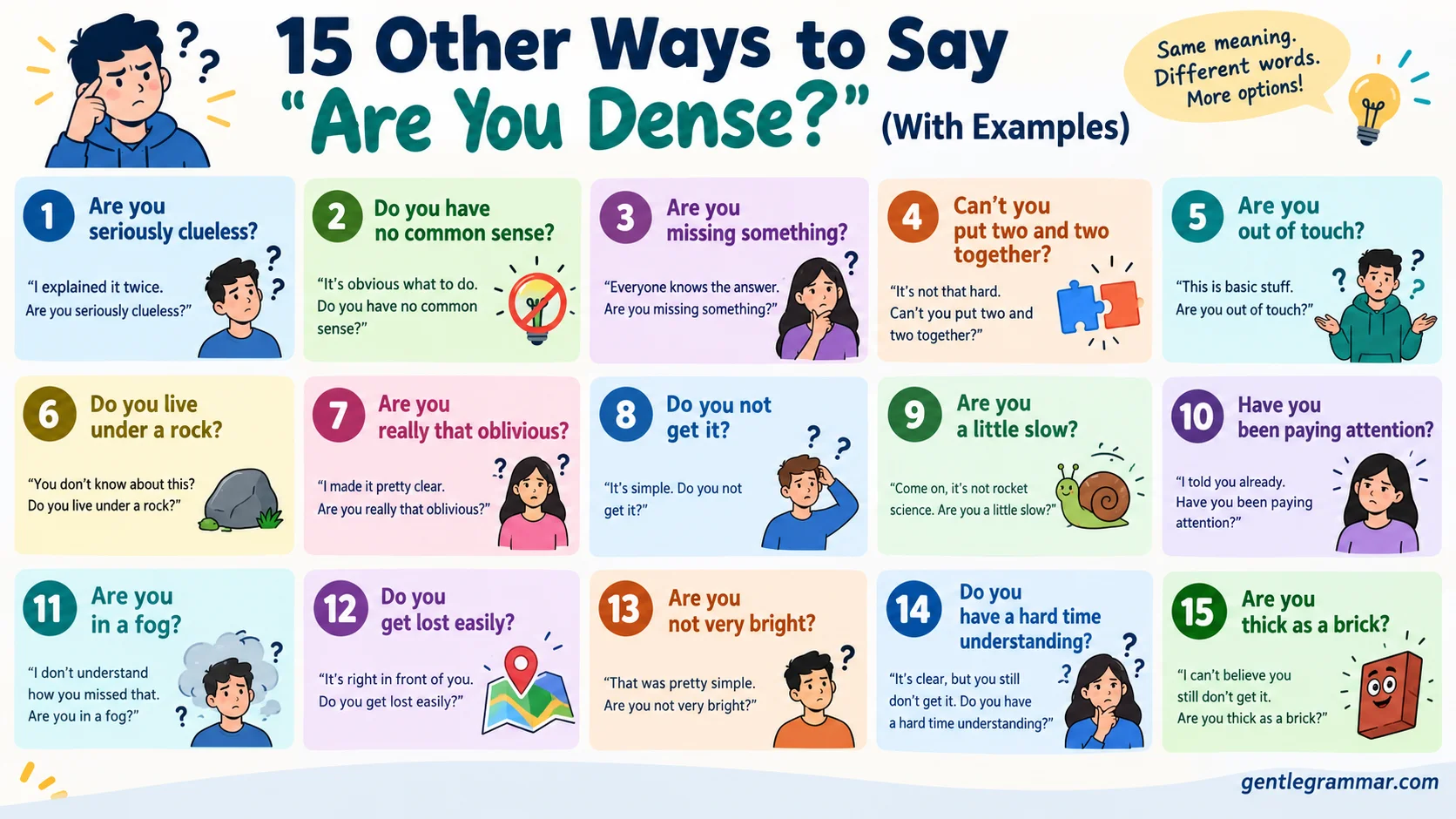
The way we respond when someone misunderstands something can change the entire conversation. Saying “Are you dense?” expresses frustration, but it can also sound insulting or disrespectful. Depending on the situation, a different phrase can communicate confusion, ask someone to pay attention, or express disagreement without making the conversation unnecessarily uncomfortable.
If you want to explore 15 other ways to say “Are you dense?”, this guide offers alternatives for everyday conversations, friendly teasing, disagreements, and professional communication. You will learn the meaning, tone, and appropriate usage of each expression so you can choose wording that fits your relationship with the other person.
What Does “Are You Dense?” Mean?
“Are you dense?” is a question used to suggest that someone is being slow to understand something obvious. In this expression, dense means mentally slow or unable to grasp an idea quickly. The speaker usually uses the phrase when they feel frustrated because someone has misunderstood an explanation, missed an obvious point, or failed to understand something after it has been explained.
Although the question literally asks whether someone has difficulty understanding, it is generally rhetorical and insulting, rather than a genuine question about intelligence. For example, someone might say, “Are you dense? I already explained the instructions.” The underlying message is that the speaker thinks the other person should have understood. Depending on the relationship and delivery, it might be intended as teasing, but it can easily hurt someone’s feelings.
Common Situations Where “Are You Dense?” Is Used
People generally use this expression during moments of frustration, impatience, or disagreement. It may appear in heated conversations when someone repeatedly misunderstands a point or ignores an explanation.
- Everyday conversations: Someone may use it after explaining the same thing several times.
- Text messages: Friends or acquaintances might use it during an argument, although written messages can make the insult feel harsher.
- Social media: It may appear in online debates when people disagree about an obvious point or interpretation.
- Personal relationships: Partners, siblings, or friends might say it when annoyed, but it can damage trust if used repeatedly.
- School or learning environments: A teacher or student might encounter the expression during a frustrating discussion, although respectful clarification is more helpful.
- Workplace communication: The phrase is generally unsuitable because it attacks someone’s perceived intelligence instead of addressing the misunderstanding.
People often seek alternatives because they want to express impatience, disbelief, or confusion without making the other person feel personally attacked.
Is It Professional or Polite to Say “Are You Dense?”
“Are you dense?” is usually informal, confrontational, and impolite. It suggests that the listener lacks intelligence, so it can sound condescending even when the speaker believes the misunderstanding should be obvious. Among close friends, it might be used as teasing if both people are comfortable with that style of humor. However, the phrase can quickly become hurtful when the relationship or tone does not support playful banter.
In professional communication, it is better to focus on the misunderstanding rather than criticize the person. For example, “Could I explain that another way?” or “I think there may be a misunderstanding” communicates the problem without insulting anyone. In personal conversations, expressions such as “Are you following me?” or “Do you see what I mean?” can also encourage clarification. The best alternative depends on whether you want to be firm, playful, direct, or polite.
Advantages and Disadvantages of Saying “Are You Dense?”
Advantages
The phrase communicates frustration and disbelief immediately. It is short, direct, and recognizable in informal English. In a relationship where teasing is welcome, it might also be used as exaggerated humor. Its bluntness can make the speaker’s annoyance unmistakable, particularly during an argument.
Disadvantages
The main disadvantage is that it can sound insulting and condescending. Rather than explaining what went wrong, it attacks the other person’s intelligence. This can make the listener defensive, intensify an argument, or discourage them from asking questions. The expression is also unsuitable for most workplace, academic, and customer-service situations. More constructive alternatives can communicate the same frustration while keeping the conversation focused on the actual issue.
Synonyms for “Are You Dense?”
- Are you even listening?
- Do you understand what I’m saying?
- Are you following me?
- Do you see what I mean?
- Did you miss the point?
- How is that not clear?
- What part don’t you understand?
- Are we on the same page?
- Have I lost you?
- Do I need to explain that again?
- Are you being serious?
- Are you deliberately misunderstanding me?
- Does that make sense to you?
- Can you see where I’m coming from?
- Are you not getting it?
1. Are You Even Listening?
Meaning
“Are you even listening?” questions whether someone is paying attention to what you are saying. Like “Are you dense?”, it often expresses frustration, but it focuses on attention rather than intelligence.
Definition
A question used to express doubt that someone is paying attention to a conversation.
Detailed Explanation
This expression is useful when someone repeatedly ignores information or responds as though they have not heard you. It can sound sharp because it implies that the listener has not been paying attention. Unlike the original phrase, it does not necessarily suggest that the person is unable to understand. They may simply be distracted or preoccupied. However, it can still sound accusatory if delivered angrily.
Scenario Examples
Scenario: You explain your plans to a friend, but they keep suggesting something you already ruled out.
Example: “Are you even listening? I said I can’t go on Saturday.”
Scenario: A colleague misses an important detail during a meeting.
Example: “Are you even listening to the instructions? We need the final version by noon.”
Best Use
Use it in informal conversations when you genuinely suspect someone is distracted or ignoring what you have said. In professional settings, a gentler question about whether the person heard the instructions may work better.
Tone
Tone: Frustrated, direct, confrontational.
The wording challenges the listener’s attention and can make them feel accused.
2. Do You Understand What I’m Saying?
Meaning
“Do you understand what I’m saying?” checks whether someone has understood your explanation. It can replace the original expression when your main concern is a lack of understanding rather than a desire to insult someone.
Definition
A question that asks whether a listener has understood the speaker’s message.
Detailed Explanation
This phrase is more neutral than “Are you dense?”, particularly when spoken calmly. It gives the listener an opportunity to explain what they have understood or ask questions. However, an irritated voice can make it sound patronizing. It is especially useful when discussing complicated instructions, personal boundaries, or an important decision. The focus remains on understanding the message rather than judging the person’s intelligence.
Scenario Examples
Scenario: You explain a boundary to a friend who continues to disregard it.
Example: “Do you understand what I’m saying? I need you to ask before borrowing my things.”
Scenario: A supervisor checks whether an employee understands a new procedure.
Example: “Do you understand what I’m saying about the updated approval process?”
Best Use
Use this expression when you need to confirm understanding, especially during serious conversations, explanations, or discussions about expectations.
Tone
Tone: Direct, serious, potentially firm.
It can sound respectful when asked sincerely, but aggressive when used as a challenge.
3. Are You Following Me?
Meaning
“Are you following me?” asks whether someone can keep up with an explanation or understand the points being made. It is a practical alternative when a conversation seems confusing.
Definition
A question asking whether someone understands the explanation or reasoning being presented.
Detailed Explanation
This expression is commonly used during explanations that involve several steps or connected ideas. It does not directly criticize someone’s intelligence, making it less insulting than the original phrase. It can also encourage the listener to speak up if they have missed something. In some situations, however, it may sound slightly impatient if the speaker expects immediate understanding. A friendly delivery makes it more collaborative.
Scenario Examples
Scenario: You explain how to complete a school assignment.
Example: “First, outline your argument, then add the evidence. Are you following me?”
Scenario: A friend is trying to understand a complicated travel plan.
Example: “We change trains at Central Station and get off two stops later. Are you following me?”
Best Use
This expression works well in conversations, tutoring, presentations, and step-by-step explanations. It is also suitable for workplace discussions when delivered respectfully.
Tone
Tone: Conversational, explanatory, direct.
It checks comprehension without automatically implying that the listener has done something wrong.
4. Do You See What I Mean?
Meaning
“Do you see what I mean?” asks whether someone understands your point of view or the idea behind your explanation. It is a softer option when you want someone to recognize a connection or understand your reasoning.
Definition
A question asking whether someone understands the point or idea being communicated.
Detailed Explanation
This expression focuses on the meaning behind your words, not on the listener’s ability to understand. It is often used after explaining an opinion, describing a problem, or giving an example. Compared with the original phrase, it sounds more inviting and less judgmental. It also leaves room for disagreement because understanding your point does not necessarily mean agreeing with it. This makes it particularly useful during thoughtful discussions.
Scenario Examples
Scenario: You explain why a particular decision could create problems later.
Example: “If we rush the launch, we might miss important errors. Do you see what I mean?”
Scenario: You tell a friend why a comment upset you.
Example: “It wasn’t the joke itself; it was the timing. Do you see what I mean?”
Best Use
Use it in personal conversations, explanations, discussions, and collaborative problem-solving when you want to check whether your point has come across clearly.
Tone
Tone: Friendly, thoughtful, explanatory.
It encourages understanding rather than attacking the listener.
5. Did You Miss the Point?
Meaning
“Did you miss the point?” suggests that someone has misunderstood the main idea of a statement or discussion. It is useful when a person responds to a minor detail while overlooking the central message.
Definition
A question asking whether someone has failed to understand the main idea.
Detailed Explanation
This phrase is more focused than “Are you dense?” because it identifies a problem with the person’s interpretation rather than their intelligence. It can sound sharp, especially during disagreements, because it implies that the main idea should have been obvious. Still, it can be appropriate when a conversation has moved away from the central issue. If you want to sound more constructive, explain the point again before asking the question.
Scenario Examples
Scenario: A friend focuses on the price of a gift instead of the thought behind it.
Example: “Did you miss the point? I chose it because it reminded me of you.”
Scenario: During a team discussion, someone responds to a minor detail while ignoring the main concern.
Example: “Did you miss the point of the proposal? We’re trying to reduce delays, not add more steps.”
Best Use
Use it in informal disagreements, discussions, and debates when the central message has been overlooked. For sensitive situations, a neutral clarification may be more effective.
Tone
Tone: Direct, critical, impatient.
It challenges the listener’s interpretation and can sound confrontational.
6. How Is That Not Clear?
Meaning
“How is that not clear?” expresses disbelief that someone has failed to understand something the speaker considers obvious. It closely matches the frustration behind “Are you dense?” without directly labeling the person.
Definition
A rhetorical question expressing frustration that an explanation seems unclear to someone else.
Detailed Explanation
This expression communicates impatience with a misunderstanding. It directs attention toward the explanation, although the wording can still imply that the listener should have understood it already. It is more confrontational than a simple request for clarification. The phrase can be useful when a point has been explained several times, but it may discourage the other person from admitting confusion. A calmer alternative is to ask which part needs clarification.
Scenario Examples
Scenario: Your roommate repeatedly misunderstands a simple household arrangement.
Example: “How is that not clear? We agreed to alternate cleaning the kitchen.”
Scenario: A group keeps overlooking an important requirement.
Example: “How is that not clear? Every submission needs the reference number.”
Best Use
Use it sparingly in informal discussions when you want to express strong frustration. Avoid it when teaching, supervising, or helping someone who may genuinely be confused.
Tone
Tone: Impatient, challenging, confrontational.
The rhetorical structure suggests that the answer should already be obvious.
7. What Part Don’t You Understand?
Meaning
“What part don’t you understand?” asks someone to identify the specific part of an explanation that is confusing. However, it often carries an impatient or sarcastic edge.
Definition
A question asking which part of a message someone has difficulty understanding.
Detailed Explanation
This expression can help identify a particular misunderstanding, but its tone depends heavily on delivery. Asked sincerely, it may help a speaker discover what needs explaining. During an argument, it can sound like a criticism of the listener’s intelligence. Compared with the original phrase, it is more specific because it invites the person to identify the problem. A neutral version, such as asking which part needs clarification, works better when the goal is cooperation.
Scenario Examples
Scenario: A friend repeatedly overlooks an agreement about sharing expenses.
Example: “What part don’t you understand? We agreed to split the bill evenly.”
Scenario: A classmate is confused about an assignment’s requirements.
Example: “Which part don’t you understand? I can walk you through the instructions.”
Best Use
Use it in casual conversations or problem-solving discussions when you need to identify a specific misunderstanding. In formal or sensitive settings, choose more neutral wording.
Tone
Tone: Direct, questioning, potentially sarcastic.
It can be helpful or insulting depending on whether the speaker genuinely wants to clarify the issue.
8. Are We on the Same Page?
Meaning
“Are we on the same page?” asks whether two people share the same understanding of a situation, plan, or expectation. It is a constructive alternative when the real issue is a mismatch in understanding.
Definition
A question checking whether people agree on the same information, expectations, or plan.
Detailed Explanation
Unlike “Are you dense?”, this expression does not accuse anyone of being slow to understand. It suggests that both people should confirm their understanding before proceeding. It is especially useful when instructions or expectations may have been interpreted differently. The phrase is common in professional communication, but it also sounds natural in everyday conversation. It is less suitable when you specifically want to criticize an individual for ignoring an obvious point.
Scenario Examples
Scenario: You and a colleague are preparing a presentation.
Example: “We’re submitting the slides on Thursday and rehearsing Friday. Are we on the same page?”
Scenario: You and a friend are arranging a shared holiday.
Example: “Just checking, we’re splitting the hotel cost equally. Are we on the same page?”
Best Use
Use it in workplace discussions, planning conversations, group projects, and personal arrangements when you want to prevent misunderstandings.
Tone
Tone: Collaborative, professional, respectful.
It emphasizes shared understanding rather than personal blame.
9. Have I Lost You?
Meaning
“Have I lost you?” asks whether someone has stopped following an explanation or become confused. It is a softer alternative because it allows the speaker to acknowledge that their explanation may be difficult to follow.
Definition
A question checking whether a listener is still following what the speaker is explaining.
Detailed Explanation
This phrase is useful when you notice someone looking confused during a long explanation. It places some responsibility on the speaker to check whether the message is clear. Unlike the original phrase, it does not suggest that the listener lacks intelligence. It is often used in presentations, conversations, and teaching situations. Although generally friendly, it can sound impatient if the speaker uses it sarcastically.
Scenario Examples
Scenario: You explain a complicated board game to a friend.
Example: “You collect a card each turn, then trade when you have a matching set. Have I lost you?”
Scenario: A coworker gives a detailed explanation of a reporting process.
Example: “The figures go into the shared spreadsheet before approval. Have I lost you, or should I go over that step again?”
Best Use
Use it in explanations, presentations, tutorials, and conversations involving complex information. It is especially helpful when you want to make sure the listener feels comfortable asking questions.
Tone
Tone: Friendly, self-aware, considerate.
It recognizes that communication can be difficult for either person.
10. Do I Need to Explain That Again?
Meaning
“Do I need to explain that again?” suggests that someone has not understood or remembered an explanation. It can express frustration, but it can also be a straightforward offer to repeat information.
Definition
A question asking whether an explanation needs to be repeated.
Detailed Explanation
The phrase is more focused on repetition than intelligence. It can be useful when someone has missed an instruction or needs another explanation. However, the wording may sound condescending if the speaker clearly expects the answer to be no. A warmer delivery makes it an offer of help, while an irritated delivery turns it into a reprimand. In professional situations, directly offering to clarify a point often sounds more respectful.
Scenario Examples
Scenario: Your friend forgets the agreed meeting place.
Example: “Do I need to explain that again? We’re meeting outside the library at six.”
Scenario: A supervisor notices that a process remains unclear.
Example: “Would it help if I explained that step again before you continue?”
Best Use
Use it in everyday conversations and situations involving repeated instructions. The more neutral version is preferable when helping a student, colleague, or customer.
Tone
Tone: Direct, impatient, or helpful, depending on delivery.
Its wording can communicate either frustration or a genuine willingness to clarify.
11. Are You Being Serious?
Meaning
“Are you being serious?” expresses disbelief about what someone has said or done. It can replace “Are you dense?” when the speaker is reacting to an unexpected, unreasonable, or seemingly unbelievable response rather than a simple misunderstanding.
Definition
A question expressing doubt or surprise about whether someone genuinely means what they said.
Detailed Explanation
This expression focuses on the credibility or surprising nature of a statement, not directly on someone’s ability to understand. It can convey mild disbelief among friends or strong frustration during an argument. The phrase is not an exact synonym for the original because a person may understand everything perfectly and still say something surprising. Choose it when you are questioning a person’s statement or decision rather than their comprehension.
Scenario Examples
Scenario: A friend suggests leaving for the airport only minutes before boarding.
Example: “Are you being serious? We haven’t even left the house yet.”
Scenario: A teammate proposes deleting a file that contains important work.
Example: “Are you being serious? That folder contains the final versions.”
Best Use
Use it in casual conversations, surprising situations, and disagreements when you want to express disbelief. It is generally too emotional for formal business writing.
Tone
Tone: Surprised, skeptical, sometimes confrontational.
The emphasis is on disbelief rather than a direct insult.
12. Are You Deliberately Misunderstanding Me?
Meaning
“Are you deliberately misunderstanding me?” suggests that someone may be pretending not to understand what you mean. It expresses frustration about suspected intentional misinterpretation rather than an ordinary failure to understand.
Definition
A question challenging whether someone is intentionally interpreting a message incorrectly.
Detailed Explanation
This expression is stronger than most alternatives because it questions the other person’s intentions. It may be appropriate when someone repeatedly twists your words or ignores a point that has already been clarified. However, it can escalate an argument if the misunderstanding is genuine. Unlike “Are you dense?”, it does not suggest low intelligence; instead, it suggests possible bad faith. Use it only when you have a reasonable basis for thinking the misunderstanding is intentional.
Scenario Examples
Scenario: During an argument, someone repeatedly changes the meaning of your statement.
Example: “Are you deliberately misunderstanding me? I said I need more time, not that I want to cancel.”
Scenario: A discussion keeps returning to a point you have already clarified.
Example: “I’ve explained what the policy says. Are you deliberately misunderstanding my position?”
Best Use
Use it in serious disagreements or discussions involving repeated misrepresentation. Avoid it when a simple clarification could resolve the problem.
Tone
Tone: Accusatory, firm, confrontational.
It questions the other person’s motives, so it should be used carefully.
13. Does That Make Sense to You?
Meaning
“Does that make sense to you?” asks whether an explanation is understandable. It is a useful alternative when you want to check comprehension without directly criticizing someone.
Definition
A question asking whether information, reasoning, or instructions are clear to the listener.
Detailed Explanation
This expression is common after giving instructions or explaining a complicated idea. It can sound considerate when the speaker genuinely wants feedback. However, if asked sarcastically, it may imply that the listener should have understood something obvious. Unlike the original phrase, it can encourage an honest response and create an opportunity to clarify confusion. In professional contexts, it works best when paired with an invitation to ask questions.
Scenario Examples
Scenario: You explain how to use a new software feature to a colleague.
Example: “Select the report, choose the date range, and export the file. Does that make sense to you?”
Scenario: You explain a change in plans to a family member.
Example: “We’ll leave earlier so we can avoid the traffic. Does that make sense?”
Best Use
Use it in workplace communication, teaching, instructions, and everyday explanations when you want to confirm that the message is clear.
Tone
Tone: Helpful, neutral, considerate.
It sounds respectful when it invites clarification rather than testing the listener.
14. Can You See Where I’m Coming From?
Meaning
“Can you see where I’m coming from?” asks whether someone understands your perspective or the reasons behind your position. It is a useful alternative when a disagreement involves different opinions rather than a failure to understand basic information.
Definition
A question asking whether someone understands the reasoning or perspective behind your opinion.
Detailed Explanation
This expression encourages the listener to consider your point of view without demanding agreement. It is more empathetic than “Are you dense?” because it recognizes that people may interpret situations differently. It is particularly helpful when emotions are involved or when both sides have reasonable concerns. However, it does not directly address whether someone understood a simple instruction. Choose it when the goal is mutual understanding rather than correcting a factual mistake.
Scenario Examples
Scenario: You explain why you cannot attend a friend’s event.
Example: “I have an early shift the next morning, so I need to leave before midnight. Can you see where I’m coming from?”
Scenario: You disagree with a coworker’s proposed deadline.
Example: “I’m concerned that rushing this will affect quality. Can you see where I’m coming from?”
Best Use
Use it in personal relationships, workplace discussions, negotiations, and disagreements where understanding another person’s perspective matters.
Tone
Tone: Empathetic, thoughtful, persuasive.
It invites consideration rather than insulting or blaming the listener.
15. Are You Not Getting It?
Meaning
“Are you not getting it?” asks whether someone still fails to understand a point. It is a direct alternative that preserves some of the impatience behind “Are you dense?” without explicitly calling the person unintelligent.
Definition
A question expressing frustration that someone has not understood an explanation or message.
Detailed Explanation
This expression is informal and often used when someone appears to have missed a point that has already been explained. It is more direct than “Are you following me?” and can sound dismissive when spoken angrily. Unlike a neutral comprehension check, it suggests that the speaker expected the listener to understand by now. It may work among familiar people who are comfortable with blunt communication, but it is less suitable for sensitive discussions. If you want to solve the misunderstanding, asking what remains unclear is usually more constructive.
Scenario Examples
Scenario: Your sibling keeps forgetting a simple agreement about household chores.
Example: “Are you not getting it? We take turns washing the dishes.”
Scenario: A friend continues to misunderstand your plans for the weekend.
Example: “Are you not getting it? I’m saying I can meet on Sunday, not Saturday.”
Best Use
Use it in informal conversations when you want to communicate clear frustration. Choose a gentler expression for professional settings or when the other person may be genuinely confused.
Tone
Tone: Blunt, impatient, informal.
It communicates frustration directly, although it is still less explicitly insulting than the original expression.
FAQs:
What is another way to say “Are You Dense?”
You could say “Are you following me?”, “Did you miss the point?”, or “Do you understand what I’m saying?” The best choice depends on whether you want to check understanding, express frustration, or point out a misunderstanding.
What does “Are You Dense?” mean?
“Are you dense?” is an insulting rhetorical question suggesting that someone is slow to understand something. It usually communicates frustration, disbelief, or impatience rather than a genuine question about intelligence.
Is “Are You Dense?” professional?
No, it is generally not appropriate for professional communication because it can sound disrespectful and condescending. A phrase such as “I think there may be a misunderstanding” is more suitable for workplace discussions.
What is a more polite way to say “Are You Dense?”
A more polite option is “Do you see what I mean?” Another useful choice is “Could I explain that another way?” Both phrases help address a misunderstanding without insulting the other person.
Which alternative works best in formal communication?
“I think there may be a misunderstanding” is a suitable formal alternative, although it is not one of the 15 expressions listed above. It identifies a communication problem without assigning blame. You can also ask, “Could we clarify this point?” when discussing instructions, expectations, or decisions.
Conclusion:
Choosing the right words can help you express frustration without turning a simple misunderstanding into a personal conflict. Although “Are you dense?” communicates impatience, it can sound insulting because it questions someone’s intelligence rather than addressing the problem. Alternatives such as “Are you following me?” and “Do you see what I mean?” are useful when you want to check understanding, while “Did you miss the point?” communicates stronger criticism. For workplace conversations, collaborative wording is usually more effective than a personal remark.
Before choosing an expression, consider your relationship with the listener, the seriousness of the situation, and the tone you want to convey. Clear communication is not just about making your point; it is also about helping the other person understand it. A thoughtful choice of words can make even a difficult conversation more productive.
