
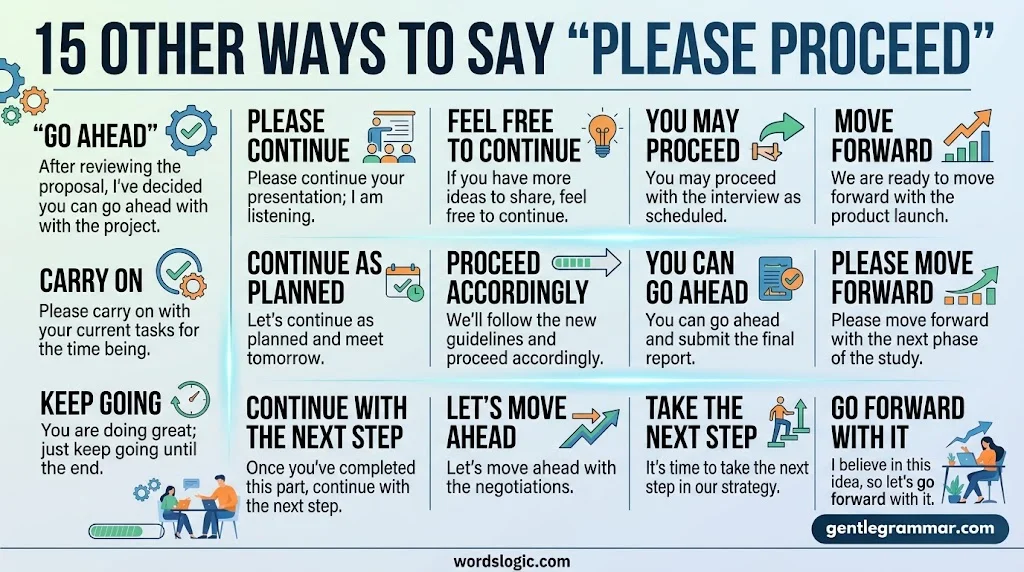
In professional writing, Other Ways to Say “Please Proceed” Other Ways to Say “Please Proceed” can help when communicating with clients, managers, or colleagues in English.
In my journey, I have relied on this powerful, correct, and usable phrase in work settings, such as offices, meetings, emails, and customer service calls. Still, using the same phrase again and again may sound stiff, repetitive, cold, or overly formal. The right wording can make communication more polite, respectful, friendly, confident, and clear. When guiding someone to continue to the next step of an action or process, simple phrases and useful alternatives can sound more natural and fluent, without feeling harsh or rushed.
The right tone also depends on word choice and the situation. In business emails, academic work, casual chats, formal meetings, and everyday speech, I use different expressions to match the level of formal communication required. A short, clear request can help when asking for progress, while an authoritative option may suit a formal action or process. The 11 examples and tips in this guide show how written English can remain polite and practical while ensuring the message is not too direct. Whether I am regularly managing a professional interaction or asking someone to continue.
What Does “Please Proceed” Mean?
“Please proceed” is a polite expression used to give someone permission or encouragement to continue with an action, discussion, process, or task. In everyday English, it can mean “go ahead,” “continue,” or “move forward,” depending on the context. The word “please” makes the instruction more courteous, while “proceed” suggests continuing from the current point rather than starting something completely unrelated. The phrase is especially common in professional, formal, administrative, and instructional communication, although it can also be used in ordinary conversation when a more formal tone is appropriate.
Common Situations Where “Please Proceed” Is Used
People commonly use “please proceed” when they want someone to continue with an action after receiving permission, approval, or an instruction. At work, a manager might use it when authorizing a colleague to begin a project, while a customer-service representative might use it to tell someone to continue through a process. It can also appear in emails, meetings, instructions, applications, and formal correspondence.
In casual conversation or texting, however, “please proceed” may sound somewhat formal. Someone talking to a friend would usually choose a simpler expression such as “go ahead” or “keep going.” The best alternative therefore depends on whether you want to sound professional, friendly, encouraging, direct, or formal.
Is It Professional or Polite to Say “Please Proceed”?
Yes. “Please proceed” is generally professional and polite, particularly in workplace, business, customer-service, academic, and administrative settings. It communicates permission or direction without sounding openly commanding. However, its formal wording can feel slightly distant in a personal conversation. If you are speaking with a close colleague, friend, or family member, a warmer expression such as “go ahead” may sound more natural. In formal writing, “please proceed” can work particularly well when clarity and courtesy are more important than conversational warmth.
Advantages and Disadvantages of Saying “Please Proceed”
Advantages
The main advantage of “please proceed” is its clarity and politeness. It tells the other person that they can continue while maintaining a respectful tone. It also works well in professional communication because it does not sound overly casual. The expression is concise, making it useful when giving permission, approving an action, or moving a process forward.
Disadvantages
The phrase can sometimes sound formal or impersonal, especially in relaxed conversations. If used repeatedly in workplace emails, it may also make communication feel somewhat stiff. In some situations, a more specific expression can communicate the intended meaning better—for example, “go ahead” for permission, “continue” for an ongoing activity, or “move forward” for a project or decision.
Synonyms for “Please Proceed”
- Go Ahead
- Please Continue
- Feel Free to Continue
- You May Proceed
- Move Forward
- Carry On
- Continue as Planned
- Proceed Accordingly
- You Can Go Ahead
- Please Move Forward
- Keep Going
- Continue With the Next Step
- Let’s Move Ahead
- Take the Next Step
- Go Forward With It
1. Go Ahead
Meaning
“Go ahead” tells someone that they have permission to continue or begin an action. It is one of the most natural alternatives to “please proceed” in everyday English.
Definition
Go ahead means to continue, begin, or do something after receiving permission or approval.
Detailed Explanation
“Go ahead” is usually less formal and more conversational than “please proceed.” It works especially well when someone has asked whether they can do something. Unlike “proceed,” which can sound procedural, “go ahead” feels natural in spoken English and informal messages. It can still be polite when used with appropriate wording.
Scenario Examples
Scenario: A colleague asks whether they can send the document.
Example: “I’ve reviewed it, so go ahead and send it.”
Scenario: A friend asks whether they should tell you the story.
Example: “Yes, go ahead. I’m listening.”
Scenario: A customer asks whether they can complete the online form.
Example: “Everything is ready. You can go ahead and submit it.”
Best Use
Best for casual conversation, workplace conversations, texting, friendly messages, and spoken English.
Tone
Tone: Friendly, natural, permissive
It sounds approachable and is generally less stiff than “please proceed.”
2. Please Continue
Meaning
“Please continue” directly asks someone to keep doing or saying what they have already started.
Definition
Please continue means continue what you are currently doing, saying, or explaining.
Detailed Explanation
This expression is close to “please proceed,” but it emphasizes continuation rather than permission to begin. It is particularly useful when someone has paused during a presentation, explanation, conversation, or task. The wording remains polite and professional without being unnecessarily complicated.
Scenario Examples
Scenario: A speaker stops during a presentation.
Example: “Sorry for interrupting. Please continue with your presentation.”
Scenario: A student is explaining an answer to a teacher.
Example: “Your reasoning is interesting. Please continue.”
Scenario: A colleague pauses while explaining a problem.
Example: “I understand. Please continue; I’d like to hear the rest.”
Best Use
Best for meetings, presentations, classrooms, professional conversations, and formal discussions.
Tone
Tone: Polite, attentive, professional
It shows that you want the other person to keep going.
3. Feel Free to Continue
Meaning
“Feel free to continue” gives someone permission to continue while making the invitation sound relaxed and welcoming.
Definition
Feel free to continue means you are welcome to keep doing or discussing what you have started.
Detailed Explanation
This expression is softer than “please proceed” because it gives the listener a sense of freedom and permission. It can make communication sound warmer, especially when you want someone to feel comfortable rather than instructed. It is useful when you want to remove any concern that the person might be interrupting or imposing.
Scenario Examples
Scenario: Someone apologizes for continuing a discussion while you are working.
Example: “No problem at all. Feel free to continue.”
Scenario: A colleague asks whether they should finish explaining an idea.
Example: “I have a few minutes. Feel free to continue.”
Scenario: A guest wants to finish a conversation.
Example: “There’s no rush, so feel free to continue.”
Best Use
Best for friendly workplace communication, conversations, meetings, customer interactions, and welcoming messages.
Tone
Tone: Warm, accommodating, polite
The phrase emphasizes permission and comfort rather than authority.
4. You May Proceed
Meaning
“You may proceed” formally gives someone permission to continue with an action.
Definition
You may proceed means you have permission to continue or begin the requested action.
Detailed Explanation
This expression is more formal and authoritative than “please proceed.” It is often appropriate when a person is officially granting permission or confirming that a process can continue. Because of its formal character, it may sound overly serious in casual conversation. The phrase is most effective when the context genuinely calls for clear authorization.
Scenario Examples
Scenario: An administrator confirms that an application can move forward.
Example: “Your documents have been verified. You may proceed with the application.”
Scenario: A supervisor gives permission to begin a task.
Example: “The equipment has been checked. You may proceed.”
Best Use
Best for formal instructions, administrative communication, official settings, and professional situations requiring explicit permission.
Tone
Tone: Formal, authoritative, respectful
It clearly communicates authorization rather than casual encouragement.
5. Move Forward
Meaning
“Move forward” means to continue toward the next stage or make progress.
Definition
Move forward means continue with a plan, decision, project, or process.
Detailed Explanation
Unlike “please proceed,” “move forward” often refers to progress or advancement rather than simply continuing an immediate action. It works especially well in business, project management, planning, and decision-making. The phrase can also suggest that a decision has already been made and the next stage should now begin.
Scenario Examples
Scenario: A team has approved a proposal.
Example: “The proposal has been approved, so we can move forward with the project.”
Scenario: A customer agrees to the next stage of a service.
Example: “If everything looks correct, we can move forward with the order.”
Best Use
Best for business communication, project discussions, planning, decisions, and professional emails.
Tone
Tone: Professional, purposeful, confident
It conveys progress and forward momentum.
6. Carry On
Meaning
“Carry on” tells someone to continue what they are doing.
Definition
Carry on means keep doing something without stopping.
Detailed Explanation
“Carry on” is more conversational than “please proceed.” It is common in British English and is also understood in other varieties of English. Depending on the context, it can sound friendly, encouraging, or slightly informal. It usually focuses on continuing an existing activity rather than formally authorizing a new one.
Scenario Examples
Scenario: A coworker stops talking because you entered the room.
Example: “Sorry, I didn’t mean to interrupt. Carry on.”
Scenario: Someone is working while you briefly step away.
Example: “I’ll be back in a few minutes. Carry on.”
Best Use
Best for everyday conversation, informal workplace situations, and spoken English.
Tone
Tone: Casual, encouraging, conversational
It sounds relaxed and natural when the situation is informal.
7. Continue as Planned
Meaning
“Continue as planned” tells someone to follow the existing plan without changing course.
Definition
Continue as planned means keep following the agreed plan or schedule.
Detailed Explanation
This phrase is more specific than “please proceed” because it indicates that there is already an established plan. It does not simply give permission to act; it suggests that no changes are necessary at this point. It is particularly useful when communicating decisions to a team or confirming that an arrangement remains valid.
Scenario Examples
Scenario: A project is progressing normally.
Example: “The client has approved the schedule, so please continue as planned.”
Scenario: An event is unaffected by a minor issue.
Example: “The equipment is working properly now. We can continue as planned.”
Best Use
Best for workplace emails, project management, schedules, events, and organized activities.
Tone
Tone: Professional, reassuring, directive
It gives clear guidance while emphasizing consistency with an existing plan.
8. Proceed Accordingly
Meaning
“Proceed accordingly” means to take the appropriate next action based on the information, instructions, or circumstances already provided.
Definition
Proceed accordingly means act in the appropriate way based on what has been communicated.
Detailed Explanation
This is a highly formal expression and is less conversational than “please proceed.” It is useful when the exact action depends on previous instructions or circumstances. Because it can sound bureaucratic, it should be used selectively. In plain workplace writing, a more specific instruction is often clearer.
Scenario Examples
Scenario: A manager has provided instructions for handling different customer cases.
Example: “Please review the customer’s request and proceed accordingly.”
Scenario: An official notice gives instructions based on an individual’s circumstances.
Example: “Once you have reviewed the requirements, proceed accordingly.”
Best Use
Best for formal correspondence, administrative writing, official instructions, and business communication.
Tone
Tone: Formal, procedural, authoritative
It sounds structured and emphasizes appropriate action based on prior information.
9. You Can Go Ahead
Meaning
“You can go ahead” tells someone that they are permitted to continue or begin something.
Definition
You can go ahead means you have permission to do what you are considering.
Detailed Explanation
This phrase is a natural conversational alternative to “please proceed.” It is particularly useful when someone has asked for permission or confirmation. Compared with “you may proceed,” it sounds warmer and less formal. Adding “and” plus a specific action can make the instruction even clearer.
Scenario Examples
Scenario: A coworker asks whether they can contact a supplier.
Example: “The details are correct. You can go ahead and contact them.”
Scenario: A friend asks whether they can choose the restaurant.
Example: “That sounds good. You can go ahead and book it.”
Scenario: A team member asks whether to start the next stage.
Example: “Everything has been approved. You can go ahead.”
Best Use
Best for workplace conversations, everyday speech, texting, and informal professional communication.
Tone
Tone: Friendly, clear, permissive
It gives permission without the formality of “you may proceed.”
10. Please Move Forward
Meaning
“Please move forward” politely asks someone to advance to the next stage of a process, plan, or task.
Definition
Please move forward means continue to the next stage or take the next appropriate action.
Detailed Explanation
This expression has a more purposeful and professional feel than “please proceed.” It often suggests that a decision has been made and the person should now take action. It is especially effective in project-related communication, where “moving forward” naturally refers to progress. It may sound less natural if the person is simply continuing a conversation.
Scenario Examples
Scenario: A project proposal has received approval.
Example: “The proposal has been approved. Please move forward with the implementation.”
Scenario: A department is ready for the next stage.
Example: “The requirements have been confirmed, so please move forward with the next phase.”
Best Use
Best for professional emails, project management, business decisions, and organizational communication.
Tone
Tone: Professional, direct, purposeful
It emphasizes progress toward a specific objective.
11. Keep Going
Meaning
“Keep going” encourages someone to continue without stopping.
Definition
Keep going means continue doing something, especially when it is already underway.
Detailed Explanation
This is a much more casual and encouraging expression than “please proceed.” It is often used when someone needs motivation rather than formal permission. The phrase can be appropriate for conversations, learning, creative work, sports, or difficult tasks. It is generally not a direct substitute for “please proceed” in formal business correspondence.
Scenario Examples
Scenario: A student is working through a difficult problem.
Example: “You’re almost there. Keep going.”
Scenario: A friend is telling a long story.
Example: “This is interesting—keep going.”
Scenario: Someone is explaining how they solved a problem.
Example: “I understand the first part. Keep going.”
Best Use
Best for casual conversation, encouragement, personal messages, learning, and informal situations.
Tone
Tone: Encouraging, casual, supportive
It focuses more on motivation than formal permission.
12. Continue With the Next Step
Meaning
“Continue with the next step” tells someone to advance to the following stage of a process.
Definition
Continue with the next step means move from the current stage to the following action in a process.
Detailed Explanation
This expression is more precise than “please proceed” because it identifies the next stage rather than simply saying to continue. It works well when instructions involve several steps and clarity matters. The phrase can sound slightly instructional, so it is most useful when the process itself is important.
Scenario Examples
Scenario: An applicant has completed the first part of a form.
Example: “Your information has been saved. You can now continue with the next step.”
Scenario: A technician has completed an initial check.
Example: “The first test is complete. Continue with the next step in the procedure.”
Best Use
Best for instructions, training, applications, procedures, workplace communication, and educational settings.
Tone
Tone: Clear, instructional, professional
Its strength is specificity rather than warmth.
13. Let’s Move Ahead
Meaning
“Let’s move ahead” suggests that everyone should continue together with a plan, decision, or activity.
Definition
Let’s move ahead means let us continue or begin the next stage together.
Detailed Explanation
This expression differs from “please proceed” because it creates a sense of shared action. Instead of instructing another person to continue independently, the speaker includes themselves in the next step. It can therefore sound collaborative and positive. It is particularly useful when a team has reached an agreement.
Scenario Examples
Scenario: A team agrees on a project direction.
Example: “We’ve addressed the main concerns, so let’s move ahead with the revised plan.”
Scenario: Two people have agreed on an arrangement.
Example: “Everything looks good to me. Let’s move ahead.”
Scenario: A group is ready to start a new phase.
Example: “The preparation is complete. Let’s move ahead.”
Best Use
Best for team communication, meetings, business discussions, collaborative planning, and group decisions.
Tone
Tone: Collaborative, confident, positive
It emphasizes shared responsibility and forward movement.
14. Take the Next Step
Meaning
“Take the next step” encourages someone to move forward by completing the next action in a process.
Definition
Take the next step means perform the next action needed to make progress.
Detailed Explanation
This phrase is more action-oriented than “please proceed.” It suggests that there is a specific next action that should be taken. It can be used in professional communication as well as personal conversations, although its meaning becomes more figurative when discussing goals or decisions. Because it focuses on action, it is useful when you want to make progress clear.
Scenario Examples
Scenario: A customer has received all the information needed to place an order.
Example: “If everything looks correct, you can take the next step and complete your purchase.”
Scenario: A manager wants an employee to begin the next phase of a project.
Example: “The research is complete. It’s time to take the next step.”
Scenario: Someone is deciding whether to apply for a course.
Example: “If the program interests you, consider taking the next step and submitting your application.”
Best Use
Best for professional communication, instructions, planning, personal goals, and decision-making.
Tone
Tone: Encouraging, purposeful, action-oriented
It encourages progress without sounding like a strict command.
15. Go Forward With It
Meaning
“Go forward with it” means to continue with or commit to an idea, plan, decision, or action.
Definition
Go forward with it means decide to continue or proceed with something that has been considered.
Detailed Explanation
This phrase is useful when someone has already discussed or considered an option and now needs to decide whether to act. It therefore carries more of a sense of commitment or approval than simply continuing an activity. It is conversational but can also appear in relaxed workplace communication. For formal documents, a more precise phrase may be preferable.
Scenario Examples
Scenario: A team has discussed a new marketing idea.
Example: “We’ve reviewed the proposal, and I think we should go forward with it.”
Scenario: A friend has decided to attend an event.
Example: “If you really want to go, go forward with it.”
Scenario: A small business owner approves a planned change.
Example: “The numbers look reasonable, so we can go forward with it.”
Best Use
Best for conversations, workplace discussions, planning, decisions, and informal professional communication.
Tone
Tone: Conversational, decisive, supportive
It suggests commitment to a previously discussed plan or idea.
FAQs:
What is another way to say “Please Proceed”?
A common alternative is “go ahead.” It is more conversational and works especially well when giving someone permission. In professional settings, “please continue,” “please move forward,” or “continue as planned” may be more appropriate depending on the situation.
What does “Please Proceed” mean?
“Please proceed” means continue or go ahead with an action. It is commonly used when someone has permission to begin or continue a task, process, discussion, or activity.
Is “Please Proceed” professional?
Yes. “Please proceed” is generally professional and polite, especially in workplace, business, administrative, and formal communication. However, it may sound more formal than necessary in casual conversations.
What is a more polite way to say “Please Proceed”?
“Please proceed” is already polite, but “feel free to continue” can sound warmer and more welcoming. The best choice depends on whether you are giving formal permission, encouraging someone, or simply asking them to continue.
Which alternative works best in formal communication?
For formal communication, expressions such as “you may proceed,” “please continue,” and “proceed accordingly” can work well. The choice depends on the intended meaning: “you may proceed” emphasizes permission, while “proceed accordingly” refers to acting based on previous instructions.
Conclusion:
Choosing an alternative to “please proceed” is not simply about replacing one phrase with another. The right wording depends on whether you are giving permission, encouragement, instructions, approval, or direction. “Go ahead” feels natural and conversational, while “you may proceed” is more formal and authoritative. Expressions such as “continue as planned” and “take the next step” add more specific meaning, while “let’s move ahead” creates a sense of collaboration.
When choosing among these alternatives, consider your audience, relationship, purpose, and tone. A phrase that sounds perfect in a business email may feel unnecessarily formal in a text to a friend. Understanding these small differences helps you communicate with greater clarity and confidence.
