
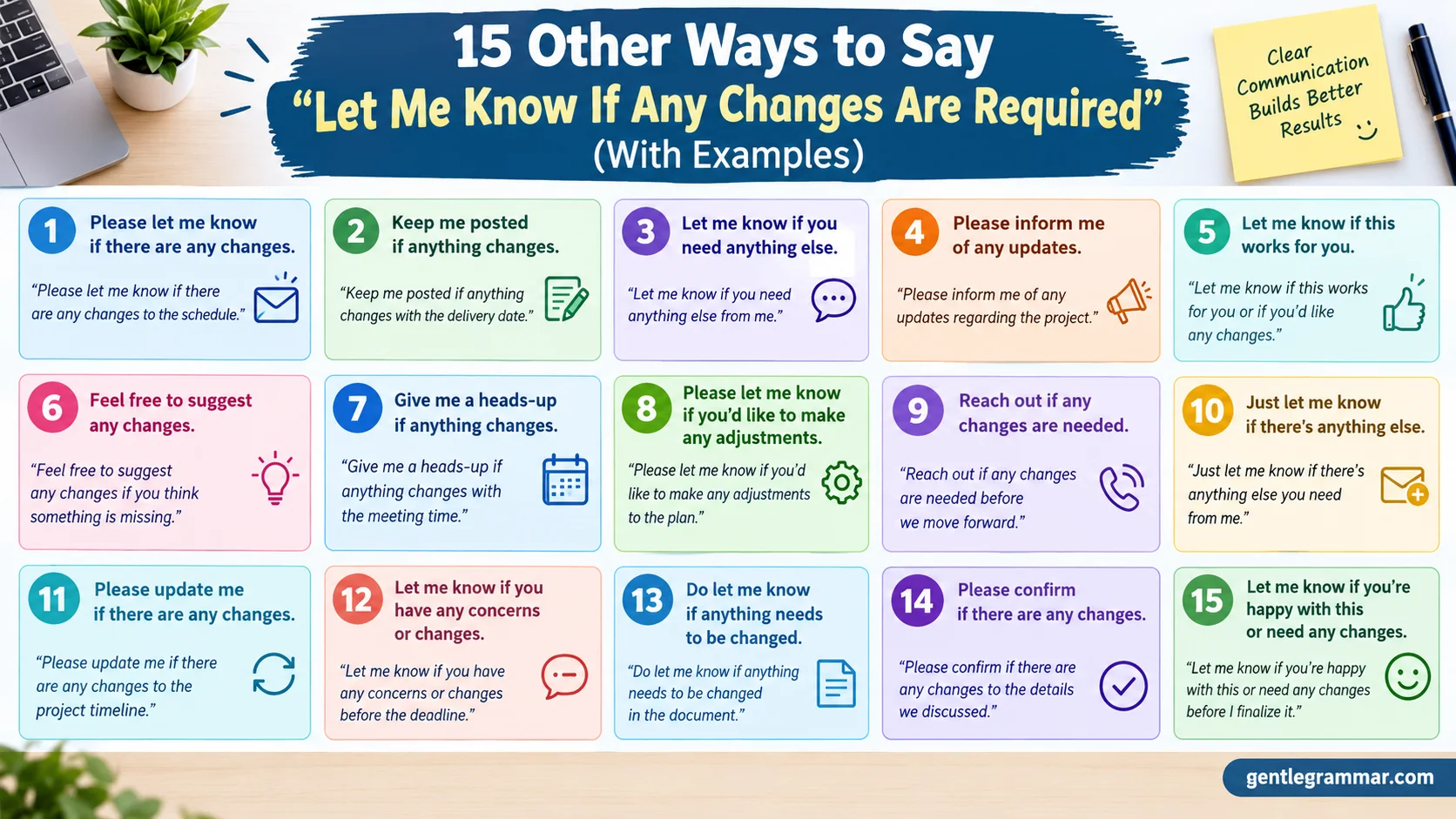
In daily writing, effective communication starts with choosing the right words for your audience and scenario.
In a digital-first workplace, email is a widely used tool for professional communication, whether you are applying for a job, communicating with clients, coordinating with teammates, or following up with leadership. I find that “let me know if any changes are required” is a clear, polite way to invite feedback after you share a document, draft, design, proposal, or completed task.
It shows openness, teamwork, and a willingness to improve your work. Good email etiquette and professional email etiquette help save time, save face, and prevent misunderstandings, delayed replies, and lost opportunities. A well-written message can sound softer, firmer, or warmer while remaining approachable and professional. These soft skills support career growth, strengthen your professional image and credibility, and may improve your response rate.
What Does “Let Me Know If Any Changes Are Required” Mean?
“Let me know if any changes are required” means asking someone to tell you if something needs to be revised, corrected, updated, or improved. It shows that you are open to feedback and willing to make adjustments when necessary. The phrase is commonly used after sharing a document, report, presentation, proposal, or completed assignment. The word “required” suggests that the changes may be necessary rather than simply optional. Depending on the context, the expression can sound professional, cooperative, and respectful. It also gives the other person an opportunity to review your work before considering it final.
Common Situations Where “Let Me Know If Any Changes Are Required” Is Used
This expression is particularly useful in workplace communication, especially when submitting drafts, reports, designs, or project updates for review. Employees may use it when sending work to a manager, while freelancers and businesses may include it in emails to clients. Students can also use similar wording when submitting assignments or asking teachers to review their work.
The phrase is suitable for emails, professional messages, and collaborative projects. However, it may sound slightly formal in casual conversations. In those situations, shorter alternatives such as “Let me know if you want anything changed” can feel more natural. Choosing the right wording helps communicate whether you are inviting feedback, offering revisions, or asking for necessary corrections.
Is It Professional or Polite to Say “Let Me Know If Any Changes Are Required”?
Yes, “let me know if any changes are required” is generally professional and polite. It communicates that you are open to feedback without pressuring the recipient to request changes. Its wording is especially appropriate for business emails, formal documents, and conversations with supervisors or clients. The phrase is somewhat formal because of the word “required,” which emphasizes necessity. In friendly workplace conversations, “Let me know if anything needs changing” may sound more conversational. If you want to encourage collaboration, “I’d be happy to make any adjustments” communicates a more personal willingness to help. The best choice depends on your relationship with the recipient and the type of work being reviewed.
Advantages and Disadvantages of Saying “Let Me Know If Any Changes Are Required”
Advantages
The phrase is clear, polite, and professional. It tells the recipient that you are open to reviewing feedback and making necessary corrections. It works well in formal emails because it does not assume that changes will be needed. It also supports collaboration by giving the other person an opportunity to identify problems before the work is finalized.
Disadvantages
The wording can feel slightly formal or impersonal in casual conversations. The word “required” may also suggest that changes are necessary rather than optional, depending on the context. Additionally, the phrase does not explicitly say that you are happy to make revisions or explain what kind of feedback would be useful. A warmer or more specific alternative may communicate your intentions more effectively.
Synonyms for “Let Me Know If Any Changes Are Required”
- Let Me Know If Anything Needs to Be Changed
- Please Let Me Know If Any Revisions Are Needed
- Let Me Know If You’d Like Any Adjustments
- Please Share Any Feedback or Suggestions
- I’m Happy to Make Any Necessary Changes
- Let Me Know If Anything Needs Updating
- Please Tell Me If Anything Should Be Revised
- Feel Free to Suggest Any Changes
- Let Me Know If You Notice Anything That Needs Correction
- Please Advise If Any Modifications Are Necessary
- I’m Open to Any Feedback You May Have
- Let Me Know If You’d Like Me to Revise Anything
- Please Let Me Know If Further Improvements Are Needed
- Let Me Know If Anything Should Be Different
- I’m Happy to Refine This Based on Your Feedback
1. Let Me Know If Anything Needs to Be Changed
Meaning
This expression asks someone to tell you if any part of your work should be different. It communicates openness to revisions without suggesting that changes are definitely necessary.
Definition
A polite request for feedback about possible changes to something you have shared.
Detailed Explanation
This is a natural, straightforward alternative that works in professional and everyday communication. Compared with the original phrase, it sounds less formal and more conversational. It allows the recipient to identify anything they would like you to change, whether it is a small detail or a larger revision. The expression is useful when you want to keep your message friendly without losing clarity.
Scenario Examples
– Scenario: You send a draft report to a colleague.
Example: I’ve attached the report. Let me know if anything needs to be changed.
– Scenario: You share a plan with a friend.
Example: Here’s the plan for Saturday. Let me know if anything needs to be changed.
Best Use
Use this phrase in emails, team messages, document reviews, and casual conversations. It is especially useful when you want a simple alternative that does not sound overly formal.
Tone
Tone: Friendly, clear, and cooperative.
The wording invites feedback in a relaxed way while showing that you are willing to make improvements.
2. Please Let Me Know If Any Revisions Are Needed
Meaning
This phrase asks the recipient to identify any parts of a document, project, or piece of work that need revision. It is particularly appropriate when the material is still being reviewed.
Definition
A polite request to be informed about changes that should be made to submitted work.
Detailed Explanation
The word “revisions” is commonly used for changes to written material, presentations, designs, and proposals. This expression sounds more formal than “let me know if anything needs to be changed.” It is useful when you want to maintain a professional tone and make the review process clear. Unlike wording that refers specifically to corrections, it can include improvements to structure, clarity, or presentation.
Scenario Examples
– Scenario: You email a proposal to your manager.
Example: I’ve attached the updated proposal. Please let me know if any revisions are needed.
– Scenario: You submit an article to an editor.
Example: Thank you for reviewing my draft. Please let me know if any revisions are needed before publication.
Best Use
This phrase works best in professional emails, editorial work, academic assignments, proposals, and formal document reviews.
Tone
Tone: Professional, polite, and respectful.
The use of “please” softens the request, while “revisions” makes it suitable for work that requires careful review.
3. Let Me Know If You’d Like Any Adjustments
Meaning
This expression invites someone to request changes according to their preferences or needs. It suggests that adjustments are possible even when the current version is already acceptable.
Definition
An informal-to-professional invitation to request modifications to something.
Detailed Explanation
The word “adjustments” often refers to smaller or targeted changes rather than completely rewriting something. The phrase sounds accommodating because it gives the recipient room to express preferences. Unlike “changes are required,” it does not imply that something is wrong or that modifications are necessary. It is particularly useful when working collaboratively on a design, schedule, plan, or presentation.
Scenario Examples
– Scenario: You send a proposed meeting schedule.
Example: I’ve arranged the meetings for next week. Let me know if you’d like any adjustments.
– Scenario: You share a draft design with a client.
Example: Here’s the first version of the brochure. Let me know if you’d like any adjustments to the layout.
Best Use
Use this expression for client projects, creative work, schedules, plans, and collaborative tasks where personal preferences may influence the final result.
Tone
Tone: Accommodating, friendly, and collaborative.
The wording emphasizes flexibility rather than the possibility of errors.
4. Please Share Any Feedback or Suggestions
Meaning
This phrase asks the recipient to share their thoughts, opinions, or ideas about your work. It welcomes both comments on the current version and recommendations for improvement.
Definition
A polite invitation for someone to provide comments or ideas that may help improve something.
Detailed Explanation
Unlike the original phrase, this expression is not limited to changes that must be made. “Feedback” can include praise, concerns, questions, or constructive criticism, while “suggestions” invites new ideas. It is useful when you want a broader review rather than a simple list of required corrections. The wording also encourages collaboration by making the recipient’s perspective part of the process.
Scenario Examples
– Scenario: You present a new project idea to your team.
Example: I’ve outlined the proposed approach. Please share any feedback or suggestions before we move forward.
– Scenario: You send a draft newsletter to a colleague.
Example: Here’s the newsletter draft. Please share any feedback or suggestions you have.
Best Use
This expression is suitable for team meetings, brainstorming sessions, project proposals, customer surveys, and document reviews.
Tone
Tone: Open, professional, and collaborative.
It encourages a two-way exchange of ideas instead of focusing only on necessary corrections.
5. I’m Happy to Make Any Necessary Changes
Meaning
This expression tells the recipient that you are willing to make changes if they are needed. It emphasizes your readiness to take action rather than simply asking for feedback.
Definition
A statement expressing willingness to revise or modify something when necessary.
Detailed Explanation
The phrase places the focus on your willingness to help. While the original expression asks the recipient to identify required changes, this alternative reassures them that you are prepared to make those changes. It is especially helpful when submitting work that may need approval. The word “necessary” keeps the statement practical by suggesting that changes will be made when there is a genuine reason for them.
Scenario Examples
– Scenario: You submit a draft policy to your supervisor.
Example: I’ve completed the first draft of the policy, and I’m happy to make any necessary changes.
– Scenario: You deliver a website design to a client.
Example: The updated design is ready for review. I’m happy to make any necessary changes based on your comments.
Best Use
Use this phrase in client emails, workplace correspondence, project submissions, and service-related communication.
Tone
Tone: Helpful, professional, and reassuring.
It demonstrates a willingness to cooperate and follow through on feedback.
6. Let Me Know If Anything Needs Updating
Meaning
This expression asks someone to identify information or material that is outdated or needs to be brought up to date. It is more specific than a general request for changes.
Definition
A request to be informed when information, records, or content requires an update.
Detailed Explanation
The word “updating” is best suited to information that may have changed over time. Examples include dates, contact details, prices, statistics, schedules, and project status reports. Unlike the original phrase, this alternative does not naturally cover every type of revision, such as changing a design’s style or rewriting an argument. It works particularly well when accuracy and current information are the main concerns.
Scenario Examples
– Scenario: You share a staff contact list.
Example: I’ve uploaded the latest contact list. Let me know if anything needs updating.
– Scenario: You send a project status document.
Example: Here’s the current project summary. Let me know if anything needs updating before Friday’s meeting.
Best Use
This phrase is appropriate for spreadsheets, databases, contact lists, reports, schedules, and shared records.
Tone
Tone: Practical, neutral, and cooperative.
Its wording focuses on keeping information accurate rather than suggesting that the work is incorrect.
7. Please Tell Me If Anything Should Be Revised
Meaning
This expression asks someone to identify material that would benefit from being revised. It is especially suitable for drafts and other work that may go through several rounds of review.
Definition
A courteous request for advice about which parts of something should be changed or improved.
Detailed Explanation
The word “revised” often refers to making considered changes to improve clarity, accuracy, or quality. This phrase sounds professional and slightly more formal than “tell me if anything needs changing.” The word “should” leaves room for judgment, rather than suggesting that every possible change is mandatory. It is a good option when you want the recipient to review the work carefully and identify meaningful improvements.
Scenario Examples
– Scenario: You submit a research summary to your instructor.
Example: I’ve completed the summary. Please tell me if anything should be revised before I submit the final version.
– Scenario: You send a company announcement to a communications manager.
Example: The announcement is ready for review. Please tell me if anything should be revised.
Best Use
Use this expression for academic writing, company announcements, formal documents, reports, and content reviews.
Tone
Tone: Respectful, thoughtful, and professional.
It encourages careful consideration without making the request sound demanding.
8. Feel Free to Suggest Any Changes
Meaning
This phrase gives someone permission to recommend changes if they think something could be improved. It communicates openness without directly asking for a detailed review.
Definition
An informal, welcoming invitation to recommend modifications.
Detailed Explanation
The expression “feel free” makes the request sound relaxed and approachable. It reassures the recipient that they can share ideas without worrying about overstepping. Compared with the original phrase, it focuses more on optional suggestions than on identifying required changes. It is especially useful when working with colleagues or people with whom you already have a comfortable professional relationship.
Scenario Examples
– Scenario: You share a draft presentation with a teammate.
Example: I’ve put the slides together. Feel free to suggest any changes before our meeting.
– Scenario: You send a dinner plan to your family.
Example: I’ve chosen the restaurant for Sunday. Feel free to suggest any changes if you have another idea.
Best Use
This phrase works well in team chats, friendly emails, collaborative projects, and informal planning conversations.
Tone
Tone: Relaxed, friendly, and inviting.
It makes suggestions feel welcome rather than making the recipient feel responsible for finding problems.
9. Let Me Know If You Notice Anything That Needs Correction
Meaning
This expression asks someone to point out mistakes or inaccuracies they find. It is more focused on correcting errors than on making optional improvements.
Definition
A request for someone to identify mistakes that should be fixed.
Detailed Explanation
The word “correction” suggests that something may be wrong, inaccurate, or inconsistent. This makes the phrase useful for proofreading and checking factual details. It is narrower than the original expression because it focuses on errors rather than broader changes to style, structure, or preference. Choose it when accuracy matters more than creative feedback.
Scenario Examples
– Scenario: You share a report containing figures and calculations.
Example: I’ve checked the figures in the report. Let me know if you notice anything that needs correction.
– Scenario: You ask a colleague to proofread a document.
Example: Could you review this document and let me know if you notice anything that needs correction?
Best Use
Use this expression for proofreading, data checking, financial reports, factual documents, and quality-control reviews.
Tone
Tone: Precise, professional, and attentive.
The wording shows that you want errors identified so they can be corrected.
10. Please Advise If Any Modifications Are Necessary
Meaning
This phrase asks the recipient to inform you if something must be modified. It is particularly appropriate for formal correspondence and situations where a decision or approval is expected.
Definition
A formal request for guidance about whether changes need to be made.
Detailed Explanation
The expression uses “advise” in the sense of providing guidance or information. “Modifications” sounds formal and often refers to specific alterations to a plan, proposal, process, or document. Compared with the original phrase, this version is more businesslike and less conversational. It may sound stiff in a friendly chat, but it can fit well in formal workplace correspondence when a professional tone is important.
Scenario Examples
– Scenario: You send a revised contract draft for review.
Example: Please review the attached draft and advise if any modifications are necessary.
– Scenario: You submit a proposed project timeline.
Example: I’ve attached the proposed timeline. Please advise if any modifications are necessary before approval.
Best Use
This phrase is best suited to formal business emails, administrative communication, project approvals, and procedural documents.
Tone
Tone: Formal, respectful, and direct.
It communicates a request for guidance in a structured professional setting.
11. I’m Open to Any Feedback You May Have
Meaning
This expression tells someone that you welcome their opinions, observations, and suggestions. It shows that you are willing to listen, even if the feedback goes beyond specific changes.
Definition
A statement indicating that you are receptive to another person’s comments or evaluation.
Detailed Explanation
This phrase emphasizes receptiveness rather than immediate revision. It is useful when you want to encourage honest opinions without implying that every suggestion will automatically be adopted. Unlike the original wording, it welcomes general impressions, questions, and positive comments as well as recommendations for improvement. It can also help create a collaborative atmosphere when you are seeking input early in a project.
Scenario Examples
– Scenario: You present a new idea to your department.
Example: That’s the initial proposal. I’m open to any feedback you may have before we develop it further.
– Scenario: You share a draft with a trusted colleague.
Example: I’ve written the first version of the article, and I’m open to any feedback you may have.
Best Use
Use this expression for brainstorming, presentations, project discussions, peer reviews, and collaborative planning.
Tone
Tone: Receptive, thoughtful, and collaborative.
It shows that you value another person’s perspective without limiting the conversation to corrections.
12. Let Me Know If You’d Like Me to Revise Anything
Meaning
This expression invites the recipient to request specific revisions. It makes clear that you are willing to take responsibility for modifying your work.
Definition
A polite offer to revise particular parts of something if the recipient wants changes.
Detailed Explanation
The phrase is especially useful when someone has the authority to approve or review your work. “You’d like me to” makes the recipient’s preference central, while “revise” signals that the changes may involve more than simple corrections. Unlike wording that refers to necessary changes, this expression also allows for optional refinements. It sounds helpful without promising that every possible suggestion will automatically be implemented.
Scenario Examples
– Scenario: You submit a presentation to your manager.
Example: I’ve finished the presentation for Monday. Let me know if you’d like me to revise anything.
– Scenario: You send a draft proposal to a client.
Example: The proposal is attached for your review. Let me know if you’d like me to revise anything before we finalize it.
Best Use
This phrase works well for drafts, presentations, proposals, client work, and assignments submitted for review.
Tone
Tone: Helpful, professional, and accommodating.
It makes your willingness to make changes explicit while leaving the decision to the recipient.
13. Please Let Me Know If Further Improvements Are Needed
Meaning
This expression asks whether additional improvements would make the work better. It suggests that the current version is already developed but may still benefit from refinement.
Definition
A polite request to be informed if additional steps are needed to improve something.
Detailed Explanation
The word “further” indicates that some work has already been completed or improvements have already been made. This phrase is useful when presenting an updated version after addressing earlier feedback. Compared with the original expression, it emphasizes the quality of the result rather than simply whether changes are required. It can sound more constructive because it frames possible changes as improvements instead of corrections.
Scenario Examples
– Scenario: You submit a revised training document.
Example: I’ve incorporated the feedback from our last meeting. Please let me know if further improvements are needed.
– Scenario: You share a completed website page.
Example: The updated page is ready for review. Please let me know if further improvements are needed.
Best Use
Use this expression for revised reports, project updates, website content, business proposals, and work that has already undergone review.
Tone
Tone: Constructive, professional, and improvement-focused.
It communicates that you are willing to refine the work further if doing so would add value.
14. Let Me Know If Anything Should Be Different
Meaning
This expression invites someone to point out anything they would prefer to be done differently. It is broad and can refer to plans, arrangements, creative choices, or other decisions.
Definition
A casual request for someone to identify aspects they would prefer to change.
Detailed Explanation
This alternative focuses on preferences and expectations, rather than errors or mandatory revisions. It sounds natural in everyday English because the wording is simple and direct. Compared with the original phrase, it is less formal and may be better suited to situations where several options could be acceptable. However, it may be too vague for a formal review that requires specific corrections or documented changes.
Scenario Examples
– Scenario: You organize a weekend outing with friends.
Example: I’ve booked the tickets for Saturday. Let me know if anything should be different.
– Scenario: You suggest a schedule for a small team.
Example: Here’s my proposed schedule for next week. Let me know if anything should be different.
Best Use
This phrase is suitable for casual planning, group arrangements, friendly messages, and collaborative decisions.
Tone
Tone: Casual, open, and considerate.
It invites people to express preferences without suggesting that the current arrangement is wrong.
15. I’m Happy to Refine This Based on Your Feedback
Meaning
This expression tells someone that you are willing to improve or polish your work using their comments and suggestions. It emphasizes an active, collaborative approach to refinement.
Definition
A statement offering to improve something in response to another person’s feedback.
Detailed Explanation
The word “refine” usually means making something better through careful, often small adjustments. This expression is particularly effective when the work is already reasonably complete but could benefit from another round of improvement. Unlike the original phrase, it explicitly connects the next changes to the recipient’s feedback. It sounds warm and constructive, making it a good option for collaborative projects and client relationships.
Scenario Examples
– Scenario: You send a branding concept to a client.
Example: I’ve attached the initial branding concepts. I’m happy to refine this based on your feedback.
– Scenario: You share a draft article with an editor.
Example: Thank you for reviewing the draft. I’m happy to refine it based on your feedback.
Best Use
Use this expression for creative projects, writing, design work, client presentations, and collaborative assignments.
Tone
Tone: Warm, professional, and collaborative.
It communicates a genuine willingness to use feedback to produce a more polished result.
FAQs:
What is another way to say “Let Me Know If Any Changes Are Required”?
A natural alternative is “Let me know if anything needs to be changed.” For a more formal email, use “Please let me know if any revisions are needed.” If you want to emphasize your willingness to help, try “I’m happy to make any necessary changes.”
What does “Let Me Know If Any Changes Are Required” mean?
It means asking someone to tell you if something needs to be changed, corrected, updated, or improved. It is commonly used when submitting documents, reports, proposals, or other work for review.
Is “Let Me Know If Any Changes Are Required” professional?
Yes. It is generally professional and polite, particularly in workplace emails and document submissions. However, “Please let me know if any revisions are needed” may sound more polished in formal correspondence, while “Let me know if anything needs changing” is more conversational.
What is a more polite way to say “Let Me Know If Any Changes Are Required”?
You could say, “Please let me know if you would like any revisions.” Another courteous option is “I’d be happy to make any adjustments you suggest.” Both expressions invite feedback while showing consideration for the recipient.
Which alternative works best in formal communication?
“Please let me know if any revisions are needed” is an excellent choice for formal communication. For situations involving approval or official decisions, “Please advise if any modifications are necessary” may also be appropriate. Choose the wording that best matches the relationship and purpose of your message.
Conclusion:
Choosing the right wording can make your communication clearer, more natural, and more considerate. Although “let me know if any changes are required” is a useful professional expression, other phrases can better communicate your specific intention. You might ask for revisions when submitting a document, invite feedback when discussing a new idea, or offer to refine a project when working with a client.
The important difference is whether you are asking for corrections, welcoming suggestions, or expressing your willingness to improve something. For most everyday workplace messages, “Please let me know if any revisions are needed” is a reliable choice. When a warmer tone feels appropriate, “I’m happy to make any necessary changes” works well. Always consider your audience, the purpose of your message, and the kind of response you hope to receive.
