
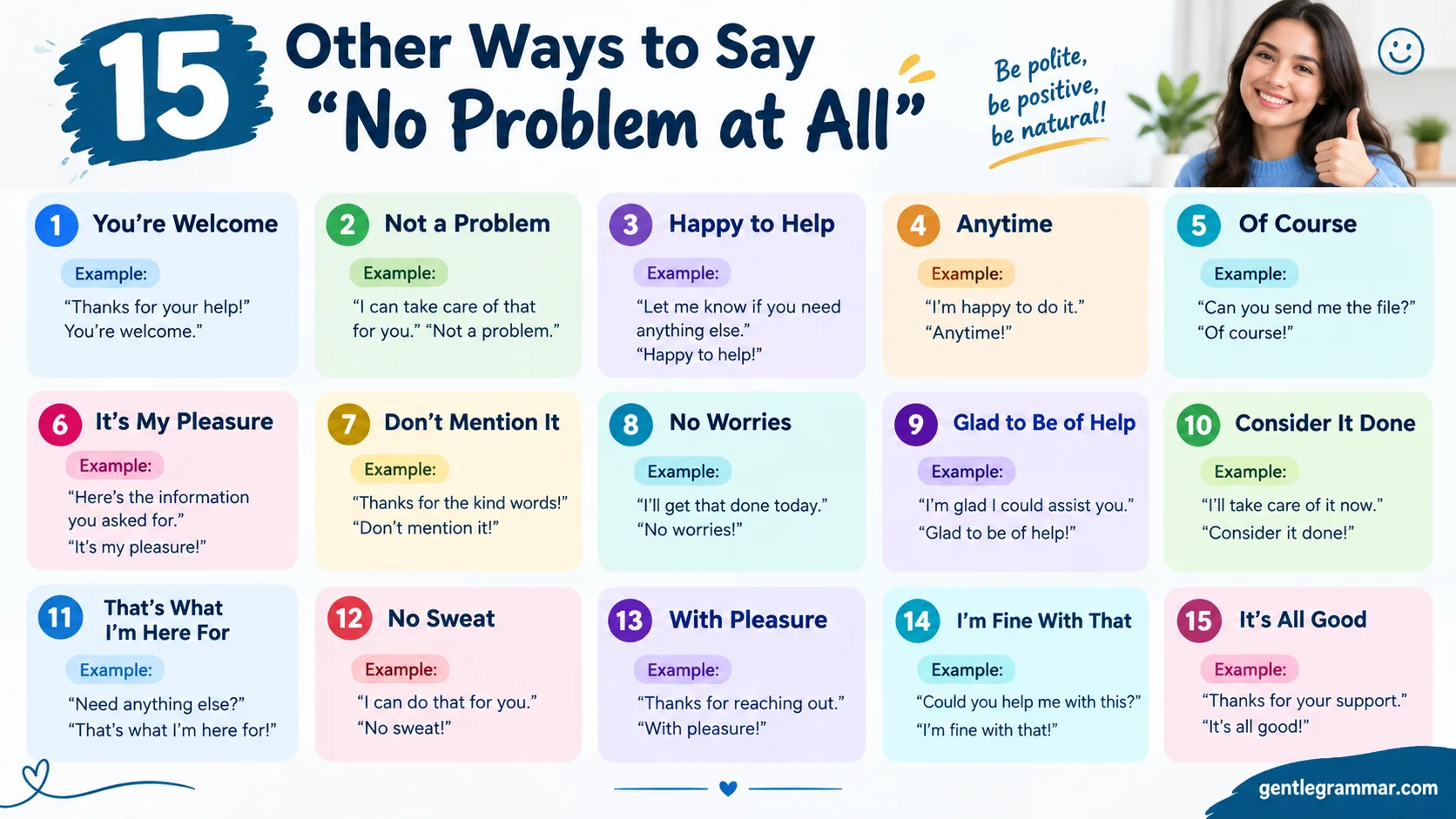
In everyday conversations, Other Ways to Say “No Problem at All” can help you communicate with friends, colleagues, and clients while adding professionalism and a touch of charm.
People always say no problem when chatting, but eight alternative expressions can make your responses more polite, friendly, and versatile. These different phrases include casual alternatives, formal expressions, and the ordinary you’re welcome, giving your English language a more on point style. When you use these expressions in the right situation, conversations can become smoother and more engaging, while an article like this can provide a handy list for incorporating useful phrases into English conversations.
When you say no problem, you show willingness to help and assure others that their concerns are unnecessary. People may use this response for requests, to show nothing wrong, or as a form of agreement. Using this informal expression is helpful in a casual setting, but a professional setting may need a most professional response. A request can be easy and manageable, yet the words may not show the effort involved in addressing or addressing it.
What Does “No Problem at All” Mean?
“No problem at all” is a reassuring expression that means something was not difficult, inconvenient, or troublesome. It is often used when someone thanks you, apologizes for something minor, or worries that they have caused an inconvenience. For example, if a friend says, “Thanks for helping me move,” you might respond, “No problem at all,” to show that you were happy to help and did not consider it a burden.
The phrase can also reassure someone after an apology. If a colleague says, “Sorry for asking you to stay a few extra minutes,” saying “No problem at all” communicates that the request was acceptable and did not bother you. The expression is generally friendly, casual, and reassuring, although its appropriateness depends on the situation and the relationship between the speakers.
Common Situations Where “No Problem at All” Is Used
People commonly use “No problem at all” in everyday conversations, text messages, friendly emails, workplace discussions, and customer communication. It works particularly well when someone says “thank you” or “sorry” and you want to reassure them that their request, mistake, or inconvenience was not an issue.
For example, a friend might thank you for picking them up, a coworker might apologize for interrupting you, or a customer might thank you for answering a question. In each case, “No problem at all” creates a relaxed and positive response.
Sometimes, however, you may want different wording. “You’re welcome” can respond directly to gratitude, while “It’s no trouble” emphasizes that helping did not create an inconvenience. “My pleasure” sounds warmer and more polished, whereas “No worries” is more casual. The best alternative depends on what you actually want to communicate.
Is It Professional or Polite to Say “No Problem at All”?
Yes, “No problem at all” is generally polite and friendly, but it is more conversational than formal. It is perfectly natural in everyday speech and can work well in relaxed workplace communication, especially when speaking with familiar colleagues. It can also sound reassuring when someone apologizes or worries that they have inconvenienced you.
In more formal communication, alternatives such as “You’re very welcome,” “It’s my pleasure,” or “It was no trouble” may sound more polished. That does not make “No problem at all” incorrect; it simply gives you fewer formal nuances than some other expressions. Context matters, so consider your relationship with the recipient, the purpose of the message, and the level of formality expected.
Advantages and Disadvantages of Saying “No Problem at All”
Advantages
One major advantage of “No problem at all” is its reassuring quality. It quickly tells the other person that you are not upset or inconvenienced. The phrase is also easy to understand and works naturally in spoken English, texting, and informal written communication. It can respond to both thanks and minor apologies, making it versatile in everyday interactions.
Disadvantages
The main limitation is that the phrase can sometimes sound too casual for highly formal communication. It may also be less warm than expressions such as “My pleasure” when someone has thanked you for a meaningful favor. In some situations, repeatedly saying “No problem” can unintentionally suggest that the other person’s request could have been a problem, even though that is not usually the speaker’s intention. Choosing a more specific response can make your message feel more thoughtful.
Synonyms for “No Problem at All”
- You’re Welcome
- Not at All
- No Worries
- It’s No Trouble
- Don’t Mention It
- My Pleasure
- Happy to Help
- Anytime
- Of Course
- That’s Okay
- It’s Perfectly Fine
- No Big Deal
- Glad to Help
- Not a Problem
- You Got It
1. You’re Welcome
Meaning
“You’re welcome” is a standard response to someone who thanks you. Like “No problem at all,” it reassures the other person that their gratitude is appreciated and that you were willing to help.
Definition
“You’re welcome” means “I am glad I could help” or “There is no need to thank me further.”
Detailed Explanation
This is one of the most natural responses when the other person has explicitly said “thank you.” Unlike “No problem at all,” it does not focus on whether the favor caused difficulty. Instead, it directly acknowledges the person’s gratitude. It works in both casual and professional settings, making it a particularly versatile choice.
Scenario Examples
Scenario: A coworker thanks you for sending a document.
Example: “Thanks for sending that over so quickly.”
“You’re welcome. Glad you received it.”
Scenario: A friend thanks you for giving them a ride.
Example: “Thanks for driving me home.”
“You’re welcome! Anytime.”
Scenario: A customer thanks an employee for answering a question.
Example: “Thank you for explaining that.”
“You’re welcome. I’m happy to clarify.”
Best Use
Use “You’re welcome” when someone has thanked you. It is suitable for everyday conversations, workplace communication, customer service, emails, and polite interactions.
Tone
Tone: Polite, friendly, neutral
It is a dependable expression that sounds courteous without being overly formal or emotional.
2. Not at All
Meaning
“Not at all” reassures someone that something was not a bother, inconvenience, or difficulty. It is especially useful when responding to an apology or a polite expression of concern.
Definition
“Not at all” means “It was no trouble” or “You did not inconvenience me.”
Detailed Explanation
This expression can be slightly more polished than “No problem at all.” It is particularly natural when someone says “Sorry to bother you” or asks whether something was inconvenient. It can also respond to thanks, although “You’re welcome” is more directly associated with gratitude. The meaning depends on the context and the sentence that came before it.
Scenario Examples
Scenario: Someone apologizes for interrupting you.
Example: “Sorry to interrupt you for a moment.”
“Not at all. What do you need?”
Scenario: A guest worries about asking for assistance.
Example: “I hope I’m not causing any trouble.”
“Not at all. I’d be glad to help.”
Best Use
Use “Not at all” for polite conversations, apologies, requests, and situations where you want to reassure someone.
Tone
Tone: Polite, calm, slightly formal
Its concise wording gives it a more polished feel than some highly casual alternatives.
3. No Worries
Meaning
“No worries” tells someone that something is fine and does not need further concern. It is a relaxed alternative to “No problem at all.”
Definition
“No worries” means “Don’t worry about it; everything is okay.”
Detailed Explanation
This expression is especially common in casual spoken English and texting. It can respond to a thank-you, an apology, a small change of plans, or a minor mistake. Compared with “No problem at all,” it places more emphasis on removing the other person’s concern than on saying the task was easy.
Scenario Examples
Scenario: A friend apologizes for arriving late.
Example: “Sorry I’m ten minutes late.”
“No worries. We just got here.”
Scenario: Someone thanks you for covering a small task.
Example: “Thanks for taking care of that.”
“No worries! Happy to do it.”
Scenario: A friend needs to change plans.
Example: “Can we move our meeting to tomorrow?”
“No worries. Tomorrow works for me.”
Best Use
Use “No worries” in texting, casual conversation, friendly messages, and relaxed workplace settings.
Tone
Tone: Casual, warm, reassuring
It sounds easygoing and approachable, so it is usually better suited to informal situations than formal correspondence.
4. It’s No Trouble
Meaning
“It’s no trouble” emphasizes that helping or doing something did not cause difficulty or inconvenience.
Definition
“It’s no trouble” means “It was not inconvenient or difficult for me.”
Detailed Explanation
This expression is closely related to “No problem at all” because both reassure someone that their request was acceptable. However, “It’s no trouble” specifically highlights the absence of inconvenience. It can sound a little more polished than “No worries,” making it useful in polite personal and professional interactions.
Scenario Examples
Scenario: A neighbor asks for a small favor.
Example: “Thanks for bringing my package inside.”
“It’s no trouble. I was already outside.”
Scenario: A customer thanks an employee for checking something.
Example: “Thank you for checking that for me.”
“It’s no trouble at all.”
Best Use
Use “It’s no trouble” for polite conversations, customer interactions, workplace communication, and everyday favors.
Tone
Tone: Polite, reassuring, considerate
It communicates that the favor required little inconvenience without sounding excessively casual.
5. Don’t Mention It
Meaning
“Don’t mention it” tells someone that there is no need to thank you or keep talking about the favor.
Definition
“Don’t mention it” means “You don’t need to thank me for that.”
Detailed Explanation
This expression is traditionally used after someone thanks you. It can sound warm and generous because it suggests that the favor was not important enough to require continued gratitude. Unlike “No problem at all,” it is primarily connected with responding to thanks, not reassuring someone about an apology or inconvenience.
Scenario Examples
Scenario: A colleague thanks you for helping with a presentation.
Example: “Thanks for staying late to help me finish this.”
“Don’t mention it. We got it done together.”
Scenario: A friend thanks you for lending them a book.
Example: “Thanks for letting me borrow your book.”
“Don’t mention it. I’m glad you enjoyed it.”
Best Use
Use “Don’t mention it” when someone expresses gratitude for a favor or kindness.
Tone
Tone: Friendly, gracious, traditional
It can sound slightly old-fashioned in some contexts, but it remains a natural and understandable expression.
6. My Pleasure
Meaning
“My pleasure” communicates that you were genuinely happy to help. It is warmer and more gracious than simply saying that something was not a problem.
Definition
“My pleasure” means “I was happy to do it.”
Detailed Explanation
This phrase is often used when you want to make your response feel more positive and intentional. Rather than focusing on the absence of inconvenience, it emphasizes your willingness and enjoyment. It works particularly well in customer service and polished professional communication, but it can also sound warm in personal conversations.
Scenario Examples
Scenario: A customer thanks you for your assistance.
Example: “Thank you for helping me find the right option.”
“My pleasure. I’m glad I could help.”
Scenario: A friend thanks you for organizing a small celebration.
Example: “Thanks for putting everything together.”
“My pleasure. It was fun to plan.”
Best Use
Use “My pleasure” in customer service, professional conversations, polite emails, and situations where you want to sound especially gracious.
Tone
Tone: Warm, courteous, polished
It gives the impression that helping was willingly offered rather than merely tolerated.
7. Happy to Help
Meaning
“Happy to help” communicates that you were willing and pleased to provide assistance.
Definition
“Happy to help” means “I was glad to assist you.”
Detailed Explanation
This expression is especially useful when the interaction involves actual assistance. It is more specific than “No problem at all” because it directly states your positive attitude toward helping. It works naturally in professional communication, customer service, workplace messages, and friendly conversations.
Scenario Examples
Scenario: A coworker thanks you for reviewing a document.
Example: “Thanks for checking my report.”
“Happy to help. Let me know if you want another pair of eyes.”
Scenario: A customer thanks a support representative.
Example: “Thank you for walking me through the process.”
“Happy to help. I’m glad we got it sorted out.”
Scenario: A friend thanks you for helping with a project.
Example: “Thanks for helping me move those boxes.”
“Happy to help!”
Best Use
Use “Happy to help” for workplace communication, customer service, professional emails, and situations involving assistance.
Tone
Tone: Friendly, professional, supportive
It combines warmth with a useful level of professionalism, making it adaptable to many settings.
8. Anytime
Meaning
“Anytime” suggests that you would be willing to help again in the future.
Definition
“Anytime” means “Feel free to ask me again whenever you need help.”
Detailed Explanation
This expression goes slightly beyond “No problem at all.” Instead of simply saying that the current favor was acceptable, it communicates future willingness. It is particularly natural among friends, family members, and familiar coworkers. It may sound too informal for some highly formal business situations.
Scenario Examples
Scenario: A friend thanks you for helping them prepare for an interview.
Example: “Thanks for practicing those questions with me.”
“Anytime. I hope the interview goes well.”
Scenario: A coworker thanks you for helping with a task.
Example: “I really appreciate your help.”
“Anytime. Just let me know if you need anything else.”
Best Use
Use “Anytime” in friendly conversations, texting, informal workplace communication, and personal relationships.
Tone
Tone: Casual, generous, friendly
It sounds open and welcoming, especially when you want to signal that you are available to help again.
9. Of Course
Meaning
“Of course” can reassure someone that their request was completely reasonable and natural.
Definition
“Of course” means “Certainly” or “Naturally, I was willing to do that.”
Detailed Explanation
This expression is often used when someone thanks you for doing something or asks for a favor that you are happy to provide. It can sound warmer than “No problem at all” when spoken with a friendly tone. However, because “of course” has several uses in English, its exact meaning depends heavily on context and delivery.
Scenario Examples
Scenario: A friend thanks you for helping them study.
Example: “Thanks for going over those questions with me.”
“Of course! I’m glad I could help.”
Scenario: A colleague asks whether you can send the file again.
Example: “Could you send that attachment one more time?”
“Of course. I’ll send it now.”
Best Use
Use “Of course” in everyday conversation, workplace communication, friendly messages, and responses to reasonable requests.
Tone
Tone: Friendly, confident, accommodating
It can sound very natural and reassuring, although the speaker’s tone of voice matters because a sarcastic delivery can change its meaning.
10. That’s Okay
Meaning
“That’s okay” tells someone that a situation, mistake, or inconvenience is acceptable.
Definition
“That’s okay” means “It is fine; you do not need to worry.”
Detailed Explanation
This phrase is especially useful when someone apologizes or expresses concern. It is not always a direct replacement for “No problem at all” after a thank-you because it focuses more on accepting a situation than acknowledging gratitude. When used warmly, it can be comforting and reassuring.
Scenario Examples
Scenario: A friend accidentally forgets to bring something.
Example: “I’m sorry, I forgot to bring the charger.”
“That’s okay. We can use mine.”
Scenario: A colleague apologizes for making a small mistake.
Example: “Sorry, I entered the wrong date.”
“That’s okay. We can correct it.”
Scenario: Someone cancels a casual plan.
Example: “I’m sorry, I can’t make it tonight.”
“That’s okay. We can meet another day.”
Best Use
Use “That’s okay” for apologies, minor mistakes, changes of plans, and reassuring personal conversations.
Tone
Tone: Gentle, accepting, reassuring
It works best when you genuinely want to communicate that the situation is acceptable.
11. It’s Perfectly Fine
Meaning
“It’s perfectly fine” strongly reassures someone that something is completely acceptable.
Definition
“It’s perfectly fine” means “There is absolutely nothing wrong with it.”
Detailed Explanation
This phrase is useful when you want to give someone stronger reassurance than “That’s okay.” The word “perfectly” adds emphasis, making the expression especially suitable when someone is worried that they have inconvenienced you. It can be used in personal and professional settings, although a friendly delivery keeps it from sounding stiff.
Scenario Examples
Scenario: A colleague asks whether it is okay to move a meeting.
Example: “Would it be okay if we moved our meeting to Thursday?”
“It’s perfectly fine. Thursday works for me.”
Scenario: A friend apologizes for taking extra time.
Example: “Sorry I kept you waiting.”
“It’s perfectly fine. I wasn’t in a hurry.”
Best Use
Use “It’s perfectly fine” when someone needs clear reassurance, particularly in polite conversations and workplace situations.
Tone
Tone: Reassuring, polite, composed
The expression sounds more deliberate than “No worries” and can be useful when you want your reassurance to be unmistakable.
12. No Big Deal
Meaning
“No big deal” means that something was minor or not important enough to worry about.
Definition
“No big deal” means “It was not important or troublesome.”
Detailed Explanation
This is a strongly casual expression and is often used among friends or familiar coworkers. It can minimize the importance of a favor, mistake, delay, or inconvenience. While that relaxed quality can be useful, it may not be appropriate when someone is expressing deep gratitude for something significant.
Scenario Examples
Scenario: A friend thanks you for sharing some notes.
Example: “Thanks for sending me your notes.”
“No big deal. Hope they help.”
Scenario: Someone apologizes for a short delay.
Example: “Sorry I made you wait five minutes.”
“No big deal. I was checking my messages anyway.”
Best Use
Use “No big deal” in casual conversation, texting, friendships, and relaxed social situations.
Tone
Tone: Very casual, relaxed, easygoing
It makes the situation sound small and unimportant, which is useful when you want to keep the conversation light.
13. Glad to Help
Meaning
“Glad to help” expresses genuine satisfaction that you were able to assist someone.
Definition
“Glad to help” means “I’m pleased that I could assist you.”
Detailed Explanation
This phrase is similar to “Happy to help,” but “glad” can sound slightly more appreciative or reflective. It works particularly well after someone thanks you for assistance. It focuses on your positive reaction to being useful rather than simply saying that the task caused no trouble.
Scenario Examples
Scenario: A coworker thanks you for explaining a process.
Example: “Thanks for showing me how to submit the request.”
“Glad to help. It can be confusing the first time.”
Scenario: A customer thanks you for resolving an issue.
Example: “I appreciate you sorting that out.”
“Glad to help. I’m pleased we found a solution.”
Best Use
Use “Glad to help” in professional communication, customer service, workplace conversations, and friendly exchanges.
Tone
Tone: Warm, helpful, professional
It communicates willingness and goodwill without sounding overly formal.
14. Not a Problem
Meaning
“Not a problem” means that something did not cause difficulty, inconvenience, or annoyance.
Definition
“Not a problem” means “It is completely fine” or “It did not cause me any trouble.”
Detailed Explanation
This is one of the closest everyday alternatives to “No problem at all.” It can be used after both thanks and minor apologies, depending on the context. The phrase is generally casual and direct, while adding “at all” to the original makes the reassurance slightly stronger.
Scenario Examples
Scenario: A colleague asks you to resend a document.
Example: “Sorry, could you send that file again?”
“Not a problem. I’ll resend it now.”
Scenario: A friend thanks you for picking something up.
Example: “Thanks for grabbing that for me.”
“Not a problem!”
Scenario: A customer apologizes for asking another question.
Example: “Sorry to ask one more thing.”
“Not a problem. What would you like to know?”
Best Use
Use “Not a problem” in everyday speech, workplace conversations, customer interactions, and informal messages.
Tone
Tone: Friendly, direct, casual
It is simple and versatile, although a more formal setting may call for a more polished expression.
15. You Got It
Meaning
“You got it” communicates that you understand a request and are willing to take care of it.
Definition
“You got it” means “Certainly; I’ll take care of that.”
Detailed Explanation
Unlike “No problem at all,” this phrase is most natural before or immediately after agreeing to a request rather than simply responding to gratitude. It conveys confidence and readiness to act. Because it is highly conversational, it works best in friendly or relaxed professional environments.
Scenario Examples
Scenario: A coworker asks you to print a document.
Example: “Could you print three copies of this?”
“You got it. I’ll bring them over shortly.”
Scenario: A friend asks you to bring something to dinner.
Example: “Can you bring some extra napkins?”
“You got it!”
Scenario: A customer makes a simple request.
Example: “Could you update the address on the order?”
“You got it. I’ll take care of that.”
Best Use
Use “You got it” for casual requests, friendly communication, customer service, and relaxed workplace interactions.
Tone
Tone: Casual, confident, upbeat
It sounds energetic and cooperative, making it particularly natural in spoken English.
FAQs:
What is another way to say “No Problem at All”?
Natural alternatives include “You’re welcome,” “No worries,” “It’s no trouble,” “My pleasure,” and “Happy to help.” The best choice depends on the context. For example, “You’re welcome” works especially well after thanks, while “That’s okay” is more appropriate after a minor apology.
What does “No Problem at All” mean?
“No problem at all” means that something was not difficult, inconvenient, or troublesome. People often use it to reassure someone after a request, favor, thank-you, or minor apology.
Is “No Problem at All” professional?
Yes, but it is generally conversational rather than highly formal. It can work well in relaxed workplace communication, but expressions such as “You’re very welcome,” “My pleasure,” or “It was no trouble” may sound more polished in formal situations.
What is a more polite way to say “No Problem at All”?
Depending on the situation, “My pleasure,” “You’re very welcome,” “It’s no trouble,” or “Not at all” can sound especially polite. “My pleasure” emphasizes that you were happy to help, while “Not at all” is useful when reassuring someone that they did not inconvenience you.
Which alternative works best in formal communication?
There is no single alternative that fits every formal situation. “You’re welcome,” “My pleasure,” and “It’s no trouble” can all work well, depending on whether you are responding to gratitude or reassuring someone about an inconvenience. The relationship, setting, and purpose of the message should guide your choice.
Conclusion:
“No problem at all” is a useful, friendly expression, but the right alternative can give your response a more precise tone. “You’re welcome” directly answers gratitude, “It’s no trouble” reassures someone about an inconvenience, and “My pleasure” adds warmth and graciousness. More casual choices such as “No worries,” “No big deal,” and “You got it” work naturally in relaxed conversations.
The key is to consider context, relationship, formality, and emotional tone before choosing your wording. Similar expressions do not always communicate exactly the same idea. When you choose an alternative thoughtfully, your response can feel clearer, warmer, and more natural. Whether you say “No problem at all” or another expression, the most useful wording is the one that accurately reflects what you mean.
