
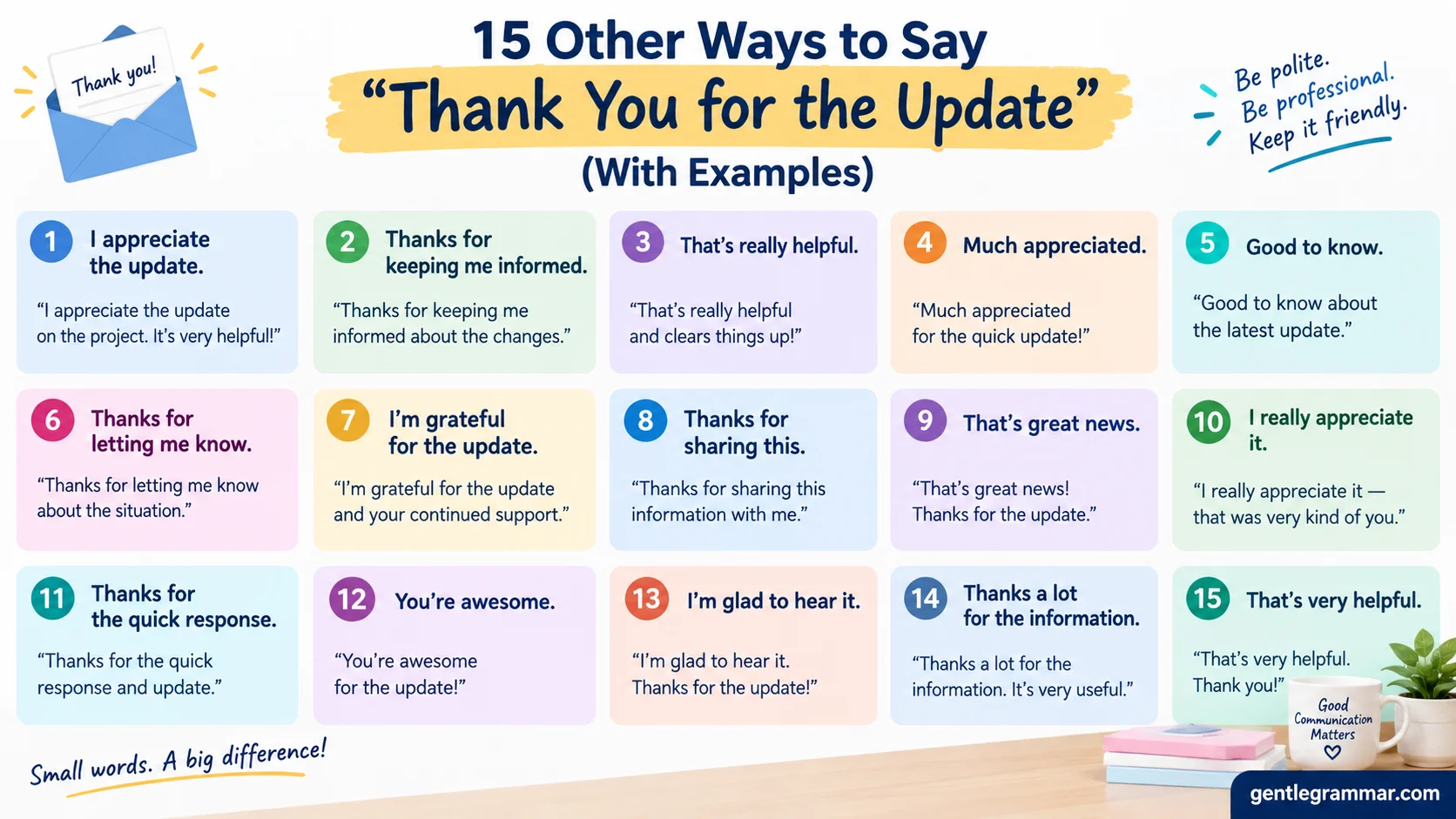
Other Ways to Say “Thank You for the Update” can help express appreciation naturally when receiving new information in work-related or personal conversations.
In my experience, this commonly used English simple phrase shows appreciation after receiving, sharing, or discussing new information. This small, steady gesture supports staying present, staying connected, courtesy, respect, and honest gratitude across business communication, workplace communication, personal communication, emails, chats, meetings, and everyday conversations.
When receiving an update, a recipient can give a thoughtful response that recognizes the sender’s effort and builds trust. An update response or acknowledgment message can show that you received, understood, and paid attention to the message, instruction, or news. Well Noted may suit formal messages, work replies, and professional emails, although it can sound short or serious. Using better words, polite phrases, and softer alternatives can make your response more natural.
What Does “Thank You for the Update” Mean?
“Thank you for the update” is a polite expression used to show appreciation when someone gives you new information about a situation, task, event, decision, or ongoing matter. An “update” usually means information that brings you up to date with what has happened or what is currently happening.
For example, if a coworker tells you that a project deadline has changed, you might reply, “Thank you for the update.” If a friend tells you that their travel plans have changed, the same phrase can acknowledge the information in a friendly way. In professional communication, it can also recognize someone’s effort to keep you informed without adding unnecessary detail.
The phrase is generally neutral, polite, and flexible. It does not necessarily express strong emotion. Depending on the context, it can sound professional in an email, friendly in a conversation, or slightly formal in a text message. Alternatives can add more warmth, informality, gratitude, or specificity when the basic phrase does not quite express what you want to say.
Common Situations Where “Thank You for the Update” Is Used
“Thank you for the update” is especially common when communication involves ongoing information. At work, someone might use it after receiving a project report, a scheduling change, a progress update, or information about a meeting. It works well when you want to acknowledge the message before moving on to your next point.
The phrase is also useful in customer communication. A customer service representative may receive new information about an order or problem and respond with the expression to acknowledge it politely. Likewise, a customer can use it when a company provides information about delivery, a refund, an appointment, or a service request.
In everyday communication, the phrase can be used with friends, family members, classmates, or acquaintances. However, in very casual situations, expressions such as “Thanks for letting me know” or “Thanks for the heads-up” may sound more natural.
The phrase can also appear in formal writing and email correspondence. When the purpose is simply to acknowledge receipt of new information, it is concise and appropriate. Someone may choose an alternative when they want to sound more appreciative, more conversational, more personal, or more specific about why the information was useful.
Is It Professional or Polite to Say “Thank You for the Update”?
Yes. “Thank you for the update” is both polite and professional in most workplace and formal communication settings. It acknowledges the information someone has provided without sounding overly emotional or excessively familiar. This makes it particularly useful in emails, project discussions, business correspondence, customer service conversations, and communication with people you do not know well.
Its tone is generally respectful, neutral, and straightforward. It can also be friendly, depending on the surrounding message. For example, “Thank you for the update. I’ll review the revised schedule this afternoon” sounds professional, while “Thank you for the update! I’m glad to hear everything worked out” sounds warmer.
The expression is not necessarily the most casual choice. When talking with a close friend, “Thanks for letting me know” may feel more relaxed. When someone has gone out of their way to help you, “I really appreciate you keeping me informed” may communicate more gratitude. The best wording depends on the relationship, situation, and feeling you want to convey.
Advantages and Disadvantages of Saying “Thank You for the Update”
Advantages
One major advantage is its versatility. “Thank you for the update” can be used in professional emails, workplace conversations, customer messages, school communication, and many everyday situations. It is also easy to understand and does not require the recipient to interpret a complicated expression.
Another benefit is its neutral tone. The phrase acknowledges new information without making assumptions about the situation. It can be used whether the update is good, bad, routine, or simply informative. It also gives the recipient a polite acknowledgment before you respond to the substance of the message.
Disadvantages
The main limitation is that the phrase can sometimes feel routine or formulaic, especially if you use it repeatedly in emails. It communicates appreciation, but it does not always show how useful, important, or welcome the information was.
It may also be less suitable when you want a strongly casual or personal tone. In those situations, an expression such as “Thanks for letting me know” can sound more conversational, while “I really appreciate the update” can convey stronger gratitude. The original phrase is effective, but the right alternative can add a more precise emotional or contextual nuance.
Synonym for “Thank You for the Update”
- Thanks for the Update
- I Appreciate the Update
- Thank You for Keeping Me Informed
- I Appreciate You Keeping Me Posted
- Thanks for Letting Me Know
- I Appreciate the Information
- Thanks for the Information
- I’m Grateful for the Update
- Thank You for Keeping Me in the Loop
- I Appreciate the Heads-Up
- Thanks for the Heads-Up
- I’m Glad You Let Me Know
- That’s Helpful, Thank You
- I Appreciate You Sharing That
- Thank You for the Clarification
1. Thanks for the Update
Meaning
“Thanks for the update” is the shorter, more conversational version of “Thank you for the update.” It expresses appreciation for receiving new information while sounding relaxed and natural.
Definition
Definition: A friendly way to acknowledge and appreciate new information someone has provided.
Detailed Explanation
This expression has essentially the same basic meaning as “Thank you for the update,” but the contraction and shorter wording make it feel less formal. It is particularly natural in everyday workplace emails, instant messages, texts, and conversations. It can still be polite and professional, but it has a slightly more relaxed quality than the full version. Choose it when you want to acknowledge information without making your response sound overly formal.
Scenario Examples
Scenario: A coworker sends you a quick message about a project.
Example: “Thanks for the update. I’ll make the changes before the afternoon meeting.”
Scenario: A friend tells you about a change in their travel plans.
Example: “Thanks for the update. Just let me know when you arrive.”
Scenario: A colleague emails you with a progress report.
Example: “Thanks for the update. It’s good to know we’re still on schedule.”
Best Use
This phrase works best in workplace communication, texting, casual emails, and everyday conversation. It is especially useful when you want to sound polite without being overly formal.
Tone
Tone: Friendly, polite, conversational
The shorter wording makes the expression feel more relaxed while retaining the appreciation of the original phrase.
2. I Appreciate the Update
Meaning
“I appreciate the update” expresses gratitude for the information while placing slightly more emphasis on the value of receiving it.
Definition
Definition: A polite expression used to show that you value someone providing you with new information.
Detailed Explanation
Compared with “Thank you for the update,” this expression can sound a little more thoughtful and appreciative. It suggests that the information was useful or that you recognize the person’s effort to keep you informed. It is particularly natural in professional communication when you want to sound courteous without becoming overly formal. The phrase can also work in personal situations when the update matters to you.
Scenario Examples
Scenario: A manager tells you that a deadline has been extended.
Example: “I appreciate the update. The additional time will help us complete the remaining work.”
Scenario: A colleague provides information about a delayed shipment.
Example: “I appreciate the update. Please let me know if anything changes again.”
Scenario: Someone keeps you informed about an ongoing situation.
Example: “I appreciate the update. It helps to know what’s happening.”
Best Use
Use this expression in professional emails, workplace communication, customer correspondence, and situations where the information is particularly useful.
Tone
Tone: Professional, appreciative, respectful
The wording gives slightly more weight to your gratitude than the straightforward “Thank you for the update.”
3. Thank You for Keeping Me Informed
Meaning
“Thank you for keeping me informed” thanks someone not merely for one update but for making an effort to ensure you have the information you need.
Definition
Definition: A polite expression of gratitude for someone consistently or intentionally providing relevant information.
Detailed Explanation
This alternative emphasizes the person’s effort to keep you informed, rather than focusing only on the latest piece of information. It can therefore feel more appreciative when someone has been communicating with you throughout a process. The phrase is somewhat more formal than “Thanks for letting me know.” It works particularly well when communication and transparency are important.
Scenario Examples
Scenario: A manager regularly tells you about changes to a project.
Example: “Thank you for keeping me informed throughout the project.”
Scenario: A service provider gives you several updates about a repair.
Example: “Thank you for keeping me informed about the progress of the repair.”
Scenario: A family member has been giving you regular information about an important event.
Example: “Thank you for keeping me informed. I really appreciate knowing what’s happening.”
Best Use
This phrase is well suited to professional emails, formal correspondence, project communication, customer service, and situations involving ongoing updates.
Tone
Tone: Professional, respectful, appreciative
The wording recognizes not just the information but also the effort involved in maintaining communication.
4. I Appreciate You Keeping Me Posted
Meaning
“I appreciate you keeping me posted” means you are grateful that someone continues to tell you about developments as they happen.
Definition
Definition: A friendly expression showing appreciation for someone providing ongoing updates.
Detailed Explanation
The phrase “keep me posted” is an informal expression meaning to continue giving someone relevant information. As a result, this alternative is more conversational than “Thank you for keeping me informed.” It is useful when an issue is still developing and you expect to receive further information later. Because “keeping me posted” is relatively informal, it may be better suited to colleagues you know well than highly formal correspondence.
Scenario Examples
Scenario: A coworker is waiting for a client’s response.
Example: “I appreciate you keeping me posted. Let me know as soon as you hear back.”
Scenario: A friend is organizing a group event.
Example: “I appreciate you keeping me posted about the plans.”
Scenario: A teammate is monitoring a changing schedule.
Example: “I appreciate you keeping me posted while we work out the new timing.”
Best Use
Use it in friendly workplace communication, casual emails, texts, and conversations with people you know.
Tone
Tone: Friendly, conversational, informal
“Keeping me posted” gives the expression a relaxed quality and suggests ongoing communication.
5. Thanks for Letting Me Know
Meaning
“Thanks for letting me know” is a natural way to acknowledge information someone has just given you.
Definition
Definition: A friendly expression used to thank someone for telling you something you needed or wanted to know.
Detailed Explanation
This is one of the most natural alternatives in everyday English. It focuses on the act of telling you rather than describing the information as an “update.” It can be used for both small and important pieces of information, making it highly flexible. Compared with “Thank you for the update,” it usually sounds more conversational and less businesslike.
Scenario Examples
Scenario: A friend tells you they will arrive late.
Example: “Thanks for letting me know. Take your time.”
Scenario: A coworker tells you that a meeting has moved.
Example: “Thanks for letting me know. I’ll update my calendar.”
Scenario: Someone tells you that an appointment has been canceled.
Example: “Thanks for letting me know. I’ll reschedule it.”
Best Use
This expression is ideal for texting, casual conversation, friendly emails, workplace chats, and everyday communication.
Tone
Tone: Casual, friendly, polite
It sounds natural without being overly formal, which makes it especially useful for ordinary conversations.
6. I Appreciate the Information
Meaning
“I appreciate the information” expresses gratitude for information that someone has provided, especially when it is useful or relevant.
Definition
Definition: A polite expression showing that you value information someone has shared with you.
Detailed Explanation
This phrase focuses on the information itself rather than the fact that it represents an update. That makes it useful when someone gives you facts, details, instructions, or background information rather than a progress report. It has a professional quality and can sound more deliberate than “Thanks for letting me know.” It is particularly appropriate when the information helps you make a decision or take the next step.
Scenario Examples
Scenario: A customer provides details about an issue.
Example: “I appreciate the information. We’ll review the matter and get back to you.”
Scenario: A colleague explains a new procedure.
Example: “I appreciate the information. That makes the new process much clearer.”
Scenario: Someone sends you details you need for a project.
Example: “I appreciate the information. I’ll use these details when preparing the report.”
Best Use
It works especially well in professional communication, customer service, formal emails, and situations where the information has practical value.
Tone
Tone: Professional, courteous, neutral
Its straightforward wording communicates respect without adding unnecessary emotion.
7. Thanks for the Information
Meaning
“Thanks for the information” is a simple way to acknowledge and appreciate information someone has shared.
Definition
Definition: A polite expression used to thank someone for providing useful or relevant information.
Detailed Explanation
This phrase is close in meaning to “I appreciate the information,” but it is less formal and more conversational. It can refer to a single fact, several details, or information about an ongoing situation. Unlike “Thank you for the update,” it does not specifically imply that the information is a new development in an existing situation. That makes it useful when the person has simply provided information rather than reported progress.
Scenario Examples
Scenario: A classmate sends you instructions for an assignment.
Example: “Thanks for the information. I’ll check the requirements before I start.”
Scenario: A coworker shares details about an upcoming event.
Example: “Thanks for the information. I’ll pass it along to the rest of the team.”
Scenario: A friend gives you details about a local activity.
Example: “Thanks for the information. That sounds like something I’d enjoy.”
Best Use
Use it in casual workplace communication, school, everyday conversation, emails, and friendly messages.
Tone
Tone: Friendly, polite, straightforward
It is relaxed enough for everyday use while remaining respectful.
8. I’m Grateful for the Update
Meaning
“I’m grateful for the update” expresses stronger personal appreciation for receiving new information.
Definition
Definition: A warm expression used to communicate sincere gratitude for an update someone has provided.
Detailed Explanation
This expression is more emotionally warm than the neutral “Thank you for the update.” “Grateful” suggests that the information was particularly appreciated, reassuring, helpful, or meaningful. It may therefore sound excessive for a routine workplace message about a minor change. Use it when you genuinely want to emphasize your appreciation rather than simply acknowledge receipt.
Scenario Examples
Scenario: Someone keeps you informed during a stressful situation.
Example: “I’m grateful for the update. It’s reassuring to know that everything is moving forward.”
Scenario: A friend provides important news.
Example: “I’m grateful for the update. I was wondering how things were going.”
Scenario: Someone takes time to explain an important development.
Example: “I’m grateful for the update and for taking the time to explain everything.”
Best Use
This phrase fits personal communication, meaningful situations, supportive messages, and professional situations where sincere gratitude is appropriate.
Tone
Tone: Warm, sincere, appreciative
The word “grateful” adds emotional depth and should be used when the level of appreciation is genuine.
9. Thank You for Keeping Me in the Loop
Meaning
“Thank you for keeping me in the loop” means you appreciate someone making sure you remain informed about developments or decisions.
Definition
Definition: A polite expression thanking someone for continuing to include you in relevant information or discussions.
Detailed Explanation
“Keep me in the loop” is an idiomatic expression meaning to keep someone informed and involved. It is particularly common in workplace communication, especially when several people are involved in a project or decision. Unlike a simple update, being “in the loop” can suggest that you are being kept aware of the broader situation. The phrase is friendly and professional in many modern workplace settings, although it is more informal than highly formal wording such as “Please keep me informed.”
Scenario Examples
Scenario: Your coworker includes you in project developments.
Example: “Thank you for keeping me in the loop as the project progresses.”
Scenario: A team member tells you about changes that affect your work.
Example: “Thanks for keeping me in the loop. I’ll adjust my schedule accordingly.”
Scenario: Someone continues to share decisions made by a group.
Example: “Thank you for keeping me in the loop. It’s helpful to understand what the team has decided.”
Best Use
It works well in workplace communication, team projects, emails, meetings, and friendly professional relationships.
Tone
Tone: Professional, friendly, collaborative
The phrase suggests not only information but also inclusion and continued communication.
10. I Appreciate the Heads-Up
Meaning
“I appreciate the heads-up” thanks someone for giving you advance notice or warning about something.
Definition
Definition: A casual expression showing appreciation for useful advance information.
Detailed Explanation
This expression is not a perfect synonym for every use of “Thank you for the update.” A heads-up usually means information given early enough to help someone prepare or respond. Because of that, it is especially useful when the information is about a change, potential problem, delay, event, or upcoming situation. The phrase is informal and should generally be avoided when a highly formal tone is required.
Scenario Examples
Scenario: A coworker warns you that a meeting time may change.
Example: “I appreciate the heads-up. I’ll keep that time open.”
Scenario: A friend tells you that a busy event is expected downtown.
Example: “I appreciate the heads-up. I’ll leave a little earlier.”
Scenario: A colleague warns you that a client may call later.
Example: “I appreciate the heads-up. I’ll make sure I’m available.”
Best Use
Use it for casual workplace communication, texts, conversations, friendly emails, and situations involving advance notice.
Tone
Tone: Casual, friendly, appreciative
“Heads-up” is an informal expression, so it creates a more relaxed tone than the original phrase.
11. Thanks for the Heads-Up
Meaning
“Thanks for the heads-up” is a casual way to thank someone for warning you or giving you useful advance notice.
Definition
Definition: A friendly expression used to thank someone for telling you about something before it happens or becomes a problem.
Detailed Explanation
This expression is similar to “I appreciate the heads-up,” but “Thanks” makes it even more conversational. It is best used when the information allows you to prepare, avoid a problem, or change your plans. It should not automatically replace “Thank you for the update,” because a routine progress report is not necessarily a heads-up. The distinction is small but important for natural English.
Scenario Examples
Scenario: A friend warns you that traffic is unusually heavy.
Example: “Thanks for the heads-up. I’ll take a different route.”
Scenario: A coworker tells you about a last-minute change.
Example: “Thanks for the heads-up. I’ll update the presentation.”
Scenario: Someone tells you that a store will close early.
Example: “Thanks for the heads-up. I’ll go there before work.”
Best Use
It is best for texting, casual conversation, informal workplace messages, and friendly communication.
Tone
Tone: Casual, direct, friendly
Its informal wording makes it sound natural between people who have a comfortable relationship.
12. I’m Glad You Let Me Know
Meaning
“I’m glad you let me know” communicates appreciation while also showing that receiving the information was useful or reassuring.
Definition
Definition: A warm expression indicating that you are pleased someone told you about something.
Detailed Explanation
This phrase adds a feeling that is not always present in “Thank you for the update.” Rather than simply acknowledging the information, it says that you are pleased to have received it. It is particularly natural when the information affects your plans, clears up uncertainty, or prevents confusion. Because it expresses a personal reaction, it can sound warmer and more conversational than a standard professional acknowledgment.
Scenario Examples
Scenario: A friend tells you that plans have changed.
Example: “I’m glad you let me know. I would have gone to the old location.”
Scenario: A coworker tells you about a change before you begin a task.
Example: “I’m glad you let me know. That saves me from working with the old information.”
Scenario: Someone tells you that an appointment has been moved.
Example: “I’m glad you let me know. The new time works much better for me.”
Best Use
This expression works well in personal messages, everyday conversation, friendly workplace communication, and situations where the information has a clear benefit.
Tone
Tone: Warm, friendly, appreciative
It sounds personal because it explains how you feel about receiving the information.
13. That’s Helpful, Thank You
Meaning
“That’s helpful, thank you” shows appreciation while specifically indicating that the information or explanation has helped you.
Definition
Definition: A polite expression used to thank someone while acknowledging that their information is useful.
Detailed Explanation
This alternative is useful when the information has a practical effect. Instead of merely acknowledging an update, you tell the other person that what they shared has helped you understand something, make a decision, or move forward. It can be especially natural after someone answers a question or provides clarification. The expression is less suitable when you have received information that is not actually helpful to you.
Scenario Examples
Scenario: A coworker explains how to complete a task.
Example: “That’s helpful, thank you. I’ll follow those steps.”
Scenario: A customer service representative explains what will happen next.
Example: “That’s helpful, thank you. I’ll wait for the confirmation.”
Scenario: A friend gives you useful information about an event.
Example: “That’s helpful, thank you. Now I know what time to arrive.”
Best Use
Use it in workplace conversations, customer communication, everyday exchanges, and situations where someone has provided useful details or guidance.
Tone
Tone: Polite, appreciative, practical
The phrase highlights the usefulness of the information, rather than simply acknowledging its receipt.
14. I Appreciate You Sharing That
Meaning
“I appreciate you sharing that” thanks someone for personally choosing to provide information, thoughts, details, or an experience.
Definition
Definition: A warm expression showing appreciation for something another person has chosen to share.
Detailed Explanation
This phrase has a broader meaning than “Thank you for the update.” It can be used when someone shares information, thoughts, feelings, experiences, or details, not just a progress report. Because it recognizes the act of sharing, it can sound more personal and considerate. It is especially appropriate when someone has offered information voluntarily or shared something meaningful.
Scenario Examples
Scenario: A colleague explains a useful lesson from a previous project.
Example: “I appreciate you sharing that. It gives me something to consider before we start.”
Scenario: A friend tells you about a personal experience.
Example: “I appreciate you sharing that with me. It helps me understand what happened.”
Scenario: A teammate shares an important concern about a project.
Example: “I appreciate you sharing that. Let’s discuss how we can address it.”
Best Use
This phrase works best in personal conversations, thoughtful workplace communication, supportive messages, and situations where someone has voluntarily shared something meaningful or useful.
Tone
Tone: Warm, thoughtful, respectful
The wording feels more personal because it acknowledges the person’s willingness to share.
15. Thank You for the Clarification
Meaning
“Thank you for the clarification” is used when someone has explained something that was unclear, confusing, or open to misunderstanding.
Definition
Definition: A polite expression thanking someone for making information, instructions, or a situation clearer.
Detailed Explanation
This is a context-specific alternative, rather than a universal replacement for “Thank you for the update.” It is appropriate when the new information resolves uncertainty or corrects a misunderstanding. It can sound more precise than simply thanking someone for an update because it tells the recipient exactly what you appreciated: the clarification. The expression is particularly useful in professional, academic, administrative, and formal communication.
Scenario Examples
Scenario: A manager explains an ambiguous instruction.
Example: “Thank you for the clarification. I’ll proceed with the revised instructions.”
Scenario: A customer service representative explains a billing issue.
Example: “Thank you for the clarification. I understand the charge now.”
Scenario: A teacher explains part of an assignment.
Example: “Thank you for the clarification. I understand what we need to submit.”
Best Use
Use it in professional emails, formal correspondence, school communication, customer service, and situations involving confusion or misunderstanding.
Tone
Tone: Professional, respectful, precise
The expression sounds polished because it identifies the specific value of the information: greater clarity.
FAQs:
What is another way to say “Thank You for the Update”?
Natural alternatives include “Thanks for the update,” “I appreciate the update,” “Thanks for letting me know,” and “Thank you for keeping me informed.” The best choice depends on the context. “Thanks for letting me know” is more conversational, while “Thank you for keeping me informed” is more formal and emphasizes ongoing communication.
What does “Thank You for the Update” mean?
“Thank you for the update” means “I appreciate you giving me new information about the situation.” It is normally used to acknowledge information about progress, changes, developments, plans, or events. The phrase is polite and neutral, so it works in many professional and everyday situations.
Is “Thank You for the Update” professional?
Yes. “Thank you for the update” is professional, polite, and widely suitable for workplace communication. It works particularly well in emails, project discussions, customer communication, and formal exchanges. A more casual expression such as “Thanks for letting me know” may be preferable when the relationship is informal.
What is a more polite way to say “Thank You for the Update”?
The original phrase is already polite. If you want to emphasize appreciation, “I appreciate the update” or “Thank you for keeping me informed” can sound especially courteous. If someone has been providing information consistently, “Thank you for keeping me informed” also recognizes their continued effort to communicate.
Which alternative works best in formal communication?
For formal communication, “Thank you for keeping me informed,” “I appreciate the information,” and “Thank you for the clarification” can work well when their meanings fit the situation. The appropriate choice depends on whether you are acknowledging an ongoing flow of information, receiving useful details, or thanking someone for resolving confusion.
Conclusion:
Choosing an alternative to “Thank You for the Update” is mainly about matching your wording to the situation. The original phrase is already clear, polite, and professional, but a small change can communicate a more specific feeling. “Thanks for letting me know” feels natural and conversational, while “I appreciate the update” adds a little more gratitude. Expressions such as “Thank you for keeping me in the loop” emphasize continued communication, while “Thank you for the clarification” is better when someone has resolved confusion.
The most useful approach is to consider your relationship with the recipient, the formality of the situation, and what you are actually thanking them for. You do not need to use complicated vocabulary to sound thoughtful. Often, the simplest natural expression is the strongest choice.
